[From C4SIF]
In the recent Advisory Opinions episode “Who’s the Loneliest Supreme Court Justice?” (The Dispatch, Oct. 22, 2026), hosts Sarah Isgur and David French discuss several Supreme Court orders, including one they flag as the case that will have “our libertarian friends jumping from the second-story window.” That order is the grant of certiorari in Department of Justice v. McNutt, the challenge to the nearly 160-year-old federal ban on distilling liquor at home (or in a connected dwelling, shed, or yard).
The ban, codified at 26 U.S.C. § 5178(a)(1)(B) and related provisions, dates to 1868. Congress enacted it as part of a broader scheme to enforce the federal excise tax on distilled spirits. The government’s longstanding justification is that home stills make tax evasion easier: they are harder to inspect, easier to conceal, and more difficult for revenue agents to monitor than commercial facilities. Under the Necessary and Proper Clause, the argument runs, Congress may prohibit the activity outright rather than merely tax it, because the practical difficulty of enforcement otherwise undermines the tax power.
The Fifth Circuit held the ban exceeds Congress’s enumerated powers; the Sixth Circuit upheld it. The Supreme Court will now decide whether a location-based prohibition on an activity that can generate taxable goods is “necessary and proper” to the taxing power simply because enforcement is imperfect. (See also the related episode “A Constitutional Crisis Over a Golf Course,” which notes the cert grant on home distilling.)
This reasoning, if accepted, has implications far beyond moonshine. It supplies a ready template for the state to outlaw tools and technologies whose existence makes enforcement of other laws more difficult—even when those tools have substantial legitimate uses.
We have already seen a version of this logic in intellectual property. Section 1201 of the Digital Millennium Copyright Act (DMCA) prohibits the circumvention of technological protection measures and the trafficking in tools primarily designed or marketed for circumvention. Courts and the statute itself treat this as independent of whether the underlying use of the work would be noninfringing (fair use, reverse engineering for interoperability, etc.). A tool can have legitimate applications and still be banned if it also facilitates infringement. The parallel to the home-distilling ban is clear: because some people will use the technology to evade the law, the technology itself may be prohibited.
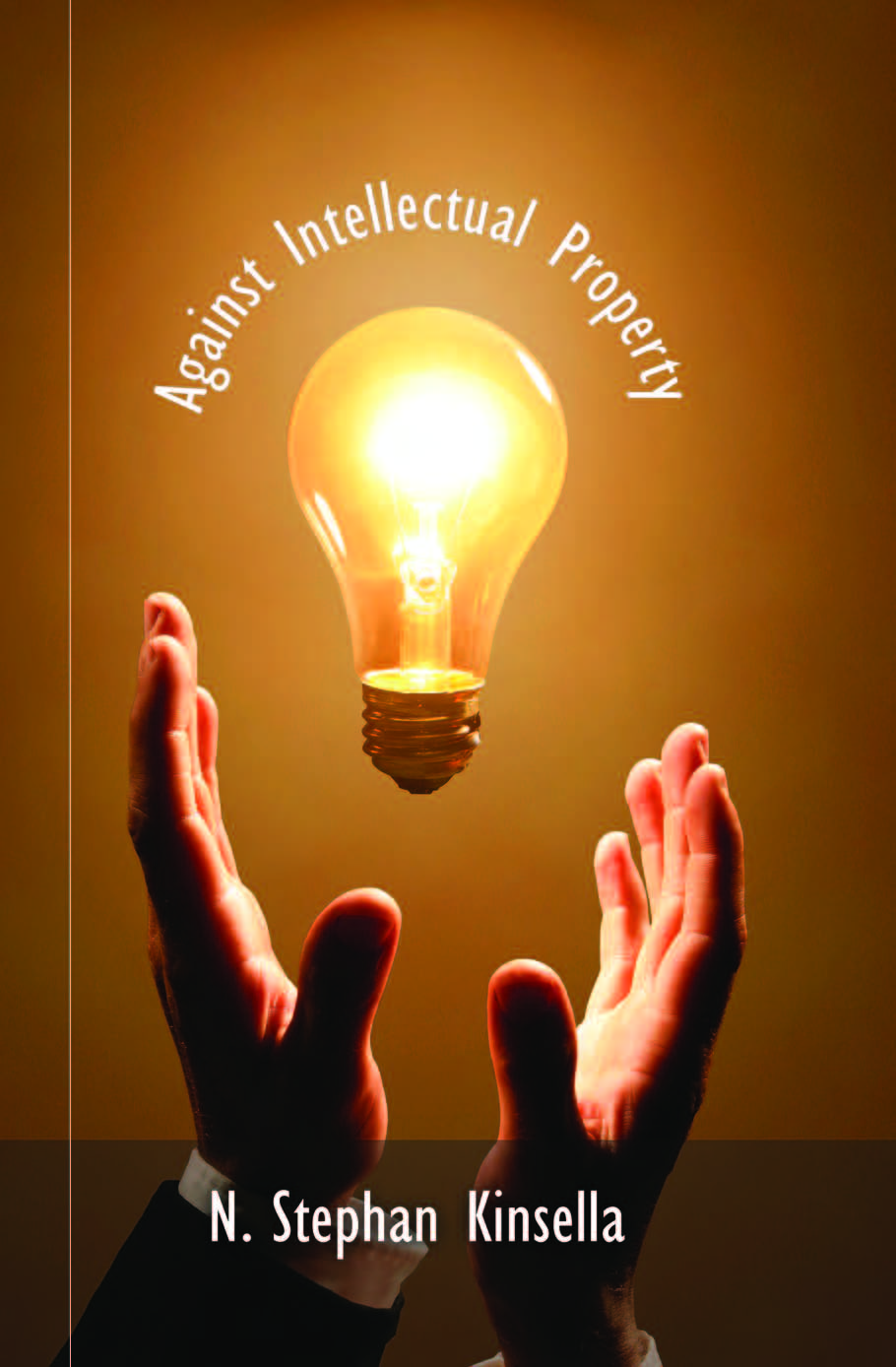
The same logic can be extended to patent and copyright more generally. As I have noted for years, digital technology, encryption, torrenting, and the internet have already made large-scale copyright enforcement against consumers nearly impossible. In “Against Intellectual Property After Twenty Years: Looking Back and Looking Forward” I observed that “piracy of copyrighted works is already rampant due to the Internet and encryption.” In the 2021 interview “KOL346 | Copyright and Satoshi’s Legacy” I noted that “because of the advent of encryption and torrenting and the internet and digital technology… basically copyright on a consumer level is almost a dead letter.” The same hope applies to patents once 3D printing and related fabrication technologies mature: “they can download an encrypted file for any object… and… print a device that’s patented.” See also “Gary North on the 3D Printing Threat to Patent Law,” “Patents Kill Update: Volunteers 3D-Print Unobtainable $11,000 Valve For $1,” the October 2026 discussion “KOL502 | Abolish Intellectual Property?,” “Phillips: Has AI Already Ended Intellectual Property?,” and the 2025 APEE remarks in “KOL458 | Patent and Copyright versus Innovation, Competition, and Property Rights.”
Recent developments only accelerate the trend. As noted in “Every app on Earth is now open source… whether it likes it or not,” reverse-engineering tools and AI-assisted decompilation are making proprietary software increasingly transparent and replicable. Encryption, secure file sharing, and decentralized fabrication do the same for copyrighted works and patented devices.










 Alessandro Fusillo
 Andreas Tögel
 David Dürr
 Doug French
 Fernando Chiocca
 Greg Morin
 Hans-Hermann Hoppe
 Jay Baykal
 Jayant Bhandari
 Jeff Deist
 Jeffrey Barr
 Juan Fernando Carpio
 Ken Yamarashi
 León Isidoro
 Martin Cabrera
 Nick Hoppe
 Oscar Grau
 Peter Wong
 PFS
 scholarium
 Saifedean Ammous
 Sean Gabb
 Sean Ring
 Stephan Kinsella
 Stéphane Geyres
 Thomas Jacob
 Tom DiLorenzo

Follow Us!