Hans-Hermann Hoppe, “My Discovery of Human Action and of Mises as a Philosopher,” Property and Freedom Journal (July 27, 2026); also in The Influence and Significance of Human Action After 75 Years, Joseph T. Salerno, ed. (Auburn, Ala.: Mises Institute, 2025), presented at the Human Action Conference, Ludwig von Mises Institute, Auburn, AL, May 16, 2024. Now finally available online. Who knows when Hoppe’s “On War, Democratic Peace, and Reeducation: The “German Experience” in Reactionary Perspective” will ever be published (it was supposed to be forthcoming in a book based on the Mises Institute’s Revisionist History of War Conference, May 15, 2025—May 17, 2025).
Related
- The Influence and Significance of Human Action After 75 Years Finally in Print
- Hoppe, “My Discovery of Human Action and of Mises as a Philosopher,” HansHoppe.com (June 6, 2024)
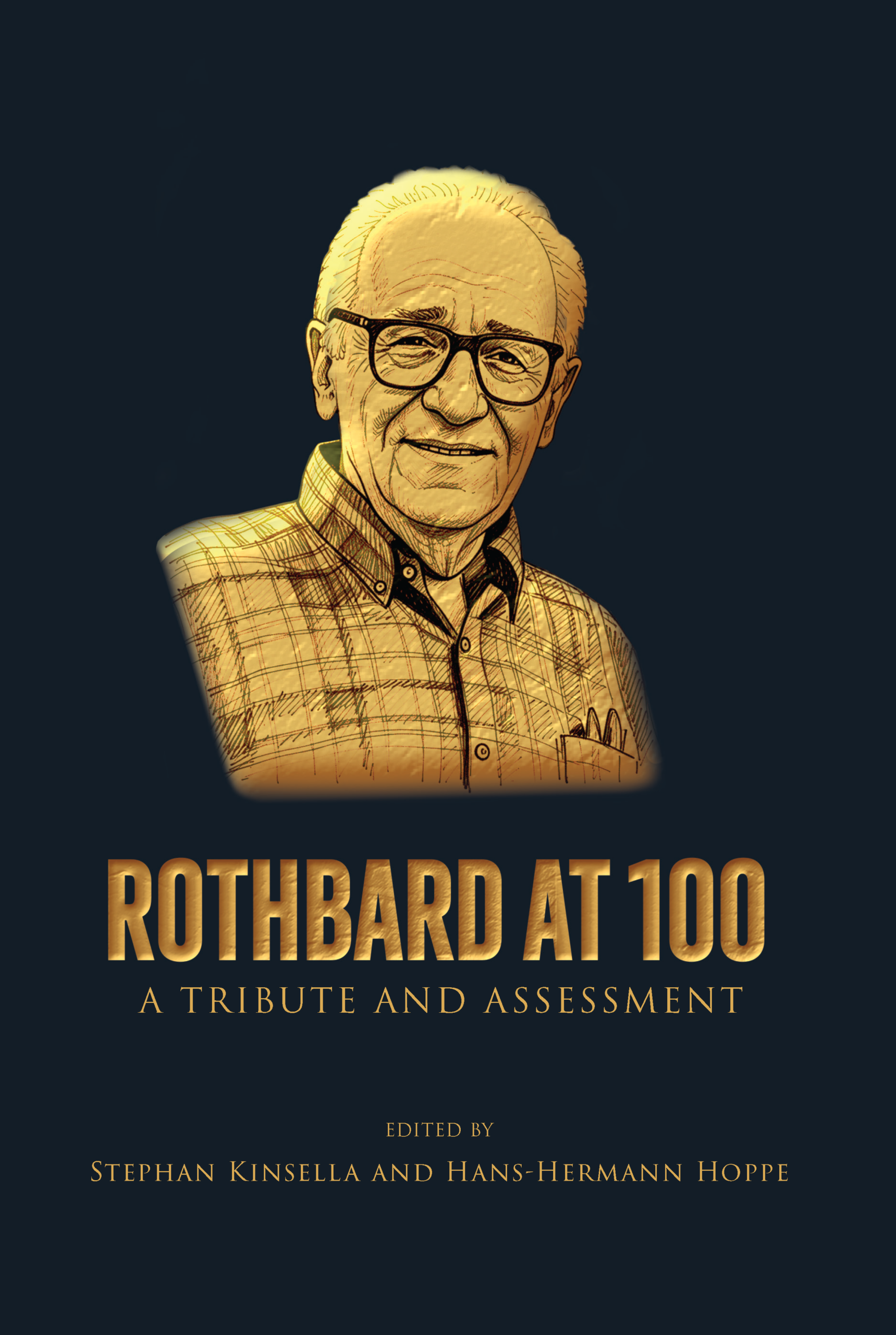
- Stephan Kinsella, “Preface” and “Mises, Rothbard, Hoppe: An Indispensable Framework,” in Rothbard at 100: A Tribute and Assessment, Stephan Kinsella and Hans-Hermann Hoppe, eds. (Papinian Press and The Saif House, 2026): “I almost wish Hoppe had not discovered Mises until later in his own path to discovering economic science, to see how his own version of praxeology might have developed.”
- “Essentially, economic analysis consists of: (1) an understanding of the categories of action and an understanding of the meaning of a change in values, costs, technological knowledge, etc.; (2) a description of a situation in which these categories assume concrete meaning, where definite people are identified as actors with definite objects specified as their means of action, with definite goals identified as values and definite things specified as costs; and (3) a deduction of the consequences that result from the performance of some specified action in this situation, or of the consequences that result for an actor if this situation is changed in a specified way. And this deduction must yield a priori-valid conclusions, provided there is no flaw in the very process of deduction and the situation and the change introduced into it being given, and a priori—valid conclusions about reality if the situation and situation-change, as described, can themselves be identified as real, because then their validity would ultimately go back to the indisputable validity of the categories of action.” –Hoppe, TSC p. 142
- Kinsella, Verstehen and the Role of Economics in Forecasting, or: If You’re so Rich, Why Aren’t You Smart? (Sep. 1, 2009)
- Ayn Rand to Mises: “You are treating me like a poor, ignorant little Jewish girl!” (July 22, 2026)
- Hoppe: “Among some followers of Austrianism, the Kant interpretation of Ayn Rand (see, for instance, her Introduction to Objectivist Epistemology [1979]; or For the New Intellectual [1961]) enjoys great popularity. Her interpretation, replete with sweeping denunciatory pronouncements, however, is characterized by a complete absence of any interpretive documentation whatsoever. On Rand’s arrogant ignorance regarding Kant, see B. Goldberg, “Ayn Rand’s ‘For the New Intellectual,’” New Individualist Rev., vol. 1, no. 3 (1961).”1
- Kinsella, Mises and Rand (and Rothbard) (Feb. 4, 2005)
- Rothbard, My Break With Branden and the Rand Cult (Liberty, September 1989)
- Habermas, Hoppe’s Teacher and PhD Advisor, dies at 96
- On scientism and empiricism, see Murray N. Rothbard, “The Mantle of Science” in Economic Controversies (Auburn, Ala: Mises Institute, 2011), and Hans-Hermann Hoppe, “In Defense of Extreme Rationalism,” in The Great Fiction: Property, Economy, Society, and the Politics of Decline, Second Expanded Edition (Auburn, Ala.: Mises Institute, 2021). On epistemological dualism, see Ludwig von Mises, The Ultimate Foundation of Economic Science: An Essay on Method (Princeton, N.J.: D. Van Nostrand Company, Inc., 1962); idem, Epistemological Problems of Economics, 3d ed., George Reisman, trans. (Auburn, Ala.: Mises Institute, 2003); Hans-Hermann Hoppe, Economic Science and the Austrian Method (Auburn, Ala.: Mises Institute, 1995); Hoppe, “On Certainty and Uncertainty, Or: How Rational Can Our Expectations Be?”, in The Great Fiction.
- On the Frankfurt school: My Path to the Austrian School of Economics; Habermas, Hoppe’s Teacher and PhD Advisor, dies at 96; On War, Democratic Peace, and Reeducation: The “German Experience” in Reactionary Perspective; Tom Woods Elite Letter: The Hans Hoppe Interview (2025)
- On Hume: The Amazing Hume, Libertarian Standard (May 30, 2012)
- On Hayek vs. Mises:
- Knowledge: Rothbard: “the entire Hayekian emphasis on ‘knowledge’ is misplaced and misconceived.” See Hoppe’s and others’ related critiques in Kinsella, “Mises, Rothbard, Hoppe: An Indispensable Framework,” in Rothbard at 100: A Tribute and Assessment, Stephan Kinsella and Hans-Hermann Hoppe, eds. (Papinian Press and The Saif House, 2026).
- Apriorism: “In a letter on May 15, 1983, to Terence Hutchison, Friedrich August von Hayek wrote literally:
I had never accepted Mises’s a priorism. … 1936 was the time when I first saw my distinctive approach in full clarity—but at the time I felt … that I was merely at last able to say clearly what I had always believed—and to explain gently to Mises why I could not ACCEPT HIS A PRIORISM. Curiously enough. Mises, who was so sensitive to criticism from younger men, praised that article without seeming to be fully aware how much it was in conflict with his views.” 2
- On Peter Janich: Handwerk und Mundwerk: Über das Herstellen von Wissen, Protophysics of Time, What Is Information?, Euclid’s Heritage: Is Space Three-Dimensional?; and references/discussion in Hoppe on Falsificationism, Empiricism, and Apriorism and Protophysics; Kinsella, A Visit with Hoppe: Touch, Janich, AI, Being Interviewed, Bankruptcy, Money and Demonstrated Preference;
- Hans-Hermann Hoppe, Praxeology and Economic Science (1988), later included in idem, Economic Science and the Austrian Method (Auburn, Ala.: Mises Institute, 1995), at 45 n.14. See also Stephan Kinsella, “The Undeniable Morality of Capitalism,” in Legal Foundations of a Free Society (Houston, Texas: Papinian Press, 2023), p. 604. [↩]
- Thorsten Polleit, “Thank you, Murray Rothbard, For Your Extreme ‘Defense of Extreme Apriorism’” in Rothbard at 100, n. 29 [↩]
Discover more from The Property and Freedom Society
Subscribe to get the latest posts sent to your email.


















 Alessandro Fusillo
 Andreas Tögel
 David Dürr
 Doug French
 Fernando Chiocca
 Greg Morin
 Hans-Hermann Hoppe
 Jay Baykal
 Jayant Bhandari
 Jeff Deist
 Jeffrey Barr
 Juan Fernando Carpio
 Ken Yamarashi
 León Isidoro
 Martin Cabrera
 Nick Hoppe
 Oscar Grau
 Peter Wong
 PFS
PFS scholarium
 Saifedean Ammous
 Sean Gabb
 Sean Ring
 Stephan Kinsella
 Stéphane Geyres
 Thomas Jacob
 Tom DiLorenzo