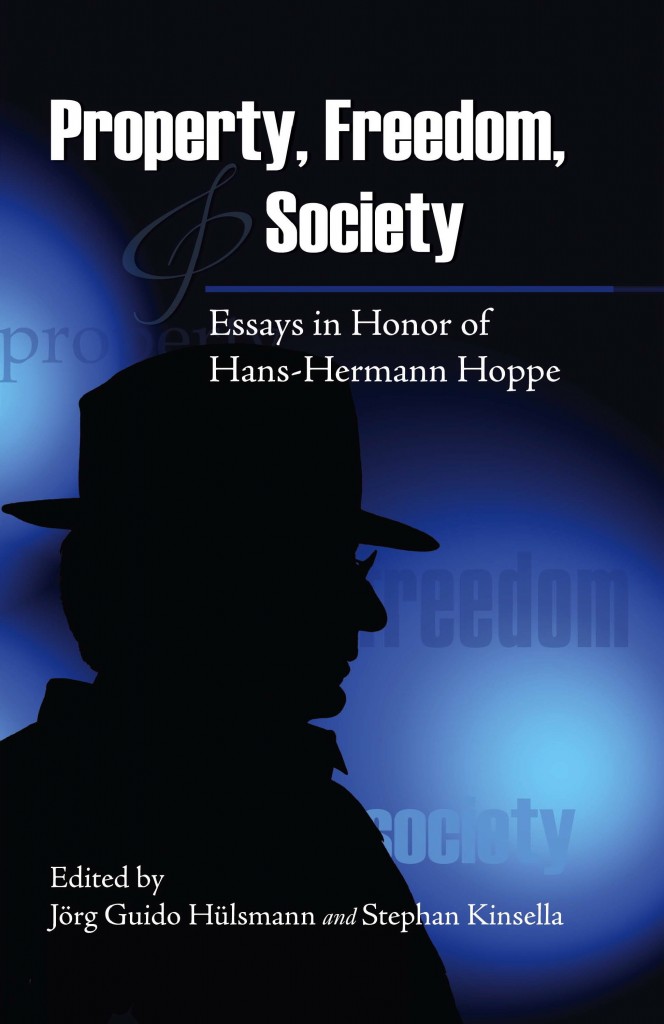
 In 2009, the Mises Institute published Property, Freedom, and Society: Essays in Honor of Hans-Hermann Hoppe, a project Guido Hülsmann and and Stephan Kinsella spearheaded to honor Hans Hoppe on the occasion of his 60th birthday. Only a few of the pieces were published independently; we are posting some of them here in this Bookstream.
The first entry was republished at Property, Freedom, and Society Bookstream: Introduction, Hülsmann and Kinsella. Links to the remaining chapters may be found at the book’s landing page here, which will be updated as the book is streamed here.
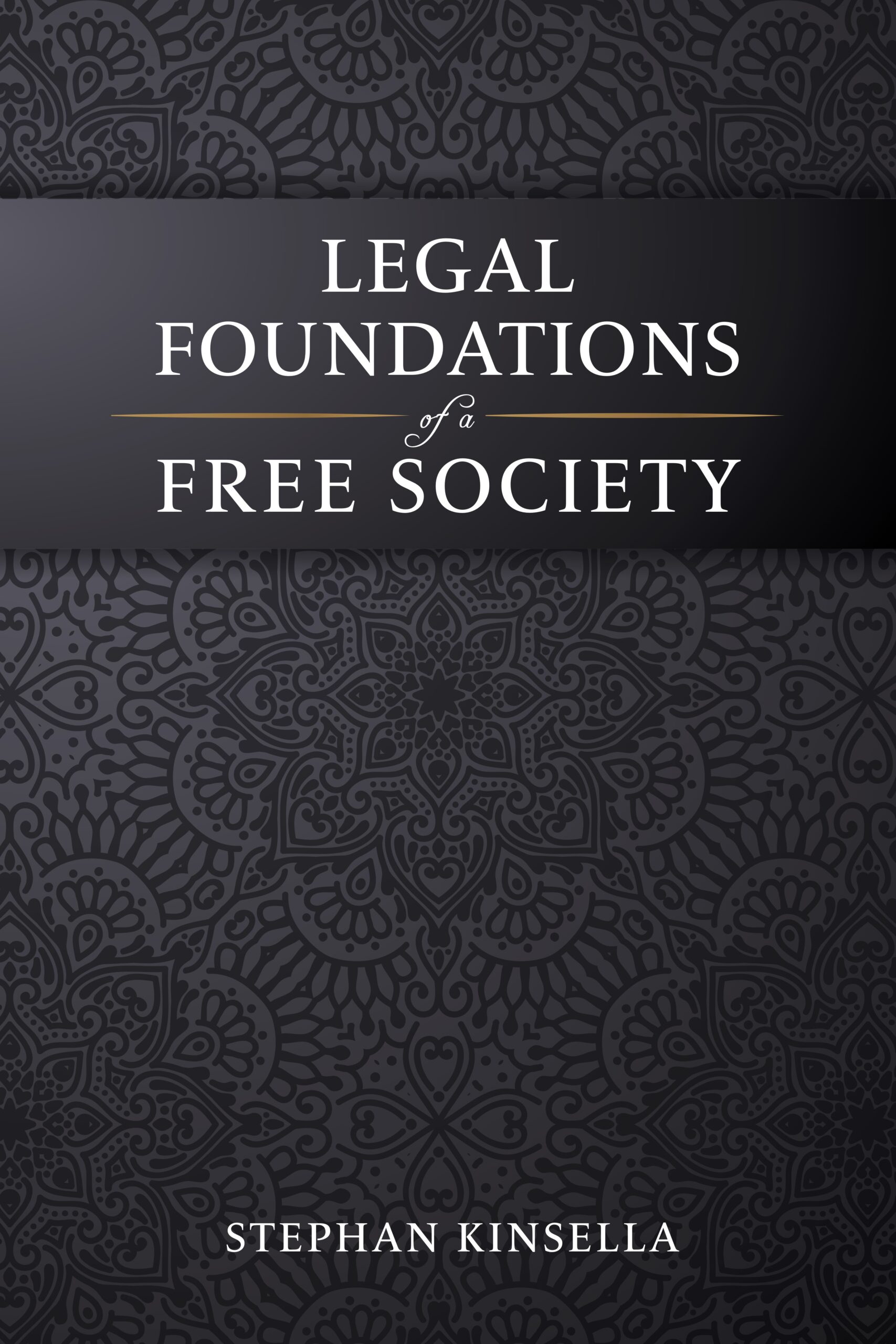
The next entry is What Libertarianism Is – Stephan Kinsella. It was also published as “What Libertarianism Is,” Mises Daily (August 21, 2009), and as “What Libertarianism Is,” LewRockwell.com (Aug. 24, 2009) (audio); also translated into several other languages. Additional commentary and related resources are available here. The version below is the updated version that appeared as chapter 2 in Legal Foundations of a Free Society (Houston, Texas: Papinian Press, 2023).
20
What Libertarianism Is
Stephan Kinsella*
L ibertarians tend to agree on a wide array of policies and principles. Nonetheless it is not easy to find consensus on what libertarianism’s defining characteristic is, or on what distinguishes it from other political theories and systems.
Various formulations abound. It is said that libertarianism is about: individual rights; property rights;[1] the free market; capitalism; justice; the nonaggression principle. Not all these will do, however. Capitalism and the free market describe the catallactic conditions that arise or are permitted in a libertarian society, but do not encompass other aspects of libertarianism. And individual rights, justice, and aggression collapse into property rights. As Murray Rothbard explained, individual rights are property rights.[2] And justice is just giving someone his due—which, again, depends on what his rights are.[3]
The nonaggression principle is also dependent on property rights, since what aggression is depends on what our (property) rights are. If you hit me, it is aggression because I have a property right in my body. If I take from you the apple you possess, this is trespass, aggression, only because you own the apple. One cannot identify an act of aggression without implicitly assigning a corresponding property right to the victim.[4]
So, as descriptive terms for our political philosophy, capitalism and the free market are too narrow, and justice, individual rights, and aggression all boil down to, or are defined in terms of, property rights.
Discover more from The Property and Freedom Society
Subscribe to get the latest posts sent to your email.











 Alessandro Fusillo
 Andreas Tögel
 David Dürr
 Doug French
 Fernando Chiocca
 Greg Morin
 Hans-Hermann Hoppe
 Jay Baykal
 Jayant Bhandari
 Jeff Deist
 Jeffrey Barr
 Juan Fernando Carpio
 Ken Yamarashi
 León Isidoro
 Martin Cabrera
 Nick Hoppe
 Oscar Grau
 Peter Wong
 PFS
PFS scholarium
 Saifedean Ammous
 Sean Gabb
 Sean Ring
 Stephan Kinsella
 Stéphane Geyres
 Thomas Jacob
 Tom DiLorenzo