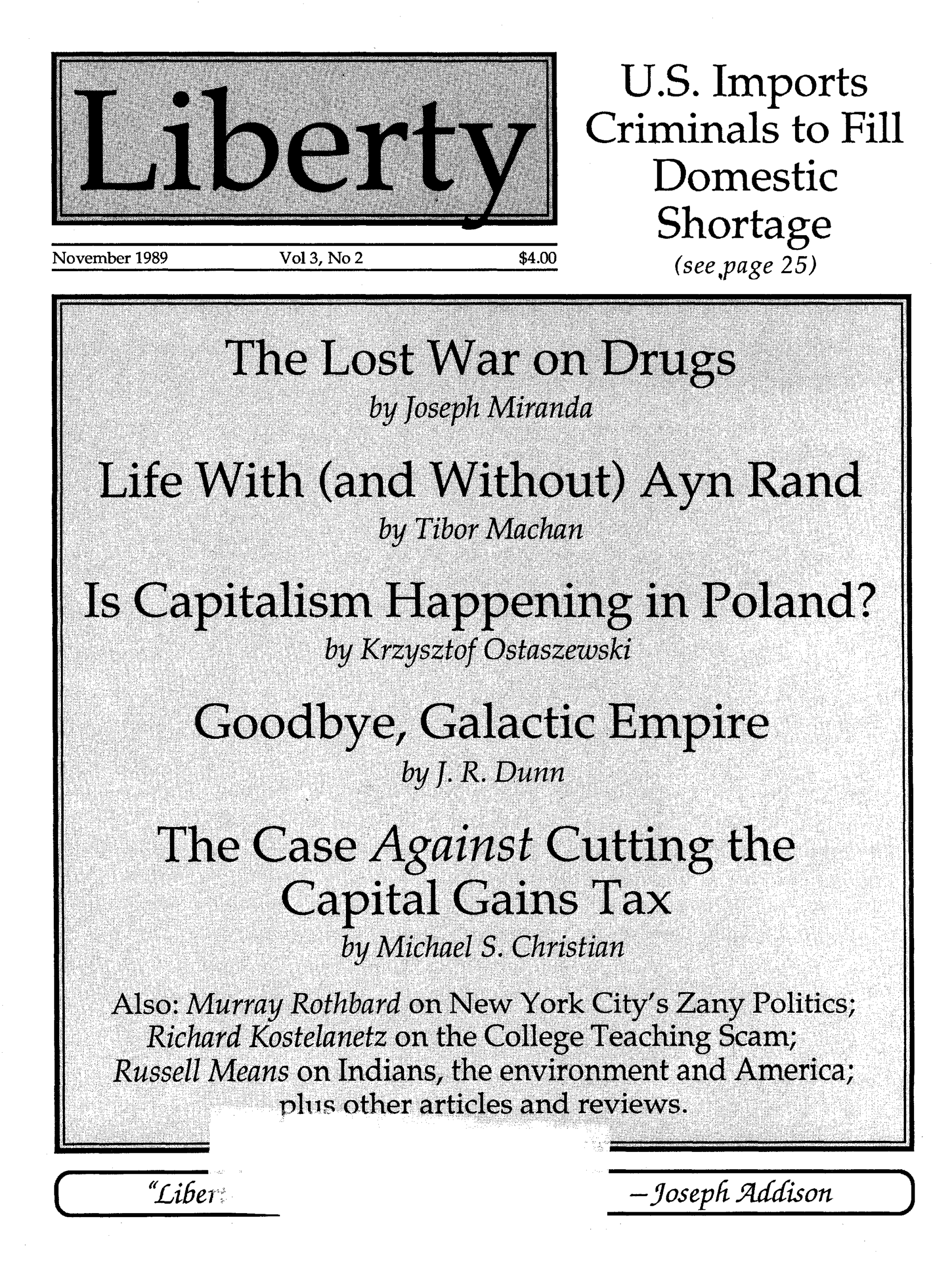
 From the vault: Murray N. Rothbard, “Loathing the Fear in New York, New York,” , Liberty (November, 1989): 29–32. And one Reflection: “Two cheers for Webster” (p. 7).
Also in this issue: Hoppe, “Intimidation by Argument—Once Again” (Nov. 1989; also in EEPP, Appendix).
“Two cheers for Webster” (p. 7): Grok summary:
Rothbard gives qualified support (“two cheers”) to the Supreme Court’s Webster decision. He argues it largely preserves the core right to abortion choice established in Roe v. Wade, making only a marginal restriction: states may require viability testing earlier in the second trimester (up to about the 20th week). He notes this limit already existed in Roe itself, which never recognized an absolute right of privacy or bodily self-ownership across all trimesters—only in the first, after which “state interest” could regulate or ban abortion.
What most outraged pro-choice advocates, he says, was Webster’s permission for states to end their own public funding of abortions. Rothbard sees this as a clear libertarian win. Freedom to choose does not entail a right to force taxpayers to pay for the choice. Most pro-choicers (as left-liberals) confuse the two, while libertarians do not. He hopes all governments will stop using tax money or facilities for abortions, both on general anti-statist grounds (oppose taxpayer funding of any medical procedure) and on the specific ground that it is especially unjust to compel people who sincerely believe abortion is murder to subsidize it.
He dismisses the standard equity argument for public funding (“poor women can’t afford private abortions”) as the usual left-liberal rationale that ultimately justifies total egalitarianism or socialism for any good or service.
Though he finds both pro-life and pro-choice camps philosophically off-base, Rothbard welcomes the political polarization Webster produced: it forces politicians—who normally evade principles—to confront principled single-issue voters on both sides. Finally, he proposes a coherent libertarian position that could serve as a political compromise: absolute free choice for every woman, but zero taxpayer support for abortion. He suggests this principled stance might even prove the pragmatic outcome of political give-and-take.
***
Politics
Loathing the Fear in New York, New York
by Murray N. Rothbard
Corruption, greed, lies, mudslinging, racism, the threat of success, the fear of failure–in other words: politics as usual in the America’s Metropolis.
One of the joys of spending summers in New York is being plunged once again into the glorious if fetid pool of New York City politics. This year’s melee is particularly juicy, since the mayoralty race is for once not cut and dried. Three-term mayor Ed Koch, a centrist Democrat, was no longer invincible, since his last term was shot through with a remarkable, pervasive scandal of corruption and sleaze. The scandal was touched off by the dramatic suicide of near-indicted Don Manes, long-time pal of Koch and head of the Queens Democracy. A large number of top New York Democrats eventually wound up in jail. Koch’s standing was plunged even lower in last year’s presidential campaign, because of his hysterical tirade against Jesse Jackson, which embarrassed even his staunchest supporters.
Koch began this summer’s campaign almost invisible at the polls, but the old campaigner, always effective in TV comments and debates, managed a remarkable comeback; by mid-August he was tied for first in the polls for the September 12 Democratic primary. Koch’s comeback was no great surprise; for many years, he has been ”Mr. New York,” in whom New Yorkers see themselves, their friends and neighbors writ large. Narcissistic to the point of egomania, New York accent to the hilt, by turns whiny, nasty, witty, cranky, and hypochondriacal, and always larger-than-life, Koch can be relied on to put on a good show. In campaigns he rises to his best, fighting for the political post that has come to define his very life. Indeed, Ed Koch is the last of the great Jewish tummlers who, in the early days of Borscht Belt resort hotels (before they swelled to giant palaces), were hired as permanent entertainers to play pinochle with the guests by the pool, crack jokes, insult the customers, and generally fill in the time entertainingly until the next gigantic meal.
But why did New Yorkers warm to Koch despite the corruption of his reign and the continuing rapid and grisly decline in the city’s quality of life? Because New Yorkers, quite properly, realize in their heart that none of the other clowns in the race would make any difference, so if you’re going down the tubes anyway you may as well have fun along the way.
The only thing that would help New York now is radical surgery, and none of the candidates are prepared to do much of anything. The city is overwhelmed not only by violent crime, but more so by the new plague of aggressive “bums,” as New Yorkers are wont to call them, and to hell with the official designation of “the homeless.” Plus the fact that the city’s “infrastructure”—its filthy and pitted streets, worst in the country; its horrific subways; its deteriorating housing stock, punctuated by grand new, expensive and subsidized buildings; its crumbling bridges and highways—is falling apart. At least, New Yorkers feel, Koch will talk tough even if there is no action.
Ed Koch is the last of the great tummlers who, in the early days of Borscht Belt resort hotels were hired as permanent entertainers to play pinochle with the guests by the pool, crack jokes, insult the customers, and generally fill in the time entertainingly until the next gigantic meal.
Neck and neck with Koch, and clear front-runner until August, was David Dinkins, Borough President of Manhattan, and the black candidate. Dinkins is the only type of black candidate who could ever possibly win as Mayor. Not “conservative”—his views are the usual left-liberal claptrap, akin to Jesse Jackson’s. No—it’s his style that sets him off dramatically from Jesse. For Dinkins is soft-spoken, elderly, courteous, even elegant, the opposite of charismatic—in personality very much akin to the Pullman porter of days gone by. In brief: unthreatening. For the unpublicized but vital fact about New York is the tremendous rage and hatred felt by the whites against the black population. And that means virtually all whites—including what used to be the last bastion of pro-black sentiment in New York: liberal Jewish intellectuals, who are mainly clustered in the West Side of Manhattan. (A straw in the wind: an old friend of mine, a distinguished Marxist academic who is the diametric opposite of anyone who could be considered a “redneck.” Recently one of the seemingly endless series of governmental commissions studying the state of blacks in New York City issued the usual kind of report: calling for more welfare, more teachers, more social workers—the usual left-liberal litany of demands on taxpayer money, to solve the black problem. The response of our Marxist academic: “The only solution to the black problem is to lock up all male black teenagers until they’re thirty.”)
Dinkins is the only type of black candidate who could ever possibly win as Mayor-soft-spoken, elderly, courteous, even elegant, the opposite of charismatic—in personality very much akin to the Pullman porter of days gone by. In brief: unthreatening.
Jesse, in short, could not get a white vote in New York if he tried. (Koch’s attack on Jesse was considered too frenetic as well as—wonder of wonders!—too blatantly oriented toward Israel.) But Dinkins can, and did end up winning the primary. He was assured not only the entire black vote, but also that of Jewish liberals, including most of the union leadership in New York City.
The other two Democratic candidates were, despite their best efforts, so far behind as to be totally out of it. The best they hoped to do was to throw the primary into a runoff. Harrison Goldin, the bald-headed longtime Comptroller of New York, is a bitter enemy of Koch, and once in a while has some tough things to say about crime and the homeless. Richard Ravitch, the independently wealthy former head of the disastrous Metropolitan Transit Authority (an “independent” governmental authority that is responsible for the subways and bridges), never made it out of last place. He’s got two problems. First, Ravitch has to explain why he spent several years as a lapdog of Koch in city government, and why he is not almost as responsible as the Mayor for the sad state of city transportation. Second, his voice is slow and gravelly. Gravelly, of course, is OK—indeed is in the great Northeast urban tradition, popularized by Marlon Brando in The Godfather (Hey, do these guys go to school to learn how to talk gravelly?) But slow is bad, since the New Yorker is deeply convinced that slow speech means a slow mind. (One of the fun demonstrations of this truth came in the classic Cuomo v. Lehrman campaign for governor in which Mario made his blazing entry into national politics. At one point, Lehrman unwisely denounced Cuomo as “a fast-talking lawyer.” Cuomo’s witty riposte won the hearts of New Yorkers: “All right, from now on, I’ll talk v-e-r-y s-l-o-w-1-y so that he will be able to understand.”)
The non-New Yorker might well ask why it is that, aside from Dinkins, the other three mayoral candidates among the Democrats were all Jewish. The answer is that New York politics is almost all ethnic. What is hard for heartland Americans to realize is that WASPs in New York City are virtually non-existent, except for Park Avenue corpo-rate and Rockefeller types. Most New Yorkers view WASPs as a small group of wealthy Park Avenue residents who go to Choate and Yale or Harvard. And, indeed, virtually the only middle-class or working-class WASPs reside in small pockets in the outer boroughs, far from the subway lines that are the city’s communication and transportation hub: in obscure places like Ridgewood, on the border of Brooklyn and Queens, popu-lated by German Lutherans; and a few WASPS in Woodlawn, in extreme north-ern Bronx hugging the Westchester County border.
The New Yorker is deeply convinced that slow speech means a slow mind. At one point in the classic Cuomo v. Lehrman campaign for governor, Lehrman denounced Cuomo as “a fast-talking lawyer.” Cuomo’s riposte won the hearts of New Yorkers: “All right, from now on, I’ll talk v-e-r-y s-l-o-w-l-y so that he will be able to understand.”
It will have become evident to the reader that, with WASPs almost non-existent, this leaves very little room for the Republican party; indeed, there are usually only one or two Republicans elected to the City Council—hailing from Italian enclaves in Brooklyn or Staten Island. Furthermore, within the Democratic Party, Jews are disproportionately powerful, because the Jewish turnout rate, for primaries as well as general elections, is traditionally very high, whereas the black and Hispanic turnout rate, especially for primaries, is very low. What of the Hispanics? Aside from their low turnout, the Hispanic vote is an enigma, since there has long been political hostility in New York between the blacks and Hispanics—sparked a few years ago when the blacks refused to support the mayoral race of the Puerto Ricans’ beloved leader, Herman Badillo.
The race is further complicated this year by a Republican resurgence, or rather by the mayoral race of the young ltalo-American Savanarola, former Federal Attorney Rudolph Giuliani, the conductor of the reign of terror against insider trading on Wall Street. Since Republicans cannot win on their own in the city, the politically ambitious Giuliani, who proved a master of publicity when he was Federal Attorney, set out to conduct a “fusion” race of all anti-Democrat forces in the style of the much-beloved, clownish Halo-American leftist, Fiorello (“Little Flower”) LaGuardia, who ran a Republican-“Fusion” ticket. Giuliani tried to put together a Republican-Liberal-Conservative coalition, but it proved ideologically impossible for Conservatives and Liberals to support the same candidate (even in this age of bland compromise). So Giuliani is running as a “Republican-Liberal” tough on crime as befits an allegedly heroic prosecutor, but left-liberal on all other issues.
New York is the only state where Conservative and Liberal parties have managed to exist as independent, continuing entities. The Conservative Party was launched by Bill Buckley and associates to use as a hammer against Rockefeller Republicanism. Since the rise of Reaganism, the Conservative Party has been functioning as an appendage of Reagan Republicanism, with top officials getting cushy jobs in Republican Administrations.
But why a Liberal party in a city where almost everyone is liberal? The Liberal Party was born at the beginning of the Cold War, when the Communist-dominated American Labor Party (ALP) was a strong third force in New York politics, controlled largely by the then pro-Communist men’s clothing workers union (headed by Sidney Hillman). The Liberal Party was a split off from the ALP, engineered by the Social Democrat (Menshevik) oriented ladies garment workers’ union, controlled by David Dubinsky, and the hat workers union, headed by Alex Rose, who soon became the maximum leader and straw boss of the Liberals. The Liberals lingered on long past the demise of the ALP as a patronage force and another line on the ballot. Ethnically, the Liberals have been almost completely Jewish. Since the death of Rose, the Liberal Party has been controlled by a fat, cigar-chomping Boss in the old tradition, Raymond Harding, who made the deal with Giuliani to put him on the Liberal line.
The defeated anti-Harding faction of the Liberals, however, protested the choice of Giuliani, and decided to run the venerable Reverend Donald Harrington against Giuliani in the Liberal primary. Harrington, the leader of the Liberals before being ousted by Harding in a bitter struggle, is beloved as an old-time left-liberal activist organizer, and head of the Community Church in Manhattan. Harrington, a Unitarian minister, has also been valuable to the Liberals as one of the few authentic gentiles in the Party. Unfortunately, Harrington now lives in Long Island, outside the city limits. More important, since Harrington would undoubtedly have won a genuine Liberal primary and thus ruined Giuliani’ s fusion image, Harding was able to decree an “open” primary for the Liberals and make it stick in court, meaning that Republicans could invade the primary and vote for Giuliani. End of Harrington, and end of the Liberal primary.
The Giuliani candidacy was met with less than warmth by the most powerful Italian Republican politician in the state, Senator Alfonse D’ Amato, a product of the corrupt Republican machine in Nassau County on Long Island. Friction between them supposedly began when Giuliani, preparing his resignation as Federal Attorney, tried unsuccessfully to dictate the choice of his successor, thereby overriding the traditional de facto appointive power of the Republican Senator. There are murmurings, however, that D’Amato doesn’t want anyone challenging his high post as capo de tutti capi of Republican Italians in New York State.
Former Federal Attorney Rudolph Giuliani, the conductor of the reign of terror against insider trading on Wall Street, tried to put together a Republican-Liberal-Conservative coalition, but it proved ideologically impossible for Conservatives and Liberals to support the same candidate (even in this age of bland compromise). So Giuliani is running as a “Republican-Liberal”-tough on crime as befits an allegedly heroic prosecutor, but left-liberal on all other issues.
Lauder has a big problem, in addition to his initial lack of name recognition. Tall and gawky, he not only seems dumb (like the unfortunate Ravitch); he is dumb. His being Jewish scarcely helps him in a party almost devoid of Jews. Also, the Lauder cause has hardly been aided by the breaking of the Felix Bloch spy scandal, which occurred under Lauder’s nose when he was Ambassador to Austria. Lauder had no chance even to come close to Giuliani in the Republican primary, but still the Lauder forces, masterminded by D’Amato ally Art Finkelstein, have run a brilliant negative campaign, slamming hard again and again at Giuliani, and successfully destroying Giuliani’s shiny armor as the new White Knight of purity and integrity. Indeed, so negative has the Lauder campaign been that it was even too much for Roger Ailes, the famed architect of the Willie Horton campaign for the presidency. Originally hired as the No. 2 Man to Finkelstein, Ailes resigned, denouncing the Lauder campaign as too negative, and then shifting to work for the Giuliani forces.
The New York masses began the campaign in love with Giuliani, sure that he would end corruption and all the other problems of the city. But the Lauder campaign exposed Giuliani as just another waffling and confused liberal on all the controversial issues-and furthermore as someone who would be tough on victimless crime but no tougher than anyone else on real crime.
Rudolph Giuliani started the mayoral campaign far ahead of either Koch or Dinkins in the polls; as the primary approached he badly trailed both of them. The cause is the constant hammering by Lauder, aided by attacks from the other candidates, including the formidable Koch. The New York masses began the campaign in love with Giuliani, sure that he would end corruption and all the other problems of the city—precisely because they knew nothing about his stand on any of the issues. The Lauder campaign has exposed Giuliani as just another waffling and confused liberal on all the controversial issues—and furthermore as someone who would be tough on victimless crime but no tougher than anyone else on real crime. Also, various sleazy peccadilloes of Giuliani himself were uncovered.
Furthermore, under pressure Giuliani did not handle himself well. Used to the universal adulation of the media, a man armored in arrogance and self-righteousness, Giuliani clearly did not understand the political process. Hit by round after round of personal attacks, Giuliani was bewildered by the sudden demise of his love affair with the world and reacted bitterly and defensively at the enormity and grave sin of anyone daring to attack Saint Rudy. Giuliani also has a deep corollary problem with the Italian masses, who one might think would embrace him with enthusiasm. For while the great bulk of Italian-Americans hail from the Mezzogiorno (southern Italy and Sicily), and share the general love of life and enjoyment of that culture, Rudy Giuliani stems from northern Italy, and his grim, puritanical style and air of self-righteousness—the style of the hated northern occupiers and colonizers of the Mezzogiorno—scarcely wear well with the Italian masses of New York. The Italians do not find Giuliani simpatico, and so his popularity turned out to be only skin deep.
The unfortunate Italians of New York have had many crosses to bear in their long struggle to make it in politics. For many years, the Italians whom the Establishment (e.g. the New York Times) dubbed as wise Italian-American statesmen, were not considered by the masses as real Italians. Fiorello LaGuardia Was half-Jewish and an Episcopalian(!), Ferdinand Pecora was a northern Italian and an Episcopalian, Edward Corsi was an Episcopalian (these three must have constituted the entire congregation of Italian Episcopalians in the U.S!) and State Senator John Marchi is a dour northern Italian. Hence, the great importance of Cuomo and D’Amato (who, by the way, though of different parties are good friends): the first major Italian leaders from New York who are what their constituents think of as real Italians: Catholics from southern Italy.
Despite Koch’s final surge, David Dinkins won the September primary by nine percentage points (52 to 43), with the other two candidates scarcely registering in the race. An estimated 29 percent of whites voted for Dinkins (26 percent of Jews) while Dinkins corraled 93 percent of the black vote. Lauder got a surprising one-third of the Republican vote against Giuliani, about twice as much as expected.
The crucial question is whether Dinkins keeps the Jewish liberals happy until November. On primary night, he got off to a shaky start, as an overwhelmingly black Dinkins headquarters crowd cheered Jesse Jackson to the rafters while lustily booing Dinkins’ warm supporter State Attorney-General Robert Abrams (because of Abrams’ well-founded skepticism toward the trumped-up rape story of Tawana Brawley last summer) as well as booing Ed Koch’s uncharacteristically gracious concession speech. Dinkins acted quickly to cut off his troops. “No, no,” he wagged his finger sternly at his supporters. “We’re all together now. I’m the fella who’s going to bring everyone together, remember?” Whether or not New York suffers under a dour Torquemada for the next four years depends on the ability of the courtly Dinkins to tame his own militants. Look for lots of pictures coming out of New York with Dinkins going in and out of synagogues during the Jewish High Holy Days wearing the obligatory yarmulke.
Whether or not New York suffers under a dour Torquemada for the next four years depends on the ability of the courtly Dinkins to tame his own militants, aided by Lauder continuing to pour millions into his Conservative campaign. Look for lots of pictures coming out of New York with Dinkins going in and out of synagogues during the Jewish high holy days.
Discover more from The Property and Freedom Society
Subscribe to get the latest posts sent to your email.








 Alessandro Fusillo
 Andreas Tögel
 David Dürr
 Doug French
 Fernando Chiocca
 Greg Morin
 Hans-Hermann Hoppe
 Jay Baykal
 Jayant Bhandari
 Jeff Deist
 Jeffrey Barr
 Juan Fernando Carpio
 Ken Yamarashi
 León Isidoro
 Martin Cabrera
 Nick Hoppe
 Oscar Grau
 Peter Wong
 PFS
PFS scholarium
 Saifedean Ammous
 Sean Gabb
 Sean Ring
 Stephan Kinsella
 Stéphane Geyres
 Thomas Jacob
 Tom DiLorenzo