 Duncan Whitmore, “The Leftist Assault on Western Thought,” Libertarian Alliance (6 October, 2026)
Related
- The Genius of the West (Louis Rougier, 1971; abridged from Le Génie de l’Occident, 1969; introduction by F. A. Hayek) — a liberal account of the West as a cumulative mentality of intellectual courage, from Greek inquiry through Roman order, Christianity, the scientific revolution, and the market order.
- Ideas Have Consequences (Richard M. Weaver, 1948) — the modern collapse of objective value, traced from nominalism, as the intellectual source of Western cultural decay.
- The Closing of the American Mind (Allan Bloom, 1987) — the university’s relativist “openness” has closed students off from the great books and from any rational ground for moral and political judgment.
- Giants and Dwarfs (Allan Bloom, 1990) — essays, including his Harvard address on “Western Civ,” defending the canon against the claim that classic texts are only class, race, or gender prejudice.
- Paideia: The Ideals of Greek Culture (Werner Jaeger, 1933–47) — the classical statement of Greek education as the formation of the human type on which later Western high culture rests.
- Religion and the Rise of Western Culture (Christopher Dawson, 1950) — Gifford Lectures arguing that medieval Christianity, not material conditions alone, supplied the moral and institutional frame of Western civilization.
- The Revolt of the Masses (José Ortega y Gasset, 1930) — a defense of the minority culture of standards, science, and liberal institutions against mass man, who inherits the West’s benefits while rejecting the discipline that produced them.
- Notes Towards the Definition of Culture (T. S. Eliot, 1948) — culture as the incubation of a whole way of life (religion, class, region, the arts), not a programme that planners can redesign.
- The Abolition of Man (C. S. Lewis, 1943) — a short defense of the Tao, the shared moral wisdom of the high civilizations, against subjectivism that leaves man nothing to be loyal to but appetite and technique.
- Suicide of the West (James Burnham, 1964) — liberalism as the ideology of a contracting civilization: guilt, abstraction, and the loss of the will to defend the order it inherited.
- Eccentric Culture: A Theory of Western Civilization (Rémi Brague, 1992; English 2002) — the West as a “secondary” culture, Roman in structure, that knows its sources (Athens, Jerusalem) lie outside itself and therefore remains capable of return and self-critique.
- What Is the West? (Philippe Nemo, 2004; English 2006) — a compact synthesis: the Greek city and science, Roman law, biblical ethics, the papal revolution, and the liberal-democratic settlement as one cultural entity.
The Leftist Assault on Western Thought
Western civilisation may well have the strongest claim to being the greatest in the history of mankind. The West flourished not merely as one cultural arrangement among many – distinguished only by different customs, tastes, or historical accidents – but by developing institutions and habits of thought unusually well adapted to the permanent conditions of human existence: reason, individual moral agency, voluntary cooperation, limits upon political power, and a social order capable of sustaining trust and productive activity.
These principles are not “Western” because the laws of economics, physics, chemistry, biology or logic somehow change when one transits between Europe and Asia, but because Western civilisation developed and institutionalised them to an unusual degree. Other peoples can achieve the same benefits, but only by adopting methods sufficiently analogous to those that produced them in the West.
Seen in that light, the collapse of the Soviet Union in the early 1990s was not merely a geopolitical victory, but a particularly dramatic demonstration of the superiority of one set of ideas over another. A system built largely upon private ownership, decentralised exchange, individual agency, and relatively freer inquiry had vastly outperformed one organised around collective ownership, central direction, political conformity, and the subordination of truth to ideological necessity. One might reasonably have expected socialism, communism and leftism more generally to have therefore entered a period of terminal intellectual decline.
Fast forward nearly four decades, however, and nothing of the sort has happened. Western governments increasingly resemble watered-down, ever more centralised versions of their former adversaries, while leftism has reappeared in new forms: environmentalism, stakeholder capitalism, identity politics, cultural radicalism, and the expanding rule of managerial institutions.
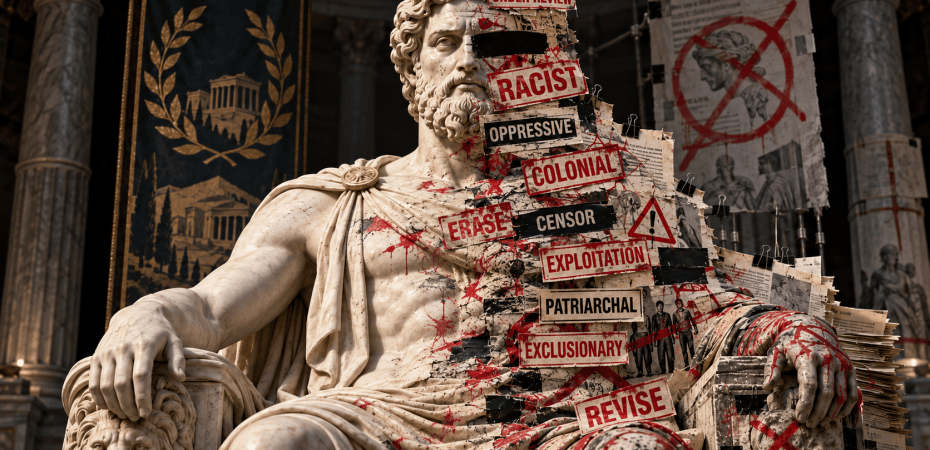
More strikingly, Western civilisation itself is now increasingly presented in influential academic, institutional, and cultural discourse not as the greatest example of human flourishing, but as an historical evil – a blemished chapter in the history book of mankind for which its heirs should apologise rather than feel gratitude. Its prosperity is attributed less (if at all) to ingenuity, saving, enterprise, scientific discovery, and social cooperation, and instead to slavery, colonisation, exploitation, and environmental destruction. Its institutions are described not as achievements but as mechanisms of exclusion. The family becomes patriarchy; private property becomes theft; markets become exploitation; science and reason become expressions of cultural dominance; inherited customs become prejudice; Christian ethics are discriminatory; and even biological distinctions are recast as oppressive constructions.[1]
To some extent, this is nothing new. Marxian theories of class consciousness and ideology, for instance, served partly to insulate socialist doctrine from the objections of science and objective reason. In other words, an argument could be dismissed not because it was false, but because it expressed the outlook of a particular class.[2] But it is difficult to deny the amplification today. Everywhere one turns, the message is much the same: the West did not build, discover, create or liberate; it conquered, stole, excluded and oppressed. Its monuments must be reassessed, its heroes disgraced, its history rewritten, and its descendants taught not to celebrate their inheritance but to bear a yoke of shame. This is more than a disagreement over particular policies or episodes of history, but amounts to a sustained assault upon the intellectual and moral foundations of Western civilisation itself.
Ideas vs. Culture
Whereas the Cold War was primarily characterised as a struggle between competing economic ideologies, it is tempting to see this present assault on the West as being rooted in culture. Undeniably the estrangement between rulers and ruled has acquired a distinctly cultural character, for the priorities of the former seem alien: transferring authority to remote global institutions, treating borders as embarrassing inconveniences, recasting patriotism and inherited faith as suspect, celebrating abstract commitments to the “international community,” and subjecting domestic populations to an endless diet of managerial slogans about diversity, inclusion, sustainability, and progress while roads deteriorate, schools decline, and local communities fray. The sense is not merely that government is incompetent, but that the people exercising power inhabit a different moral world.
Much of this hostility to Western civilisation has been transmitted through the leftist “march through the institutions” – a strategy that drew upon Antonio Gramsci’s conception of cultural hegemony, with the wider intellectual assault on Western culture reinforced by strands of critical theory associated with the Frankfurt School. This process has been decades in the making, but its cultural consequences have only more recently become the principal arena in which many of today’s battles are fought. On the right, theory appears to have lost much of its force as a motivational driver. Anyone still chanting “End the Fed” or droning on about property rights risks sounding like an autistic relic trapped in a Ron Paul 2008 time loop. Today, political attraction has become less a matter of philosophical coherence than recognition. An alternative need not possess a perfectly worked-out theory of money, property or constitutional order; it need only appear to understand what people value, speak without embarrassment about loyalty, continuity, nation, family and place, while treating the inherited culture as something worth preserving rather than overcoming. That alone has made outsiders – such as Donald Trump in America, Reform UK in Britain, and the AfD in Germany – not merely viable but magnetically so, even if they appear shambolic. Indeed, disorder itself can become attractive when it appears as the opposite of scripted managerialism.[3]
On the one hand, libertarians have not, and should not have, ignored the importance of this.[4] As I’ve argued a number of times on this blog, the fight for liberty is unlikely to be manifest as a universalist movement across the world. A sudden, global vanquishing of statism to create some kind of “lib-topia” is, in the words of Joseph R Peden, an “adolescent fantasy” ignorant of “the complexities of social reality.”[5]
One such complexity is that individuals, communities, and peoples will not suddenly band together from their disparate corners of the globe, but will, instead, seek political change from specific oppressors for specific grievances in order to establish a specific alternative at a specific time in a specific place. Sometimes this motivation will be economic or material; sometimes it will be anti-colonial; sometimes it may be to preserve a religious tradition, a linguistic identity, or a cultural way of life under threat. Liberty is not pursued in the abstract but is fought for a concrete goal, when the costs of submission outweigh the risks of resistance. People don’t necessarily mobilise just because they’ve garnered some philosophy; they rise up because they can’t afford bread, because their customs are criminalised, or because their children are being conscripted into someone else’s war.
A corollary of this is that such movements are always likely to be “imperfect” from the point of view of textbook philosophy – or, in some cases, even antithetical to liberty in a theoretical sense. The American colonists sought freedom from British rule, but they differed sharply over the degree of power and centralisation their new government should have. The Paris Commune of 1871 was a local revolt against the French Third Republic, but it was socialistic and “destructionist”, burning the Tuileries Palace to the ground as a symbol of ridding Paris of its inherited monuments. In our own times, Brexit was motivated by the desire for the British people to “take back control”, but the infamous speculation that “£350 million a week” of Britain’s EU funding could be diverted to the NHS is scarcely something a libertarian would champion.
In short, while liberalisation is the goal, it is not necessarily the rationalisation or the motivation, nor is it pursued to anything approaching a level of consistency. In fact, most of the time, people aren’t even squabbling about power itself – just over who should be in charge and the precise plan they follow. The difficulty for libertarians, therefore, is determining whether such movements strive not for a final decimation of statism, but whether their goals are likely to constitute an improvement upon the status quo.
On the other hand, however, such shortcomings are the reason why our support for these movements – and our use of their terms and dialogue – should be transient and temporary; for there will come a point when those shortcomings will themselves begin to constitute the new threat. To date, global statism – manifest in a number of different ways but felt especially keenly through the cultural disconnect – has indeed, been that graver threat, and, in many ways, still is. As such, in our strive for “better” over “worse”, promoting, say, national statism has made sense, as has doing so in its cultural terms. But it would be a mistake to conclude that the present importance of cultural primacy has permanently displaced the need for adherence to sound, underlying ideas.
I first started to detect a modicum of failure in this regard in the late 2010s, culminating in my response to a now deleted article penned by a self-described post-libertarian conservative wailing about the shortcomings of “abstract” libertarian theory – the implication being that his enlightened emphasis on family, culture, custom and tradition was the real deal for political change, compared to the output of theorists like myself squabbling over the “mere” matter of property rights.
Although this kind of smug, sneering ignorance is far from uniform, elevating this author’s attitude into a level of permanence and priority could result in us sleepwalking into the assumption that nation- or cultural-centric thinking is all that matters to both preserve liberty and to reverse the erosion of Western civilisation. Extrapolated to national economic policies, the upshot of such thinking would be that production, investment and prosperity can be forced centrally into lines that are important for “the country” so long as the guy with the clipboard believes in grit and nationhood. After laying waste to parasitic elites, cartelised capital, and hollowed-out national autonomy, the vision for the future could easily become: “We hate drag queen story hour too, so we’ll run the state better.”
There is only so far this cultural diagnosis can take us before it begins to obscure the underlying causes. Economic socialism failed in large part not because bosses and workers were merely held together by a common culture, but because the notion of class antagonism on which it rested was itself false. Employer and worker, producer and consumer, capitalist and labourer were not locked in an intrinsically hostile relationship, but joined through exchange in a reciprocal division of labour from which each expected to benefit. Their shared cultural order emerged from that cooperation and was therefore not the source of the underlying economic relations, but one of their expressions.
It is not, therefore, the case that the left could simply “shift” its attention to culture through the aforementioned “march through the institutions” – education, religion, government, law, the media, the arts, and so forth – in an effort to weaken inherited norms and replace them with a new ideological paradigm. Such an interpretation mistakes a change of battleground for a change of cause. Rather, as I’ve explained in detail before, the causal connection runs largely in the opposite direction: culture is not a prime mover, but a manifestation of deeper ideas and institutions. Cultural decay can take hold only when it is enabled by false economic and ethical doctrines, and it can be reversed only by the restoration of sound ones. For economics is not concerned merely with material output, but with human action and the framework of incentives within which people choose. Change the ruling ideas, and you change those incentives; change the incentives, and you gradually change habits, expectations, values, and, ultimately, culture itself. Nor is libertarian theory concerned only with “property rights” in some narrow, technical sense. At the base of all social life lies a simple ethical divide: do we deal with one another through voluntary cooperation, or do some people compel others through force? Do we persuade, serve, exchange and build? Or do some seize, compel, subsidise, and politically redistribute from others? The more a society is institutionalised around the former, the more it rewards restraint, reciprocity, trust, foresight and productive effort. The more it reflects the latter, the more it breeds dependency, resentment, short-termism, corruption and social conflict. Culture does not float above this choice, but grows out of it.
By contrast, a regime of fiat money and state dependency loosens the connection between effort and reward, and between choice and consequence. Easy money allows governments, financial institutions, and asset holders to acquire wealth without first creating corresponding value, while welfare statism allows individuals and groups to sustain themselves without bearing the full cost of their decisions. In both cases, prosperity appears less and less as the fruit of service, discipline, and production, and more as something obtainable through leverage, proximity to political power, administrative status, or membership of a favoured category.
The cultural effects are profound. Where advancement is increasingly detached from serving others, people become less inclined to see social life as a network of mutual obligation and more inclined to see it as a field of claims, grievances, and expressive self-assertion. If one can live by subsidy, inflation, credit expansion or institutional patronage, then the older pressure to conform one’s conduct to the demands of productive cooperation is weakened. Restraint gives way to appetite, responsibility to entitlement, and moral judgment to the language of personal choice and lifestyle. What earlier generations would have regarded as self-destructive, unserious, or socially corrosive can now be indulged, defended, and even publicly subsidised.
This is the reason why the most aggressive forms of cultural leftism have been nurtured – and could only have been nurtured – in state-funded environments. Universities, arts bodies, quangos, NGOs, and the administrative class are insulated, to varying degrees, from the hard test of profit and loss. They are therefore freer to cultivate ideas and lifestyles that would be far more difficult to sustain in institutions directly answerable to voluntary consumers. The point is not that everyone outside the market becomes deranged (although it often appears that way), but that the further an institution is removed from the disciplines of value creation and voluntary exchange, the easier it becomes for bad ideas to be developed, protected and normalised without having to bear the full cost of their consequences. In that sense, these institutions did not simply become the site of a “march through the institutions”; rather, they were made fertile ground for it by deeper economic and ethical distortions already embedded in the wider order.
In short, the cultural aloofness of modern elites is a symptom rather than a cause of bad ideas. The latter alter the incentives that govern everyday life, and in doing so they reshape the habits of mind and character of the people living under them. That is why cultural decline cannot be understood, still less reversed, merely at the symptomatic level. So long as the underlying ideas remain in place, the culture they have produced will continue to reproduce itself.
An especially topical revelation of this truth comes from examining one of the main arenas in which Western civilisation is perceived to be under attack: immigration. It is true, of course, that mass, unwanted immigration can cause a drastic reshaping of a social order. But who bears the ultimate responsibility? Contrary to the preoccupations of many of those on the right, the principal threat comes less from immigrants, ethnic minorities, or outsiders themselves, but from sections of the native Western elite who have acquired sufficient insulation from ordinary social and economic consequences to impose transformations upon their own populations. Politicians, academics, journalists, NGO workers, corporate managers, and affluent metropolitan liberals are often far more willing than immigrant communities themselves to disparage inherited national traditions, weaken borders, reinterpret their own history through the language of guilt, or treat attachment to nation, faith, family, and continuity as morally suspect. The immigrant or minority population frequently serves less as the author of radical cultural transformation than as the both the vehicle and moral justification through which native elites pursue changes they already favour.[6]
In short, the cultural conflict is not principally something alien populations have inflicted upon the West from outside. It has been enabled, encouraged, and often morally celebrated by native Western elites whose own position is sustained by the very political and economic distortions already discussed. The assault on Western civilisation is therefore, at root, an internal one.[7]
Objectives of the Assault on Western Thought
If, therefore, we have identified the agents of the assault (Western elites), the arena in which it is chiefly fought (culture), and the means by which it has been enabled (bad economic ideas), then one essential part of the explanation remains: motivation. Why are these people so determined to denigrate the civilisation that not only grants them the freedom to express these ideas, but without which their comfortable standards of living would be impossible?
The answer, in my view, is two-fold, and rests upon impulses that long predate modern leftism, recurring throughout Western history in different philosophical, religious, and political forms.
The first is relatively simple: Western thought leaves remarkably little room for the moral justification of power, and thus, is a constant stumbling to those who seek to exercise it. From classical philosophy through Christianity, the Enlightenment, and the liberal tradition, Western civilisation developed a body of ideas that continually narrowed the scope within which authority could claim legitimacy: all men, from beggars to emperors, are equal before God; individuals possess moral agency; reason provides a mechanism through which reality is examined; law is meant to bind power rather than merely express it; property and voluntary exchange limit what governments may command; coerced exchanges cannot benefit everyone, but only some people at the expense of others. Taken together, these ideas place rulers in an uncomfortable position. They are asked not merely to justify their own, particular authority to rule, but why authority itself has any justification in the first place.
For those who wish to expand power, this intellectual inheritance presents an existential dilemma. If the principles embedded in Western thought were taken seriously, the role of the modern state would shrink dramatically – especially in light of the twentieth century’s catastrophic failures with socialism. The alternative is to weaken those principles until the exercise of power once again appears natural and necessary. It is therefore hardly surprising that so much modern political energy has been devoted to discrediting the cultural and philosophical foundations of Western civilisation:
If Western civilisation is rooted in Christian moral anthropology that places limits on the exercise of power, then Christianity must be displaced or ridiculed. Equally and oppositely, people undisposed or antithetical to that anthropology must be welcomed and protected – hence the left’s fervour for unlimited immigration, and their seemingly anomalous preoccupation with embracing Islam.
If Western prosperity arose from voluntary exchange and entrepreneurial activity rather than state planning, then markets must be portrayed as destructive forces requiring constant supervision or outright curtailment.
Similarly, if objective, merit-based achievement allows individuals to acquire status, reward and influence through demonstrated accomplishment rather than political allocation or approval, such standards must be eroded in favour of more subjective, politically malleable notions of “authenticity”, “self-expression” and “personal experience” as alternative grounds for recognition and esteem.
If businessmen and producers stand as rivals to political authority, they must be recast as villains while bureaucrats and political actors are portrayed as guardians of the public good – especially in popular culture, which has a near obsession with exalting police, military, spies and other state actors while casting entrepreneurs as greed-ridden exploiters.
If the family has been the primary social and economic unit of allegiance, then it must be destroyed in favour of alternative lifestyles that either rely on or do not stand in the way of allegiance to state authority.
If Western civilisation as a whole achieved unprecedented prosperity and technological advancement in spite of its rulers, its history must be reframed primarily as one of exploitation and oppression, requiring endless atonement – regardless of the fact that crimes such as colonisation and slavery have been common to all civilisations, and the West was distinguished instead by developing the intellectual wherewithal to discredit and end them.
Indeed, there is no hint of irony in the fact that the normative force of such complaints were themselves Western intellectual developments. “Stand up for the oppressed” requires one to first understand what constitutes the latter, and why such persons should be deemed to have equal rights and dignity. One only knows that slavery and racism, for instance, are wrong because such conclusions are derived from principles of individual agency and equal moral worth, developed by Western philosophers. Mahatma Gandhi would have lacked the intellectual framework necessary to challenge British rule in India had he not been educated in the West.
The correct view that Western economic thought came to recognise is that we are each born as separate agents, endowed with unequal talents, abilities, temperaments, and circumstances, into a natural world that gives us scarcity rather than abundance. Crushing poverty is not manufactured, but is the starting condition from which human beings must escape. To improve our condition, we must cooperate, trade, specialise, save, invest, and develop institutions and ethics capable of sustaining peace and trust between individuals.
On this view, private property, the division of labour, contract, family, religion, custom, and inherited moral norms are accumulated responses to the permanent facts of human life; they are the necessary preconditions that allow us to overcome scarcity, conflict, uncertainty, unequal ability, limited knowledge, and the need for cooperation among separate persons.
However, the socialist tradition rests, broadly speaking, on a radically different metaphysical imagination. Between the usual suspects (e.g. Saint-Simon, Fourier, Owen, Comte, Marx) details differ, but the common gist is that the inherited order of human life is a false, corrupt, artificial and oppressive construction sustained by superstition, false consciousness, and prejudice. From this abysmal state, mankind can be redeemed by the doctrines of an enlightened class who will institute a consciously redesigned social order.
For the want of a unifying term for this metaphysical underpinning, the most broadly agreeable is probably “secular gnosticism,” given its similarity to the heterodox religious version that characterised various movements dating back to the second century.[8] At the centre of secular gnostic world is the shared assumption that inherited Western institutions are not accumulated wisdom for managing human limits, but obstacles to man’s true condition. Under this view, equality, harmony and abundance are treated less as achievements wrested from nature than as the proper condition of mankind, frustrated by existing institutions. If men are unequal, someone must have made them so. If some people are rich, they must have become so by exploiting others. If poverty persists, someone must have withheld abundance. If conflict exists, some social structure must be generating it. If property excludes, then exclusion itself appears as the original sin.
This is why socialists have always spat untold quantities of venom at the concept of private property and why Marx and Engels declared that their entire communistic project may be summarised as its abolition.[9] If, as libertarians argue, scarcity is permanent, property is necessary: someone must decide how scarce means are to be used. But if scarcity is treated as artificial, exaggerated, or politically manufactured, then property itself begins to look like the source of conflict rather than the institution that manages it. From there, the rest follows: law becomes domination; family becomes patriarchy; religion becomes mystification; tradition becomes prejudice; unequal outcomes become proof of oppression.
For the socialist, therefore, Western thoughts, ethics, institutions and the entire civilisation are understood not as tools that overcome scarcity and conflict but as an artificial prison from which mankind must be liberated. Their assault on Western civilisation follows from a world view in which the inherited order must be destroyed so that man can be remade. As Tom Woods summarises:
The Jacobin approach to history is always this way. When you seek the total transformation of society, the older version of that society must be portrayed as wicked, and those who cling to it as evil and deranged. The existing society must be shamed and demoralized.[10]
However, beneath most of the grandiose, secular gnostic claptrap of liberation, emancipation, identity, and social transformation, lies an impulse that is, in fact, remarkably childish: the refusal to accept that reality places limits upon human desire. Instead of modifying desire to reality, reality is expected to yield. The child who cannot have what he wants does not initially ask whether the obstacle is unavoidable; he simply experiences the obstacle as an injustice. Much liberationist thought elevates the same disposition into a metaphysics.
This is why much of modern leftism can resemble a prolonged “toddler tantrum” against (to everyone else) obvious features of reality. For instance, the existence of biological differences between men and women, or the fact that those differences may sometimes produce different preferences, aptitudes, risks or social roles, is treated not simply as a reality to be understood and accommodated, but as evidence of an injustice to be overcome by force. If men and women do not arrive at identical outcomes, the presumption is often that some oppressive structure must be responsible. Even the biological categories themselves can be treated as though they were little more than administrative inconveniences capable of being dissolved by changing pronouns or reassigning bathroom rights. Similarly, differences in ability become “inequality”; differences in achievement become “privilege”; differences in preference become “social conditioning”; differences in behaviour become products of structures rather than choices. In short, every failure, shortcoming, and disappointment can be blamed on “the system”. The political task then becomes one of compelling institutions, language, and ultimately other people to conform to a preferred conception of how reality ought to be rather than what it actually is.
Grasping this correctly matters because simply trying to rebut leftist arguments by pointing out that the present system is better described as “cronyism” or “corporatism” than as “genuine” capitalism is likely to fall on deaf ears. From the metaphysical perspective under discussion, the objection is to the reality that underpins the market order, corrupted or otherwise; both systems still permit private ownership, unequal outcomes, competition, hierarchy, and the possibility that individuals may succeed or fail according to circumstances that cannot simply be equalised by political decree. You can’t rebut “inequality is oppression” merely by showing that inequality arose without coercion if the other side regards unequal outcomes themselves as evidence that reality has been arranged wrongly. You can’t defend markets by showing they are efficient if the objection is that they mean people must adapt themselves to scarcity, effort, discipline, and the preferences of others. You can’t defend sex distinctions with better statistics if the objection is to the fact that those distinctions constrain identity or aspiration at all. And you can’t defend inherited institutions merely by showing that they evolved functionally if the prior belief is that inherited constraints are precisely what mankind must be liberated from.
If Western thought obstructs these liberationist ambitions by insisting that the world is something to be understood and accommodated rather than rewritten by declaration, then it is obvious that Western thought itself must be jettisoned. Western thought is like the adult telling the child about reality; but the child, instead of learning the lesson, rebels. Nor is it surprising that this rebellion is especially attractive to those social strata most insulated from reality by the economic and institutional distortions discussed earlier: people whose livelihoods, status and security depend less upon satisfying others through voluntary exchange than upon public funding, bureaucratic protection, credentialled employment, subsidised institutions, or proximity to political power.
Whether or not our current crop of globalist power seekers actually shares this metaphysical belief or merely exploits those who do as useful idiots is beside the point. Undeniable is that these ideas supply the moral grammar through which power can present itself as liberation. Once Western society is treated as artificial, inequality as proof of oppression, inherited institutions as instruments of domination, and man as something to be remade through enlightened administration, the expansion of political authority becomes far easier to both justify and achieve under the banner of emancipation.
The Fundamental Problem of Power
This is where much contemporary populism threatens to repeat the error of the people it opposes. The grievance may be genuine, and the diagnosis of cultural alienation substantially correct, yet the proposed cure too often amounts to little more than putting the machinery of the managerial state into friendlier hands. The technocrat remains a technocrat whether he wears a Canary Wharf lanyard or a Barbour jacket. A culturally sympathetic state is not thereby a limited state; if the same machinery of coercion, administration, surveillance and redistribution remains intact, the change is one of purpose and personnel rather than principle. Moreover, it is ultimately one to which amoral statists with fluid allegiance can easily mould themselves.[11]
The danger becomes especially clear whenever the nationalist right attempts to justify the accumulation of powers in order to solve the problems that leftist/globalist rule has created. Mass immigration, crime, terrorism, social disorder or electoral fraud may all require serious answers, but the mere fact that something is bad does not mean that every state measure directed against it is good. Increasingly, parts of the right have become comfortable with systems of surveillance, internal identification, financial monitoring, and bureaucratic permission so long as they are directed initially at illegal immigrants or other unpopular targets. But such measures risk reversing one of the central presumptions of a free society. Instead of the state having to show cause before interfering with an individual, the individual is required to prove that he has a lawful right to be where he is, to work, travel, transact, or remain unmolested. The burden of justification shifts from authority to the citizen, and once that machinery exists, it is rarely confined to its original purpose: yesterday’s system for identifying an illegal alien can become tomorrow’s system for identifying a dissident – as the current furore over flock cameras and data centres indicates.
The answer, therefore, cannot consist merely of replacing one ruling faction with another. Western civilisation did not advance because it finally discovered the right people to wield unlimited power, but because, however imperfectly, it developed ideas that questioned whether such power should exist at all. Individual moral agency, private property, voluntary exchange, natural law, freedom of association, divided authority, and the presumption that coercion itself requires justification all work in the same direction: they remove decisions from rulers and return them to the people actually living with their consequences.
A genuine defence of Western civilisation must therefore be anti-political in the deepest sense. It is not enough to demand a more patriotic bureaucracy, a more traditional welfare state, or a surveillance apparatus pointed at more deserving targets. The machinery itself must be dismantled wherever possible, because no permanent cultural victory can rest upon institutions whose very operation contradicts the principles that produced that culture.
In closing, it would be a mistake to conclude from this that decentralisation and secession should be ignored simply because they may be expressed in nationalist, regional or cultural terms; in fact, as I have repeatedly argued, they are likely to provide the most realistic vehicle for curbing statism. For not only must the local motivations of breakaway movements mentioned earlier be embraced if change is to occur, but decentralisation has real consequences: to halve a state is to halve its power.
Ultimately, however, the choice is not between globalist power and nationalist power, or between progressive administrators and conservative ones. Rather, it is between a social order in which individual human beings cooperate voluntarily, and one in which some are authorised to forcibly organise the lives of others. Everything else is detail. The former produced the greatest achievements of Western civilisation; the latter has spent centuries trying to undo them.
Notes
[1] For an instance of Western prosperity being interpreted through the centrality of slavery and its relationship with capitalism, see Sven Beckert and Seth Rockman (eds.), Slavery’s Capitalism: A New History of American Economic Development, Philadelphia: University of Pennsylvania Press, 2016. For an instance of the family being treated as a site of inequality, power and oppression, see Debra Satz, Feminist Perspectives on Reproduction and the Family, Stanford Encyclopedia of Philosophy, Summer 2017 ed. For an instance of capitalism and market relations being characterised as structurally exploitative, see Nicholas Vrousalis, Exploitation as Domination: What Makes Capitalism Unjust, Oxford: Oxford University Press, 2023. For an instance of private property itself being challenged as an historically contingent institution associated with inequality and domination, see Karl Widerquist and Grant S. McCall, The Prehistory of Private Property: Implications for Modern Political Theory, Edinburgh: Edinburgh University Press, 2021. For an instance of traditional conceptions of scientific objectivity and neutrality being challenged as socially situated or reflecting dominant perspectives, see Julian Reiss and Jan Sprenger, Scientific Objectivity, Stanford Encyclopedia of Philosophy, Winter 2020 ed. For an instance of Western science being characterised in terms of colonial privilege and “epistemic empire,” see Mathew Bukhi Mabele, Wilhelm Andrew Kiwango and Iddi Mwanyoka, Disrupting the Epistemic Empire Is Necessary for a Decolonial Ecology, Nature Ecology & Evolution 7 (2023). For an instance of environmental and climate problems being interpreted through colonialism and capitalism, see Natalie Osborne and Anna Carlson, Against a Nation State of Emergency: How Climate Emergency Politics Can Undermine Climate Justice, npj Climate Action 2 (2023). For an instance of gender being treated explicitly as a social construct distinct from biological sex, see American Psychological Association, Gender and Sexuality, PsycLearn Essentials, April 2024, www.apa.org/education-career/training/psyclearn-psychology-action-gender-sexuality. For an institutional example of monuments and historical figures being reassessed through their connections with slavery, colonialism and changing moral judgments, see Historic England, Contested Heritage in Listing, 30 October 2023, updated 27 February 2026, https://historicengland.org.uk/advice/planning/contested-heritage/contested-heritage-in-listing/. For an example of the movement to “decolonise” inherited academic curricula within a major Western university, see Steven Puttick, Natasha Robinson and Maryam Toorawa, Decolonising the Curriculum?, University of Oxford Department of Education seminar, 15 June 2021, https://www.education.ox.ac.uk/event/decolonising-the-curriculum/.
[3] I suspect we have reached the point where the present UK Labour government could substantially re-engineer its policies into something many of its opponents might otherwise find agreeable, and yet it would still be met with deep suspicion. For the problem is no longer confined to policy, because too much has been said and done for too long. Voters increasingly doubt that the governing class is “like us,” shares their priorities, or even understands why those priorities matter. A change of programme cannot easily repair a collapse of cultural trust.
[4] A notable speech highlighting these factors to the Austro-libertarian community was Jeff Deist’s For a New Libertarian: https://mises.org/mises-wire/new-libertarian
[5] Joseph R Peden, Liberty: From Rand to Christ, in Joseph R Peden (Pub.), Murray N Rothbard (Ed.), The Libertarian Forum, July – August 1971, Vol. III, nos. 6-7. 3-4 at 4.
[6] As Hans-Hermann Hoppe has said:
I believe it to be a serious strategic error to make “whiteness” the exclusive criterion on which to base one’s strategic [political] decisions, as some strands of the Alt-Right have suggested to do. After all, it is above all white men that make up the ruling elite and that have foisted the current mess upon us. True enough, the various protected “minorities” mentioned before take full advantage of the legal privileges they have been accorded and they have become increasingly emboldened to ask for ever more “protection,” but none of them and all of them together did not and do not possess the intellectual prowess that would have made this outcome possible, if it were not for the instrumental help that they received and are receiving from white men.
And Paul Craig Roberts:
Critical Race Theory, Systemic Racism, the declaration of infinite genders, the movement of white straight males to the back of the bus for university admissions, employment and promotion even in the US military and to the front of the line for “racial sensitivity training,” and the prosecution of Trump supporters as “insurrectionists” is the work of white American liberals, progressives, and leftists, not the doings of blacks and illegal immigrants. Certainly, the anti-American white liberals have created many black spokespersons for their agenda, but the blacks in this game are the liberals’ “Uncle Toms.”
The fact of the matter is that it is white liberals, white progressives, white leftists who are the deadly enemies of the American people, not blacks and illegal immigrants. American conservatives are so brainwashed and indoctrinated that they don’t even know who their real enemy is.
[7] Immigration also illustrates a further danger of mistaking the visible consequence for the underlying cause. Opposition to open borders and mass immigration is often expressed in terms of “cultural incompatibility”, as though entire peoples possessed fixed and intrinsic capacities either to coexist or not. But culture is not prior to association in this way. Historically, particular cultures became associated with particular places and populations because biological relatives and neighbours in close proximity were the most readily available people with whom to cooperate under the division of labour. Shared practices, expectations, values, and customs then emerged from repeated interaction and gradually made further cooperation easier. “Cultural compatibility” is therefore not simply the prerequisite of successful coexistence, but partly its product. Moreover, to speak as though whole peoples are intrinsically compatible or incompatible is also a methodological error, because individuals do not associate as homogeneous ethnic or national blocs. Specific individuals associate with other specific individuals for specific purposes, according to the values, expectations, interests, and circumstances relevant to them. Out of innumerable such interactions emerge recurring patterns of conduct and expectation which, over time, form a common culture. The problem with state-managed immigration is therefore more fundamental: forced association. Where individuals are free to choose whom they live with, employ, trade with, rent to, marry, worship with, educate alongside, or otherwise associate with, they sort themselves according to the preferences and values relevant to their own lives. A shared culture can emerge from that process. Where association is imposed politically, however, the state overrides those choices and then treats the resulting friction as another problem requiring administrative management. The tension is blamed upon insufficient tolerance, prejudice, or “integration”, when the prior coercion that denied individuals control over their own associations is ignored.
[8] The traditional metaphysical view coheres with the Biblical creation story: that the created order is basically good, but fallen man must live outside the Garden of Eden, confronting scarcity, labour, temptation and moral choice in a world that remains ordered and intelligible. Gnosticism inverted this interpretation, treating creation itself as a source of alienation from which mankind must escape through special knowledge – the gnosis. Murray N Rothbard traces this metaphysical pattern into Marxism, arguing that communism functions as a secularised eschatology in which the alienation and limitations of the created world are ultimately overcome; see Murray N. Rothbard, Karl Marx: Communist as Religious Eschatologist, The Review of Austrian Economics, Vol. 4, 1990, 123–79. Frank Van Dun makes the same contrast more directly in terms of natural law, distinguishing an adaptive worldview that accepts the constraints of the human condition from a liberationist one that seeks emancipation from them; see Frank van Dun, Natural Law, Liberalism, and Christianity, Journal of Libertarian Studies, Vol. 15, no. 3 (Summer 2001), 1–36.
[10] Tom Woods, Abnormal people run the museum, Tom Woods Letter, July 8th 2026.
[11] The implosion of Donald Trump’s populist-nationalism into simply another variety of big statism illustrates the point. As Ryan McMaken has said:
Trump-style populism is effectively pro-regime populism, and therefore fundamentally perpetuates the status quo. This style of populism assumes that democracy “works,” that the status quo legal framework of the regime is a good thing, and that the federal government ought to remain “united,” intact, and generally strong. That is, in this way of thinking, it is a mistake to want to dismantle the federal government or to advocate for “limited government.” Rather, this types of populism tells us that it’s a good thing to centralize power and increase it—and that the real goal is simply to wield this power. [Emphasis in original]














 Alessandro Fusillo
 Andreas Tögel
 David Dürr
 Doug French
 Fernando Chiocca
 Greg Morin
 Hans-Hermann Hoppe
 Jay Baykal
 Jayant Bhandari
 Jeff Deist
 Jeffrey Barr
 Juan Fernando Carpio
 Ken Yamarashi
 León Isidoro
 Martin Cabrera
 Nick Hoppe
 Oscar Grau
 Peter Wong
 PFS
PFS scholarium
 Saifedean Ammous
 Sean Gabb
 Sean Ring
 Stephan Kinsella
 Stéphane Geyres
 Thomas Jacob
 Tom DiLorenzo
Follow Us!