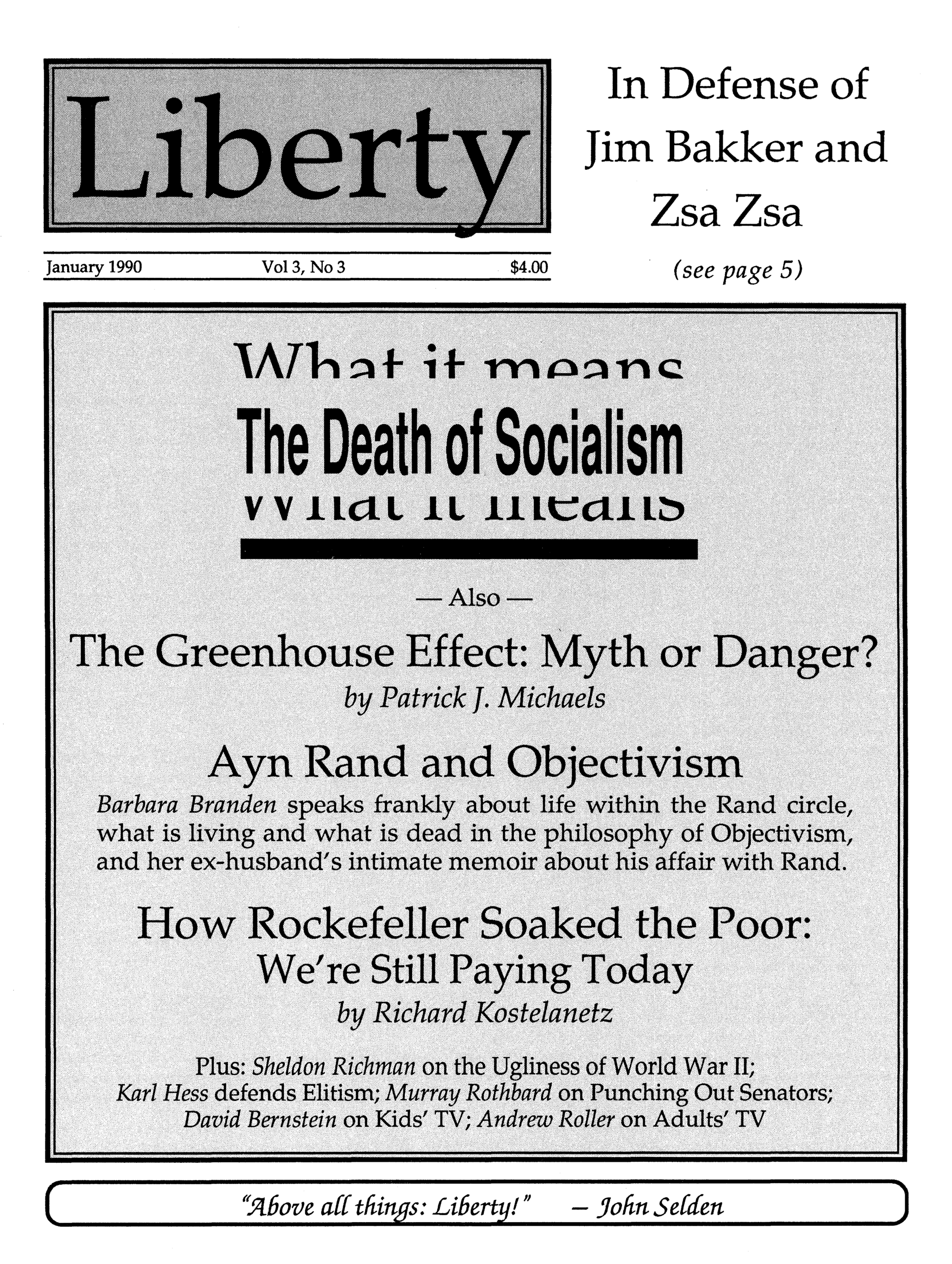
From the vault: Murray N. Rothbard, with two articles, “No Time for Pessimism” and “Kingdom Come: The Politics of the Millennium,” and three Reflections in Liberty (January 1989). The Reflections and first article are covered here; the second article will be covered in a second post.
Reflections
- “Pineapple Face?” (p. 5): Rothbard notes the media’s habitual nickname for Panamanian leader Manuel Noriega—“pineapple face”—and mockingly asks whether this shows “remarkable and brutal insensitivity toward the pockmarked.” He facetiously predicts that the “Pockmarked League of America” will soon protest.
- “Punching out Senators” (pp. 9–10): Rothbard describes with relish the televised moment when a young engineer, Michael Breen, walked up to Senator John Glenn after a tree-planting ceremony and punched him in the jaw. Breen’s motives were unclear but apparently tied to the Fatima apparitions and a belief that the recent San Francisco earthquake fulfilled a secret Marian prophecy; just before striking, he muttered “The earthquakes are starting.” Rothbard half-seriously invents a more charming theory: that Breen believed tree-planting causes earthquakes and felt compelled to alert the world. He quotes Breen’s lawyer calling him “just a very nice young man who… is a little confused.”
- “Race with no winners” (pp. 10–11): Rothbard rejects the self-congratulatory claim that David Dinkins’s narrow 1989 election as New York’s first black mayor signals growing racial tolerance. Instead, he argues the race polarized the city more sharply than ever. Jews (normally solid Democrats) voted heavily for Republican Rudolph Giuliani—often by 3–1 or 5–1 margins in key districts—while non-Jewish whites did so even more overwhelmingly. Dinkins won only because of near-unanimous black turnout (far higher than usual) and strong Puerto Rican support. Exit polls badly overstated Dinkins’s margin because voters of both races systematically lied. Rothbard warns that the city has moved closer to “eventual race war,” notes Dinkins’s left-wing advisors and statist proposals (expanded rent control, comparable worth, stronger municipal unions), and dismisses the failed pollsters with a final “tough patootie.”
From the Symposium feature, “The Death of Socialism: What it Means,” Rothbard’s piece: “No Time for Pessimism” (p.20)
Summary of Symposium, “The Death of Socialism: What it Means”:
Main article: “Now the Real Struggle Begins: Seven Observations on the Death of Socialism” by R. W. Bradford
Bradford celebrates the collapse of the Berlin Wall and the broader disintegration of communism/socialism as a triumph for liberty, then offers seven reflective observations:
- The faith is broken. Across Eastern Europe and the Soviet Union (and even Vietnam), communist regimes are collapsing or reforming: free elections, private property ideas, open borders, the fall of the Wall itself, and mass resignations of hard-liners. Western democratic-socialist parties are also abandoning central planning. Socialism has lost its moral high ground and idealistic appeal.
- Failure to deliver the goods caused the collapse. Decades of broken promises left people with shoddy goods, long waits, declining life expectancy, and visible prosperity gaps (especially via Western TV). Partial economic and political liberalization only fueled greater demands for freedom. The theoretical critique of socialism is now historical fact.
- Do not rely solely on the free market’s prosperity record. The 1930s Depression briefly discredited capitalism in the public mind (even if intervention, not the market, was the real cause). Mixed economies today are vulnerable to similar misperceptions. A free market is neither strictly necessary nor sufficient for prosperity (ceteris paribus); subjective factors, cultural attitudes, and investment choices matter.
- This creates a crisis for conservatism. Cold War conservatism subordinated domestic liberty to anti-communism. With the “inevitable” communist threat gone, will conservatives return to quasi-libertarian roots or double down on their statist social agenda? Bradford suspects the latter.
- This is not a victory for libertarian ideas per se. Ending total state control is progressive and cause for celebration, but libertarians seek radical reduction (or abolition) of state power, not merely the rejection of totalitarianism.
- Libertarians now face their greatest challenge. The real opponent is no longer pure socialism but the popular “Middle Way” (a powerful but limited state that optimizes outcomes case-by-case). Most people find both pure liberty and pure socialism too extreme. Libertarians must now prove a free society superior to this mixed, interventionist status quo—a harder task than refuting socialism.
- Socialism is dead as ideology, but socialist states may persist. Like the Roman Empire after its founding ideology faded, socialist regimes may linger through inertia, elite self-interest, and residual force. Most will drift toward the Middle Way (elections + partial markets); a few hard-liners may survive in isolation via terror.
Side pieces within the section
- “Doors” (poem by Stephen Cox): A personal vignette of painting a door while the Wall falls; contrasts everyday life with historic upheaval and questions whether history has shape or is mere chaos.
- “Socialist dreamworld” (Sheldon L. Richman): Mocks The Nation’s attempt to spin East German emigration as a move toward “capitalism with a human face” (i.e., West German welfare-statism as the true Marxist heritage).
- “Gorby: closet Objectivist?” (Sheldon L. Richman): Speculates (half-seriously) that Gorbachev’s reforms could be consistent with a secret conversion to free-market ideas; emphasizes that intentions matter less than irreversible consequences.
- “RIP: The New Soviet Man” (William P. Moulton): Observes that Stalin was right about the need for total terror within Leninism, and that the myth of a reinvented Homo sovieticus has been shattered—people remain ordinary humans with national, religious, and individual identities.
- “No time for pessimism” (Murray N. Rothbard): Pushes back on Bradford’s caution. With pure socialism discredited, libertarians now hold the moral high ground. The Misesian analysis of intervention shows it forces a choice between escalating to socialism or rolling back toward freedom; Eastern Europe is choosing the latter path, which should shift the Middle toward liberty.
***
The Death of Socialism: What it Means: No Time for Pessimism (p.20)
Murray N. Rothbard
I think Bradford is too pessimistic about libertarian chances in the dialogue or struggles of the future.
While it is true that most people tend to stay in the confused Middle, one extreme pole—socialism—has now been thoroughly discredited, whereas freedom has not. One powerful argument we can use is that Middle Way policies are socialistic and incorporate aspects of policies that everyone dreads. This means that, in contrast to the socialists in the late 19th century, we now have the permanent moral high ground. We can now say, when an advocate of the Middle Way says that libertarianism won’t work, “Give us a country, or a region, and let’s find out.” The fact that Communists are constantly calling for freedom, private ownership, currency convertibility (even a gold standard), private property rights, etc. has to have an enormous effect on the Middle, and to shift the Middle way toward our position.
It should be noted that the Misesian position on the Middle Way is far more sophisticated than the common libertarian position Bradford outlines. It is not simply that government intervention creates new problems in a failed attempt to solve one, and thereby leads cumulatively to socialism. It is rather that these new problems confront everyone with this choice: either escalate the interven-tions (finally going on to socialism) or go back, repeal the interventions and move “back” to freedom. Whereas the West has generally taken the first set of choices, the Communist countries (beginning with Yugoslavia in the 1950s and 1960s) take the otherpath. When things get screwed up, they ask: where can we roll back the state in order to solve these problems? The point is not that social-ism the inevitable result of intervention; it is that intervention is not a viable system pecause it sets these other choices into motion.












 Alessandro Fusillo
 Andreas Tögel
 David Dürr
 Doug French
 Fernando Chiocca
 Greg Morin
 Hans-Hermann Hoppe
 Jay Baykal
 Jayant Bhandari
 Jeff Deist
 Jeffrey Barr
 Juan Fernando Carpio
 Ken Yamarashi
 León Isidoro
 Martin Cabrera
 Nick Hoppe
 Oscar Grau
 Peter Wong
 PFS
PFS scholarium
 Saifedean Ammous
 Sean Gabb
 Sean Ring
 Stephan Kinsella
 Stéphane Geyres
 Thomas Jacob
 Tom DiLorenzo