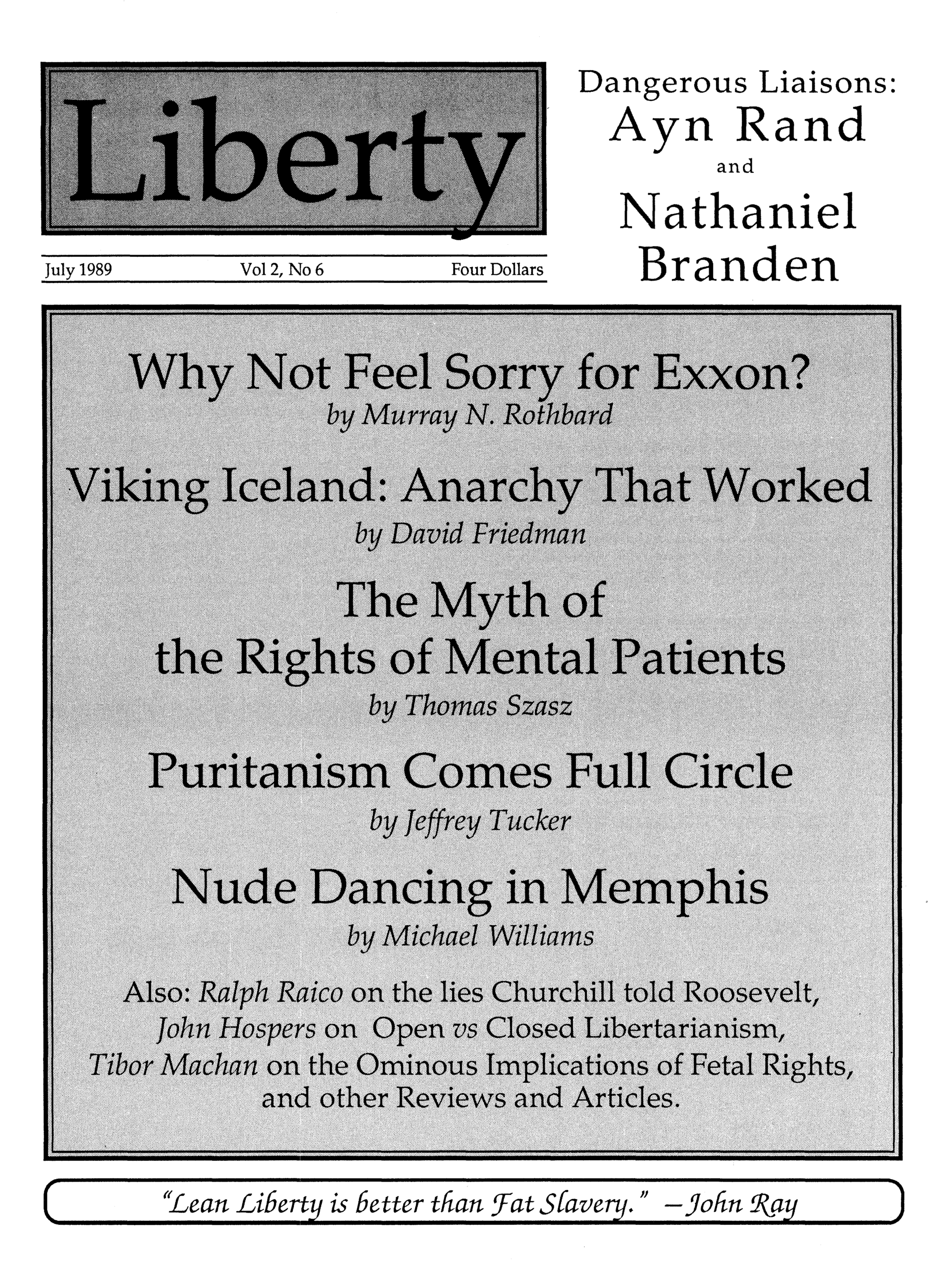
 From the vault: Murray N. Rothbard, two entries in the Reflections section (pp. 7–8, 9–10), Liberty (July 1989).
Related
- Rothbard, Greenhouse defects (Liberty, Jan. 1989), and libertarian criticisms of environmentalism by Rothbard and others linked there
Why not feel sorry for Exxon? – To say that the oil spill has been blown up to hysterical dimensions is a grave understatement. Hysteria abounds everywhere, and everywhere the term “disaster” is freely used. Even Pat Buchanan, who of all the media commentators I thought would be most resistant to the wiles of environmentalism, used that term. The Idiotic Overstatement Award of the Year goes to Alaska Judge Kenneth Rohl, who opined about the oil spill, “We have a man-made destruction that has not been equalled, probably, since Hiroshima.”
Hundreds of thousands of innocent Japanese were massacred at Hiroshima; that’s a disaster. Over the last several months, the Ayatollah’s government has murdered thousands of political prisoners; a million Iranians and Iraqis were killed in their late monstrous war; the Pol Pot regime, in the mid-1970s, genocidally massacred one-third of the Cambodian population. Those are disasters. That’s “man-made destruction.” In the Valdez oil spill, not a single human life was lost. Not a single person was even injured.
Furthermore, those disasters were intentional; the oil spill was, quite obviously, an accident. Who suffered the loss of the oil spill? None other than the Exxon Corporation, which lost ten million gallons of crude oil; in addition to the $5 million this loss represents, Exxon will be forced to pay cleanup costs, as well as compensation to the economic losses incurred by the fishing industry in Alaska. And so the only loser is Exxon, suffering from the negligence of its allegedly drunken sea captain. So is everyone feeling sorry for Exxon, as I do? Hell no; to the contrary, Exxon has been reviled every day by virtually everyone in the media and in public life. Contrary to government when it commits an accident or similar “externality,” Exxon, as a private corporation, must pay the costs it inflicts on others. So what’s the problem? Once in a while, accidents happen. Are we to ban all oil tankers, because once in a long while, a tanker runs aground? Are we to outlaw all shipping because some ships sink? Are we to prohibit all air flight because once in a while a plane crashes?
What’s the problem? Once in a while, an accident happens. Are we to ban all oil tankers because once in a long while a tanker runs aground? Are we to outlaw all shipping because some ships sink? Are we to prohibit all air flights because once in a while a plane crashes?
Note the difference between the berserker reaction to the Valdez oil spill, and the response to the last great oil spill in 1978, off the French coast, when the Amoco Cadiz let loose no less than 60 million gallons of crude oil into the Atlantic-the worst oil spill in history. There was no hysteria, no screaming headlines, no bellyaching on television. The courts quietly forced Amoco to pay $115 million to compensate for costs of the accident, and that was that. The reactions were different because, in the meantime, the virus of environmentalism has deeply infected our culture. Arguing on the basis of private firms paying the costs of liabilities they impose upon others is all very well, but, as we see in the smears against Exxon, it is not enough. We must no longer allow the environmentalists to seize, undisturbed, the moral high ground, and arrogate to themselves the good of the cosmos while the rest of us are portrayed as narrow, selfish, short-sighted, and immoral. There is no greater immorality than deep opposition to mankind per se, and environmentalism must be exposed as that kind of immoral and destructive creed. Only then will the party of mankind be able to take back our culture. -MNR
Inexhaustible fusion energy and the environmentalists – The scientific world has been set agog by the biggest scientific news in years: the possibility that nuclear fusion energy has been produced at room temperatures-as has been reported by two University of Utah chemists. Teams of scientists all over the globe have been rushing to try to replicate the experiment, because, if true, it means a virtually inexhaustible supply of cheap energy. The resource is sea water, and the equipment is no more complex or expensive than a kitchen laboratory. The prospect is joyous for mankind, for this means an enormously higher standard of living for all, and an end to the spectre of the disappearance of energy that has been highly touted in recent decades.
You would think that the environmentalists would be happy, too, especially because nuclear fusion, unlike fossil fuels, is virtually pollution free, and, unlike nuclear fission, causes no toxic waste that is difficult to dispose of. But, shockingly, you would be wrong. Instead, our beloved left-environmentalist leaders are, as usual, wringing their hands in anguish. Washington author Jeremy Rifkin laments: “It’s the worst thing that could happen to our planet.” And Stanford biologist Paul Ehrlich, long-time worrier about the “population bomb,” complains that the prospect of cheap, inexhaustible fusion power is “like giving a machine gun to an idiot child”—that’s us, folks. [Paul Ciotti, “Some Find Research Troubling,” LA Times/ Washington Post, April 23.] The fact that such fusion power is clean, charges Rifkin, is “beside the point.” For this only means that man, dammit, will use more rubber tires, and employ “non-polluting” bulldozers to knock down trees or “build housing developments on farmland.”
Paul Ehrlich, long-time worrier about the “population bomb,” complains that the prospect of cheap, inexhaustible power is “like giving a machine gun to an idiot child.” The fact that such power is clean, we are told, is “beside the point.” It only means that man, dammit, will use more rubber tires and employ “non-polluting” bulldozers to knock down trees.
In fact, as Mr. Ciotti puts it, “worst of all” about the possibility of fusion power, to the environmentalists, is that “cheap inexhaustible energy would let the planet support many more people than its current population of 5.2 billion.” There we have it: the environmentalist creed is fundamentally animated by a hatred of people, by hostility to the human race. -MNR
Discover more from The Property and Freedom Society
Subscribe to get the latest posts sent to your email.





















 Alessandro Fusillo
 Andreas Tögel
 David Dürr
 Doug French
 Fernando Chiocca
 Greg Morin
 Hans-Hermann Hoppe
 Jay Baykal
 Jayant Bhandari
 Jeff Deist
 Jeffrey Barr
 Juan Fernando Carpio
 Ken Yamarashi
 León Isidoro
 Martin Cabrera
 Nick Hoppe
 Oscar Grau
 Peter Wong
 PFS
PFS scholarium
 Saifedean Ammous
 Sean Gabb
 Sean Ring
 Stephan Kinsella
 Stéphane Geyres
 Thomas Jacob
 Tom DiLorenzo