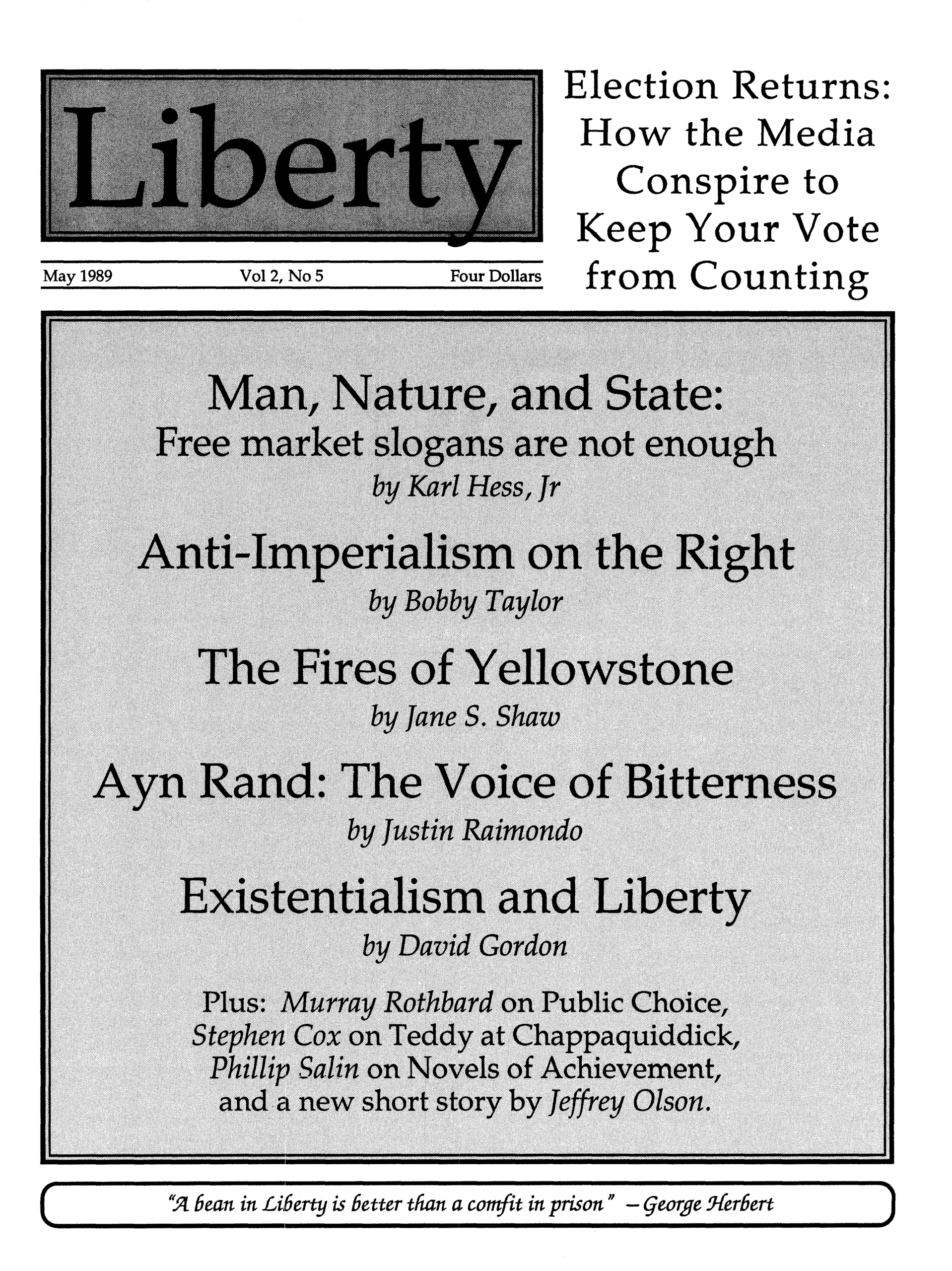
 From the vault: Murray N. Rothbard, “Eyeing the Top of the Pyramid: Mr. Friedman at the Apex” (pp. 33–34) and various entries in the Reflections section (pp. 7–8, 11, 12–13), Liberty (May 1989).
Rothbard’s article is a response to Jeffrey Friedman’s article “The End of Political Activism” from the previous issue (March 1989), critiquing aspects of Rothbard’s approach to libertarian strategy and ideology, and also includes R.W. Bradford’s response, “What’s Wrong with Friedman’s Pyramid” (p. 34–36).
Reflections
Society as addict – It is high time that someone raise his voice in protest: the American public is increasingly being treated as one vast outpatient clinic. It’s as if heroic libertarian psychiatrist Thomas Szasz had never written. Szasz has partially won his great battle against compulsory commitment for “mental illness”; but his lifetime of writing apparently has made no dent in the larger campaign to stop the odious medicalization of all life’s problems.
All around us we are assaulted by medical news and prof-fered medical treatment. It is perfectly natural to have one cable TV channel-Lifetime Cable-devoted solely to medical news and discussion; surely, this topic is just as legitimate for specialized information as is finance or the weather. But the problem is that virtually all news has been medicalized. Two minutes on the latest problem in Paraguay are invariably followed by far more time on the latest heart, lung, or whatever medical report. Despite the alleged glories of modem medicine, new dread diseases are being discovered nearly every day, and pressure groups devoted to these new ailments never cease to clamor for our attention. (“Send funds immediately to combat the heart-break of XYZ, which strikes one American every five and a half days!”)
Far worse is that all of life has been turned into a medical problem. It used to be that babyhood, adolescence and old age were singled out for the administration of medical therapy; then, a few years ago, in her best-selling work, Passages, Gail Sheehy brought a Great Leap Forward to this scientific disci-pline by discovering an allegedly grave crisis for every two or three years of one’s life. In addition to the so-called “midlife crisis,” which had been in vogue for a decade or so, Sheehy sup-plied an unending series of grim crises; no sooner did one mi-raculously get past the “late-twenties crisis” than one was plunged headlong into the dread “early-thirties crisis,” and so on, until presumably one was happy to drop dead, at long last, from sheer exhaustion.
The worst aspect of this medicalizing of society has been the universalization of the concept of “addiction.” Once a plausible description of the strictly physiological consequences of drugs, the concept got expanded to “psychological addiction,” and since then the fat has been in the fire. It has now come to the point where “addiction” is a smear term for anything you or I like and would hate like hell to give up.1
So there are alcohol, tobacco, work, sex, and love “addicts” as well as addicts to a zillion other activities. All this means that if you are attached or devoted to any particular person or activity, then this attach-ment is “addictive” and you become duty-bound to give it up. Not only that: the latest wrinkle holds that if you have any sort of close relation with anyone whom these scolds and busybodies claim to be “addicted,” then you too automatically become a “co-dependent” and at least equally addictive as the culprit/ outpatient you are in a relationship with. Recently I came across paperbacks with screeching headlines: How to Cure the Disease of Codependency and even, Society is an Addict.
Is everything then hopeless? Oh no, things may be grim, but for the hawkers of the medical paradigm, there is a way out, albeit a painful and expensive one. Aid is available from the massed legions of those who like to call themselves “helping” or “caring” professionals. For every ten of us outpatient addicts there are one or more “helpers” or “caregivers” ready to fleece us of our dollars and our self-respect. Methinks the only “addiction” we are really suffering from, and from which we are in desperate need of help, is our accelerating dependency upon the medical model and its assiduous promoters, the helping professionals.
You see, getting rid of one’s “addiction” on one’s own can never work, according to our self-appointed Helpers. Recently I had a conversation with two shrinks who are experts in alcoholism. One said that her ex-husband “is” an alcoholic, even though he had successfully carried through his own decision to quit drinking at the age of 50. “Oh, he’s a ‘dry’ alcoholic—they’re the worst.” “But,” I asked, “how can he be a terrible alcoholic if he’s quit drinking?” ‘That’s because he refuses to follow the Eleven Steps (of Alcoholics Anonymous.)” I’m not sure the number was Eleven, but you get the picture. The whole world is an addict, and the only way out is to surrender our souls to our Helpers. Since, according to all these people, the addiction prob-lem is getting steadily worse, this seems to indicate that we should try something new and different: so why not get really radical and Dump the Helpers? -MNR
Good news on the “Greenhouse” – The 80s has been the decade of the New Puritanism, a systemic assault on bourgeois comfort and enjoyment; that is, on what is truly our “quality of life.” In the name of what used to be called “hygiene,” we have been subjected to an organized and crippling barrage. We have been commanded to give up sex, tobacco, and liquor, to say nothing of the more exotic drugs; we have been deprived of any food that might possibly taste yummy; we have been ordered into the vile torture of continual exercise; and we have been divested of our fondest activities in the dread name of “aholic”: “alcoholic,” “workaholic,” even “loveaholic.” In the immortal words of Sheridan Whiteside in the Man Who Came to Dinner: “Are we to be spared nothing?”
Last year the misery of a hot summer was made even worse by those pests and harpies, the environmentalists. “It’s the greenhouse effect,” they warned, trying to strip us of our last shred of comfort by taking away our aerosol cans, our automobiles, even our air conditioners-all so that the earth’s temperature won’t rise by two degrees in fifty years. Well, now Science has spoken, in the January issue of Geophysical Research Letters. In the latest study, a team of scientists from the National Oceanic and Atmospheric Administration tried their damndest to find a greenhouse effect in the U.S. weather records since 1895, but they were grudgingly forced to admit defeat. Try as they might, they could find no record of the dread warming effect. To the contrary, they discovered that, in the 45 years from 1895 to 1940, there was a “marginally significant” rise in temperatures; but this warming was followed by another 47 years of a “marginally significant” drop in temperatures! Result? Zilch.
Yes, yes, we know that any decade now, the Greenhouse Trend may start down its inexorable path. But, in the meantime, greenhouse hysterics, beat it out the door. Don’t come back for another ten years or so. And, on your way out, leave that sum-mer thermostat set at 68 degrees. -MNR
The end of the secular century – The storm over Salman Rushdie provides a vivid and dramatic illustration of one of the great truths of our era: that the Age of Atheism is ended. During the 1960s trendy theologians proclaimed that God is dead; but now we find that God is still (or again?) very much alive, and that it is Atheism for which burial rites must be conducted.
We have to realize that the secularist age, even though seem-ingly inevitable and eternal at the time, was only a brief glitch in the history of mankind. Secularism was born in the Age of the Enlightenment, in the eighteenth century; it was given great impetus by Darwin in the late nineteenth century, and it came into its own and dominated Western culture from the 1920s through the 1960s. In the United States, mainstream Protestantism had slowly but surely been transformed from a militant pietism of the mid-nineteenth century into a secular, barely religious, form of left-liberalism. Mainstream Protestant preachers would deliver sermons about the virtues of the Marshall Plan or aid to the homeless interlarded with a few small sentimental references to “God” or “Jesus.” During the early 1960s a friend of mine rented a room for a while in the home of the Protestant chaplain at the University of Chicago. After lengthy discussions about theology and religion, my friend told the chaplain: “It seems that you and I have identical views on religion. The only difference is that I call myself an ‘atheist’ whereas you call yourself a Protestant minister.”
As for pre-Vatican II Catholics, they were scarcely integrated into American cultural and intellectual life. They were considered a strange breed, a throwback to the Dark Ages, who really believed that stuff.
Bill Buckley likes to tell a story of his meeting, as a young man, with Ayn Rand, with Rand telling him: “Come, come, Bill, surely you are much too intelligent to believe in God.” Ayn Rand, however, was not alone in this attitude compounded of arrogance and naivete. She was, characteristically, simply more blunt about it. The dominant secularist attitude in American culture was precisely that: the only people who could believe in God or Christianity were credulous and halfwitted peasants. And American life of the 1920s through 1960s seemed to confirm this notion. For, after their defeat at the Scopes trial, conserva-tive fundamentalist Protestants retreated into the hills and rural fastnesses of America, and into the life of marginal social and economic classes. It was then easy for sophisticates to dismiss hard-shell Christianity as merely a cult of hillbilly snake-charmers.
And not only Christianity. The secularist twentieth century also dealt a grave setback to Islam. Moslem regimes were generally secularist and heedless of Islam; the gravest blow came when the Kemal Ataturk regime, after World War I, brutally forced a Western-style “modernization” on Turkey by virtually suppressing Islam and outlawing such Moslem practices as the chador (the veiled dress for women).
In every civilization, religion had always been the dominant force in people’s values, goals, and very lives. In the twentieth century, it was possible for secularist intellectuals to ignore this overriding fact, and to claim that modern science had put an end to these “superstitions” of the past. But now, since the 1970s, secularism is rapidly going down the tubes, in the United States and throughout the world. Religion is back, and with a vengeance—literally and figuratively. Fundamentalism has made a remarkable comeback in the United States, and Islam, both Sunni and Shi’ite, is back with a roar. No longer is it possible to ignore the importance of religion in human life and culture.
Even though more fuss about the Rushdie affair has been made in the United States, England, of course, has really been the center of the storm. England, arguably the least religious country in the Western World, is the adopted home of the ex-Moslem Salman Rushdie and was the original publisher of his book. A fascinating article from London in the L.A. Times, (Dan Fisher, “Multicultural Concept Takes Beating in Britain,” March 1, p. 10), reports a rising tide of anti-foreign and generally xenophobic attitudes in England in the wake of the Rushdie controversy. Apparently, in 1966, Labor Party Home Secretary Roy Jenkins (now a leader of the Social Democrats) set forth a new policy toward Britain’s racial and ethnic minorities: acceptance of cultural diversity, instead of trying to mold all minority groups into one homogeneous British product. But now, in the wake of increased Moslem immigration and the Rushdie contro-versy, Right and Left alike are rapidly rejecting cultural diversity and talking again about a stern approach toward imposing one ”British culture and its values.”
The trouble is that cultural liberalism was adopted in Britain, and to a large extent in the U.S., by seclularists whose benign and naive view of cultural differences is of happy ethnics wearing their quaint folk costumes and going through their charming little folk dances on national holidays. What they left out of this Disneyfied view of life is real cultural differences and conflicts, and especially the serious commitments of militant religion. In short, clashing attitudes toward liquor, the role of women, religious blasphemy, and all the rest. Cultural diversity is a noble ideal but, to paraphrase Mao, it is no tea party; it is an often serious and rugged business, and secularists had better start wising up to this basic fact.
Secularist libertarians should stop trying to convert the religious to the dubious glories of atheism, and should start trying to convert them to the cause of liberty.
The long-term strategic lesson for secularist libertarians of the resurrection of religion in the modern world should be crystal clear. The prospects for the eventual victory of liberty, in the U.S. and in the rest of the world, are excellent; the prospects for the triumph of atheism are nil. Secularist libertarians should stop trying to convert the religious to the dubious glories of atheism, and should start trying to convert them to the cause of liberty. -MNR
***
Discussion
Eyeing the Top of the Pyramid
“If one wants to change the culture of our day and age,” wrote Jeffrey Friedman in the March Liberty [“The End of Political Activism”], “then one goes to the top of the intellectual pyramid-to the professors who educate [the] intellectuals-and works one’s way down.” By failing to recognize this fact, he argues, libertarians have wasted their efforts. Two of Liberty’s editors challenge Friedman’s thesis. [R.W. Bradford’s response is “What’s Wrong with Friedman’s Pyramid” —SK]
Eyeing the Top of the Pyramid: Mr. Friedman at the Apex
The trouble with Mr Friedman’s article is that, written as it is from the apex of his beloved “intellectual pyramid,” his view of the rest of us peons down below has gotten murky and obscure. His opinion of life and history is ass-backwards: applied to previous centuries, his simplistic view of the Pyramid is one-sided enough; applied to the present era it is dead wrong. In the current age of TV and modern communications, the Pyramid is often upside-down and a two-way street. All too often, Friedman’s cherished intellectuals, like politicians and Supreme Court justices, follow the election returns. That is, to put it in economic jargon, they are often demand rather than supply-oriented. After the 900,000 votes of the Clark campaign in 1980, lo and behold, and as if by magic, many economics textbooks devoted an entire section to a respectful and fairly accurate account of libertarianism. But after Friedman and his buddies jumped ship in 1983 following their defeat at the presidential convention, and the Bergland vote fell to 227,000 the following year, for some obscure reason the textbook writers high on that Pyramid (though not of course up in the stratosphere with Comrade Friedman) lost all intellectual interest in libertarian-ism and it disappeared from the pages of textbooks. On a lower but still highly important level, Mr Friedman’s vaunted opinion-moulders recently went into whirlwind changes, as their estimate of George Bush speedily moved from unelectable preppy wimp to vital man-of-the-people.
But no—by Mr Friedman’s own self-serving version of the trickle-down theory, we at the bottom of the pyramid are expected to forget about politics or journalism or the real world: our only intellectual duty is to pour all our financial resources into the few rarefied Masters at the apex of the pyramid (say, into Critical Review, which he edits) and then be content to wait a thousand years until the goodies of liberty seep slowly down to the social bottom. As for those of us who are so moronic or impatient that we find politics more exciting than participating in the turgid hermeneutical dialogue up there at the pinnacle—well, Mr Friedman will graciously allow us to run some political campaigns, but only, mind you, in order to win respectability from his academic buddies.
But oh my friends, how libertarianism will be transformed after the thousand-year trickle-down—in fact is being transformed right now at the pinnacle! For, you see, the one thing that respectable left-liberal academics (and who else is respectable up there?) will not stand for is libertarianism that is harsh, consistent, clear-cut, hard-edged, “dogmatic.” They will only admit to the pantheon of respectability—and tenure—a libertarianism that is suitably qualified, hesitant, confused, turgid, oh-so-very “open,” in fact a “libertarianism” that sounds very much like half-assed, relativistic Marx-ism badly translated from the Old Bul-garian! So: who is influencing whom in that dizzying atmosphere at the apex of the pyramid? Only one guess is needed.
By Mr Friedman’s theory, we at the bottom of the pyramid are expected to forget about politics or journalism or the real world: our only intellectual duty is to pour all our financial resources into the few Masters at the apex of the pyramid and then be content to wait a thousand years until the goodies of liberty seep slowly down to the social bottom.
Mr Friedman is also wrong on the other major point of his article. He has the odd view that politics makes intellectual attitudes narrower and more dogmatic, and hence the reason why, in my inveterate pursuit of narrowness and dogma, I changed my mind and joined the Libertarian Party. The truth is pre-cisely the reverse. If you want intellectual purity and consistency, you had best stick to discourse with four or five friends. To leap into a mass movement, a political party, means that inevitably you will have to deal with a much broader range of thought, and the fight for even broad consistency (let alone the delights of narrow dogma) is much more difficult.
When the Libertarian Party was founded in 1971, I thought that there were only ten or twelve libertarians in the whole country
There is, of course, nothing new about Mr Friedman’s call for “openness” and respectability. For a century, our culture has been stifled and our intellec-tual wells poisoned by what can only be called ”bullshit liberalism”: the idea that it is man’s highest (top-pyramid) calling to search for the truth, but that God for-bid he ever finds it, for then he becomes a narrow, unrespectable, controversial, “dogmatist!” God forbid, too, he ever writes in plain English, for that too is a bottom-pyramid failing. Because if ever one finds the truth, especially if one finds a truth as lovely and inspiring as libertarianism, then watch out! For then one is in danger of spending the rest of one’s life, not only trying to refine and elaborate the theory, but worse yet, actually trying to embody that theory of liberty in real-world political institutions! That is one strategy of life, one that apparently irritates the likes of Mr Friedman, and even (horrors!) diverts resources from his beloved apex.
The alternative strategy; the strategy suggested by Mr Friedman, is to be “flexible” enough to adapt and mould your former principles in order to cozy up to the gravy train of funds, power, and respectability, wherever you hap-pen to be placed on the Pyramid. At the lower parts of the Pyramid, this means sucking up to the Reagan/Bush administration, or running Pete duPont for President; in the heady and stratospheric zone where Mr Friedman has his being, this means questing for academic posts and tenure by plunging into the mire of liberal-Marxoid hermeneutics. While the rest of us drones wait forever and kick in resources—if, of course, we can stomach the spectacle.
- See Kinsella, “Let Kids Smoke,” LewRockwell.com (July 25, 2000) (“all choices have opportunity costs, and the choice to stop smoking is no different than any other in this regard”). —Ed. [↩]
Discover more from The Property and Freedom Society
Subscribe to get the latest posts sent to your email.



















 Alessandro Fusillo
 Andreas Tögel
 David Dürr
 Doug French
 Fernando Chiocca
 Greg Morin
 Hans-Hermann Hoppe
 Jay Baykal
 Jayant Bhandari
 Jeff Deist
 Jeffrey Barr
 Juan Fernando Carpio
 Ken Yamarashi
 León Isidoro
 Martin Cabrera
 Nick Hoppe
 Oscar Grau
 Peter Wong
 PFS
PFS scholarium
 Saifedean Ammous
 Sean Gabb
 Sean Ring
 Stephan Kinsella
 Stéphane Geyres
 Thomas Jacob
 Tom DiLorenzo