
Podcast: Play in new window | Download (Duration: 43:41 — 10.0MB)
Property and Freedom Podcast, Episode 336.
From French, Rothbard as Intellectual Inspiration (Mises University, 2006): Douglas E. French, “Rothbard as Intellectual Inspiration,” Mises Daily (08/15/2006) (from Mises University 2006; mp3; local mp3)
Transcript and summary below.
Overview
Main Talk Summary In his 2006 Mises University talk, Doug French first honors entrepreneurs such as Willis Haviland Carrier, whose invention of modern air conditioning transformed daily life and made events like the conference possible, and Ron Yanke, the hardworking, generous Idaho businessman who co-founded Micron Technology and helped create Silver State Bank; he contrasts these men with the false Marxist stereotype of greedy capitalists and quotes Mises on the progressive role of entrepreneurial capital accumulation. French then recounts his personal experience as a UNLV graduate student who, despite being warned that Rothbard was a “kook,” took his electrifying History of Economic Thought and U.S. Economic History courses, wrote a thesis on speculative bubbles under Rothbard’s guidance, navigated departmental hostility from the chair and graduate coordinator, and continued to receive generous mentorship by letter after graduation, culminating in a final meeting just before Rothbard’s death. He closes by arguing that true greatness lies in the lasting influence of figures like Carrier, Yanke, and Rothbard, criticizes billionaire philanthropy of the Buffett-Gates variety as misguided, and urges the young audience to carry forward Austrian economics and free markets either as entrepreneurs or scholars.
Q&A Summary In the question period French explained that Bill Bradford’s Liberty magazine talk “Why Libertarians Love to Hate”1 portrayed both Rothbard and Ayn Rand as people who created enemies rather than consensus, though Bradford had once called Rothbard the best person with whom to share a martini; he noted that Rothbard himself, despite having been expelled from Rand’s circle, remained complimentary and urged French to read Atlas Shrugged and The Fountainhead. He recalled only a handful of fellow students who stayed connected to the Mises Institute, observed that UNLV classes were small and the broader campus lacked intellectual seriousness, admitted that Austrian insights had cost him money by making him overly wary of bubbles while missing the Las Vegas real-estate boom, yet still found business-cycle knowledge useful in banking, and said the rest of the faculty liked Rothbard personally but did nothing to help him or Hans Hoppe attract students and were jealous of their productivity.
Related
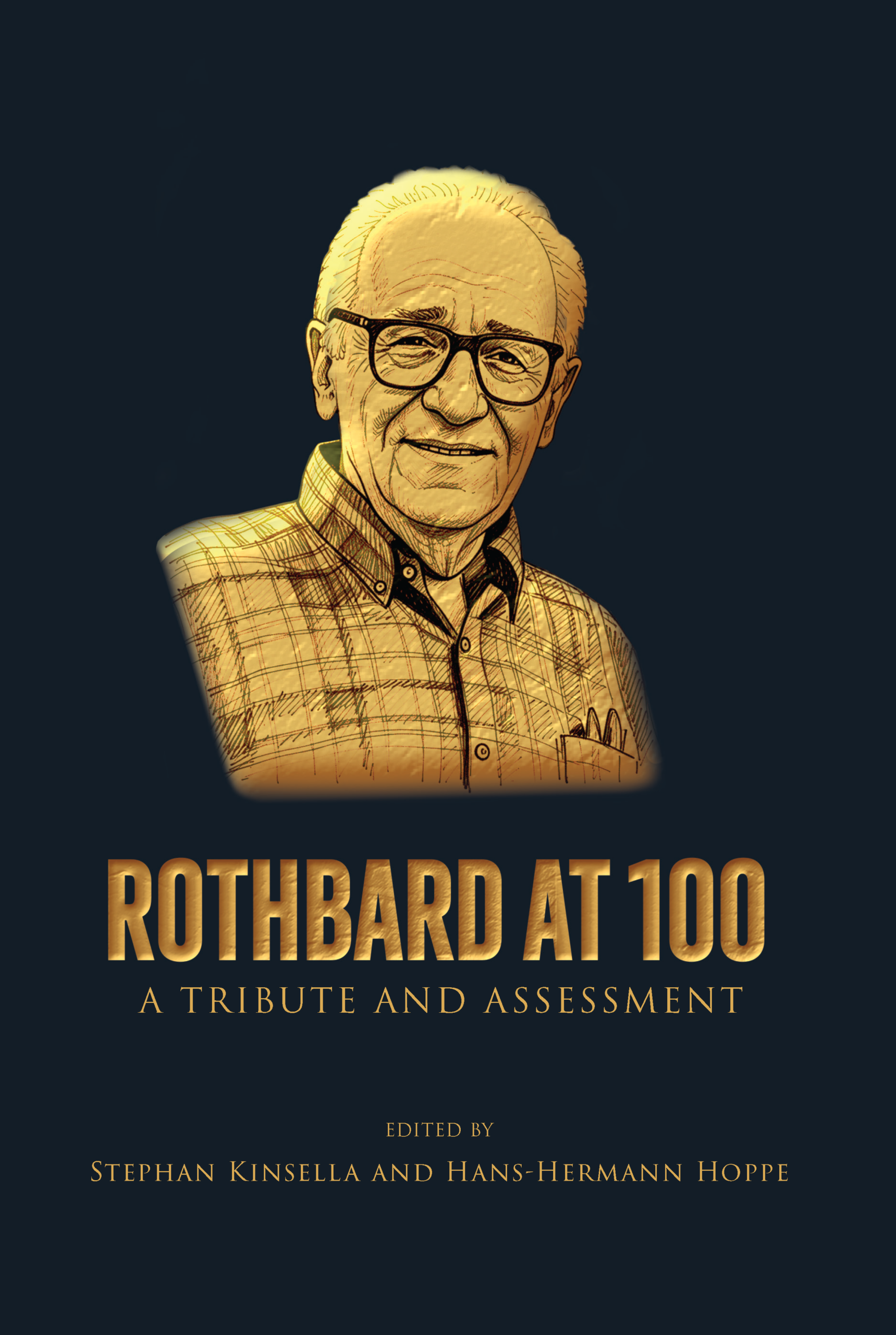
- Rothbard at 100: A Tribute and Assessment, Stephan Kinsella and Hans-Hermann Hoppe, eds. (Papinian Press and The Saif House, 2026) and various links and resources collected there
- See especially Hans-Hermann Hoppe and Stephan Kinsella, “Appendix: Rothbard’s UNLV Evaluation and Syllabus,” in Rothbard at 100: A Tribute and Assessment, including “Memo from Douglas E. French to Stephan Kinsella” as well as Rothbard’s annual faculty review at UNLV by Chairman Mark A. Thayer (1991), followed by Rothbard’s draft comment in reply, and two letters from Rothbard to Doug French (Dec. 3, 1992 and Dec. 11, 1992)
- Re: “Bill Bradford entitled “Why Libertarians Love to Hate”: see Douglas E. French, “Rothbard as Teacher,” Liberty (May 1995), p. 14 & 69; Liberty (March, 1995), p. 13 (offering for sale video and audiotape of “Why Libertarians Hate,” by R.W. Bradford, from the Liberty Editors’ Conference in Tacoma, Washington, 1994)
- Stephan Kinsella, “My Years with the Mises Institute,” Property and Freedom Journal (May 2, 2026) (re the importance, and decline, of the Mises.org website)
- Douglas E. French, “Remembering Murray Rothbard: Teacher, Friend, and Inspiration,” in Rothbard at 100: A Tribute and Assessment
- Douglas E. French et al., “Memories: Murray N. Rothbard (1926–1995) as Mentor and Teacher,” Property and Freedom Society Annual Meeting 2015, Bodrum, Turkey (Sep. 11, 2015), available at PFP129 | Memories: Murray N. Rothbard (1926–1995) as Mentor and Teacher, Hoppe, DiLorenzo, French, Iglody (PFS 2015)
- French, Buckley’s Belligerent Obit
- Doug was the recipient, in 2005, of the Center for Libertarian Studies’ Murray N. Rothbard Award and, in 2012, of the Murray N. Rothbard Medal of Freedom, and also endowed the Mises Institute’s Douglas E. French Prize.
- Douglas E. French et al., “Murray Rothbard as a Teacher: The UNLV Years—A Panel with Rothbard’s Former Students,” Austrian Economics Research Conference 2023, Auburn, Alabama, Mises Institute (Oct. 7, 2017), available at Stephan Kinsella, “PFP252 | Bonus: Murray Rothbard as a Teacher: The UNLV Years—A Panel with Rothbard’s Former Students (AERC2023),” Property and Freedom Podcast (Oct. 2, 2023)
- French, “Reminiscences of Murray,” LewRockwell.com (April 8, 2005), republished as “Studying Under Murray,” in I Chose Liberty: Autobiographies of Contemporary Libertarians, Walter Block, ed. (Auburn, Ala.: Mises Institute 2010) (based on a talk was delivered on the occasion of receiving the Center for Libertarian Studies’ Murray N. Rothbard Award in recognition of his dedication to the ideals of liberty in the Rothbardian tradition);
- French, “Learning From the Master,” LewRockwell.com (Dec. 24, 2002)
- Lee Iglody, “The Man Across the Hall: My Time with Professor Rothbard,” in Rothbard at 100: A Tribute and Assessment
- Jeff Barr, “The Last Lecture,” in Rothbard at 100: A Tribute and Assessment
- Hans Hoppe, “Coming of Age with Murray,” in Rothbard at 100: A Tribute and Assessment
- APPENDIX
Summary (main talk)
Honoring Entrepreneurs Through Willis Carrier 00:00:00
Doug French opens by noting the informal setting at Mises University in Auburn and the need to honor someone critical to the event’s comfort: Willis Haviland Carrier, the father of modern air conditioning. Carrier did not invent the first cooling system, but his was the first truly successful and safe one, founding Carrier Engineering Corporation in 1915 with $35,000 (about $650,000 in today’s terms). By the previous year the company had $12.5 billion in sales and 45,000 employees.
Cooling for human comfort began in 1924 with the installation at Detroit’s J.L. Hudson department store, where people flocked simply to enjoy the air. It quickly spread to theaters, restaurants, and malls, then to homes in 1928. Carrier transformed lives without public recognition. French asks how Mises University could be held in August in Auburn, or how cities like Phoenix and Las Vegas could grow, without air conditioning. Great entrepreneurs improve lives while receiving little credit.
Debunking Stereotypes of Businessmen 00:02:40
The public image of entrepreneurs as conniving, miserly, and greedy—shaped by Dickens’s Scrooge and Gordon Gekko in Wall Street—mirrors Marxist class-struggle theory. That theory claims the ruling class appropriates a social surplus product from the exploited for its own consumption. French calls this stereotype as false as Marxism itself. While people suffer under socialist regimes, capitalist entrepreneurs invest capital, organize resources, create products and jobs, and make the world better.
He quotes Mises from Human Action: economic progress comes from capital accumulation through saving and technological improvement. The agents of progress are entrepreneurs who adjust production to satisfy consumers best. In doing so they must share the benefits with workers, capitalists, and landowners until their own share melts away.
Ron Yanke as Exemplary Entrepreneur 00:04:58
French turns to Ron Yanke, an entrepreneur who touched thousands of lives and died a few years earlier in Boise. Yanke took over his father’s machine shop, which continued serving contractors, mining, and forestry for 64 years. Employees stayed decades because Yanke would do anything for them and they would walk through fire for him.
He expanded into Montana sawmills, a charter air service, firefighting-equipment manufacturing, ranching, vast timberlands, real-estate projects, mechanical contracting, manufactured housing, and two banks. Most famously, with Tom Nicholson and Allen Noble he funded the Parkinson brothers who started Micron Technology in a dentist’s basement in 1978. Micron became a New York Stock Exchange company with $8 billion in assets, $5.8 billion in equity, and 19,000 employees worldwide—the largest private employer in Idaho.
At Yanke’s funeral speakers described a man with not a mean bone in his body, a true gentleman, the hardest worker and hardest player anyone had seen, operating at “pedal to the metal.” Despite great wealth he lived simply—flying Southwest Airlines to Las Vegas bank meetings and eating at a casino soup-and-salad bar. He and Nicholson put $5 million into starting Silver State Bank, which grew to $1 billion in assets and 190 employees; that investment became worth $100 million. French, employee number 11, credits Yanke and Nicholson for opportunities that enriched both the material and the human world. Yanke’s constant cheerfulness matched only one other person French had known: Murray Rothbard.
Encountering Rothbard at UNLV 00:09:37
Everyone present knows Rothbard; a few knew him personally, and French is proud to be one. After moving to Las Vegas in 1986 he pursued a master’s in economics at UNLV, having minored in the subject as an undergraduate. MBA degrees were the fashion, but he chose economics anyway.
By fall 1990, with twelve credit hours completed and determined to avoid econometrics and statistics, he spotted “History of Economic Thought—Rothbard” in the catalog. A classmate warned that Rothbard was a “kook” and urged independent study instead. French knew nothing of Austrian economics or libertarianism and had no time to arrange alternatives, so he enrolled.
The first night Rothbard entered already talking—about politicians attacking oil companies during the Gulf War—and launched straight into centuries of economic thought without roll call or syllabus. Eight or ten students took furious notes; half were auditors who returned every semester because Rothbard varied the emphasis (that term it was financial history). The lectures were narrative “good guys versus bad guys” delivered at Robin-Williams speed, punctuated by cackles and a dozen precise reading references each night. French recognized this as economics taught as it should be—far superior to graphs and equations.
He took U.S. Economic History the next semester. His first real conversation with Rothbard occurred during a bomb scare at Beam Hall: French suggested sending underclassmen to find the bomb; Rothbard replied, “I like the way you think, Douglas.”
Thesis Advising and Mentorship 00:15:12
Needing to choose between a comprehensive exam and a thesis, French was steered toward the thesis. After another professor declined, he asked Rothbard, who accepted warmly and immediately listed about twenty sources on speculative bubbles. French was among the last students to graduate under the Theory and Policy track designed for those studying with Rothbard and Hans Hoppe; the department later abolished it to discourage such students.
During the thesis work French came to know Rothbard well. Rothbard nicknamed him “the efficient banker” for handling forms and copying. Over time French realized Rothbard’s brilliance: he knew everything yet never acted pompous, always answering “in my opinion” or “in my view.” Bankers, customers, and especially regulators constantly claimed brilliance; Rothbard simply possessed it. At a Stanford Mises seminar people begged French for class notes once they learned he was Rothbard’s student, revealing the professor’s stature. Rothbard was a walking bibliography, supplying full citations on every meeting. His best writing advice was to read H.L. Mencken to cure wordiness.
Department Hostility and Thesis Defense 00:19:45
Department chair Dr. Thayer’s 1991 evaluation rated Rothbard only satisfactory, criticizing limited student contact, “disappointing” scholarly growth, and insufficient service, while demanding more departmental participation and role-modeling for junior faculty. Rothbard replied with a 3,000-word rebuttal calling the evaluation an outrage, listing eleven overlooked 1991 accomplishments, and defending his attendance at meetings, committee work, teaching, advising, and office hours. He asked what other “daily life” was expected and suggested the best role model is a scholar left free of harassment.
Graduate coordinator Tom Carroll circulated a sarcastic memo pretending ignorance of French’s thesis topic and committee (Rothbard, Hoppe, Terry Ridgeway) despite having signed the prospectus and appointment forms months earlier. Rothbard withheld the memo until after the defense so French would not be upset. The defense lasted a torturous hour and a half in an un-air-conditioned room; Rothbard calmed French beforehand by saying he knew more about bubbles than anyone present.
Post-Graduation Mentorship and Final Meeting 00:24:46
After graduation French moved to Reno but stayed in touch by long, single-spaced letters. Rothbard urged him to submit the tulip-mania section of the thesis to mainstream journals, believing it made a real contribution. After repeated rejections Rothbard wrote that referees always seemed “a pack of morons” who missed the point, and that he himself rarely submitted to journals any longer; he suggested further outlets including the Review of Austrian Economics.
In December 1994 French waited an hour outside Rothbard’s office, then met him by chance as the elevator opened. They talked before Rothbard’s last final exam; afterward Rothbard would grade the ten-page papers and essay exams and catch the red-eye to New York. French described a Liberty magazine conference talk by Bill Bradford titled “Why Libertarians Love to Hate,” focused on Rand and Rothbard.1 Rothbard howled with laughter and they planned to listen to the tape together after the holidays—a laugh they never shared. Rothbard never returned from New York.
True Greatness and a Call to Action 00:28:41
Carrier, Yanke, and Rothbard continue to influence lives after death; that is true greatness. In contrast, the press gushes over Warren Buffett’s $31 billion gift to the Gates Foundation. Both men are skilled at accumulating capital yet now seek praise by throwing money at problems free markets already solve—malaria (DDT banned by government) and education (remove government). Capital accumulation, whoever owns it, raises the demand for labor and enriches everyone. If they truly wished to help, they should fund the teaching of Austrian economics and the message of free markets.
John Mackey of Whole Foods argues that well-executed business is the greatest force for good, ending poverty and improving lives. He believes the left captures young idealists; French disagrees, pointing to the room full of idealistic young people at Mises University. They can change the world either as entrepreneurs serving customers or as scholars following Rothbard. Austrian economics is the intellectual backbone of the freedom movement and the Mises Institute its wellhead. The future of that movement and of Rothbard’s legacy rests in their hands.
Summary (Q&A)
Q&A: Bradford’s Talk on Libertarians and Hate 00:33:23
An audience member asked what was on Bill Bradford’s tape from the Liberty magazine conference. French explained that the talk, titled “Why Libertarians Love to Hate,”1 focused on Murray Rothbard and Ayn Rand. Bradford’s essential point was that both men did nothing but create enemies rather than build consensus; they preferred to fight with everyone. French recalled that Bradford once wrote that Rothbard was the best person in the world to have a martini with, but beyond that he did not have many positive things to say. That was the thrust of the presentation.
Q&A: Rothbard’s View of Ayn Rand 00:34:43
Asked whether Rothbard was a Randian, French said he would not call him one. At the time French knew almost nothing and had never heard of Rand. It was Rothbard who introduced him to her work, recommending Atlas Shrugged and The Fountainhead. Even though Rothbard had been excommunicated from Rand’s circle, he remained complimentary rather than antagonistic. French noted that Rand had a choice of economists—Rothbard or Alan Greenspan—and she chose Greenspan.
Q&A: Fellow Students and Career Paths 00:35:48
French was asked about other students from Rothbard’s classes. He recalled only a few names associated with the Mises Institute: someone named Fiametta (last name forgotten) and James Philbin. In one class there were MBA students who were completely befuddled by the pure lecture format and essay exams; they were used to multiple-choice tests and complained constantly. A number of people audited the courses, including Lee Iglody and Jeff Barr, who were still around town. French observed that Rothbard and Hans Hoppe had produced a surprising number of lawyers (in Hoppe’s case, probably a good idea) but not many economics professors. [Ed. note: also including Joe Becker; Kinsella is also an attorney]
Q&A: The Atmosphere and Class Size at UNLV 00:37:52
When asked about the intellectual climate, French noted that UNLV was known mainly for gaming studies and food-and-beverage programs. There was little intellectual rigor among students coming from other disciplines, and the classes themselves were small—only eight to ten people.
Q&A: Practical Applications of Austrian Economics 00:38:52
An audience member asked about real-world applications. French admitted the ideas had cost him money: after studying with Rothbard he began looking for a bubble around every corner and bought gold at $500, only to watch it fall to $250. Living in Las Vegas, he should instead have borrowed heavily and invested in real estate. Still, knowledge of the business cycle is useful in banking. Most bankers and business owners are not particularly smart about cycles. Entrepreneurs, when money is cheap, will borrow and build until they go broke and then start over. French said he had lent as much as possible on Las Vegas real estate over the previous decade and it had worked so far, though he could not predict the next few years. He also received emails asking whether an MBA or a master’s in economics is better; employers sometimes find an economics degree intimidating, while an MBA intimidates no one.
Q&A: Faculty Attitudes Toward Rothbard and Hoppe 00:42:19
French was asked how the rest of the faculty viewed Rothbard. He said they universally thought Murray was a good guy, yet they did him and Hans Hoppe no favors in attracting students. Virtually all the publishing in the department came from the east end of the hall where Rothbard and Hoppe had their offices; the other faculty published almost nothing and there was jealousy. Murray was impossible not to like, but the department never encouraged anyone to become an Austrian.
Transcript
Honoring Entrepreneurs and the Father of Air Conditioning 00:00:06
Thank you, Lou. Thank you, everyone above me, behind me. Jeff said this would be very casual and informal. Actually, I find it kind of intimidating, actually, to be surrounded. But I am going to talk about Murray, but that’s going to come a little later.
I think that given the conditions here in Auburn, I think there’s someone that we really need to honor as someone who’s critical to the Mises Institute. A guy named Willis Haviland Carrier. No, he wasn’t an Austrian economist, but he’s recognized as the father of air conditioning.
Carrier didn’t invent the very first system to cool an interior structure. However, his system was the first truly successful and safe one and started a science of modern air conditioning. He and six engineers started Carrier Engineering Corp. in 1915 with only $35,000. That’s not very much today. The equivalent today would be $650,000. But last year, Carrier sales topped $12.5 billion, and the company employs 45,000 employees.
Now, cooling for human comfort rather than just industrial need began actually in 1924, which is not all that long ago. They installed it in the J.L. Hudson department store in Detroit. And strangely enough, people flocked into the store just to enjoy the air conditioning. They then started putting air conditioning in movie theaters, restaurants, theaters, and shopping malls. And then it was very quickly began in 1928 putting air conditioners in residential units.
Now William Carrier made a huge difference in people’s lives, people that have never really heard of him. And can you imagine having the Mises University in August in Auburn without air conditioning? Would millions of people be moving to Phoenix or Las Vegas if there was no air conditioning? But that’s what great entrepreneurs do. They make people’s lives better, and most of the time they receive little or no credit for it.
In fact, the public’s image of entrepreneurs and businessmen as conniving, miserly, greedy crooks has been shaped since the time of Charles Dickens, Ebenezer Scrooge, to the modern-day Michael Douglas character of Gordon Gekko in the movie Wall Street. This image essentially puts a face on Marxist class struggle theory. According to the theory, the primary form of exploitation is economic. The ruling class… It appropriates part of the productive output of the exploited, or as Marxists say, it appropriates a social surplus product and uses it for its own consumptive purposes.
Of course, this negative stereotype of businessmen is as false as Marxist theory itself. While millions continue to struggle and have struggled under Marxist and socialist economic regimes, entrepreneurs are at work in the capitalist world, investing capital, organizing resources, and developing new products and creating jobs to make the world a better place.
Mises wrote in Human Action, the vehicle of economic progress is the accumulation of additional capital goods by means of saving and improvement in technological methods of production. The execution of which is almost always conditioned by the availability of new capital. The agents of progress are the promoting entrepreneurs intent upon profiting by means of adjusting the conduct of affairs to the best possible satisfaction of customers. In the performance of their projects for the realization of progress, they are bound to share the benefits derived from progress with the workers and also with the part of the capitalists and landowners and to increase the portion allocated to those people step by step until their own share melts away entirely, unquote.
Ron Yanke: Entrepreneur Who Touched Thousands of Lives 00:04:58
Now a guy you haven’t heard of is probably a guy named Ron Yanke. He was an entrepreneur who touched thousands of lives, died a couple years ago up in Boise, Idaho. Yanke grew up working in his father’s machine shop and took over the business when his father died. Yanke Machine Shop is now in its 64th year in business, serving contractors, mining companies, and the forestry industry.
Speaking at Yanke’s Funeral Services, his friend Tom Nicholson mentioned that there are a number of people that have worked for the machine shop for over 50 years. Yanke would do anything for an employee, and in turn, the employees would walk through fire for him. The machine shop business was just the beginning for Yanke. He owned two sawmills in Montana, Charter Air Service Company, a company that manufactures firefighting equipment. He was a rancher. He owned vast amounts of timberland in western United States. He developed a number of real estate projects. Held significant ownership in a mechanical contracting firm and manufactured housing firm in two banks.
But Yanke is best known as being one of the three original investors in a little company called Micron Technology, second largest memory chip manufacturer in the world, and the largest private sector employer in Idaho. Yanke, along with Nicholson and a friend, Allen Noble, funded brothers Ward and Joe Parkinson when they started Micron in 1978 in the basement of a dentist’s office. From those humble beginnings, Micron’s now traded on the New York Stock Exchange. It has $8 billion in assets, $5.8 billion in shareholder equity, and employs 19,000 employees worldwide.
Reverend James Wilson said at the Yanke funeral that there was not a mean bone in Ron Yanke’s body. He described him as a gentleman in the true sense of the word, a gentle man. But Ron Yanke was, believe me, the hardest worker anybody had ever seen and the hardest player anybody had seen, as I can attest when I went to a little snowmobile trip with Ron. Nicholson, his friend, amplified the point, telling the crowd that he had one speed for work and play, pedal to the metal.
Now, Ron Yanke was a man of considerable wealth, but his tastes were not very expensive at all. He’s a big supporter of the Boise State football team, and he would allow the coaches to use the airplane on their recruiting trips. However, when he would come down to Las Vegas for bank board meetings, he, his son-in-law, and his friend Tom Nicholson would fly Southwest Airlines. And after the board meeting, we’d all have lunch at the soup and salad bar at a local casino. He also was interested in any free drink tickets any of us had for Southwest.
Now, Boise Media did not mention Ron Yanke’s investment in a community bank in southern Nevada after he died. Because in relation to Micron and some of his other businesses, the bank was really too small to merit any attention. But just in the case of Micron, there wouldn’t be a Silver State Bank if it wasn’t for Ron. Yanke and Nicholson invested $5 million to start the bank 10 years ago. Today the bank has a billion in assets, employs 190 people, and that $5 million investment is now worth $100 million.
Now, I’m one of those 190 employees. In fact, I think I was employee number 11, I believe. But I thank my lucky stars for Ron Yanke and his friend Tom Nicholson for the opportunities that they created for me. And if it was not for people like Ron Yanke, the world would be not only a poorer place, but an emptier place. Ron Yanke was a big man. He was larger than life personality. It’s been said that he never had a bad day. And you should believe it. The only other person I’ve been around who was as constantly cheerful as Ron Yanke was a person very near and dear to my heart, Murray Rothbard.
Meeting Murray Rothbard at UNLV 00:09:37
Of course, everybody in this room knows who Murray Rothbard is. And a few of us know him personally. And I’m proud to say that I’m one of those people. I moved to Las Vegas in 1986. And I got the bright idea to pursue a master’s in economics at UNLV.
Why economics, you might ask? Well, I minored in the subject during undergrad, and I kind of liked it. But at the time, MBA degrees were all the rage, and they probably still are. I was advised that an MBA degree would be much better for my career. But I decided on economics anyway. By the fall of 1990, I had 12 hours of master’s credit under my belt, and I was desperately running out of options in terms of trying to avoid econometrics and statistics. So I was looking through the catalog, the UNLV course catalog, and I saw an entry, History of Economic Thought, Rothbard. Perfect.
I mentioned this to one of my classmates that I’d be taking the course under Rothbard, and he said, no, no, you shouldn’t do that at all. Guy’s a kook. Don’t want to think about it. He said I should go take the course independent study with another instructor. Now, I didn’t know who Murray was. I didn’t know whether he was a kook or not. I didn’t know what Austrian economics was. I hadn’t heard of the term libertarian. But I worked all day at the bank, and I was taking classes at night, and frankly, I didn’t have time to go screwing around lining up an instructor for independent study. So I went ahead and took Rothbard.
Well, the first night of class, Murray hit the door and he started talking immediately, like he had started his lecture out in the hallway somewhere. And it was something about dumb politicians threatening the evil oil companies that were raising gas prices. Some things never change, I guess. It was during the first Gulf War, I believe. And from that thought, he just continued right into the history of economic thought lecture. He didn’t take roll. He didn’t hand out a syllabus. He didn’t have time for any of that. He had centuries to cover. So the eight or ten of us in class furiously took notes to keep up.
And I didn’t know it at the time, but only about half of us were taken for credit. The other half had already taken the course, and they were just auditing because Murray changed his history of economics class every semester focusing on a different aspect of economic history. And in the fall of 1990, the course had a financial history emphasis. And in fact, if you want to read essentially the notes from Murray’s history of economics class, pick up his history of economics from an Austrian perspective book.
As Murray launched into this lecture, I knew that this was economics the way it should be taught. Forget the graphs, the equations, the other nonsense that I endured for previous two semesters. This was good guys versus bad guys, human action stories told at a pace of a Robin Williams monologue. Occasionally punctuated with occasional cackle and a dozen or so reading references a night. He’d give you the book title, the author, the year published, the publisher name. It’s really quite extraordinary.
So I went ahead and took Murray for U.S. Economic History the following semester, but I didn’t really know Murray at all. And to illustrate that point, someone asked me last night, the first book that I ever read by Murray. I said, well, it’s America’s Great Depression. And really, why? And I said, well, I decided to write a paper on America’s Great Depression. And I went into Murray to see if he was okay with the topic. He said, yeah, yeah, that’s great. I said, do you have any suggestions for sources? He says, well, I wrote a book about that, and you might want to take a look at it. I said, is it in the library? He goes, yeah, yeah. That’s a little tip for you students. If your instructor has written a book on your subject, you should probably consult it and quote it liberally. That’s probably the way to do that.
But anyway, the only time we spoke actually was one night when there was a bomb scare at Beam Hall over at UNLV. And so I couldn’t get into the classroom. So I went over to the student union, and I saw Murray sitting with one of my classmates. And I walked up and I said, what’s going on? And Murray said, oh, there’s a bomb scare. And I said, well, we should send some of the underclassmen in there to find it. He goes, I like the way you think, Douglas. And that was essentially my first kind of conversation with Murray.
Thesis Work and Mentorship Under Rothbard 00:15:12
But I was getting close at this point to, I needed to make a decision whether to take a comprehensive test to get a master’s or write a thesis. And I was actually leaning toward taking the test, but thankfully somebody convinced me to write a thesis. But I still didn’t know Murray well enough, actually, to pursue him as my thesis coordinator or chairman, if you will. So I asked somebody else, and in another huge break, that instructor turned me down. So I went to Murray and reintroduced myself to him and asked him if he’d be my advisor and I proposed a subject and Murray welcomed me with open arms. And then he proceeded to rattle off about 20 sources on speculative bubbles to, you know, just get me going. And away we went.
Something else I was very lucky about, at UNLV they used to have something called the Theory Policy Track. And it was really geared for students who wanted to come and study under Murray and Hans Hoppe. And I think I was the last, or I believe that I am, the last student who was able to graduate via that theory policy program. Subsequent to that, the economics department graduate coordinators and others managed to dump that program to actually keep people from coming to UNLV to study under Murray and Hans.
I really got to know Murray during the researching and writing of my thesis. Spent a lot of time with him. But I really didn’t realize his greatness. To me, he was just a good guy. He called me the efficient banker because I was fairly adept at getting approval forms signed and getting things copied. You know, things like that. Probably because I wasn’t his smartest student, so he had to call me something. But anyway. But over time, I realized how brilliant he was. And as a banker, I meet a lot of people. And I have a lot of people who are trying to convince me that they’re brilliant. Whether they be other bankers, customers, regulators. They all think they’re brilliant and they want to convince you of that. Especially regulators.
And talk to anybody who’s made millions of dollars in real estate investment. They’re all real smart. Just ask them. But Murray was actually a guy who did know everything. But he didn’t act like it. He was never pompous. He never talked down to me or anybody else that I knew of. When I asked him a question, he’d start with an answer. Well, in my opinion or in my view, he didn’t act like he had all the answers, but he did.
And as for his professional stature, I really didn’t have a sense of it until I attended a Mises seminar in Stanford. And when I told some people at the table I didn’t know anybody there other than Murray, I told them I was from Vegas. And they said, well, do you know Murray Rothbard? I said, yeah, I’m actually a student of his. And then these people proceeded to beg me for my class notes. And I guess it was at that point it kind of hit me that this guy was something special. Of course, Murray was a walking bibliography. Every time I would meet with him on my thesis, he had more sources, just title, author, publisher, year published. I can’t imagine a better weapon as far as having a thesis advisor.
But actually, Murray’s best advice came and concerned my writing. My initial drafts and my thesis were very wordy. I had these long, complicated sentences. And Murray told me, if you want to learn how to write well, just read H.L. Mencken. And that started my love affair with Mencken. And I would urge anyone who’s struggling with their writing to do the same.
Department Conflicts and Thesis Defense 00:19:45
Now, as great as I thought Murray was, the department chair, Dr. Thayer, didn’t give Murray high marks in his 1991 annual evaluation. And although the chairman, and the chairman, by the way, his claim to fame, I think, was a professional paper on the various potency of sunscreen and how that would affect. That was his contribution to economic literature, Dr. Thayer. Anyway, he criticized Murray for having only, quote, only limited contact with most economic students, unquote. Incredibly, in the area of scholarly research or creative activity, Thayer wrote, Professor Rothbard’s performance in the area of professional growth has been disappointing. Thayer also wrote that Murray was disappointed in the area of service. Thayer gave Murray an overall satisfactory rating, but he concluded his evaluation with, quote, also we expect Professor Rothbard to participate in departmental affairs to teach more students to be available as a role model for junior faculty, unquote.
Now you can imagine, Murray blasted Thayer with this 3,000-word comment, he called it, calling Chairman Thayer’s evaluation an outrage. Murray pointed out 11 of his scholarly accomplishments in 1991 that for some reason Thayer had overlooked. And commenting on Thayer’s rating him disappointing for service, Murray wrote, In the economics department, I have attended and participated in all department meetings, and I have not refused appointment to any department committees. I don’t know what Chairman Thayer means by seldom participating in the daily life of the department, teaching courses, advising students, keeping office hours, attending department meetings. What other daily life am I supposed to be missing?
The only clue in Chairman Thayer’s remarks is that I am supposed to be available as a role model for junior faculty. Apart from wondering why Mr. Thayer should possibly want someone of limited professional growth to serve as a role model, I must say that the best way someone, including myself, can so serve is to be allowed to go about his business as a scholar and teacher without being subject to harassment.
Along with Chairman Thayer, the graduate coordinator, Tom Carroll, or the evil Tom Carroll, as we now called him, was also antagonistic toward Murray and Murray’s students. After I subjected my committee and the others who attended my torturous one-and-a-half-hour thesis defense, by the way, if you’re ever defending your thesis, you want to thin out the crowd, keep the questions at a minimum, go for an hour and a half. Especially in an unconditioned room. Murray handed me, after the defense, Murray handed me a sarcastic memo that Carroll had circulated to the Economics Department faculty. It read, on Thursday, April 2nd at 3 p.m., Doug French will defend his thesis in room 518. Since he has not shared his thesis topic with me, you will have to learn that on Thursday. As far as I know, his committee consists of Murray Rothbard, Hans Hoppe, and Terry Ridgeway. Nevertheless, all graduate faculty from the department are permitted to attend the presentation, ask questions, and make recommendations to the candidates committee.
Now, the idea that Carroll, as graduate coordinator, didn’t know what my topic was or who was on my committee is complete nonsense. In fact, he signed off on my thesis prospectus on October 2, 1991, approving my topic, he signed my appointment of examination committee on November 21, 1991, approving my committee members. See, I’m the efficient banker. I kept all these records. Carroll’s memo clearly bothered Murray, but he didn’t want me upset, so he didn’t show me the memo until after I’d completed the defense. I also remember being quite apprehensive the day of my thesis as the thesis defense approached and knowing that all the graduate economics faculty were invited. But Murray calmed me down. He said, don’t worry, you know more about bubbles than anyone in the room.
Continued Mentorship and Final Meeting 00:24:46
Murray’s mentoring didn’t stop when I completed my thesis and graduated. I moved to Reno, but we did stay in touch by mail. I was actually talking to Jeff on this iPod thing we did today. Whatever an iPod is. Tell me. But a guy as busy and productive as Murray had time to write letters to me, two and three pages long, single space, just staying in touch with an ex-student. It was really quite extraordinary. And Murray was very, very generous with his time.
But Murray encouraged me to take part of my thesis that dealt with tulip mania. Submitted as an article for publication in various mainstream economics journals. He felt I had a good chance for publication, believing that I had made, as he put it, a contribution. However, for whatever reason, none of the seven or eight mainstream economics journals shared Murray’s view. And actually, he wrote me in a letter in December of 92. Your experience with the journals reminds me that every time I’ve been rejected by a scholarly journal, I’ve been infuriated, not because of the rejection, but because the referees all seem to be a pack of morons. I’ve missed the point of the article. Hence, I rarely submit stuff to the journals anymore. But Murray wanted me to continue to try and mention three other journals to submit to, which I did. But then a year later, after these rejections, Murray wrote me, that’s monstrous about these rejections. I might have told you that I’ve never received a rejection letter that furthered the alleged purpose of the offering, of offering helpful criticisms, and I guess it’s still a perfect record. If you haven’t tried Economic Inquiry and the Southern Economic Journal, you might try them if the Journal of MCB turns it down. If all else fails, don’t forget the Review of Austrian Economics, which will certainly be receptive.
I was back in Vegas in December of 1994, and I went to see Murray. I hadn’t seen him in a few years since I’d moved to Reno. And went up to his office and actually waited in the hallway, as I had many, many times, for an hour to see him. Thankfully, over the years, they’ve started putting a chair out there so you didn’t have to sit on the floor. But I waited for an hour. He didn’t show up, so I gave up. I actually took the elevator down to leave. But the elevator opened, and there he was. So we went up to his office. We chatted for a while before he was going to give his last final. And what Murray would do would give his last final. He’d grade all the papers. Everybody had to write a 10-page paper, if I remember right, and all the exams, which were all essay questions. And then he’d catch the red-eye in New York. And so I was catching him on that last night.
But I told Murray about a Liberty Magazine conference that I had attended that fall. It was given by Bill Bradford, I guess the late Bill Bradford, which was entitled, Why Libertarians Love to Hate.1 And the speech was essentially about Ayn Rand and Murray. I told Murray about it. He just howled with laughter when I told him about it. And I had ordered the tape of Bradford’s talk, and we were actually going to get together when he got back from the holidays and play the tape, and what fun that would have been to do that with Murray. Unfortunately, that’s a laugh we were never able to share. He never made it back from New York City.
True Greatness Versus Billionaire Philanthropy 00:28:41
But these gentlemen that I’ve talked about, have had and continue to influence lives even after their deaths. And that is true greatness. In contrast, the mainstream press is gushing over Warren Buffett’s $31 billion contribution to the Bill and Melinda Gates Foundation. And all these guys are very astute at accumulating wealth. And now they want to bask in the glow of the worldwide praise, they’re essentially going to throw their money at solving problems that money’s not needed to solve. Gates said he and Buffett are looking for problems that the free market cannot or will not solve, and Buffett claims the market system has not worked in terms of poor people.
I tend to agree with Doug Casey, who wrote in his recent International Speculator newsletter that he calls Gates and Buffett idiot savants, that they are anti-capitalistic limousine liberals. Buffett is on record as being pro-high property taxes and along with Bill’s dad. Bill Gates is dead, supports taxing the dead. And the Gates Foundation, by the way, focuses on world health and on improving U.S. libraries and high schools. Ironically, one of the diseases the foundation focuses on is malaria, but as Lou wrote a couple weeks ago, it’s already a cure for malaria. DDT and the government’s banned it. And as far as improving high schools, again, get the government out of the education business and that problem would be solved. Don’t need Warren’s $31 billion to fix that problem.
Gates and Buffett should continue to do what they do best, make money and accumulate capital. The accumulation of capital, no matter who owns it, adds to the demand for everyone’s labor and so enriches everyone. If these billionaires want to truly help the poor and sick and insist on donating their vast fortunes, they should support the teaching of Austrian economics. What the world needs now are free markets and unfettered capitalism. Gates and Buffett should use their billions to spread that message. But something tells me they haven’t dropped by the Mises Institute to drop off a check. So it’s left to us to carry on Murray Rothbard’s work and ideas. Ideas that will stop the devolution of society and allow entrepreneurs like Carrier and Yanke to make the world a better place.
There’s only free markets that can do that, not increasing amounts of government interference, not billionaires spreading their money around perpetuating the same frauds, or rich ex-basketball stars being governor. John Mackey, the CEO and co-founder of Whole Foods, believes, quote, business has a much greater purpose than just profits and is possibly the greatest force for good on the planet today. He said, when executed well, business increases prosperity, ends poverty, improves the quality of life, and promotes the healthy and longevity of the world population at an unprecedented rate. But Mackey also thinks the left has the young audience captured because leftists are idealists who want to change the world.
Well, I think Mackey is wrong. I think we have a room full of idealistic young people that want to change the world right here. You have your whole lives in front of you. And with that, you have the chance to change people’s lives for the better, either by serving customers as an entrepreneur or following in Murray’s footsteps as a scholar and teacher. Austrian economics is the intellectual backbone for the freedom movement. The Mises Institute is the wellhead for its education. You in this room are the best and brightest we have. The future of the Freedom Movement and Murray Rothbard’s legacy is in your hands. I know you’re up for the task. Thank you.
Q&A: Bradford’s Talk on Libertarians and Hate 00:33:23
Audience Member: What was on Bradford’s tape?
Doug French: It was essentially that Murray and Ayn Rand did nothing but create enemies. And that was… That was essentially, instead of building consensus, they wanted to fight with everybody. And that was essentially his take on both Murray and him. I mean, I think that Bill wrote once that Murray was the best guy in the world to have a martini with. But other than that, I don’t know if he had all that many good things to say. That was essentially the thrust of his presentation.
Audience Member: Is that right?
Doug French: Yeah.
Q&A: Rothbard and Ayn Rand 00:34:43
Audience Member: What’s that?
Doug French: Well, interestingly enough, I wouldn’t call him a Randian, and I didn’t know who Rand was at the time. In fact, as you can tell, I didn’t know much of anything. Probably still don’t. But Murray is the one who introduced me to Ayn Rand. And since he was, of course, excommunicated from the circle, you would expect that maybe Murray would be somewhat antagonistic about Rand. But he wasn’t. He was very complimentary. Oh, you should read Atlas Shrugged. You should read Fountainhead. So when I talked to him about Ayn Rand, he was very complimentary, but I certainly wouldn’t call him a Randian. So, you know, Rand picked her economist. She had a choice, Murray and Alan Greenspan. So the choice was obvious. She went to Greenspan.
Q&A: Other Students and the Theory-Policy Track 00:35:48
Audience Member: Yes, sir.
Doug French: Yeah. Yeah, you know, a few of them you know. Fiametta. I forgot our last name, James Philbin. It’s the only two that I can really remember that I think at all have been associated with the Mises Institute. I know in one class we had, I remember we had some MBA students, and they were completely befuddled by A, it was complete lecture, and B, the tests were essay, and they were all used to multiple choice. And so they did nothing but complain. But there were a number of people, like I say, that took it for auditing purposes. Lee Iglody, Jeff Barr, a few people that are around town. Hans and Murray have been, actually, they’ve produced a lot of lawyers for whatever reason. [Ed. note: also including Joe Becker; Kinsella is also an attorney] In Hans’ case, it’s probably a good idea.2 But not many economics instructors, so anyway.
Q&A: Intellectual Atmosphere at UNLV 00:37:52
Audience Member: Right.
Doug French: I mean, UNLV is known for its gaming studies, I think, and food and beverage, I believe. So, yeah, there wasn’t a lot of intellectual rigor going on in terms of students coming from other disciplines. And there wasn’t very many people in class. There were only about eight to ten people.
Q&A: Practical Applications of Austrian Economics 00:38:52
Audience Member: Yeah.
Doug French: Yeah, it’s cost me a lot of money, actually. Yeah, you know, I took Murray and then fell into this hook, line, and sinker. So I immediately thought, I’m looking for a bubble around every corner. So I buy gold. So I was buying gold at $500 and watched it go down to $250. Instead, I was in Las Vegas, and I should have been taking my money and putting it in real estate, borrowing all I could. But I think that in banking, certainly, there is an application in terms of a knowledge of the business cycle that I think that a lot of people believe that bankers are smart, their average banker is smart, and he’s not. And the average business owner that’s out there…
I think there was a question in the macro panel today about entrepreneurs, why don’t they anticipate when things are going to be bad? And that’s not the way entrepreneurs are. If money’s cheap, and I’ve literally had real estate developers say this to me, I’m going to borrow money even if it’s wrong because the money’s so cheap. And they also will build until they go broke. If it doesn’t work out, then they’ll hit the wall and they’ll start all over again. And I’ve heard the chairman of the National Association of Income Property essentially say that. So I think as a banker you get a better sense for business cycles, and that’s especially probably the most handy thing about it. However, I think we tend to be a little early. We see things and probably miss some opportunities, and that’s why you can be sure, folks, that I’ve lent as many dollars as I possibly can on real estate in Las Vegas in the last nine or ten years. And to this point, it’s been successful, but I can’t say, you know, what it will be in the next few years. But, yeah, there are some applications.
But as far as, and I have received e-mails about whether it’s better to get an MBA or a master’s in econ. And that’s maybe an open question, but I think that employers, an economics degree sometimes might intimidate them, whereas an MBA I don’t think intimidates anybody. And it certainly shouldn’t.
Q&A: Faculty Attitudes Toward Rothbard and Hoppe 00:42:19
Doug French: I think that universally the faculty thought that Murray was a good guy, but that they certainly didn’t do him or Hans any favors in terms of trying to help them attract students. All of the publishing that was being done at the east end of the hall where Professor Hoppe and Murray’s office was. None of the other faculty were publishing anything, and I think there was a fair amount of jealousy because of that. But Murray was impossible not to like. I mean, they liked the guy, but they certainly didn’t encourage anyone to become an Austrian.
Audience Member: You guys aren’t going to spit on me.
Doug French: Thank you very much.
- See Douglas E. French, “Rothbard as Teacher,” Liberty (May 1995), p. 14 & 69; Liberty (March, 1995), p. 13 (offering for sale video and audiotape of “Why Libertarians Hate,” by R.W. Bradford, from the Liberty Editors’ Conference in Tacoma, Washington, 1994). —Ed. [↩] [↩] [↩] [↩]
- See Kinella, “The Ordeal of Hoppe” (with Jeffrey Tucker), The Free Market, Volume 25, Number 4 (April 2005). —Ed. [↩]
Discover more from The Property and Freedom Society
Subscribe to get the latest posts sent to your email.











 Alessandro Fusillo
 Andreas Tögel
 David Dürr
 Doug French
 Fernando Chiocca
 Greg Morin
 Hans-Hermann Hoppe
 Jay Baykal
 Jayant Bhandari
 Jeff Deist
 Jeffrey Barr
 Juan Fernando Carpio
 Ken Yamarashi
 León Isidoro
 Martin Cabrera
 Nick Hoppe
 Oscar Grau
 Peter Wong
 PFS
PFS scholarium
 Saifedean Ammous
 Sean Gabb
 Sean Ring
 Stephan Kinsella
 Stéphane Geyres
 Thomas Jacob
 Tom DiLorenzo