Laurence M. Vance, “Murray Rothbard and ‘Liberty Magazine,’” ASC 2012 (03/21/2012; recorded March 10, 2012) (mp3). The longer article is now posted at Laurence M. Vance, “Murray Rothbard and Liberty Magazine,” Property and Freedom Journal (July 6, 2026).
The Liberty archives disappeared from both its website and Mises.org a while back (not a surprise in either case, given the way libertarians operate).1 They are now hosted at my site at Liberty Magazine Archives.
Regarding Vance’s comments here:
Steele’s statement that Rothbard wasn’t an outstanding thinker and made no lasting contributions to any branch of thought, or Skousen’s claim that today Friedman’s influence is ten times Rothbard’s.
And from Liberty editor R.W. Bradford after Rothbard’s death in 1995:
his [Rothbard’s] influence on libertarians waned, partly because of his apparent retreat toward his old nemesis, the political right, partly because of his increasing relish for ideological infighting, and partly because a new generation of libertarian intellectuals found his brand of libertarianism too simplistic.2
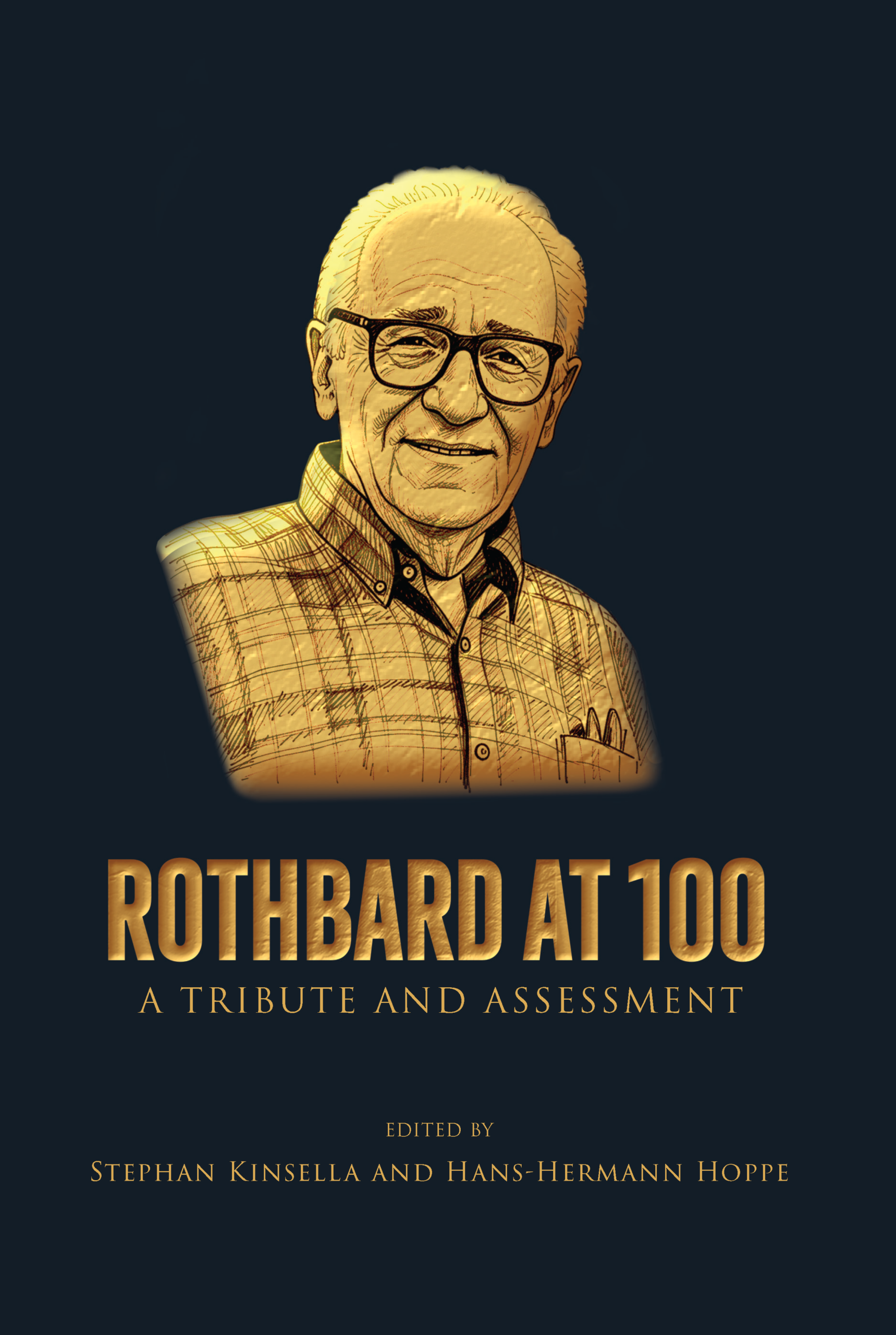
I am also also reminded of similar dismissive comment by Pete Boettke at Austrian Scholars Conference 1995, that Rothbard was merely a “popularizer” of ideas or something like this,3 leading to the infamous incident at ACS 1995 when Hoppe blew a raspberry at Boettke when he said this during his presentation at the big auditorium at the Auburn Hotel and Conference Center. In any case, such dismissive comments look only sillier with the passage of time, especially in this centenary year of Rothbard’s birth, events like 100 Years with Rothbard and his recent Gedenkschrift, Rothbard at 100: A Tribute and Assessment, Stephan Kinsella and Hans-Hermann Hoppe, eds. (Papinian Press and The Saif House, 2026). The influence and importance of Rothbard’s ideas on the libertarian movement has only grown.
***
Murray Rothbard and Liberty Magazine
Laurence Vance
edited transcript from Murray Rothbard and ‘Liberty Magazine, ASC 2012, Mises Institute, recorded March 10, 2012 (headers added by Grok)
Murray Rothbard and Liberty Magazine: An Overview
Murray Rothbard was at the forefront of the libertarian movement for over 40 years. During this time, he made and broke many alliances and wrote for every conceivable libertarian publication, including some of his own. One publication he was associated with from the beginning of its print run was Liberty Magazine. This paper examines the relationship of Murray Rothbard to Liberty Magazine, where he began as an editor and writer, and later became an object of criticism and ridicule.
Rothbard’s Enduring Legacy
I don’t know what I could possibly say about Murray Rothbard that has not been said about him at the Mises Institute for the past 17 years since his death in 1995. He was a student of Ludwig von Mises, a prolific author, an inspiring teacher, a revisionist historian, an astute political observer, the most comprehensive system builder within Austrian economics, a libertarian icon, and the greatest enemy the state ever had.
In the words of his greatest student, Hans-Hermann Hoppe, Rothbard has remained beyond his death, without doubt, the most important and highly respected intellectual authority within the entire libertarian movement. To this day, his rationalist, axiomatic, deductive Austro-libertarianism provides the intellectual benchmark by which not only everyone and everything within libertarianism is defined, but increasingly everyone and everything in American politics.
About Liberty Magazine
The print edition of Liberty Magazine was published from August 1987 until December 2010. It is now available only online. Each of the back issues is now posted online at the Liberty website and also at the Mises Institute website.
Liberty began as a bi-monthly, consistently publishing six issues a year. Beginning in 1999, Liberty generally appeared monthly. There were a total of 208 issues of the printed magazine produced. The founder, publisher, and editor of Liberty was R. W. Bradford, who also wrote under two pen names.
According to an editorial titled “Why Liberty” that appeared in the first issue, Liberty was to be a journal produced by libertarians for libertarians—a journal with the space and inclination to discuss issues that interest libertarians, written from an unapologetically libertarian perspective.
Founding Editors and Early Contributors
The original associate editors were Murray Rothbard, Douglas Casey, Stephen Cox, and Ross Overbeek. Rothbard, whom Bradford says “didn’t know me from Adam,” was the second person he contacted after his old friend from college, Stephen Cox.
Bradford says in his fifth anniversary retrospective, “How We Started Liberty,” that Rothbard was immediately interested and encouraging. Bradford also described Rothbard as “the best known of those involved in Liberty,” perhaps the most influential living participant in the libertarian movement, and “a first-rate writer who devoted incredible energy to shaping libertarian opinion.”
The editors settled on the name Liberty mostly by default, since the other names they considered seemed too cute or insufficiently descriptive. Future senior editors of Liberty included Carl Hess, John Hospers, and Harry Browne. Its many contributing editors over the years have included such libertarian giants as Ralph Raico, Sheldon Richman, and Robert Higgs.
Rothbard’s Editorial Tenure
Rothbard’s last issue as a senior editor was that dated March 1990. After Bradford’s death in December of 2005, Stephen Cox assumed the position of editor beginning with the March 2006 issue.
I first noticed Liberty sometime in the late 1990s on the magazine rack at my local Books-A-Million bookstore. I hesitated to subscribe after that because the subscription appeals I received in the mail attacked by name someone I knew and greatly respected, named Lew Rockwell.
After occasionally perusing Liberty for a few years at the magazine rack, I wrote my first article for Liberty in 2007, the second in 2009, and some short reflections during and after that time. After all the back issues of Liberty were posted online a year or so ago, I began looking through them—first to help fix the Liberty Archive on the Mises website, and then because of the great treasure trove of information about libertarianism and the libertarian movement that they contain.
Insights from the Archives
If you really want insight into the history of libertarianism, and especially the disputes and controversies among libertarians, read the back issues of Liberty Magazine. You may not like some of the things you read—like Rothbard modeled his approach to ideology and social change on those of Marx and Lenin, or one of the reasons I never became an acolyte of Murray Rothbard was his notion that he was Lenin and we had to obey. But in spite of that, you will learn a great deal about libertarianism.
Rothbard’s Pervasive Presence
One thing I quickly noticed in my reading of the Liberty back issues was the number of references to Murray Rothbard—not just when he served as an editor, but after his departure from the magazine in 1990, and even after his death in 1995. Although Rothbard was only associated with Liberty for 16 issues, he is actually mentioned in some way in 176 of the 208 issues that were printed. His enemies regularly invoke his name. Rothbard was certainly the most polarizing figure to ever be mentioned in Liberty.
We can see this in a couple of letters to the editor that appeared after the publication of Rothbard’s (in the words of R. W. Bradford) “delightfully vicious” article “Ronald Reagan: An Autopsy” that appeared in the March 1989 issue.
Here’s the first letter: “Cancel my subscription to Liberty immediately. I don’t want another issue. Reason: that diatribe against Ronald Reagan by Murray Rothbard was the most disgusting thing I’ve ever read.”
Now contrast that with this: “Kudos for Murray. Though I’ve been a critic of Murray from time to time, I think his greatest article to date is ‘Ronald Reagan: An Autopsy.’ It was pure Rothbardian excellence.”
Quantifying Rothbard’s Footprint
Murray Rothbard is mentioned 2,632 times in Liberty Magazine. I know because I counted, documented, and examined each and every occurrence of “Rothbard,” “Murray Rothbard,” “Murray N. Rothbard,” “Murray Newton Rothbard,” “MNR,” “Rothbard’s,” “Rothbardian,” “Rothbardians,” and just plain “Murray.” I might have missed a few references to Rothbard when he was just referred to by the pronouns “he,” “his,” or “him,” but I think I got all the direct references.
Rothbard is mentioned in every conceivable place in the magazine: on the cover, in the table of contents, in footnotes, in articles he wrote, in articles written by others, in reflections he wrote, in reflections written by others, in ads for books by Rothbard or others, or for back issues of Liberty, in letters to the editor, in indexes, in book notes and book reviews he wrote, and reviews of books by him, books about him, and books unrelated to him in any way.
Early Harmony and Promotion
All seemed well at the beginning of Liberty in August 1987. Rothbard had given Bradford permission to publish and use as a subscription premium his essay called “The Sociology of the Ayn Rand Cult.” Writing on Liberty’s fifth anniversary, two years after Rothbard’s departure, Bradford remarked about the bonus given to subscribers: “I have no doubt that it was an important factor in goosing the response to our advertising. We continue to use it from time to time, and it still pulls.”
Beginning with the November 1988 issue, Rothbard’s essay was instead offered for sale for $4. This continued off and on for the next 20 years.
Another way that Rothbard endured in a subtle way throughout the pages of Liberty was in regular ads for back issues of the magazine that mentioned the title and author of articles in each issue. Rothbard’s name appeared on the cover of the first issue to promote his article endorsing Ron Paul for president in the 1988 election. Of the sixteen issues of Liberty that Rothbard was associated with, his name graced the cover of 13 of them. After his departure from the magazine, Rothbard appeared on two more covers: the first was in the March 1995 issue that contained a tribute to him upon the occasion of his death, and the second was in 2004 when Liberty reprinted his “Ronald Reagan: An Autopsy” as part of a symposium on Reagan after the former president’s death.
Rothbard’s Contributions
During his 16-issue period of association, Rothbard authored eleven full-length articles, twenty-two short reflections, five interviews or editorial commentaries, one book notes column, and one book review. Only in the May 1988 issue did Rothbard not have something he wrote appear, although he is mentioned 35 times by others in that issue.
Ads for the Center for Libertarian Studies appeared in the first two issues of Liberty, followed by ads for the Mises Institute in the next 14, and an ad for the Rothbard-Rockwell Report in the March 1990 issue, the final issue that Rothbard was associated with.
Early Dissent and Open Debate
In 1988, Rothbard talked to an interviewer about Liberty: “The libertarian movement was beginning to crumble before Liberty was founded. Everybody was so concerned with talking to the outside, to Democrats or Republicans or whoever, that we forgot to develop our own thinking, our own ideology, our own point of view.”
This does not mean that there was no dissent from Rothbard’s views in the pages of Liberty. But aside from the denigration of Rothbard in letters to the editor, there were only three criticisms of Rothbard by name to appear in the magazine when he served as an editor, and only one of them was a whole article devoted to rebutting something he had written.
David Brown criticized Rothbard in a 1988 piece over his hostility to Rand. Jeffrey Friedman criticized Rothbard’s style of libertarian thought in the May 1989 issue. Also in that issue is a rebuttal by an environmentalist to an earlier piece by Rothbard on environmentalism. Rothbard and Bradford replied to Friedman in the next issue. Here Bradford defended Rothbard against Friedman’s charge that he has worked to make libertarianism into a narrow, dogmatic philosophy.
In Bradford’s analysis, he sheds some light on Rothbard’s early relationship with Liberty and its editor: “Rothbard has contributed both his advice and writing freely, written a letter soliciting subscriptions, helped us recruit writers, and made frequent editorial suggestions. All this he has done on behalf of a journal that explicitly opens itself to the full range of libertarian thinking, including frequent criticisms of many of his own passionately held beliefs.”
Philosophical Differences
On more than one occasion he has told me that some essay or another that we have published, including some written by me, have infuriated him. He has criticized my editorial judgment once or twice, but on no occasion has he suggested that we change Liberty’s open editorial policy.
In the September 1989 issue, Bradford favorably reviewed Man, Economy, and Liberty. The only controversy between Rothbard and Bradford during this time appears to be over Rothbard’s steadfast adherence to the non-aggression principle. Bradford had written an article in the second issue of Liberty in defense of Robert Nozick, in which he criticized moralistic libertarians and a libertarianism based on the morality of the non-initiation of force. Rothbard replied in the next issue. Bradford responded to Rothbard’s reply and to the criticism of others in the following issue.
There he accused Rothbard of not addressing his central argument that the non-aggression axiom is unsatisfactory as a basis for libertarian theory. This was followed by Bradford’s article “The Two Libertarians” in the May 1988 issue. There he advocated a consequentialist libertarian position contrary to Rothbard’s moralist libertarianism. Although a major rebuttal to this was penned by Sheldon Richman in the September 1988 issue, there was nothing forthcoming from Rothbard.
This difference of opinion was not personal. For as Bradford explained in his 10th anniversary editorial in the September 1997 issue, “From the start Murray understood that Liberty would be open to all libertarian opinions and would make no attempt to follow the well-hewn Rothbardian line. At my first meeting with him, I warned him of my disagreement with much of his political theory and suggested that I might publicly disagree with him from time to time. This he accepted joyously. He always shared his pungent and powerful opinions, and cheerfully accepted the fact that sometimes his advice was not followed.”
The Rift and Later Criticism
By 1990, though, things between Bradford and Rothbard were not going so well. In his 10th anniversary editorial, Bradford maintains that Rothbard told him as early as 1987 that he was thinking of abandoning libertarianism in favor of the political right. And in 1989, says Bradford, Rothbard had decided, along with Lew Rockwell, to join his erstwhile enemies, the conservatives, after going through a phase as a paleo-libertarian.
Bradford insisted that his relationship with Rothbard during this time remained cordial, and that he continued to contribute to each issue. But after the publication of Rockwell’s “A Paleo-Libertarian Manifesto” in Liberty’s January 1990 issue, things went downhill. Bradford asserts that he received a fax from Rockwell telling him that Murray had decided that he wouldn’t be writing for Liberty in the future and would like to resign his position as senior editor. Even so, Bradford claims that his relationship with Rothbard still remained cordial, even as his relationship with Rockwell had deteriorated.
Between this time and Rothbard’s death in 1995, Bradford maintains that he and Murray spoke occasionally, even though he heard from time to time that Rothbard had denounced him in the pages of his newsletter.
Post-Death Criticisms and Tributes
Because of the lack of time, I can only briefly mention some of the men and instances and refer you to my full paper when it is published. Rothbard was criticized most viciously in the pages of Liberty by David Ramsay Steele and Mark Skousen. Some of the criticisms are so ludicrous that I don’t think I could read them through without laughing—like Steele’s statement that Rothbard wasn’t an outstanding thinker and made no lasting contributions to any branch of thought, or Skousen’s claim that today Friedman’s influence is ten times Rothbard’s.
In light of the current events regarding the Cato Institute, I should also mention that in an interview with Cato’s president, Ed Crane, in Liberty’s November 1990 issue, Rothbard’s name comes up quite a bit. Crane faulted Rothbard for the unwillingness to pay any respect to people who disagreed with him. He also charges Rothbard with intolerance: “There’s always been a kind of, I don’t want to say racist, a very intolerant attitude among people like Rothbard and Rockwell on ethnic and cultural matters, and even on the question of sexual diversity.” Crane concludes about Rothbard, “I’m a little disappointed that Murray seems to be so motivated by hatred of all the enemies that he sees out there. I don’t advise anyone to get on his wrong side.”
After Murray died in January 1995, there appeared a tribute to him in Liberty’s March 1995 issue, consisting of short remembrances by Gary North, Ron Paul, Sheldon Richman, Robert Higgs, and of course Liberty’s editor. However, Bradford’s assessment of Rothbard’s influence was premature. In the end, this is Bradford: “his influence on libertarians waned, partly because of his apparent retreat toward his old nemesis, the political right, partly because of his increasing relish for ideological infighting, and partly because a new generation of libertarian intellectuals found his brand of libertarianism too simplistic.”
Conclusion
I think that now in 2012, 17 years after Rothbard’s death, that his influence is stronger than ever. And it is the influence on libertarians of R. W. Bradford that has waned.
Thank you.
- Libertarians unfortunately somewhat becoming a pejorative. Re the dysfunctional Mises.org website, see Kinsella, “My Years with the Mises Institute,” Property and Freedom Journal (May 2, 2026), section “Pointless Name Changes, Website Changes, and Journal Confusion.” [↩]
- From “Rothbard Remembered,” Liberty (March, 1995): 20–26. [↩]
- See also Peter J. Boettke, “Economists and Liberty: Murray N. Rothbard,” Nomos (Fall/Winter (1988; pdf2): 29–34, 49–50. [↩]
Discover more from The Property and Freedom Society
Subscribe to get the latest posts sent to your email.

















 Alessandro Fusillo
 Andreas Tögel
 David Dürr
 Doug French
 Fernando Chiocca
 Greg Morin
 Hans-Hermann Hoppe
 Jay Baykal
 Jayant Bhandari
 Jeff Deist
 Jeffrey Barr
 Juan Fernando Carpio
 Ken Yamarashi
 León Isidoro
 Martin Cabrera
 Nick Hoppe
 Oscar Grau
 Peter Wong
 PFS
PFS scholarium
 Saifedean Ammous
 Sean Gabb
 Sean Ring
 Stephan Kinsella
 Stéphane Geyres
 Thomas Jacob
 Tom DiLorenzo