Why Is the Austrian School Anti-Democratic?
November 26, 2026
Written by Austrian School Lao Gu in Guangdong Province, China at 11:01 a.m. on 8 November 2026
The title is, admittedly, a little sensationalist. Mises was not opposed to democracy, and Rothbard never offered a detailed critique of democracy as a political system in its own right.1 The leading Austrian economist to make the case against democracy was Hans-Hermann Hoppe, one of the most influential contemporary scholars in the Austrian School, and also one of its most controversial.
Hoppe went so far as to state explicitly that monarchy is superior to democracy.2 This sounds counter-intuitive not only to people outside the Austrian School, but also to many within it. His position has consequently attracted considerable criticism, and has even led to a parting of the ways between Hoppe and another group of Austrian economists.
Empiricists, of course, find the argument even harder to understand. There have been countless brutal monarchs throughout history, so on what grounds can anyone claim that monarchy is superior to democracy?
Mises, by contrast, clearly explained the advantages of democracy. He argued that democracy prevents political competition from leading to civil war. That, he said, is its greatest advantage: competing for political power does not require the use of force.3
I would argue, however, that Hoppe has not fully developed his own theory.
When making the case for the superiority of monarchy over democracy, Hoppe relies primarily on the theory of time preference. His argument is that politicians under democracy are essentially tenants. They have little incentive to think in the long term, and are therefore more inclined to consume resources in advance and destroy capital. Under monarchy, by contrast, the ruler is a long-term tenant, with a lower time preference and a greater inclination towards long-term plunder. In other words, the incentive structures of the two systems are different.
But I do not think it is enough for Hoppe to stop there. He needs to explain more thoroughly the nature of democracy itself, as well as the methodology used to analyse political institutions.
Hoppe defines democracy simply as a system of caretaker rule under a form of public government. In this system, governing authority is divided and periodically transferred, but there is no actual monarch, no owner, who takes responsibility for the long-term survival of the system.
I think there is something further we can add to make Hoppe’s theory more complete.
I. The Essence of Democracy Is Polycracy
In Hoppe’s argument, he does point out that democracy is a form of public government. He also notes that politicians have high time preferences and are effectively short-term tenants who do not think about the long term. What he does not explain clearly, however, is that under democracy, politicians’ behaviour is not determined entirely by politicians themselves. It is determined by the groups that prevail in the battle for public opinion, together with the interest groups capable of influencing political decisions.
In other words, whether politicians are short-term or long-term tenants is merely the outward appearance of political behaviour under monarchy and democratic republicanism. The underlying reality is that, under democracy, political power is open to everyone who can compete for it. The real contenders are the opinion-forming groups that prevail in public debate, and the various interest groups.
Opinion groups exert political pressure by mobilising public opinion. This includes the waves of public sentiment generated by the media and intellectuals, as well as the political pressure created by demonstrations and protests. These are all means of competing for power. Such groups acquire influence by applying pressure through public opinion.
Interest groups, meanwhile, operate through what might be called a deep-state model. They lobby politicians to establish mechanisms that protect their privileges. For example, they may secure a special market position for a particular industry, or persuade the government to suppress its foreign competitors.
The real monarchs are in society, not the politicians sitting in the seats of government.
If the real monarchs are in society, then the theory of time preference alone is not sufficient to explain the shortcomings of democracy. The opinion groups and interest groups within society have long-term positions to defend. They do not face term limits.
The real problem is that, under polycracy, if you do not compete for power, you become the one being dispossessed. Power is the One Ring. At its core, power is a mechanism for transferring wealth: the interests of one group are sacrificed to satisfy those of another.
In a system that actively encourages competition for power, and in which the winners can successfully seize benefits while the losers suffer the consequences of subjection, it is inevitable that everyone will seek to acquire power.
On the surface, what we see is a two-party or multi-party political system. It may appear that the politicians belonging to the victorious party are the ones who win and benefit from the struggle. But that is not really what happens.
Suppose the Democratic Party wins an election. The ordinary people demanding a substantial increase in taxes on billionaires then become the victors. They get to claim a share of the wealth belonging to the rich, allowing them to improve their own living standards in the short term.
Do these ordinary people become monarchs because their time preferences lead them to seize the wealth of the rich? Of course not. The problem is still that they cannot see the long-term consequences of expropriating the wealth of the rich.
There is another reason, too. If these ordinary people do not call for the plunder of the rich, they may find themselves on the receiving end of plunder instead. Inflation, driven by financial interest groups, is continually stripping ordinary people of their wealth.
When political power is open to everyone, failing to acquire it means becoming a victim. That is the logic of the system.
The theory of time preference can certainly explain some politicians’ behaviour. Under democracy, politicians make their immediate political decisions according to whether those decisions will help them continue to win votes. The system does not allow them to think and plan for the long term. But the more important point is that democracy is fundamentally an open system of political power. It is a form of polycracy, with monarchs spread throughout every corner of the country. Its structure systematically encourages everyone to participate in the struggle for power.
Ancient monarchs might prohibit people from engaging in certain activities on the basis of a particular ideology or personal preference. They might ban a particular form of entertainment, or even forbid people from wearing certain kinds of clothing.
Under modern democratic republicanism, however, voters can even seek to prohibit other groups from gambling or playing video games. Everyone can use political power to impose their own preferences on other people. Someone living in a remote small town can participate in public debate, cast a vote, and ultimately discover that their wish to prohibit other people’s behaviour has actually been realised through the political system.
For example, supporters of the Republican Party have successfully prevented large numbers of American women from having abortions. They have also, in the past, succeeded in putting gay men in prison.
Everyone enjoys that particular thrill of exercising power.
I disapprove of your gambling, prostitution, drug use, homosexuality, abortion, drinking, smoking, or any other lifestyle choices I regard as undesirable. Through political power, I can make you live according to my preferences.
The greater problem, therefore, is the structure of political competition created by polycracy. It drives changes throughout society. Everyone comes to realise that there are numerous ways of acquiring power: making a public statement, casting a vote, taking part in a social-media discussion, or posting a comment. All of these are forms of political participation and, ultimately, of competing for power.
At this point, the theory of time preference can also be used to explain the behaviour of these monarchs within society.
These civil-society monarchs have neither the titles nor the fixed terms of office enjoyed by politicians. They might appear to be monarchs with unlimited tenures, but in reality their time preferences can be considerably higher than those of politicians in government.
That is because the struggle for power takes place during every debate over public policy. Each participant in public opinion and each voter has, in effect, a tenure that lasts only for an instant. They do not even know whether they will hold power at the next opportunity. Indeed, they may not know whether the restrictions they advocate will be implemented this time round.
The result is that politicians under democracy have lower time preferences than the monarchs within society. At the very least, democratic politicians have terms of office lasting several years. They may also have party interests to consider.
Take Trump, for example. Is he free to do absolutely as he pleases during the final two years of his term? No. The people working under him still have elections to win and political careers to protect. If he completely abandons all restraint, those people may turn against him and distance themselves from him.
Look at politicians across Europe, too. They are actively cutting welfare benefits because, while in office, they need to avoid a full-scale social crisis. They have to ensure, for example, that pensions continue to be paid. Otherwise, countless elderly people will turn on them. Given limited public finances, this means cutting spending on education, healthcare and other welfare provision.
And how does the public respond? They do not care how much money the government has. Cutting welfare is simply wrong. The civil-society monarchs do not consider the state of public finances at all. Their demand is that the existing benefits must continue to be paid in full, with no reductions whatsoever.
After Greece’s debt crisis, the government was forced to implement austerity under the constraints imposed by the EU. The result was massive demonstrations and protests. So whose time preference was higher in this situation? Obviously, that of the civil-society monarchs.
Consider, likewise, the employees of Samsung and SK Hynix. After seeing their companies make money, they organise themselves and demand to seize corporate wealth. Large numbers of employees receive millions in plundered wealth, while the shareholders bear the losses. Politicians, meanwhile, must face a deteriorating local business environment and falling tax revenues. But do the employees care? Once they have got their hands on the money, what does it matter if South Korea goes to rack and ruin? They can simply move to another country.
Under polycracy, then, politicians with high time preferences are not merely the short-term tenants in government. The greater problem lies with the civil-society politicians who cannot see the consequences of their demands, and with ordinary people who, as monarchs within the system, simply do not care about the fate of everyone else in their country. Their time preferences are even higher.
Just look at trade union movements around the world. Ports shut down, bus services stop, and even police forces and hospital systems can grind to a halt. How much do these people care about the livelihoods and future of everyone else in their own country?
Politicians in public office would not dare to behave in quite this way. Even when they collude with interest groups in practice, their public rhetoric has to maintain that they are protecting everyone’s interests. Trade union groups, by contrast, treat the interests of others as worthless.
For this reason, I do not think Hoppe’s argument goes far enough when it focuses only on the short political tenures of politicians.
My conclusion is that monarchy effectively prevents political competition, reduces the number of monarchs, and, more importantly, keeps large numbers of people with high time preferences, and no responsibility for the consequences, out of politics. As a result, its plunder is more likely to take place over the long term rather than the short term.
An analysis based solely on time preference is not enough to explain the distortion of the incentive structure under democracy.
There is another important dimension: the relationship between political power and responsibility for its consequences.
In Hoppe’s argument, politicians can saddle a country with enormous debts without having to bear the cost themselves. They can exercise power at will, printing money and accumulating debt, for example, while the consequences are borne by future generations and the population as a whole. They themselves face no consequences. This incentive structure of short-term politics encourages politicians to use precisely these methods.
That is certainly correct, but the argument needs to go further.
When we analyse the civil-society monarchs under polycracy in the same way, we find that they are even less likely to bear responsibility for the consequences of their actions.
They compete for power through lobbying, demonstrations, media campaigns and all sorts of other means. Yet every order to confiscate other people’s property or issue more currency is ultimately issued by a particular politician in government. If something goes seriously wrong, that politician still faces political consequences. The war with Iran, for example, led to a disastrous performance for Trump in the midterm elections.
But what about the civil-society monarchs? Whatever they advocate, whatever they demand, they never, ever face any political consequences.
What is more, civil-society politicians can sometimes secure substantial direct benefits simply by expressing their views in public. Media intellectuals may be hailed as voices of conscience. Conservatives may receive social approval from people who share their values. When an activity offers nothing but rewards and no political consequences, of course people will engage in it.
Some media intellectuals and agitators have even become online influencers as a result, making enormous amounts of money. Yet if their actions lead to disaster, not one of these civil-society monarchs will accept responsibility and say, “This was my fault.”
That is because the person who actually issues the orders is the politician in government.
Today, amid Europe’s welfare crisis, has any ordinary European citizen stood up and said, “I was partly responsible. I helped promote the public demands for welfare benefits, and I took part in calls to seize corporate wealth”? Of course not.
People attribute every disaster to the politicians they elected.
At the level of assigning and pursuing responsibility, therefore, polycracy has effectively become a paradise for people who can do whatever they like, issue instructions as they please, and undermine the economy without having to answer for it.
Some people always emphasise that, under democracy, politicians who perform badly can simply be replaced. But how, exactly, are you going to replace Europe’s environmentalists? How are you going to replace the workers in America’s swing states who demand trade protectionism? Can you replace the real monarchs within society? What about American port workers, who repeatedly threaten to bring the country’s logistics system to a standstill? How are you going to replace them?
They are all monarchs.
Under democracy, simply replacing the nominal people in charge through the formal mechanisms of the system cannot improve politics.
Improvement is possible only when public opinion broadly accepts equality before the law, rejects privileged interest groups, and recognises that its own demands may be harmful to its long-term interests. In other words, what needs to change is the mindset of the civil-society monarchs.
II. The Level of Public Opinion
Within Hoppe’s framework, exploitation under monarchy is clear and visible. Its source is the clearly defined structure of ownership.4
The monarch is regarded as the private owner of the state. All the resources he requisitions belong to him personally, both in law and in practice. In other words, this kind of expropriation resembles a robber stealing money. Everyone can see perfectly clearly who benefits and who is being robbed.
This clarity of property rights, paradoxically, creates a constraint.
When redistributing wealth, a monarch faces an ideological risk.
He must also defend the legitimacy of private property. Otherwise, if he casually violates that principle, he may provide other monarchs, such as King George or King Henry, with a pretext for coveting and seizing his own property.
Consequently, a monarch’s plunder is usually subject to some restraint. Redistribution is more likely to take the form of privileges or rewards granted to a small number of successful individuals, rather than a systematic policy of robbing the rich to pay the poor.
After all, the way for another potential monarch to attack him, or to rally support for replacing him, is to launch a public campaign accusing him of breaking the rules and taking too much.
More importantly, because expropriation under monarchy is so obvious and clearly identifiable, the monarch also faces widespread resistance.
Monarchy is not merely a political system based on perpetual hereditary succession. It is also a system with a distinctive ideological character.
Consider whether there are long-serving rulers under republican systems. Of course there are, and quite a few.
But does long-term rule automatically make someone a monarch? No.
The ideological character of monarchy is that the country belongs to the monarch. He enjoys the tribute of his subjects and lives in luxury. The dispossession of the population is treated as perfectly natural. These are the ideological characteristics associated with monarchy itself.
Politicians under republicanism do not possess these ideological characteristics.
The King of Saudi Arabia can travel abroad in a golden lift and openly flaunt his wealth. Politicians under republicanism would not dare to do the same. Their accumulation of wealth cannot be made public, nor can it become an undisputed and universally accepted fact.
This characteristic produces widespread resistance to expropriation among the population under monarchy.
To prevent kings from imposing a window tax, under which people were taxed according to the number of windows in their homes, people across Europe bricked up large numbers of their windows.
Whenever taxes increased, public opinion would generally turn against the royal authorities, accusing them of excessive expropriation.
In other words, the plunder carried out under monarchy is visibly oppressive and unjust. It is easy to identify, and therefore becomes an obvious target for resistance and opposition.
Democracy, however, completely removes this protective barrier of visibility.
Under democracy, those responsible for redistribution, the politicians, do not have to act as defenders of private property. They can openly embrace the language of public ownership and the public interest, because their authority no longer comes from inherited ownership. It comes from the supposed will of the people, expressed through elections.
This creates a crucial ideological transformation.
In the democratic era, exploitation and expropriation through taxation and legislation no longer look nearly as oppressive or evil. They have been institutionalised and disguised by a particular vocabulary. Yet tax rates can be far higher than those imposed under monarchy.
Both Europe and the United States have at various times imposed top marginal personal income tax rates exceeding 80 per cent. The monarchs of earlier periods could hardly have imagined such a thing. How could anyone possibly enforce tax rates of that scale?
And during wartime, democratic republics can conscript the lives of their populations on an enormous scale, sending them to the battlefield. This is another extraordinary political manoeuvre that monarchs would scarcely have imagined.
Democracy has institutionalised exploitation and concealed it behind the language of equality and representative government.
The concealed nature of exploitation under democracy comes from the fact that it disperses the agent of plunder from a single person, the monarch, into an entire system: representative government and coalitions of the majority.
When taxation and redistribution are presented as a social contract, public welfare or national development, the individual’s sense of being dispossessed becomes fragmented and abstract.
You can identify a particular king and make him the target of your resistance. But it is much harder to resist a system, especially when that system claims to represent you.
The visibility of exploitation is itself a constraint. Under monarchy, the visibility of expropriation forces the ruler to exercise a degree of self-restraint in order to preserve the appearance of legitimacy.
Under democracy, ideological camouflage removes that visibility and thereby eliminates the constraint imposed by public perception.
The result, as Hoppe argues, is that democracy has institutionalised short-term exploitation and decline. A system that continually destroys wealth in terms of its real opportunity costs can keep operating beneath the narratives of democracy and equality, until the bill is finally presented to the next generation.
III. Methodology
The way Hoppe argues for the superiority of monarchy over democracy is, in fact, an application of the method of imaginary construction.
The method of imaginary construction is one of the central tools of Misesian praxeology.5 It is a tool for thinking and for constructing arguments. It involves abstracting certain conditions from real human action and constructing, in one’s mind, a logically coherent model that could not exist in reality. This model can then be used to derive the fundamental categories of action.
The defining feature of an imaginary construction is that it does not describe reality. It isolates variables.
By removing the various factors that are mixed together in the real world, the a priori laws of praxeology can be seen more clearly within a purified model.
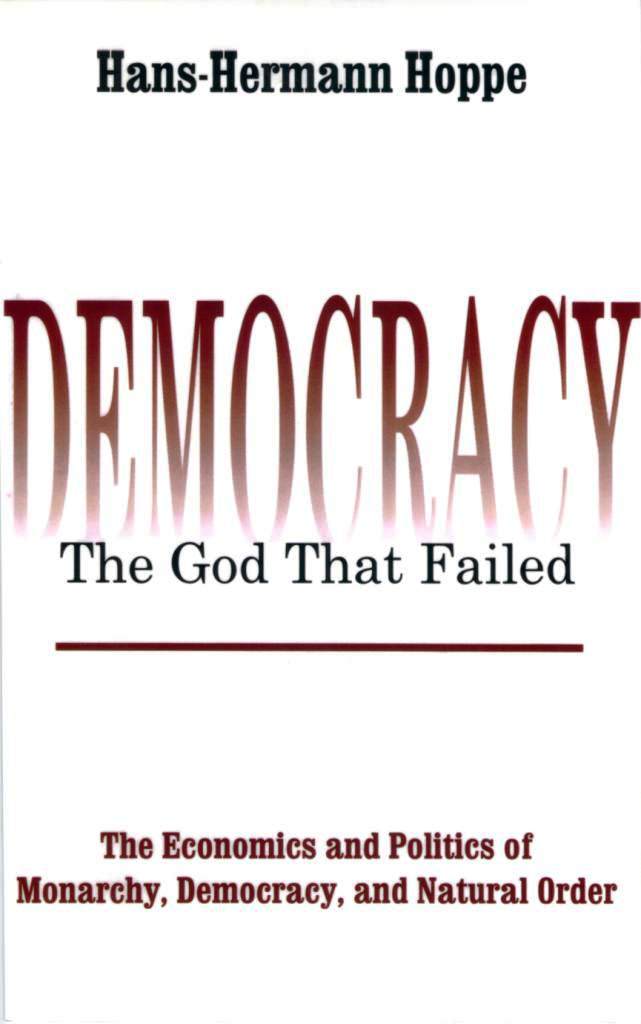
The central argument in Hoppe’s Democracy: The God That Failed is built around a dichotomy between private government and public government.
He models monarchy as private government. The monarch owns the state and possesses an ownership interest in its capital value. Hereditary succession lowers his time preference and gives him an incentive to preserve the productive foundations of the state over the long term.
He models democracy as public government. Politicians are caretakers or tenants. They do not own the future value of public assets, and their terms of office are limited. Their optimal strategy is therefore to maximise what they can extract during their time in office, rather than to preserve the system.
Both models are pure types constructed by abstracting away the mixed factors found in reality. The purpose is to isolate the variable of ownership structure and observe how it independently shapes the incentives of those who govern.
Anyone familiar with the philosophy of scientific methodology will immediately understand the point.
In the natural sciences, researchers necessarily isolate different environmental conditions so that they can repeatedly test, through empirical observation, the effects produced by a single variable. This is called experimentation. It allows them to establish a particular causal relationship through the method of induction.
Research in the social sciences works in much the same way. The variables influencing human behaviour in society are also virtually unlimited. But social scientists cannot isolate variables in the same way as natural scientists. Instead, they use the mind to construct pure forms of logical reasoning in which all other variables have been excluded.
The objection most commonly raised by critics is to point to the scale of the disasters under monarchy and use them to refute Hoppe’s theory. Hoppe did not explain his methodology in sufficient detail in the book, and this has consequently led to a great deal of misunderstanding.
Put simply, Hoppe is saying that, with all environmental variables held constant, changing only the institutional arrangement from monarchy to democracy will increase politicians’ time preferences.
His argument follows the same method as the proposition that those who own property have a greater incentive to think long term.
That proposition is also an argument based on imaginary construction.
For example, imagine two environments. In environment A, nobody owns private property and nobody possesses lasting assets, as under a centrally planned economy. In environment B, everyone knows that the world will be destroyed tomorrow, but everyone owns private property. In which environment would people show greater long-term commitment?
The people under the planned economy, of course. At least they know that the sun will rise tomorrow and that they still need to make plans for the future.
But even under the same end-of-the-world scenario, people who own private property and people who do not will still have different time preferences. Under an institutional arrangement in which people possess lasting property, they will continue to show greater long-term commitment than they would in an arrangement without private ownership, even if that difference amounts to only an extra minute or an extra hour of forward thinking.
In other words, Hoppe is not saying that countries with democratic systems are inferior to countries with monarchical systems. The condition of a country is determined by countless variables. He is simply saying that, under otherwise identical conditions, the monarch’s time preference is lower than that of a democratic politician.
Some people point to historical examples of monarchs ruthlessly plundering their populations and imposing unlimited taxes in order to refute Hoppe. This is a misunderstanding of the methodology.
Under monarchy, when foreign enemies invade or civil wars erupt, the monarch’s time preference changes. At that point, the change in time preference is not caused by the institutional arrangement. It is caused by a change in the external environment.
To protect his political position, the monarch resorts to every possible means of preserving his regime. This simply shows that the monarch’s time preference is also influenced by another factor: the possibility of losing his position entirely, or even being killed.
In ancient China, monarchs who lost their political positions were generally destined to be killed, sometimes along with their entire extended families. If someone threatens to seize his position, it is only natural that the monarch will resort to every available political means to expropriate the wealth of the population and maintain his rule. The result is a form of frenzied political behaviour in which no cost is considered too high, and time preference rises to an unprecedented level.
This is a characteristic of monarchy that Hoppe overlooks in his argument.
He discusses only one attribute of the monarchical system: perpetual hereditary succession. In other words, the monarchy described in Hoppe’s framework is itself an unrealistic, pure institutional model. It is another imaginary construction.
Within this construction, monarchy is a system that faces no political threats and, once established, continues indefinitely. But real-world monarchies also face political threats. Other monarchs, and potential monarchs, are constantly looking for opportunities to replace the incumbent. In political competition between monarchs, the effect on an individual monarch’s time preference can be far greater than the effect on politicians under republicanism.
Under republican systems, politicians can also face severe consequences for failure. South Korea, for example, has seen politicians face imprisonment after losing power. But compared with the threat of execution or the extermination of one’s entire family in a struggle between monarchs, the effect of such consequences on time preference is still much smaller.
Hoppe’s argument, therefore, screens out this environmental variable associated with monarchy.
His model of private government discusses the issue purely at the institutional level. It isolates a variable that, in reality, has almost never existed in a stable form. Within this model, the monarch’s ownership is secure. He needs to worry only about the depreciation of his assets, not about being physically removed from his position as owner.
But for the vast majority of monarchs throughout history, the latter was precisely their primary concern.
Succession to the khanate in the nomadic empires of the steppe rarely resembled the situation in Hoppe’s model, where a father passes power to his son and the new ruler calmly sets about maintaining the value of his assets. It was much closer to a continuous struggle for survival, in which entire families competed to avoid elimination.
After the Ögedei clan lost the struggle for the khanate, Möngke’s purge was not simply a matter of stripping people of their political rights. A total of 76 princes descended from the Golden Lineage were taken to a riverbank and beheaded together, while hundreds of women from their families were distributed among the victors as slaves.6
After Esen had lured and killed Agbarjin, he “put to death all the members of the Golden Lineage”, becoming the first khan who did not belong to that lineage. Following Kublai’s suppression of Nayan’s rebellion, historical accounts record that “not a single person remained alive” among Nayan’s people, or ulus.
In these cases, the owners of capital, together with all their biological heirs, were effectively wiped out in a single stroke.
A monarch operating within this kind of competitive structure cannot have his time preference lowered by the expectation of perpetual inheritance. Perpetual succession is itself an extremely unstable assumption in steppe politics.
His rational strategy is not to preserve an asset over the long term when it might no longer belong to his family tomorrow. It is to extract everything he can before being eliminated, converting it into immediate military strength and loyalty.
In other words, the instability of monarchy under different environmental conditions is an established fact.
Between AD 600 and 1200, 21.8 per cent of European monarchs were killed by their own subjects. Even between 1200 and 1800, the proportion remained at 6 per cent.7
Another set of earlier aggregate figures is even more striking. Among the monarchs included in the data, 364 were deposed, 108 were sentenced to death and executed, 123 died in war, and 21 committed suicide.8
Edward II was deposed and murdered at Berkeley Castle. Richard II died in captivity after being deposed. Henry VI was killed in the Tower of London. Edward V disappeared after being sent to the Tower. Charles I was publicly tried and beheaded.
If a monarch knows that there is a significant possibility of being deposed, imprisoned or killed, the incentives associated with ownership are severely weakened.
The monarch in Hoppe’s model cares about the value of his assets because the model assumes that he will still occupy the same position tomorrow.
But the expropriatory and coercive nature of monarchy, together with its concentration of power in a single position, can attract considerable political competition under different environmental conditions. This is an environmental variable that Hoppe does not discuss sufficiently in his analysis of monarchy. I would nevertheless argue that Hoppe is still not wrong.
The reason is that once we introduce a second variable, namely the political environment in which the monarch operates, we can no longer derive a clear conclusion.
From a methodological perspective, economic theory can analyse only the consequences produced by a single variable. Once another variable is introduced, the argument can no longer be regarded as a theory of the same kind.
Political competition faced by a monarch is not an institutional factor in itself. It is an environmental factor, depending on the external conditions confronting the monarch, including the prevailing intellectual climate, the international environment and so on.
The rise in time preference among so many monarchs throughout history was precisely a result of brutal political struggles. In order to protect their positions, they naturally came to prefer the present over the future. After all, time preference is about the fact that you have to survive today before you can have a tomorrow.
If the external environment is hostile, and a monarch might be driven from power today, with his entire family killed, how could he possibly have a low time preference?
To understand Hoppe’s theory, therefore, we also need to understand a basic point of methodology: the method of imaginary construction. It allows us to analyse how a single variable affects the rise or fall of time preference.
Hoppe is not claiming that the actual operation of monarchy, under every possible combination of environmental variables, will produce better results than democracy. He is analysing the institutional arrangement of monarchy in isolation.
That is why it is difficult to understand Hoppe’s theory without some familiarity with economic methodology.
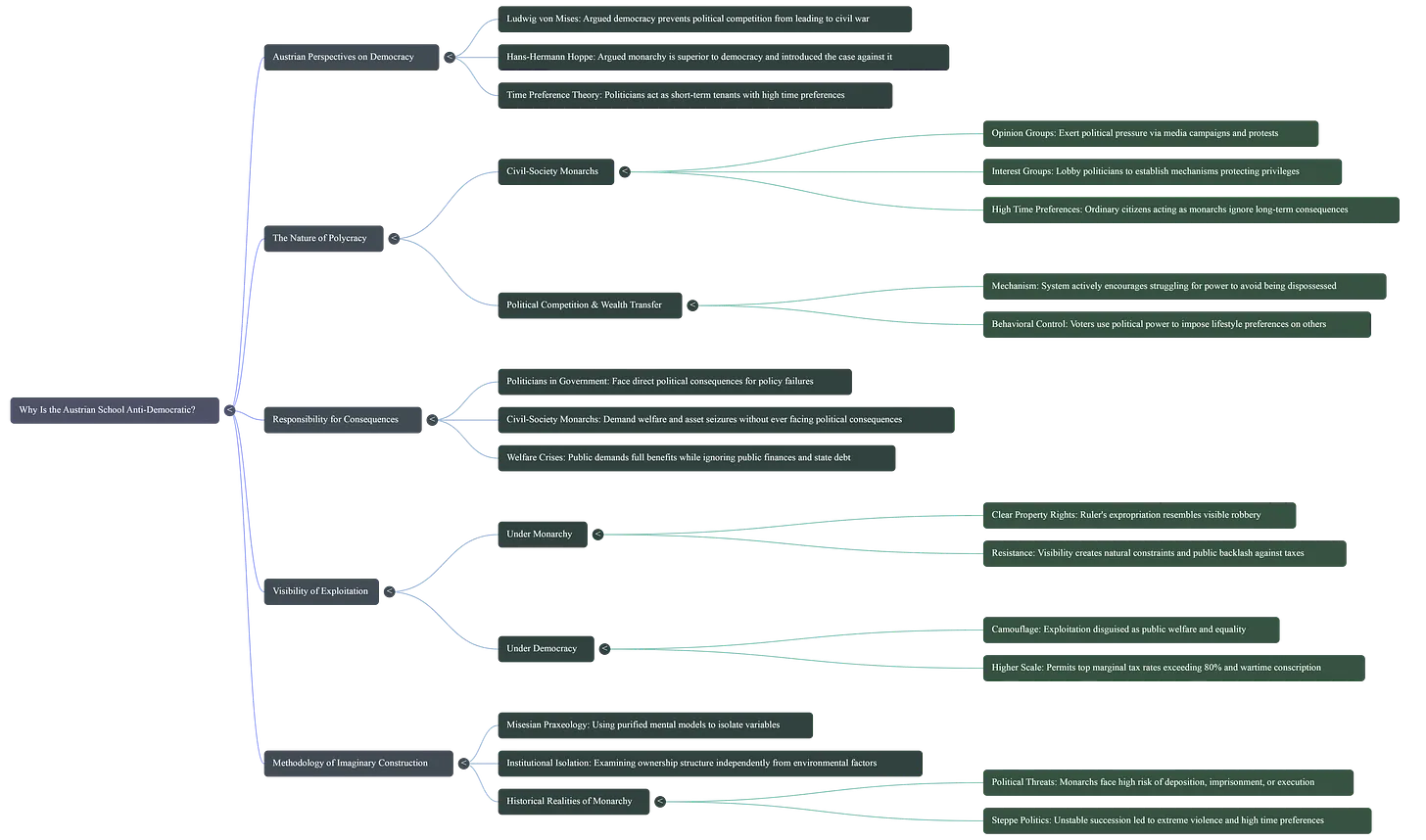
Mind map of the essay’s argument, from the original Substack post.
Endnotes
* Austrian School Lao Gu writes on Austrian economics and libertarian theory in Chinese; his essays appear in English translation at the Ludwig von Mises Substack. This article was originally published as “Why Is the Austrian School Anti-Democratic?,” Ludwig von Mises Substack (Nov. 8, 2026), translated from the Chinese original, written in Guangdong Province, China (Nov. 8, 2026). Republished with permission. The Substack’s editors drew PFS’s attention to the essay, and invited Professor Hoppe’s corrections, in a note appended to Lao Gu’s “A Whopping Loss,” Ludwig von Mises Substack (Nov. 25, 2026), reprinted as “Lao Gu on the Welfare State’s Whopping Loss,” PFS Blog (Nov. 26, 2026). Endnotes 1–8 were added by the editor, who also made minor stylistic changes. See the accompanying blog post “Lao Gu: Why Is the Austrian School Anti-Democratic?,” PFS Blog (Nov. 26, 2026), for related information; audio.
1 Rothbard did, however, criticize Mises’s “peaceful change” argument for democracy in Power and Market. See David Gordon, “Mises and Rothbard on Democracy,” Mises Wire (Aug. 21, 2020). —Ed.
2 See Hans-Hermann Hoppe, Democracy—The God That Failed: The Economics and Politics of Monarchy, Democracy, and Natural Order (New Brunswick, N.J.: Transaction Publishers, 2001), esp. ch. 1, “On Time Preference, Government, and the Process of Decivilization,” and ch. 2, “On Monarchy, Democracy, and the Idea of Natural Order”; see also idem, “The Political Economy of Monarchy and Democracy, and the Idea of a Natural Order,” Journal of Libertarian Studies 11, no. 2 (Summer 1995): 94–121. —Ed.
3 See Ludwig von Mises, Liberalism: In the Classical Tradition, ch. 1, § 8, “Democracy”; idem, Socialism: An Economic and Sociological Analysis, ch. 3, § 2, “The Social Function of Democracy.” —Ed.
4 See Hoppe, Democracy—The God That Failed, ch. 3, “On Monarchy, Democracy, Public Opinion, and Delegitimation.” —Ed.
5 See Ludwig von Mises, Human Action: A Treatise on Economics, Scholar’s ed. (Auburn, Ala.: Mises Institute, 1998), ch. XIV, § 2, “The Method of Imaginary Constructions.” —Ed.
6 Accounts of Möngke’s purge of 1251–52 differ. Modern estimates of the aristocrats, officials, and commanders put to death range from 77 to 300, and most of the Genghisid princes implicated in the plot against him are usually said to have been exiled rather than executed. See “Möngke Khan,” Wikipedia. —Ed.
7 The original gives no source for these figures. They appear to come from Sverre Bagge, “The Decline of Regicide and the Rise of European Monarchy from the Carolingians to the Early Modern Period,” Frühmittelalterliche Studien 53, no. 1 (2019): 151–89, who counts 94 regicides between 600 and 1200 (21.8 percent of monarchs) and 20 between 1200 and 1800 (6 percent). See also Manuel Eisner, “Killing Kings: Patterns of Regicide in Europe, AD 600–1800,” British Journal of Criminology 51, no. 3 (May 2011): 556–77, finding that about 22 percent of 1,513 European monarchs died violently and about 15 percent were murdered. —Ed.
8 The original gives no source for these figures. They appear to derive from the entry “Kings” in E. Cobham Brewer, Dictionary of Phrase and Fable, new ed. (1894), which reports that, “of the 2,550 sovereigns who have hitherto reigned,” 300 were overthrown and 64 forced to abdicate (together 364), 108 executed, 123 “taken captive in war” (not killed), 100 slain in battle, and 28 committed suicide. —Ed.









 Alessandro Fusillo
 Andreas Tögel
 David Dürr
 Doug French
 Fernando Chiocca
 Greg Morin
 Hans-Hermann Hoppe
 Jay Baykal
 Jayant Bhandari
 Jeff Deist
 Jeffrey Barr
 Juan Fernando Carpio
 Ken Yamarashi
 León Isidoro
 Martin Cabrera
 Nick Hoppe
 Oscar Grau
 Peter Wong
 PFS
 scholarium
 Saifedean Ammous
 Sean Gabb
 Sean Ring
 Stephan Kinsella
 Stéphane Geyres
 Thomas Jacob
 Tom DiLorenzo

Follow Us!