 On November 19, 2026, the Soho Forum in New York held an Oxford-style debate on the resolution “The United States’ war in Iran is a war of necessity.” National Review senior writer Noah Rothman argued for it. Scott Horton (stepping in for David Stockman, originally slated to appear), director of the Libertarian Institute, editorial director of Antiwar.com, and host of the Scott Horton Show, argued against. Soho Forum director Gene Epstein moderated.1
Rothman granted much of the case against how the war was run: no plan for Iran closing the Strait of Hormuz, an early halt to combat, a “disastrous” June memorandum of understanding, and a president who never leveled with Congress or the public. But he insisted a showdown with a terror-sponsoring regime bent on the bomb was inevitable: “We can argue about how it was fought. We should not pretend the alternative was a world in which we didn’t have to.” Horton opened with the obvious question: if this was a war of necessity, why didn’t the president go to Congress and ask for a declaration of war? He argued there was no imminent threat, no Iranian nuclear weapons program, and no achievable goal short of a World War II–scale invasion, only a regime-change war sold on Israeli intelligence and exile fantasies. A majority of the audience sided with Horton both before and after the debate, but Rothman took home the Soho Forum’s Tootsie Roll for moving more votes.
Watch the debate below, or listen to the audio at Reason:
Summary of the Debate
Rothman’s Opening: Bungled, But Necessary (0:56)
Rothman opened with a confession. A March 12 CNN report revealed that top Trump officials told lawmakers they had never planned for Iran closing the Strait of Hormuz, even though war games had featured exactly that scenario for years and the U.S. had fought it before: escorting tankers during the Iran-Iraq war, and wrecking much of Iran’s navy in Reagan’s Operation Praying Mantis. The war’s supporters, he admitted, himself included, “had egg on their face.”
But the critics were wrong too, he said. Pessimists such as Robert Kagan forecast “America’s Suez moment,” with Iran establishing that passage through the strait was a privilege Tehran could grant or deny. Instead, by mid-September the flow of crude through the strait had recovered to pre-war levels, minus Iran’s own exports, which the U.S. blockade was meant to stop. Iran’s attacks on shipping were reduced to “a mere risk premium.” Had America ceded the strait, he argued, it would have abandoned its role as guarantor of free navigation, inviting spheres of influence and an unstable multipolar world.
He then listed what he called the war’s underappreciated successes:
- A fast buildup. Assets began flowing into theater only in mid-January, and combat operations (Operation Epic Fury) began on February 28. He described the war as a contingency sparked by the regime’s slaughter of tens of thousands of protesters.
- A decapitation strike that killed Iran’s civilian leadership and many senior military and intelligence officials.
- Iranian missile launches down 92% by the end of Epic Fury; 60 Iranian vessels disabled or destroyed, including all of its modern Soleimani-class warships; and quick air superiority over Russian- and Chinese-supplied air defenses.
- Even setbacks impressed him. After Iran shot down an F-15E Strike Eagle, the U.S. rescued the crew by way of a clandestine forward air base set up deep inside Iran, a lesson he said Moscow and Beijing are surely studying.
- Citing David Albright of the Institute for Science and International Security: Iran’s centrifuge program and its ability to make centrifuges and feed gas are destroyed, and its highly enriched uranium is mostly buried under rubble. Its ballistic missile capability is down about 80%.
- A blockade throttling Iran’s economy (90% inflation, unpaid wages) while U.S. gas prices just posted some of their largest declines in 18 years. New overland routes such as Iraq’s Kirkuk pipeline are draining the strait of its value: 60% of Gulf crude exports passed through it in September, down from 83% before the war.
Rothman admitted that Iran can still hit back. It is stepping up terror plots in Europe and America (enough to force the U.S. to pull its B-1 bombers out of RAF Fairford), its missiles still threaten the region, and the Houthis remain in the fight. He was also scathing about Trump’s own handling of the war: the halt to combat on April 8, the June memorandum of understanding that gave the regime a reprieve and “flooded its coffers with US dollars,” and the president’s refusal to tell Congress and the public what the war would cost and what it was for. These missteps, he said, were “uniquely Trumpian.”
Still, he called conflict “inevitable,” and blamed the 2015 nuclear deal for making it so. The JCPOA, he argued, could never catch Iran cheating. It barred prompt, unannounced inspections of military sites, let Iran keep enriching and developing advanced centrifuges, required Iran only to mothball its enrichment capacity rather than destroy it, and phased out its limits after 8 to 15 years. He cited German intelligence reports of dozens of illicit Iranian procurement attempts in 2016; Iran’s hunt for carbon fiber for centrifuge rotors; a side deal letting Iran collect its own samples at the Parchin military complex; and the nuclear archive Israel seized in 2018, which he said showed warhead-related explosive testing at Parchin. Iran’s word, he said, is worthless. In 2017 its military promised that its missiles would not exceed a 2,000 km range; in March it fired two intermediate-range ballistic missiles at Diego Garcia, 4,000 km away.
Rothman rejected the claim that the U.S. provoked Iran (or Russia, or, someday, China) as a “chauvinist outlook” in which only America has agency. Iran is uniquely “apocalyptically millenarian,” he said, a regime “drenched in American blood”: the sponsor of Hezbollah, Hamas, Palestinian Islamic Jihad, and the Houthis, and a partner of China and Russia (to which it shipped thousands of Shahed drones) in their shared goal of ending American dominance. His bottom line: “the case against the war’s conduct is not a case against its necessity.”
Horton’s Opening: No Threat, No Declaration, No Plan (16:58)
Horton began by asking why, if this was a war of necessity, the president didn’t go to Congress and ask for a declaration of war, “like it says in the charter that created his office.” There was no imminent threat at all, he said. By Secretary of State Marco Rubio’s own account, the U.S. joined because Israel was going to attack anyway and Iran would retaliate against America regardless. (Rubio, Horton added, also debunked CNN’s story that Iran was preparing a radioactive dirty bomb for Washington.)
Netanyahu’s key role, Horton argued, was persuading Trump to treat civilian enrichment as a weapons program. Enrichment was Iran’s line in the sand, which it would never give up as a matter of economics, sovereignty, and pride. “No fourth-dimensional chess, just checkers.” The so-called 12-day war of June 2025 had already knocked out the enrichment plants at Natanz and Fordow and the conversion facility at Isfahan, freezing Iran’s program eight months before the February 2026 regime-change war, which didn’t even bother to bomb the nuclear sites again. For decades the standoff had been simple: the U.S. would attack only if Iran broke out toward a bomb, and the heavy implication from Iran was that it wouldn’t build one if left alone. Trump called that bluff in June 2025, and then attacked again anyway. The Director of National Intelligence had testified before the 2025 war that Iran was not building a bomb. As for Senator John Kennedy’s claim on Theo Von’s show that secret intelligence showed Iran was about to decide to break out, Horton cited Joe Kent, who headed counterterrorism in the administration, as saying that intelligence came from Israel, not from U.S. agencies.
On the 60%-enriched uranium the hawks like to cite, Horton gave the timeline. After Israel assassinated nuclear-program chief Mohsen Fakhrizadeh in November 2020, Iran went to 20%, which it needs for medical-isotope reactor targets. After the April 2021 sabotage at Natanz, it went to 60%. That was three years after Trump tore up the JCPOA, and Iran then stayed at 60% for four years without going to 90%. It was a bargaining chip to get the U.S. back to the table, he said, not a dash to a bomb.
He also condemned how the war was fought. Both the 2025 and 2026 attacks came in the middle of negotiations, “one might suspect even because they were going too well.” The February 28 surprise attack killed Iran’s head of state, Ayatollah Khamenei, and blew up an elementary school, killing 157 people, including 123 children, mostly six to ten years old. Imagine, he said, if the Japanese had attacked Pearl Harbor in the middle of talks, killed the sailors’ children too, and killed FDR and his family while they were at it, and FDR had also been the pope. NBC News reported that Israelis were involved in selecting the targets that likely led to the strike on the school.
His other main points:
- The paradox of the “easy” war: if Iran was weak enough to be a pushover, what was the emergency? And it turned out not to be a pushover.
- The plan Israel sold Trump, that protesters, Kurds, monarchists, the MEK, and others would rise up and take over, rested on wildly inflated death tolls from the January protests. Nobody worried about the strait because “our brand new best friends” would be running Tehran two days into the war.
- Shipping through the strait has recovered only as insurance costs skyrocketed, and Americans are paying for it.
- The U.S. lost 25 bases from Erbil to the tip of Oman, including the Fifth Fleet station in Bahrain and Central Command’s headquarters at Al Udeid. (“On the bright side,” U.S. forces finally left Iraq in September.)
- Iran’s missile and drone arsenal is barely diminished. Destroying its rusting Nixon-era F-4s and F-14s and its “showpiece navy” amounts to “participation trophies for the US military.” And regime change has failed, unless you count replacing old clerics with hardline IRGC veterans of the Iran-Iraq war.
- Hawks like Mike Pence and Ben Shapiro demand that Trump “finish the job” without saying how. Mark Levin at least admits it would take 400,000 troops, in a mountainous country whose capital region holds 15 million people. “Imagine marching the US Army into the middle of Mexico City.”
- The worst case was avoided only because Trump quit on April 8, six weeks in. Americans balked before 25 U.S. troops had been killed, and Trump lacks the political capital to escalate.
His parting advice: “Send the Israelis. Let them fight their own wars.”
Rebuttals (32:36)
Rothman said Kennedy’s missile-shield argument is nothing new. Officials have long warned that Iran was building up conventional missiles to raise the cost of striking its remaining nuclear capabilities, and its attacks on Gulf infrastructure and desalination plants prove the point. Getting uranium to about 3.5% is the hard part, he said; beyond that there is no civilian use, and each further step is easier, so 60% makes sense only as bomb fuel. He called Horton’s fabrication charges extraordinary claims lacking extraordinary evidence, and said Iran’s proxies, Hezbollah above all, feel abandoned. And if Khamenei was a Shiite “pope,” why hasn’t the Shiite world risen up at his death? “Because he wasn’t. He was their tormentor.” Ask the Iranian diaspora, he said.
Horton invoked Machiavelli’s warning against exiles who want you to do their dirty work: the decapitation strike didn’t produce the promised uprising. Kagan’s lament, he said, shows how badly the war went. Trump let Iran call America’s bluff on the conventional dominance it has asserted in the Gulf since the 1980 Carter Doctrine, and the Pentagon is now floating moving its forces to Jordan. The U.S. never needed those bases; it could “offshore balance” from an aircraft carrier. Iran held at 60% for years and repeatedly offered Kushner and Witkoff to downblend it. “If they were racing to an atom bomb, they’d have at least one by now,” since it’s 1940s technology. Iran stopped firing missiles because Trump agreed to a ceasefire, not because it ran out, and it is launching $8,000 drones that the U.S. shoots down with $5 million PAC-3 interceptors. The JCPOA, he said, was better than Rothman allowed. Iran poured concrete into the Arak heavy-water reactor, inspections expanded, the Parchin story is “a hoax,” and the U.S. and its allies could demand inspections of undeclared sites by a simple majority vote, with sanctions snapping back automatically if Iran refused. Trump could have negotiated away the sunset clauses in good faith. Instead, he “tore it up and set us on a path to war.”
Q&A Highlights (40:42)
- Agency. Horton called Rothman’s “agency” point a red herring: of course foreign leaders make choices, but so does Washington. The exchange veered into whether the U.S. provoked Russia over Ukraine (Horton: “I wrote a thousand-page book about it”) until Epstein steered them back to Iran.
- Did the war stop an Iranian bomb? Pressed by Epstein, Rothman said he lacked the intelligence to be sure, but that the destruction of enrichment capacity, the killing of nuclear scientists, and the burial of the uranium stockpile had delayed a bomb “for a very significant time.” The Pickaxe Mountain complex remains “a black box,” and “there are no happy endings with this regime in power.” Horton replied that Iran had no weapons program, and its civilian program was already set back in June 2025. He added that the Omani mediator said on February 27 that Khamenei would accept a five-to-ten-year moratorium on all enrichment, which “completely takes away the case for aggressive war.”
- Normalization as regime change? An audience member asked whether leaving Iran alone would let its protest movements flourish. Horton: “Yes.” Rothman said Iranians have risen up repeatedly (2009, 2017–18, 2022) regardless of Israeli action, and that the hostility has been Tehran’s choice since the 1979 hostage crisis. Horton countered that Carter’s green light for Saddam Hussein’s invasion probably saved Khomeini’s regime through the rally-round-the-flag effect, just as Bush’s approval rating hit 90% after 9/11.
- Necessary wars? Asked to name a necessary U.S. war, Horton picked the War of Independence. Asked to name an unnecessary one, Rothman first said “No” (to laughter), then offered the Libya intervention and its “responsibility to protect” doctrine. He defined America’s national interests geographically: East Asia, Europe, and the Middle East.
- American dominance. Horton said America should be dominant only between Canada and Mexico, and that even by imperialists’ standards this war has weakened U.S. power in the Gulf. Rothman said the alternatives to U.S. hegemony are worse: a bipolar, Cold War–style world, an unstable multipolar one like pre–World War I Europe, or Chinese dominance.
- What now? Rothman opposes normalization (“The term for that is called surrender”) and isn’t persuaded to resume high-tempo combat. He wants to keep the blockade for a year or longer, keep Iran from a bomb for five to ten years, and keep the strait open at a tolerable risk premium. Horton said the Iranians endured nine years of Saddam’s war, nerve gas included, and only fought harder, so a blockade won’t topple them. He favors “the Joe Kent solution”: come home and let Iran be the rest of Eurasia’s problem. Rothman warned that walking away would let Iran toll the strait, push up energy prices, and embolden China over Taiwan. Horton replied that China has already learned from Iran’s performance that the U.S. can’t stop it from taking Taiwan, and that everything the U.S. has done in the region this century, from handing Baghdad to Iran’s friends to the Syria war and the rise of the Houthis, has empowered Iran.
- The midterms. Epstein asked whether the war drove the Republicans’ midterm rout. Rothman said the war and fuel prices were a reason but not the only one. His main complaint was that Trump never trusted the American people with the war’s aims and costs: “He did not trust them. They returned the favor.”
- A double standard on civilian deaths? Asked why he condemned the school strike but not the regime’s killing of protesters, Horton called such condemnations performative and the inflated death tolls (now 100,000, by Trump’s telling) preposterous. Even a U.S.-aligned human rights group, he said, estimated about 4,000. Rothman called the school strike horrible and faulted the Pentagon for not investigating it properly. He said the protester figures match European assessments and accused Horton of trusting the Hamas-run Gaza health ministry; Horton replied that the Israeli government confirms its numbers.
- More reason to build a bomb? Rothman said Iran’s hostility long predates this war, citing the Iranian-supplied roadside bombs (EFPs) that killed U.S. troops in Iraq and the 1983 Beirut bombing: Iran is “not something you can make peace with. It is something you defeat.” Horton agreed that Iran’s motive to build a bomb has grown, though its capacity has shrunk. He said the EFPs were made and used by Iraqi Shiites, not Iranians. He granted that Iran ordered the 1983 Beirut bombing, but said Israel knew it was coming and didn’t warn the U.S., citing ex-Mossad officer Victor Ostrovsky’s By Way of Deception. And he cited a New York Times report that Trump had conflated Iranian plots against him with the Butler shooting: “I got him before he got me.”
- Israel. Asked how far defending Israel serves U.S. interests, Rothman cited the 1973 Yom Kippur War, the Camp David Accords, and Israel’s human intelligence, which he said made the decapitation strike possible, and called Israel the region’s only democracy. Horton said the Israel lobby and the neoconservatives pushed the U.S. into Iraq and into backing al-Qaeda-aligned rebels in Syria. Meanwhile, he said, America’s real enemies, the Sunni jihadists of al-Qaeda and ISIS who carried out 9/11 and the Khobar Towers attack, are Iran’s enemies too. He noted that the night after the war began, a Muslim immigrant shot 18 people in an Austin bar, killing three, in what Horton called a direct blowback attack. Rothman replied that the Sharon government had lobbied against invading Iraq, that Iran sheltered al-Qaeda operatives after 9/11, and that blaming Israel for Muslim terrorists’ crimes is antisemitic. Horton answered that the terrorists had agency but were reacting to what Israel and America had done: “blowback,” a term the CIA coined. Epstein then cleared both sides of any hint of antisemitism and ended the Q&A.
Closing Statements (1:25:48)
Rothman argued that Trump was never inclined toward a shooting war with Iran. He did nothing after the 2019 drone attack on Saudi Aramco’s facilities, nothing after Iran-backed militias shelled U.S. positions in Iraq, and struck back only when a militia-led mob besieged the U.S. embassy in Baghdad, killing Qassem Soleimani. It wasn’t the hawks who talked Trump into this war, Rothman said, but the Iranians, by making plain the intentions they have held since 1979. “Sometimes a cigar is a cigar,” and a radical Islamist theocracy that exports terror can’t be talked out of it. “I don’t think it’s a war that we chose. I think it’s a war we’re joining.”
Horton replied that if Iran has been at war with America for 47 years, America has been “picking on Iran for 73,” starting with the 1953 coup against Mossadegh. The Carter administration first embraced Khomeini and turned on him only after the hostage crisis, which Horton called a terrible move by Iran. The 1983 Beirut attack hit combatants, and Reagan later wrote that sending the Marines was his greatest regret. Iran-Contra was Israel’s idea, he said; Israel stayed friendly with Iran through the 1980s and turned on it only in 1993, under Rabin. The U.S. could have normalized relations in the 1990s. Instead, Martin Indyk sold Clinton on “dual containment” from permanent bases in Saudi Arabia, the leading cause of al-Qaeda’s turn against America, and when figures from Alexander Haig to Dick Cheney urged lifting sanctions, the World Jewish Congress and AIPAC marshaled Congress against it. Iran tried to negotiate with Bush, Obama, and Trump, and Trump “keeps attacking them every time they do.” When people say Iran supports terrorism, he said, they mean Hamas and Hezbollah: Israel’s enemies, not ours. His final shot: the last time Republicans took America into a major Middle East war for Israel, it handed the left 16 years of cultural and political hegemony. Now, after only a two-year break from “woke insanity,” the right is “discredited again because of Zionism.”
The Vote (1:36:49)
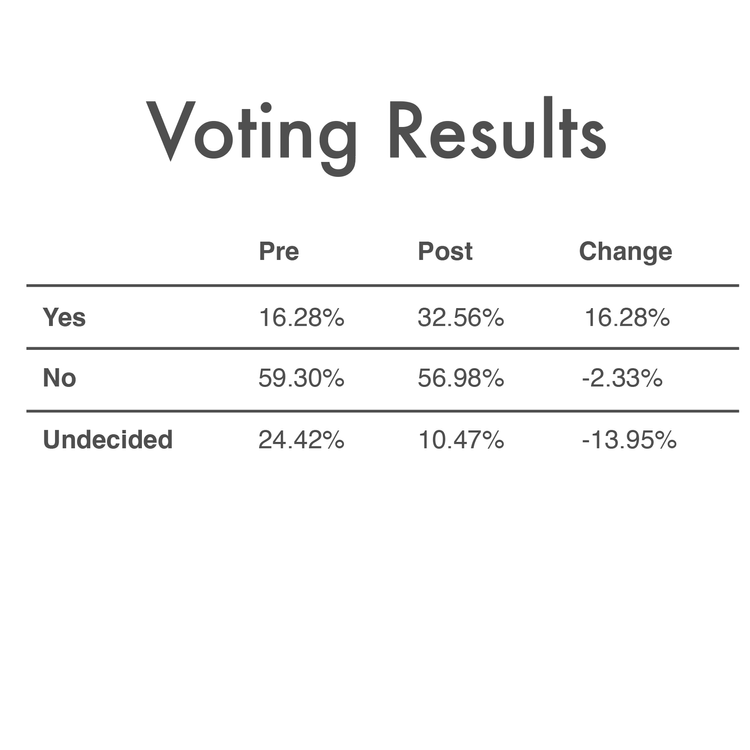
Under the Soho Forum’s Oxford-style rules, the debater who moves more of the audience wins. Epstein announced that the Yes vote doubled, from 16% to 32%, while the No vote slipped by just two points. A majority opposed the resolution both before and after, as Rothman himself acknowledged, but the Tootsie Roll went to Rothman.2
Related
- Gene Epstein, “Bill Kristol and Scott Horton Debate U.S. Interventionism at the Soho Forum,” Reason (Oct. 8, 2021) (video); also as idem, “U.S. Foreign Policy: Bill Kristol vs. Scott Horton,” Reason (Oct. 8, 2021) (podcast). Resolution: “A willingness to intervene, and to seek regime change, is key to an American foreign policy that benefits America.”
- Gene Epstein, “Should the U.S. Be Sending Weapons to Ukraine? Scott Horton vs. Cathy Young at the Soho Forum,” Reason (July 6, 2022)
- Gene Epstein, “Did the U.S. Provoke Russia’s Invasion of Ukraine?,” Reason (Feb. 8, 2025) (Scott Horton vs. Eli Lake)
- Lex Fridman, “#473 – Iran War Debate: Nuclear Weapons, Trump, Peace, Power & the Middle East,” Lex Fridman Podcast (June 26, 2025) (Scott Horton vs. Mark Dubowitz)
- Saifedean Ammous, “Escalating from Suez to Waterloo: Trump’s Three-Card-Monte Takes on the Chess Grandmasters,” Property and Freedom Journal (Mar. 29, 2026)
- “Godwyn, Trump and the Peace: America Has Found Its Churchill: On the War with Iran,” PFS Blog (June 17, 2026)
- Ken Yamarashi, “Trump Can’t Take Tehran,” PFS Blog (July 25, 2026)
- “Raico, ‘The Case for an America First Foreign Policy’,” PFS Blog (Oct. 28, 2026)
- “Ron Paul: Democrats Should Defund the Iran War, Not Raise Taxes on Homeschoolers,” PFS Blog (Nov. 17, 2026)
- “Napolitano: The Case for Impeaching Pete Hegseth,” PFS Blog (Nov. 23, 2026)
- “Colonel Douglas Macgregor: America Is Walking Into Iran’s Trap,” PFS Blog (Nov. 25, 2026)
- Stephan Kinsella, “International Law, Libertarian Principles, and the Russia-Ukraine War,” Free Life (Apr. 19, 2022)
- See Gene Epstein, “Is War with Iran Justified?,” Reason (Nov. 24, 2026); The Soho Forum, “Past Events.” [↩]
- See Noah Rothman, “Watch: Noah Rothman and Scott Horton Debate the Necessity of the Iran War,” National Review (Nov. 24, 2026). [↩]












 Alessandro Fusillo
 Andreas Tögel
 David Dürr
 Doug French
 Fernando Chiocca
 Greg Morin
 Hans-Hermann Hoppe
 Jay Baykal
 Jayant Bhandari
 Jeff Deist
 Jeffrey Barr
 Juan Fernando Carpio
 Ken Yamarashi
 León Isidoro
 Martin Cabrera
 Nick Hoppe
 Oscar Grau
 Peter Wong
 PFS
 scholarium
 Saifedean Ammous
 Sean Gabb
 Sean Ring
 Stephan Kinsella
 Stéphane Geyres
 Thomas Jacob
 Tom DiLorenzo

Follow Us!