From the Vault: Hans-Hermann Hoppe, “Where the Right Goes Wrong,” Rothbard-Rockwell Report (April 1997): 7–14. This piece critiques traditionalist conservatives (e.g., Pat Buchanan-style) for wanting to preserve the welfare state (Social Security, Medicare, protectionism, etc.) while complaining about cultural/moral decay. Hoppe argues this is impossible—you cannot have the welfare state and traditional families/norms, because the welfare state itself subsidizes and accelerates family breakdown, illegitimacy, irresponsibility, etc. Related issues also discussed in Hoppe, A Four-Step Health Care Solution and From Welfare to Health Care: Commentary on von Studnitz (forthcoming).
Related
- Libertarianism and the Alt-Right: In Search of a Libertarian Strategy for Social Change (2017) (discussing “Liberallala-Libertarians”)
- Hoppe, “A Realistic Libertarianism,” LewRockwell.com (Sept. 30, 2013)
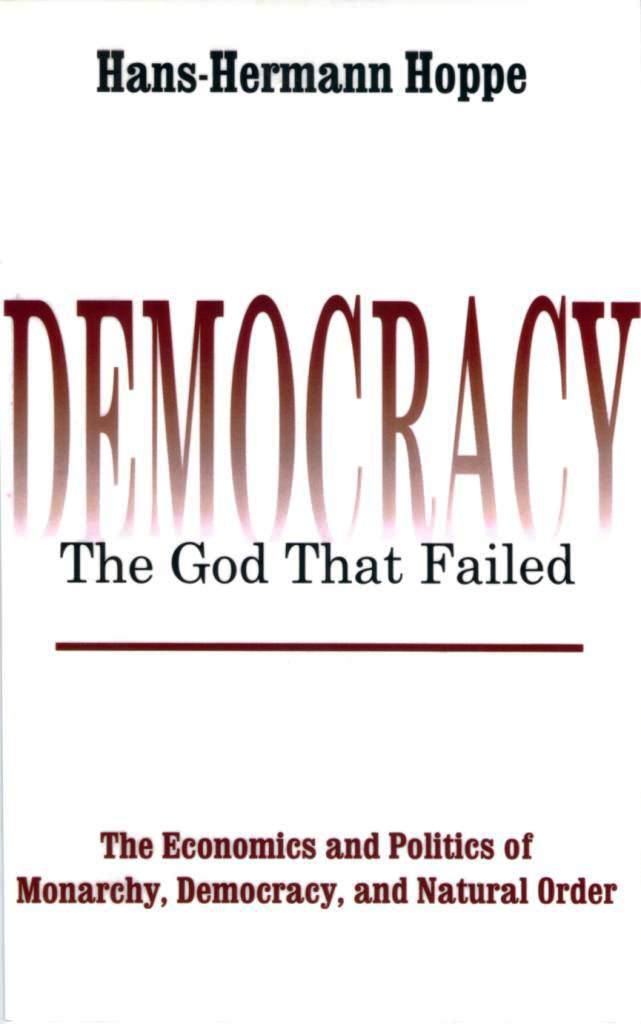
- Introduction to Democracy: The God That Failed (2001)
- Hoppe vs. the Alt-Right
- Kinsella, Hoppe on Covenant Communities and Advocates of Alternative Lifestyles
- Hoppe, The Property And Freedom Society—Reflections After Five Years, The Libertarian Standard (June 10, 2010); also published at VDare and as ch. 24 in The Great Fiction; video
- From Nation to Household: The Middle American Illusions of Sam Francis (and Pat Buchanan) (unpublished, 1996)
- Discussions of conservatism vs. libertarianism in Democracy: The God That Failed (Transaction, 2001)
- —and in “The Socialism of Conservatism,” in A Theory of Socialism and Capitalism (Kluwer, 1989; Mises Institute reprint, 2007; Laissez Faire Books, 2013)
- Economy, Society, and History (Mises Institute, 2021)
- The Great Fiction: Property, Economy, Society, and the Politics of Decline (Laissez Faire Books, 2012; second revised edition, Mises Institute, 2021)
- A Short History of Man: Progress and Decline (Mises 2015)
- Kinsella, The Three Fusionisms: Old, New, and Cautious (Jan. 16, 2022) (on paleolibertarianism etc.)
- Rothbard on lifestyle and “modal” libertarians:
- Rothbard, The Libertarian family and entrepreneurship and other Reflections (Liberty, July 1988)
- Rothbard, Purity and Libertarian Politics (1990)
- Rothbard, Libertarians In a State-Run World (Liberty, December 1987)
- Jeff Deist, “Appreciating Rothbard’s Political Genius,” in Rothbard at 100: A Tribute and Assessment
- On “modal” libertarians, see various mentions in Murray N. Rothbard, The Irrepressible Rothbard: The Rothbard-Rockwell Report Essays of Murray N. Rothbard (Center for Libertarian Studies, 2000)
***
WHERE THE RIGHT GOES WRONG
Hans-Hermann Hoppe
[Rothbard-Rockwell Report (April 1997): 7–14]
The American right is generally divided into three camps: the global hawks, the traditionalists, and the libertarians. Let’s set aside the global hawks as hopeless allies of the imperial world state who look fondly upon international war and military government. It’s not clear why they should be considered on the right at all. That leaves us the traditionalists or traditional conservatives, and the libertarians, who like free markets but most often want to toss out tradition in favor of a social and cultural free-for-all.
There are strong reasons why modern conservatism and modern libertarianism are not suitable ideological vehicles for the restoration of a civilized social order. In effect, if not by design, the conventional ideological taxonomy of the right leaves nowhere for the clear-headed lover of liberty and property, and hater of the welfare-warfare state, to turn. I’ll explain why, and offer an alternative.
The Right and Wrong of Conservatism
What distinguishes conservatives from adherents of other political philosophies? Foremost, that they believe in a natural order. That order can be disturbed-by earthquakes and disease, by war and tyranny—but it can never be abolished. And no matter what the circumstances, the normal can always be distinguished from the abnormal.
In this tradition, conservatives see households based on private property—in cooperation with a community of other households—as the most fundamental, natural, ancient, and indispensable social units. They also see the household as a model of the social order. As a hierarchical order exists in a family, for example, so it exists within a community of families. Above all, conservatives have wanted to conserve the family and the social hierarchies based on kinship relations and layers of authority.
All of this is a good fit with traditional libertarian doctrine, which views natural order as flowing from natural liberty. But conservatism in our time has been deeply corrupted. It never recovered from the transformation of the U.S. and Europe into mass democracies from World War I onward. Instead of challenging democracy at its very root, it came to terms with it and the global wars the state conducted on its behalf. As a result, conservatism fell back on its pure moral doctrine, stripped of institutional context, and was gradually transformed into a movement in favor of one or another variety of democratic statism.
For example, today’s conservatives worry, as they should, about divorce, illegitimacy, loss of parental and spiritual authority, multiculturalism, alternative lifestyles, promiscuity, and crime; all are deviations from the natural order. But the spokesmen for the conservative establishment do not recognize that their goal of restoring normalcy requires drastic anti-statist political and social changes.
Social Democracy of the Heart
How, for example, does Pat Buchanan (among many other ex-amples) propose to fix the problem of moral degeneration and cultural rot? Sometimes he will say that those parts of the federal Leviathan responsible for the proliferation of moral and cultural pollution—such as the Department of Education and the National Endowment of the Arts—should be cut down to size. This is to the good, but it hardly goes far enough. Government involvement in education must be fundamentally opposed and abolished. A natural order in education means that it is entirely a family matter.
Worse, there is no recognition that moral degeneracy and cultural rot have deeper causes in the welfare state, and cannot be cured by some national curriculum or presidential declamation. Indeed, the traditionalists explicitly defend the three core institutions of the welfare state: social security, medicare, and unemployment subsidies. And they want to expand the social responsibilities of the state by assigning it the task of “protecting,” by means of import and export restrictions, American jobs.
The traditionalists freely admit they are statists. They detest and ridcule capitalism, free markets, free trade, and wealth, advocating a new proletarian conservatism which amalgamates cultural conservatism, nationalism, and socialism, with such policies as federal confiscation of all estates over $1 million.
Writes a leading traditionalist, “while the left could win Middle Americans through its economic measures, it lost them through its social and cultural radicalism, and while the right could attract Middle Americans through appeals to law and order and defense of sexual normality, conventional morals and religion, traditional social institutions and invocations of nationalism and patriotism, it lost Middle Americans when it rehearsed its old bourgeois economic formulas.” His answer is to combine the economic policies of the left and the nationalism and cultural conservatism of the right to create “a new identity synthesizing both the economic interests and cultural-national loyalties of the proletarianized middle class in a separate and unified political movement.”
Is Buchananism Possible?
But is it possible to maintain the current economic socialism and restore cultural normalcy? Traditionalists do not feel the need to ask this question, because they think that politics is largely a matter of will and power. If only a leader wants something, and he can seize the government power to implement his will, everything can be achieved. The man they denounce as a “dead Austrian economist,” Ludwig von Mises, characterized this belief as “historicism,” the intellectual posture of the German academic socialists who justified any and all statist measures.
But historicist contempt and ignorance of economics does not alter the fact that inexorable economic laws do exist. You cannot have your cake and eat it too. What you consume now cannot be consumed in the future. Producing more of one good requires producing less of another. No wishful thinking or government mandate can make such laws go away.
Historicist contempt and ignorance of economics does not alter the fact 1hat inexorable economic laws do exist.
To recognize this, it is only necessary to recall one of the most fundamental laws of economics. That is, compulsory wealth redistribution involves taking from some—the haves—and giving to others—the have-nots. Accordingly, the incentive to be an owner is reduced, and the incentive to be a non-owner is increased. In fact, as another “dead Austrian economist,” Henry Hazlitt, pointed out, the welfare state subsidizes, and thus worsens, the very problems it claims to solve.
By subsidizing people with tax funds because they are poor, there will be more poverty. By subsidizing people because they are unemployed, there will be more unemployment. By subsidizing unwed mothers, there will be more unwed mothers and more illegitimate births, and so on.
The Onslaught on the Family
This is most obvious in the system of so-called social security that has plagued Western Europe since the 1880s and the U.S. since the 1930s: of compulsory government “insurance” against old age, illness, occupational injury, unemployment, indigence, etc. In conjunction with the even older compulsory system of public education, social security amounts to a giant onslaught on the family and personal responsibility.
Relieving individuals of the obligation to provide for their own income, health, safety, old age, and children’s education also reduces the range and temporal horizon of private provision. In addition, it lowers the value of marriage, family, children, and kinship relations. It promotes irresponsibility, shortsightedness, negligence, illness, and even destructionism while punishing responsibility, farsightedness, diligence, health, and conservatism.
Consequently, not only do people want to have fewer children—and indeed, birthrates have fallen in half since the onset of social security …
Consequently, not only do people want to have fewer children—and indeed, birthrates have fallen in half since the onset of social security—but also the respect which the young traditionally accorded to their elders is diminished. Indicators of family disintegration and malfunction—such as divorce, illegitimacy, child abuse, parent abuse, wife abuse, single parenting, singledom, alternative lifestyles, and abortion—have all increased.
Subsidizing Sickness
Moreover, socialization of the health care system through medicaid and medicare and the regulation of the health-insurance industry (in particular by abolishing an insurer’s right of refusal) has created a monstrous machinery of redistribution at the expense of responsible individuals and low-risk groups in favor of the irresponsible and high-risk groups. Subsidies for the ill, unhealthy, and disabled breed illness, disease, and disability, and weaken the desire to work for a living and to live a healthy life.
The moral degeneration and cultural rot around us is the inescapable result of the welfare state.
accident and health insurance lies above all in the fact that such institutions promote accident and illness, hinder recovery, and very often create, or at any rate intensify and lengthen, the functional disorders which follow illness or accident. To feel healthy is quite different from being healthy in the medical sense. By weakening or completely destroying the will to be well and able to work, social insurance creates illness and inability to work; it produces the habit of complaining—which is in itself a neurosis—and neuroses of other kinds …. As a social institution it makes a people sick bodily and mentally or at least helps to multiply, lengthen, and intensify disease.
Spare me the task of explaining in detail the ancient fallacies of the traditionalists’ protectionism. If they were right, their argument in favor of economic protection would amount to an indictment of all trade, and a defense of the thesis that each family would be better off if it never traded with anyone else. Certainly in this case no one could ever lose his job, and unemployment due to “unfair” competition would be reduced to zero. Yet such a fullemployment society would not be prosperous; it would be condemned to poverty and starvation.
International protectionism, while less destructive than a policy of interpersonal protectionism, would result in precisely the same effect. So this is not authentic conservatism; conservatism wants families to be prosperous and strong. Protectionism is economic destructionism.
Libertarianism’s single principle is original appropriation: that is, ownership of scarce resources is acquired through an act of original appropriation, by which resources are taken out of a state of nature and put into a state of civilization. From the principle of original appropriation, rules concerning the transformation and exchange of originally appropriated resources are derived, and all of law, including the principles of punishment, is then reconstructed in terms of a theory of property rights.
Social education and social security provide a way for rebellious youth to escape paternal authority, and to get away with continuous misbehavior. Old conservatives knew that these government policies would emancipate the individual from the discipline imposed by family and community life only to subject him to the direct control of the state. And they knew that this would inevitably lead to systematic societal regression, emotionally and mentally, from adulthood to adolescence.
In contrast, proletarian conservatism is ignorant of all this. For if one is indeed concerned about America’s moral decay and wants to restore normalcy to society and culture, one must oppose the welfare state, root, stem, and branch.
A Return to Normalcy
A return to normalcy requires the elimination of the present social security system: of unemployment insurance, social security, medicare, medicaid, public education, etc. If we are ever to restore normalcy, government funds and power must dwindle to, or even fall below, their 19th-century levels. Hence, true conservatives must be libertarians, that is, anti-statists. They cannot follow proletarian conservatism or neoconservatism; they cannot seek a return to traditional morality while at the same time endorsing the very institutions responsible for the perversion and destruction of traditional morals.
Most contemporary conservatives, of course, especially the media darlings, are not conservatives at all but social democrats—either internationalist or nationalist. True conservatives, on the other hand, can only be radical libertarians, and as such, demand the demolition—as a moral and economic perversion—of the entire structure of social security.
The Right and Wrong of Libertarianism
Libertarianism’s single principle is original appropriation: that is, ownership of scarce resources is acquired through an act of original appropriation, by which resources are taken out of a state of nature and put into a state of civilization. From the principle of original appropriation, rules concerning the transformation and exchange of originally appropriated resources are derived, and all of law, including the principles of punishment, is then reconstructed in terms of a theory of property rights.
I do not want to further analyze or even defend the libertarian theory of justice at this point, although I believe it to be true, indeed to be irrefutably so. Rather, I want to examine the relationship between libertarianism and conservatism. Some commentators, such as Russell Kirk, have characterized libertarianism and conservatism as hostile ideologies. But this is wrong. The relationship between libertarianism and conservatism is one of logical complementarity, sociological reciprocity, and mutual presupposition.
Let me first point out that most leading libertarian thinkers were ar-dent defenders of traditional morals and manners. Most notably, Murray N. Rothbard, the single most important and influential libertarian thinker, was an outspoken cultural conservative. So was Rothbard’s most important teacher, Ludwig von Mises. While this does not prove much, it is indicative of a substantive affinity between the doctrines.
If one wants to restore normalcy to society and culture, one must oppose the welfare state, root, stem, and branch.
That is, families, authority, communities, and social ranks are the empirical-sociological concretization of the abstract concepts of property, production, ex-change, and contract. Property and property relations do not exist apart from families and kinship relations. The latter shape and determine the specific form of property and property relations, but they are at the same time constrained by the universal and eternal laws of scarcity and property.
Families considered normal by conservative standards are household families, and the family disintegration and moral and cultural decay which contemporary conservatives deplore is the result of the destruction of households as the economic basis of families by the welfare state. Thus, the libertarian theory of justice can actually provide conservatism with a more precise definition and a more rigorous moral defense of its own end than conservatism itself could ever offer.
Counter-Cultural Capitalism
While many of the intellectual creators of modern libertarianism were cultural conservatives, and while libertarian doctrine is fully compatible with the conservative world view, the libertarian movement is adamantly not. To a large extent, this movement has tried to combine radical anti-statism and market economics with cultural leftism and personal hedonism; that is, it is the exact opposite of the traditionalist program of culturally conservative socialism. But like this sort of conservatism, leftist libertarianism is also false and counterproductive.
That much of modern libertarianism is culturally leftist is the result of a superficial understanding of libertarian doctrine by many of its followers, which can be explained by the welfare state’s promotion of intellectual and emotional infantilization.
The beginnings of the modern libertarian movement in the U.S. go back to the late 1960s. Simultaneously, promoted by civil rights and the war on poverty, a new mass-phenomenon emerged. A new Lumpenproletariat of intellectuals and intellectualized youths, the product of an ever-expanding system of socialist education, arose, alienated from mainstream morals and culture.
Multiculturalism, cultural relativism, and egalitarian anti-authoritarianism were elevated from a transitory phase in mental development (adolescence) to a permanent attitude among grown-up intellectuals and their students.
The libertarian movement attracted an unusually high number of misfits and plain losers.
The libertarian movement attracted an unusually high number of abnormal types. The counter-cultural ambiance and relativistic “tolerance” of the movement in turn captivated an even greater number of misfits and plain losers. Rothbard, in disgust, referred to them as the “modal” (typical) libertarians. They dreamed of a society where everyone would be free to choose whatever non-aggressive lifestyle, career, or character he wanted, and where, as a result of free-market economics, everyone could do so on a level of general prosperity. Ironically, the movement that had set out to dismantle the state and restore private property and market economics was largely shaped by the mental and emotional products of the welfare state: the new class of permanent adolescents.
The Necessity of Discrimination
This intellectual combination could hardly end happily, and it didn’t. Private-property capitalism and egalitarian-multiculturalism are as unlikely a combination as social-ism and cultural conservatism. In trying to combine what cannot be combined, much of the modern libertarian movement has contributed to the further erosion of private-property rights (just as much of contemporary conservatism contributed to the erosion of families and traditional morals).
What the counter-cultural libertarians failed to recognize, and what true libertarians cannot emphasize enough, is that the restoration of private-property rights and laissez-faire economics implies a sharp and drastic increase in social discrimination. This would swiftly eliminate most if not all of the life-style experiments so close to the heart of left libertarians. In other words, libertarians must be radical and uncompromising conservatives.
In other words, libertarians must be radical and uncompromising conservatives.
You, not I, own something You are entitled to exclude me from your property. You may attach conditions to my using your property, and may expel me from it. Moreover, you and I, as private property owners, may enter into a restrictive covenant. We and others may impose limitations on the future use that each of us (and our heirs) can make with our property.
The modern welfare state has largely stripped private-property owners of the right to exclude. Employers cannot hire whom they want. Landlords cannot rent to whom they want. Sellers cannot sell to whom they want. Buyers cannot buy from whom they want. And groups of private-property owners may not enter into whatever restric-tive covenants they believe to be mutually beneficial. The central state has thus robbed us of much of our personal and physical protec-tion. Not to be able to exclude others means not to be able to protect oneself. The result of this erosion of private property rights under the democratic welfare state is forced integration. Americans must accept immigrants they do not want, teachers cannot get rid of lousy or ill-behaved students, employers are stuck with poor or destructive employees, landlords are forced to live with bad renters, banks and insurance companies are not allowed to avoid bad risks, restaurants and bars must accommodate unwel-come customers, and private clubs and covenantal associations are compelled to accept members and actions in violation of their own rules and restrictions. Moreover, on public property in particular, forced integration has taken on the form of permanent danger: of normlessless and lawlessness.
To exclude other people from his property is the means by which the owner can avoid events that will lower the value of his property. If the owner is not permitted to freely exclude the ill-behaved, lazy, unreliable, and rotten students, employees, and customers, there will be an increase in them, and that property values will fall. In fact, forced integration of all sorts breeds ill behavior and bad character. In civilized society, the ultimate price for ill behavior is expulsion, and all-around rotten characters (even if they commit no criminal offense) will find themselves quickly expelled from everywhere and by everyone. They will become outcasts, physically removed from civilization.
The results of forced integration are only too visible. All social relations have become increasingly egalitarian and uncivilized.
In distinct contrast, a society where the right to exclude was fully restored to owners of private property would be profoundly unegalitarian and discriminatory. There would be little or none of that “tolerance” and “open-mindedness” so dear to left-libertarians; all economic exchange and social relations would be governed by strict adherence to the principles of ownership, contract, cooperation, and exclusion.
We would be well on the way to restoring the freedom of association as it is implied in the institution of private property if towns could do what they did as a matter of course until well into the 19th century in Europe and the U.S. There would be signs regarding entrance requirements to the town, and, once in town, requirements for entering specific pieces of property (no beggars, bums or homeless, for example); and those who did not meet these entrance requirements would be kicked out as trespassers. Almost instantly, cultural and moral normalcy would reassert itself.
Counter-cultural lifestyle experimentalists would once again have to pay a price for their behavior. If they continued in it, they would be largely barred from civilized society and have to live physically separate from it, in ghettos or on the fringes of society, and many positions or professions would be closed to them. On the other hand, if they wanted to live and advance within society, they would have to adjust to the moral and cultural norms of the society they wanted to enter.
To thus assimilate would not necessarily imply that one would have to give up one’s abnormal life-style. It would imply, however, that one could no longer exhibit one’s alternative behavior in a way people disapprove of. It would have to be hidden from the public eye and restricted to the privacy of one’s own four walls. Displaying it would lead to exclusion from society.
Every social order requires a self-enforcement mechanism. More precisely, social orders are not maintained automatically; they require conscious effort and purposeful action on the part of the members of society. In a libertarian society, there would be sharp increase in discrimination against behaviors contrary to high cultural standards and the social norm generally.
The Centrality of the Covenant
The libertarian model of society is one of private-property owners who, instead of living isolated from one another, associate with others as neighbors. In the language of property-rights theory, by virtue of choosing neighborhood over isolation, independent property owners enter into a mutually binding, re-strictive, and protective covenant.
Through this covenant, they agree to certain limitations on the use of their property and personal conduct (initially set and defined by the founder of the community in question); and every freeholder consents to these restrictions based on his belief that doing so will be to his own as well as everyone else’s personal advantage, and increase his and everyone else’s property values.
The perfectly harmonious conservative model of a society adds to this the fundamental insight that, as a matter of natural-empirical fact, households typically are made up of families, and communities are normally tied together by kin and kinship relations. Indeed, the constant tendency will be for them to consist of genetically related and linguistically and culturally homogeneous people.
Egalitarianism, in every form and shape, is incompatible with the idea of private property.
In any case, to maintain society—to protect and enhance the value of private property and of families and kin—the members of society, and especially the natural elite and the heads of families, must be willing to take two forms of protective measures. First, they must be willing to defend themselves by physical force and punishment against external invaders and domestic criminals. Second and equally important, they must be willing to defend themselves by ostracism and expulsion against anyone who advocates actions incompatible with the very purpose of the covenant to protect property, family, and kin.
In this regard, a society always faces the double and intercon-nected threat of egalitarianism and cultural relativism. Egalitarianism, in every form and shape, is incompatible with the idea of private prop-erty. Private property implies exclusivity, inequality, and difference. And cultural relativism is incompat-ible with the foundational fact of families and inter-generational kinship relations.
Families and kinship relations imply cultural absolutism. As a matter of socio-psychologic fact, both egalitarian and relativistic sentiments find support among ever-new generations of adolescents. Owing to their still incomplete mental development, male juveniles especially are always susceptible to both ideas. Adolescence is marked by regular-and for this stage normal-outbreaks of rebellion by the young against the discipline imposed on them by family life and paternal authority.
Cultural relativism and multiculturalism provide the ideological means of emancipating oneself from these constraints. And egalitarianism—based on the infantile view that property is “given” (and thus distributed arbitrarily) rather than individually appropriated and produced (and hence, distributed justly)—provides the intellectual tool through which rebellious youths can lay claim to the economic means for their life outside the disciplinary framework of families and communities.
The enforcement of a covenant is largely a matter of prudence, of course. How and when to react, and what protective measures to take, requires judgment on the part of the members of society and especially the natural social elites. Thus, so long as the threat of moral relativism and egalitarianism is restricted to a small proportion of juveniles for only a brief period in life (until they settle into family-constrained adulthood), it may be sufficient to do hardly anything. A small dose of ridicule may be all that is needed.
The situation is very different, however, if the spirit of moral rela-tivism and egalitarianism has taken hold among adult members of society. If they habitually advocate egalitarian sentiments, whether in the form of democracy (majority rule) or of communism, it becomes essential that other members, and in particular the natural social elites, be prepared to exclude and ultimately expel them.
Libertarians should be moral and cultural conservatives of the most uncompron1ising kind.
The Virtue of Intolerance
Libertarians should be moral and cultural conservatives of the most uncompromising kind. The current state of affairs of moral de-generation, social disintegration, and cultural rot is precisely the result of too much tolerance, made possible only by the expansion of the redistributive state and the proliferation of the common ownership of property. Rather than having all habitual democrats, communists, and alternative lifestylists excluded from civilization, they were tolerated in the midst of society.
Of course, this toleration encouraged even more egalitarian and relativistic sentiments, until at last the point was reached where the authority of excluding anyone from anything had effectively evaporated, while the power of the central state, as manifested in forced integration, had correspondingly grown.
Libertarians, in their attempt to establish a free and natural social order, must strive to regain from the state the right to exclusion inherent in private property. Yet even before they may accomplish this, to render such an achievement even possible, libertarians must begin to reassert, as far as they can, the right to free association, which necessarily means the right to exclusion, in everyday life.
Libertarians, then, have a moral duty to advocate and practice intolerance and discrimination: against egalitarians, democrats, socialists, communists, multi-culturalists, and environmentalists; against ill manners, misconduct, incompetence, rudeness, vulgarity, and obscenity.
As true conservatives will have to dissociate themselves from right-wing social democratic traditionalists, true libertarians must dissociate themselves from left-lifestyle-libertarians. Those who care about the future of families and prosperity, of morals and property, have no other alternative but to become uncompromising advocates of strict adherence to private property, and all that it implies, as the very basis of civilization. [RRR]
Discover more from The Property and Freedom Society
Subscribe to get the latest posts sent to your email.




















 Alessandro Fusillo
 Andreas Tögel
 David Dürr
 Doug French
 Fernando Chiocca
 Greg Morin
 Hans-Hermann Hoppe
 Jay Baykal
 Jayant Bhandari
 Jeffrey Barr
 Juan Fernando Carpio
 Ken Yamarashi
 León Isidoro
 Martin Cabrera
 Oscar Grau
 Peter Wong
 PFS
PFS Saifedean Ammous
 Sean Gabb
 Sean Ring
 Stephan Kinsella
 Stéphane Geyres
 Thomas Jacob
 Tom DiLorenzo