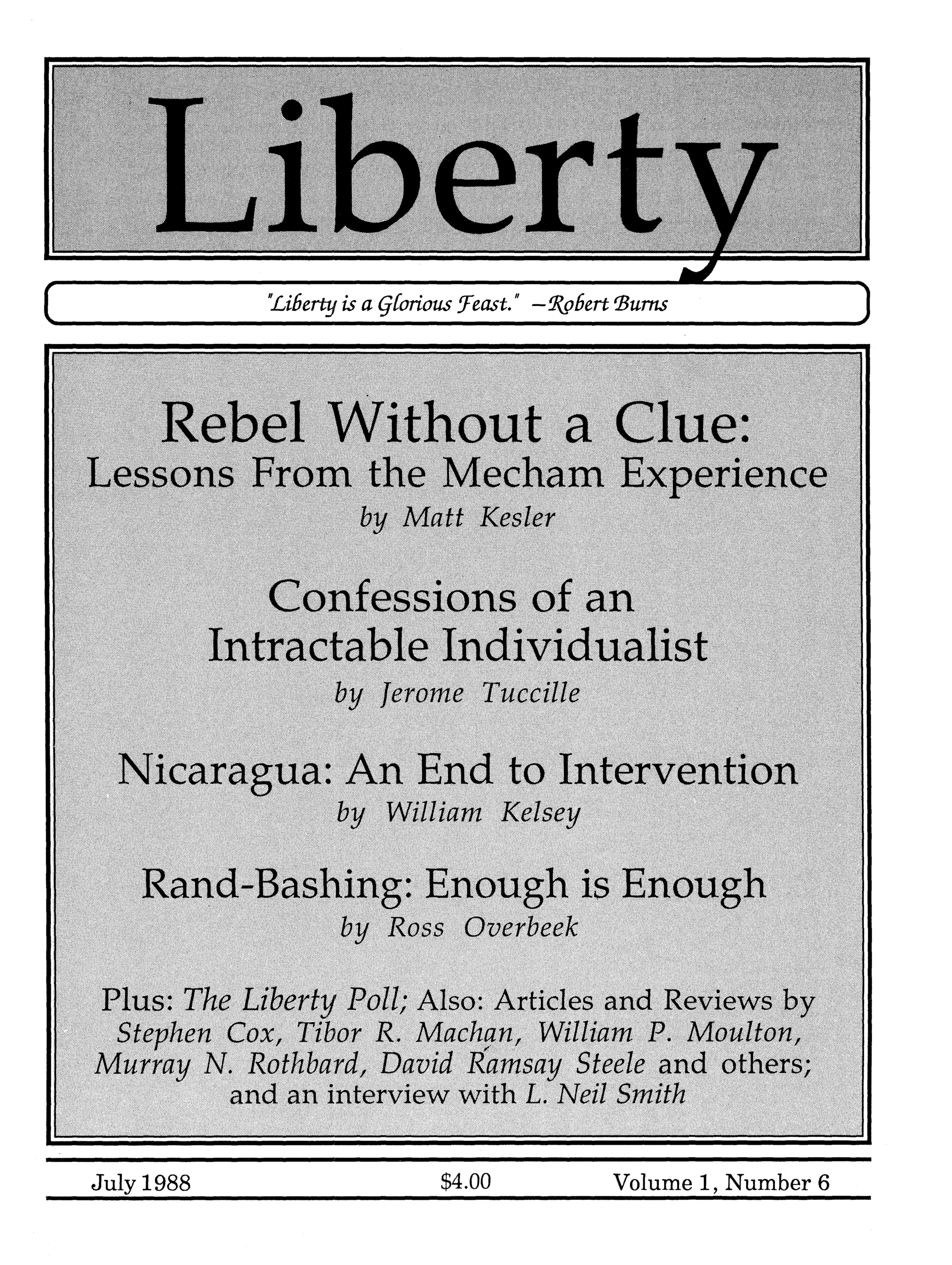
 From the vault: Murray N. Rothbard, various entries in the Reflections section, Liberty (July 1988): 9–13.
The Libertarian family and entrepreneurship—In the letter column of Liberty (May 1988), Dagny Sharon threatens (albeit somewhat ironically) to leave the libertarian movement. Now, certainly everyone has the moral right to leave the movement, and I’m sure that most of us, in moments of despair or disgust, have been tempted to do the same. But I am interested in her stated reasons, which I think are typical of many who have suffered from similar “burnout.” The trigger was a gently ironic review by Mike Holmes of her Free Market Yellow Pages (“Libertariana,” Liberty, Dec 1987), which actually pulled the punches of the criticisms he might have levelled at the publication. But apparently the very fact that criticism of Ms. Sharon was made was almost enough to send her reeling “out of the movement.”
Ms. Sharon revealingly states that the reason for her distress is that she joined the libertarian movement and moved to California in the expectation that she would find in it the “family” to replace the biological family which had failed to give her moral support. Not surprisingly, she was disappointed when her expectations in the libertarian movement were dashed.
I think the problem with Ms. Sharon, and with many other activists, is the nature of their goal. The libertarian movement is a political and ideological movement, period; it is neither a “family” nor an encounter or therapy group. One hopes that within the movement, because of common interests and principles, we can find lifelong friends and soul-mates; but to expect or demand this result from everyone is sheer folly. Perhaps among family or close friends or therapy groups one can expect or give “unconditional love” and emotional support, but it is absurd to seek such a result from libertarians in general.
In the movement, as in the “real world,” each of us is free and responsible for his or her own actions, and we must expect to be held accountable for those actions according to the gener-al principles and standards we adopt in the rest of society; just as our libertarian colleagues must expect the same sort of ac-countability from us. To be exempt from ordinary standards and accountability, is to foster incompetence on a grand scale, and to exempt virtually everyone from criticism. In fact, for many libertarians, the only ground on which to criticize any-one is that the person is critical, divisive, and disruptive of the organic harmony of the libertarian movement.
There is another, related syndrome evident in Ms. Sharon’s letter. She proudly lists the record of three years of libertarian activism, as if she deserved unstinted praise for this resume of the activities themselves. Perhaps so; but there is a labor-theory-of-value attitude here, that people somehow deserve praise for the number of labor-hours put into the activity, with no discussion of the output. Were the conferences valuable? Did they make or lose money, etc.? It was precisely Mike Holmes’ attempt to evaluate one of those products—the Free Market Yellow Pages—that has ostensibly driven her out of the movement.
I myself would have been much tougher on the Yellow Pages, for this reason. It makes the fatal mistake of assuming that if one has a job to get done (say, plumbing, or gardening, or dentistry) that one is impelled to seek out fellow libertarians to hire or employ. In my decades in the libertarian movement, I have seen no positive correlation whatever between honesty or ability in business and the degree of a person’s commitment to libertarian doctrine. To the contrary, the facts cut the other way, and in general, in seeking out business or consumer services, I would tend to go out of my way to avoid libertarian dentists, plumbers, carpenters, etc. My experience, and it is not unique, is that the proportion of incompetents, moochers, hustlers, and quasi-crooks in the libertarian movement is far higher than in the general business population. The only use, therefore, I personally would have for the Free Market Yellow Pages is to find out whom to avoid. If you operate as a consumer or in business by assuming that every libertarian is a member of your “family,” you are going to get fleeced.
A final general observation, which may or may not be applicable to Ms. Sharon. I find that all too many libertarians are se-duced by the glamor of being an “entrepreneur,” as though being an entrepreneur is a valuable good in itself. One difference between our movement and the real world is, that if you ask a real world businessman about his occupation, he or she will say: “I am a shoe manufacturer,” or, “I am a commodity broker.” In the libertarian movement the response is, “I am an entrepreneur.” What most libertarians fail to realize is that the purpose of entrepreneurship is not to” be an entrepreneur” but to make profits, and that making profits is not at all easy. To be a real entrepreneur you have to know a lot about specific areas and markets of the real world (e.g. shoes or commodity markets), you have to work hard, you have to be competent, and you have to be able to forecast successfully demands and costs in the area of your business. None of this makes for an easy life. The great bulk of entrepreneurs in the world lose money rather than make profits. To be a successful entrepreneur requires just as much talent, in its way, as it does to be a nuclear physicist.1 In short, there is in life a division of labor, and only a relatively small number of people are cut out to be successful (that is, profitable) entrepreneurs. But that means that only a small number of people are cut out to be entrepreneurs period. If libertarian entrepreneurs suffer a consistent string of business losses, they should not expect support, admiration, or subsidy from the ranks of the libertarian movement. It would be far better for themselves and for the rest of us if they faced reality, realized that they are no more cut out to be entrepreneurs than they are to be nuclear physicists, and rejoined the rest of us in the ranks of the proletariat. -MNR
Silly out of season—Traditionally, the dog days of August are supposed to be the “silly season,” but libertarians have an unchallenged capacity for extending that season through the entire year.
Thus: Jim Peron, in his Gay and Lesbian Caucus newsletter, writes a lengthy attack on Ron Paul’s AIDS position as set forth in the Ron Paul Political Report. The position is unimpeachably libertarian, but also tough on AIDS. In his philippic, Peron states that he has heard from “his sources” that I am the author of Ron’s statement. One of Peron’s arguments is that since I am clearly not a certified physician, my views on the medical status of AIDS should be disregarded. Carried away on the wings of his rhetoric, however, Peron overlooks two ironic points. One is that he, too, is not a certified physician, so why should anyone listen to him? Even more delicious is the second irony: that if anyone is a certified medical authority in this debate, it is most assuredly Dr. Ron Paul, a medical doctor of long standing, and the actual author of the article in question.
Another wacko example: Carol Moore, of Southern California, has apparently made it her life’s work to attack Ron Paul—on any and all grounds, hoping against hope that something will stick. Recently, she quoted from a statement critical of Israel and America’s devotion to that state in the Ron Paul Political Report. Although she herself pioneered in criticism of Israel in the libertarian movement, and even repeats that criticism, she maintains that Ron only keeps “harping” on Israel for anti-Semitic reasons. In other words, she knows in her heart that her motives for criticizing Israel are pure, whereas anyone else’s (or is it just Ron’s?) must be a priori suspect. It is typical of Ms. Moore’s astute sense of timing that she levels the charge of picking on Israel precisely at the time when the media, and even much of the American Jewish community, are reacting in horror at the barbarous treatment of the Palestinian natives by the Israeli occupation troops. Leave it to libertarians to jump on the wrong horse at the wrong time.
In general, the Meansians and other critics of Ron Paul are busily poring over every statement or press release of Ron’s trying desperately to find something anti-libertarian. They have not been able to do so. What they are complaining about, and vociferously, is the tone of his campaign statements. “Yes, the content is libertarian all right, but the tone … it’s so … Old Right.” Precisely. We of the Paul campaign laid it on the line before Seattle. If Ron is nominated he will of course be purely libertarian, we said, but the stress, the emphasis, the tone, will be geared to attract the millions of quasi-libertarian Old Rightists who have been cast in the shade for three decades by the theocratic, warmongering post-National Review right-wing. The stress, we proposed, would be outreach to the average Old Right middle-class American. Why is the Paul campaign being dumped on for doing precisely what we said we were going to do? -MNR
Dancing with Joy in Saigon and Washington—Michael Townshend comes forth with a brand new principle for the libertarian movement: an attack on “glee,” or what we might call killjoyism (Letters, Liberty, May 1988). Mr Townshend strongly objects to my enthusiasm at envisioning a “smashing defeat” for the Republican Party in November, and darkly likens it to my “glee” at the collapse of the South Vietnamese government in 1975, in both cases allegedly forgetting the evils that came after: the establishment of a Communist Vietnam and the putative ascendancy of Michael Dukakis to the American throne.
Much as I admire the diligence with which clearly Mr Townshend has pored over my writing, and hoping against hope that he really does not mean to liken Mike Dukakis to Ho Chi Minh, I take strong exception to the new Puritanism with which he wishes to infect the libertarian movement. Now that sex, alcohol, smoking, tasty food, drugs and pornography have been systematically excised from our society, Mr Townshend proposes to rob us of the last form of enjoyment left: delight in the defeat of our enemies. God knows that libertarians have little enough to crow about in today’s state-ridden world, so why can’t we delight in our occasional triumphs and in our enemies’ defeats?
In 1975, I wrote “The Death of a State,”2 which has given the Right Wing of our movement heartburn ever since. I expressed jubilation, not at the victory of the Communists in Vietnam, but in various other aspects of that notable event. There was, first the resounding final defeat admjnistered to a long, bloody campaign of mass murder waged by U.S. imperialists in Viet-nam. But above all, and this is what I was celebrating in the ar-ticle, there was the glorious epiphany of the sudden death of a State. How often, in our lifetimes, are we privileged to experience the actual death of a State? It is truly a rare event, and one to be savored, regardless of what kind of State it was and what kind of State followed. For a brief, resplendent moment, a state crumbled; executives or legislatures met in a room, issued de-crees, and no one paid any attention. As the State’s infrastructure crumbled, this mighty force, only a few days before absolute ruler of its territory, became a chaos of scattered men, issuing edicts into the wind. To me, steeped in the history of the American Revolution, this was reminiscent of early British-dominated colonial legislatures (as in Pennsylvania) passing august laws but learning that no one cared, and finding them-selves just a bunch of guys beating the air. For quasi-governmental authority had devolved, by general social action, onto alternative institutions outside the legal structure of government. To libertarians, in short, there can be nothing quite so rare or inspiring as the sudden collapse of a State apparatus.
What about the possibility of a Republican defeat this November? It is a consummation that I devoutly wish. I say flatly that if there were no Libertarian Party in the field, I would vote Democratic, not out of a great love for the Democratic Party, but out of bitter hostility to the Republicans.
In the first place, to fend off Mr Townshend’s spectre of Dukakis, I can see no effective and substantial difference between Bush and Dukakis, and certainly nothing to motivate any libertarian to rush to the polls to save George Bush. But more profoundly, I see several clear reasons to prefer Dukakis over Bush in November. First, on the overriding question of war and peace, the Republicans in general and Bush in particular are significantly more warmongering than the Democrats, even though the latter are hardly doves of peace. On Nicaragua and the Contras, missile brandishing against the Russians, on the Persian Gulf, Afghanistan and virtually every other trouble spot, the hawks and the war ultras are almost all in the Republican ranks—this even though the Democrats have gone along with U.S. aggression against Grenada, Libya, Iran and now Panama. (The bipartisan argument that the U.S. must swiftly overthrow Noriega because he is a dictator and a drug-runner, founders on the basic fact that almost every other government shares the same features. So why the hysteria against poor No-riega, who only wants his cut of the action?)
Secondly, if the pro-Republicans retort that their favorite party employs far more libertarian rhetoric than the Democrats, my response is that that is precisely why we must revile the Republicans. For it is far more odious to spout libertarian rhetoric merely to bamboozle the public than it is to be a statist without sham or pretense. At least, political life is clearer, and the air is not befouled by repellent mendacity. Far better an open statist than a mendacious and fake libertarian!
And thirdly, and far from least, whatever happened to the good old tradition of “throw the rascals out”? Instead of focussing on the bad guys in the wings, how about punishing and getting rid of the bad guys who have been deceiving and looting us for eight long years? Kick them out! Specifically, by doing so you destroy an entrenched Republican machine, and it will take time for the Democrates to reconstruct a machine of their own. And more importantly, the “ins” must be punished. When do libertarians ever get a chance to punish state-crimes, and levy justice upon the state-criminals? The only thing we can do to punish the rascals, the only thing that is legal and will not get us into deep trouble, is to defeat the SOBs at the polls, to throw them out. Let us exercise and enjoy the only power to punish that we have.
As an added esthetic note coming under the rubric of the second and third reasons discussed above, we should kick out the Republicans in order to rid ourselves of those leeches, those slimy opportunists, those con-men, those former and so-called “libertarians” who rush to shed their principles and join the Reagan Administration, wriggling happily along the corridors of power. What joy it will be to throw these bums out, to stop them, at least for four years, from feeding their allegedly libertarian selves at the public trough! Wow!
“Glee,” Mr Townshend? You’re damn tootin’! And since· I seem to be pioneering adding German terms to our political lexicon, I would offer a wonderful word for this experience: Shadenfreude (“shameful joy”)—except there should be no shame or guilt in this elation, but unalloyed enthusiasm in get-ting rid of a pack of repellent poltroons, and returning them forcibly to the bracing air of the private sector.
There is one final arrow in Mr Townshend’s quiver: the currently fashionable “I” word with which he tars me: “insensitive.” “Insensitivity” has been the favorite word used to silence all critics of sham, cant and hypocrisy, and to get right down to it, of the rulers of the social order. Stuff it, Mr Townshend, and all the Townshends of this world! Mencken once wrote that he was dramatic and provocative because he engaged in heaving dead cats into the temples of social idolatry, thereby demonstrating to the benumbed citizens that he had not been struck dead by lightning on the spot. -MNR
The political circus-1. First prize for Political Tactics of the Year goes to the George Bush team: head honcho Lee Atwater and media maven Roger Ailes. Atwater & Co. had only one week after Iowa to save Bush’s bacon in New Hampshire. Things looked bleak. Atwater and team started moving on all cylinders. They had two tasks. The first was to “humanize” George Bush. And so they stuck him onto 18-wheelers, put him into a farmer’s hat, and had him photographed by TV cameras wolfing down MacDonald’s hamburgers as if he enjoyed them. The brilliant Reaganaut speech writer, Mrs. Peggy Noonan, was brought out of retirement for one week and whisked up to New Hampshire, where she wrote excellent speeches giving Bush “warmth.” The second task was to de-sanctify Bob Dole. And so the great Ailes whipped together a dynamite TV commercial exposing Dole’s high-tax record, and sprung it in the last 48 hours of the New Hampshire campaign, just when Dole, advised by the revered Bill Brock, was sitting back and being “presidential.” If there is one thing New Hampshire Republicans don’t like, it’s high taxes, so the TV commercial worked like a charm.
2. Second prize goes to the same Bush team for understanding that, in politics, Governors beat In the crucial pre-Super Tuesday states of New Hampshire and South Carolina, Bush relied on the governors: John Sununu and Carroll Campbell, Jr. In Illinois he relied on Governor Big Jim Thompson. Thus, in South Carolina, Dole might have had the support of his Senate colleague, the venerable and beloved Strom Thurmond, but it was Governor Campbell who had the organization and got out the votes. The equally beloved Jeanne Kirkpatrick got Dole no votes either.
3. Why did Kemp never catch on as leader of the conservative ultras? For two reasons, I think. One is image. The American masses don’t like to vote for a President with a squeaky, rheumy voice. He also has the muscle-bound look of the prototypical jock. Now Americans like jocks, of course, but the jock look is not “presidential” enough to place in an office that Americans take very—in fact, much too-seriously. The press complained that Kemp “talked too much.” That’s not quite it, since all politicians talk too much. Kemp failed to talk pithily, in the famous 30-second “bites” that are needed for TV summary. He droned on.
But second, and most important, was the content of the Kempian message. Conservatives are bitter, frustrated; they feel that they have lost control of the Reagan presidency, and power is slipping away from them. To them, it is no longer “morning in America” but twilight. Yet Kemp had only the sunny Reaganite soft-soap to hand out: cheery optimism. To make things worse, Kemp talked constantly of “compassion,” and of “reaching out” to all oppressed groups, promising care and subsidy and no reduction in welfare state spending. Conservatives don’t want the soft-soap; besides, Kemp does not have the creamy Gipper voice and beloved Gipper smile to carry it off. Moreover, conservatives are sick and tired of compassion and of reaching out to the “oppressed.” Conservatives want some good old-fashioned bitterness and hate,3 some reaching in to the middle-class and to reducing at least the welfare end of the welfare-warfare State. So why Kemp when everyone else is offering the “compassionate” package?
4. On the other hand, Pat Robertson self-destructed when his paranoia was let loose in a series of whoppers that he alone (with his hard-core followers) saw nothing wrong with. Of course, when God sends us Armageddon, Pat will be redeemed, but one hopes not until then. In addition, Pat’s moral standing was not improved by the well-publicized fact that Pete McCloskey got the goods on his Korean Why did Pat sue? Maybe he jumped the gun on Armageddon.
5. Libertarians of course take heart at the demise of all the Democratic and Republican turkeys, but we should add all extra heartfelt cheer at the departure of Dick If you like all-out protectionism and 2000% farm price support programs, Dick is your man. Third tactical prize of the year goes to who-ever in the Dukakis camp thought up that great last minute New Hampshire commercial that called the phony “populism” that Gephardt had been pushing in Iowa. As the scroll of one big corporate contributor to Gephardt after another went rolling, a dry-voiced commentator declared: “Dick Gephardt says he’s one of us. But this looks like he’s one of theirs.”
Beautiful: caught him at his own game. -MNR
- See Kinsella, Verstehen and the Role of Economics in Forecasting, or: If You’re so Rich, Why Aren’t You Smart? —SK [↩]
- Murray N. Rothbard, “The Death of a State,” The Libertarian Forum 7, no. 4 (April 1975), in Rothbard, ed., The Complete Libertarian Forum: 1969–1984 (Auburn, Ala.: Mises Institute, 2012) and idem, “Viewpoint: The Death of a State,” Reason (July 1975); reprinted in Rothbard, The Death of a State (1975) (forthcoming). [↩]
- On Rothbard’s comment “hatred is my muse” and hatred of the state, see Kinsella, Rothbard on Conspiracy Theories. —SK [↩]

















 Alessandro Fusillo
 Andreas Tögel
 David Dürr
 Doug French
 Fernando Chiocca
 Greg Morin
 Hans-Hermann Hoppe
 Jay Baykal
 Jayant Bhandari
 Jeff Deist
 Jeffrey Barr
 Juan Fernando Carpio
 Ken Yamarashi
 León Isidoro
 Martin Cabrera
 Nick Hoppe
 Oscar Grau
 Peter Wong
 PFS
PFS scholarium
 Saifedean Ammous
 Sean Gabb
 Sean Ring
 Stephan Kinsella
 Stéphane Geyres
 Thomas Jacob
 Tom DiLorenzo
Follow Us!