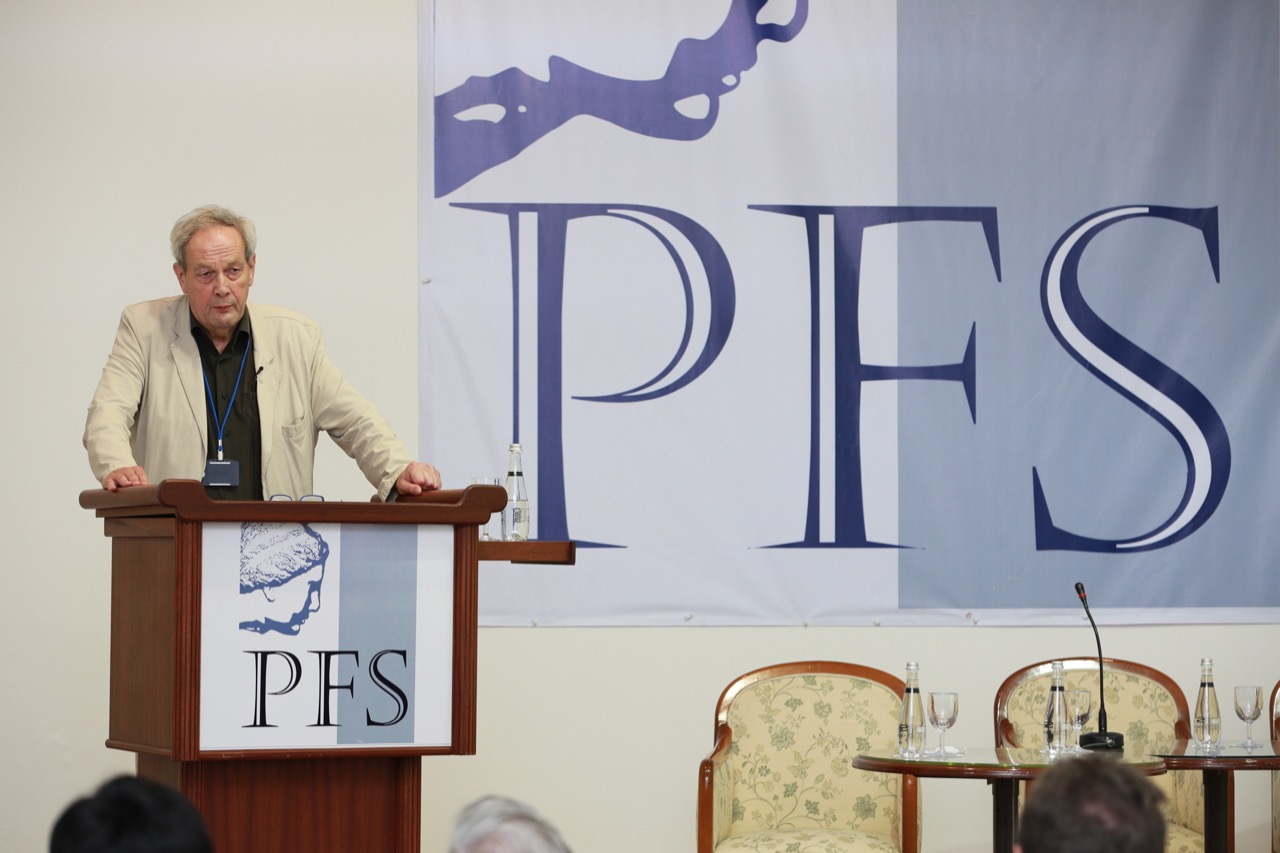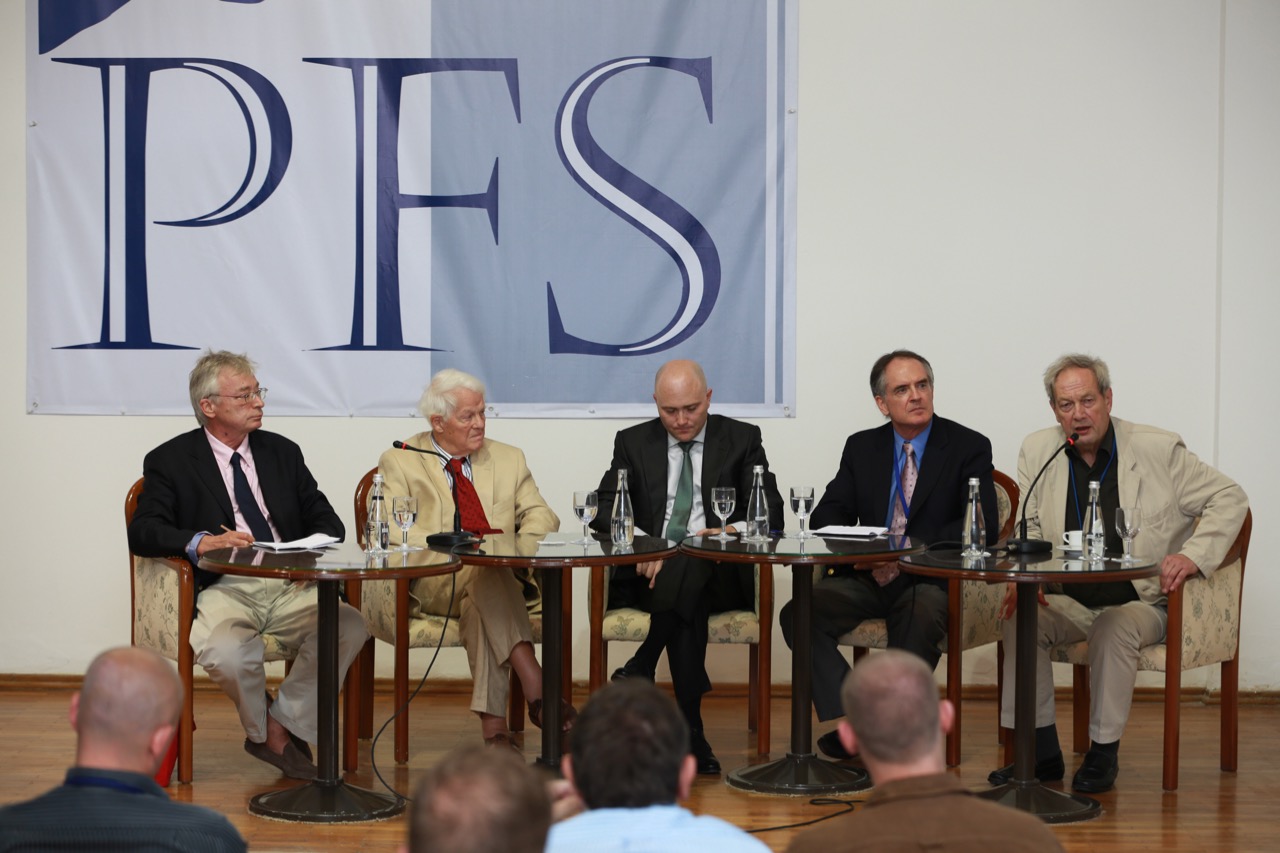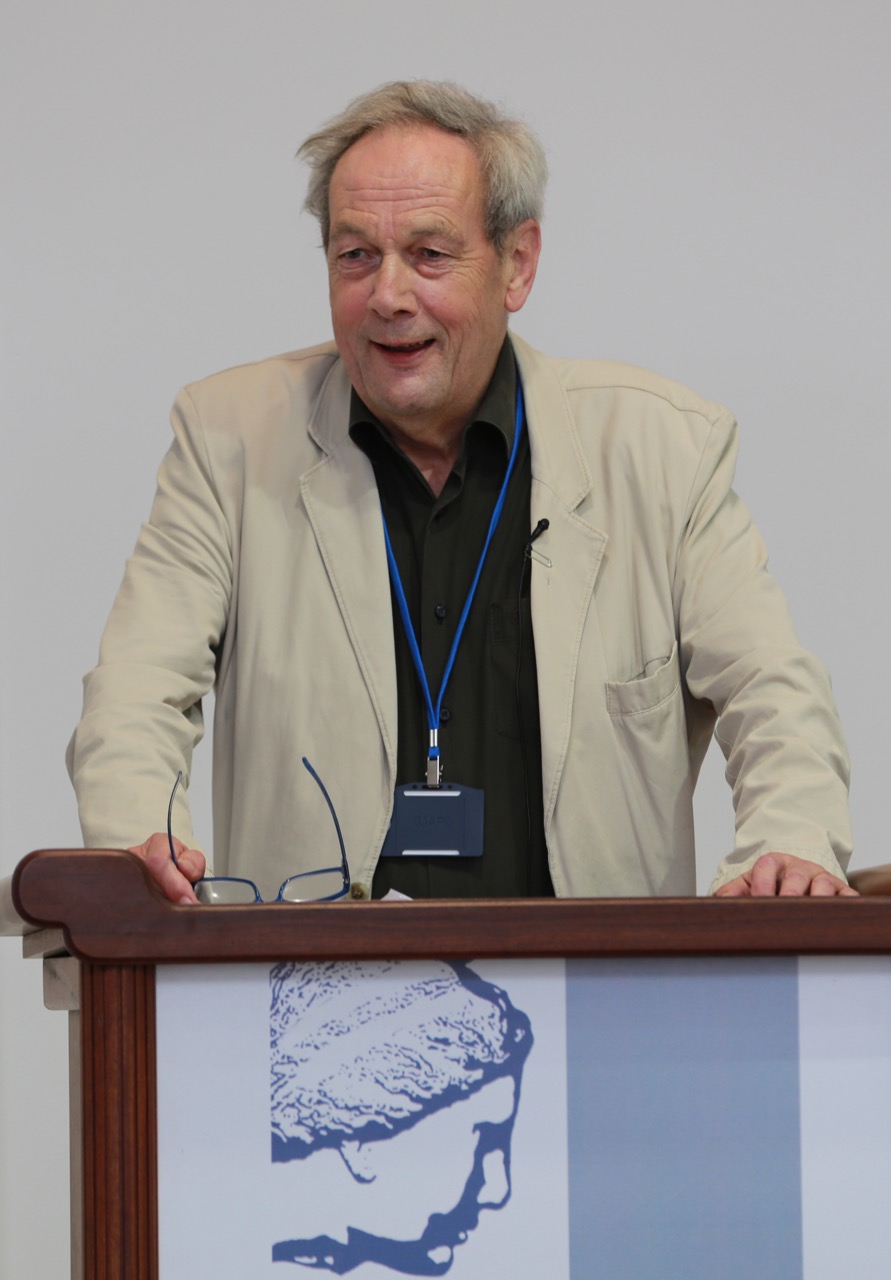
The following is a video of Prof. Hoppe speaking at the Rafael del Pino Foundation’s Master Lecture Series in Madrid, Spain, on June 20, 2013: “From Aristocracy to Monarchy to Democracy: A Tale of Moral and Economic Folly and Decay.”
From the UK publication The Libertarian:
Hans-Hermann Hoppe in 10 Great Quotes
by Eric Field,![]()
By Eric Field
Hans-Hermann Hoppe is one of the most defining of contemporary libertarian thinkers. A graduate of the Goethe University Frankfurt, Germany and a former Marxist, Hoppe’s is best known for his rigorously logical examination of culture, human action, and the state. Hoppe has at times courted controversy for his belief that natural hierarchies are essential to human liberty. Regardless of whether or not one agrees with much of Hoppe’s statements, he has greatly improved the quality of libertarian discourse. So much so, that “Hoppean” has become a synonym for rigorously supported scholarly support for libertarianism.
Ekonomia I Eytka Własności Prywatnej, the Polish translation of Professor Hoppe’s The Economics and Ethics of Private Property, is now available.
See also: Etica y Economia de la Propiedad Privada, Spanish translation of The Ethics and Economics of Private Property.
Economía Y Ética de la Propiedad Privada, the Spanish translation of Professor Hoppe’s The Economics and Ethics of Private Property, is available at the following links:
- Paper edition: http://amzn.to/13Fq0Rq
- Electronic edition for América: http://amzn.to/10mk2al
- Electronic edition for Spain:http://amzn.to/12lXSal
German translation of the speech presented at the 2012 PFS meeting: Hans-Hermann Hoppe, “The Hayek Myth” (PFS 2012).
Professor Hoppe’s Economic Science and the Austrian Method has been translated into Chinese.
From the Authors Forum, presented at the Austrian Economics Research Conference 2013 (formerly ASC) (21 March 2013, Ludwig von Mises Institute in Auburn, Alabama).
Professor Hoppe’s A Theory of Socialism and Capitalism has been translated into Portugese (Mises Brazil, 2013; translated by Bruno Garschagen). It is available for free download into PDF and kindle (.mobi) formats.
Information on the new Laissez Faire Books edition of TSC may be found here. Professor Hoppe’s work now appears in at least 23 languages in addition to English.
From HansHoppe.com:
Hoppe: “The Economics of World Government” (transcript)
by STEPHAN KINSELLA on MARCH 8, 2013
From LewRockwell.com, a transcript of Hoppe’s speech The Economics of World Government (The Lew Rockwell Show #130, 18 Aug. 2009) (from Mises University 2009).
The Economics of World Government
A transcript of the Lew Rockwell Show episode 130 of Hans-Hermann Hoppe at the 2009 Mises University talking about the economics of political centralizationRecently by Hans-Hermann Hoppe: On the Impossibility of Limited Government and the Prospects for a Second American Revolution
ANNOUNCER: This is the Lew Rockwell Show.
ROCKWELL: Recently, at the 2009 Mises University, Professor Hans-Hermann Hoppe talked about the economics of political centralization. What is it that brings about unification, unfortunate unification and centralization within a country like the United States where the states gradually become irrelevant under an all-powerful D.C., and, for that matter, drives countries to join together into an even worse situation, of course, a world government?
Here’s Dr. Hoppe.
HOPPE: OK, I will begin my lecture.
At the beginning, I want to repeat a few points that I have made in my previous lecture on law and economics, and then I want to get to an entirely different subject than the one that I dealt with in that previous lecture.
Because there is a scarcity in the world, we can have conflicts regarding these scarce resources. And because conflicts can exist whenever and wherever there exists scarcity, we do need norms to regulate human life. Norms – the purpose of norms is to avoid conflicts. And in order to avoid conflicts regarding scarce resources, we need rules of exclusive ownership of such scarce resources or, to say exactly the same, we need property rights to determine who is entitled to control what and who is not entitled to control what.
The first Mises Institut Deutschland conference will be held on June 15, 2013, in the Koenigssaal of Hotel Bayerischer Hof in Munich, Germany. Speakers are Hans-Hermann Hoppe, Rahim Taghizadegan, Thorsten Polleit, Phillip Bagus, and Guido Huelsmann. For more information, go to http://www.misesde.org/?p=4304.
A new version of Professor Hoppe’s A Theory of Socialism and Capitalism has recently been published by Laissez Faire Books. Earlier editions of the book may be found here. The book is free in epub and kindle (mobi) format for members of the Laissez Faire Club (members also gain free access to dozens of other e-books in the members-only library). More information about the club.
I wrote a Foreword, which may be found here. Jeffrey Tucker also wrote a useful Editorial Preface that draws attention to the insights in the book that the reader might otherwise miss.
Below is the email message sent to Laissez Faire Club Members by Jeff Tucker in announcing the publication of the book:
Jeffrey Tucker The usual model of politics that most everyone uses today makes no sense. Hans-Hermann Hoppe’s A Theory of Socialism and Capitalism utterly smashes intellectual conventions and makes a case for an alternative way of classifying political and economic systems.
This book was Hans-Hermann Hoppe’s first treatise in English and the one that put him on the map as a social thinker and economist to watch. This new edition includes a detailed analysis by one of his leading students and interpreters, N. Stephan Kinsella. Also, the editorial preface, written by yours truly, draws attention to the insights in the book that the reader might otherwise miss.
Hoppe argues that there are only two possible poles in economic affairs: socialism (violation of private property) and capitalism (respect for private property). All systems are combinations of those two types. The capitalist model he defines as pure protection of private property, free association, and exchange – no exceptions. All deviations from that ideal are species of socialism, with public ownership and interference with trade.
Within the structure of socialism, he distinguishes the left and right version. “Conservative”socialism favors high regulation, behavioral controls, protectionism, and nationalism. The “liberal” version tends more toward outright public ownership and redistribution. In addition, there is a technocratic version that intervenes based on expediency. The consequences of socialism vary based on their degree and kind, but they have similarities: high costs, resource waste, low growth, and economic stagnation.
This structure of the book is that of a comparative systems text, but it goes much further than that. What matters about this book most is the theory and the analytics that Hoppeuses to make the case. This is where we find the innovation. This is where the book shines. This is where the reader will find a more perfect form of a side of an argument that has been ongoing for hundreds if not thousands of years. The reason is Hoppe’s method. It is strictly logical, proceeding step-by-step through every thought, expanding and expanding relentlessly but never leaping from point-to-point in a way that skips or takes anything for granted.
It is through this method that Hoppe presents a thorough and compelling case for the existence and protection of private property, explaining in some detail the first condition of ownership: rivalrous use of physical resources.
His defense of self ownership is the first application of the philosophical rule against performative contradiction to issues of political economy. His case against technocratic regimes rests, implausibly, on an epistemological case for a special kind of cause and effect relationship that exists in human affairs over the natural sciences.
Even his understanding of Marxism is unique: he is careful to discard only the illogical and nonsensical parts while retaining the features that actually do make sense. It concludes with essays on the two most common objections to a fully privatized society.
This masterful book is the template for most of Hoppe’s contributions throughout his career, but here they are succinctly stated and very well organized.
[HHH]
As many of my readers know, I often lecture and speak and give podcast or radio interviews on various libertarian topics and issues, such as intellectual property (IP), anarcho-libertarians, Austrian law and economic, contract theory, rights and punishment theory, and so on. I also blog and comment regularly on such matters in various blogs (primarily The Libertarian Standard, on general libertarian matters, and C4SIF, on IP-related matters), Facebook, and so on—often posting my take on a given issue in response to a question emailed to me or posted online.
This month I am launching a new podcast, Kinsella on Liberty. I expect to post episodes once or twice a week. The podcast will include new episodes covering answers to questions emailed to me (feel free to ask me to address any issue of libertarian theory or application) as well as interviews or discussions I conduct with other libertarians. I’ll also include in the feed any new speeches or interviews of mine that appear on other podcasts or fora, as well as older speeches, interviews, and audio versions of my articles, which are collected for now on my media page). Audio and slides for several of my Mises Academy courses may also be found on my media page, and will also be included in the podcast feed later this year.
Feel free to
Subscribe in iTunes or
Follow with RSS, and spread the word to your libertarian friends. I welcome questions for possible coverage in the podcast, as well as any criticism, suggestions for improvement, or other feedback.
My general approach to libertarian matters is Austrian, anarchist, and propertarian, influenced heavily by the thought of Ludwig von Mises, Murray N. Rothbard, and Hans-Hermann Hoppe. My writing can be found in articles here and blog posts at The Libertarian Standard and C4SIF, such as:
- How I Became A Libertarian, December 18, 2002, LewRockwell.com (published as “Being a Libertarian” in I Chose Liberty: Autobiographies of Contemporary Libertarians (compiled by Walter Block; Mises Institute 2010))
- “What Libertarianism Is,” Mises Daily (August 21, 2009)
- What It Means To Be an Anarcho-Capitalist, January 20, 2004, LewRockwell.com
- How We Come To Own Ourselves, Mises Daily (Sep. 7, 2006)
- Causation and Aggression, The Quarterly Journal of Austrian Economics, vol. 7, no. 4 (Winter 2004)
- A Libertarian Theory of Contract: Title Transfer, Binding Promises, and Inalienability, Journal of Libertarian Studies 17, no. 2 (Spring 2003)
- Inalienability and Punishment: A Reply to George Smith, Winter 1998-99, Journal of Libertarian Studies
- Argumentation Ethics and Liberty: A Concise Guide, Mises Daily (May 27, 2011)
- New Rationalist Directions in Libertarian Rights Theory, 12:2 Journal of Libertarian Studies (Fall 1996)
- Punishment and Proportionality: The Estoppel Approach, 12:1 Journal of Libertarian Studies (Spring 1996).
- Defending Argumentation Ethics: Reply to Murphy & Callahan, Anti-state.com (Sept. 19, 2002)
- Montessori, Peace, and Libertarianism, LewRockwell.com (April 28, 2011)
On IP in particular, which I’ll also cover from time to time in the podcast, see:
Below is a recent post from Mises Deutschland with videos of Professor Hoppe speaking on “Privatrechtsgesellschaft statt Staat,” Modelhof Akademie (Nov. 23, 2012).
Vortrag von Professor Hoppe in der “Akademie Modelhof”: “Privatrechtsgesellschaft ohne Staat”
16.1.2013 – Am 23. November 2012 sprach Prof. Dr. Hans-Hermann Hoppe in der “Akademie Modelhof” (Müllheim, Kanton Thurgau, Schweiz) zum Thema “Privatrechtsgesellschaft ohne Staat”.
Prof. Hoppe zeigt in seinem Vortrag, dass der Wettbewerb in der heutigen Parteiendemokratie – ein Wettbewerb im Lügen und Abkassieren, im Täuschen und Tarnen – keine guten Ergebnisse hervorbringen kann.
Als Alternative bietet er die Privatrechtsgesellschaft an, aufgebaut auf Selbstbestimmung und Freiwilligkeit. In diesem System werden Konflikte neutral gelöst.
Prof. Hoppe zeigt auch auf, dass das Modell der Privatrechtsgesellschaft keine Utopie, sondern streng durchdacht, realistisch und genau betrachtet sogar selbstverständlich ist.
Wir bedanken uns bei der “Akademie Modelhof” für die Genehmigung zur Veröffentlichung der Videos.
Andreas Marquart
(Hinweis: es lässt sich leider nicht vermeiden, dass die Videos gleichzeitig starten, bitte ein Video einfach auf “Pause” stellen)
Hier können Sie die Diskussion im Anschluss an den Vortrag verfolgen: [continue reading…]
As Andy Duncan notes in a Facebook post about this interview: “At one point I ask him a little about Hoppe World, in the future, and he says it’s likely.”
DOUG CASEY: ‘WE ARE LIVING IN THE MIDDLE OF THE BIGGEST BUBBLE IN HISTORY’
Episode 88: GoldMoney’s Andy Duncan talks to Doug Casey, the founder and chairman of Casey Research and the author of a new book called Totally Incorrect. They discuss the current state of global finance and the chances of an upcoming paper money collapse.
Casey points out that the recovery after the 2008 financial crisis is just an illusion created by central bank money printing which will ultimately lead to very high inflation once bank lending starts to pick up again. Both men discuss what will happen when all the US dollars currently held overseas are repatriated as foreigners lose confidence in the greenback. They also speculate about what Keynesians might be thinking at the moment, and analyse how non-western central banks are beginning to behave with regards to gold.
They evaluate the likelihood of western economic collapse in 2013, what this would imply for the global monetary standing of gold, and how GoldMoney subscribers can best protect themselves and their assets. On this note they also talk about how a future world monetary situation might look like once we are through the Keynesian collapse. Casey also speculates about how the theories of Professor Hans Hermann-Hoppe might have applicability to the shape of the world order post-crash, and what readers can look forward to if they purchase a copy of Totally Incorrect.
Finally, they discuss what type of “black swans” we can expect to land in the coming months.
This podcast was recorded on 15 January 2013.
From Mises Sweden:
Interview with Michael McKay – PFS2012
There are so many good things you can say about Michael McKay so I will just mention a few things. Michael is the founder of Radio Free Market. I can really recommend one of his recent lectures about Reality Economics at Carthage College here. Michael is also a vivid supporter of many freedom organizations. Michael has been a successful business man for several years and is also the author of the Secrets About Money.
To sit down with Michael and discuss any subject is always a pleasure and I admire him on so many levels. I think one of the things I love most about Michael is that he is dedicated to help young people and to really spread his knowledge. In this interview Michael tell us about PFS, his books, advice for young people and how to build a business.
Buy Secrets About Money here and visit the website for Radio Free Market.
Interview with Michael McKay – Property and Freedom Society 2012 from LvMI Sverige on Vimeo.
Below is the initial (preliminary) list of speakers and topics for the Eighth Annual Meeting of the PFS, which will be held in Bodrum, Turkey at the Hotel Karia Princess, from Thursday, September 19, to Tuesday, September 24, 2013. Those interested in attending should contact Dr. Hoppe or Mr. Grözinger, Administrative Secretary, regarding conditions, availability, and requirements. (Please be advised that nearly half of all available places have already been reserved. So don’t wait too long.)
(Note: The list of speakers and topics for the Seventh Annual Meeting (Sept. 27-Oct. 1, 2012), as well as video of the presentations, may be found here.)
Property and Freedom Society
8th Annual Meeting, September 19–24, 2013
Karia Princess Hotel, Bodrum, Turkey
Speakers & Topics
- Anthony Daniels (Theodore Dalrymple), Public Health or Public Totalitarianism? A Report from Medical Journals
- Norman Stone, World War II Revisited
- Thomas DiLorenzo, The Myth of American Exceptionalism
- Hans-Hermann Hoppe, What is Human Nature? Does it Exist?
- Jared Taylor, A Brief History of US Race Relations
- Stephan Kinsella, The Role of the Corporation and Limited Liability in a Free Society
- Paul Cantor, What Literature can teach Economics
- David Howden, Labor Laws: Legislating Unemployment
- Richard Lynn, Why are the Jews so Smart?
- Eugen-Maria Schulak, Friedrich Nietzsche – Right Wing Anarchist?
- Gerard Casey, Begotten not made: Law, Order and Community
- Sean Gabb, Understanding England and the English
- Nikolay Gertchev, Entrepreneurship and Betting: What, if anything, can Businessmen learn from Betting Odds?
- Robert Nef, Understanding Switzerland and the Swiss
- Thorsten Polleit, Organized Crime and the Progression Towards a Single World Fiat Currency


Follow Us!