Re: Louise Perry, “How Did We Come to Bash the Dead?“, Wall Street Journal (July 15, 2026): “In a polarized society, speaking ill is an act of symbolic banishment, casting the decedent out.”
WF Buckley’s obituaries were notoriously vicious. I’ve wondered if he rejected this supposed tradition on grounds that it is not actually a Christian one. My own feelings on this point are mixed. https://t.co/eP0IE6WrvB
— Jeffrey A Tucker (@jeffreytucker) July 17, 2026
Most of us principled, anti-state libertarians are deed admirers of Rothbard. Hoppe has written glowingly of Rothbard’s singular genius, assessment I share. As Hoppe has written,
And there was a certain amount of, I would say, jealousy, because, I mean, Rothbard was enormously bright. I’ve met bright people in my life, but the only person I’ve met whom I would consider to be a genius was Rothbard. He could tell you the the content of every book in his library. And that wasan enormous library. Whenever you would ask him about any strange subject, he could give you some suggestions on what to read. You felt like a little, urn, uneducated person if you talked to him. So jealousy played a big role in explaining why it was that he was not treated like a genius, as he should have been treated.
… There are certain purely theoretical points, like the foundation of private property rights and so forth, where I think I did make some breakthroughs, which Murray endorsed. I’m very proud of that. But since I’m now 75, if I had to assess my general impact that I hadon the world, I think it would make me most proud if people would say Hoppe is, in a way, the most important successor of Rothbard in the present age. It would make me enormously proud if that became the general view, even though I admit I’m not in the same league as Mises and Rothbard. Those two were geniuses. I’m a pretty bright guy. I contributed quite a bit to libertarian thought. But I would never, ever put myself in the same league as them. But since there is nobody in sight who is in the same league as they are for the time being, I’m a pretty good substitute for these two giants.1
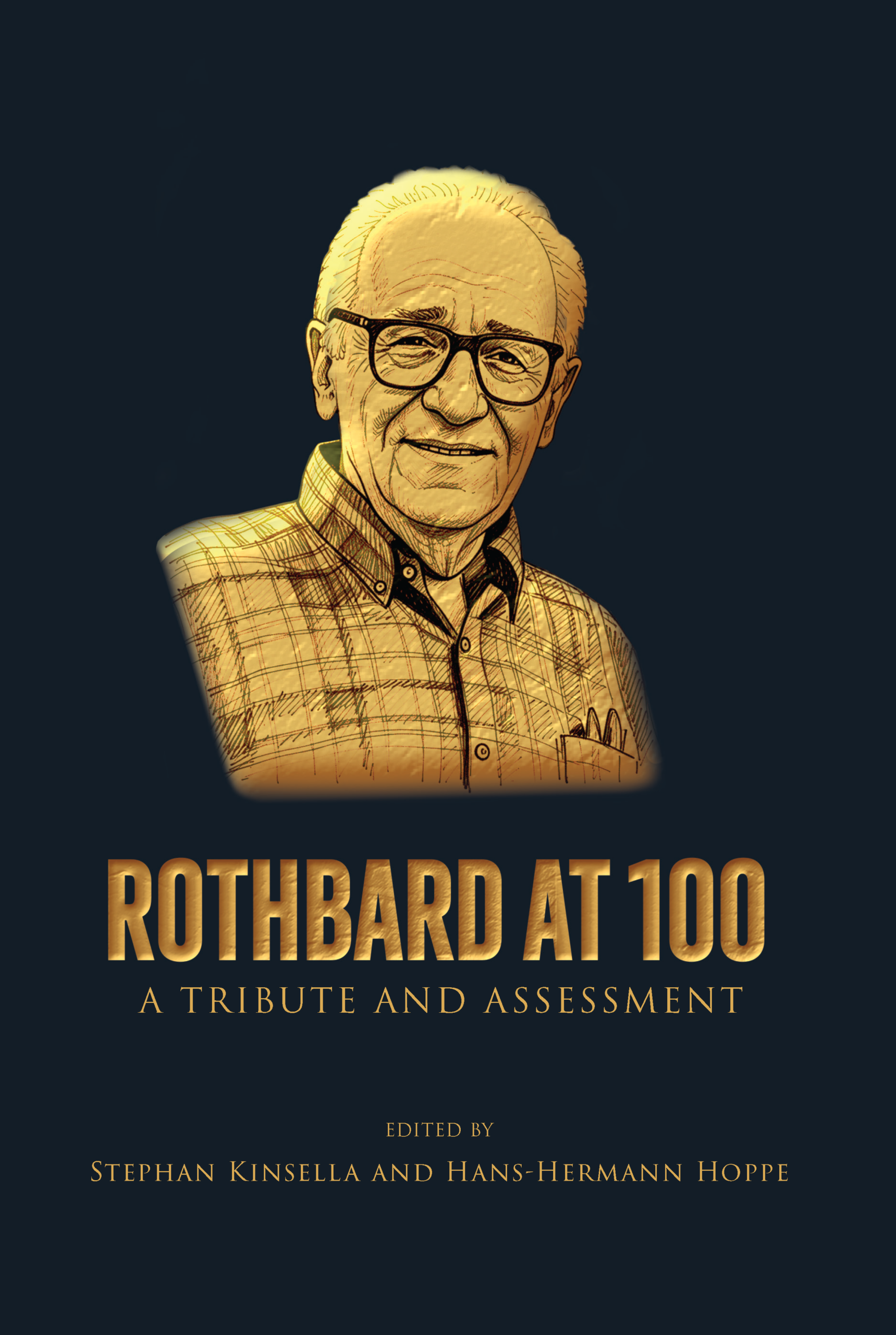
Many others feel the same, as evidenced by tributes to him both before and after his death. See Rothbard at 100: A Tribute and Assessment, Stephan Kinsella and Hans-Hermann Hoppe, eds. (forthcoming 2026); Murray N. Rothbard: In Memoriam (Auburn, Ala.: Mises Institute, 1995) (various authors); “Rothbard Remembered,” Liberty (March 1995; pdf): 20–26 (various authors); Man, Economy, and Liberty: Essays in Honor of Murray N. Rothbard, Walter Block and Llewellyn H. Rockwell, Jr., eds. (Mises Institute, 1988).
But not everyone appreciates him the same way. The Randians hate him because he didn’t footnote them properly, or something petty like that.2 Some neo-cons, like William Buckley, Jr., for the obvious, usual reasons; Buckley infamously and classlessly besmirched him upon his death, writing:
his problem ought not to be thought of as tracing to the seamless integrity of libertarian principles. In Murray’s case, much of what drove him was a contrarian spirit, the deranging scrupulosity that caused him to disdain such as Herbert Hoover, Ronald Reagan, Milton Friedman, and — yes — Newt Gingrich, while huffing and puffing in the little cloister whose walls he labored so strenuously to contract, leaving him, in the end, not as the father of a swelling movement that “rous[ed] the masses from their slumber,” as he once stated his ambition, but with about as many disciples as David Koresh had in his little redoubt in Waco. Yes, Murray Rothbard believed in freedom, and yes, David Koresh believed in God.3
To which Lew Rockwell responded, upon Buckley’s death:
The CIA agent, founder of the modern conservative movement, enforcer of warfare-state discipline on the right, brilliant writer and editor, transoceanic sailor, harpsichordist, TV star, charming aristocrat, founder of National Review and Young Americans for Freedom, enabler of neoconservatism, expeller of heretics from Birchers to Rothbardians, and thoroughly bad ideological influence in general, is dead at 82. 4
And minarchists and utilitarians disdain him because he was anti-state, and a principled individual-rights property-rights libertarian. I remember Ed Feser, bizarrely invited to the Mises Institute many years ago to deliver the Rothbard Lecture (as I recall), who proceeded to reject and criticize Rothbard for a hodgedge of reasons.5 And others were just jealous of his achievements and stature, as Hoppe notes. Some of them snidely repeat this old canard, with snickers: that he was viewed as a great economist, a historian, and philosopher, but not by those specialized in those fields. For example, Liberty editor R.W. Bradford wrote, in the Nov. 1995 Liberty:
- Tom Woods Elite Letter: The Hans Hoppe Interview (2025). [↩]
- Rothbard’s Objectivist Influences. [↩]
- William F. Buckley Jr., Murray Rothbard, RIP, National Review (Feb. 6, 1995). [↩]
- Llewellyn H. Rockwell, Jr., William F. Buckley, Jr., RIP, LewRockwell.com (Feb. 27, 2008). See also idem, Murray Rothbard Soars, Bill Buckley Evaporates, LewRockwell.com (March 29, 2016); David Gordon, A Birthday Tribute to William F. Buckley, Jr., LewRockwell.com (Nov. 17, 2005). [↩]
- See Kinsella, The Trouble with Feser (on Libertarianism); Woods, Fleming, Chronicles Discussion; The Problem with Natural Rights and True Believer Activism; Walter Block, “Libertarianism is unique; it belongs neither to the right nor the left: a critique of the views of Long, Holcombe, and Baden on the left, Hoppe, Feser and Paul on the right”. [↩]










 Alessandro Fusillo
 Andreas Tögel
 David Dürr
 Doug French
 Fernando Chiocca
 Greg Morin
 Hans-Hermann Hoppe
 Jay Baykal
 Jayant Bhandari
 Jeff Deist
 Jeffrey Barr
 Juan Fernando Carpio
 Ken Yamarashi
 León Isidoro
 Martin Cabrera
 Nick Hoppe
 Oscar Grau
 Peter Wong
 PFS
PFS scholarium
 Saifedean Ammous
 Sean Gabb
 Sean Ring
 Stephan Kinsella
 Stéphane Geyres
 Thomas Jacob
 Tom DiLorenzo
Follow Us!