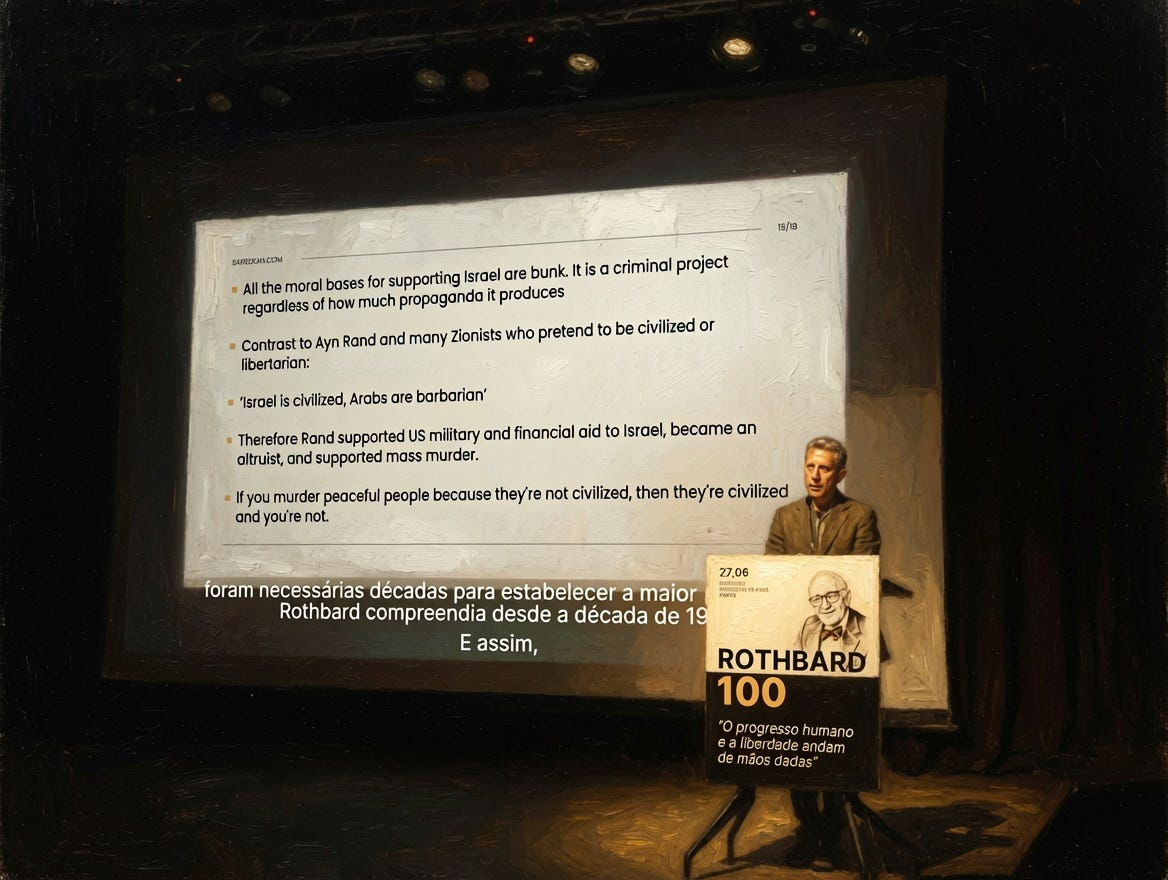
Rothbard Porto: Saifedean Ammous: Beegarc AI watercolor rendering
Below is the video of the speech by PFS stalwart Saifedean Ammous at 100 Years with Rothbard (Porto, Portugal, June 27, 2026). See Cataláxia Editora Rothbard 100 Youtube playlist. Transcript and summary below.
Select photos (for further information and additional photos, see Kinsella, Rothbard Takes Portugal: 100 Years with Rothbard: A Personal Account).






-

- Rothbard 100, Portogal, Fernando Chiocca, Saifedean Ammous, Hoppe


-

- Thumbnail for Youtube Video, Hoppe Voiceover for Rothbard Tribute, “100 Years with Rothbard” (Porto, Portugal, June 27, 2026).


Related
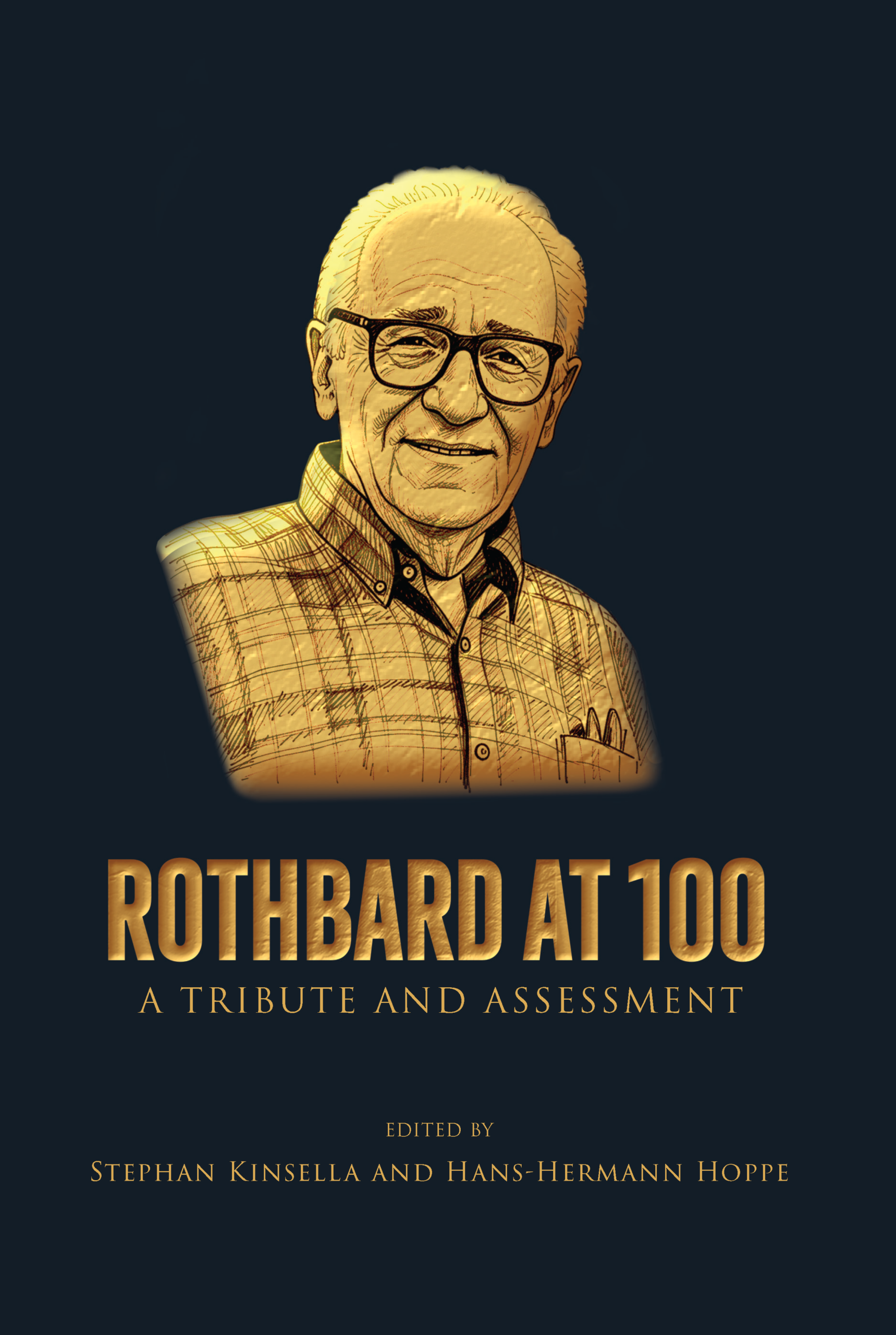
- Saifedean Ammous, “Murray Rothbard: An Ode to an Intellectual Hero,” in Rothbard at 100: A Tribute and Assessment, Stephan Kinsella and Hans-Hermann Hoppe, eds. (Papinian Press and The Saif House, 2026)
- Ammous Interview with Mario Nawfal: A Misesian-Propertarian Take on the Palestinian/Israeli Conflict
- Saifedean Ammous, “Javier Milei’s Austrian Scam By the Numbers”
- Ammous, “Property Rights: The Root Cause of the Palestinian-Israeli Conflict,” Property and Freedom Journal (May 7, 2026)
- PFS posts on Israel
- Ammous, Property Rights: The Root Cause of the Palestinian-Israeli Conflict
- Hoppe, Judeo-Christian tradition affirmed by new law: Death penalty for thee (Goy) but not for me (Jew)
- Kinsella, Block on Israel, Self-Defense, Pacifism
- Kinsella, Ammous vs. Block on Israel
- Van De Haar and Besada on Hayek, Mises, Rothbard on Zionism
- Hoppe, An Open Letter to Walter E. Block
Summary (Grok)
Saifedean Ammous on Rothbard’s Perspective on Palestine 0:05
Saifedean Ammous thanks the audience in Porto and honors Murray Rothbard as his hero. While Rothbard’s economic ideas shaped his thinking, Ammous focuses on Rothbard’s rarely discussed views on the Palestine conflict and the broader Middle East.
Rothbard’s Sharp Analytical Style 0:51
Rothbard wrote on countless topics with exceptional clarity. He consistently strips away lies, propaganda, romance, emotional manipulation, and obfuscation to reach the core of any issue. His writings on Palestine illustrate this strength, offering a powerful and precise dissection of the conflict.
Courage in Speaking Unpopular Truths 1:36
Rothbard repeatedly spoke uncomfortable truths, like the child declaring the emperor has no clothes. This approach harmed his academic career but produced ideas that endure. He embraced unpopularity, calling hate his muse. His critiques of inflation, legal tender laws, and central banking seemed radical in the 1960s-80s yet proved prescient.
Opposition to Central Banking and Fixed Money Supply 2:49
Rothbard opposed inflation, central banks, and government planning while advocating a fixed money supply. These ideas appeared ridiculous at the time but are now more relevant, especially with Bitcoin. He wrote for the future, knowing truth is timeless. His work on money provided tools to understand Bitcoin.
Rothbard’s Early Insight on Palestine 7:11
As a Palestinian familiar with the history, Ammous praises Rothbard’s clarity on the conflict. Rothbard’s best piece, “War Guilt in the Middle East,” identifies the dispossession of Palestinians and denial of their property rights as the root cause. This is a distinctly Austrian analysis.
Zionism as the Historical Root Problem 9:00
Rothbard traces the issue to Zionism, a political movement seeking Jewish nationalism on someone else’s land. Western European Jews largely assimilated after the French Revolution, but Eastern European Jews faced different challenges. Four solutions were proposed: assimilation, Bundism on European land, nationalism on uninhabited land, and nationalism on inhabited land belonging to others. Only the last option made no sense and guaranteed conflict.
Balfour Declaration and British Role 10:53
The 1917 Balfour Declaration promised land Britain did not own to a people who did not live there. Palestine was roughly 90% non-Jewish. Under British rule from 1917 to 1948, authorities helped Zionists build state institutions and a military while disarming Palestinians on a racial basis. This disarming from 1936 to 1939 set the stage for later events.
Terrorism, Nakba, and Systematic Expulsions 13:06
Zionist terrorism increased in the 1930s-1940s. By 1945, despite extensive support, Zionists owned only about 5.67% of Palestine, scattered and non-contiguous. The Nakba involved systematic expulsion, with 250,000 to 300,000 Palestinians removed before Israel’s independence and before Arab armies entered. The UN partition plan gave Zionists 55% of the land despite minimal ownership.
Ethnic Cleansing Plans and Looting 16:38
The ethnic cleansing plan was developed in the 1930s by David Ben-Gurion and Zionist groups, not as a result of war fog. Hundreds of villages were destroyed. Recent books like Adam Raz’s Loot document systematic military looting of Palestinian property, while Ilan Pappé’s The Ethnic Cleansing of Palestine details the meticulous planning.
Rothbard’s Conclusion and Property Rights 26:36
Rothbard concluded Israel faces a dilemma: continued hostility leading to overthrow by guerrilla war, or cutting Western imperial ties to become ordinary Jewish citizens of the Middle East, allowing peace and justice. Peaceful Jewish-Arab coexistence existed for centuries before Western imperialism. There is no inherent enmity between Arab and Jew. Property rights are the foundation of civilization and the solution to conflict.
Contrast with Ayn Rand and Final Reflections 21:48
Ammous contrasts Rothbard with Ayn Rand, who supported U.S. government aid to Israel, embracing taxation and altruism selectively. Rothbard’s property-rights framework remains superior. Ammous thanks Rothbard for his principled stance as a Jewish thinker who prioritized truth and expresses regret at never meeting him.
Transcript (Youtube/Grok)
Introduction and Purpose of the Talk 0:05
Good afternoon everybody. Thank you so much for the invitation. It’s a pleasure and an honor to be here in Porto and a pleasure and an honor to be speaking about my hero Murray Rothbard.
And I’ve read a lot of Rothbard over the years and I’ve usually discussed his work on economics. He has been the most influential economist on my development and I discussed this in the book that is available outside. I discuss how important it was. But today I’m going to talk about something different which is not usually mentioned when Rothbard is discussed understandably because Rothbard wrote about so many different topics. I’m going to be talking today about his perspective on the conflict in Palestine and the conflict in the Middle East in general.
Rothbard’s Analytical Clarity 0:51
And as I was saying, he wrote on many many many topics. And it’s actually astonishing to see how many of these topics he had a very strong grasp of even though they may not obviously appear to be things that are relevant to him. But whenever you read Rothbard, you may agree or you may disagree, but you can’t question just the sharpness and the ability to strip away the lies, the propaganda, the romance, the emotional manipulation and the obfuscation to put it all aside, get to the heart of the matter.
And I think Palestine, Rothbard on Palestine is interesting because it’s important to understanding the topic, but it’s also an illustration of Rothbard at his best in his ability to really get to the bottom of things.
Rothbard’s Courage in Speaking Unpopular Truths 1:36
In all of these topics, we see a constant theme wherein Rothbard sticks his neck out like the child who says, “The emperor has no clothes.” And he just stands there and he says something extremely unpopular, extremely hurtful to the feelings of the majority of adult children in the world who are incapable of handling ideas like Rothbard and it gets him into all kinds of trouble.
It’s not been good for his career as you know as you can imagine I mean he’s been such a prolific scholar and he’s produced things that have been read so widely and yet his success in academia is very limited. He was at a relatively low ranking university compared to the more established universities and he could have easily had a career in those established universities if he towed the line if he went along with what was popular. But in everything he always went with the truth and he embraced the hate and the unpopularity. He used to call I think he said hate was his muse that was inspiring to him. He didn’t care.
And you see this in economics and you see this in all kinds of topics where his ideas survive the test of time even though they’re unpopular when they come out but then in the long term they come out to have been very prescient and very important.
Opposition to Inflation and Central Banking 2:49
So in economics you know he spoke up against inflation and you know now there are a lot more people talking about inflation than there was back then in the 1960s or 70s or 80s. There was no internet. There were very little avenues for talking about the damage that inflation does because the vast majority of media and academic journals were controlled largely by governments and their central banks and the economists who work there were paid by the central bank.
So everybody went along with the inflation story. Everybody agreed that the central bank needed to operate. It was necessary for a modern economy to have a central bank. And very few people questioned that. And of course when you question that, you know, it doesn’t help your career prospects. And so Rothbard spoke out against inflation. He opposed legal tender laws. He criticized the entire existence of the central bank, which is a very bad career move.
If you are in an industry where the central bank pays roughly 90% of the salaries about 90% of academics published in the journals of monetary economics are paid directly by the Federal Reserve or by institutions that are paid by the Federal Reserve. So really the best way to destroy your career in economics is to go against the Federal Reserve. So obviously Rothbard embraced that opportunity and he opposed central planning. He opposed the role of the government and he argued for a fixed supply of money which in the 60s and 70s and 80s must have seemed you know not just heretic but also deeply silly. Why would you even imagine something like this? Even gold would always make more gold. Why would anybody want a fixed supply money?
And as far as I can tell, Rothbard was the only and first one to ever discuss the possibility of a fixed supply money. All these ideas were very ridiculous in the 1960s and 70s when Rothbard was writing them. They’re a lot less ridiculous now. You still will ruin your career by talking about the Fed, but you can maybe find people outside who will talk to you, not just the homeless guy on the street. You can make friends and you can join organizations and discuss this. And there’s Bitcoiners and you can go online and you can make fun of the fiat people. It’s a very different world now.
Rothbard’s Enduring Legacy 5:15
His career suffered. He didn’t get the recognition that mainstream economists would have gotten but he’s today much more widely read than most of those economists. So when you think about the economists that were active in the 60s and 70s and 80s, practically none of them are having conferences about them on their 100th birthday today. Practically none of them are selling any substantive number of books. Practically none of them have hundreds of reviews on Amazon or thousands of reviews on Amazon from people that are still reading their books these days.
And with his identification of the fixed supply, he really touched on something very, very profound. He was the only one who gave us the tools to think about Bitcoin. And the reason why I think I understood Bitcoin and understood the significance of Bitcoin is because I’d read this paper, particularly a paper called the Austrian theory of money. It’s a brief paper that summarizes a lot of the work of the Austrians and does a terrific job of it. And once you think about that idea of a fixed supply money, then Bitcoin becomes possible and workable and then you’re able to understand it much better.
You get the feeling when reading Rothbard that he wrote for the future. He knew that in the present this was not going to get him jobs. It was not going to win him a lot of friends. But he didn’t care. He knew that he was writing for us. He knew that 20, 30, 50 years from now, people would make sense of what he said and they would appreciate it a lot more. And I think he was absolutely correct because truth and wisdom are timeless. They do not go and come with fads. They are timeless. And I think this is what Rothbard shows us. And in the same way that he did that with economics, he did it with Palestine. So I’m going to try and illustrate this with some of his discussion.
Rothbard on the Root of the Palestine Conflict 7:11
If you read his work on Palestine, you’re struck and I say this as a Palestinian who had been very familiar with the Palestinian issue and I studied the history for all of my life. Basically, I’d lived the history and you start reading Western perspectives on the conflict and it’s very rare that you come across somebody who understands the issue.
If you read people on the left, it’s usually presented from the perspective of, you know, leftists and colonialism and it’s a continuation of Western imperialism and it’s all because of Westerners being bad and colonialism being bad and all of that and it’s just very cliched and not very useful toward understanding what’s happening on the ground today. On the other hand, if you read perspectives from the right, you are constantly inundated with idiotic Israeli propaganda along the lines of, you know, we are the good guys, they are the bad guys, so we have to kill them and do all kinds of horrible things to them. Essentially Ayn Rand level cartoonish nonsense.
But here was Murray Rothbard presenting a very very very powerful dissection of the conflict and with remarkable clarity and precision identifying the root of the problem and I think the best article that he has on this is an article called War Guilt in the Middle East. He has many other articles on this but this one is I think the one that summarizes his views best and he pinpoints the problem from the first couple of pages. The cause of the problem is the dispossession of the Palestinians and the denial of their property rights. It’s a very Austrian perspective and it is inevitable that you would see this if you were an Austrian economist. It’s very clear and it’s practically inarguable and it’s completely indefensible and the only way that it can be defended is essentially through lies and propaganda as we’re going to be seeing.
Zionism and the Four Proposed Solutions 9:00
So Rothbard pinpoints the historical root of the problem as Zionism. He says Zionism is a political movement that made no sense. He says Western European Jewry assimilated into Western European societies after the French Revolution. Eastern European Jewry however did not. And so they needed a solution and there were four practical solutions to the problem of the presence of Jews in Eastern Europe and the problems that they were having with their neighbors.
Number one is assimilation which is what western Europeans chose but it seemed like it was not a very practical solution in Eastern Europe as Rothbard puts it. The second was Bundism or Jewish nationalism on Jewish land in Europe. So territories in Europe that were mostly Jewish owned would declare their independence and build independent communities and potentially even a state. So Jewish nationalism on European land was the second option.
The third was Jewish nationalism on uninhabited land. And there were many proposals as such. Nebraska, Alaska, Uganda, Argentina. In the turn of the 20th century, these were seriously discussed by a lot of the people in the Zionist movement, but none of these really took off.
And then the fourth option, as Rothbard describes it, is the only one that made no sense whatsoever. It’s Jewish nationalism on somebody else’s land. So, it’s not unowned land and it’s not Jewish land. It’s somebody else’s land. And so, you can see where the problem is. You can see why inevitably this is going to lead to all of the problems that you see unfold over the last century. If you did this anywhere on Earth, if you went to a group of people and you said, “Sorry, we’re kicking you out. We need to build a national homeland for another group of people.” You’re going to get conflict. There’s just no way around it. It’s very, very simple.
Balfour Declaration and British Facilitation 10:53
So in 1917 when the British issued the Balfour Declaration granting a land that they did not own to a people who did not live in the land when that was issued the population of Palestine was about 90% not Jewish only about 10% of the population of Palestine was Jewish and 10% may be a vast overstatement might be as low as four or 5% but it’s not very clear what the number was but by all accounts it can’t possibly have not been over 12 or 13%. Jews were a small minority with very little land ownership. They likely owned less land than their population percentage because they were more concentrated in the cities.
And so, how do you build a national homeland for a group of people that don’t own the land on which you want to build the homeland? It’s tricky. You can try and buy the land, but you can’t really just buy a whole country. You can buy individual plots, but it’s difficult to convince an entire population to sell at once and leave. And where do they go? You know, it’s not like you’re selling your one property and you buy another one in your same town or in the town next door. You’re talking about displacing all of the people who live in that land. So, if they’re not going to sell their land, what are you going to have to do? Obviously, force.
So, under British rule, which started in 1917 and lasted until 1948, the Zionists and the British worked to make the Zionist state in Palestine possible. And Rothbard identifies all of this in the 1960s. And more and more has come clear about what actually was happening during that time over time that vindicates what he has seen and what he had written in the 1960s but a lot more research has come out since then but because it’s Rothbard and because he’s using the Austrian analytical praxeological framework he doesn’t need to get a lot of the details that we needed many decades later he could see the clarity of the situation that’s a property right violation and so clearly we can see what’s going on.
Disarmament, Terrorism, and the Path to Nakba 12:50
And so he understood what was happening under the British when and one of the roots of the problem was that when the British took over they worked to develop the state institutions of a Jewish state and not a state for the local population. They allowed the Zionist movement to build the institutions of a state. Most important of course being a military while disarming the Palestinians and preventing them from building any institutions and from building a military. And that was really the key point.
From 1936 to 1939, the British and the Zionists disarmed the Palestinians. And everything that has happened to the Palestinians since then has just been an inevitable consequence of the disarming of the Palestinians, which was done on a purely racial basis. If you were not Jewish, you couldn’t hold weapons, but if you were Jewish, you could be part of terrorist militias that were out there massacring civilians as well as British soldiers and British civilians. But they were allowed to keep their weapons.
So this of course then resulted in Zionist terrorism becoming very very common in the 1930s and the 1940s and it led to mass casualty events and many many victims and then of course the culmination of this was in 1947 with the Nakba or the Palestinian catastrophe.
Land Ownership in 1945 and Planned Ethnic Cleansing 14:04
Because in 1945 and this is a very important chart or graph that I’ve got there in 1945 even after three decades of the Zionist movement receiving countless military and financial forms of support from European countries, from the British, from the Soviet Union, from Nazi Germany. Incidentally, as well, the Nazis were quite happy to get European Jews out and to join the Zionist project in the 1930s. And from receiving a lot of money and financing from the international Jewish community, even after all of that, the Zionist movement had only acquired about 5.67% of Palestine by 1945.
This is really the most important fact perhaps in the history of the conflict. This is it. This glaring fact that you have this entire piece of land and if you look at the map it shows you independent individual districts and the percentage of land ownership by district and you see that the green is predominant that’s basically the ownership by Muslims Christians and other groups whereas the red is the ownership by Jews and it is essentially only in some of the districts and it’s not a majority of any of the districts.
So, it’s not only 5.6%, it’s also not concentrated. It’s distributed over several areas that are not territorially contiguous. And so, building a nation state with dots of land dispersed all over is not very practical. And so, the Zionists of course understood this very very well. And over the years, you know, Rothbard wrote this article in the 1960s, but over the years, a lot more resources have come out and a lot more explanations have come out with quotes and diaries and classified documents and secret documents that have revealed the reality of what was going on.
So now we know that yes, it makes sense that it could only work through mass expulsion and murder. And Rothbard isn’t very familiar with all of the details that come out decades after he wrote that article obviously. But he still arrives at the right conclusion because he gets it because the property rights belong to the Palestinians. The land belonged to the Palestinians predominantly. And all of human history shows us there are no examples of people just picking up and leaving their land voluntarily because other people nicely asked to have their land. It just doesn’t happen. So if somebody wants your land, there’s going to be conflict. There’s no way around it. So this was the plan for the ethnic cleansing of Palestinians. We later find out in the 1990s was developed in the 1930s. It was very clear that where the population centers were in Palestine, the Jewish population centers were and that there were areas that needed to be cleaned in the middle between those areas so that the Jewish population areas could be contiguous and defensible. And so all of the population that was between those areas had to go.
And so this was a plan laid out in the 1930s. It was not something that happened in the fog of war as Israeli propaganda likes to pretend. It was systematically laid out in the 1930s by David Ben-Gurion who was Israel’s first prime minister and the Haganah and all the other terrorist organizations that were part of the Zionist movement at that time.
The Nakba and Systematic Expulsions 17:19
One of the most important factoids which Rothbard doesn’t mention but supplements and proves his point. He says the idea you know most Americans think that the refugees were a result of the war. The Arabs invaded and there was a fight and as the first Israeli president Chaim Weizmann put it, a miracle happened and they left. And that’s essentially the extent of intellectual work in your average brainwashed Zionist in academia and media today. A miracle happened and people just decided to leave their home and now they can’t have them back and that’s just how we’re going to have peace and prosperity for the future.
But in reality, of course, 300,000 Palestinians, between quarter million and 300,000 Palestinians were expelled before Israel announced its independence and before a single Arab soldier had entered Palestine. So the notion that they were expelled as a result of the war is completely fabricated, bold-faced lie. 250 to 300,000 already been expelled from their homes.
And when the Arab armies invaded, they didn’t invade Israel. They invaded primarily almost all of the land in which Arab military operated was the land was not partitioned to Israel as part of the partition plan. The plan was the partition plan was done by the UN at that point. It gave the Zionist movement something like 55% of Palestine and even though they owned only about 5% of it and it gave the Palestinians the other part and even the supposedly Jewish state that was planned from the partition plan would have still had a majority of its land owned by Palestinians.
The majority of the land of the Jewish state was still owned by Palestinians. So the rest of that country which was supposed to become a Palestinian state or an Arab state at that point that was where the Arab armies entered mainly in order to defend these territories from also being taken over by the Israelis. There was very little Arab incursion into Israeli territory and yet the ethnic cleansing happened before that and it continued throughout 1948. 500 villages were systematically destroyed and depopulated. And there’s been a very systematic attempt of looting and the looting of private property.
Looting, Ethnic Cleansing Books, and Rothbard’s Foresight 19:38
And this has been only recently revealed the extent of this has only recently been revealed by this book by an Israeli scholar called Adam Raz. It’s called Loot: How Israel Stole Palestinian Property. And it’s an absolutely astonishing book. I’ve not heard of a more systematic attempt to just rob an entire country. We’re talking about divisions of the military that would go into villages and just go into the houses and rob every single object in the house, every single thing you can imagine. And it was a bit of a scandal amongst the high ranks of the Israeli military at that time, but it wasn’t very well publicized.
And of course, the other very important book about this is the ethnic cleansing of Palestine by Ilan Pappé, which shows us Rothbard’s intuition was absolutely correct. And it shows us the Rothbard shows us the motive and concludes that clearly it must have happened because it’s inevitable but Ilan Pappé shows us the exact details of how this took place and how it was planned meticulously from first sources.
Now as I was saying you know it took decades to establish most of the stuff Rothbard understood from the 1960s and as I was saying there and so essentially Rothbard really understood the problem of Zionism very early back when the vast majority of people in the US were completely hoodwinked by this ideology and he just understood that if it’s a criminal project that has displaced and murdered hundreds of thousands of people and that you can’t have peace based on that there’s not going to be a peaceful solution to this.
Contrast with Ayn Rand 21:16
An interesting contrast here is with Ayn Rand who many of her followers continue to be very ardent supporters of Zionism. And I find that to be really puzzling at a certain point because you know the entire idea is about individualism and not wanting to support others and not being altruistic and not being a socialist and that’s all that she talks about and yet all of that is thrown out of the window when it comes to the issue of Palestine in Israel. Famously Rand said the US should do everything the US government should do everything to support Israel and so that includes taxation of Americans. Suddenly taxation is good. Let’s tax Americans so we can take their money and send it to Israel. Rand has become a fan of socialism and taxation when it comes to Israel.
And it’s really remarkable to think about why this would be the case from somebody who spent their entire life talking about the evil of altruism. Altruism is evil. Why would you want to give anybody anything? You have to work for yourself. Except in one case, if there’s an ethnostate in the Middle East that needs to murder its neighbors so that it can expand, then your altruism is acceptable. Then altruism is good in that case. Only when funding mass murder of the goyim, then altruism is acceptable.
And of course when asked to and pressed to explain this moronic contention, Miss Rand said, “Well, Israel is civilized and it’s fighting a barbarian foe and so therefore we must stand by the civilized person.” And this is of course ridiculous to put it mildly. Essentially she was arguing that it’s okay to murder peaceful people if they’re uncivilized. But if you’re murdering peaceful people, then you are the one who’s uncivilized. And if they’re peaceful, then they’re the ones who are civilized.
It’s such an idiotic and childish and moronic view of what civilization constitutes because it looks at civilization as essentially being the candy and fruits that we can gain from civilization rather than the process that makes civilization possible. So civilization is not about having nicer clothes. Civilization is about behaving in a civilized way, respecting property rights, and therefore being able to coexist with humans in a society and trade and be part of the division of labor. That’s what civilization is. So, if your clothes aren’t nice, but you’re peaceful, you’re more civilized than a person who is dressed in clothes that are nice, but is a violent person and who initiates conflict.
Property Rights as the Foundation of Civilization 23:54
So, this you see this tension in the libertarian movement until today. There are still people who want to cling to this very very idiotic idea that it’s okay to murder people if we call them uncivilized and somehow this doesn’t make us the ones who are uncivilized and it’s just completely baseless and of course it’s built on the idea which Rothbard also exploits he’s got an article discussing Ayn Rand particularly on this point the entire premise is built on the idea that the Arabs who lived in Palestine were savages who didn’t have civilization. But Palestine had a system of property rights that had existed for hundreds if not thousands of years and had been a working system of property rights.
How do we know that it’s a working system of property rights? Well, what is the point of property? The point of property is that it is the solution for the problem of scarcity. It’s the only way that we can avoid conflict over scarce resources. So, how do we know that the property system in Palestine was working? Because for 1300 years, there were practically no conflicts. There were the crusades for a couple of hundred years which was a foreign invasion but domestically in 1300 years there was practically no civil unrest. There was no civil war. There were no people who were denied the property rights under that property system.
Whether you were Muslim or Christian or Jewish or belonging to any group, you still had the right to own property and you could sell and buy property to people from other religions without this being an issue. It was never an issue and therefore conflict was never an issue. And once property stops being something that is available for everybody, once a group of people are denied the right to have property because of whatever reason, there’s going to be conflict. This is the very simple idea that Mises explained and Rothbard reiterated. We have a very simple choice as a human civilization, as a human race, property or conflict.
As Mises put it, if history could teach us anything, it would be that private property is inextricably linked with civilization. Incidentally, I’ve looked all over and I’ve asked a lot of LLM models about Mises on the Palestinian Israeli conflict. He’s basically never written anything about it except for one very tiny passing mention about he was sort of mocking the Zionist movement for pretending that the language can make a national movement or something like that. But he never got into it which I think is really interesting because he wrote also about a very wide variety of issues and you would imagine that if he had any kind of sympathy towards the Zionist project he would have expressed it somewhere or the other. So I think the silence there is quite interesting. But you know Mises was a lot more diplomatic than Rothbard. So Mises chose silence. Rothbard did not. Rothbard was very very outspoken about it.
Rothbard’s Conclusion and Peaceful Coexistence 26:36
And so his conclusion of the article was so he concludes this article by saying, “Israel therefore faces a long run dilemma which she must someday meet either to continue on her present course and after years of mutual hostility and conflict be overthrown by Arab people’s guerrilla war or to change direction drastically to cut herself loose completely from Western imperial ties and become simply Jewish citizens of the Middle East if she did that then peace and harmony and justice would at last reign in that tortured region.”
There is ample precedent for this peaceful coexistence. For in the centuries before 19th and 20th century western imperialism, Jew and Arab had always lived well and peacefully together in the Middle East. There’s no inherent enmity or conflict between Arab and Jew. I think this is entirely accurate and very important and it’s something amazing to come from somebody who wasn’t primarily a Middle East historian because the vast majority of Middle East historians completely stepped over this point and it’s a really really important point to ask when your local Zionist idiot is telling you the Palestinians just want to murder the Israelis and throw them in the sea. Ask them why did they only decide to start murdering them after 1948 and what happened in 1948 that made them somehow wake up after 1300 years when Jews were a tiny minority of Palestine when they were 5 or 10% of the population why didn’t they just kill them then why wait until 1948.
No, obviously it’s a ridiculous conjecture. We have there’s a well-known story of a rabbi who traveled from Poland to Palestine in 1747. And he describes just how friendly the relationships were between the local Palestinian community and the local Jewish community. And specifically he talks about how on the Shabbat the Jewish community leave all of their property unattended and that nobody from the Palestinian ever touches them or abuses their property and as a result he talks about how whenever there’s a celebration in the Jewish community the Muslims come and they dance with them and they celebrate with them and they have very friendly and coordinated relationships and indeed this is the case why because they had property rights the Jews had property rights the Muslims had property rights they could dance together in the circumcision parties. Now we don’t have property rights. Nobody dances in those parties anymore.
It’s a really really simple thing. It’s not an enmity of an Arab and a Jew and it’s not racial and ethnic hatred and it’s not any of these stories that many of these people try and sell us to justify the crimes. It is simply a matter of property rights.
Final Thanks and Reflections 30:19
And I truly and genuinely thank Rothbard for writing this because not only is it so important analytically, not only is it so important because it’s a very powerful voice among the libertarian movement. I think libertarianism continues to be an intellectually very powerful movement. You can’t measure it by whether it wins elections. You can measure it in terms of its impact on ideas and its impact on the development of civilization. And he’s played a very important role in that. But also I think it’s really a really beautiful thing because Rothbard himself was Jewish and he can step back from all this, put all of this aside and understand the issue. And for me it makes me truly wish that I had had the fortune of meeting him. But unfortunately I never did. I think we would have made great friends and would have been a great testament to what he says that there is no inherent enmity or conflict between Arab and Jew. Thank you very much.












 Alessandro Fusillo
 Andreas Tögel
 David Dürr
 Doug French
 Fernando Chiocca
 Greg Morin
 Hans-Hermann Hoppe
 Jay Baykal
 Jayant Bhandari
 Jeff Deist
 Jeffrey Barr
 Juan Fernando Carpio
 Ken Yamarashi
 León Isidoro
 Martin Cabrera
 Nick Hoppe
 Oscar Grau
 Peter Wong
 PFS
PFS scholarium
 Saifedean Ammous
 Sean Gabb
 Sean Ring
 Stephan Kinsella
 Stéphane Geyres
 Thomas Jacob
 Tom DiLorenzo
Follow Us!