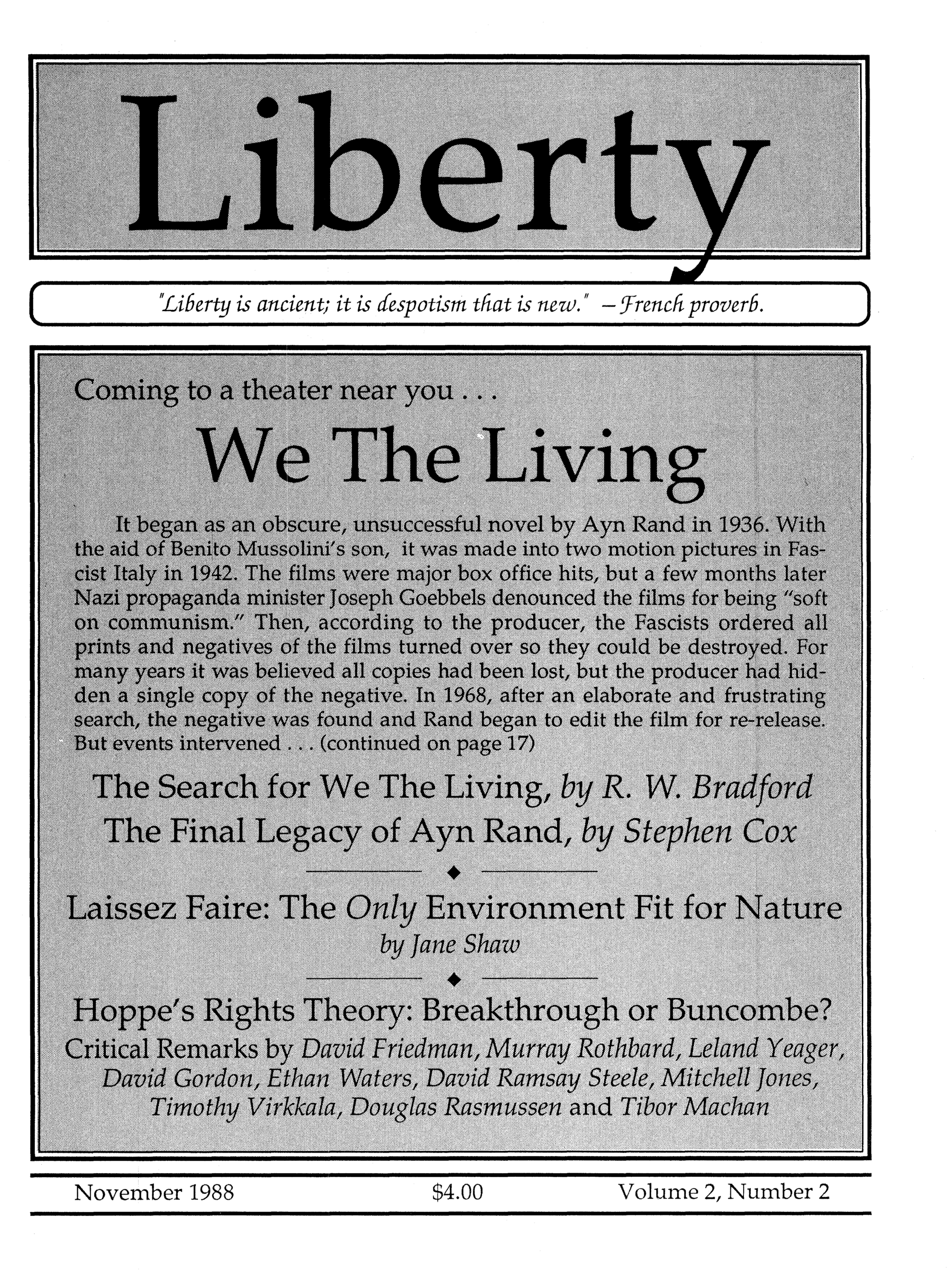
 From the vault: Murray N. Rothbard, two Reflections: “The tall and the short of genocide” (p. 6) and “That Cato Seminar” (pp. 7–8), Liberty (November 1988). Note: this is the same issue as the Symposium discussing Hans Hoppe’s significant article “The Ultimate Justification of the Ethics of Private Property” in the previous issue, which, in addition to this symposium (including Rothbard’s significant commentary), also inspired much scholarly commentary and controversy over the following 28 years, which continues to this day.1
Here’s the piece on genocide:
The tall and the short of genocide – William Raspberry, in his syndicated column of August 31, asks why the genocidal massacre of the Hutu majority of Burundi by the Tutsi ruling elite is shrugged off with little protest by the Western world. This summer, the Tutsi, who constitute only 15 percent of the Burundi population, slaughtered over 5,000 Hutu men, women, and children, and drove nearly 40,000 others into neighboring Rwanda. And this is but a sequel to the monstrous massacre of 1972, when the Tutsi annihilated around 200,000 Hutu, including all of that tribe’s educated members, thereby ensuring a generation of continued oppression without educated tribesmen able to lead a resistance among the oppressed.
Raspberry wonders whether the casual response to this hor-ror by Americans is best explained by the fact that it is blacks, rather than whites, who are being massacred, or-in contrast to the case of South Africa-because blacks are oppressing other blacks, instead of the more sensational white vs. black confrontation. Or maybe because there are no western TV reporters to record the event. The answer is probably all of the above. But there is one causal factor that Raspberry doesn’t mention, and that I suspect plays an active role in this double standard of emotional response: aesthetics.
As we remember from Hollywood movies on Africa, the Tutsis (sometimes called “Watutsi”) are an extraordinarily hand-some and graceful ethnic or racial group: all very tall, very slender, and remarkably elegant dancers and spear-throwers. The Hutu, on the other hand, are a short, clunky, and decidedly undistinguished-looking people. Americans, we should note, are dominated by a simplistic Hollywood culture, in which beauty and grace of shape and outward form invariably reflect nobility of soul beneath. And the reverse for common-looking or the ugly. (Or should we call the latter, the “aesthetically handi-capped”?) And we should not forget that the Randian culture, which has helped form the libertarian movement, is very similar: Randian heroines look like Greta Garbo (they should live so long!), and Randian villains are [c]owering and loose-lipped.
It is true, then, that the American public gives very little thought to Burundi one way or another, and that there is no powerful political constituency to call attention to that tragic land. But I am willing to bet that if the Hutu ever slaughter the Tutsi, even to a small fraction of what the Tutsi have committed the outcry from Americans would be fierce, and there would b; cries that the U.S. should intervene to save the beloved Tutsi. Simply because the Tutsi look more handsome and more noble—and much taller. Part of the ingrained double standard in the American value-system is aesthetic.
I once wrote an article “Short People, Arise!” in which I called attention to the age-long domination of American culture and society by the Tall over the Short, although I stopped short-inveterate libertarian that I am-of calling for affirmative action programs to recompense the Short for centuries of Tallist oppression. In the political campaign of 1988, Tallism continues; one of the “charges” being levied against Dukakis by the Bush forces is that he is “short” (tsk, tsk!) and that he has “no shoulders” (an odious and insensitive attack on the sloping-shouldered). Short people, rise up against Tallist tyranny, before you too meet the fate of the poor Hutu! -MNR
***
Here’s the piece on Taco:
That Cato Seminar — As Liberty grows bigger and lustier, it is beginning to take on the dimensions in microcosm of the libertarian movement as a whole: lively, entertaining, cacophonous, and a bit wacky around the edges. The wacko ingredient is, for example, embodied in the recent remarks of Messrs. Overbeek and Vogt on a week-long Cato seminar no less than ten years ago (“Rand-Bashing: Enough is Enough,” Liberty, July 1988; and Letters, Liberty, September, 1988). Both of these gentlemen, it appears, have been independently brooding into their beers for the last ten years, ruminating over assorted evils at that conference. Suddenly, ten years after the fact, they have burst forth with their conclusions on the libertarian movement, all of which are apparently based on that one conference. It must have been a traumatic week!
As a veteran of not only that seminar, but countless week-long seminars since, held by Cato and other libertarian institutions, I must admit to being dumbfounded. I don’t remember any of those incidents that have formed the psyches of Overbeek and Vogt—and that have apparently led Mr. Vogt to advocate the extermination (only metaphorically, I hope!) of all libertarian leaders above the age of 60? 50? I don’t remember being nice to Mr. Overbeek or not-nice to Mr. Vogt; I don’t remember any libertarian leader dropping a drink on anyone’s head; all this richness of incident that traumatized Overbeek and Vogt totally passed me by.
I would, however, for the benefit of all past and future conference-attendees, like to put in a plea for the lecturers’ point of view. And even-though Lord knows I am no defender of Cato officialdom—a plea for the plight of the poor officials at these gatherings. The officials have a heavy responsibility: to keep every detail of the week-long conference going smoothly-a task that students and lecturers alike tend to pooh-pooh and take for granted. It is therefore no wonder if conference officials are often a tense and preoccupied lot, not given to relaxed glad-handing.
As for the lecturer, consider the strain of being at the beck-and-call of the student body, twenty-four hours a day for an en-tire week. I, for one, consider this sort of lecturing mainly exhilarating, but concede the moments of strain and exhaustion. And also we have to remember that every lecturer has his or her own personality, and that the degree of strain and exhaustion will differ from person to person. The peak hours of fatigue come from the lectures themselves and the following question-periods, and even the most enthusiastic lecturer often likes to follow these lecture hours with a couple of hours of quiet meditation. Imagine, then, the following scenario, after one of these lecture sessions, into which the lecturer has poured his soul:
Lecturer is quietly sitting, ruminating into his beer.
Enthusiastic Young Student sees lecturer, sits down promptly at his table.
Young Student: “Professor Zilch, I have discovered three glaring contradictions on page 633 of your ‘magnum opus,’ Steps Toward Liberty. Here they are … ”
Or, alternatively, Scenario II, Young Student declares:
“Professor Zilch, your position on economics is very interesting, and I accept most of it. But I demand to know what your views are on the Rothbardian Rights question, and how, or if, you would defend it.”
Is it any wonder that a lecturer or two, faced with this common scenario, might grow a bit testy and reach, metaphorically at least, for his revolver? -MNR
$$$
Related
- Kinsella, What Kind of Libertarian Are You? [Cato] (July 8, 2009)
- ——, Mutualists and Randians on Arab Oil
- ——, Rand on the Injuns and Property Rights
- ——, Rand on Collateral Damage
- ——, Objectivism Schism Form Letter; I break for Randians; Breaking, Broken, Broke: Silly Objectivist Tendencies
- Yaron Brook, No Apologies for Hiroshima and Nagasaki
- Ayn Rand Institute editorial, Onkar Ghate, War, Nuclear Weapons and “Innocents” (9/28/01)
- Justin Raimondo on this: “Of course, Schwartz and his crowd, notably Rand’s “intellectual heir” Leonard Peikoff, have called for a nuclear first strike against the entire Arab world”);
- also Lynne Cheney’s Circles Call for Mass Murder (”Dr. Yaron Brook, the executive director of the Ayn Rand Institute … warned that “Islamic totalitarian states pose a severe threat to the security of the United States,” adding that a way to defeat these regimes “is to kill up to hundreds of thousands of their supporters.” This, he said, would “shrink popular support for extremist ideas to a small minority of the population,” instead of the 40% which he claims supports such regimes now”);
- End States Who Sponsor Terrorism By Leonard Peikoff
- Barbara Branden’s The Lepers of Objectivism;
- Yaron Brook and the ARI;
- Objectivism Online topic “Can You List Five Reasons We Should NOT nuke Tehran?“
- ARI Attacks ‘Just War’ Theory, Advocates Nuclear Option
- Objectivists on Positive Parental Obligations and Abortion
- Objectivist Hate Fest
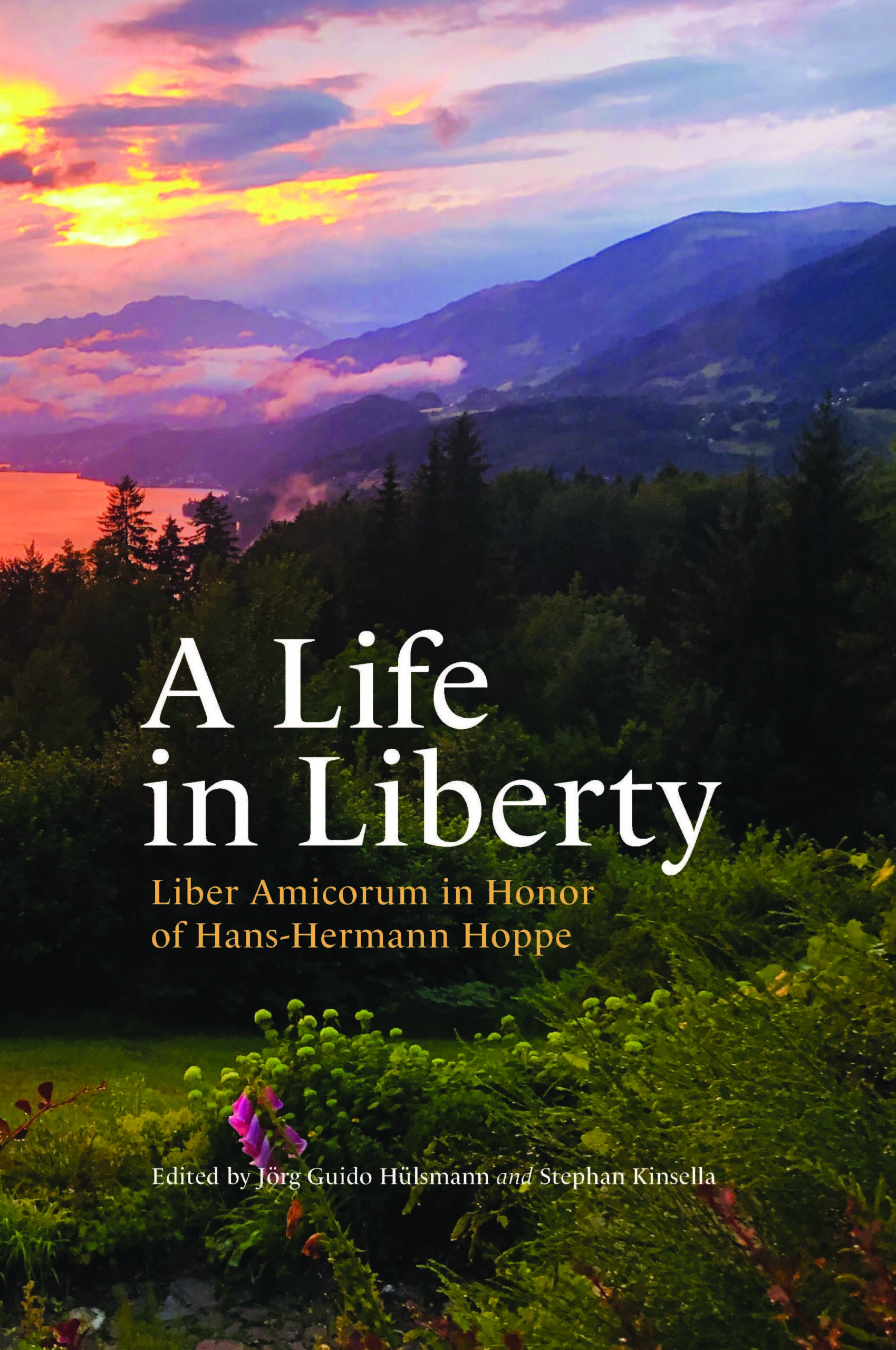
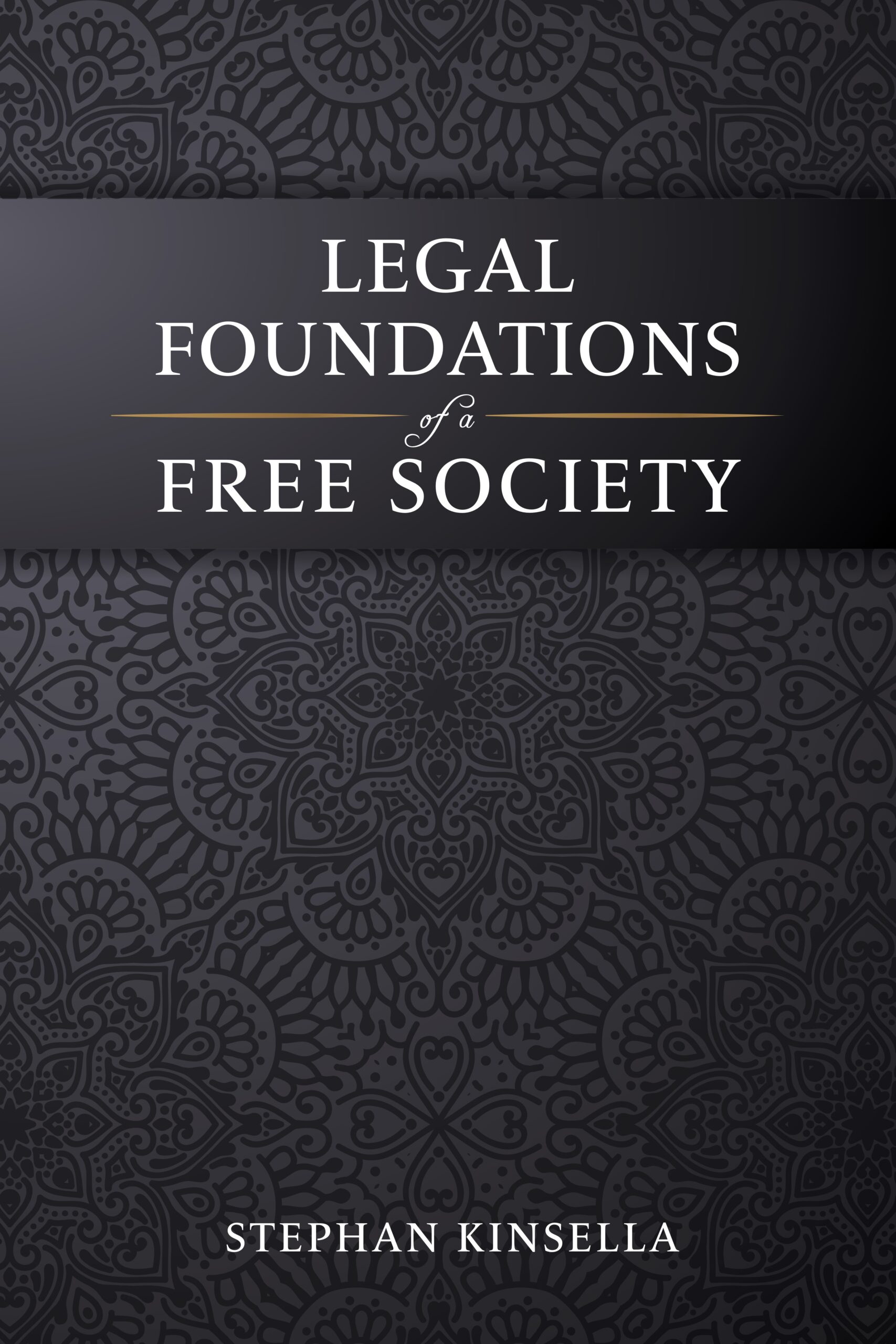
- Hans-Hermann Hoppe, “The Ultimate Justification of the Ethics of Private Property” (September 1988; also in EEPP); Symposium on Hoppe’s argumentation ethics: “Breakthrough or Buncombe?”, esp. Murray N. Rothbard, “Beyond Is And Ought” (Nov. 1988); Kinsella, “Argumentation Ethics and Liberty: A Concise Guide,” Mises Daily (May 27, 2011); Kinsella, “A Libertarian Theory of Punishment and Rights,” “Dialogical Arguments for Libertarian Rights,” and “Defending Argumentation Ethics: Reply to Murphy & Callahan,” all in Legal Foundations of a Free Society (Houston, Texas: Papinian Press, 2023); “The Genesis of Estoppel: My Libertarian Rights Theory“; “Hoppe’s Argumentation Ethics and Its Critics,” “Revisiting Argumentation Ethics.” [↩]
Discover more from The Property and Freedom Society
Subscribe to get the latest posts sent to your email.












 Alessandro Fusillo
 Andreas Tögel
 David Dürr
 Doug French
 Fernando Chiocca
 Greg Morin
 Hans-Hermann Hoppe
 Jay Baykal
 Jayant Bhandari
 Jeff Deist
 Jeffrey Barr
 Juan Fernando Carpio
 Ken Yamarashi
 León Isidoro
 Martin Cabrera
 Nick Hoppe
 Oscar Grau
 Peter Wong
 PFS
PFS scholarium
 Saifedean Ammous
 Sean Gabb
 Sean Ring
 Stephan Kinsella
 Stéphane Geyres
 Thomas Jacob
 Tom DiLorenzo