From PFS members John Leask, “We Wanted Flying Cars,” Madness of Crowds (Substack; Jul 18, 2026)
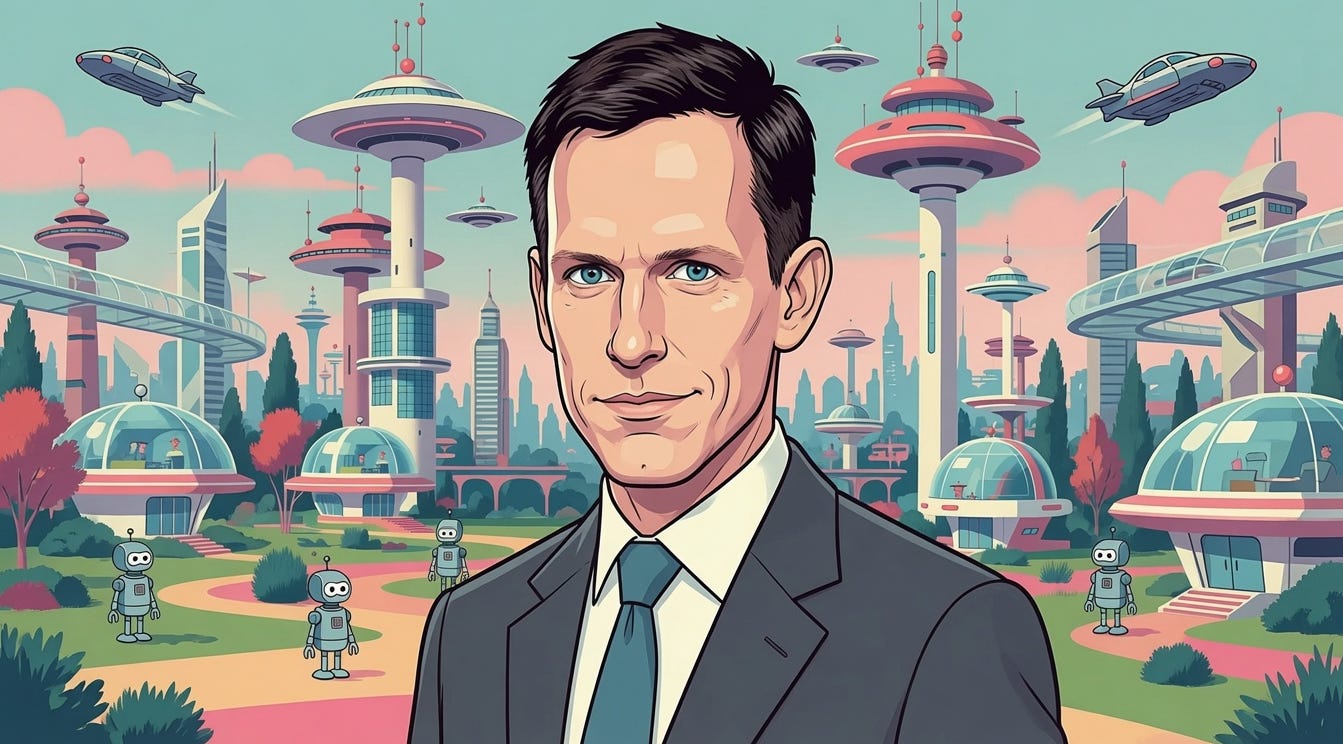
“We wanted flying cars; instead we got 140 characters.” – Peter Thiel, 2011
The science fiction genre — Isaac Asimov, Robert Heinlein, George Lucas — created a sense of wonder between the ‘50s and the ‘70s. Robots, flying cars, interstellar travel. I grew up in the ‘90s watching the Jetsons, which featured video conferencing, smart home technology, robots, and handheld digital devices. Additionally, I watched Luke Skywalker transform from a (somewhat annoying) rural farmer on Tatooine to a space-traveling heroic Jedi. And finally, The 6th Day starring Arnold Schwarzenegger featured self-driving cars! So where is all that technology that science fiction creatives have been obsessing over for decades? Why did Elon Musk buy Twitter and rename it to X, when he could be working on some real technological advancements? Well, while it’s still unknown to many, it looks like the technology is here. Apparently Elon has engaged in numerous simultaneous science projects. And so have others.
A Retrospective on Human Progress
- Money — While we can argue very clearly that we have gone backward in terms of progress on the technology of money (government-issued fiat is the equivalent of toilet paper with an official stamp on it), we can indeed see plenty of progress from barter to the use of gold and bitcoin for commerce. In What Has Government Done to Our Money?, Murray Rothbard summarizes the complications of barter:
Yet, direct exchange of useful goods and services would barely suffice to keep an economy going above the primitive level. Such direct exchange—or barter—is hardly better than pure self-sufficiency. Why is this? For one thing, it is clear that very little production could be carried on. If Jones hires some laborers to build a house, with what will he pay them? With parts of the house, or with building materials they could not use?
So barter was used — exclusively — as far back as 6000 BC by the Mesopotamians, and as recently as 1,000 AD throughout Western Europe. There are still certain times and places in which barter is used in the developed world, but the development of money helped usher in the Commercial, Scientific, and Industrial Revolutions. Rothbard again:
The emergence of money was a great boon to the human race. Without money—without a general medium of exchange—there could be no real specialization, no advancement of the economy above a bare, primitive level. With money, the problems of indivisibility and “coincidence of wants” that plagued the barter society all vanish. Now, Jones can hire laborers and pay them in… money.
The invention and progress of money truly humbles the student of ancient Greek and Roman history.





















 Alessandro Fusillo
 Andreas Tögel
 David Dürr
 Doug French
 Fernando Chiocca
 Greg Morin
 Hans-Hermann Hoppe
 Jay Baykal
 Jayant Bhandari
 Jeff Deist
 Jeffrey Barr
 Juan Fernando Carpio
 Ken Yamarashi
 León Isidoro
 Martin Cabrera
 Nick Hoppe
 Oscar Grau
 Peter Wong
 PFS
PFS scholarium
 Saifedean Ammous
 Sean Gabb
 Sean Ring
 Stephan Kinsella
 Stéphane Geyres
 Thomas Jacob
 Tom DiLorenzo
Follow Us!