Long-time PFS speaker Sean Gabb (England) was slated to deliver “The Institution of Ancient Slavery” at the recently-concluded Seventeenth Annual (2023) Meeting of the PFS, Bodrum, Turkey (Sep. 21–26, 2023). He was unable to attend but has submitted a video of the lecture (below). We include this in the podcast feed in the order it was slated to apepar.
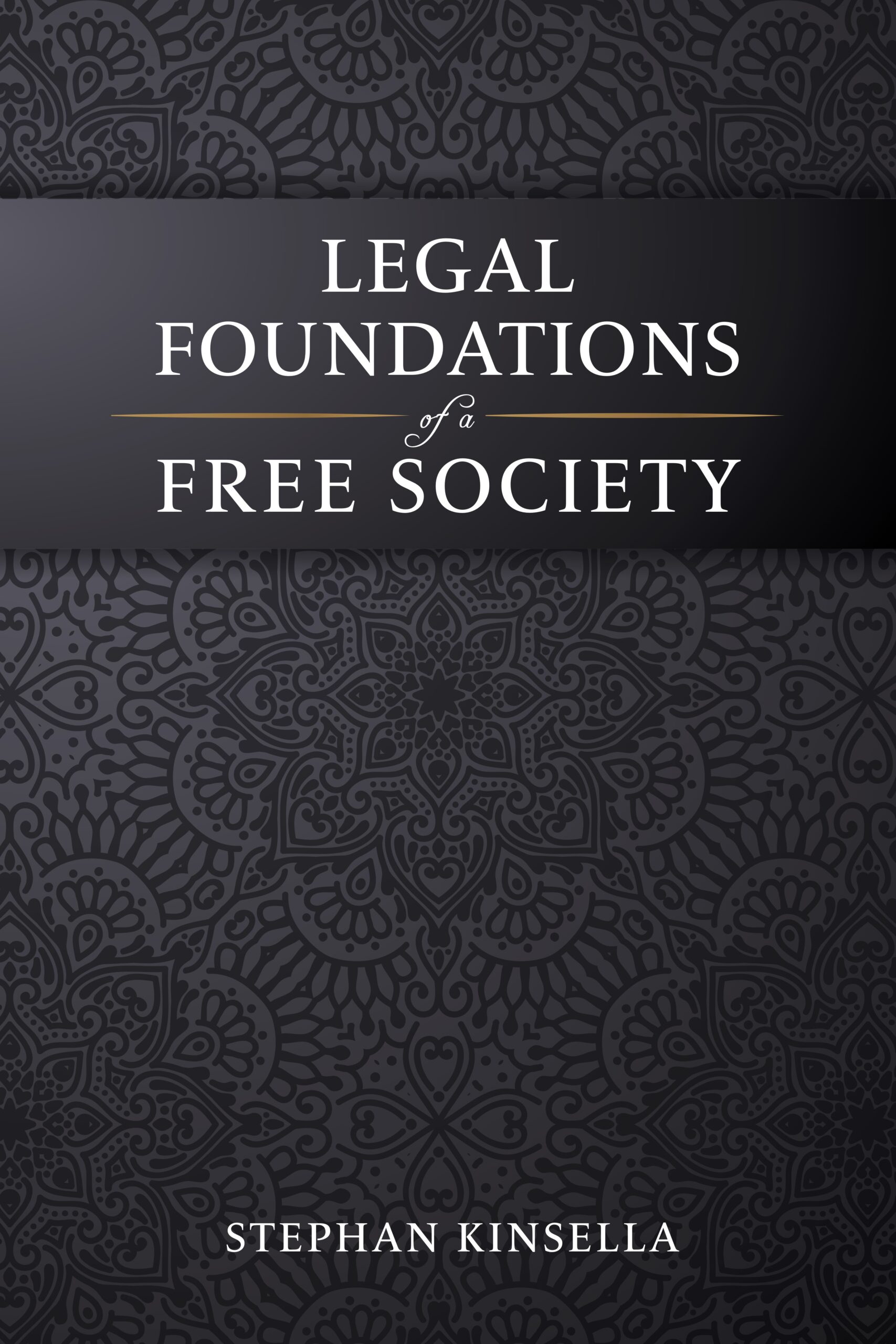
As PFS 2023 attendees are aware, longtime PFS member Stephan Kinsella’s book Legal Foundations of a Free Society (Houston, Texas: Papinian Press, 2023) was recently published. Professor Hoppe provided the Foreword. A special inaugural print run was available at the recent PFS Annual Meeting (see pix below).
The book is now available to order in paperback and hardcover (pre-order), on some of the major platforms. Ebook versions and a free PDF will be available presently. [continue reading…]
Long-time PFS speaker Sean Gabb (England) was slated to deliver “The Institution of Ancient Slavery” at the recently-concluded Seventeenth Annual (2023) Meeting of the PFS, Bodrum, Turkey (Sep. 22–24, 2023). He was unable to attend but has submitted a video of the lecture (below). Slides: Gabb pfs 2023 Slavery in the Roman World.
Audio and video from the recently-concluded Seventeenth Annual (2023) Meeting of the PFS, Bodrum, Turkey (Sep. 24, 2023) will be posted and podcast soon. Kinsella’s informal audio is up already. Read more>>
Audio and video from the recently-concluded Seventeenth Annual (2023) Meeting of the PFS, Bodrum, Turkey (Sep. 24, 2023) will be posted and podcast soon. One of the speakers already had his audio put up as well as the text of his speech: ThorstenPolleit (Germany): “The Economics of The “Great Reset”: Getting To The Truth” (soundcloud; text).
In his lecture at the Property and Freedom Society (PFS) 2022 conference, Alessandro Fusillo explores the ideas of Swiss political scientist Carl Ludwig von Haller (1768–1854), focusing on his critique of the social contract theory and the influence of Roman law on modern state concepts. Fusillo begins by thanking the hosts and referencing Professor Hoppe’s prior talk, which inspired his topic.1 Haller’s primary work, Restoration of Political Science, challenges the notion that state power derives from a magical delegation from the people, a foundational idea in modern states. Fusillo notes that Haller was criticized by figures like Hegel, who saw the state as a supreme duty, and Hannah Arendt, who dismissed him as a defender of the ancien régime without reading his work.
Haller’s analysis of Roman law is a key focus, though not his primary subject. He praises Roman private law as a timeless system of reasonable principles, forming the basis of modern civil codes in continental Europe. Fusillo aligns this with Bruno Leoni’s view that Roman private law, developed slowly through expert judges, exemplifies how law could be discovered in a free society. In contrast, Haller critiques Roman public law for negatively shaping modern state theories, particularly by fostering the social contract idea. The fascination with classical culture and the use of Latin as a lingua franca in the Middle Ages reinforced Roman terminology, such as societas civilis and res publica, which implied that states belong to the people, a concept Haller disputes.
Roman Public Law and Social Contract
Fusillo elaborates on Haller’s argument that Roman public law, rooted in republican terminology, was adapted by early emperors like Augustus to mask military dictatorships as republics. This terminology, suggesting a transfer of sovereignty from public assemblies to magistrates, influenced modern thinkers like Hobbes, Locke, and Rousseau, who developed social contract theories. Fusillo describes ancient Rome as a “corporation of robbers,” built on conquest and the principle that might is right. The lex de imperio, a law transferring absolute military power to leaders, underscores this, particularly in the military context where commanders held unchecked authority, contrasting with limited citizen protections in Rome itself.
Roman Military and Social Dynamics
The evolution of Roman military practices further illustrates Haller’s critique. Rome shifted from heroic warfare to large infantry armies, necessitating broader societal participation and empowering plebeians through political revolts. Conflicts over land distribution between the nobility and soldiers fueled the republic’s crises, exemplified by the Gracchi brothers’ reforms. The concept of imperium—absolute military power—became central to Roman public law, with commanders wielding life-and-death authority in the field. Marius’s army reform, allowing proletarians to join, increased military commanders’ power, paving the way for figures like Pompey, Caesar, and Augustus, who blended civil and military authority.
Rise of the Roman Empire
Fusillo highlights how Pompey’s absolute power, granted through laws like the Lex Gabinia and Lex Manilia, marked the beginning of the Roman Empire’s centralized authority. Julius Caesar and Augustus furthered this by subduing territories and consolidating power, with Augustus using propaganda to present a Pax Romana while enforcing ruthless dominion. This “great reset” transformed the ancient world, leaving a legacy in Romance languages and global Roman influence. Sertorius’s failed rebellion against Roman exploitation underscores the empire’s dominance, achieved through military might and betrayal.
Haller’s Libertarian Solution
In conclusion, Fusillo presents Haller’s alternative vision for state power, rooted in private property, contracts, and voluntary associations, akin to the authority of an individual property owner. Haller argues that state power is limited by natural law—freedom and property—and suggests three defenses against abuses: adherence to religious principles, resistance (including violent resistance), and flight. This aligns with later libertarian ideas, such as Gustave de Molinari’s advocacy for competing governments. Fusillo frames Haller’s ideas as a challenge to state-centric models, advocating for a decentralized, voluntary basis for governance.
First of all, I would like to thank Hans and Gülçin for the invitation. It is a privilege and an honor to be in Bodrum at the PFS conference, and I hope to share something interesting this afternoon.
0:24
My talk today stems from a suggestion by Professor Hoppe last year.1 If you haven’t heard his presentation, I urge you to do so. It discussed the Swiss political scientist and jurist Carl Ludwig von Haller, who lived from 1768 to 1854. His main work, Restoration of Political Science, challenges the theorists of the social contract.
Carl Ludwig von Haller’s Ideas
1:00
Haller’s primary aim was to dismantle the notion that power magically originates from the people through a delegation to governments, a concept still foundational to most modern states. The social contract is often referenced, especially in recent years, in a negative sense—as something broken. Yet, it remains a principle we’re taught from school: that a covenant underpins all societies. I will expand on Haller’s ideas later in my talk.
2:09
Haller was not widely appreciated as a thinker. Two notable criticisms came from prominent figures. Hegel wrote that Haller’s view of the state as a protection agency for property and personal freedom implies that membership is optional, which Hegel deemed fundamentally wrong. This is an intriguing remark from a philosopher like Hegel, who saw the state as the highest duty of individuals.
3:15
Another negative critique came from Hannah Arendt in The Origins of Totalitarianism. Without reading Haller, she dismissed him as an advocate for the ancien régime, attempting to justify the Restoration. Haller’s main work, with its first volume published in 1816 and subsequent volumes until 1834, indeed aligns with this period.
Haller’s Perspective on Roman Law
4:01
Haller does not focus extensively on Roman law; it’s not his primary topic. His research centers on modern states, kingdoms, princes, republics, and democracies. He develops a theory explaining why states exist and what they do, opposing the social contract theory.
4:48
However, Haller makes a few highly intelligent remarks about Roman law in roughly ten pages, analyzing its influence on modern state theories. He praises Roman private law as a treasure trove of reasonable principles, valid across time. This aligns with the experience of anyone who has studied law. Roman private law forms the basis of modern civil codes in continental Europe, and in some countries, it is still applied after two thousand years.
5:57
Bruno Leoni, for instance, held a favorable view of Roman law, noting its slow development through the work of experts, judges, and the gradual accumulation of principles. Leoni suggested this could model how law is discovered in a free society, not posited by a sovereign but derived from basic principles. Haller shares this view of Roman private law.
Critique of Roman Public Law
6:43
Haller’s evaluation of Roman public law is starkly different and highly interesting. He argues that Roman public law negatively influenced modern thought about the state and may be responsible for the damaging theory of the social contract. He identifies several reasons for this.
7:14
First, the fascination with classical culture persists. We read ancient authors like Cicero, Greek philosophers, and Roman historians. Latin, as Haller notes, was the lingua franca during the Middle Ages in Europe, used in academia and universities. No one would consider writing something significant in French, Italian, or German—only Latin was deemed appropriate.
8:12
Haller highlights another issue: the adoption of Roman terminology. Legal theorists discussing the state inevitably used Latin terms from Roman public law. These terms, rooted in the republican era, were later adapted to the Roman Empire as part of the propaganda of early emperors, particularly Augustus. They maintained the illusion of a republic, though Haller calls it a military dictatorship.
9:02
Terms like societas civilis (civil society) and res publica (republic, or public affairs) were used, alongside concepts like the “patrimony of the people” or public monies, which Haller deems illogical in a monarchy. This republican terminology carried into modern states, fostering the idea that states belong to the people.
10:11
Haller argues that this terminology, rooted in the notion of sovereignty transferring from public assemblies to magistrates, gave rise to social contract theories, as seen in the works of Thomas Hobbes, John Locke, Rousseau, and others. These theories posit that states emerge from a covenant between the people and power structures.
Roman Society as a Corporation of Robbers
11:02
Why does this idea originate in Rome? Ancient Rome, both during the age of kings and the early republic, can be described as a corporation of robbers. It was built on the principle that might is right, centered on conquest, killing enemies, enslaving them, and seizing their property—a common practice in ancient Europe.
11:50
Rome’s early kings were elective, and a key tradition in Roman public law was the lex de imperio, a law (often symbolic) by which the people’s assembly transferred absolute military power to kings and later magistrates. This was crucial, as elected officials like consuls or praetors could not exercise military power without it.
12:49
Rome’s military evolution was significant. It transitioned from heroic warfare, where champions fought individually (e.g., the Horatii and Curiatii), to large infantry armies, as seen with Alexander the Great. This shift led to social tensions between patricians and plebeians. As warfare required broader participation, plebeians gained political influence through revolts and secessions.
14:19
A system emerged where a nobility-led corporation coexisted with armed peasants, some of whom were wealthy enough to maintain war horses (the cavalry). Proletarians, however, had little influence in war or governance.
Social and Land Conflicts in the Republic
15:08
As Rome expanded, conquering vast territories in Italy and beyond, conflicts arose over land distribution. The nobility claimed exclusive rights to conquered lands, while soldiers and plebeians demanded a share. This tension fueled the crisis of the republic, exemplified by the Gracchi brothers’ reforms, which aimed to distribute conquered lands to soldiers.
Roman Military Law and the Concept of Imperium
16:20
To understand Roman public law, the concept of imperium is central. Imperium represents the absolute power of a military commander, who was hailed as “emperor” by soldiers after victories. Roman public law distinguished between domi (at home, in Rome) and militiae (in the military). At home, citizens had protections, like the right of provocatio (appeal to the people against a magistrate’s ruling). In the military, commanders held absolute, disciplinary power, akin to a pater familias (head of the household), with authority over life and death.
18:19
Roman armies were brutally effective, instilling greater fear of commanders than enemies. Military discipline was strict, with soldiers facing death for minor disobedience.
19:05
The term provincia (province) derives from vincere (to conquer), referring to territories subdued militarily. As social equilibrium crumbled over land disputes, the republic faced further instability.
Marius and the Rise of Military Power
19:43
The army reform of Marius, opponent of Sulla, was pivotal. Marius allowed proletarians (the capite censi, or “head count”) to join the army, enabling the lowest classes to pursue military careers. This offered risks but also rewards, like sharing in war booty and promised land distributions.
21:02
Marius’s reform empowered military commanders, laying the groundwork for the absolute power of emperors. While Caesar is often seen as the first emperor and Augustus as the true founder of the empire, Pompey was the first to blend civil and military power.
21:34
The Lex Gabinia granted Pompey absolute authority over provinces and much of Italy to combat pirates, followed by the Lex Manilia, which gave him command in Asia against King Mithridates. For years, Pompey was the de facto ruler of what became the Roman Empire.
Resistance and the Rise of Caesar
22:52
Around this time, a revolution led by Sertorius, a former military commander, took hold in Spain. Allied with pirates, King Mithridates, and Celtic tribes, Sertorius aimed to resist Roman domination, possibly to defend freedom. He was defeated not in battle but by betrayal through poisoning.
24:21
Julius Caesar followed Pompey’s example. His first military command was in Spain, where he subdued the region for its resources. Later, as consul, he secured a special command in Gaul, mirroring Pompey’s actions. Unlike Pompey, Caesar crossed the Rubicon with his armies, seizing control of the state.
25:21
Caesar amassed immense wealth by plundering Gaul, killing between one and three million people. He tried to reconcile with the landed aristocracy but was assassinated. His successor, Octavian (later Augustus), took a harsher approach, eliminating opponents through proscriptions (confiscations and executions).
The Pax Romana and Propaganda
26:50
Caesar and Augustus reshaped history through propaganda, convincing posterity of the Pax Romana (Roman Peace). In reality, they were military commanders who established ruthless dominion. Their actions constituted a “great reset,” transforming the ancient world. Romance languages and the spread of Roman culture (e.g., in France and Spain) reflect their lasting impact.
Haller’s Solution: A Libertarian Vision
28:14
What is Carl Ludwig von Haller’s solution? He argues that princes and republics cannot exercise more power than individuals would have. State power should be based on private property, contracts, and voluntary relationships, akin to the authority of a property owner or a knowledgeable teacher.
29:09
Haller emphasizes that power is limited by natural law—the law of freedom and private property. He proposes three defenses against abuses of power:
Religion: Rulers should adhere to religious principles.
Resistance: Individuals can resist, even violently, against state abuses.
Flight: As a last resort, people can flee oppressive regimes.
30:08
Haller envisions states as voluntary associations. A few years after his magnum opus, Gustave de Molinari wrote about the private production of security, advocating for competition among governments—a concept aligned with Haller’s and libertarian ideas.
As noted here, the 2026 Twentieth Annual Meeting of the Property and Freedom Society was recently held from Thursday, September 17, 2026 to Tuesday, September 22, 2026. Information on the 2027 meeting will be released in early 2027.
Rothbard at 100 is in production! As you can see, the books are printed in premium hardcover with gold foil stamping, and then they will be covered with a dust jacket. Also available as an audiobook and eBook. Preorder your copy now: https://t.co/iaEh0bk5G0pic.twitter.com/bapPGmhFHb
To donate with BITCOIN please use the address below. If you would like us to credit your payment (for dues, conference fees, etc.) please email Stephan Kinsella ([email protected]) when you make the bitcoin payment.
17M9V6m5X5Da4vNM5wWLjzcHz9qF36FPk6
“Property does not exist because there are laws, but laws exist because there is property.” — FrédéricBastiat
“Because the concept of property, for instance, is so basic that everyone seems to have some immediate understanding of it, most people never think about it carefully and can, as a consequence, produce at best a very vague definition. But starting from imprecisely stated or assumed definitions and building a complex network of thought upon them can lead only to intellectual disaster. For the original imprecisions and loopholes will then pervade and distort everything derived from them. To avoid this, the concept of property must first be clarified.” —Hans-Hermann Hoppe, TSC, ch. 2
The Property and Freedom Society (PFS; Facebook) stands for an uncompromising intellectual radicalism: for justly acquired private property, freedom of contract, freedom of association—which logically implies the right to not associate with, or to discriminate against—anyone in one's personal and business relations—and unconditional free trade. It condemns imperialism and militarism and their fomenters, and champions peace. It rejects positivism, relativism, and egalitarianism in any form, whether of "outcome" or "opportunity," and it has an outspoken distaste for politics and politicians. As such it seeks to avoid any association with the policies and proponents of interventionism, which Ludwig von Mises identified in 1946 as the fatal flaw in the plan of the many earlier and contemporary attempts by intellectuals alarmed by the rising tide of socialism and totalitarianism to found an anti-socialist ideological movement. Mises wrote: "What these frightened intellectuals did not comprehend was that all those measures of government interference with business which they advocated are abortive. ... There is no middle way. Either the consumers are supreme or the government."
(A more complete statement of our Principles can be found here.)

 As PFS 2023 attendees are aware, longtime PFS member Stephan Kinsella’s book
















 Alessandro Fusillo
 Andreas Tögel
 David Dürr
 Doug French
 Fernando Chiocca
 Greg Morin
 Hans-Hermann Hoppe
 Jay Baykal
 Jayant Bhandari
 Jeff Deist
 Jeffrey Barr
 Juan Fernando Carpio
 Ken Yamarashi
 León Isidoro
 Martin Cabrera
 Nick Hoppe
 Oscar Grau
 Peter Wong
 PFS
PFS scholarium
 Saifedean Ammous
 Sean Gabb
 Sean Ring
 Stephan Kinsella
 Stéphane Geyres
 Thomas Jacob
 Tom DiLorenzo
Follow Us!