Rothbard and the Paleo Right
September 27, 2026
I. Introduction: Rothbard the Man
Rothbard’s late-life political thinking is often termed “Paleolibertarianism,” but we might simply call it “Rothbardianism.” We can define it as “Anarcho-capitalism +.” It’s the plus I’d like to discuss today.
To truly understand Rothbard’s late-life political thinking we need to know something about the man himself and not just his work: his background, life experiences, triumphs and setbacks, and the broader sociology of the movement surrounding him.
It’s always a mistake to separate thinkers from their ideas, as disembodied minds without personal stories. People matter just as much—maybe more– than the ideas they embody and promote. Their credibility and integrity are paramount—and often determine just how far and wide their ideas spread. Not always, of course. Sometimes the bad guys win. But we should always champion the good guys, and never hesitate to point out the personally unsavoury elements of the bad guys, whether Marx or John Maynard Keynes or some modern politician like Milei.
When we consider Rothbard the Man, it’s interesting to contrast his life and origins with those of Ludwig von Mises– the man to whom he is forever linked. From 1949, when Rothbard first read and favorably reviewed Human Action.
On one level, Rothbard and Mises share a tremendous amount in common, both personally and professionally:
Both were Ashkenazi Jews, serious intellectuals, childless, atheist, and born into small families. Both married but remained childless, too beholden to their careers for family life. Both became groundbreaking scholars in the Austrian school; both were systematic in their approach to economics, and thus both wrote more than one comprehensive treatise.
Both were incredibly prolific, publishing millions of words. Both men endured shabby treatment from academia and the mainstream economics journals; neither ever held a tenured university seat, neither ever made much money. Both relied mostly on endowments by businessmen. Both were principled and courageous to the point of intransigence. Both could have made small compromises here and there and enjoyed vastly easier career paths; and neither could bear the hypocrisy and sellouts of many of their “classical liberal” contemporaries.
Most importantly, both became enormously well-known and influential in spite of all this, or perhaps because of it. That intransigence paid off, in the rare distinction of becoming more well-known and more influential after their deaths– thanks in great part to their tremendous popularity among lay audiences. By contrast, someone like Arther Burns has faded into total obscurity as a footnote despite his pedigree.
But Mises was in some ways Rothbard’s reluctant mentor, despite being such a towering intellectual influence on the younger man. Rothbard attended Mises’s seminar student in New York City, and must be considered his greatest student, but they were never personally close. And while Mises was fulsome in his praise for Man, Economy, and State in 1962, calling it an “epochal contribution” to economics and praxeology, anyone who has read Professor Hülsmann’s biography of Mises knows he held serious doubts about Murray’s radicalism, especially his anarchism.
And beyond their professional lives they were simply two very different men—men of completely different bearing and temperament.
Mises was man of Old Europe, someone who embodied prewar Vienna at the absolute height of its cultural power. His dress, his cultured mannerisms, his speech, and his outlook reflect this environment. He is fundamentally reserved and serious in demeanor. And this formal style he exhibited personally also flowed through his writing and his professional career. He was ultimately a pessimist, saying he set out to be a reformer but ended up the “historian of decline.”
Rothbard, by contrast was a pugnacious Brooklyn kid, a natural and reflexive contrarian, talkative, and oriented toward extremes. His father is a middle-class chemist, is the sole Republican in an apartment building literally full of Jewish commies. How does one rebel against that? For young Rothbard, naturally, it means becoming the opposite: not only does he become a Republican, but goes out of his way at Columbia University to form a “Students for Strom Thurmond” chapter when the Southern Dixiecrat Senator ran for president in 1948 representing the “States Rights” party! In 1948 Manhattan this must have amounted to calling for Martians to invade.
But perhaps something else helps explain the differences between the two men.
Mises is a Jew from Galicia, in the Austro-Hungarian Empire. His family carries the Edler von Mises title, a lower rank of Austrian nobility. His grandfather is a prominent banker, member of the Lemberg Chamber of Commerce, and an influential figure in Galician Jewish society.
For Austro-Hungarian Jews, universities are far more accessible; large numbers of Jews are able to enroll in medicine, law, journalism, engineering, and academia; and Vienna, Kraków, Czernowitz, and Lemberg became major centers of Jewish intellectual life. A Jew from Lemberg lived under a state that, especially after 1867, granted Jews formal legal equality and opportunities for political participation.
Thus Jews were disproportionately represented in the liberal professions. Viennese Jews like Mises become professors and intelligentsia; they join liberal parties; municipal governments, and parliamentary politics. They are more cosmopolitan and integrated with broader European society. And so Mises’s experiences as a Jew in prewar and interwar Jew in Vienna mirrors this; he joins the Wiener Handelskammer (Chamber of Commerce) and later becomes an advisor to the Austrian national government and Austrian National Bank. Mises is Jewish but not a reviled outsider in Vienna.
Rothbard’s family is not so fortunate, and emerges from the Pale of Settlement. His father’s side is from near Warsaw, a Polish city but controlled by the Russians. His mother’s family’s roots trace to an undisclosed region of Russia—though possibly having roots in the Russian upper class or intelligentsia. So Rothbard’s family origins, unlike Mises’s, were squarely within the Pale and the Russian rather than Austrian partition of Poland.
This was almost certainly unlucky.
A Jew from Warsaw, lived under a state that officially restricted Jewish residence and imposed numerous legal disabilities through the Pale of Settlement system. This meant occupational limitations, especially with regard to higher professions and government; limited access to universities and higher education, and serious restrictions on movement and residence.
The results were poverty-stricken Jewish shetls, and all the resentment that came with it. But these were not stupid people, and so these limitations and mistreatment turned them into radicals: Socialists, Zionists, and revolutionaries of every stripe. Pale of Settlement Jews, in a certain sense, could not afford to be good liberals like Mises. Austria-Hungary produced Jewish liberals and intellectuals who spread across Europe. The Pale produced Jewish radicals and street fighters who escaped to America.
Murray seemed to inherit this outsider status from the Pale in his DNA– shown by his intense radicalism, his reflexive hostility for authority, his always rooting for the underdog. And Murray himself was the underdog consistently throughout his career, even in classical liberal circles. His shabby professional treatment is s a recurring theme—at Columbia, at National Review, at Brooklyn Polytech, at Cato, by the Koch-funded orbit at George Mason University, at UNLV, and even by the Libertarian Party.
Maybe Murray Rothbard the happy agnostic, the admirer of Catholic traditions and hater of pietist reformers, was a more of a bare knuckle Eastern European Jew than even he knew.
II. Rothbard the Radical
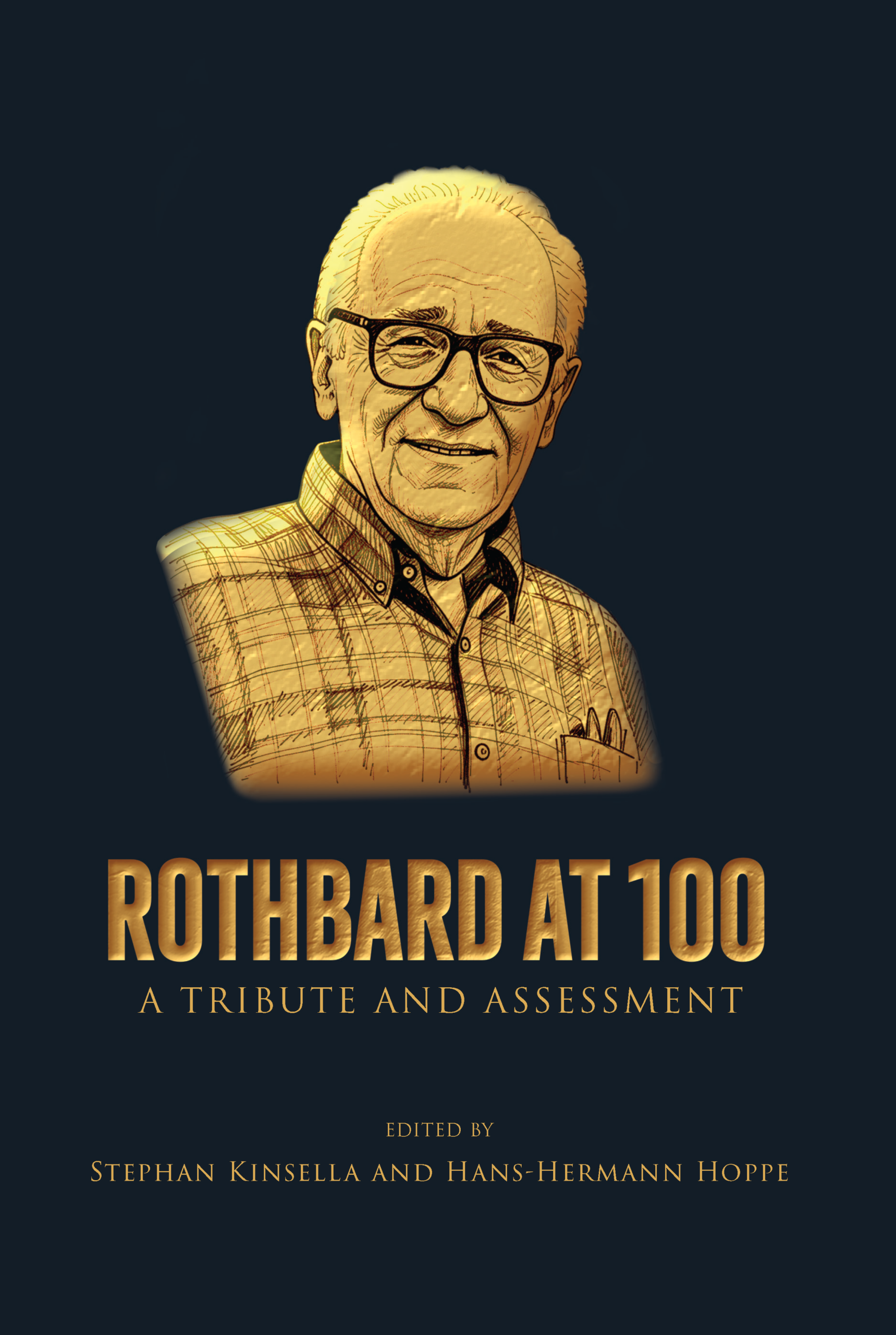
Murray Rothbard was many things, as evidenced by the depth and breadth of the essays in the Rothbard at 100 anthology we celebrate at PFS this week. Economist, philosopher, historian, legal scholar, journalist– take your pick.
It is also no stretch to add “political genius” to that list. Given nearly 35 years of hindsight since his premature death, we can conclude today that he was both remarkably prescient and strategically brilliant in his trenchant political analysis of the West: able to see not only the big picture—thank to his incredible grasp of history—but also master the minute details of individual races and candidates, district by district.
Naturally Rothbard’s views and opinions evolved and changed over five decades and millions of published words. This applies to his political prognostications as well. But across all of these aforementioned disciplines, across time, across all of the factions and alliances and fallings out, across all his political forays, three enduring themes consistently emerge: Rothbard was a radical, a reactionary, and a revisionist.
These three themes surface and repeat throughout his career. His approach, whether to problems of politics, war, statism, economics, or culture, was always absolutist and radical rather than gradualist or reformist; always anti-establishment and anti-elite; and always opposed to sanitized, grandiose versions of history or important figures.
Which mean, in plain terms, he was a natural born populist and political radical. And distinctly not a conservative, either by temperament or doctrine. When we think of Rothbard’s politics, we picture a radical intellectual, not an effete George Will type. Or even a Russell Kirk type. We think of his incendiary writings and his unflinching anti-state prescriptions. And Rothbard certainly had no interest in conserving anything about the American political status quo, including the dopey constitutionalism and “propositional nation” nonsense which still plagues Conservative Inc. and the Tories and the European conservative parties today.
So we have this dilemma whereby Rothbard had a tremendous influence on the Right but was never a conservative. Even though he spent quite a bit of his career—especially early and late—in and around the Right, it’s a separate question whether he was truly of the Right? Should he be remembered and chronicled as a Rightwing figure?
It’s a question worth considering, and not merely an academic or rhetorical one. It matters quite a bit to those who revere his work and hope to see his posthumous influence grow. Rothbard’s legacy deserves to escape the libertarian ghetto. It deserves a fuller hearing today, and that hearing could provide a blueprint for an emerging new Rightwing in America and Europe—but only if the Right has the courage to give up its love affair with statecraft.
III. “90s Rothbard”: the Paleo/Populist Evolution
The writing Rothbard produced during the later years of his life, labeled derisively by left-libertarians as “90s” Rothbard,” gave us some of his most trenchant political analysis and strategy. It also featured some of his most incendiary, bomb-throwing commentary on current event and figures. And it cemented his legacy as an avatar of the then-emerging “Paleo” Right, centered around figures like Paul Gottfried and Patrick Buchanan, and around outposts like the Rockford Institute and Chronicles magazine.
Two infamous works from this period stand out: First, Rothbard’s 1992 essay “Right Wing Populism: A Strategy for the Paleo Movement”, his full-throated endorsement of populist politics, a reassertion of bourgeoisie cultural norms, support for street level law and order – “Unleash the Cops!”– and contempt for corrupted elite.
Second is his 1994 “Nations by Consent” article, representing a significant shift on immigration from his older analysis in Man, Economy, and State, where he presented immigration restrictions as simple economics- triangular interventions and pure protectionism. Here Rothbard begins to align more closely with Mises in recognizing organic nationhood, but goes beyond that to identify how open immigration threatens culture, cohesion, and local sovereignty. It’s not merely an economic issue.
These two articles typify 90s Rothbard, and show an evolution the libertarian movement badly needed. Notice how this era of Rothbard’s work is marked by something his left-libertarian critics lack completely: a deep and abiding affection for and understanding of common people.
Who might have guessed in the 50s or 60s that this diminutive intellectual man this garrulous New York radical in a bow tie, would end up a great champion of the little guy? Probably not even Rothbard himself. But there is no irony in this. Rothbard’s focus from the beginning, and his later program of what we might call “extreme liberty,” was rooted in a desire to benefit the lives and material well-being of common people.
I think every Rothbardian in this room has sensed this everyman worldview in his popular writing—populist and hardboiled, combined with a punchy journalistic style derived from the strong influence of Alber J Nock. Rothbard gives us a sense that liberty was for us, not only some sneering intellectual vanguard; that the goal was to win hearts and minds, not political spoils; and that the audience was Des Moines and not DC. He taught us liberty was not only achievable, but desirable—and desirable precisely because it celebrated the prospects for man as he actually is, not as some perfectible being. He actually liked middle America.
In this sense his name belongs among the great American populists, figures like William Jennings Bryan Huey P. Long, George Wallace, and his friend Patrick Buchanan. But unlike them, Rothbard got the economics right and got the statism right. He understood the impossibility of statecraft, but more importantly of the state itself. He saw the impossibility of “effective” politics; not even Misesean liberalism can overcome zero-sum political outcomes. Politics can only produce “bads” and is necessarily illiberal. There is no “state-capacity liberty.”
And so Rothbard in the 90s sought to fill an gap in the Right populist worldview, by pointing out the error in seeking populist ends via statist means. He tried to bring libertarianism and correct economics to the remnant of the Right that understood both culture and war. And by doing so in the 90s he went back to his roots as a young man, attempting to resuscitate the nearly forgotten “Old Right” tradition: the brief but shining period between roughly the 1930s and 1950s—roughly from FDR to the Cold War– when American conservatives were both radically laissez-faire at home and isolationist with respect to foreign affairs.
Thus his final act in life was an attempt to build a populist Right coalition to as a needed revolt against the ruinous commandeering of conservativism by Buckleyite neoconservative forces. He saw quite clearly that the supposed postwar liberal consensus centered around American political, military, economic, and especially cultural hegemony was neither liberal nor consensual among Americans. It had to be fought, and it had to be fought on the Right. And it turns out he was correct, and soon to be vindicated by history.
IV. Rothbard the Sage
Looking back today on Rothbard and his 90s political project, it’s remarkable to realize just how clearly he understood the West’s political future. And he did this three decades ago, against a backdrop that seems quaint today: a US national debt of $5 trillion, the collapse of the Soviet Union, the Gulf War, Bill Clinton, NAFTA, the LA riots—and when, to quote our friend Vincent, the immigrants to the US we worried about were Mexican Catholics!
First, he accurately identified the precise populist impulses that would animate Trumpism, Brexit, the AlfD in Germany, the Marine LePen backed National Rally party in France, Covid resistance, and a host of other 21st‑century rebellions. He understood how elites—left and right—had become a tyrannical managerial ruling class, and how the only viable political energy capable of resisting this was populist, anti‑elite, and anti‑globalist. And he clearly understood not only the deep unease created by mass immigration from the Third World– south to north and east to west– at an ever-increasing pace despite never being put to a vote. But he also understood the meaning behind contempt elites had for white working classes. When elites are corrupt and inept, populism is both warranted and noble. Rothbard paid no mind to the sniffing from self-styled “classical liberals” in this regard.
Second, he squarely predicted the growing economic insecurities behind those populist impulses, especially in America: driven by the erosion of the middle and working classes, marked by stagnant wages; inflationism as Fed policy; serious price increases in housing, education, healthcare, cars, and now even food; outsourcing of jobs and manufacturing; H1B visas; colleges becoming both unaffordable and hostile to their own children; and a consistent pattern or Fed-induced Wall Street crises and scandals, followed by bailouts.
And yet the political class was AWOL on all of these concerns. Their response?
Endless money printing and deficit spending to hide economic reality; and doubling down on globalist programs taking priority over domestic concerns, including endless unwinnable wars and trade policies that never benefit average people;
Third, Rothbard was entirely correct in his assessment of “culture wars” and the futility of avoiding cultural concerns in political strategy.
He recognized that politics is downstream from culture—sometimes far downstream. The progressive triumphs of the 20th and early 21st century were first and foremost cultural; but the left’s cultural rout of American society yielded several important and lasting political victories. He understood entirely that institutions can never be neutral, and thus the left’s grip on media, academia, think tanks, corporate America, and even religious denominations had to be broken.
And the ensuing years again prove him correct: we have endured disorienting cultural attacks on every facet of traditional life, mockery of marriage and religion, rapid secularization, and a relentless forcing of gay and transgender ideology on middle America.
V. Conclusion—Rothbard was Right, and Right
In the end Rothbard was Right. And the Paleo Right was his natural end point politically. He was always reflexively outside the mainstream, out of step both with the Bushite neoconservatives and the 80’s lifestyle libertarians. The Right had become a grandiose project to replace the Cold War; libertarianism had become a misfit program of self-actualization.
While conservatives and Beltway libertarians dithered about minutia, Rothbard as always saw the big picture and the urgent need for a populist revolt.
Libertarianism, were it to survive at all, had to anchor itself on the Right and embed itself within the only cultural coalition not wholly captured by the Left. This meant working with conservative America and injecting libertarian political economy into a movement with real demographic weight, while understanding (30 years before conservatives did) that the left was too far gone for any return to political sanity- it could not be defeated with persuasion or electoral politics. Rothbard knew intuitively, given the economic and cultural realities, that “moderates” of all stripes would be crushed into oblivion. And so he embraced the culture wars as pushback, as self-defense against a relentless leftwing cultural project out to destroy everything traditional and bourgeois. He had the courage to fight the battle where it was, rather than where libertarians wished it were.
Conservatism, were it to survive at all, had to reject statism entirely and focus on rebuilding on a foundation already laid by the Old Right nearly a century ago. This required a complete repudiation of neoconservative grandiosity and interventionism, and a clean break from the Buckleyite deformation.
To the extent that both Trumpism and the post‑Brexit European Right have drifted from Rothbard’s animating principles—toward factionalism, personality worship, or good old‑fashioned selling‑out—they have only themselves to blame. He gave the New Right a blueprint, yet the temptations of power and the gravitational pull of politics often overwhelm insurgent movements.
Rothbard, in sum, knew all the action was on the Right. Only the Right had the cultural grounding and the latent majoritarian instincts to resist the ambitions of the Left. Only a revitalized Right—rooted in the best elements of America’s Old Right and animated by populist distrust of elites—could anchor liberty in a coherent political program.
This program was right-wing populism: an embrace of the culture war, but in service of political and economic freedom.
In the end, in sum, we must claim Rothbard and his legacy for the Right. When William F. Buckley claimed to stand athwart history yelling “Stop,” he didn’t really mean it. He was just kidding. Buckley and his progeny turned out to be nothing more than standard post-war liberal democrats, and very bad liberals at that.
When Rothbard said “We shall repeal the 20th century” he was dead serious. It’s hard to get more reactionary than that!
- Jeff Deist ([email protected]) is former President of the Mises Institute and currently general counsel for Monetary Metals. He is the author of, inter alia, “Appreciating Rothbard’s Political Genius,” in Rothbard at 100: A Tribute and Assessment, Stephan Kinsella and Hans-Hermann Hoppe, eds. (Houston: Papinian Press and Property and Freedom Society, 2026). This paper served as the basis for a talk delivered at the Property and Freedom Society’s 2026 Annual Meeting, Bodrum, Turkey, Sept. 19, 2026. See the accompanying blog post “Deist, Rothbard and the Paleo Right (PFS 2026),” PFS Blog (Sept. 27, 2026), for related information; audio. [↩]








 Alessandro Fusillo
 Andreas Tögel
 David Dürr
 Doug French
 Fernando Chiocca
 Greg Morin
 Hans-Hermann Hoppe
 Jay Baykal
 Jayant Bhandari
 Jeff Deist
 Jeffrey Barr
 Juan Fernando Carpio
 Ken Yamarashi
 León Isidoro
 Martin Cabrera
 Nick Hoppe
 Oscar Grau
 Peter Wong
 PFS
PFS scholarium
 Saifedean Ammous
 Sean Gabb
 Sean Ring
 Stephan Kinsella
 Stéphane Geyres
 Thomas Jacob
 Tom DiLorenzo
Follow Us!