[Cross-posted at StephanKinsella.com]
This video, based on Christopher Ingraham, “Victory! Illinois Village Agrees to Let Laura’s Garden Grow After IJ Letter,” Institute for Justice Press Release (, covers a recent “right to garden” case in Illinois involving a homeowner, Laura Schaefer, and the Village of Millstadt, Illinois (apparently a local government, as it has a mayor).
Schaefer, a gardener and botany instructor with decades of experience, and her husband bought a village block that included a house and several vacant lots. Over five years, she transformed the half-acre property into a well-maintained oasis of native plants, pollinator plants, heirloom vegetables, and edible plants, with mowed paths and detailed documentation. In May, the village issued her a citation for violating a local ordinance against “high grass and weeds” (specifically prohibiting vegetation over one foot tall). A village official threatened that if she didn’t tear out the garden within 7 days, village workers would destroy it and bill her $40 per hour.
After the Institute for Justice (IJ) sent a letter informing them that any such action would be illegal under the Illinois Vegetable Garden Act, they backed down.
This appears to be a good result in this case. Even though principled libertarians favor decentralization and federalism on the federal level,1 and even though in general we might favor localism and decentralization on the state level, as long as it is not required in the state constitution (as it is in the US Constitution; see the 10th Amendment), there is nothing wrong with the state government prohibiting its subunits, like towns, villages, cities, and so on, from violating residents’ property rights. Thus IJ has previously favored enactment of laws like the Illinois Vegetable Garden Act and of other states, like Florida. As noted in J. Justin Wilson, “Illinois Becomes Second State to Enact Right to Garden Bill,” Institute for Justice Press Release (Aug. 2, 2021):
In 2019, Florida enacted the nation’s first statewide Vegetable Garden Protection Act, which sprouted from a years-long legal battle the Institute for Justice fought on behalf of a Miami Shores couple that was forced to uproot their 17-year old vegetable garden, after the city banned vegetable gardens in front yards. The Florida and Illinois legislative reforms are part of IJ’s National Food Freedom Initiative, which promotes the ability of individuals to produce, procure and consume the foods of their choice.
“This new law will strip local governments of the power to impose HOA-style prohibitions on an act of self-sufficiency in which humans have been engaged for thousands of years,” said IJ Attorney Ari Bargil.
But apparently these laws do not only protect citizen rights by restricting the power of subunits of the state; they apply to private contracts as well. This is because of the way Section 15 is worded:
Notwithstanding any other law, any person may cultivate vegetable gardens on their own property, or on the private property of another with the permission of the owner, in any county, municipality, or other political subdivision of this state.
Because this is stated as a “right” as to what a person “may” do, instead of a simple restriction or limitation on governmental power, it appears to limit HOA power to limit gardens even if it was agreed to by the homeowners.
See, e.g., Hayleigh Evans, “Homeowner plots defense of property rights after ‘ludicrous’ HOA response to their garden: ‘State laws supersede any HOA laws’,” The Cooldown (Jan. 12, 2024):
The Redditor collaborated with professionals to create a sustainable garden design plan with 10-plus raised garden beds in their backyard. Altogether, the garden covers less than 25% of the lawn area.
Shortly after they began planting, they received a letter from the HOA claiming the Redditor broke the rules for adding to their property without prior review and approval.
… “I find it ludicrous we have to have right to garden laws,” one user wrote.
“State law supersedes any HOA laws,” another Redditor said. “I think you should be fine as long as the state law covers the stuff you are doing.”
And see Hillcrest HOA Management’s “A Board’s Guide To Spring Gardening Rules In HOA Communities“:
Do Homeowners Need Approval for Garden Changes?
Whether or not homeowners require approval for gardening modifications or improvements depends on the governing documents. Most associations enforce an application process in which owners submit change requests and wait for approval.
While small changes may not require approval, major ones, such as redesigns, new beds, and trees, typically do. Requiring approval is part of an association’s commitment to maintaining uniform aesthetics and standard landscaping.
Of course, more specific requirements and procedures should be outlined in the CC&Rs and bylaws. Moreover, there are certain laws in Illinois that might impede an HOA’s ability to regulate plants. These include the Homeowners’ Native Landscaping Act and the Vegetable Garden Protection Act.
Of course, libertarians who respect private property rights should oppose such laws to the extent they do not merely limit units of the state government itself, but impair contractual rights and agreements (just as we should oppose a federal law that regulates state laws, or private HOAs—such as Fair Housing Act provisions that prohibit racist HOA exclusions and so on).2
But there are a good number of libertarians who are more results-oriented, more libertine and oppose private rules and authority,3 do not appreciate federalism or the distinction between state and private power, and who would favor such state limitations, just as many of these DC/Cato “respectable” types support the Civil Rights Act.4 These types hate HOAs just like they hate all types of private authority.5 How are we supposed to have private discrimination, associations, covenant communities, and Rothbard’s “gorgeous mosaic” of different communities, if people are not free to associate and contract however they want? As he wrote in a 1991 article:
In a country, or a world, of totally private property, including streets, and private contractual neighborhoods consisting of property-owners, these owners can make any sort of neighborhood-contracts they wish. In practice, then, the country would be a truly “gorgeous mosaic,” … ranging from rowdy Greenwich Village-type contractual neighborhoods, to socially conservative homogeneous WASP neighborhoods.6
In fact, the main reason to oppose IP rights like patent and copyright is that they are nonconsensual negative servitudes,7 but we have no problem with consensual negative servitudes (e.g. the negative easements that constitute the restrictive covenants that HOAs employ). Consent makes all the difference; it is the difference between rape and consensual sex.
- Libertarian Centralists. [↩]
- See The Fair Housing Act, 42 U.S.C. 3601 et seq.; HUD, Housing Discrimination Under the Fair Housing Act; Homeowners Protection Bureau (HOPB), Understanding How The Fair Housing Act (FHA) Regulates Homeowners Associations. [↩]
- Classic Hoppe on the Realistic Right vs. the Egalitarian Left. [↩]
- Private Discrimination, Rand Paul, and the Civil Rights Act of 1964; also Libertarian Centralists; Cato on Federalism. [↩]
- Libertarian Answer Man: Corporations, Trusts, HOAs, and Private Law Codes in a Private Law Society;;Libertarian Answer Man: Restrictive Covenants and Homeowners Associations (HOAs). [↩]
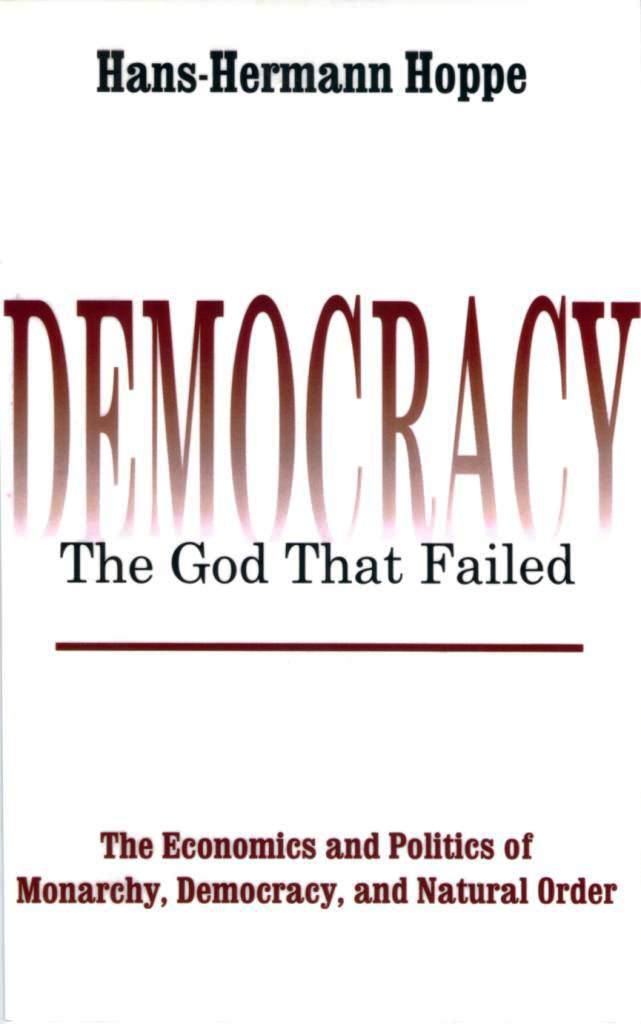
- Murray N. Rothbard, “The ‘New Fusionism’: A Movement For Our Time,” Rothbard-Rockwell Report, Vol. II, no. 1, pp. 1, 3–10 (Jan. 1991), in The Irrepressible Rothbard: The Rothbard-Rockwell Report Essays of Murray N. Rothbard (2000); see also Hoppe, Democracy: The God That Failed (2001); Kinsella, Hoppe on Covenant Communities and Advocates of Alternative Lifestyles. [↩]
- Intellectual Property Rights as Negative Servitudes. [↩]
Discover more from The Property and Freedom Society
Subscribe to get the latest posts sent to your email.


















 Alessandro Fusillo
 Andreas Tögel
 David Dürr
 Doug French
 Fernando Chiocca
 Greg Morin
 Hans-Hermann Hoppe
 Jay Baykal
 Jayant Bhandari
 Jeff Deist
 Jeffrey Barr
 Juan Fernando Carpio
 Ken Yamarashi
 León Isidoro
 Martin Cabrera
 Nick Hoppe
 Oscar Grau
 Peter Wong
 PFS
PFS scholarium
 Saifedean Ammous
 Sean Gabb
 Sean Ring
 Stephan Kinsella
 Stéphane Geyres
 Thomas Jacob
 Tom DiLorenzo