 [Cross-posted at StephanKinsella.com]
Ryan McMaken, in “Why the French Revolution Was Not a Libertarian Revolution,” Mises Wire (08/20/2026), quotes Ralph Raico’s The Struggle for Liberty (Auburn, AL: Mises Institute, 2025) to persuasively argue that the French Revolution was not “some sort of classical liberal or libertarian revolution.” McMaken writes: it is a mistake
when modern libertarians attempt to rehabilitate the French Revolution to portray is as pro-freedom phenomenon. For example, in an essay titled “Thinking about the French Revolution,” David Boaz—a libertarian, although of the ultra-milquetoast regime-libertarian variety—lists the French Revolution among [the triumphs of liberalism].”
As Raico writes,
We further see the lack of liberalism among the revolutionaries in the fact that the French revolutionaries’ Declaration of the Rights of Man and of the Citizen” is in no way as unequivocal as the American Bill of Rights. The French declaration says, for instance, there shall be freedom of thought, even for religion, “within the limits of the law.” They never got to the American point [as shown by the American Bill of Rights], which was that Congress shall make no law regarding the establishment of a religion or prohibiting the free exercise thereof.
McMaken is right to criticize the Declaration for using the “weasel words”: “These limits [on individual rights] can only be determined by law.” This is a point I have made before:
State laws and constitutional provisions often pay lip service to the existence of various personal and property rights, but then take them back by recognizing the right of the state to regulate or infringe the right so long as it is “by law” or “not arbitrary.”1
For these and other reasons, McMaken concludes, “the French Revolution was not liberal in either the way it was conducted, or in the results it attained.”
I would agree. Its excess rationalism also led to the central planning and central legislating mindset—when the French Code Napoleon or Civil Code of 1804 was an elegant compilation of evolved, organic Roman and customary law but it was enacted as a statute and elevated legislation as the supreme source of law. This legislative positivism led to the rise of legal positivism and legislation and to the gradual replacement of more natural, organic, malum in se type law with malum prohibitum law—with the idea of the state as the primary or only source of law.2
Yet the article implies that the American Revolution, by contrast, was more libertarian than the rationalistic French Revolution. As noted above, for example, the US Constitution’s Bill of Rights does not employ the “by law” weasel words found in European “liberal” declarations of rights.
McMaken also writes:
It is easy to see why some modern-day advocates of liberalism/libertarianism might still be confused about the nature of the revolution. In the very early years of the revolution, American libertarians like Thomas Jefferson and Thomas Paine largely thought the revolution to be liberal.
This implies Jefferson was a libertarian, implying the American experiment was more libertarian than the French. But classical liberals are not libertarians. Jefferson was no libertarian. McMaken also writes:
It is also notable that the revolutionary impulse to crush all efforts toward local self determination grew out of the revolution’s nationalistic drive toward greater centralization of state power. Unlike the American revolutionaries, who really had embraced decentralization, self-determination, and a weak central state, the French state had leaned into declaring France to be indivisible.
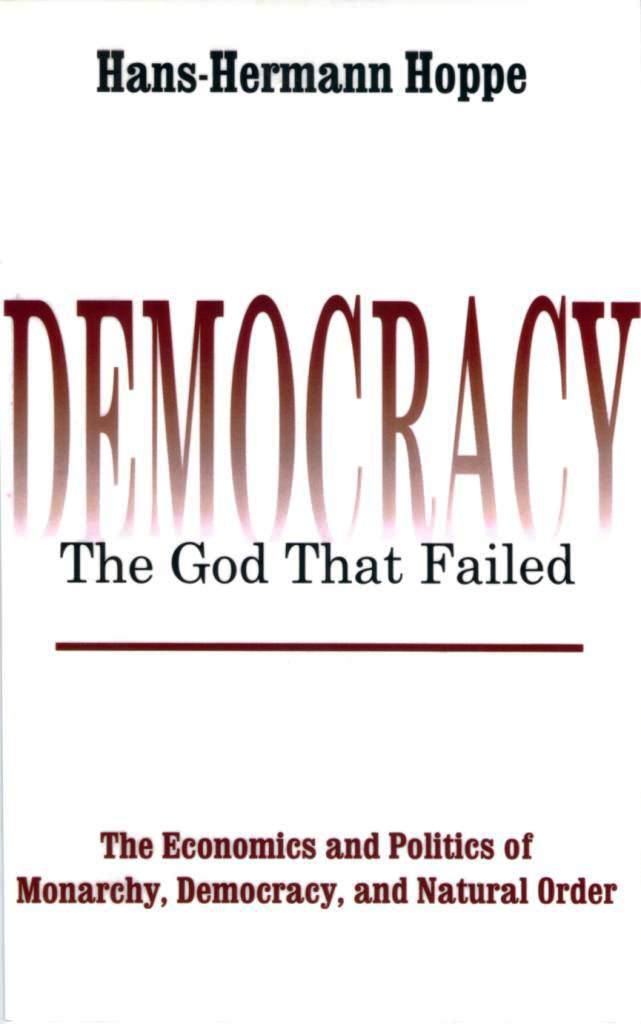
It is true that the French revolution was not libertarian, and the US revolution was better in some respects, but it is also given somewhat undue praise by libertarians. Hoppe, for example, points out that Mises and Rothbard had a “soft spot” for the American constitutional system and democracy.3
As for McMaken’s claim that the American Founders “had embraced … a weak central state”—well, not so fast there. As Rockwell and Hoppe point out, the US Constitution was an expansion of state power.4 Naive libertarians are wrong to claim that the US Constitution protects rights. It does not. That is primarily the function of the US States. The purpose of the Constitution was not to protect rights: it was to set up, to establish—to constitute—a new central state.
Yes, the Framers were concerned about the dangers of the new federal state, as were the people, the States, the ratifiers—and so they attempted to disperse power constitutionally and limit the new central state’s power by constitutional structures.5 The Framers had to try to limit the new central state’s power, or pretend to do so, to get it ratified. But it seems a stretch to say they wanted a weak central state. After all, the very purpose of drafting a new Constitution instead of patching the Articles of Confederation was that the previous confederate government was seen as too weak, as a failure. The Constitution was to replace the old USA and its flaccid confederate government with a new, more powerful general government. As we see now, and as the country saw during the Civil War—the Hamiltonians’ plan worked. So, yes, the Framers wanted to keep the new general government (now called the federal government) from violating rights via a Bill of Rights and separated and divided powers, but that was not the aim of the Constitution. It was to constitute, to create, a new state.
So yes, let’s point out that the French Revolution was in no wise libertarian, but let’s keep in mind that neither was the American Revolution. Some might argue it was a mistake.6
- Kinsella, What Libertarianism Is, n.38. See, e.g., the United Nation’s Universal Declaration of Human Rights, U.N. GAOR, 217A (III) (1948), at articles 22–26 (reciting, for example, “human rights” to “social security” and to “free” “education”); Khawaja on Socialist Welfare Rights; Using International Law to Protect Property Rights and International Investment. [↩]
- Kinsella, Legislative Positivism and Rationalism in the Louisiana and French Civil Codes; “Legislation and the Discovery of Law in a Free Society,” and Hoppe’s comments on the civil law vs. the common law, at n. 152; Herman, The Louisiana Civil Code: A European Legacy for the United States; KOL474 | Where The Common Law Goes Wrong (PFS 2025); On the Role of Commentators and Codes and the Oracles of the Law. [↩]
- See, e.g., Hoppe, “Introduction,” in Democracy: God that Failed (New Brunswick and London: Transaction Publishers, 2001) (“although aware of the economic and ethical deficiencies of democracy, both Mises and Rothbard had a soft spot for democracy and tended to view the transition from monarchy to democracy as progress”); idem, “Introduction,” in Rothbard at 100: A Tribute and Assessment, Stephan Kinsella and Hans-Hermann Hoppe, eds. (Houston: Papinian Press and Property and Freedom Society, 2026); idem, “The Libertarian Quest for a Grand Historical Narrative,” in The Great Fiction; Robert A. Nisbet, The Quest for Community: A Study in the Ethics of Order and Freedom (Wilmington, Del.: ISI Books, 2010 [1953]). [↩]
- Rockwell on Hoppe on the Constitution as Expansion of Government Power. [↩]
- Structural Safeguards to Limit Legislation and State Power; Constitutional Structures in Defense of Freedom (ASC 1998). See also Randy Barnett’s “Federalism Amendment”–A Counterproposal; and related posts; How to Fix the US; KOL345 | Kinsella’s Libertarian “Constitution” or: State Constitutions vs. the Libertarian Private Law Code (PorcFest 2021); KOL359 | State Constitutions vs. the Libertarian Private Law Code (PFS 2021); Libertarian Nation and Related Projects. [↩]
- See Kinsella, When Did the Trouble Start?, September 5, 2003, LewRockwell.com; Down with the Fourth of July. [↩]














 Alessandro Fusillo
 Andreas Tögel
 David Dürr
 Doug French
 Fernando Chiocca
 Greg Morin
 Hans-Hermann Hoppe
 Jay Baykal
 Jayant Bhandari
 Jeff Deist
 Jeffrey Barr
 Juan Fernando Carpio
 Ken Yamarashi
 León Isidoro
 Martin Cabrera
 Nick Hoppe
 Oscar Grau
 Peter Wong
 PFS
PFS scholarium
 Saifedean Ammous
 Sean Gabb
 Sean Ring
 Stephan Kinsella
 Stéphane Geyres
 Thomas Jacob
 Tom DiLorenzo
Follow Us!