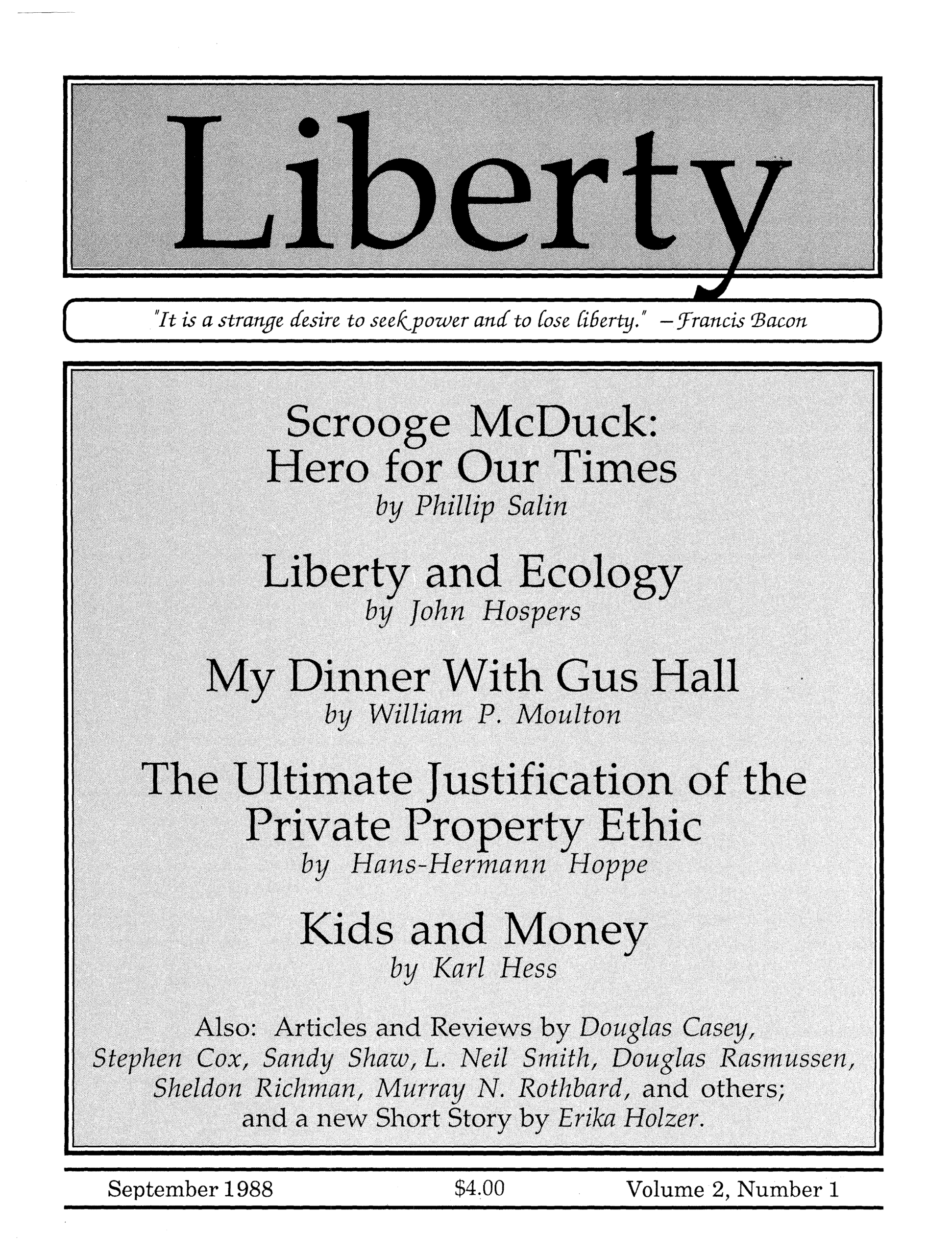
 From the vault: Murray N. Rothbard, “Taking Libertarianism Seriously,” Liberty (September 1988): 34–36. As far as I can determine, this piece has never been published separately or in any collection. Note: this piece appeared in the same issue as Hans Hoppe’s significant article “The Ultimate Justification of the Ethics of Private Property,” which inspired a symposium in the next issue and much scholarly commentary and controversy over the following 28 years, which continues to this day.1
It’s a commentary on the institutional and scholarly respect (or lack thereof) given to libertarian and Austrian ideas in the late 1980s. Rothbard contrasts the relatively serious treatment these ideas receive in Britain—especially at the Institute of Economic Affairs (IEA) under Arthur Seldon, which engaged Austrian economics, anarcho-capitalism, and radical free-market thought without embarrassment—with the more dismissive or superficial attitude common in American academia and establishment think tanks such as the American Enterprise Institute and the Heritage Foundation.
Rothbard observes that even Austrian economics was only beginning to gain limited traction in the United States, while broader libertarian theory received even less serious scholarly attention. The piece implicitly criticizes the tendency of American institutions to marginalize or water down radical libertarian arguments in pursuit of mainstream respectability.
The “Two Libertarianisms” Debate
This essay fits naturally into the lively debate then running in Liberty about the proper foundations of libertarianism—particularly the tension between natural-rights/moralist approaches and consequentialist/utilitarian ones. The original exchange began with Ethan O. Waters, “The Two Libertarianisms,” Liberty (May 1988), p. 7. The debate continued in this issue with Sheldon Richman, “The One Libertarianism: What’s Wrong With Waters,” Liberty (September 1988), p. 53, and Ethan O. Waters, “The Two Libertarianisms, Again: What’s Wrong With Richman,” Liberty (September 1988), p. 56.
Rothbard’s piece can be read as implicitly supporting the moralist/natural-rights side of this debate. He appears frustrated with American institutions that fail to take libertarian ideas seriously on their own terms rather than diluting them for respectability.
Later commentary on the broader discussion includes R.W. Bradford, “The Old Liberty and the New,” Liberty (February 1999), p. 23, at p. 26 n.1); one issue, November, 1998, promised “Virkkala, ‘The Many Libertarianisms,’” but I cannot find it in the Nov. 1998 issue or elsewhere.
Note that Bradford, in “The Old Liberty and the New,” at p.26 n.1, says,
For a more detailed discussion of the two schools of libertarian thought, see [the Waters and Richman pieces noted above,] David Boaz, Libertarianism: A Primer (pp. 82-87); and “On The Duty of Natural Outlaws to Shut Up,” by Murray N. Rothbard (New Libertarian, April 1985, pp. 10–11).2
Rothbard’s September 1988 contribution is therefore best understood as a related cultural-institutional critique. While not a direct reply to Waters or Richman, it reinforces the case for taking libertarian ideas seriously in their most consistent and principled form rather than compromising them for academic or institutional acceptance.
Related
- Rothbard, Robert Nozick and the Immaculate Conception of the State, in The Ethics of Liberty
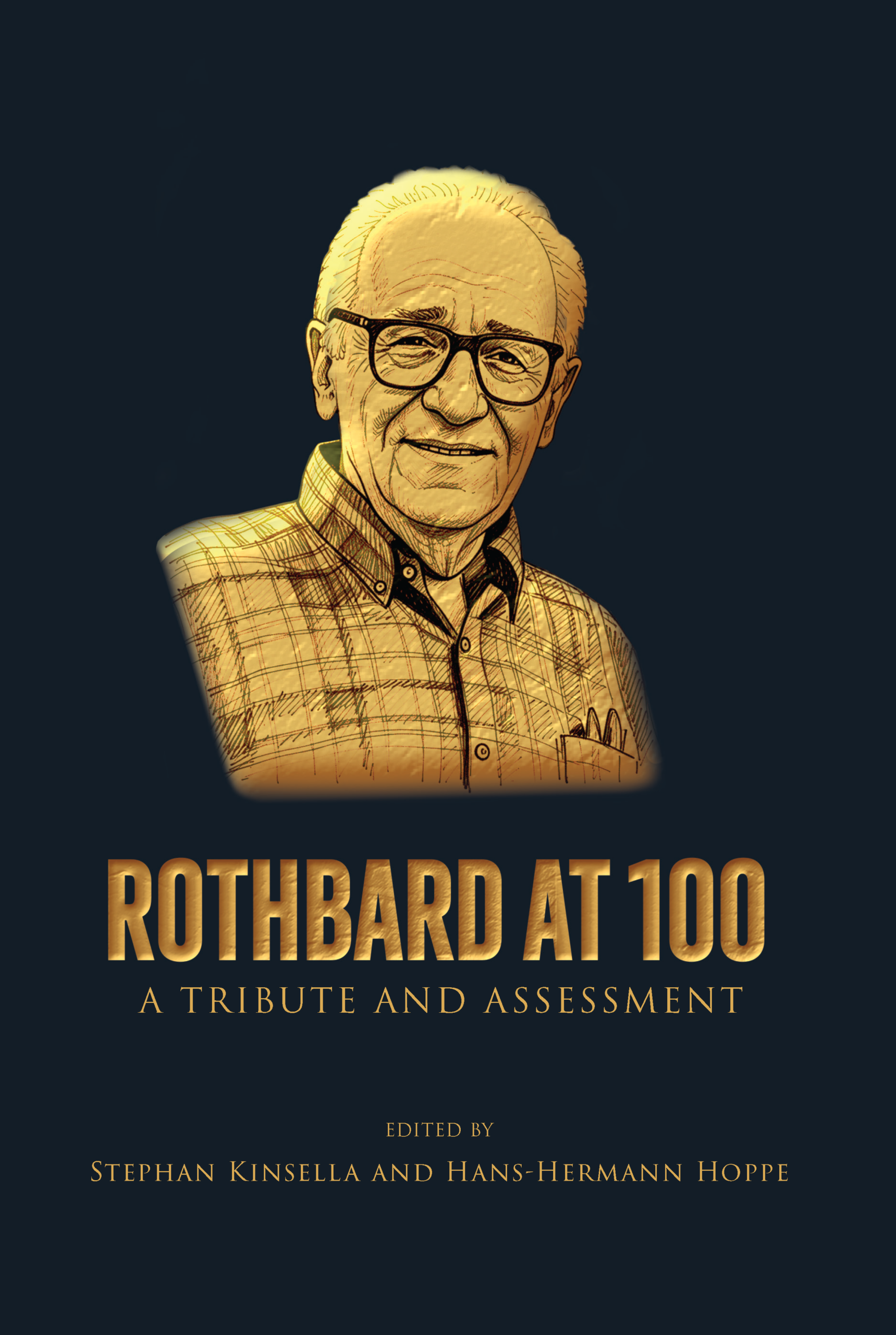
- Hoppe, “Introduction,” in Rothbard at 100: A Tribute and Assessment, Stephan Kinsella and Hans-Hermann Hoppe, eds. (Houston: Papinian Press and Property and Freedom Society, 2026), n.4 (on Nozick’s “razzle-dazzle”); also, on this:
- Thomas Jacob, “Murray Rothbard, Mises University 1990, and the Power of Living Institutions,” n.5
- Kinsella, Don’t tell me to read Hayek
- Sean Gabb, “Rothbard: An Appreciation from England,” in Rothbard at 100: A Tribute and Assessment, Stephan Kinsella and Hans-Hermann Hoppe, eds. (Papinian Press and The Saif House, 2026)
- Kinsella, The Three Fusionisms: Old, New, and Cautious
- Classic Hoppe on the Realistic Right vs. the Egalitarian Left
- Rothbard, Freedom is for Everyone (Including the despised “Rightists”) (Liberty, March 1988)
- Rothbard, Purity and Libertarian Politics (1990)
Here’s the piece.
Taking Libertarianism Seriously
by Murray N. Rothbard
[from Murray N. Rothbard, “Taking Libertarianism Seriously,” Liberty (September 1988): 34–36]
Why is it that British scholars take liberty so much more seriously than do Americans?
Visiting England these days is a genuinely nostalgic experience. Despite the Thatcher ascendancy, all intellectuals to the right of the Labor Party huddle together in small groups, feeling themselves, with considerable justice, a beleaguered minority. As a result, rightist intellectuals, ranging from anarcho-capitalists to minarchists, conservative pragmatists, Hayekians, Hobbesian contractarians, Humean skeptics, and High Tories, cluster together in friendly fashion, swapping horror stories of the “loony Left”-Trotskyite local government councils, crazed egalitarian school teachers, Marxoid union thugs, etc. Britain is in this way strongly reminiscent of the U.S. in the 1950s, when anar-chists, minarchists, laissez-fairists, t rad i tio nali st s, op port uni st s, McCarthyites, global warmongers and various brands of monarchists banded together in reasonably good fellowship against the dominant attitudes and in-stitutions of the New Deal. Since then, all brands of rightism on these shores have grown and flourished, and as they prospered they were able to split off into their own, often antagonistic movements.
Not only is libertarian political ac-tion and social organizing far greater and more impressive in the U.S. than in Britain, but the extent of libertarian intellectual and scholarly activity is far greater, both absolutely and proportion-ally, in the United States. Austrian economics, the most consistently libertarian of the schools of free-market economics, has been developing rapidly in the last few years. Libertarian political philosophy, while much less developed, has also been making its mark, particularly in departments of philosophy and in scholarly think tanks. And yet, in the United States, libertarian scholarly activity gets little or no respect. There are precious few books or journal articles that take libertarianism or Austrianism seriously. Although Austrian economics has become increasingly well-known in recent years, it is just now beginning to break out of its confined status, only recently becoming recognized as a respectable and important school of thought. But libertarianism is still dis-missed by political philosophers as a kooky fringe sect.
It is therefore remarkable that in Britain, despite the small numbers of li-bertarians and the beleaguered status of libertarianism, both Austrian economics and libertarian political theory are treated with great respect. Although agreement with the doctrine is still highly limited, these disciplines get a fair shake in Britain.
In the U. S., for example, introduc-tions to Austrian economics consist of two pamphlets written by Thomas Taylor1 and Lawrence White.2 British in-troductions to Austrianism include one pamphlet (by Stephen Littlechild3) and two substantial books (by W. Duncan Reekie4 and Alexander Shand5). The Institute for Economics Affairs (IEA), the British counterpart to such American public policy think-tanks as the American Enterprise Institute or the Heritage Foundation, is far more scholarly, far more hard-hitting than these sister institutions in the U.S. Arthur Seldon, the intellectual leader of the IEA, does full justice to the Austrian and anarchist, as well as the monetarist-Chicagoite, wings of free-market thought.
There is no counterpart in the States to the work of Sheila Dow’s Macroeconomic Thought: A Methodological Approach6 which treats Austrian macro-economic theory as a fully respectable alternative to mainstream theories, and is even rather sympathetic to the Austrian view.
A particularly striking example of British fair play in scholarly assessment is The New Palgrave: A Dictionary of Economics,7 a massive four-volume en-cyclopedia of economics recently pub-lished by Macmillan in London. The New Palgrave will serve as the fundamental reference work in economics for decades. Remarkable for such a project, there was no Editorial Board to lend it balance; there are only three editors, with absolute power to select articles and contributors, and to ride herd over the articles if they so desired. The first editor is John Eatwell, professor at Cambridge, and a leader of the left Keynesian-quasi-Marxist Cambridge School; and a second editor is Murray Milgate, a student and disciple of Eatwell’s. Indeed, cursory reading, backed by a more systematic critique by Seldon,8 demonstrates that far more space-and almost all space in New Palgrave is favorable space-is devoted to Keynesianism and Marxism than to any other school of thought. And crucial articles, such as the one on “Capitalism,” were given to the third-rate Marxoid Robert Heilbroner rather than to any defender of capitalism.
There is no doubt about The New Palgrave’s left-wing bias. And yet … despite that bias, there is no question that Austrianism is well represented in the Palgrave, all the articles in this area being written by such leading Austrian adherents and sympathizers as Israel M. Kirzner, Klaus H. Hennings, Roger W. Garrison, Paul McNulty, Karen Vaughn and the present writer. I venture to guess that no left Keynesian-Marxist-controlled encyclopedia in the U. S. would give Austrians as good a break, and I strongly doubt that Austrians would fare as well in a Chicagoite-monetarist-controlled encyclopedia published here, either.
Not only that, but mainstream British scholarship is even fair to libertarianism, a school of political thought that is barely acknowledged in the U. S., let alone treated as a serious movement to be reckoned with by orthodox political theorists. (Arthur Seldon goes so far as to chide The New Palgrave for not including any articles on “anarcho-capitalism” or “libertarianism,” for whom Seldon suggests David Friedman and myself respectively.) In the United States, during the New Left era of the late 1960s and early 1970s, anthologies included individualist anarchist writings9 or libertarianism alongside Marxist ideologies.10 But there has been virtually nothing since.11
The big exception, of course, was the exhaustive comment and analysis accorded Robert Nozick’s Anarchy, State and Utopia, but Nozick’s work was treated as an isolated text rather than as a leading volume in a broad movement, so that the nature of libertarianism, or indeed, any libertarian outside of Nozick himself, was totally ignored. And while the existence and stature of Anarchy, State and Utopia happily made the very discussion of such themes as “liberty” and “rights” at long last respectable in dissertations and articles in philosophy journals, its impact was dis-sipated after a few years by Nozick’s stubborn refusal to respond publicly to any of his host of critics.12
There are encouraging recent signs, however, that attention to libertarian-ism in mainstream political science might be making a comeback. Larry Arnhart, a Straussian political scientist of libertarian sympathies at Northern Illinois University, has a reasonably favorable discussion of libertarianism in his recent textbook13 on contemporary political thought, while there is a fair discussion of individualist anarchism, anarcho-capitalism, and the Libertarian Party in the seventh edition of Lyman Tower Sargent’s text, Contemporary Political Ideologies: A Comparative Analysis.14
U. S. coverage, however, pales beside the treatment accorded to libertarian scholarship in Great Britain. There is Professor David Miller’s book on Anarchism.15 Also, a fair and intelligent discussion of both Austrian free-market economics and libertarian anarcho-capitalism has been provided by Peter Wynarczyk.16 After discussing the various schools of free-market thought, Wynarczyk concluded that my own anarcho-capitalist arguments “are extremely consistent and persuasive,” but he then draws back from the precipice at the last minute, telling himself and the reader that there are historical problems getting from here to there [no doubt!] and that we must abandon the Utopian extremism of laissez faire, which must, he says, be “fallible,” since man is fallible. [Did anyone promise omniscience and perfection?] No, no he reminds himself, in a world of uncertainty “we must be pragmatic, eclectic and pluralistic.” [Is he certain about that statement?] These final paragraphs, however, constitute a remarkably feeble coda to a thorough and generally excellent discussion. Were they tacked on, perhaps, to get himself off the hook?
The two most comprehensive and recent British works on libertarianism have, unfortunately, not even remote analog in the U. S. One is a book by David G. Green, a research fellow at the IEA, on The New Conservatism: The Counter-Revolution in Political, Economic and Social Thought.17I should hasten to add that such current terms as “the New Right” or “New Conservatism” in Britain have nothing to do with such American doctrines as Kirkian traditionalism, right-wing populism, or Moral Majoritarianism. To Green, for example, the “New Conservatism” is identical to the “new [Classical) Liberalism,” and his chapters on ideology are confined to the Classical Liberalism of previous centuries; “Anarcho-Capitalism or the Minimal State?” which includes discussions of my own “anarcho-libertarianism,” David Friedman’s anarcho-capitalism, Nozick’s minimal state, and Rand’s Objectivism; “Friedman and the Chicago School”; The Public Choice School” [of Buchanan and Tullock]; and Hayekian doctrine: “Hayek and the Austrian School.”
The most important new British work on libertarian theory is On Classical Liberalism and Libertarianism,18 by Norman Barry, Professor of Politics at the University of Buckingham. Similar to Green, Barry has chapters devoted to classical liberalism, the Chicago School, Mises and the Austrian School, Buchanan and “Contractarian Liberalism,” Ayn Rand and “Egoism,” Nozick and the Minimal State, and myself and Anarcho-Capitalism. It is a subtle work deserving a substantial re-view on its own, but here suffice it to say that Barry’s is a highly intelligent treatment that appreciates the power and the consistency of anarcho-libertarianism, a little like Wynarczyk, but on a much higher level, finally tilting toward the seemingly greater practicalities of some form of Buchananite constitutionalism.
We are left with the conundrum: why is British treatment of American libertarian and Austrian scholarship so much more appreciative, and on such a far higher level, than it is accorded in the United States of America? Who knows? Is it the old story of someone being a prophet abroad but scorned at home? Or are the British simply more civilized?
Endnotes
- Thomas Taylor, An Introduction to Austrian Economics, 2nd edition (Auburn, Ala.: Ludwig von Mises Institute, 1983).
- Lawrence White, The Methodology of the Austrian School, 2nd edition (Auburn, Ala: Ludwig von Mises Institute, 1984).
- Stephen Littlechild, The Fallacy of the Mixed Economy: An “Austrian” Critique of Conventional Economics and Government Policy (London: The Institute for Economic Affairs, Hobart Paper #80, 1978); fortunately, a revised edition was prepared for American readers, and published by Cato (San Francisco: Cato Institute, Cato Paper #2, 1978).
- Duncan Reekie, Markets, Entrepreneurs,and Liberty (New York: St Martin’s Press, 1985).
- Alexander Shand, The Capitalist Alternative: An Introduction to Neo-Austrian Economics (New York: New York University Press, 1984).
- Sheila Dow, Macroeconomic Thought: A Methodological Approach (UK: Basil Blackwell, 1985).
- John Eatwell, Murray Milgate, Peter Newman, eds., The New Pa/grave: A Dictionary of Economics (UK: Basil Blackwell, 1987; New York: Stockton Press, 1987).
- Arthur Seldon, “Enlightenment or Ideology? Part II: Assessment,” Economic Affairs (April/May 1988), pp. 42-46.
- Leonard Krimerman and Lewis Perry, Patterns of Anarchy (Garden City, NY: Anchor Books, Doubleday & Company, Inc., 1966).
- Dorothy James, Outside, Looking In (New York: Harper & Row, 1972).
- For a few years after the Oark campaign for the presidency on the Libertarian Party ticket in 1980, which garnered 920,000 votes, several free-market oriented basic economic textbooks, such as those by Roger LeRoy Miller [Economics Today: The Micro View (New York: Harper & Row, 1985)] and Edwin Dolan [Basic Microeconomics (Hinsdale, Ill.: Dryden Press, 1983)] mentioned libertarianism as an alternative extreme ideology along with Marxism. After the falling off of votes in 1984, however, all references to libertarianism in later editions were dropped. Let us hope that 1990 will see a comeback!
- Robert Nozick, Anarchy, State and Utopia (New York: Basic Books, 1974). See Jeffrey Paul, Reading Nozick(Totowa, NJ: Rowman and Littlefield, 1981), pp. 206-231, wherein Nozick’s contribution is not a comment on any of his critics, but an earlier essay on Ayn Rand!
- Larry Arnhart, Political Questions (New York: Macmillan, 1987).
- Lyman Tower Sargent, Contemporary Political Ideologies: A Comparative Analysis (Chicago, Ill.: The Dorsey Press, 1987).
- David Miller,Anarchism (UK: M. Dent, 1984).
- Peter Wynarczyk, “Is a Pure Market System Peasible?” in Roper and B. Snowdon, eds.,Markets, Intervention and Planning (London: Longmans, 1987), pp. 61-62.
- David G. Green, The New Conservatism: The Counter-Revolution in Political, Economic and Social Thought (New York: Martin’s Press, 1987).
- Norman Barry, On Classical Liberalism and Libertarianism(New York: St. Martin’s Press, 1987). This book is an expansion of his notable journal article on “The New Liberalism,” The British Journal of Political Science, 13 (1983), 93-123.
- Hans-Hermann Hoppe, “The Ultimate Justification of the Ethics of Private Property” (September 1988; also in EEPP); Symposium on Hoppe’s argumentation ethics: “Breakthrough or Buncombe?”, esp. Murray N. Rothbard, “Beyond Is And Ought” (Nov. 1988); Kinsella, “Argumentation Ethics and Liberty: A Concise Guide,” Mises Daily (May 27, 2011); Kinsella, “A Libertarian Theory of Punishment and Rights,” “Dialogical Arguments for Libertarian Rights,” and “Defending Argumentation Ethics: Reply to Murphy & Callahan,” all in Legal Foundations of a Free Society (Houston, Texas: Papinian Press, 2023); “The Genesis of Estoppel: My Libertarian Rights Theory“; “Hoppe’s Argumentation Ethics and Its Critics,” “Revisiting Argumentation Ethics.” [↩]
- See Murray N. Rothbard, “On the Duty of Natural Outlaws to Shut Up,” New Libertarian (April 1985); the Mises Institute version linked above mangled the title, as can be seen in The New Libertarian, Vol. IV #13 — April, 1985 (pdf). [↩]
Discover more from The Property and Freedom Society
Subscribe to get the latest posts sent to your email.
















 Alessandro Fusillo
 Andreas Tögel
 David Dürr
 Doug French
 Fernando Chiocca
 Greg Morin
 Hans-Hermann Hoppe
 Jay Baykal
 Jayant Bhandari
 Jeff Deist
 Jeffrey Barr
 Juan Fernando Carpio
 Ken Yamarashi
 León Isidoro
 Martin Cabrera
 Nick Hoppe
 Oscar Grau
 Peter Wong
 PFS
PFS scholarium
 Saifedean Ammous
 Sean Gabb
 Sean Ring
 Stephan Kinsella
 Stéphane Geyres
 Thomas Jacob
 Tom DiLorenzo