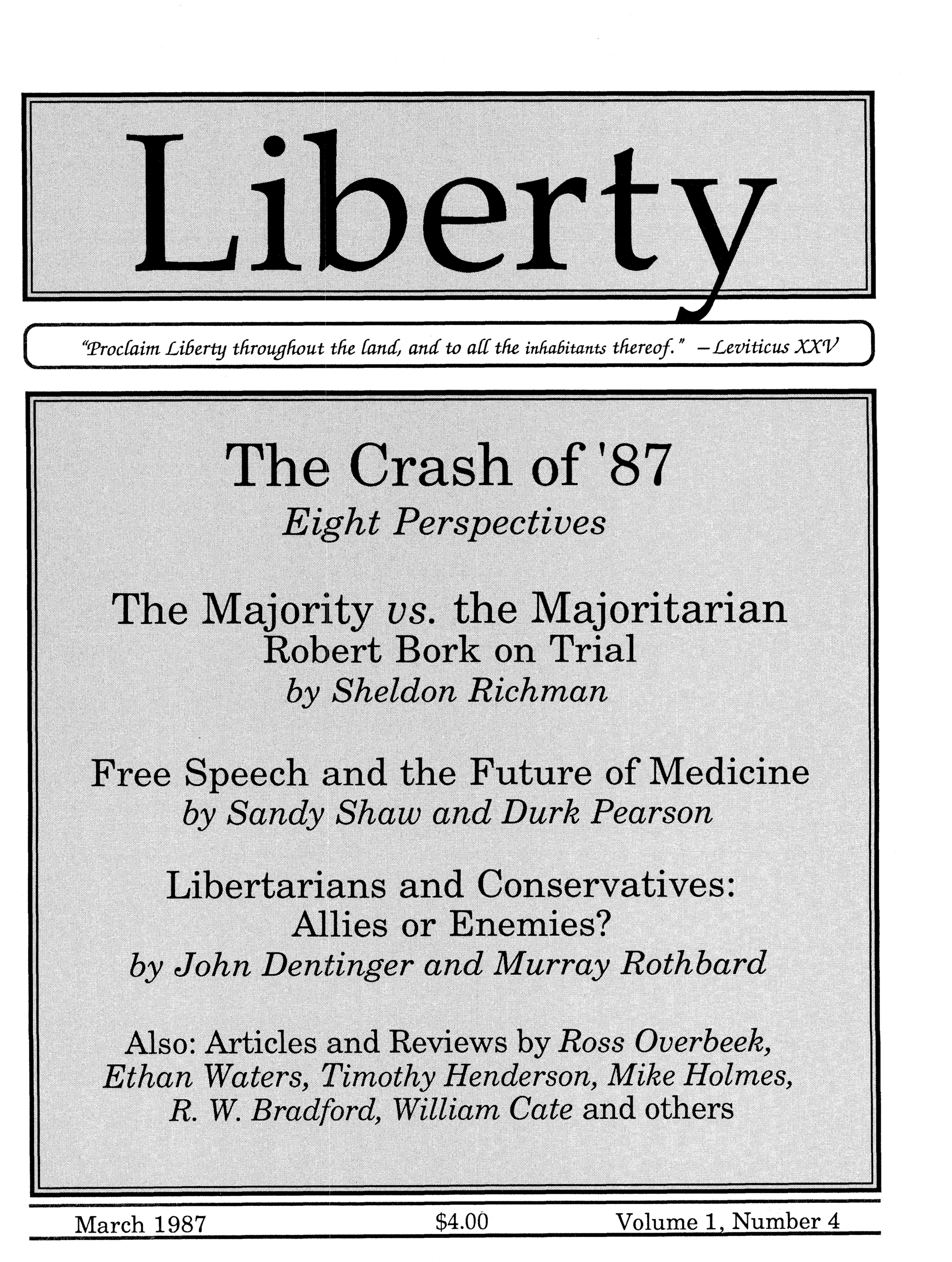
 From the vault: Murray N. Rothbard, “Freedom is for Everyone (Including the despised ‘Rightists’),” Liberty (March 1988): 43–44. This was a counterpoint to John Dentinger, “Strange Bedfellows: Libertarian/Conservative Misalliance,” Liberty (March 1988): 37–42.
Related
- Kinsella, The Three Fusionisms: Old, New, and Cautious (Jan. 16, 2022) (on paleolibertarianism etc.)
Here’s the piece.
Murray N. Rothbard, “Freedom is for Everyone (Including the despised ‘Rightists’),” Liberty (March 1988): 43–44
John Dentinger’s essay on libertarianism and the right suffers from two major problems. It frequently distorts matters of fact, which is bad enough. But worse yet, it suffers from a wrongheaded perspective.
One would never know from Dentinger’s account that the Brigg’s Initiative of 1978 was opposed by the Libertarian Party of California, was vociferously denounced by the LP, and that in my recollection not a single Libertarian supported it. One would never know from Dentinger’ s raking over the old bones of the Ron Paul DC sodomy law vote in 1982 that this issue has been discussed ad nauseum, and that the issue was a complex one, with Paul reluctant to accept a package deal that would have substantially lowered the penalty for rape. (Or perhaps Dentinger considers rape a “victimless crime”…) And Dentinger’s reference to “substantial heated opposition” to Norma Jean Almodovar’s candidacy for Lieutenant Governor willfully ignores the fact that Norma Jean had no opposition in the LP primary. Indeed, almost every issue since then of such leading libertarian periodicals as LP News and the American Libertarian have included warm messages of support for Norma Jean in her battle against the state, with not a single voice to the contrary.
I have yet to figure out why it was a Rightist sin for Libertarians to oppose the reelection of Rose Bird. Or is Dentinger maintaining that it is a libertarian duty to rush to the support of all beleaguered leftists?
In his discussion of Reason magazine, Dentinger is on slightly firmer ground. Reason unfortunately does have Reaganite tendencies; its views may well be characterized as “Reaganism-in-favor-of-atheism-and-abortion.” (I have elsewhere referred to them as the “left wing” of the Reagan movement.) But Henry Mark Holzer’s defense of the Bowers v Hardwick decision, which upheld Georgia’s barbaric anti-sodomy law, must have been as surprising to Reason’s editors as it was to me: several Reason-connected writers protested Holzer’s desertion of the libertarian position.
Even worse than Dentinger’s egregious errors of fact is his appalling intellectual perspective.
First of all, he fails to recognize that the words “conservative” and “Rightist” cover a multitude of diverse positions. In particular, the right wing we all know and detest—the Reagan-Buckley-Kirkpatrick-CIA-National Review-Human Events Right Wing is very different from the Old Right that predominated conservative ranks from the mid-1930s to the mid-1950s. The current Right is indeed power-hungry, war-mongering, dictatorial, and theocratic. But it is very different from the Old Right.
The Old Right is very libertarian. Yes, it is populist, Christian, and anti-Establishment. The Old Right of Albert Jay Nock, John T. Flynn, Frank Chodorov, Felix Morley, Colonel McCormick, and Robert Taft was strongly opposed to war and militarism. It fought conscription and strongly supported civil liberties. It defended free enterprise, the free market and the gold standard. It was profoundly hostile to the Establishment and to State power.
It is true that the Old Right was not anarchist. But neither was it a part of the Right that Dentinger denounces. Should Nock, Flynn, Chodorov, Morley and Mencken be eliminated from the libertarian movement because they are not anarchists? If so, it would seem to follow that all minarchists, no matter how hard core, must also be purged. Is this what Dentinger wants us to do?
Dentinger, moreover, writes of a “number of libertarians” who supported Reagan over Ed Clark for President in 1980, in a way that almost makes libertarians as a class responsible for the eight years of Ronald Reagan. It is clear that Dentinger and I, fortunately, do not travel in the same libertarian circles. I don’t know of any libertarians who voted for Reagan, and I don’t know how you could call them “libertarians” if they did. Ed Clark got 920,000 votes for President in 1980, and I gather that this legion included virtually all the libertarians who voted that year. As for myself, I have attacked Ronald Reagan, consistently and bitterly, day in and day out, from the beginning of his reign until the end. Somehow, I missed seeing John Dentinger in the libertarian anti-Reagan ranks until this essay for Liberty.
Dentinger mentions a few benighted libertarian ex-YAFers from the 1969 split who later backslid into the conservative ranks. But the majority of those who didn’t drop out altogether, have remained libertarian. Karl Hess, Jr., Sam Konkin, Ralph Fucetola, Dave Walter, and Don Ernsberger, for example, have remained firmly libertarian.
Yes, indeed, Ayn Rand usually backed conservative Republican politicians. But, even though her philosophy influenced many libertarians, it is ludicrous to refer to her as a “libertarian” when she herself, passionately and caustically, kept denouncing libertarians as the quintessence of evil—a line continued by her dimwit and robotic followers to this day.1 Surely, then, libertarians can in no way be held responsible for Rand’s aberrant political views.
On Bork and “judicial restraint,” once again, there are surely no more than one or two misguided libertarians who support the Frankfurter-Bork doctrine that the duty of the courts is to place the stamp of constitutional approval on any and all exercises of power by the Congress and the Executive Branch. At the Seattle convention, the Libertarian Party overwhelmingly registered its opposition to Judge Bork and everything he stands for.
Dentinger’s sneering reference to “conspiracy analysis” as “right-wing” is even less excusable. Anti-Trilateralist “conspiracy” analysis—or what I prefer to call “power elite” or “interest group” analysis—is neither right-wing nor left-wing. As a matter of fact, the best scholars who are Anti-Trilateralist are leftists: Holly Sklar, Carl Oglesby, and Lawrence Shoup. What anti-Trilateralism is is anti-Establishment. Dentinger is not alone among libertarians in viewing the Paul campaign’s anti-Trilateralism as not being “respectable.” But this misses the point: it is damn sure not respectable, but it is correct. The importance of “conspiracy analysis” is that, to the discussion of which policies are right or wrong, it adds an important dimension: that statism is not just intellectual error on the part of statists; it is a bunch of special privilege groups ripping us off and in the name of the general welfare.2
I do not want to dwell on the Ron Paul campaign here. The importance of this campaign is that Paul is an Old Right libertarian in the best sense, and that his 1988 campaign has the wonderful potential of reactivating a large number of instinctively libertarian and anti-Establishment Americans, men and women who, for thirty years have been deprived of articulate libertarian leadership. The Paul campaign can rouse these numerous Americans from their frustration and torpor and bring them into the libertarian movement, at the same time enlarging the ranks of libertarianism to make it a powerful force in American life. To fail to see the profound difference between, say, Ron Paul and Jack Kemp, is to throw away one of the great opportunities for libertarians to have a significant impact on American politics. It is an opportunity that might not come again.
But I wonder if John Dentinger wants such an opportunity. He appears to be a spiritual comrade of the Meansians who have organized FIFE (“Freedom is for Everyone”). But for Dentinger and the Fifeniks, it seems that Freedom is not really for Everyone, but only for hippies, luftmenschen, and special-interest minority groups. For Dentinger and the Fifeniks, is Freedom also for Anti-Establishment rightists? Is Freedom for the average middle-class American? Is Freedom for people who wear suits, ties, or dresses?
And, in particular, is Freedom for Christians? The libertarian movement, and the Libertarian Party, will get nowhere in America—or throughout the world—so long as it is perceived, as it generally is, as a movement dedicated to atheism. Nock, Morley, Chodorov, Flynn et al. were not atheists, but for various accidental reasons of history, the libertarian movement after the 1950’s consisted almost exclusively of atheists. There is nothing inherently wrong with this, except that many libertarians have habitually and wrongly acted as if religious people in general and Christians in particular are pariahs and equivalent to statists. This pernicious attitude, combined with aggressive luftmenschship, has managed to turn off a huge number of middle-class Americans. I remember one time when my magazine, the Libertarian Forum, included an article about Protestants and liberty. One libertarian asked my publisher, in bewilderment, “why does Murray have an article about Protestants?” “For one thing,” my publisher replied, “there are a lot more Protestants in the United States than there are libertarians.” Indeed.
In all the talk about “outreach” among libertarians, I never hear a word about outreach to Christians.3 In keeping with this hostility, the only reference John Dentinger has to Christians in his article is to the “hate-filled religious right.” Of course, we have to strongly oppose the theocracy of the Moral Majoritarians. But the religious right is not the sum and substance of Christianity in America. And I have yet to see Dentinger or the Fifeniks roll out the welcome mat to libertarian-minded Christians. I think that the hostility to Ron Paul by Meansians such as Dentinger reflects their dim perception that the bell has tolled for the old comfortable days when libertarians were only a small group of marginal people cut off from American life. Yes, Freedom is indeed for Everyone, including the large number of Americans scorned by Dentinger and company, and this is precisely what they are complaining about.
Finally, he concludes his astonishing defense of guilt by association, with the tacky charge that “when you lie down with conservatives, you get up with sleaze.” John Dentinger carefully omits one crucial fact. In the course of pillorying Reason magazine as one of the worst of these conservatives, Dentinger somehow forgets to point out that he himself is a regular columnist for that self-same Reason magazine.
How about it: Why don’t you speak for yourself, John?
- On other uses by Rothbard of the term “dimwit,” see Kinsella, Lawyer apology. —SK [↩]
- See Kinsella, Rothbard on Conspiracy Theories. —SK [↩]
- See Kinsella, Faith Seeking Freedom: Libertarian Christian Answers to Tough Questions. —SK [↩]
















 Alessandro Fusillo
 Andreas Tögel
 David Dürr
 Doug French
 Fernando Chiocca
 Greg Morin
 Hans-Hermann Hoppe
 Jay Baykal
 Jayant Bhandari
 Jeff Deist
 Jeffrey Barr
 Juan Fernando Carpio
 Ken Yamarashi
 León Isidoro
 Martin Cabrera
 Nick Hoppe
 Oscar Grau
 Peter Wong
 PFS
PFS scholarium
 Saifedean Ammous
 Sean Gabb
 Sean Ring
 Stephan Kinsella
 Stéphane Geyres
 Thomas Jacob
 Tom DiLorenzo
Follow Us!