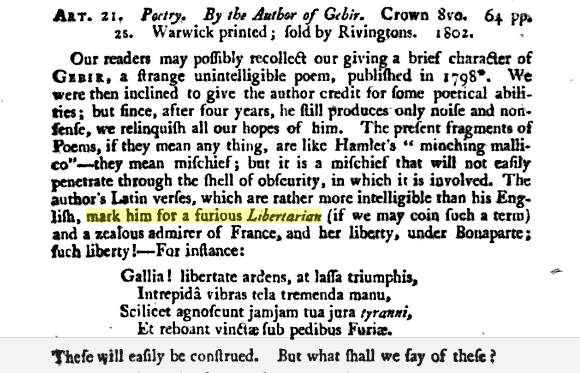
 The word libertarian appears to have been first used around 1800 or so in the political/liberalism sense (as opposed the philosophical sense having to do with free will). I initially thought the first use was from 1802. In a short piece critiquing a poem by “the author of Gebir,” in The British Critic (1802), p. 432, the author (I cannot easily make out his name) writes:
The author’s Latin verſes, which are rather more intelligible than his Engliſh, mark him for a furious Libertarian (if we may coin ſuch a term) and a zealous admirer of France, and her liberty, under Bonaparte; ſuch liberty!—For inſtance: …
Or, modernizing the archaic long s‘s:
The author’s Latin verses, which are rather more intelligible than his English, mark him for a furious Libertarian (if we may coin such a term), and a zealous admirer of France, and her liberty, under Bonaparte; such liberty!–For instance …1
I have sometimes said yeah, I’m a furious libertarian! Great name for a magazine!
But has also been claimed that libertarian was first used in the political sense around 1796:
As early as 1796, libertarian came to mean an advocate or defender of liberty, in the sense of a supporter of republicanism, when the London Packet printed on 12 February the following: “Lately marched out of the Prison at Bristol, 450 of the French Libertarians.”2
Modern libertarianism itself, as distinct from the word, and as a political movement, ideology or philosophy (as opposed to the less-radical classical liberalism that preceded it), is about 60 to 70 years old.3 The first modern libertarians in the 1950s or 1960s or so started using the term to describe their emerging, radical political philosophy, e.g. by classical liberal writer Dean Russell in 1955, and then by his colleague Leonard Read, the founder of FEE. As Rothbard, who also helped popularize the term in the 1960s and 1970s, wrote:
More than any other single person, Leonard [Read] was the founder of the modern libertarian movement. …
In addition, more than anyone else Read coined the name “libertarian” for the current movement. Before that, we had no single name, awkwardly going back and forth between “individualists'” and ”true liberals”. The problem with the latter phrase is that the quasi-socialists had already succeeded in appropriating the term “liberal”, and calling ourselves “true” anything was confusing and hardly persuasive. And the term “individualist” tended to confuse political philosophy with possessing a spirit of individual autonomy. Read and a few others launched the term “libertarian” for the freedom philosophy, and it stuck—the only case I know of when we were able to appropriate a word from others. For before that, communist-anarchists had often referred to themselves as “libertarian.” The first time when we were referred to publicly as “libertarians” was in an odious, book, published in the 1950’s, by a certain Ralph Lord Roy, entitled Apostles of Discord. There was a repellent literature in those days of works written by aggressive centrists and “moderates” who pilloried all “extremists” as per se evil. Roy, a Social Gospel Protestant, wrote this book to attack both Communist and ultra-rightist “extremists” in the Protestant church. That was par for the course in those days, but lo and behold! he included a chapter called “God and the ‘Libertarians'”, spotting quasi-anarchistic extremists then centered around a libertarian publication for Protestant ministers called Faith and Freedom. Libertarianism had arrived on the American ideological scene.4
And as the late, great—and former PFS member—Paul Cantor5 wrote in his book The Invisible Hand in Popular Culture: Liberty vs. Authority in American Film and TV:
one subject I am examining in this book is the libertarian impulse in American popular culture. Libertarianism is a philosophy of freedom, and particularly endorses the free market as the best form of social organization.
The use of libertarian to describe a political position is fairly recent; it dates mainly from the mid-twentieth century.2 But the roots of libertarianism lie in the eighteenth and nineteenth centuries, in what is often called the classical liberal tradition. (Given its insistence on limited government, this tradition must be distinguished from modern liberalism, which by contrast calls for big government.)
… 2. The person most responsible for popularizing the term libertarian was Murray Rothbard. See especially his book For a New Liberty: The Libertarian Manifesto (New York: Macmillan, 1978).6
So the older term began to be adopted by the what we now think of as the modern libertarian movement or political philosophy about 70 or so years ago.
The term is a broad one, referring both to what is called minarchism—which I call mini-statism or inconsistent libertarianism7 —and libertarian anarchism, sometimes called anarcho-capitalism, and what I often refer to as anarcho-libertarianism (and what Hoppe refers to as the “private-law society”).8
The term is always in danger of morphing. Some have abandoned the term out of disgust with some of the modern libertarians; others have moved on to “post-libertarianism”—what I call the “waystation libertarians” who were just passing through.9 Some of us—like me—stubbornly cling to the label, trying to keep from losing it or it being hijacked, as liberal was hijacked by left in the US so that it now perversely means soft leftist. It used to mean what it still means in Europe, something like what “classical liberal” means now in the US, the forebears of modern libertarianism, or proto-libertarianism. (I recall Objectivist David Kelley once in a speech said, if the leftists are done with the term liberal, can they please give it back?)10
Others have flirted with risible terms like “market liberal” and still others insist on the mis-labeled “voluntaryism” (give reasons).11 If I had my way, I might prefer a term like Hazlitt’s cooperatism, or perhaps consensualism,12 but being an irascible, stubborn type, I intend to stick with libertarianism, for the most part.
An older term we sometimes hear is night-watchman state. I used to think of this as a synonym for minarchy, but my impression is it has more of a classical liberal connotation, more like the classical liberal minimal state, but maybe not quite Nozick’s ultra-minimal state.13
Interestingly, the term “night-watchman state” began as a Marxist slur. As the Wikipedia page for Night-watchman State notes,
As a term, night-watchman state (German: Nachtwächterstaat) was coined by German socialist Ferdinand Lassalle in an 1862 speech in Berlin wherein he criticized the bourgeois-liberal limited government state, comparing it to a nightwatchman. The phrase quickly caught on as a description of capitalist government, even as liberalism began to mean a more involved state, or a state with a larger sphere of responsibility.[8] Ludwig von Mises later opined that Lassalle tried to make limited government look ridiculous, but it was no more ridiculous than governments that concerned themselves with “the preparation of sauerkraut, with the manufacture of trouser buttons, or with the publication of newspapers”.[9]
As Marxist Ferdinand Lassalle wrote in 1862:
In accordance with this difference, the bourgeoisie conceives the moral purpose of the State as consisting only in the duty to protect the personal liberty of the individual and his property.
This is a policeman’s idea, gentlemen, a policeman’s idea for the reason that it creates the State after the image of the policeman [nachtwächter], whose sole function consists — or should consist — in preventing theft and burglary.[b] I am sorry to say that this policeman notion is not only peculiar to the Liberals, but also to many alleged Democrats, owing to their insufficient mental training. If the bourgeoisie should consistently pronounce its last word, it would be obliged to admit that, according to these ideas of its own, there would be no reason for a State at all, if it were not for the existence of robbers and thieves. . . .
[b] An alternate, more literal translation for “policeman” would be “night-watchman” (nachtwächter). This concept of a “night-watchman state,” coined and mocked by Lassalle in this speech, has since been reclaimed as a desirable state of affairs by so-called “libertarians,” “minarchists,” and other apologists for capitalist rule. —New note by Bill Wright, transcriber.14
And in another tract:
In accordance with this difference, the Bourgeoisie conceive the moral object of the State to consist solely and exclusively in the protection of the personal freedom and the property of the individual.
This is a policeman’s idea, gentlemen, a policeman’s idea for this reason, because it represents to itself the State from the point of view of a policeman [nachtwächter], whose whole function consists in preventing robbery and burglary.[a] Unfortunately this policeman’s idea is not only familiar to genuine liberals, but is even to be met with not unfrequently among so-called democrats, owing to their defective imagination. If the Bourgeoisie would express the logical inference from their idea, they must maintain that according to it if there were no such thing as robbers and thieves, the State itself would be entirely superfluous.[*]
[*] This idea of the State, which in fact does away with the State, and changes it into a mere union of egoistic interests, is the idea of the State as regarded by liberalism, and historically was produced by it. It forms by the power which it has necessarily obtained and which stands in direct relation to its superficiality, the true danger of spiritual and moral decay, the true danger, which threatens us at this day, of a “modern barbarism.” In Germany happily it is strongly opposed by the ancient learning which has once for all become the indestructible foundation of German thought. From this proceeds the view “that it is necessary to enlarge the notion of the State to the fullest extent to which in my opinion it is possible to enlarge it, that the State should be the organisation, in which the whole virtue of man should realise itself.” (Augustus Boeth’s address to his University of the 22nd March, 1862.)
[a] An alternate, more literal translation for “policeman” would be “night-watchman” (nachtwächter). This concept of a “night-watchman state,” coined and mocked by Lassalle in this speech, has since been reclaimed as a desirable state of affairs by so-called “libertarians,” “minarchists,” and other apologists for capitalist rule. —New note by Bill Wright, transcriber.15
The transcriber is right that libertarians reclaimed, adopted, and reappropriated this slur,16 similar to how capitalism was used pejoratively at first but then adopted, e.g. by Ayn Rand and anarcho-capitalists.17
In any case, I’m sticking with libertarianism as my go-to, but I still like the old-fashioned, hoary, and classical-liberal connoting night-watchman state term. I’m an anarchist, but, as the saying goes, I wouldn’t kick minarchy, or the night-watchman state, out of bed unless it wanted to get on the floor.
- Kinsella, “The Origin of ‘Libertarianism,’” Mises Blog (Sept. 10, 2011). [↩]
- See Wikipedia entry for Libertarianism; Kinsella, “Rothbard on Leonard Read and the Origins of ‘Libertarianism’” (Nov. 17, 2014). [↩]
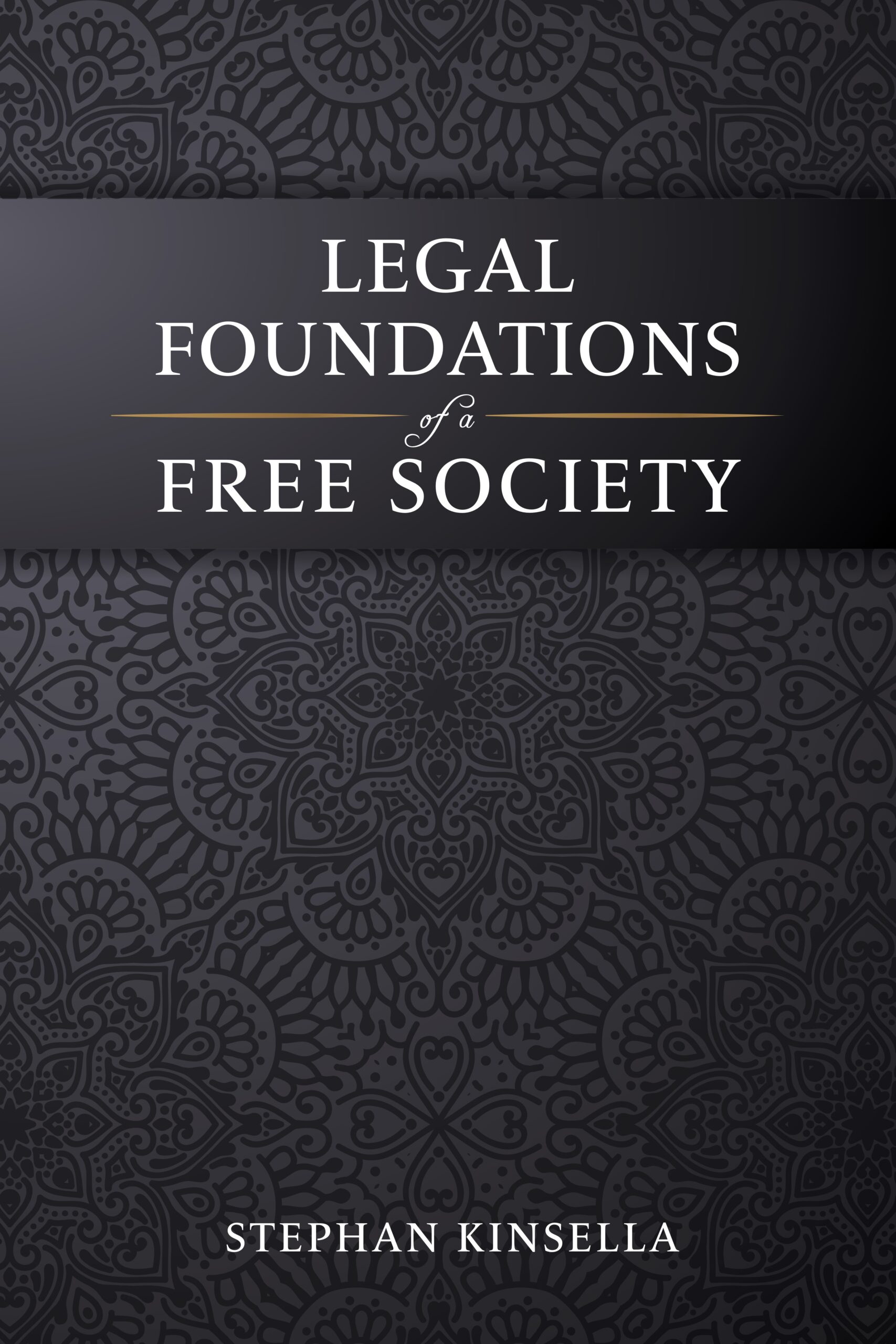
- Kinsella, “Libertarianism After Fifty Years: What Have We Learned?,” in Legal Foundations of a Free Society (Houston, Texas: Papinian Press, 2023) [LFFS]. [↩]
- Murray N. Rothbard, “Leonard Read, RIP,” Libertarian Forum 17, nos. 5-6 (May-June 1983): 1–2, in Murray N. Rothbard, ed. (2012). The Complete Libertarian Forum: 1969–1984. Auburn, Ala.: Mises Institute; Kinsella, “Rothbard on Leonard Read and the Origins of ‘Libertarianism‘.” The earlier publication Faith and Freedom reminds of the title of the recent libertarian Christian book Faith Seeking Freedom: Libertarian Christian Answers to Tough Questions (Libertarian Christian Institute Press, 2010; Amazon); see Kinsella, Faith Seeking Freedom: Libertarian Christian Answers to Tough Questions. Grok tells me that Faith and Freedom was a monthly (later bimonthly or seasonal) journal published by Spiritual Mobilization (founded by Rev. James W. Fifield Jr.), a mid-20th-century Christian libertarian organization based in Los Angeles. It ran primarily from December 1949 into the mid-to-late 1950s. It targeted Protestant ministers and promoted a fusion of Christian theology with libertarian/free-market ideas: limited government, individual liberty as rooted in God’s creation and the Declaration of Independence, opposition to statism/collectivism (including New Deal policies and communism), persuasion over coercion, and critiques of the Social Gospel. Contributors included libertarian luminaries like Edmund A. Opitz, F.A. Harper, Ludwig von Mises, Leonard Read, Murray Rothbard (sometimes under the pseudonym “Aubrey Herbert”), and others. It was explicitly positioned as a counter to liberal/mainline Protestant trends.
Some issues of Faith and Freedom are online at Mises.org, including some articles by Rothbard, listed in Tyler Kubik, “Murray N. Rothbard Bibliography: 1940s–2019,” Property and Freedom Journal (May 16, 2026). See further discussion of the journal in Lee Haddigan, “The Importance of Christian Thought for the American Libertarian Movement: Christian Libertarianism, 1950–71,” Libertarian Papers vol. 2, art. no. 14 (2010); Mary Sennholz, Faith and Freedom: The Journal of a Great American, J. Howard Pew (Grove City, PA: Grove City College, 1975). Especially, 152–57. [↩]
- Paul Cantor RIP, 1945–2022; PFP105 | Paul Cantor, What Literature Can Teach Economics (PFS 2013); PFP106 | Howden, Machaj, Gertchev, Polleit, Cantor, Discussion, Q&A (PFS 2013). [↩]
- Paul Cantor, The Invisible Hand in Popular Culture: Liberty vs. Authority in American Film and TV (University Press of Kentucky, 2012), pp. xii–xiii and 353, n. 2. See also his great books Gilligan Unbound: Pop Culture in the Age of Globalization (2003), Pop Culture and the Dark Side of the American Dream: Con Men, Gangsters, Drug Lords, and Zombies (2019), and other great works. [↩]
- Kinsella, “What Libertarianism Is,” in LFFS, the section “CONSISTENCY AND PRINCIPLE.” [↩]
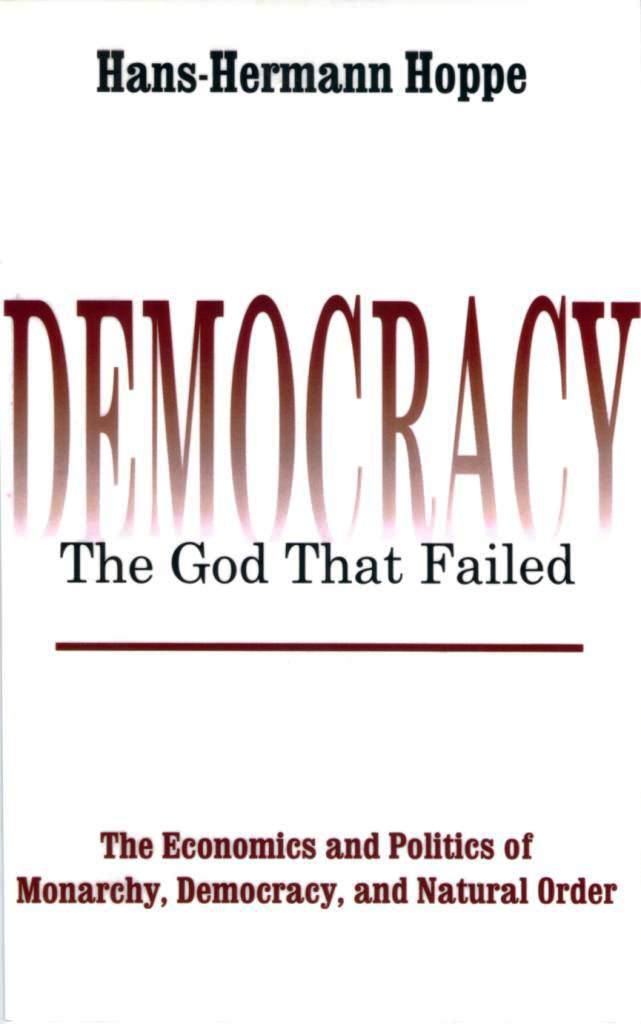
- Hans-Hermann Hoppe, State or Private-Law Society, Mises Daily (Mises Institute, May 9, 2011); Democracy—The God That Failed: The Economics and Politics of Monarchy, Democracy, and Natural Order (Transaction Publishers, 2001); The Great Fiction: Property, Economy, Society, and the Politics of Decline (2nd expanded ed., Mises Institute, 2021); The Idea of a Private Law Society (LewRockwell.com / Mises Institute, 2006). [↩]
- Posts on waystation libertarians, e.g. On Taxing Harvard: Ranting about Thuggocrats and Waystation/Post-libertarians; Conspiracy Libertarians, Waystation Libertarians, Activists vs. Principled Libertarians. [↩]
- Kinsella, The new libertarianism: anti-capitalist and socialist; or: I prefer Hazlitt’s “Cooperatism”; Intellectual Property versus Intellectual Property Rights. [↩]
- Kinsella, On Conflictability and Conflictable Resources; Voluntaryism and Voluntarism. [↩]
- Kinsella, On Conflictability and Conflictable Resources; Voluntaryism and Voluntarism; also The new libertarianism: anti-capitalist and socialist; or: I prefer Hazlitt’s “Cooperatism”; Should Libertarians Oppose “Capitalism”? [↩]
- Robert Nozick, Anarchy, State, and Utopia (New York: Basic Books, 1974), ch.3, p. 26 et pass. For criticism of Nozick’s “libertarianism,” see Rothbard, Robert Nozick and the Immaculate Conception of the State; Hoppe, “Murray N. Rothbard and the Ethics of Liberty,” in Rothbard, The Ethics of Liberty (New York: New York University Press, 1998 [1982]); Kinsella, KOL493 | Rothbard’s Greatest Hits: A Personal Mix Tape (Porto, Portugal). [↩]
- Ferdinand Lassalle, The Right to Revolution by Ferdinand Lassalle (“Night-watchman State”). Chicago: marxists.org (1862). [↩]
- Ferdinand Lassalle, The Working Man’s Programme (Ferdinand Lassalle). Chicago: marxists.org, (April 1862). [↩]
- For other examples, see Wikipedia page on Reappopriation, e.g. Jacquelyn Rahman, The N Word: Its History and Use in the African American Community (Journal of English Linguistics, 2012) (intragroup reclamation and use of variants of the n-word by African Americans); Robin Brontsema, A Queer Revolution: Reconceptualizing the Debate Over Linguistic Reclamation (Colorado Research in Linguistics, 2004) (reclamation of “queer” by LGBTQ groups); Out.com, 5 slurs that are being reclaimed by the LGBTQ+ community (examples including “queer,” “faggot,” and “dyke”). [↩]
- Wikipedia, Capitalism: Etymology (details the socialist origins of the term and its early pejorative use); FEE, How “Capitalism” Became a Dirty Word (explains the Marxist pejorative framing and the lasting stigma); Libertarianism.org, Should Libertarians Abandon the Word “Capitalism?” (notes its origins as a term of abuse and why some, including Rand-influenced thinkers, still embrace it); Ayn Rand Institute / New Ideal, ‘Capitalism’: When and How Ayn Rand Embraced the Term (traces Rand’s positive adoption and use of the word). [↩]









 Alessandro Fusillo
 Andreas Tögel
 David Dürr
 Doug French
 Fernando Chiocca
 Greg Morin
 Hans-Hermann Hoppe
 Jay Baykal
 Jayant Bhandari
 Jeff Deist
 Jeffrey Barr
 Juan Fernando Carpio
 Ken Yamarashi
 León Isidoro
 Martin Cabrera
 Nick Hoppe
 Oscar Grau
 Peter Wong
 PFS
PFS scholarium
 Saifedean Ammous
 Sean Gabb
 Sean Ring
 Stephan Kinsella
 Stéphane Geyres
 Thomas Jacob
 Tom DiLorenzo
Follow Us!