Guest post by Lipton Matthews. First published July 13, 2026. Reprinted with permission of the author. See related links at the end.
The Forgotten Sin: America’s Treatment of Germans
Lipton Matthews

Memorial stone for the Prisoner-of-War Camp Rheinberg 1945. Courtesy of Wikimedia Commons.
Americans are routinely called upon to reckon with the darkest chapters of their history. The institution of slavery, Jim Crow laws, and the internment of Japanese Americans during World War Two: these are subjects of documentaries, school curricula, museum exhibitions, and public apology. That reckoning, however uncomfortable, is broadly accepted as necessary. Yet there is one group whose treatment at American hands is almost never inserted into this conversation: the Germans. Their suffering and the systematic violation of their property rights by the United States government has been quietly buried beneath a triumphalist narrative of American liberation, and it is long past time that burial was disturbed.
Germany entered the twentieth century as the world’s foremost industrial and pharmaceutical power. By the eve of the First World War, German dye firms represented 88% of global synthetic dyestuff production, and in 1913 Germany produced more than 35% of the world’s pharmaceutical exports. These were private companies, among them Bayer, Hoechst, Merck, and Beiersdorf, whose patents and trademarks had been registered in foreign markets and protected under the international framework of the 1883 Paris Convention, which obliged signatory nations to treat foreign IP holders no less favorably than their own citizens. America tore that framework apart. Two months before entering the First World War, the United States had publicly committed itself to upholding the international law principle of national treatment, promising to treat the private rights of foreign nationals as it treated those of its own citizens. That commitment did not survive contact with the war.
The US enacted its Trading with the Enemy Act in October 1917, authorizing the placement of German-owned assets under the control of a government agency, the Alien Property Custodian. Congressional amendments then empowered that agency to go further, not merely holding German patents in safekeeping, but trading them. By 1919, 4,706 German-owned patents had been expropriated and made available for compulsory licensing to American companies by the Federal Trade Commission. These were the legally registered inventions of private citizens, forcibly transferred to American commercial rivals.
The case of Bayer illustrates precisely what this meant in practice. The company had invented aspirin in 1897, secured a US patent in 1900, and built a wholly American subsidiary by 1913. In January 1918, the US government classified Bayer’s American subsidiary as being under enemy control and confiscated it entirely. The company’s assets were publicly auctioned on the steps of its own New York plant. The German parent company never recovered its American intellectual property. Even the Treaty of Versailles, which was supposed to restore pre-war IP rights, offered no remedy for Bayer, because Germany was simultaneously required to pay reparations, allowing the Allied nations to retain what they had taken. Bayer did not recover the US trademark until 1994, when it was forced to purchase its own name back for one billion dollars.
The principle underlying these seizures had already been declared unlawful. The Hague Convention of 1907, ratified by the United States, explicitly affirmed that private property was to be respected during conflicts and that confiscation and arbitrary plunder were formally prohibited. The inviolability of private property in wartime was considered, in the language of the era, a mark of civilization. America violated it comprehensively, then insisted it had done nothing wrong, maintaining that its Trading with the Enemy Act was no departure from international law

You can buy Francis Parker Yockey’s The Enemy of Europe here.
Indeed, it is a basic axiom of conflict that states go to war and the losers pay. Reparations, territorial losses, the dismantling of military capacity: these are the expected consequences of defeat. There is, however, a distinction between imposing consequences on a defeated state and deliberately visiting misery upon its civilian population. The post-war occupation of Germany collapsed that distinction repeatedly and with apparent intent.
The occupation, running from 1945 to 1952, is remembered today as a golden age of nation building, cited by politicians and academics alike as proof that America can export democracy. The governing document of the occupation, JCS 1067, issued by the Joint Chiefs of Staff, emphasized not reconstruction or democracy but harsh treatment. Its explicit instruction to occupation forces was that they were not to take steps looking toward the economic rehabilitation of Germany. The aim was punishment, and punishment was delivered.
Secretary of State Cordell Hull made the thinking explicit. He concluded that “it is of the highest importance that the standard of living of the German people in the early years be such as to bring home to them that they have lost the war and to impress on them that they must abandon their pretentious theories that they are a superior race created to govern the world. Through lack of luxuries we may teach them that war does not pay.” This was not the reasoning of rogue soldiers in the field. It was the settled policy of senior American leadership, and it was implemented accordingly.
American forces were ordered not to allow food supplies to reach hungry Germans. Households were instructed not to let their German domestic workers have leftovers, and excess food was to be destroyed or rendered inedible. A German university professor observed that American soldiers were creating unnecessary ill will by pouring twenty liters of leftover cocoa into the gutter when it was badly needed in local clinics, noting that it made it hard to defend American democracy among his countrymen. Beyond food, the Allies placed hard limits on German industrial production, freezing the output of steel, machine tools, and chemicals at less than half of prewar rates, and even restricting the production of textiles and shoes. Hundreds of factories were deliberately dismantled, throwing hundreds of thousands of Germans out of work, continuing out of sheer bureaucratic inertia until 1950.
The dispossession extended to shelter itself. US troops seized the best homes and hotels for their own accommodation and displaced the German occupants. In Frankfurt alone, Americans requisitioned 10,800 apartments and single-family dwellings, and for each American family housed, eight Germans were made homeless. Compounding this, for three years from 1945 to 1948, Germany had no functioning currency, only Hitler’s debased wartime money and an untrustworthy occupation script, making any form of economic recovery impossible. Studies showed that German industrial facilities were largely intact after the war and that production could have been restored quickly had the Allies permitted it. The deprivation was a policy choice.
Beyond the material suffering, the occupation of Germany has been mythologized as proof that America knows how to build democracies. Politicians reaching for historical precedent before invading Iraq pointed to Germany as a model. Scholars wrote of democracy being imposed on Germany as though this were a settled, well-executed achievement. It was nothing of the sort.
The goal of preparing Germany for democracy was not a serious objective of the occupation and was never given serious attention by the Joint Chiefs of Staff. The democratic aim was included in the Potsdam Declaration because it sounded nice. The occupation’s chief historian, who served as a senior official within the occupation itself, concluded that transplanting democratic institutions to Germany would have been most uncertain at best, and that coupling even that vague goal with a vengeful programme emphasizing denazification, the imposition of a low living standard, nonfraternization, and the destruction of German industry rendered it of little or no concrete significance.
The denazification programme, far from being a surgical process, became a witch hunt affecting the entire adult population. All thirteen million German adults in the American zone were required to fill out a 150-question autobiographical questionnaire and were treated as guilty until cleared by a tribunal. No German could hold any job other than manual labor without clearance, paralyzing both the economy and the workforce. The tribunals punished people not for what they had done but for alleged sympathies, encouraging informers and penalizing the innocent alongside those with genuine culpability. A comprehensive scholarly study of the episode concluded that the denazification policy strengthened extremists in the postwar years, generating bitterness that gave martyrdom to otherwise unsaintly lives. America abandoned the programme entirely and then, in a remarkable reversal, passed a law in 1951 requiring that civil servants and teachers removed for alleged attachments be rehired, with some even receiving compensation for the wrongs done to them in the process.
Turning to the political institutions that emerged from this period, the Christian Democratic Party, soon to become West Germany’s ruling party, was founded by a group of German political leaders in Berlin two weeks before American forces even reached the city. The Americans did not officially authorize the formation of parties until more than a month after the four main ones had already been formed by the Germans themselves. Thereafter, the occupation harassed and delayed those parties through cumbersome licensing requirements, banned the use of party symbols and parades, and in Bavaria banned a democratic monarchist party entirely. The national constitution of 1949 was described by the occupation’s own official historian as definitively a German product. Democracy in Germany was not an American gift. It was a German achievement made in spite of American obstruction.
The moral accounting that Americans are asked to perform is selective. The suffering inflicted on Japanese Americans through internment is condemned. Furthermore, the question of reparations for slavery is a live political debate. Yet the expropriation of 4,706 German patents from private citizens, the deliberate destruction of the German economy, the mass homelessness imposed by requisitioning, the policy of engineered starvation, and the failed punitive occupation that contemporary observers called a fiasco pass largely unremarked. Had the Germans not been white, this catalogue of dispossession, deliberate impoverishment, and institutional humiliation would be permanent fixtures of the American moral conversation, taught in schools, memorialized in public life, and invoked in every debate about correcting historical wrongs.
***
Related
- Gerd Schultze-Rhonhof, “On the Many Fathers of World War 2”
- Hoppe on Germany, East and West, Russia/Ukraine, and US-NATO (PFS 2022)
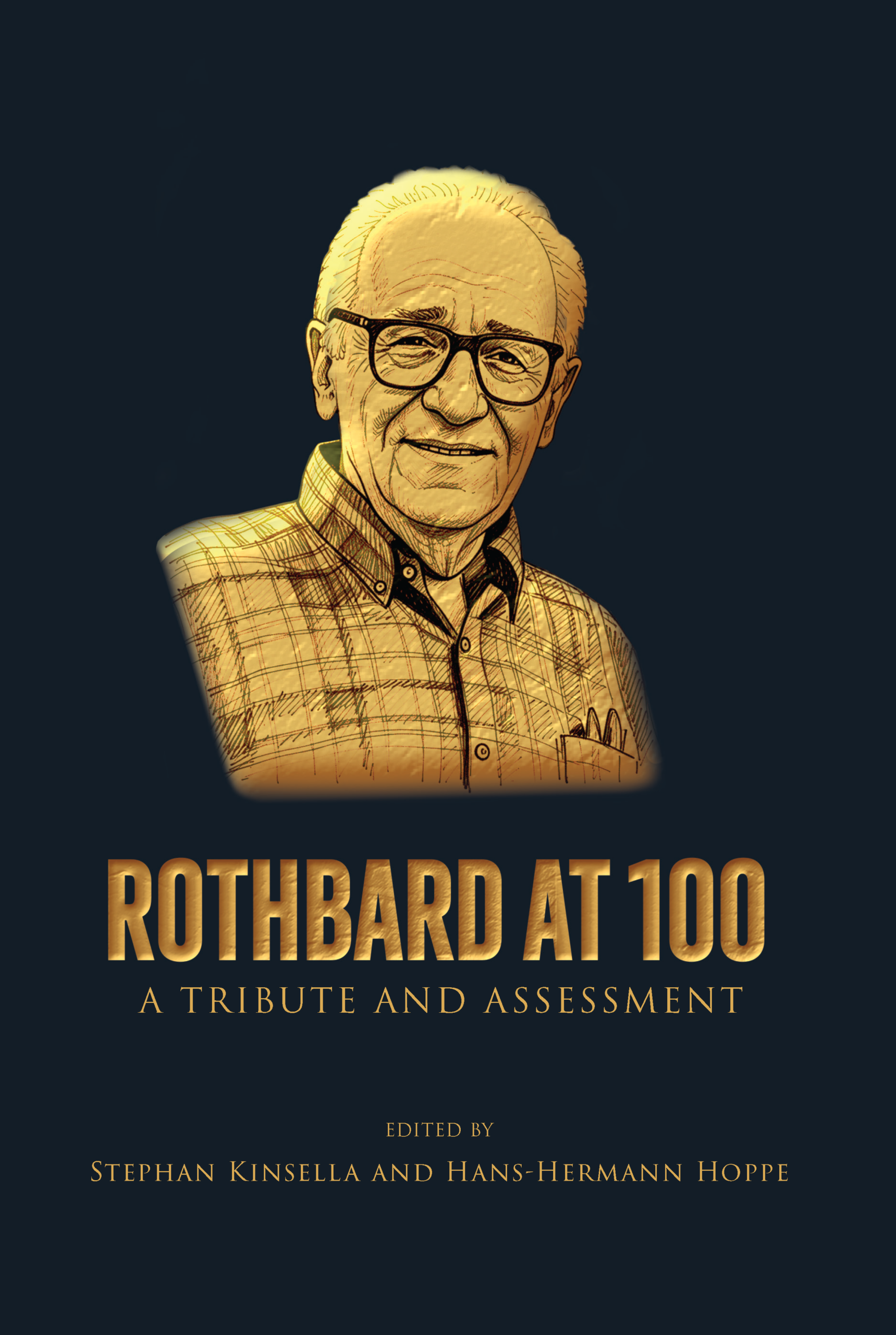
- Hoppe, “Coming of Age with Murray,” in Rothbard at 100: A Tribute and Assessment
- PFP290 | Hoppe: Considerations and Reflections of a Veteran Reactionary Libertarian (AERC 2025); Considerations and Reflections of a Veteran Reactionary Libertarian (AERC 2025): “The next war then Germany again lost or the German allies lost the Second World War, and there the peace imposed on them was even more vindictive. There were just huge territories taken away from Germany; there was about more than 10 million refugees; enormous compensation had to be paid. The Americans for instance stole all the patents that German industries had, and the most interesting thing was that this time social engineering was used in order to re-educate the German population.”
- Hoppe, “On War, Democratic Peace, and Reeducation: The “German Experience” in Reactionary Perspective,” (possibly) forthcoming in a book based on the Mises Institute’s Revisionist History of War Conference (May 15, 2025—May 17, 2025), based on idem, “On War, Democratic Peace, and Reeducation: The ‘German Experience’ in Reactionary Perspective,” 2025 Annual Meeting, Property and Freedom Society, Bodrum, Turkey (Sep. 20, 2025), available at Stephan Kinsella, “PFP307 | Hans-Hermann Hoppe: Democratic Peace and Re-Education: The German Experience (PFS 2025),” Property and Freedom Podcast (Jan. 19, 2026). See also Sebastian Wang, “Hans-Hermann Hoppe on Democratic Peace and Re-Education – PFS Bodrum 2025,” Libertarian Alliance [UK] Blog (Sep. 20, 2025)
- Hoppe, “Growing to Understand Contemporary Germany—and Weep: Part I: Germany: East and West, Reunification, and the US” [Transcript at “Growing to Understand Contemporary Germany and Weep – Part I,” LewRockwell.com (Oct. 15, 2022)]
- “Growing to Understand Contemporary Germany—and Weep: Part II: US-NATO, Germany, Russia, and the Ukraine” [Transcript at “Growing to Understand Contemporary Germany and Weep – Part II,” LewRockwell.com (Oct. 17, 2022)]
- PFP251 | Van Dun, Hoppe, Dürr, Discussion, Q&A (PFS 2022)















 Alessandro Fusillo
 Andreas Tögel
 David Dürr
 Doug French
 Fernando Chiocca
 Greg Morin
 Hans-Hermann Hoppe
 Jay Baykal
 Jayant Bhandari
 Jeff Deist
 Jeffrey Barr
 Juan Fernando Carpio
 Ken Yamarashi
 León Isidoro
 Martin Cabrera
 Nick Hoppe
 Oscar Grau
 Peter Wong
 PFS
PFS scholarium
 Saifedean Ammous
 Sean Gabb
 Sean Ring
 Stephan Kinsella
 Stéphane Geyres
 Thomas Jacob
 Tom DiLorenzo
Follow Us!