From the vault: Murray N. Rothbard, “Greenhouse defects,” Liberty (January, 1989): 13–14, reproduced below. One of many topics Rothbard touched on in his huge oeuvre, including his involvement with Liberty magazine.1
Here’s the Rothbard piece, followed by some related commentary:
Greenhouse defects – Of all varieties of statists, I find the environmentalists the most annoying, since they take an outrageously anti-human (i.e., pro-animal, pro-insect, pro-tree) position, in the name of a High Moral Stance that everyone else seems ready to grant them. So while the rest of us are selfish, narrow-minded, and pro-human, the environmentalists take the Cosmic (i.e. non-human) View. They speak for the Universe.
Those of us who place human beings over insects, animals, and plants are dismissed by the environmentalists as speciesists. The proper word for us, buster, is humanist.
Animals that are cute and cuddly have “rights” that man must respect, environmentalists claim, even though other ani-mals never respect them. Even environmentalists do not claim that cockroaches or mosquitos are cuddly; these reviled species are defended by the environmentalist fall-back anti-pesticide stance.
Why must we worry about “endangered species”? Species have become extinct since the world began-before humans had anything to do with it. Why must we worry about the snail darter? What has it ever done for us? Why shouldn’t every species on earth stand (or swim, as the case may be) on its own? Why should man grant any species special privileges? Do any of these species worry about man?
Environmentalists try to turn every natural event into a ca-tastrophe: and whatever the problem, the cause is always industrial technology and use of energy (oil, coal, or nuclear), and the solution is always to suppress technology and to adopt some form of socialism.
Take, for example, the “greenhouse effect.” So what if the temperature of the earth goes up, or goes down, a few degrees? The earth has been getting either warmer or colder through re-corded history. Why is one temperature more optimal than an-other? Can you imagine the headaches if man were able to push a button and control the weather? Think of the collective decision-making process: urban folks lobby for sunshine, farmers will vote for rain, warm-blooded and cold-blooded types will squabble over temperature … chaos will result. Forget it!
Ironically, the same environmentalists who gripe about the “greenhouse effect”—the earth’s getting warmer—also warn us of the “icebox effect”—the world’s getting colder. They conjure up images of a new Ice Age descending upon us. Well, I am no scientist, but one thing I am pretty sure of: the earth cannot be gettng warmer and colder at the same time.
And then there is the dread hole in the “ozone layer.” Curiously, the solution proposed for this problem is the same as for the dreaded “greenhouse effect”: stop using energy and bring in socialism. Okay, if there is too little ozone up there because of air-conditioners and aerosol cans, then why is the hole over the Antarctic where, the last time I looked, there were dam few air-conditioners or other blights of our energy-using civilization? You say the hole blew south from the civilized regions? So why are environmentalists also griping about too much ozone over such energy-using civilized centers as Los Angeles, New York, etc? We now have governmental restrictions on technology that creates ozone. Don’t these very environmentalist regulations deplete the ozone layer up yonder?
Ironically, the same environmentalists who gripe about the “greenhouse effect”—the earth’s getting warmer—also warn us of the “icebox effect”—the world’s getting colder. They conjure up images of a new Ice Age descending upon us. Well, I am no scientist, but one thing I am pretty sure of: the earth cannot be getting warmer and colder at the same time.
We all revile Lord Keynes’s cynical dictum that “in the long run we are all dead.” But doesn’t he have a point that is relevant here? If the long run is very very long, who the hell really cares? Why should we care? Why should we care if clearing the rain forest or using aerosol cans changes the climate in four hundred years? Why not let the future take care of itself? Human beings in the future, after all, will have far greater technological knowledge and—as long as the environmentalists are kept from having their way—more capital equipment. They will be far more able to take care of themselves than we are to take care of them. Besides, what the hell has the future ever done for us? What is the proper time-horizon anyway? Why don’t we let the market decide on the rate of time discount, and stop griping?
Here, folks, is the bottom line about the dreaded entropy: In 30 billion years, give or take a few million, our sun will burn out …
Why, with plenty of real problems on earth in the here and now, do the environmentalists persist in manufacturing phony ones? And why do the rest of us take them seriously? -MNR
Rothbard’s pro-human focus evident here also inspired one of his criticisms of socialism and communism:
Let us consider the first principle: the right to self-ownership. This principle asserts the absolute right of each man, by virtue of his (or her) being a human being, to “own” his own body; that is, to control that body free of coercive interference. Since the nature of man is such that each individual must use his mind to learn about himself and the world, to select values, and to choose ends and means in order to survive and flourish, the right to self-ownership gives each man the right to perform these vital activities without being hampered and restricted by coercive molestation.
Consider, then, the alternatives — the consequences of denying each man the right to own his own person. There are only two alternatives: either (1) a certain class of people, A, have the right to own another class, B; or (2) everyone has the right to own his equal quotal share of everyone else. The first alternative implies that, while class A deserves the rights of being human, class B is in reality subhuman and, therefore, deserves no such rights. But since they are indeed human beings, the first alternative contradicts itself in denying natural human rights to one set of humans. Moreover, allowing class A to own class B means that the former is allowed to exploit and, therefore, to live parasitically at the expense of the latter; but, as economics can tell us, this parasitism itself violates the basic economic requirement for human survival: production and exchange.
The second alternative, which we might call “participatory communalism” or “communism,” holds that every man should have the right to own his equal quotal share of everyone else. If there are three billion people in the world, then everyone has the right to own one-three-billionth of every other person. In the first place, this ideal itself rests upon an absurdity — proclaiming that every man is entitled to own a part of everyone else and yet is not entitled to own himself. Second, we can picture the viability of such a world — a world in which no man is free to take any action whatever without prior approval or indeed command by everyone else in society. It should be clear that in that sort of “communist” world, no one would be able to do anything, and the human race would quickly perish.2
Also in the same issue is John Hospers, “Property, Population and the Environment,” Liberty (January, 1989): 46–49, and there was a rebuttal to Rothbard’s piece by environmentalist Daniel Karlan in the next issue: Daniel M. Karlan, “An Environmentalist Contra Rothbard,” Liberty (March 1989): 35–36. Of course Rothbard’s seminal piece on all this is “Law, Property Rights, and Air Pollution,” in Economic Controversies (Auburn, Ala.: Mises Institute, 2011).
Below I summarize some of these and some other relevant publications on this issue by Rothbard and others (Grok assist).
Summaries of Liberty articles 1989
1. Murray N. Rothbard, “Greenhouse defects,” Liberty (January 1989): 13–14
Rothbard launches a sharp, polemical attack on environmentalists, calling them the most annoying variety of statists. He accuses them of adopting an anti-human stance (favoring animals, insects, and plants) while claiming a superior “Cosmic” moral high ground.
He mocks specific environmental concerns:
- Greenhouse effect / global warming: The Earth’s temperature has fluctuated naturally throughout history. Why assume one temperature is ideal?
- Ice Age fears: Environmentalists simultaneously warn of both warming and cooling — which is logically impossible.
- Ozone layer: Holes over Antarctica (far from industrial areas) and excess ozone over cities like Los Angeles show inconsistent claims. Regulations supposedly fixing one problem create the other.
- Endangered species: Species have gone extinct naturally for billions of years. Why should humans grant special privileges to any species? The snail darter or other obscure creatures have done nothing for humanity.
- Entropy / long-term doom: In ~30 billion years the Sun will burn out. Why worry about that when humans in the future will have vastly superior technology and capital to handle problems?
Rothbard’s core argument: Environmentalists reflexively blame industrial technology and capitalism for every problem and always push socialism as the solution. He rejects long time-horizons (“in the long run we are all dead”) and argues that the market should set the proper rate of time preference. Future generations will be better equipped to deal with issues than we are today.
2. John Hospers, “Ecology and Liberty,” Liberty (September 1988): 23–31
Hospers argues that libertarians have largely ignored environmental and animal issues. He examines three main ethical approaches to animals and then explores broader ecological problems, concluding that private property rights alone are insufficient to solve many environmental challenges.
Key sections and arguments:
- Ethics toward animals:
- Dominion theory (from Genesis): Humans have the right to use animals as they wish.
- Utilitarian (“greatest good”) view: Animals are sentient and feel pain, so needless suffering should be avoided. However, human interests generally take precedence. Killing animals for food or medical experiments may be justified if necessary for human welfare.
- Animal rights theory: Animals have a right to life just as humans do (“subjects-of-a-life”). Killing them (even painlessly) is wrong except in cases like terminal illness. Hospers criticizes this view as unrealistic and contrary to nature, where life depends on death and predation.
- Ecological realities: Hospers emphasizes the interdependence of species and the explosive reproductive potential of all life, kept in check by predators, competition, disease, and starvation. He argues that human population growth, enabled by technology and medicine, has disrupted these natural balances.
- Technology and environmental damage: He lists numerous problems caused by human activity and population growth, including air and water pollution, DDT effects on wildlife, ozone depletion, toxic waste, monoculture agriculture, and habitat destruction. He gives detailed examples of the Amazon rainforest deforestation (driven by Brazilian government policy) and the African veldt (where fences and cattle farming have destroyed wildlife habitats).
- Overpopulation: Hospers suggests the world may have “too many people,” leading to ecological strain. While he acknowledges capitalism’s productivity, he worries that continued population growth increases the risk of catastrophic environmental failure.
- Property rights and the environment: Even strong private property rights face limits because of ecological interconnectedness. One person’s use of land (e.g., cutting down forests) can harm distant others through climate or weather changes. Hospers questions whether anyone can safely use land without risking harm to others and floats (then rejects) the idea of world government as a solution.
Overall tone: Hospers takes environmental concerns seriously and challenges libertarians to grapple with issues that don’t fit neatly into standard non-aggression or property-rights frameworks. He ends by saying libertarians “do not do well in ecological issues.”
3. Jane S. Shaw, “Private Property Rights: Hope for the Environment,” Liberty (November 1988): 55–57
Shaw writes a direct rebuttal to Hospers. She argues that libertarians already have the best framework for environmental protection — strong private property rights — and accuses Hospers of misunderstanding both the problems and the solutions.
Main arguments:
- Private property as the solution: Drawing on Aristotle, Shaw explains that owners have strong incentives to care for their property because they capture the benefits of good stewardship (higher value) and suffer the costs of neglect (lower value). This works even for short-term owners because future benefits and harms are capitalized into the current market price of the property.
- Root causes of environmental problems:
- Unowned or poorly defined resources (air and water): These become “common pools” that anyone can pollute without cost. Where private rights exist (e.g., fishing rights in Britain or historical beaver ownership among the Montagnais Indians), resources are better protected.
- Government ownership and management: Bureaucrats lack personal incentives to maintain or improve land value over the long term. They are often captured by short-term political interests (examples: U.S. Forest Service logging at a loss, Bureau of Reclamation dam projects).
- Critique of Hospers: Shaw accuses Hospers of spreading misinformation and unnecessary panic. She challenges his claims about DDT wiping out species, toxic waste as a major health crisis, precarious phosphate supplies, and severe overpopulation in parts of Africa (comparing Zimbabwe/Zambia population density favorably to parts of the U.S.). She argues many of his examples of damage were driven by government subsidies and policies, not by private action or population growth alone.
- Response to specific examples:
- Amazon deforestation: Largely caused by Brazilian government subsidies and incentives. Without them, far less destruction would have occurred, and private conservation efforts (including by groups like the Nature Conservancy) could be more effective.
- African wildlife: Habitat loss is real, but not necessarily due to overpopulation. Private incentives and better management can help.
- Conclusion: Shaw rejects Hospers’ pessimism. She argues that strengthening private property rights (rather than expanding government or world government) is the most effective long-term solution to environmental problems. Libertarians, she says, are uniquely positioned to offer workable answers.
Overall tone: Shaw is confident and corrective. She presents private property rights as the practical and principled answer that Hospers overlooked.
4. John Hospers, “Property, Population and the Environment,” Liberty (January 1989): 46–49
This is Hospers’ reply to Jane Shaw’s earlier criticism (Jane S. Shaw, “Private Property Rights: Hope for the Environment,” Liberty, November, 1988): 55–57) of his September 1988 article (John Hospers, “Ecology and Liberty,” Liberty (September, 1988): 23–31). He defends his views while acknowledging limits to standard libertarian formulas.
On property rights:
- Private ownership is generally superior to government ownership because individuals have stronger incentives to care for their land.
- However, it is not a panacea. Owners may prioritize short-term profit over long-term sustainability (e.g., overgrazing or cutting forests before selling). In many African countries, wildlife survives mainly in strictly enforced national parks, not on private or communally managed land.
- Deforestation is ecologically disastrous regardless of whether it is done by private owners, collectives, or governments.
On overpopulation:
- Hospers rejects the common libertarian claim that “free markets solve all population problems.” While production has kept pace with population growth in many places, rapid human expansion is causing real ecological damage: massive deforestation (Nepal affecting India, Andes, Africa), desertification, loss of wetlands and species, and pressure on national parks.
- He argues the Earth is overpopulated in the practical sense that human numbers are destroying ecosystems at an unsustainable rate. Examples include rabbits overrunning Australia and humans eliminating habitats everywhere.
- He distinguishes total vs. average quality of life: A world with 15 billion people scraping by at a low average well-being is worse than one with 2 billion enjoying a much higher average (cleaner environment, more space, biodiversity).
Solutions (brief):
- Private property is preferable but needs supplementation.
- Incentives (not just punishment) to limit births.
- International agreements among major powers to protect the global environment.
Hospers criticizes libertarians for relying on stock formulas (“blame government ownership”) instead of grappling with difficult ecological realities.
5. Daniel M. Karlan, “An Environmentalist Contra Rothbard,” Liberty (March 1989): 35
Karlan, an environmentalist who explicitly rejects statism, offers a direct rebuttal to Rothbard’s January article. He finds Rothbard’s piece so full of errors and dismissiveness that he highlights almost the entire text.
Key points:
- Karlan rejects being labeled a statist. He is pro-human precisely because humans depend on a functioning biosphere that evolved over billions of years.
- He disputes Rothbard’s portrayal of environmentalists as uniformly anti-human or obsessed with “cute and cuddly” animal rights. Many focus on human welfare and the unity of life.
- Endangered species: Extinction has always occurred, but the rate has exploded due to human activity (from one every few hundred years to hundreds per year). Lost species may have contained cures for diseases or valuable genetic traits for crops. Rothbard’s cavalier attitude (“why worry?”) ignores potential long-term harm to humanity.
- Rothbard misrepresents environmental positions (e.g., on ozone or turning every event into catastrophe) and refuses to entertain the possibility that large-scale environmental destruction could harm human interests.
- Karlan argues that recklessly discarding our planetary heritage without considering consequences is itself anti-human. He calls for rational evaluation rather than reflexive dismissal.
Tone: Polite but firm. Karlan presents himself as a reasonable environmentalist open to libertarian principles while accusing Rothbard of closed-mindedness.
These three pieces form a small debate within Liberty magazine on libertarian approaches to environmental issues, with Rothbard taking the most hardline anti-environmentalist stance, Hospers offering a more nuanced critique of libertarian orthodoxy, and Karlan defending environmental concern from a non-statist perspective.
For additional related libertarian criticisms of environmentalism by Rothbard and others that some readers may be unaware of and find of interest:
- Murray N. Rothbard, “Law, Property Rights, and Air Pollution,” Cato Journal, Vol. 2, No. 1 (Spring 1982): 55–99 (also in Economic Controversies (Auburn, Ala.: Mises Institute, 2011)
Brief description: Rothbard’s most important and detailed theoretical treatment. He develops the strict property-rights and tort-law approach to pollution: pollution is aggression (physical invasion of another’s property) and should be treated under nuisance/trespass law with strict liability, proof of harm beyond a reasonable doubt, and proper burden of proof on the plaintiff. He rejects government regulation, pollution taxes, and “rights to pollute,” while criticizing government as a major polluter. This is the foundational scholarly article on the topic. - Murray N. Rothbard, For a New Liberty: The Libertarian Manifesto, 2nd ed. (Auburn, Ala.: Ludwig von Mises Institute, 2006; originally 1973, revised 1978).
Brief description: Contains a dedicated section on pollution (often excerpted as “The Libertarian Manifesto on Pollution”). Argues that clearly defined private property rights plus tort law (damages and injunctions) would best solve air, water, and noise pollution problems. Strongly criticizes government as a primary polluter and its failure to enforce property rights. - Murray N. Rothbard, “Government vs. Natural Resources,” The Free Market (December 1986). Reprinted in The Free Market Reader, ed. Llewellyn H. Rockwell, Jr. (Auburn, Ala.: Ludwig von Mises Institute, 1988), pp. 263–266.
Brief description: Applies the property-rights framework to natural resources (forests, fisheries, grasslands, oceans). Argues that private ownership creates incentives for conservation and long-term stewardship, while government control leads to short-term looting and depletion. Critiques the myth that capitalism causes resource destruction and advocates expanding private property rights (including homesteading of oceans and water resources). - Murray N. Rothbard, “Penthouse Interview: Murray Rothbard” (interviewed by Jim Davidson), Penthouse (October 1976), pp. 116–118, 173–178.
Reprinted in The Rothbard Reader, eds. Joseph T. Salerno and Matthew McCaffrey (Auburn, Ala.: Mises Institute).
Brief description: Directly addresses environmental arguments. Rothbard states that environmental pollution “has not been caused by the free market. The culprit is conscious government activity,” citing examples such as government DDT spraying and municipal sewage dumping. - Murray N. Rothbard, “Greenhouse defects,” Liberty (January 1989): 13–14 (this post)
Brief description: Short article critiquing alarmist claims about global warming/greenhouse effect from a libertarian/property-rights perspective. Prompted a rebuttal by environmentalist Daniel Karlan in the March 1989 issue of Liberty. - Murray N. Rothbard, various columns in Making Economic Sense, 2nd ed. (Auburn, Ala.: Ludwig von Mises Institute, 2006).
Brief description: Includes short, accessible pieces such as “Government vs. Natural Resources” (reprinted from the 1986 article above) and others applying the libertarian critique to specific environmental and resource issues (e.g., government mismanagement of resources and regulatory overreach). These are journalistic applications of the property-rights approach. - Llewellyn H. Rockwell, Jr., “An Anti-Environmentalist Manifesto” (also referred to as “The Enviro-Skeptic’s Manifesto”), originally published in From the Right (Patrick J. Buchanan newsletter), Quarterly II, Vol. 1, No. 6 (1990), p. 1. Reposted on LewRockwell.com, May 1, 2000.
Brief description: A sharp, polemical critique of environmentalism as a new form of socialism/Marxism — “pitiless and Messianic.” Attacks the regulatory agenda, anti-human elements, and statist solutions. Very much in the Rothbard-Rockwell paleolibertarian tradition. - Llewellyn H. Rockwell, Jr., “My Vice: Hating the Environment,” LewRockwell.com (August 11, 2000).
Brief description: Follow-up-style piece expressing strong opposition to environmentalism, rejecting recycling and conservation unless economically justified, and criticizing anti-human attitudes in the movement.
Objectivsts
- Ayn Rand, “The Anti-Industrial Revolution,” The Objectivist, January–February 1971.
Reprinted in The New Left: The Anti-Industrial Revolution (New American Library, 1971) and in the expanded edition Return of the Primitive: The Anti-Industrial Revolution, edited by Peter Schwartz (Meridian, 1999).
https://courses.aynrand.org/works/the-anti-industrial-revolution/ (ARI Campus page with details and purchase options)
Brief description: Rand’s seminal and most famous critique. She argues that the emerging “ecology” movement (the direct predecessor of modern environmentalism) is not primarily about human welfare but represents an “anti-industrial revolution” driven by hatred of technology, reason, industry, and man himself. She identifies it as part of the New Left’s broader assault on Western civilization and human progress. - George Reisman, “The Toxicity of Environmentalism,” pamphlet (Jefferson School of Philosophy, Economics and Psychology, 1990). Reprinted in The Freeman, September 1992.
Brief description: One of the strongest and most polemical Objectivist critiques. Reisman argues that environmentalism is philosophically “toxic” because it attributes intrinsic value to nature independent of man, which logically leads to viewing human beings as a plague or cancer on the planet. He criticizes the movement’s anti-human premises, its exaggeration of risks, its opposition to industrial civilization, and its desire to roll back the Industrial Revolution. He contrasts this with capitalism’s record of improving the human environment through science, technology, and private property. - George Reisman, “Environmentalism Refuted,” excerpt from his Ludwig von Mises Memorial Lecture at the Austrian Scholars Conference (2001). Originally posted on Mises.org, April 20, 2001.
Brief description: Reisman refutes environmentalism using the economics of Carl Menger and Ludwig von Mises. He argues that economic progress does not “exhaust” resources in any meaningful sense and that environmental improvement comes from capitalism’s price system, capital accumulation, and rearrangement of nature for human benefit — not from government controls or anti-industrial policies. - George Reisman, “Environmentalism in the Light of Menger and Mises,” Quarterly Journal of Austrian Economics, Vol. 5, No. 3 (Fall 2002): 3–15.
Brief description: A more academic treatment expanding on the themes above. Reisman applies Menger’s theory of goods and Mises’ economic analysis to show why environmentalist claims about resource depletion and the need for central planning are economically and philosophically flawed. - George Reisman, Capitalism: A Treatise on Economics (Jameson Books, 1996) (2).
Brief description: Reisman’s massive treatise contains substantial sections defending industrial civilization and critiquing environmentalist attacks on capitalism, resources, and technology. The ideas in his shorter articles above are developed at length here.
- See Tyler Kubik, “Murray N. Rothbard Bibliography: 1940s–2019,” Property and Freedom Journal (May 16, 2026); Laurence M. Vance, “Murray Rothbard and Liberty Magazine,” Property and Freedom Journal (July 6, 2026). [↩]
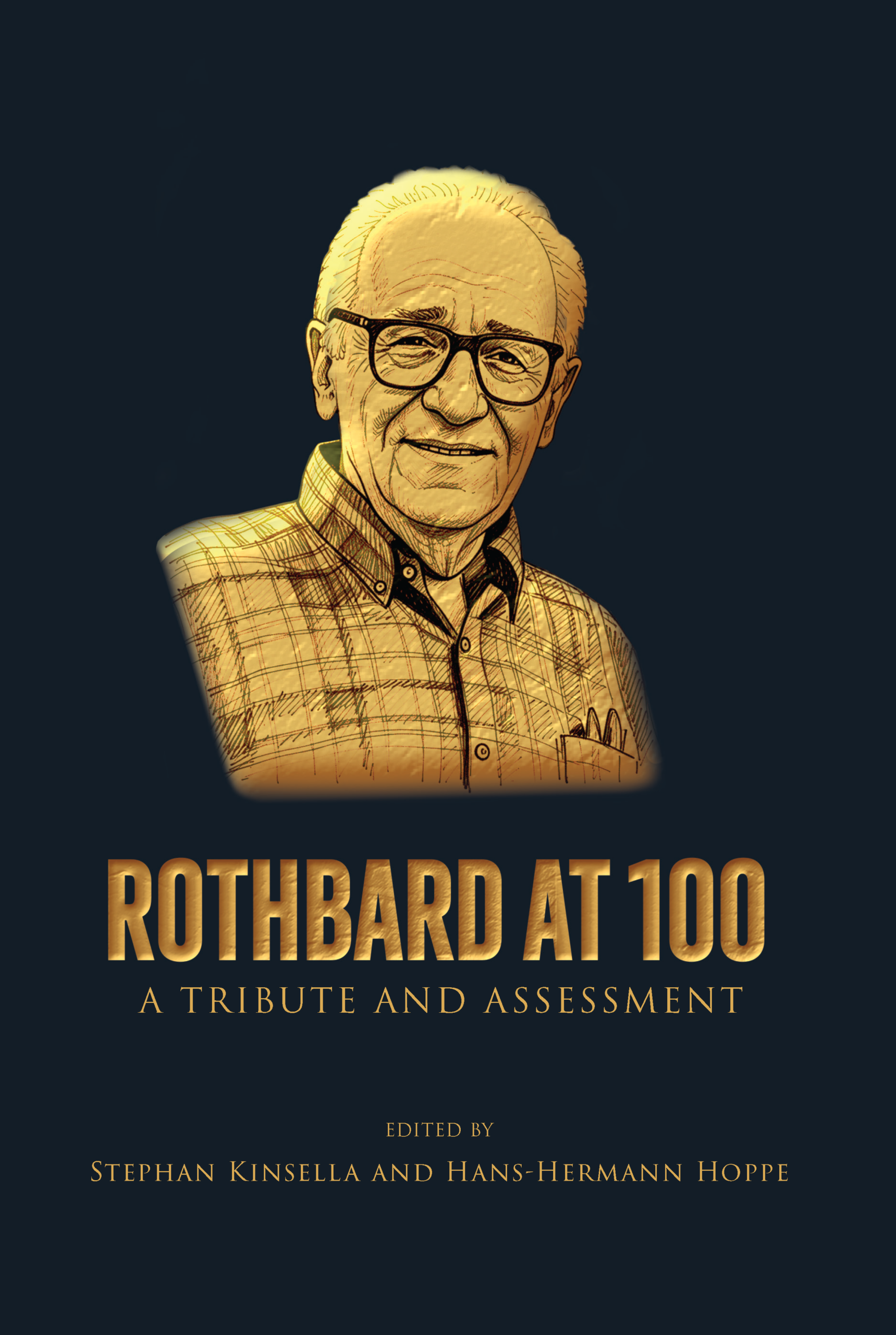
- Quoted in Kinsella, “Mises, Rothbard, Hoppe: An Indispensable Framework,” in Rothbard at 100: A Tribute and Assessment, Stephan Kinsella and Hans-Hermann Hoppe, eds. (Papinian Press> and The Saif House, 2026); see also idem, The Prior-Later Distinction and related comments by Hoppe quoted therein. [↩]
Discover more from The Property and Freedom Society
Subscribe to get the latest posts sent to your email.










 Alessandro Fusillo
 Andreas Tögel
 David Dürr
 Doug French
 Fernando Chiocca
 Greg Morin
 Hans-Hermann Hoppe
 Jay Baykal
 Juan Fernando Carpio
 León Isidoro
 Martin Cabrera
 Oscar Grau
 Peter Wong
 PFS
PFS Saifedean Ammous
 Sean Gabb
 Sean Ring
 Stephan Kinsella
 Stéphane Geyres
 Thomas Jacob
 Tom DiLorenzo