The Quiet Strangling of English Liberty
Alan Bickley (( Alan Bickley is the Director of the Libertarian Alliance (UK). ))
May 12, 2026
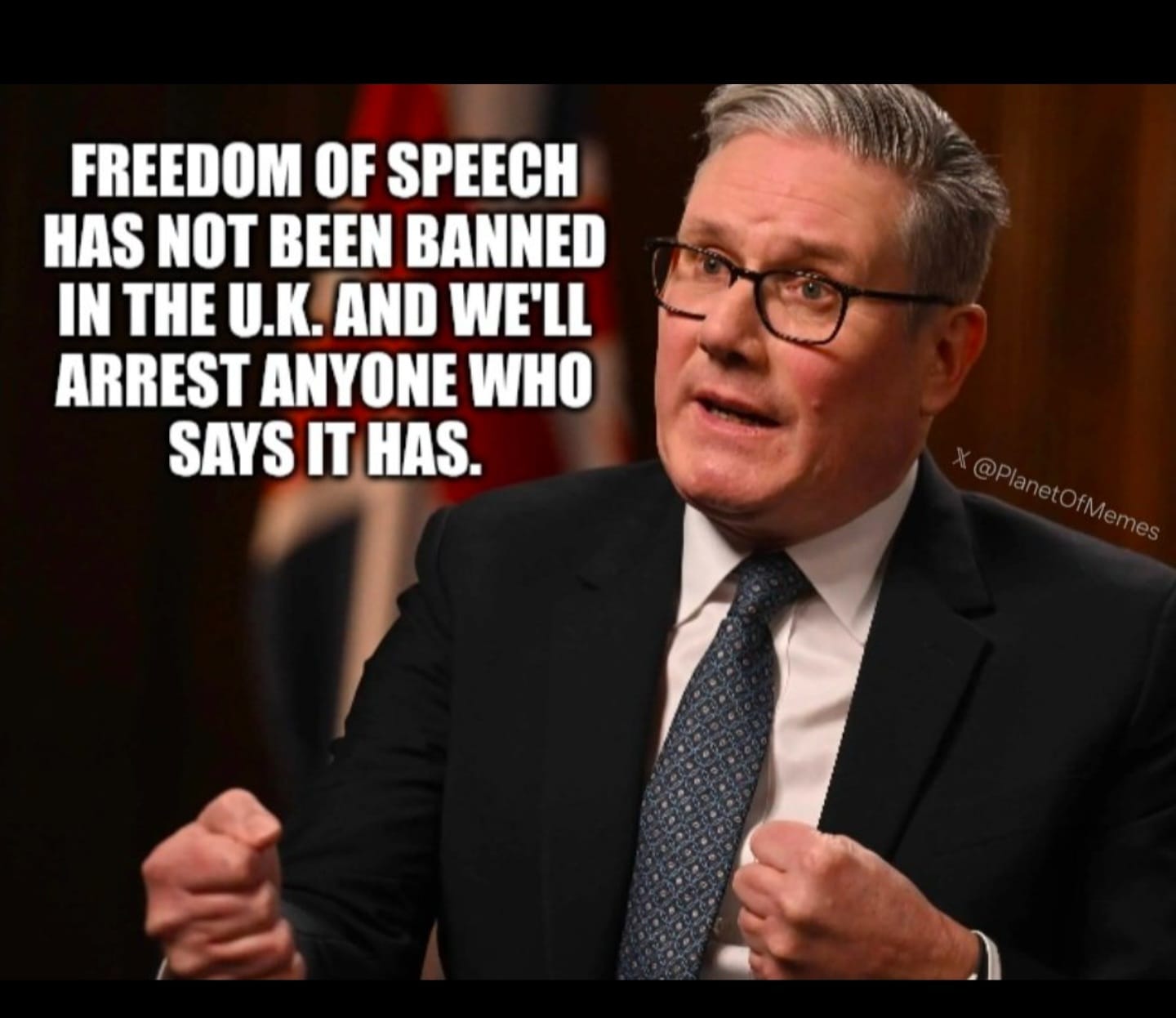 The traditional English defence of freedom of speech did not begin with modern liberalism. It emerged instead from a long and uneven struggle against authority. The medieval Church wished to supervise doctrine. The Tudor and Stuart monarchies wished to supervise printing. The political nation, when it slowly emerged from the seventeenth century, discovered by painful experience that censorship is not merely an inconvenience, but an instrument by which every other liberty may be dissolved.
It is therefore fitting that the classic English arguments for free discussion came not from radicals in the modern sense, but from men who believed themselves defenders of civilisation. When John Milton wrote Areopagitica in 1644, he was not calling for chaos. He was arguing that truth required open conflict if it was to remain alive. “Who ever knew Truth put to the worse, in a free and open encounter?” The argument was practical before it was abstract. A society that forbids discussion cripples its own intelligence. It condemns itself to the repetition of official lies.
John Locke added another layer to the argument. Though remembered chiefly for his theories of government and property, Locke also insisted that the State had no competence in the government of conscience. Coercion might secure outward conformity. It could not produce belief. The magistrate who presumes to supervise opinion therefore exceeds his proper function. He becomes not a guardian of peace but a spiritual usurper.
Then came John Stuart Mill, whose On Liberty remains perhaps the clearest statement in English of why free discussion matters. Mill’s argument was compelling because it did not depend on any claim that dissidents are usually right. Most dissidents are probably wrong. Many are fools, some dangerous cranks. But this is irrelevant. If the dissenter is right, censorship deprives society of truth. If he is wrong, society sharpens its understanding by refuting him openly. Even falsehood has utility when exposed to public examination. Orthodoxy without challenge becomes not conviction but superstition.
These arguments shaped the self-image of Britain for centuries. The country liked to imagine itself as a place where speech was unusually free, where eccentricity was tolerated, where authority could be mocked without midnight knocks on the door. Even when the reality was imperfect, the ideal itself exercised restraint on power. English governments censored less brutally than continental governments because they feared appearing un-English.
This tradition appeared, at least formally, to reach its legal culmination in the Human Rights Act 1998. Article 10 of the European Convention on Human Rights was incorporated into domestic law, declaring that:
“Everyone has the right to freedom of expression.”
This included “freedom to hold opinions and to receive and impart information and ideas without interference by public authority.” There were qualifications, naturally. Every legal right comes wrapped in qualifications. Even so, the assumption among many people was that freedom of speech had now been constitutionally entrenched. Britain might not have an American-style First Amendment, but it had at least accepted that open discussion was fundamental to a civilised society.
And this was the moment when freedom of speech began its rapid practical collapse.
The genius of the modern British censorship system is that it almost never presents itself as censorship. There is no Ministry of Truth with gigantic portraits and armed guards outside. There are no public book burnings. There is no need for these vulgarities. The modern British State learned from the failures of the twentieth century. Open repression creates martyrs. It attracts attention and embarrasses allies. Better to fragment repression into thousands of small and apparently unrelated acts.
The legal foundations for this transformation were laid gradually. Laws against incitement to racial hatred were defended as protections against violence. Few objected at first. Most people assumed that only direct calls for riots or attacks would be punished. But laws are interpreted by institutions, and institutions follow incentives. The scope of these laws widened steadily. Then came extensions regarding religious hatred, sexual orientation, “misinformation,” public order, communications offences, and the whole shifting vocabulary of emotional protection that now surrounds political life.
At the same time, the media regulatory structure became increasingly ideological. The BBC ceased even pretending to neutrality on many matters of public controversy. Ofcom developed into a mechanism not merely for technical supervision but for moral supervision. The police acquired the habit of recording “non-crime hate incidents,” a phrase so sinister in implication that Orwell himself might have considered it excessive. And all this happened while the political class continued reciting the language of liberty.
Consider the case of Palestine Action. You may approve or disapprove of its activities. You may regard its members as heroes, vandals, extremists, nuisances, or idiots. That is not the point. The point is that people associated with dissenting causes increasingly find themselves subjected not just to criminal investigation where laws are broken, but to a wider regime of intimidation designed to make political dissent socially and economically impossible. Arrests become theatre. Bail conditions become punishment. Careers disappear. Financial services become uncertain. Venues refuse bookings. Platforms disappear.
The process extends far beyond this single example. The defining feature of modern Britain is not that dissent is formally outlawed in every instance, but that dissent carries cumulative penalties that few ordinary people can afford to bear. This is where the modern system shows its true sophistication. Most censorship has now been outsourced.
The State no longer needs to suppress opinion directly because private institutions perform the task voluntarily. Human resources departments monitor staff behaviour with an ideological zeal that would have embarrassed many Communist Party officials. Banks close accounts. Payment processors suspend services. Employers dismiss workers for opinions expressed outside work. Hotels refuse bookings for conferences. Social media companies erase audiences accumulated over many years. Insurance companies, web-hosting firms, online retailers, advertising networks, and professional bodies all become informal arms of ideological enforcement.
The old dictatorships relied on secret police because economic life remained comparatively decentralised. Modern Britain enjoys the advantages of digital centralisation. A dissident need not be imprisoned if he can be rendered unemployable, unbanked, uninsurable, and unreachable.
This is why the censorship is so effective. Most people are not heroes. They have mortgages. They have children. They have ageing parents. They understand instinctively that one badly judged sentence may bring catastrophic consequences wholly disproportionate to the offence. The result is not just silence, but anticipatory silence. People censor themselves before anyone else need intervene.
The effect on public discourse has been ruinous. Whole subjects can no longer be discussed honestly except in private. Immigration, crime, race, foreign policy, biological sex, religion, policing, intelligence failures, demographic change—on all these matters there exists a widening gap between public utterance and private belief. The official conversation proceeds in one direction. The real conversation takes place behind closed doors.
This in turn corrodes trust in institutions. When people know that obvious truths cannot be stated openly, they cease believing anything said by those institutions. A society organised around compulsory dishonesty becomes intellectually unstable. The Soviet Union collapsed not because everyone believed the official lies, but because almost no one did.
There is another difference between the old and new systems of repression. Traditional tyranny tended to be dramatic. The dissident vanished in the night. The knock came at three in the morning. The family waited in terror beside the stairway. Modern Britain has improved on this model. The punishment now arrives in a brown envelope, or by email, or by the quiet cancellation of an account. The victim is informed that his services are no longer required, that his application has been unsuccessful, that his conduct has fallen below expected standards, that his account review has identified unspecified concerns. No single act appears monstrous. The terror lies in the accumulation.
And because no single official appears responsible, resistance becomes difficult. Bureaucratic tyranny is harder to fight than personal tyranny. You can hate a secret policeman. You cannot easily hate a compliance procedure.
The result is a society outwardly calm but inwardly frightened. People speak cautiously even among friends. Employers monitor social media accounts. Children are taught in schools that speech itself may constitute violence. Universities, once supposedly dedicated to open inquiry, increasingly resemble ideological training camps where deviation from approved doctrine threatens social and professional extinction.
One practical response to the new censorship is therefore the old literary tradition of writing under a false name. This does not protect anyone who commits a formally illegal act. If the State truly wishes to prosecute, anonymity will certainly fail. But for the vast territory of opinions that are not yet formally criminalised, pseudonymity remains useful.
Most people do not actually enjoy acting as inquisitors. Most employers do not want endless ideological investigations. Most institutions prefer plausible deniability. If everyone strongly suspects who wrote something, but cannot prove it conclusively, many organisations will look away. They do not wish to create scandals unnecessarily. The ambiguity itself becomes a shield. This is why pseudonymity has flourished throughout periods of censorship. The eighteenth century used it extensively. So did the Soviet dissidents. So do modern British writers who understand the realities of the system under which they live. You can probably guess who I am. My employer would know at once if you showed this. But knowing something and being unambiguously apprised of it remain different things. Show this or something else I have written to my employer, and the response will be a confused “But he isn’t employed by us.” Or mention my real name and get “Even if you can prove a connection, this doesn’t come within our guidelines.” Or have the human resources people call me to a meeting and show this to me. A raising of eyebrows and a curt “That isn’t my name” are all that is needed to end the meeting.
How long this compromise remains available is difficult to say. The trajectory of modern governance points towards universal digital identity, financial traceability, and integrated surveillance. Anonymous speech is increasingly treated not as a normal liberty but as a suspicious anomaly. The managerial State dislikes shadows because shadows permit independence.
Even so, the instinct for free discussion is not wholly dead in England. It survives in private speech, in encrypted groups, in pseudonymous writing, in the stubborn refusal of many people to believe what they are told they must believe. Milton and Locke and Mill have not yet been wholly erased. Their arguments remain true even when ignored.
A society that cannot tolerate open discussion eventually loses the ability to distinguish truth from propaganda. It becomes intellectually blind. And blindness, whether in men or nations, is rarely a stable condition.







 Alessandro Fusillo
 Andreas Tögel
 David Dürr
 Doug French
 Fernando Chiocca
 Greg Morin
 Hans-Hermann Hoppe
 Jay Baykal
 Jayant Bhandari
 Jeff Deist
 Jeffrey Barr
 Juan Fernando Carpio
 Ken Yamarashi
 León Isidoro
 Martin Cabrera
 Nick Hoppe
 Oscar Grau
 Peter Wong
 PFS
PFS scholarium
 Saifedean Ammous
 Sean Gabb
 Sean Ring
 Stephan Kinsella
 Stéphane Geyres
 Thomas Jacob
 Tom DiLorenzo
Follow Us!