The “Right to Exist” of States
April 25, 2026
Italy is among the many countries that have equipped themselves, or intend to, with increasingly effective legislative instruments to combat what legislators regard as one of the scourges of our time: the alleged resurgence of antisemitism. As is usually the case, the activism of parliaments and governments corresponds to no demand on the part of citizens who, eighty years after the fall of National Socialism and the establishment of the State of Israel in Palestine, are perfectly capable of assessing both antisemitism and the Israeli State project with objectivity and detachment. All the more so given that there are no political forces at the global level whose programs include ethnic or religious hostility toward Jews, in contrast to what has historically been the case. On the contrary, parliaments and governments around the world teem with politicians who place their friendship with Israel above their duties of loyalty to the State of which they are part. Consider the cases of Ted Cruz in the United States or of Argentine President Milei, who never misses an opportunity to boast of being the most Zionist president in the world.
That a widespread sense of antipathy toward the State of Israel may be connected to the diffuse reactions against the crimes committed by Israelis in the Gaza Strip and, more generally, against the Palestinian people, seems to be a hypothesis that never occurs to Western legislators, intent as they are on extirpating antisemitism. Italy intends to stand at the vanguard of this political project. A bill has recently been tabled bearing the signature of a right-wing-coalition parliamentarian, Senator Maurizio Gasparri. Among other things, the bill aims to amend Article 604-bis of the Italian Criminal Code, supplementing its content. As currently worded, Article 604-bis of the Criminal Code punishes anyone who propagates ideas based on racial or ethnic superiority or hatred, or who incites or commits acts of discrimination. The penalty is more severe if the incitement concerns the commission of violent acts or acts of provocation to violence, and if the propaganda or incitement is based on the denial, minimization, or apologia of the Shoah or of crimes of genocide, crimes against humanity, and war crimes.
The proposed new text seeks to extend the aggravated penalty (two to six years’ imprisonment) if the propaganda or incitement is based on hostility, aversion, denigration, discrimination, struggle, or violence against Jews and their property, as well as on the denial of the Shoah or of the State of Israel’s right to exist, or on its destruction.
We would thus have a curiously self-contradictory legal text, which on the one hand prohibits the minimization of crimes against humanity and war crimes — such as those undoubtedly committed by the State of Israel in Palestine — and on the other hand punishes incitement to hatred or discrimination grounded in the denial of the right to exist of the State of Israel, which is the very organization responsible for those war crimes and crimes against humanity.
If the bill were enacted, Italy would be the first country in the world to protect, through criminal sanctions, the right to exist of the State of Israel, severely punishing those who call this right into question, albeit in the course of discourses or actions aimed at fomenting hatred or discrimination against Jews. The bill raises an interesting legal problem.
Does a right to the existence of the State of Israel — or of any other State — actually exist? In what sense can a State be said to hold a right deserving of such legal protection as to warrant criminal sanctions against those who question it?
The question is not trivial, and it connects to a discussion that has long occupied students of law and philosophy. Without any claim to exhaustiveness, and sketching only the broad outlines of the development of thought on this point, it will suffice to recall that Roman law did not know the personification of the State. The formula generally used to refer to the Republic and then to the Roman Empire was SPQR (Senatus Populusque Romanus), that is, the sum of the two legislative assemblies. Ulpian’s very definition of public law rests primarily on the concept of utility, of the interest pertaining to matters of the Romans as distinct from those of private individuals. Nor were collective organizations such as the tax-farming companies (societates publicanorum) legal persons in the modern sense2 — although they acted with considerable patrimonial autonomy and their ownership shares appear to have been the subject of transfer or appropriation, as emerges from a passage in Cicero.3 Gaius4 refers to the authorization of the collegia — associations responsible for religious cults, firefighting, neighborhood security, and other functions — through the suggestive expression “corpus habere”, which has been thought to prefigure the incorporation of modern joint-stock companies.5
The modern theory of legal personality, however, is the product and the legacy of medieval canon law. Only centuries after the canonists’ elaboration did the idea of an abstract, eternal, and personified entity spread from theories about the Church as the mystical body of Christ to the very different domain of the nascent modern States and to the personification of the “Crown” as the political body of the State, distinct from the natural body of the sovereign understood as a natural person. Kantorowicz reconstructs the genealogy of the West’s boldest legal fiction: that according to which the sovereign has two bodies — a body natural, mortal and physical, and a body politic, immortal and corporate. The corpus mysticum elaborated by Catholic theology with reference to the Church (a mystical body of which Christ is the head and the faithful the members) became “politicized” after 1250. The polis came to be conceived as a perpetual organism, with the king as the head of a timeless political body, immune from death and prescription. Through Plowden (1571) and Coke (early seventeenth century), the Tudor jurists perfected the doctrine: the king is a corporation sole, a legal person made up of a single individual yet endowed with perpetual continuity. Maitland sarcastically remarked that this was “nonsense metaphysics”; Kantorowicz saw in it “a mystical fiction with theological roots, unconsciously transferred by the Tudor jurists to the myth of the State.” The concept of corporate personality transferred part of its religious awe to the secular governments thus contributing to the establishment of the statist cult. The logic of a perpetual fictional person, once formulated for the Church, was naturally extended to universitates: cities, colleges, parishes, and benefices — and eventually to trading companies. The legal personality of collective entities is therefore neither a natural truth nor a self-evident rational proposition, but the secularized residue of premodern political and religious theology. It is a contingent cultural inheritance, not a logical necessity of law.6 A refined system like Roman law could do without legal personality for over thousand years.
Modern States — as personified entities, bearers of rights, that are subject to moral and legal rules different from those applicable to individuals generally — became established with the end of the Thirty Years’ War.7 Significantly, it is within the same span of time that other personified corporate bodies — commercial companies — also stepped onto the stage of history. At first, governments granted legal personality by means of Royal Charters: the most celebrated example is that of the Bank of England, established in 1694 by virtue of the Tunnage Act, which declared its subscribers to be “one Body Politick and Corporate, in Deed and in Name,” endowed with “perpetual Succession” and a common seal, with the power to hold land, to sue and to be sued. Over the following century and a half, legal personality became a general privilege granted to all entities that met certain formal requirements, and this development reached its culmination in the Limited Liability Act of 1855, which definitively established, in addition to personification, the limitation of liability — thereby fully segregating the incorporated entity’s assets from those of its members and managers.8
A parallel development — intimately connected to the theme of this brief essay — is the rise of the nation-State. One of the fundamental ideas that animated the nineteenth-century revolutions and wars leading to the formation of many modern States was the Mazzinian conception of the nation as a community of destiny endowed with a “mission.” According to Mazzini the nation, understood as a necessity and as a need, is the intermediate and indispensable level between the individual and humanity: it is the instrument through which the individual enters universal history and through which humanity organizes itself. There is no “humanity” in the abstract without the mediation of the nation, and no fully moral individual without the mediation of the nation. Accordingly, every nation has the right and the duty to constitute itself as an independent State. In Mazzini’s vision, the State is the juridical-political instrument through which the nation fulfills its mission and participates in the life of humanity. A nation without a State is incomplete; a State without a nation (as in the case of multi-ethnic empires and dynastic kingdoms grounded on the private property of the ruling house) is illegitimate, because it holds together by force what nature and history have kept apart. From these premises two corollaries follow: the right to insurrection against multi-national empires such as Austria-Hungary, the Ottoman Empire, or Tsarist Russia; and the republican form of the nation-State. Mazzini will also be among the first thinkers to identify a supranational dimension of national States. It is no accident that in 1834 he founded his Giovine Europa (Young Europe): the idea being the constitution of a federation of democratic national movements struggling together for national emancipation as a moment of human emancipation.
The right to existence of nation-States rests on an overlap between civil society — made of ethnic, linguistic, geographical, and historical ties — and the bureaucratic and administrative structures that aspire to govern that society as territorial monopolists of violence, in Weber’s successful formula, or, more precisely and perceptively, as territorial monopolists of ultimate decision-making, as suggested by Hans-Hermann Hoppe.9 The idea of the right of peoples to have “their” nation-State proved to be a highly potent ideology, capable of permanently reshaping the global geopolitical order (one need only consider the emergence of States such as Germany or Italy, and the very negative weight they have exerted on the course of recent history).
The concept of a right to constitute a political community coinciding with a nation, and in particular Mazzinian thought, exerted a deep influence also on a substantial portion of the Jewish populations scattered across a vast area comprising chiefly Germany and all the countries of Central and Eastern Europe.10 The Jews came from a millennia-long history in which they had succeeded in preserving, in addition to their religious traditions, a strong ethnic, cultural, and traditional cohesion. What the “Jewish nation” lacked, however, was a territory: Jews lived dispersed across a great many countries, with the numerically most significant community being the Ashkenazim of Central and Eastern Europe, whose language was a German dialect — Yiddish.
Whereas for Italians, Serbs, or Hungarians the aspiration to found their own nation-State could be realized through violent rebellion or war against the empires within which they were embedded, for the Jews the aspiration to have a “State of their own” was bound from the outset to the problem of identifying a territory that could be used for that purpose.11 Thus was born Zionism, understood as a political, social, terrorist, and ultimately military movement aimed at realizing an apparently anachronistic and impossible project: the re-founding of the State of Israel — no longer as a monarchy but in the forms of a modern democratic State — in the very lands of Palestine that according to the biblical narration had been the object of the divine promise to Moses and to the so-called “chosen people.”
The right of modern Jews to a State was therefore not simply the right to rebel against an imperial institution perceived as alien to the historical mission of the “Jewish nation” in the Mazzinian sense, but also the right to acquire a region then belonging to the Ottoman Empire and inhabited by a small Jewish minority alongside a majority of Arab populations. Unlike, therefore, other State-formation episodes — such as the Greek, Italian, or German case — where the expulsion of the empire hated by the local population could be brought about through limited wars and a bloodshed circumscribed in time, the Zionist project was from the outset far more arduous, since the establishment of a new nation-State in an area that had belonged for over a millennium to other peoples necessarily entailed the dispossession of the current inhabitants by necessarily violent means, given that the purchase of the desired lands was a viable solution only in a very limited number of cases.
In this context the parallel between Italian unification and the establishment of the State of Israel is rich in insight. While the annexation to the Piedmontese Savoyard kingdom proceeded with relative ease in central Italy, the case of the southern Kingdom of the Two Sicilies was very different: there, the Piedmontese conquest was experienced as a conquest and gave rise to a ten-year war of resistance — the so-called brigandage. The undeniable existence of elements of linguistic, ethnic, religious, and cultural contiguity among the peoples subsequently forced into the Procrustean bed of the Kingdom of Italy eventually helped to forge — albeit imperfectly, and with strong differences still visible after a century and a half — a kind of community in which nationality came to be identified with the bureaucratic-administrative structure of the new State. Similarly, the Israeli conquest of ever larger portions of Palestinian territory has met with fierce resistance on the part of the peoples subject to foreign invasion; but in this case, unlike in southern Italy, there were no elements of commonality sufficient to allow any fusion between conquerors and subjugated people. This explains the war that has been raging for over eighty years in Palestine, pitting two fronts whose aim is mutual annihilation. The construction of a new Israeli national identity has therefore passed not only through the customary forge of States — war — but also through the artificial construction of a new national identity, also by way of overcoming the linguistic differences between Jews living in different areas of Europe with the project of resuscitating a dead language: Hebrew. The use of a German dialect like Yiddish would have been awkward after the persecutions of the Jews by the equally German national socialists. Again, this is not fundamentally different from the case of Italy where modern Italian is a largely artificial language, although it is a derivation from the dominant cultural dialect, namely the Tuscan.
The right of Jews to have their own State, and conversely the right of the State of Israel to exist as the expression of the Jewish nation, therefore poses difficulties even greater than those ordinarily encountered in any nation-building project.
Against this background, three questions must be addressed. The first concerns the possible existence of a right of someone belonging to a given national community to constitute, together with his fellow nationals, a nation-State in the Mazzinian sense. The second concerns the possibility of a right of this nation-State to (continue to) exist once constituted. The third, finally, concerns the claim to a Jewish exceptionalism that would render the right to a State, and the right of the State (to exist), stronger or more worthy of protection in the case of the Jews than the analogous rights hypothetically attaching to other States. We shall see that the answer must be negative with respect to all three questions.
States, in their capacity as territorial monopolists of ultimate decision-making, and as organizations generally characterized by coerced membership determined by place of birth (ius soli) or by descent from citizens (ius sanguinis), are entities that, in the best of cases, merely expropriate and plunder their own citizens by means of taxation, and that, in more serious cases, engage in the execution of acts endowed with a heavier criminal charge — such as reduction to slavery (military conscription), mass poisoning (the imposition of foods or pharmaceuticals harmful to health), or genocide (wars). Notwithstanding the Enlightenment rhetoric of the social contract and of citizens’ voluntary participation in the political communities in which they happen to find themselves, it is plain that any element of voluntariness in subjection to a given State is absent. In this context, States — and the ruling classes at the summit of the coercive organization12 — make use of religious narratives (monarchies by divine right) or sociological ones (democracy and the identification of the people with the State) aimed at inducing their subjects to accept the organization as legitimate, just, and inevitable. This does not change the fact, however, that every State is substantially a violent and criminal organization,13 and that no right to constitute such an organization can be asserted. Even if a majority of the people belonging to a certain nation wishes the establishment of a territorial monopoly of decision making and violence this doesn’t justify the imposition of their will on a recalcitrant minority. The collective nature and systematic organization of States does not eliminate their unlawful character and does not allow for the affirmation of any individual right — additive of other analogous rights — to the construction of such an organization. In this perspective, the deleterious nature of nationalism, with particular reference to its Mazzinian variant, and of the idea of a right to belong to a political community, cannot be highlighted enough. In this context the Mazzinian idea of an historical mission cannot be taken more seriously than the religious justifications of the ancient States (divine right, kings and emperors as gods or chosen by the gods etc.). From a strictly legal standpoint, moreover, the right to a State — insofar as it entails the founding of an organization whose purpose will be the systematic violation of the rights of others (property, life, personal integrity) — cannot be the object of a right. Likewise, there is no right to constitute a Mafia clan or a gang of robbers.
Corporations in general, and States in particular, are the product of a legal fiction, consisting in the attribution to an abstract and conceptual entity of the status of a person, for the purpose of ascribing to that entity rights and duties.14 The fiction serves to impute to a single center of interests rights and obligations that would otherwise have to be ascribed to a collectivity difficult or impossible to manage. Can we, however, affirm the right of corporations to exist? Not as the right to constitute a legal person — which is a right belonging to its members or founders — but as a right belonging to the entity itself, which would thus have a legitimate claim, for example, to defend itself or to resist attempts to bring about its dissolution or liquidation.15 It is plain that, from a logical standpoint, no such right can be said to exist. The right to constitute — and, conversely, to dissolve — a (fictional) entity can only belong to its founders and members, if and only if such corporation does not engage in crimes since in this case no such right exists even for its founders. And anyone is entitled to express opposition to the existence of such a fictional entity, all the more so where, as in the case of States, the entity is an organization that systematically and institutionally commits serious crimes. In this case opposition to the existence of a corporate criminal entity is one of the components of the right of self-defense. States, qua fictional legal persons, may be holders of rights that it is impractical to vest in the group of persons represented by the State; but they are not bearers of a right to exist modeled on the right to life of human beings. The so-called right to life is the right not to suffer lethal aggression, or — to put it the other way round — the duty to refrain from the use of lethal force against other peaceful human beings. It does not apply in cases of legitimate self-defense aimed at repelling potentially lethal aggression. No analogous right, in the form of a right to exist, can be affirmed for legal persons — and a fortiori for States. Not only, and not so much, because States are engaged in the systematic organization of criminal actions, but above all because fictional entities, however much they may be holders of rights, are not self-conscious and are not self-owners; hence the non-existence of any right to self-defense or to self-preservation, which cannot be predicated of a fictional entity such as a State.
For this reason, the use of typically human categories and concepts in the case of States is certainly misleading and is geared toward creating confusion. Thus, the right of legitimate self-defense of States in the event of aggression from outside (by another State) is the application to a fictional subject of a concept born of and conceived for self-conscious human beings, capable of reasoning and therefore bearers of rights. In fact, States and corporations are linguistic constructs geared toward the simpler management of bundles of rights and obligations attributable to a plurality of people. What must be avoided, however, is the hypostatization and anthropomorphization of a legal fiction to the point of attributing to that fiction rights that can only belong to human beings. It is one thing to vest property in a fictional subject whose purpose is to enable the more efficient management of a good held by a group of people; it is quite another to transfer to such a fiction rights that, by definition, cannot belong to it.
Having ruled out, therefore, that there can exist a right of individuals to constitute and to maintain in being a State, and having equally ruled out that the State itself, as a legal fiction, can have a right to defend itself and to remain in existence, it remains to be assessed the legitimacy of a supposed privileged position of the State of Israel as regards its existence. States are transient entities whose geographic boundaries and bureaucratic-administrative structures have historically undergone major variations. Few States have survived, in their geographical extent and political structure, for more than a few hundred years. The claim to the inviolability of borders and to perpetuity is thus an illusion fostered by the prevailing narrative of the moment. This applies to the State of Israel as to every other State organization. Moreover, the Jews themselves are the concrete, practical demonstration of how a culture and an ethno-religious tradition can be preserved even in the absence of a territory and a government. Nation does not equal State. The religious argument that would assert an existing right of Jews to repossess the biblical Promised Land is particularly thin and tends to posit an illegitimate legal rule, because it cannot pass the universalization test that is the fundamental legal trait of a valid rule. According to that narrative, the Jews would enjoy a privileged right to control a specific area of the Middle East because they are the “chosen people”, supposedly by God. Without considering the impossibility of a rational proof of such a claim, this is a religious belief grounded in discrimination, and it amounts to a direct denial of the foundation of any universally valid legal order, namely the non-aggression principle. Repossessing ancestral lands that one believes were given to the forebears by an invisible divinity entails the aggression against other peaceful human beings whose only fault is that they do not share the religious beliefs about godly promises that were made purportedly thousands of years ago. The (re-)appropriation of Palestinian lands by the State of Israel hence constitutes a direct violation of the property rights of those who inhabited those lands before the founding of the modern State of Israel.16
It is worth recalling that such an origin in institutionalized robbery is a common feature of many modern States and is in no way peculiar to Israel. One need only think of the Kingdom of Italy’s appropriation of ecclesiastical property and of the property of the Kingdom of the Two Sicilies, or of the United States’ appropriation of Native American lands and the subsequent extermination of their inhabitants. The origin of all States in violence and coercion is a well-documented historical fact that unites almost every State organization in the world. Equally fallacious and unsound is the argument that would confer on the Jews a privileged and stronger right to have a State of their own on account of the persecutions suffered through history, and in particular at the hands of National Socialist Germany. This is a historical-compensation mechanism devoid of logic: not only are the beneficiaries of reparations for past wrongs not the same persons who suffered the persecutions, but in many cases the current inhabitants of the State of Israel are unable to document any descent from the victims of persecution. Even less convincing is the argument advanced by Walter Block, according to whom the inhabitants of the modern State of Israel would be the heirs of the Israelites expelled from Judaea by the Romans in 70 CE and forced into the Diaspora.17 The archaeological evidence is inconclusive; the property rights that were the object of the Roman Empire’s robbery are overwhelmingly time-barred; and the claim to restore a state of affairs that existed almost two thousand years ago opens scenarios of historical-archaeological revanchism that risk plunging the entire world into chaos. Italians could, with equal justification, demand reinstatement within the territory of the Roman Empire and claim privileged dominion over a vast area stretching from Scotland to the Caucasus. The descendants of the Celts could claim for themselves France, Spain, and England — countries from which they were expelled by the military might of the Roman Republic. Native Americans could demand the expulsion from North America of the populations that have colonized it over the centuries. The claim to the restoration of borders and State structures as they existed in history would turn the world into a hotbed of conflicts bound to violate directly consolidated, and no longer seriously contestable, private-property rights, given the impossibility of proving one’s status as heir of a member of a people unjustly expelled from its lands and to identify the current owners of the same lands as descendants of the ancient robbers. Finally, the State of Israel itself rests on the denial of private property. Not only is almost the entire geographic extent of Israel State-owned and granted in concession only to Jews (to the exclusion of Palestinians, who are not even entitled to receive, in State concession, the very lands from which they have been expelled); but, contrary to Block’s claim that Israel is a liberal State respectful of property rights and of the Lockean idea of homesteading, the Israeli political organization refuses in principle — and by express constitutional provision — to recognize private property in its territory, with the exception of urban properties.
To this must be added the crimes and acts of violence systematically committed against Palestinians throughout the history of the State of Israel — violence and abuses that have, not by chance, been described as a genuine genocide.18
The concerns raised by any “right to exist” of the State of Israel appear all the more pressing when one considers that the Israeli political project has never, in fact, confined itself to the existing territorial boundaries. On the contrary, there runs through modern Zionism — from Jabotinsky’s Revisionist current and the Irgun’s claim to both banks of the Jordan, through the 1967 Movement for the Whole Land of Israel, down to the religious-Zionist settler movement and its contemporary heirs — a recurrent ideology of territorial expansion commonly referred to as Greater Israel (Eretz Yisrael ha-Shlema).19 The extent of this supposed “Whole Land” has varied according to speaker and context — from Herzl’s early diary note on an area “from the Brook of Egypt to the Euphrates,” to today’s more operational ambition over the West Bank, Gaza, the Golan Heights, and buffer zones in southern Lebanon and Syria — but the underlying logic has remained constant: the progressive creation, through settlement, demographic engineering, and military occupation, of facts on the ground designed to make any territorial retreat irreversible.20 A related strand of strategic thinking, exemplified by Oded Yinon’s 1982 essay “A Strategy for Israel in the 1980s,” advocates not direct annexation but the systematic fragmentation of the surrounding Arab States into smaller ethno-sectarian units unable to pose any strategic challenge — a logic the broader trajectory of Middle Eastern geopolitics over the past forty years has, whether by design or not, strikingly mirrored.21 None of this belongs any longer to the realm of extremist fringe discourse: in recent years, senior members of the Israeli government — including Finance Minister Bezalel Smotrich, who in a 2024 documentary openly declared that “the future of Jerusalem is to expand to Damascus,” and Prime Minister Benjamin Netanyahu, who in August 2025 publicly stated that he is “very much” attached to the vision of Greater Israel and that he considers himself on a “historic and spiritual mission” — have explicitly endorsed such ambitions, eliciting joint condemnations from over thirty Arab and Muslim States and from the Chair of the United Nations Special Committee to Investigate Israeli Practices.22 Whatever view one may take of the extent to which a coherent “plan” actually underlies these positions, the documentary record is sufficient to conclude that no “right to exist” can meaningfully be asserted in favor of a State organization whose own ruling elite openly proclaims its intent to expand beyond any recognized border — least of all through the machinery of criminal law.
All this leads us to exclude, a fortiori, that the State of Israel can have a right to exist. It is a violent and coercive organization founded on the negation of the non-aggression principle — at which it is particularly efficient and unscrupulous. The wish that it may cease to exist — a wish applicable to all States, from Italy to the United States of America, to Argentina, to Germany — far from being an opinion deserving of sanction, ought rather to be a hope for the world.23
- Alessandro Fusillo is a libertarian attorney based in Italy, Spain, and Germany. [↩]
- Ulpian, D. 1, 1, 1, 2: “Publicum ius est quod ad statum rei romanae spectat, privatum quod ad singulorum utilitatem”; On the societates publicanorum, cf. William N. Goetzmann and Geert Rouwenhorst (eds.), The Origins of Value; Ulrike Malmendier, “Roman Shares,” p. 31 ff., argues that the societates publicanorum anticipated the structure of modern limited-liability corporations with freely transferable shares. [↩]
- Cicero, In Vatinium, 29, English translation available online: https://www.attalus.org/cicero/vatinius.html. [↩]
- Gaius, 3 ad ed. prov., D. 3.4.1. [↩]
- Paolo Garbarino, “I collegia nella storia costituzionale romana,” Teoria e Storia del Diritto Privato, XVI (2023); see also the passages cited therein from Castrenze Minasola, I ‘collegia’ nell’antica Roma. Sulle tracce di quella libertà associativa ‘quae pactionem atque coniurationem adversus rem publicam fecit’ (Rome: Aracne, 2021). [↩]
- Ernst H. Kantorowicz, The King’s Two Bodies: A Study in Mediaeval Political Theology (Princeton: Princeton University Press, 1957); F. W. Maitland, “The Crown as Corporation,” in Collected Papers, vol. III (Cambridge: Cambridge University Press, 1911); Otto von Gierke, Das deutsche Genossenschaftsrecht, 4 vols. (1868–1913); Henri de Lubac, Corpus Mysticum: L’Eucharistie et l’Église au Moyen Âge (Paris: Aubier, 1944). [↩]
- For a critique of the traditional thesis that the sovereign State was born of the Peace of Westphalia, see Derek Croxton, “The Peace of Westphalia of 1648 and the Origins of Sovereignty,” The International History Review 21, no. 3 (1999): 569–591. [↩]
- On corporate personality and limited liability, with further references, see Stephan Kinsella, “Corporate Personhood, Limited Liability, and Double Taxation“; J. Lawrence Broz and Richard S. Grossman, “Paying for Privilege: The Political Economy of Bank of England Charters, 1694–1844,” Explorations in Economic History 41 (2004): 48–72; Charles Goodhart, “The Bank of England, 1694–2017,” LSE Working Paper, 2017; John Francis, History of the Bank of England, its Times and Traditions, 2 vols. (1847); Margaret M. Blair, “Corporate Personhood and the Corporate Persona,” University of Illinois Law Review (2013): 785–820; Evelyn Atkinson, American Frankenstein: Creating the Corporate Constitutional Person, PhD diss., University of Chicago, 2023. [↩]
- Max Weber, Politik als Beruf (1919); Hans-Hermann Hoppe, “Government, Money, and International Politics,” Etica & Politica / Ethics & Politics 2 (2003). On the idea that the strengthening of the State entails the weakening of civil society, see Albert J. Nock, Our Enemy, the State (1935). [↩]
- Moses Hess, Rome and Jerusalem: A Study in Jewish Nationalism (New York: Bloch, 1918), quoted in Shlomo Avineri, The Making of Modern Zionism (New York: Basic Books, 1981), p. 52, with a direct reference to Mazzini’s idea of a “Third Rome.” [↩]
- Theodor Herzl, Der Judenstaat (1896). [↩]
- Gaetano Mosca, The Ruling Class (New York, 1939). [↩]
- Charles Tilly, The Politics of Collective Violence (New York, 2003); idem, “War Making and State Making as Organized Crime,” in Peter B. Evans, Dietrich Rueschemeyer, and Theda Skocpol (eds.), Bringing the State Back In (Cambridge: Cambridge University Press, 1985), pp. 169 ff. [↩]
- Francesco Belvisi, “Alle origini dell’idea di istituzione: il concetto di ‘collegium’ come ‘persona ficta’ in Sinibaldo dei Fieschi,” Materiali per una storia della cultura giuridica XXIII, no. 1 (1993): 3–23. [↩]
- The normative and jurisprudential trajectory has in fact moved in precisely the opposite direction to the one argued for here, through the progressive recognition of corporate persons as bearers of constitutional rights originally conceived for natural persons. See Evelyn Atkinson, American Frankenstein: Creating the Corporate Constitutional Person (Chicago, 2021). [↩]
- Saifedean Ammous, “Property Rights: The Root Cause of the Palestinian-Israeli Conflict,” Saifedean Substack (Nov. 10, 2025; Bitcoin Standard podcast; youtube), based on PFP309 | Saifedean Ammous: Property Rights: The Root Cause of the Palestinian-Israeli Conflict (PFS 2025). See also idem, “Property Rights: The Root Cause of the Palestinian-Israeli Conflict,” Notes in the Margin, Mises Wire (Dec. 16, 2025). [↩]
- Walter E. Block and Alan G. Futerman, The Classical Liberal Case for Israel (Singapore: Springer, 2021), with a foreword by Benjamin Netanyahu. The authors’ defense of Israel is explicitly grounded in a Lockean theory of homesteading and private-property rights and contains, in Chapter 6, an explicit critique of Murray Rothbard’s anti-Zionist position (Murray N. Rothbard, “War Guilt in the Middle East,” Left and Right 3, no. 3 (Spring-Autumn 1967): 20–30, Republished in Libertarian Institute (Oct 9, 2023). ). For a systematic critique of Block and Futerman’s argument from a libertarian standpoint, see Saifedean Ammous’s response to Walter Block on the Israeli-Palestinian question (Ammous–Block debate, October 2023), partially reproduced in Stephan Kinsella, “Ammous vs. Block on Israel,” StephanKinsella.com (Jan. 29, 2024). [↩]
- See, as to the ongoing genocide in Gaza, the provisional measures ordered by the International Court of Justice in Application of the Convention on the Prevention and Punishment of the Crime of Genocide in the Gaza Strip (South Africa v. Israel), Orders of 26 January 2024, 28 March 2024, and 24 May 2024; as well as the Advisory Opinion Legal Consequences arising from the Policies and Practices of Israel in the Occupied Palestinian Territory, including East Jerusalem (summary page), delivered on 19 July 2024, which addresses the Palestinian people’s right to self-determination as an obligation erga omnes. [↩]
- On the ideological trajectory from Jabotinsky’s Revisionist Zionism (and the Irgun’s claim to both banks of the Jordan) to the post-1967 Movement for the Whole Land of Israel (HaTenu’a Lema’an Eretz Yisrael HaSheleima), see Colin Shindler, The Triumph of Military Zionism: Nationalism and the Origins of the Israeli Right (London: I.B. Tauris, 2006); Eran Kaplan, The Jewish Radical Right: Revisionist Zionism and Its Ideological Legacy (Madison: University of Wisconsin Press, 2005). The September 1967 manifesto “Le-ma’an Eretz Yisrael ha-Shlema,” signed among others by Natan Alterman, S. Y. Agnon, and Moshe Tabenkin, appeared in the main Israeli newspapers on 22 September 1967. [↩]
- On the settlement project as a deliberate instrument of territorial irreversibility, see Gershom Gorenberg, The Accidental Empire: Israel and the Birth of the Settlements, 1967–1977 (New York: Times Books, 2006); Idith Zertal and Akiva Eldar, Lords of the Land: The War over Israel’s Settlements in the Occupied Territories, 1967–2007 (New York: Nation Books, 2007); Ian Lustick, For the Land and the Lord: Jewish Fundamentalism in Israel (New York: Council on Foreign Relations, 1988); Nur Masalha, Imperial Israel and the Palestinians: The Politics of Expansion (London: Pluto, 2000). [↩]
- Oded Yinon, “A Strategy for Israel in the Nineteen Eighties,” Kivunim 14 (February 1982), English translation by Israel Shahak, Belmont, MA: Association of Arab-American University Graduates, 1982. On the continuity between the Yinon strategic blueprint and the actual trajectory of Middle Eastern fragmentation over the last four decades — independently of whether any unified “plan” ever existed — see Avi Shlaim, The Iron Wall: Israel and the Arab World, expanded ed. (New York: Norton, 2014); Zeev Maoz, Defending the Holy Land: A Critical Analysis of Israel’s National Security and Foreign Policy (Ann Arbor: University of Michigan Press, 2006); and, from a Palestinian perspective, Rashid Khalidi, The Hundred Years’ War on Palestine (New York: Metropolitan, 2020). The cautionary reading against conspiracist uses of Yinon is articulated, inter alia, by Daniel Pipes, The Hidden Hand: Middle East Fears of Conspiracy (New York: St. Martin’s, 1996). [↩]
- Bezalel Smotrich, speech in Paris, 19 March 2023, delivered behind a podium displaying a “Greater Israel” map encompassing the entire Hashemite Kingdom of Jordan; Smotrich, interview for the Arte documentary, October 2024, declaring that “the future of Jerusalem is to expand to Damascus”; Benjamin Netanyahu, interview with i24NEWS, August 2025, stating that he is “very much” attached to the vision of Greater Israel and that he considers himself on a “historic and spiritual mission.” Knesset resolution of July 2025 declaring the West Bank an “inseparable part of the Land of Israel.” For a synthesis of these recent developments within a longer historiographical frame, see the Report of the Chair of the Special Committee to Investigate Israeli Practices, United Nations General Assembly, A/80/PV session, 2025, focusing explicitly on the “Greater Israel project,” and the joint condemnation issued in August 2025 by thirty-one Arab and Muslim states, the League of Arab States, the Organisation of Islamic Cooperation, and the Gulf Cooperation Council. [↩]
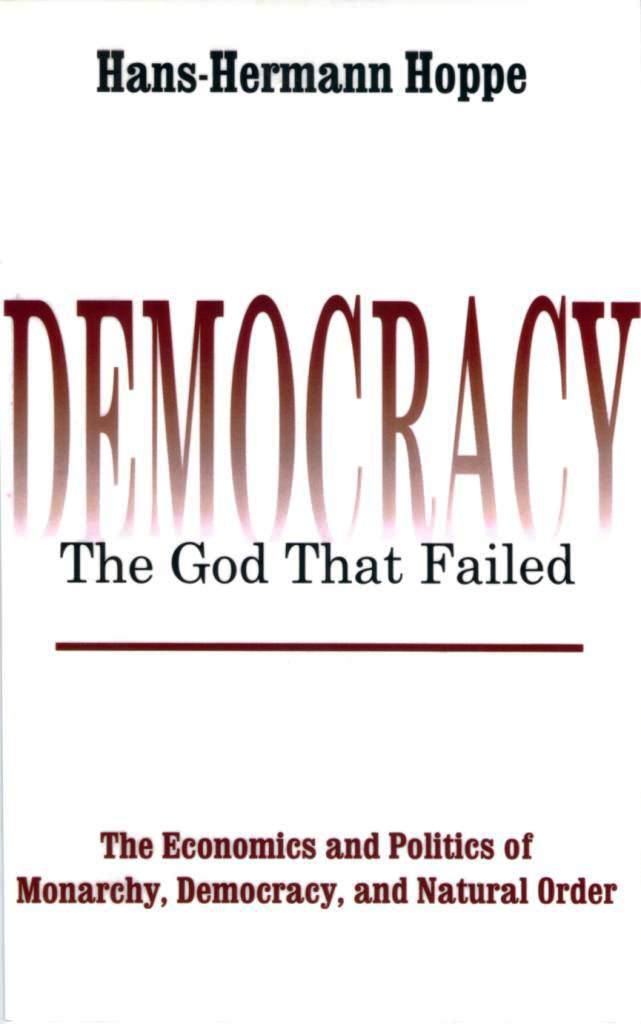
- On the distinction between nation and State, and on the corresponding right of voluntary secession — from which it follows that no State, as such, holds any right to exist against the will of those over whom it claims jurisdiction — see Murray N. Rothbard, “Nations by Consent: Deconstructing the Nation-State.” J. Libertarian Stud. 11, no. 1 (Fall 1994): 1–10; Ludwig von Mises, Liberalism: In the Classical Tradition, Ralph Raico, trans., 3rd ed. (Irvington-on-Hudson, N.Y.: Foundation for Economic Education, 1985 [1927]), esp. chap. 3 § 1 on the right of self-determination down to the individual level; and more recently Hans-Hermann Hoppe, Democracy: God that Failed (New Brunswick and London: Transaction Publishers Democracy, 2001), chap. 6 on secession and decentralization.
On the “stationary bandit” model of the State and its implications for the non-existence of any “right” of the State to exist as such, see Mancur Olson, “Dictatorship, Democracy, and Development,” American Political Science Review 87, no. 3 (1993): 567–576; and idem, Power and Prosperity: Outgrowing Communist and Capitalist Dictatorships (New York: Basic Books, 2000). For a broader sociological-historical treatment of the State as the institutional outcome of organized violence, see Charles Tilly, Coercion, Capital, and European States, AD 990–1990 (Oxford: Blackwell, 1990).
Murray N. Rothbard, The Ethics of Liberty (New York: New York University Press, 1998 [orig. 1982]), esp. chaps. 22–24 on the illegitimacy of the State; idem, Anatomy of the State (Auburn, Ala.: Mises Institute, 2009), also included in idem, Egalitarianism as a Revolt Against Nature and Other Essays, R.A. Childs, Jr., ed., 2nd ed. (Auburn, Ala.: Mises Institute, 2000 [1974]), originally published in Rampart Journal of Individualist Thought, vol. 1, no. 2 (Summer 1965): 1–24; Anthony de Jasay, The State (Oxford: Blackwell, 1985; repr. Indianapolis: Liberty Fund, 1998); Franz Oppenheimer, The State: Its History and Development Viewed Sociologically (New York: Vanguard, 1926 [orig. 1908]). [↩]



















 Alessandro Fusillo
 Andreas Tögel
 David Dürr
 Doug French
 Fernando Chiocca
 Greg Morin
 Hans-Hermann Hoppe
 Jay Baykal
 Jayant Bhandari
 Jeff Deist
 Jeffrey Barr
 Juan Fernando Carpio
 Ken Yamarashi
 León Isidoro
 Martin Cabrera
 Nick Hoppe
 Oscar Grau
 Peter Wong
 PFS
PFS scholarium
 Saifedean Ammous
 Sean Gabb
 Sean Ring
 Stephan Kinsella
 Stéphane Geyres
 Thomas Jacob
 Tom DiLorenzo
Follow Us!