Jeffrey Tucker, “A Half-Century of Household Income,” The Epoch Times (April 15, 2026). Reprinted with permission.
A Half-Century of Household Income
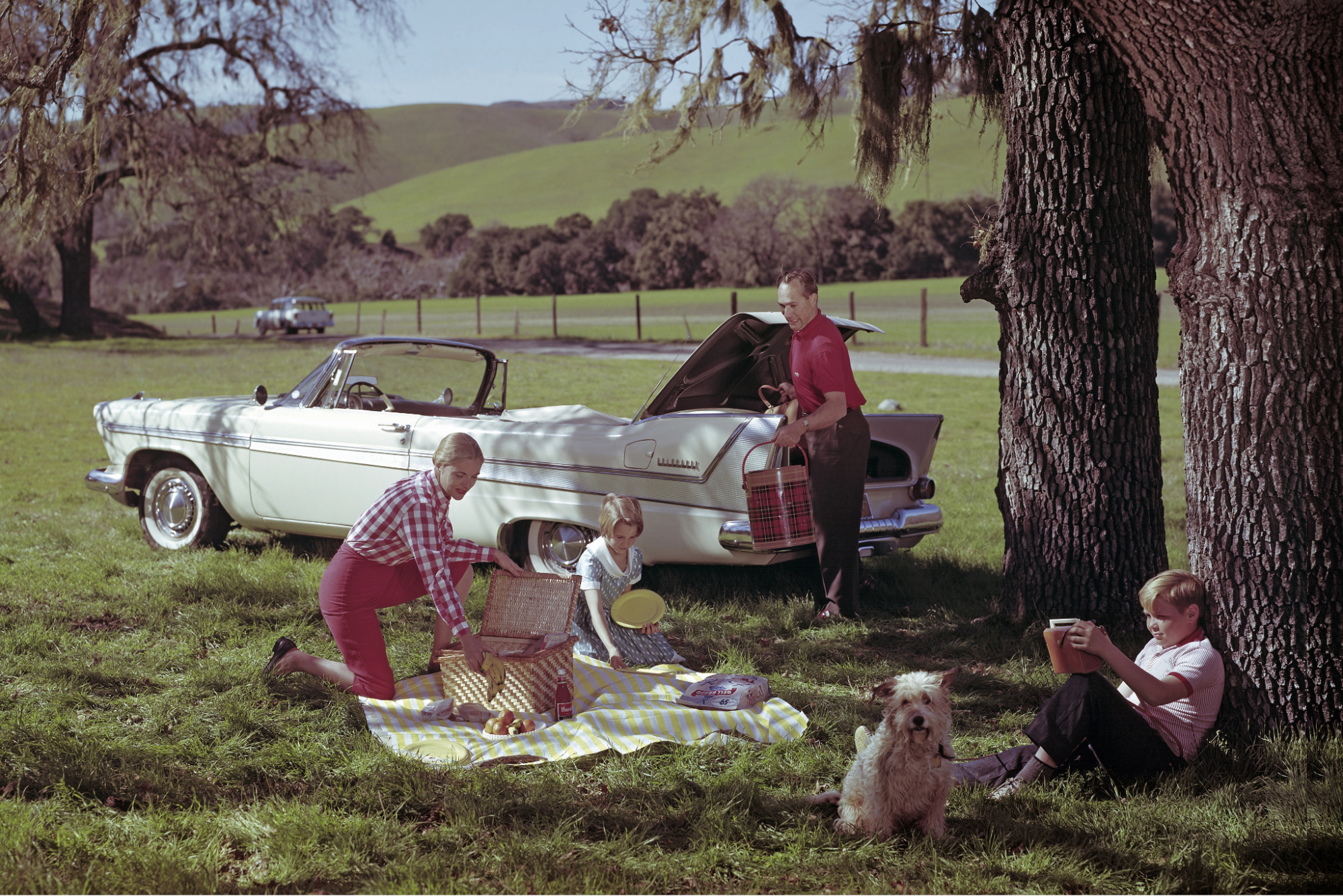
A family of four and their dog enjoy a day outdoors during a picnic in Agoura, Calif., in a file photo. (Tom Kelley/Getty Images)
Commentary
A few months back, I wrote a piece that touched on a taboo topic, though I did not know it at the time. It generated empirical evidence that confirms an intuition we all have that all is not well for American prosperity. I don’t mean just since the great inflation of the last six years.
I extended the analysis back 50 years to show just how devastating the two-income trap has been for household income. Yes, we have more toys and digital media, carry surveillance devices in our pockets, and can turn on our lights with a voice command.
Beyond that, medical care is unaffordable, home ownership out of reach, and real income is struggling despite all new technologies. Most extraordinarily, it now takes two incomes in a household to achieve a living standard that was easily met with one in the past.
I was genuinely stunned at the results of my study but equally amazed at the blowback. People said this is untrue. It was like I had committed some heresy in doubting the doctrine of progress itself, and done something even worse by generating actual evidence.
This is a topic I’ve thought about for decades and always wondered how it could be that people so strongly disagree about the basic facts. Then I hit on the answer. Economists too often look at wealth and income data based on the individual and the household, without actually considering the effective hourly pay per household unit of work.
That sounds overly technical but it matters a great deal. A think tank in Washington has been promoting a graph that seems to reveal wonderful increases in median family income. It hit a high of $106,000 in 2024, three times what it was in 1947. This is from data from the Federal Reserve. It looks very pretty, so stop complaining.
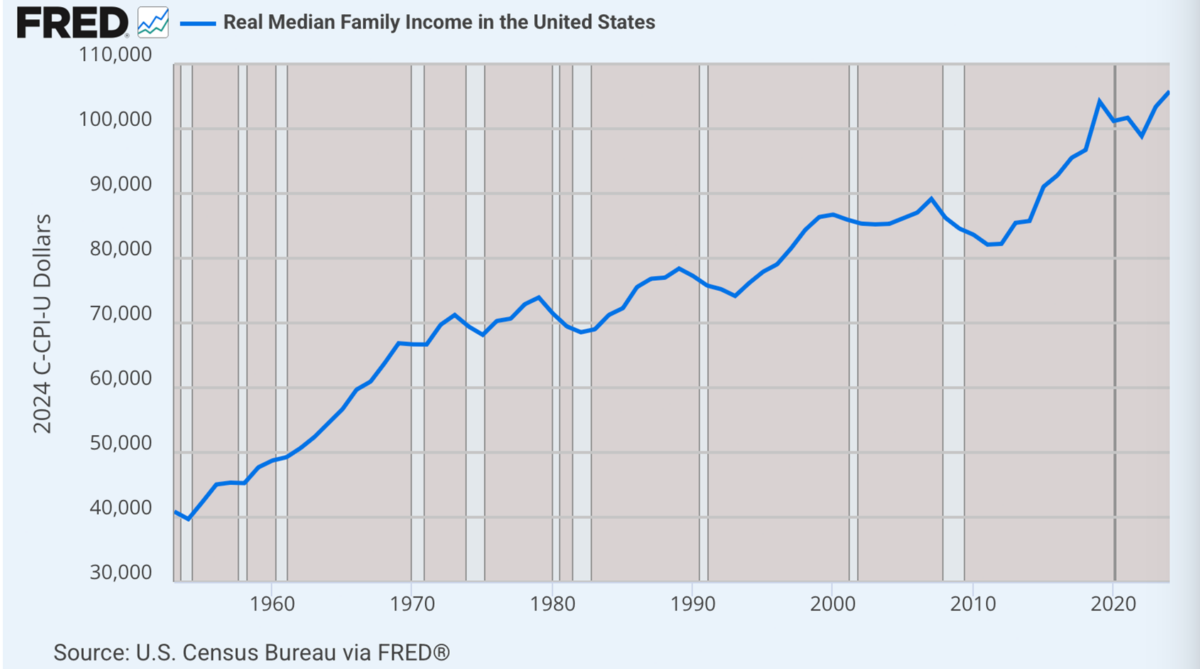
Really? Is the typical member of Gen Z so much better off than their grandparents? That’s not at all obvious.
There’s something wrong here. People of my generation know it. My father, before he went back to university and became a professor in history, made a modest income as a teacher in public school. My mother did not work. We had a home, two cars, and had plenty of clothes and food—all on one income.
When the inflation of the 1970s hit, they felt behind and my mother went to work to make up the difference.
I started thinking through the logic here. To compare before and after, we have to consider the total hours of labor per household. To find effective real income per household, we have to consider just how many spouses actually were put to work, and adjust that new income accordingly.
Here is where matters don’t look good at all. From 1984 to 2024, real median household income rose 40 percent. But during these years, it became more typical than not that a single household would have two income streams (at least) rather than just one.
On paper, it looks like we are richer. In reality, your household income is lower considering all factors. Moreover, the additional income comes with new expenses and does come close to a doubling.
What the chart does not tell you is that the main reason for the rise in real household income is the shift toward more dual-income households mostly driven by increased female labor force participation when kids are younger than 18.
How can we sum this up? Adding another income stream to the household is a 100 percent rise in work expectations but it has yielded only a 20-plus percent rise in material income. The effective pay per hour of work for the household has fallen by as much as 40 to 50 percent.
In other words, the household is not richer but shockingly poorer. At what cost? They are huge. The unpaid work my mother did caring for the household and kids now has to be crammed in on nights and weekends, leading to impossible stress. The luxurious weekends with my father have turned into a massive scramble to manage the household on Saturday and Sunday, leaving no time for anything else.
What’s more, this push to add an income to the household has largely tapped out possible gains. From 1976 to the peak, much of the household income rise came from this added labor input rather than big per-worker pay hikes. Post-2000, participation stabilized/declined somewhat (especially for men), and household income growth slowed. The “easy” gains from more dual earners are largely gone.
We are left with frenzied families struggling to pay the bills, which include the taxes plus child care, lawn services, and whatever other third parties we pay to do what husbands and wives used to do because they had time to do them. We have two people dealing with job stress rather than just one.
Just how many households have taken this route from 75 years ago to today? Vast numbers.
In 1950, 80 percent of mothers with children 18 or younger did not take a wage or salary with work outside the home. Among those with children under 6, 88 percent did not forgo raising kids for a paying job. One income was enough to support the entire family in a middle-class lifestyle.
This was not about discrimination against women. Even back to the 1920s, women before marriage and children worked. Empty nesters did too, even if in community activities such as church and civic organizations.
Child care was a thing but it was intermittently used and not full time. This is not because women were not “liberated” but because it was possible for the family to have a solid middle-class lifestyle without it (think of the show “Happy Days”).
By 1960, this had begun to change somewhat as families sought more earnings, with 70 percent of moms staying home and 80 percent with kids under 6. The number of moms in 1970 with jobs outside the home rose to 40 percent (with only 60 percent as stay-home moms). When the inflation hit, everything changed. By 1985, 60 percent of families already had two incomes. Today 65 percent of households have to bring in two incomes to keep up.
In short, in the span of 75 years, we went from 10-20 percent to 65 percent of households moving from one income to two. Propaganda at the time put the best-possible spin on this but it is actually a sign of declining living standards.
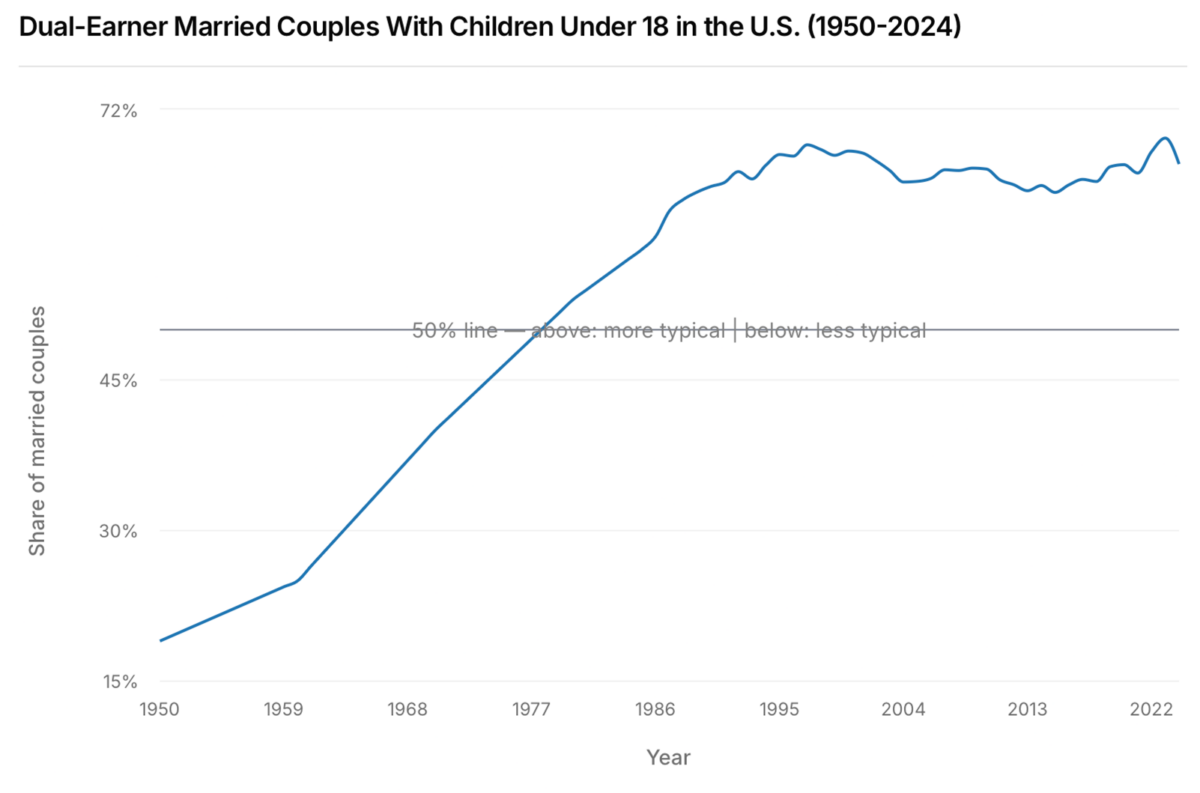
That is the main source of the supposed increase in household income. If you consider the effective hourly wage per household adjusted for inflation, this is effectively a drop in income not an increase.
All data aside, this trend has had a devastating effect on household well-being. You can understand this if you imagine matters from an individual point of view. If you work 40 hours a week for $50 an hour but now your boss makes you work an extra 20 hours at half that rate, your effective wage has fallen by 17 percent. You have more income in your pocket but you have actually experienced a cut in pay.
Expand this out toward two-thirds of American households and adjust for inflation, and you can see the point. More income, yes, but a lower income per hour worked. The real cost is the neglect of children, home life, and an overall lower standard of living. They call this incredible decay progress.
The effect on family formation has been devastating. From time immemorial, women sought marriage for children and financial security. The financial security benefit is taken away while children are pure expense. Don’t wonder what has happened to the birth rate and why women are waiting so late in life to marry and why men see no particular advantage either.
The changes detailed above are enough of an explanation.
No question that the government has benefited from all these changes. Not just the inflation, which lowers the burden of debt, of which government is the most indebted; it also has a whole new crop of people who pay taxes. On top of that, medical care insurance and services have soared in cost as have taxes of all sorts.
As for the household and family, it is another matter entirely. We have lost so much. Which would you choose? Marginal gains in household income (which is really a cut in pay per hour worked) or secure families and domestic peace? This is not a question of data but a question of values.
The worst blow is to Gen Z. Not only did they find themselves robbed of a year or two of education but they face an extremely tough job market, an unaffordable housing market, and declining prospects for living a normal and happy life that their grandparents put together. This is hardly the Golden Age. You know it intuitively. You just have to look beneath the surface to find out why.
Discover more from The Property and Freedom Society
Subscribe to get the latest posts sent to your email.























 Alessandro Fusillo
 Andreas Tögel
 David Dürr
 Doug French
 Fernando Chiocca
 Greg Morin
 Hans-Hermann Hoppe
 Jay Baykal
 Jayant Bhandari
 Jeff Deist
 Jeffrey Barr
 Juan Fernando Carpio
 Ken Yamarashi
 León Isidoro
 Martin Cabrera
 Nick Hoppe
 Oscar Grau
 Peter Wong
 PFS
PFS scholarium
 Saifedean Ammous
 Sean Gabb
 Sean Ring
 Stephan Kinsella
 Stéphane Geyres
 Thomas Jacob
 Tom DiLorenzo