≡ Menu

Protected: The Mises Institute and Me: A Personal Reckoning

The Mises Institute and Me:
A Personal Reckoning

Stephan Kinsella
May __, 2026

Property and Freedom Journal

Contents

Introduction
The Mises Institute as Intellectual Home
First Contact
Staying Independent
Getting More Involved: The Open Publishing Revolution
Increased Involvement and Libertarian Papers
Becoming “Mr. IP”
Honors, Invitations, and Senior Fellowship
Tucker, IP, and Open Publishing
The Mises Institute Goes Open Source
French Joins; Mises Global; Mises.org as Hub of Austro-Libertarian Thought
Mises Academy and the High-Water Mark
Tucker and French v. Rockwell: Behind the Scenes, 2008–2012
Kinsella Out
Aftermath
Dipping One Toe Back In
The Post-Tucker Era
Losing Presidents
Canceling Programs
Pointless Name Changes, Website Changes, and Journal Confusion
Open Publishing Abandoned
Moving Forward
Board Structure and Composition
Employees and Board Composition
Foundation vs. Public Charity
President
Mises.org; Copyright and Open Publishing/Information
Expand Mises University, Reconsider Graduate School
Conclusion: A Hope and a Forecast
Bibliography

Introduction

Hans Hoppe recently published “Mises Institute: Quo Vadis?”, which contains various criticisms of the Mises Institute (MI) as it is currently organized.1 He has since been removed as Distinguished Senior Fellow by MI.2 I fully support Hans and do not disagree with anything he wrote.3

Here I would like to mention my own experience with MI, with which I have been associated, on and off, for 32 years, since 1994. I have discussed some of this history previously,4 but given these recent events I will go into more detail here and offer some of my own thoughts on these matters.

The Mises Institute as Intellectual Home

Since its founding in 1982, the Mises Institute has served as a kind of “intellectual home” for many people. It was a place that spread the ideas of liberty and Austrian economics and, after it found its permanent location in Auburn, and then later its main campus and building there, a place where people could meet, network, learn, make friends, and so on. This was true during its first years, from 1982 to the advent of the Internet in the mid-1990s. From the late 1990s to about 2012, after the Internet, websites, YouTube, blogs, and digital “Phyles”5 started to emerge, its popularity and this phenomenon only increased when, under Jeffrey Tucker’s initiative, and also Doug French joining as President in 2009, MI and mises.org took advantage of the internet and digital information to make a mammoth amount of Austrian and libertarian material available free and open online.6

Hoppe, Rothbard, Rockwell, July 1992

MI became Rothbard’s intellectual home upon its founding in 1982, during its pre-Internet phase. It also became Hoppe’s, soon after he joined Rothbard in 1985 and closely worked and associated with him until his death a decade later, in 1995.7

Thus, Hans opens his recent missive “Mises Institute: Quo Vadis?” with an acknowledgement of his long-standing close connection to MI:

My close, personal association with the Mises Institute goes back more than 40 years, to 1985, only three years after the Institute’s founding. In the course of the years I have given dozens upon dozens of lectures. I have been awarded its Schlarbaum Prize and the Rothbard Medal. For a decade, I served as editor of its Journal of Libertarian Studies. I am the MI’s only long standing Distinguished Senior Fellow. Only two years ago, in 2024, I was a featured speaker at the Institute’s Human Action Conference, and my 75th birthday was celebrated at the occasion. In the same year I sent this congratulatory note to Lew Rockwell at the occasion of the festivities organized in honor of his own 80th birthday:

Dear Lew, to your 80th birthday I send you my best wishes and want to say thanks for by now almost 40 years of friendship and intellectual camaraderie.

I know you are too humble to say this, but I can certainly do it: You rank among the most brilliant commentators and analysts of the present age and you are the world’s greatest living promoter of sound economics in the tradition of Ludwig von Mises and Murray N. Rothbard and, more generally, of liberty, peace, common sense, and reason.

Your legacy is assured: You are already a legend.

Yours truly,
Hans
8

Despite my critical remarks here I, too, share Hans’s admiration for Lew and what he achieved with the Mises Institute. I love the mission of the MI and the role it has played. It is due to my concern over the decline of MI, and its treatment of Hans, that I publish these remarks.

Returning to Hans’s connection to MI, as he said in one recent talk:

Here though, I thank Lew Rockwell, Tom DiLorenzo, and Joseph Salerno for the invitation. And to clear up the veteran part in my lecture, I should point out that my first visit to Auburn took place in, I think, in the fall of ’85 or in the spring of 1986. So Auburn for me is my sweet home in Alabama.9

In “Coming of Age with Murray,” Hans recounts moving to New York in 1985 specifically to work with Rothbard, then details how the Mises Institute became the crucial institutional support for him and Rothbard and others when academia and “limited-government” outfits shunned radical Austro-libertarianism: “until the arrival of Lew Rockwell and the Mises Institute… I have remained closely connected from its humble beginnings to the present day.”

MI itself, in its 2024 Human Action Conference announcement, explicitly noted this close relationship:

Mises Institute Senior Fellows, Fellows, and Associated Scholars will deliver presentations on the significance of Human Action. Returning to his intellectual home for the first time since covid, Dr. Hans-Hermann Hoppe will deliver a keynote lecture. These thinkers’ contributions will be compiled into a commemorative volume in honor of Mises’s seminal work.

MI has played a similar role for countless others. It was what drew them to MI, to its people, publications, resources, conferences, and events. As Bretigne Shaffer—the daughter of Butler Shaffer, long-time legal scholar affiliated with the MI—recently wrote: “It is also a home for many intellectuals who might otherwise have found themselves homeless.” She recounts how MI and LewRockwell.com offered a lifeline to Butler, and it also became his intellectual home.10

And also mine. Starting a bit in the middle of my story—in 2002, when I was 37 years old and practicing law in Houston (after a three-year stint in Philadelphia from 1994–1997), about 8 years after becoming associated with MI, I concluded my 2002 LewRockwell.com article “How I Became A Libertarian” thus:

Since then [meeting Rothbard and Hoppe in 1994] I have attended many Mises Institute conferences, including every one of the annual Austrian Scholars Conferences, initiated … in 1995. Over the years I gained more appreciation for Mises and Austrian economics, and for the unparalleled scope of Rothbard’s scholarly contributions to economics and political philosophy, and related fields. I am now not only an anarcho-libertarian, but a Misesian-Austrian. I have gained an increasingly deeper respect for Lew Rockwell and the singular achievement that is the Mises Institute. It has become my intellectual home.11

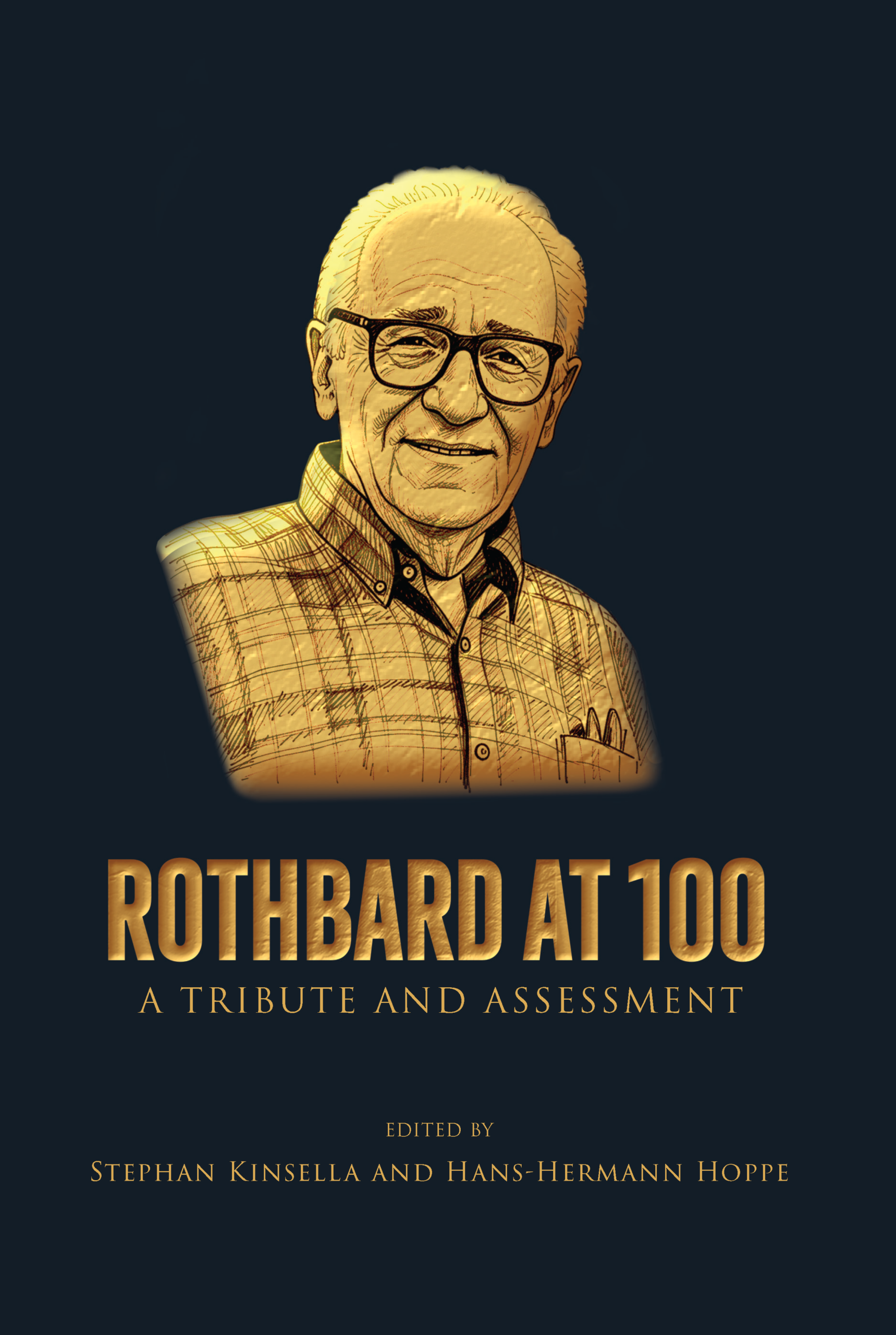
While my appreciation of the ideas of Mises, Rothbard, and Hoppe has only deepened and grown over the years, and as I have integrated it more and more into my own understanding of liberty—as can be seen in the book I recently edited and published with Hans, Rothbard at 100: A Tribute and Assessment, as well as my chapter “Mises, Rothbard, Hoppe: An Indispensable Framework”—its status as my intellectual home began to decline around ten years later, in 2013.

First Contact

But let me go back to the beginning. (As is my wont.)12 As I have recounted elsewhere, as an adolescent but always interested in books, science, and philosophy, but was essentially apolitical; politically tabula rasa. As for so many others, for me it also began with Ayn Rand.13 A librarian at Catholic High School in Baton Rouge, who knew I loved to read and talk about ideas, commended The Fountainhead to me in my sophomore year, in 1980. And also as for so many others, this soon led me to libertarianism and to Austrian and other free-market economics.

By college I was a very Randian libertarian. I went to hear Ron Paul speak at the LSU campus during his 1988 Libertarian Party run for President.14 At the time I was more Randian and pro-choice and still suspicious of the libertarians because of Ayn Rand’s critical comments, and went there to find out if libertarians were pro-choice or not; Ron’s ambiguous answer to my question made me suspicious. I ended up voting for him anyway in 1988.15

I loved technology and the natural sciences—electrical engineering was my undergrad and grad school major—but for various reasons,16 including an interest in economics, philosophy, and the social sciences and even the humanities in general,17 and increasingly in law, I entered law school in 1988, right as I was transitioning from Randian minarchism to Rothbardian anarcho-capitalism.18 As the joke has it, “What’s the difference between a minarchist and an anarchist? A: About six months.” It took me a bit longer, but I’ve seen that process play out many times.

I was influenced by many anarchist works—Rothbard’s For a New Liberty, the Tannehills’ The Market for Liberty, Bruce Benson, David Friedman, and so on.19

And then in my first year of law school I read Hoppe’s article “The Ultimate Justification of the Private Property Ethic” in the Sept. 1988 issue of Liberty,20 which, at the time, I would read cover to cover, along with other periodicals like The Freeman, The Free Market, Reason, Access to Energy, The Konzak Report, the Rothbard-Rockwell Report, The Intellectual Activist, Imprimis, the Laissez-Faire Books catalog, and so on.

Kinsella and Jack Criss, Jackson, MS, Laissez-Faire Books Catalog teeshirt, 1989

Kinsella and Jack Criss, Jackson, MS, Laissez-Faire Books Catalog T-shirt, 1989

with Guido Hülsmann, Sept. 22, 2025, Bodrum, Turkey, PFS 2025

with Guido Hülsmann, Sept. 22, 2025, Bodrum, Turkey, PFS 2025

Mises University, 1992: Hoppe, Mark Thornton, David Gordon, Tom DiLorenzo, ?, Ralph Raico, ?, Joe Salerno, ?, Guido Hulsmann, Jeff Herbener

Mises University, 1992: Hoppe, Mark Thornton, David Gordon, Tom DiLorenzo, Robert Batemarco, Ralph Raico, John Sophocleus, Joe Salerno, Andy Barnett, Guido Hülsmann, Jeff Herbener

Jim Johe, Kinsella, Guido Hülsmann, Reinhardt Steibler, ASC, Mises Institute, Auburn, April 2, 1997

Jim Johe, Kinsella, Guido Hülsmann, Reinhardt Stiebler, ASC, Mises Institute, Auburn, April 2, 1997

Mises University 1991: Rockwell, Yuri Maltsev, Hoppe, Rothbard

Mises University 1991: Rockwell, Yuri Maltsev, Hoppe, Rothbard

ICUS (International Conference on the Unity of the Sciences), Seoul, Korea, Feb. 16, 2000: Joe Stromberg, Guido Hulsmann, Kinsella,Dan Christian Comanescu, Josef Sima, Jeff Hummel, Walter Block, Hans Hoppe, Marco Bassani, Carlo Lottieri

ICUS (International Conference on the Unity of the Sciences), Seoul, Korea, Feb. 16, 2000: Joe Stromberg, Guido Hülsmann, Kinsella,Dan Christian Comanescu, Josef Sima, Jeff Hummel, Walter Block, Hans Hoppe, Marco Bassani, Carlo Lottieri

This article changed my life. Hoppe’s argument captivated and fascinated me and drew me to his work, to his powerful intellectual framework.21 After a “Eureka!” moment in contracts law class (Fall semester 1988), it stimulated me to build on it using the “estoppel” concept I had been learning about in contract law class to develop my own complementary theory of rights.22 In January 1992, while in grad school pursuing an LL.M. in international law from King’s College London, I wrote a handwritten letter to Hoppe (Jan. 31, 1992) to introduce myself and mention my draft article based on my estoppel-based rights theory. I submitted it to King’s College London’s law journal (which was my first try; how naive I was) and other fora, such as LibertyReason, Jeffrey Friedman’s Critical Review, and so on. It was rejected by all of them but someone at Tibor Machan’s Reason Papers liked it (I found out just recently that it was Eric Mack), writing “This is a clever and, for the most part, meticulously developed essay.” My first serious published academic article, it was ultimately published there in 1992, just as I was beginning my first year of legal practice in Houston.23

Hoppe’s argument was elaborated on in his 1989 A Theory of Socialism and Capitalism and also in his 1993 The Economics and Ethics of Private Property24 I wrote a lengthy review essay, “The Undeniable Morality of Capitalism,” published in St. Mary’s Law Journal in 1994,25 and a shorter review for FEE’s journal, still called The Freeman.26. I sent the longer one on to Hoppe in August 1994 and he sent me back a warm thank you note, referring to me as “Dr. Kinsella” (the first time that happened, but not the last; in the intervening years many people assume I’m a Ph.D, a sort of honorary doctorate I take more pride in than the meaningless PhDs most academics have).27 In his letter he told me he thought my estoppel argument beautifully complemented his argumentation ethics. I had actually (mildly) criticized some of Hoppe’s arguments in the review, but he still liked it; it was favorable, after all, and published in a respectable mainstream publication. This feedback, as well as that of the Reason Papers referee (belated thanks, Eric), was very encouraging to a young independent scholar.

By this time I had moved to Philadelphia for a few years for career reasons, and got wind of a meeting of the Mises Institute “paleolibertarians” and the Chronicles crowd “paleoconservatives” held October 21–22, 1994 at the Crystal City Marriott Hotel in Arlington, Virginia.28 Maybe Hoppe or someone at the MI told me about it. I don’t recall. Maybe it was Lew Rockwell, whom I had met by telephone years before. This was during one of the “fusionist” phases, attempts of “conservative” libertarians and conservatives to unite,29 but I went there primarily to meet Hoppe and Rothbard.

Rothbard and Criss, Jackson, MS October 1992

Rothbard and Criss, Jackson, MS October 1992

I actually already knew Lew, since about 1988 or so. As I wrote previously,30 I was visiting my friend Jack Criss, then a libertarian AM radio talk show host in Jackson, MS, and was in the studio while Jack interviewed Lew by phone. During a commercial, I talked to Lew and told him how much I admired his superb The Free Market Reader (1988) and other work (we had already corresponded, I believe). It wasn’t until the 1994 conference that we met in person.

I didn’t much care for the Chronicles crowd I met there—Sam Francis, Tom Fleming, and others, though I did like Paul Gottfriend and over the years got to know him better, as he has also attended several PFS events. Some of them seemed to be doing the creepy Southron thing of worshipping the Rebel Flag and the Confederacy, smoking cigars and holding court in their hotel rooms, and so on. I did not feel welcome or especially want to be. I was from Louisiana, but only geographically, so to speak.

Jack Criss, Austrian Scholars Conference, Mises Institute, Auburn, Alabama, April 1997

Jack Criss, Austrian Scholars Conference, Mises Institute, Auburn, Alabama, April 1997

At the event, I had a long talk with Rothbard when we both arrived at a meeting room early, and got him to sign my copy of Man, Economy, and State. When he died unexpectedly three months later, the following January, Hans took over the editorship of the Journal of Libertarian Studies, as he was the obvious choice. I started regularly attending the Austrian Scholars Conference held every Spring in Auburn (starting in about 1992 and going until about 2012, I believe). I would sometimes attend other MI conferences, but I almost always presented something at the ASC, always with Hoppe’s encouragement and, sometimes, guidance. Many of these papers were published in the JLS; many were incorporated in my 2023 book LFFS. So my current intellectual framework clearly developed and grew out of my early scholarly years at MI and my exposure to the ideas of Mises, Rothbard, and Hoppe, and so many others.

I made a host of friends and contacts at MI events over the years, many of them by now life-long friends, including Guido Hülsmann, whom I happened to sit next to on the shuttle from ATL airport to Auburn for our first ASC together in 1995. We were both going there for Hans—Guido was an economics PhD student and I was an aspiring Austro-libertarian legal theorist. Guido and I quickly became close friends at that very event, and though we lived far apart, we have remained friends, collaborators, and supporters and students of Hans. Hans and I became closer as well, and I eventually helped him with the JLS—first with an attempted but short-lived feature, “The Libertarian Literature Review,”31 and then as book review editor (2000–2004).

The first sign of trouble in paradise occurred in 2005 when, to our surprise, after a decade of editing the JLS, Hans was removed as editor. He was thrown a bone and relegated to some meaningless title like editor emeritus or at large. It was not clear why this happened, but Hans was upset and a bit mystified. It made no sense to me. It was great under his tenure and he was the obvious and best person to do it. I heard later that the reason given was that he was behind schedule; this was untrue. I can see now, in retrospect, after a great deal of experience writing, publishing, and editing many books and my own journal, that it was a makeweight reason. Left-libertarian Roderick Long, who was still affiliated with MI and apparently a Senior Fellow (more on this below), was hired. He was a disaster as editor. He started publishing more left-libertarian material like that of Kevin Carson and in any case it fell far behind schedule. Tom Woods was briefly enlisted to take over, but that did not last long.

With the JLS falling apart, I had the idea to replace it with a new, online (and print) journal embracing the Internet. I brainstormed this with Jeff Tucker one night, got Hans’s enthusiastic support, and, with Tucker’s help, I quickly formed a website, recruited an editorial board from contacts I had developed through MI, and we were off to the races with the innovative new journal Libertarian Papers. I published Libertarian Papers for 10 years, at first somewhat informally under the MI’s auspices—I retained ownership and control of the domain and website—but less clearly so over time, and after a few years enlisted Matt McCaffrey to step in as day to day editor. More on this later.

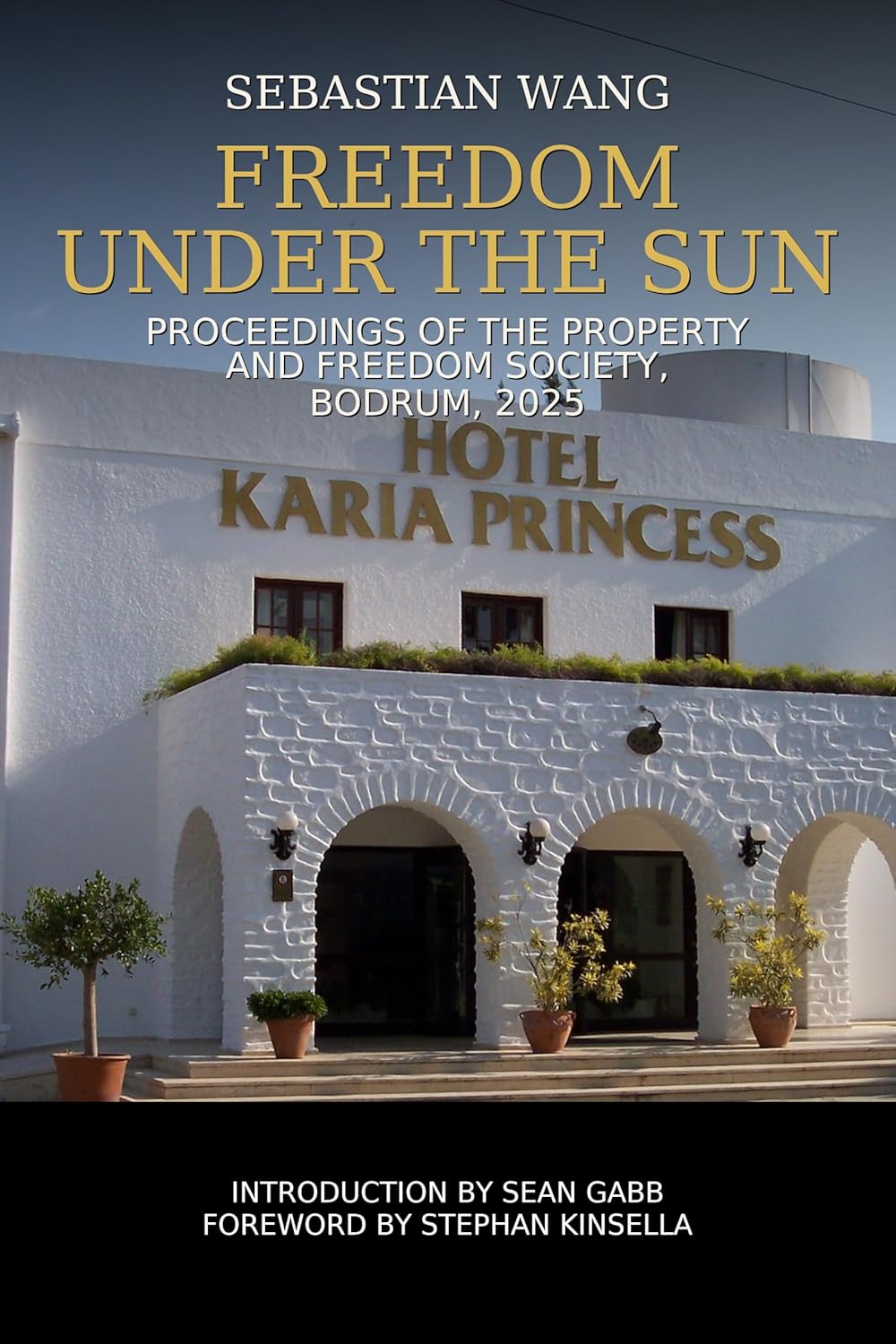
In any case, in 2005 or so Hans was removed as editor of the JLS. He was upset at the time but he accepted it. He had been paid a meager stipend of $500/month and was told this would continue. It did not. This lie as well as his senseless demotion to “Executive Editor” or “Editor at Large” (I cannot recall) and the lame excuses behind his demotion should have raised suspicions, but we were naive and I, at least, mostly shrugged this off. But this event must have alerted Hoppe’s spidey-sense. He must have sensed that being dependent on such fickle people was a precarious position to be in. The next year, in 2006, founded the Property and Freedom Society (PFS) in Bodrum, Turkey, the site of the Hotel Karia Princess, a family hotel owned by the family of his soon-to-be wife, Gülçin Imre, an Austrian economics PhD student who had also begun attending MI events as she worked on her PhD. With the recent Troubles exposed in Hans’s recent article, we can see how prescient he was to establish his own base of operations.

Staying Independent

I had an obvious academic and scholarly bent, and for a time I flirted with the idea of academia. To that end, as a young attorney, I enrolled in the University of London’s PhD—Laws program from 1996–2000, with renowned Dworkin scholar Dr. Stephen Guest as my advisor; my application was supported by helpful recommendation letters from Hoppe, Randy Barnett, and Saúl Litvinoff.32 I eventually decided not to join academia but to maintain my legal career and treat my scholarly interests as an avocation or side pursuit. I thought being an independent scholar was the best path for me.

Thus for similar reasons was also uninterested in joining the think tank world in any dependent capacity, or having a career in the “liberty world.” So when some opportunities arose I never pursued them. For example, early in my career, in studying argumentation ethics I came across similar or related arguments, which I wrote about in a 1996 JLS article, “New Rationalist Directions in Libertarian Rights Theory.”33 One of these was the interesting libertarian-oriented rights theory of Roger Pilon of Cato. So I began corresponding and talking to him. As I recounted in Disinvited From Cato:

Pilon and I continued to correspond—such as this letter (May 6, 1997) he wrote me in 1997, proposing possibly commissioning a study about how to improve property rights in the international arena (probably in response to some of my recent legal writing in that area, e.g. my book Protecting Foreign Investment Under International Law: Legal Aspects of Political Risk (Dobbs Ferry, New York: Oceana Publications, 1997)34 and related articles).35

A couple years later, in 1999 or so, I distinctly remember, I was on a vacation with my wife and brother in beautiful Capri, Italy, and was checking my work email from a laptop from the hotel room (yes, apparently it was possible back then, somehow—I think via long-distance dial-up modem), and received an inquiry from Pilon as to whether I was interested in a new position Cato was creating, editor of a Supreme Court law review. It would involve a career change, a move to DC, being a talking head on TV on occasion, and a generous salary (but still, for me, a cut in pay, since I was by then a successful large firm patent attorney), and so on.

It was never even a question for me. I did not hesitate or agonize about it. I didn’t even run it by the wife. I immediately said “no”—politely, but decisively. I didn’t want to move to DC or take a pay cut or be beholden to non-profit bosses.

I’m so glad I said no, and that I’ve remained intellectually independent since. I never wanted to be a “kept” or “house” intellectual, and am glad of my decision, and related ones in years following, to this day. I like keeping my libertarian intellectual interests as an avocation and being my own benefactor from my normal job, thank you.36 That way, one can maintain independence and integrity. My mind is my own, man.

Turning back to the Mises Institute: around the same time, Lew Rockwell hinted at a similar opportunity with the institute. I believe it was around 2000 or so, or perhaps a bit later, before MI had completely moved its conferences, such as the ASC, to their new building in Auburn. In 1995 and for a few years after, the ASC was held at the Auburn Hotel and Conference Center. Doug French was hired as MI’s first non-Rockwell president in 2009, but Lew must have been considering hiring a successor for some time before Doug was finally hired. I recall Lew and I were alone in the Auburn Hotel conference center area where coffee was served between presentations. He mentioned to me he was looking for a President to replace him. I must have said something like, perhaps some smart and ambitious young economics professor is who you need. He looked at me and said something like, “Or maybe a smart young lawyer?” I was not sure if he was serious, but I changed the subject and never brought it up again. That career path did not interest me at all. I was doing well as a big-firm attorney and would never take a pay cut, and, as noted above, I preferred to be my own benefactor and keep my vocation and avocation, my career and calling, separate.37

Getting More Involved: The Open Publishing Revolution

Increased Involvement and Libertarian Papers

In any case, my involvement with MI only increased. I kept speaking at the ASC, and helped Hans with the JLS, becoming book review editor and so on. In 2002, I was invited to deliver three lectures in the week-long Rothbard Graduate Seminar (July 28–Aug. 2, 2002). As I became more prominent and started being invited to speak, such as at Mises U or other events, I would usually decline the fee or reimbursement. Or I would take part of it (to have some speaking income to justify treating that side-hustle or avocation as a schedule C business for tax purposes, for deducting business expenses and the like; I also had a lucrative legal publishing side-gig going at the time),38 and donate money separately.

Hoppe Festschrift Ceremony, July 2009, at the home of Judge John Denson, Auburn, Alabama

Hoppe Festschrift Ceremony, July 29, 2009, at the home of Judge John Denson, Auburn, Alabama

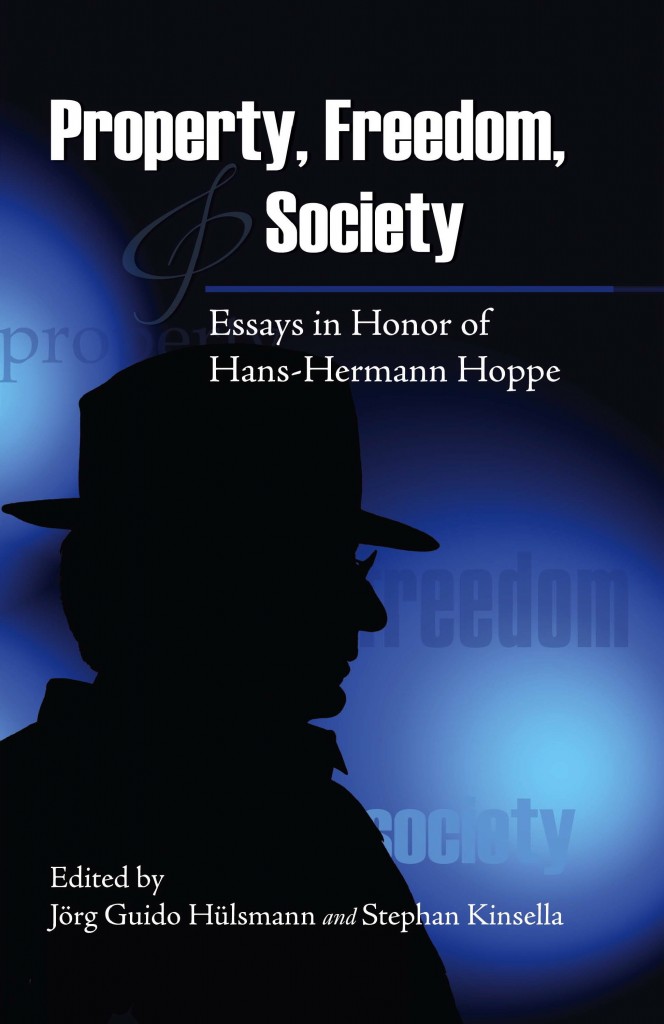
In addition to speaking regularly at MI events, I attended the inaugural meeting of Hoppe’s PFS, in May 2006 in Bodrum, Turkey.39 I blogged a lot on the Mises Blog. I also on occasion gave free legal advice. I co-edited, with Guido Hülsmann, MI’s 2009 Festschrift for Hoppe, Property, Freedom, and Society: Essays in Honor of Hans-Hermann Hoppe (this was Guido’s idea but it was supported and published by MI).40

After the disastrous and inexplicable decision to fire Hans from the JLS and Roderick Long’s short-lived tenure, one night, chatting with Jeffrey Tucker and lamenting its fate, I had the idea of starting a fully-online replacement journal, which became Libertarian Papers. I registered the domain that night and Tucker helped me quickly set up a site; I released our first batch of articles just a few weeks later, in 2009. A few years into it, Matt McCaffrey joined as editor; we published it for ten years, until 2018, closing it after Judy Thommesen and Timothy Terrell approached me at an event in Auburn and said that MI was ready to resume the JLS. We felt we had had a good run and were tired of the hard work, so agreed to close up shop and turn over to them the articles in our pipeline and our network of contacts and referees.

I recall I also suggested to Tucker around 2010 that its daily article needed an official name for citation purposes; so they started calling it Mises Daily. This lasted for many years until MI, after Tucker and French left, inexplicably changed the name to Mises Wire, just like they also inexplicably bifurcated the successful ASC into the Austrian Economics Research Conference (AERC) and Libertarian Scholars Conference (LSC), and got rid of comments on the blog (and purged old comments for no obvious reason), broke links, and reversed course on their CC-BY policy; but more on all this later.

Kinsella IP Man meme

Kinsella IP Man Meme

Becoming “Mr. IP”

In addition, I was showered with unexpected and unasked-for honors and invitations to speak. As I have elsewhere noted, my main interests have always been in libertarian legal theory—in rights theory, causation, contract law, and so on, and in incorporating the insights of Austrian economics to libertarian and legal theory.41 It was never intellectual property, though by now I have become somewhat known as Mr. IP.

As I have explained by now many times, since I switched from oil & gas law early in my career to patent and IP law, in about 1993, for career purposes, I thought I ought to finally address the IP issue from a libertarian perspective since previous arguments for IP all seemed flawed to me. I thought IP must be justified, even if the arguments by Ayn Rand and others all seemed flawed to me. After studying the issue in depth for a year or two, I finally came to my current conclusion that IP is totally unjust and incompatible with libertarian property rights, around the same time that I passed the patent bar (1994).42 I began to practice patent and IP law full time, and also, in parallel, began to write articles critical of IP, the first in 1995—a bit tentatively at first, for fear it might harm me in my career.43 But before long I gave up my reticence and I decided to go for it, when I realized that it was not going to hurt my career (clients don’t care what your personal politics are and don’t read such things anyway). Maybe I just didn’t care; I was just not made to hold my tongue.

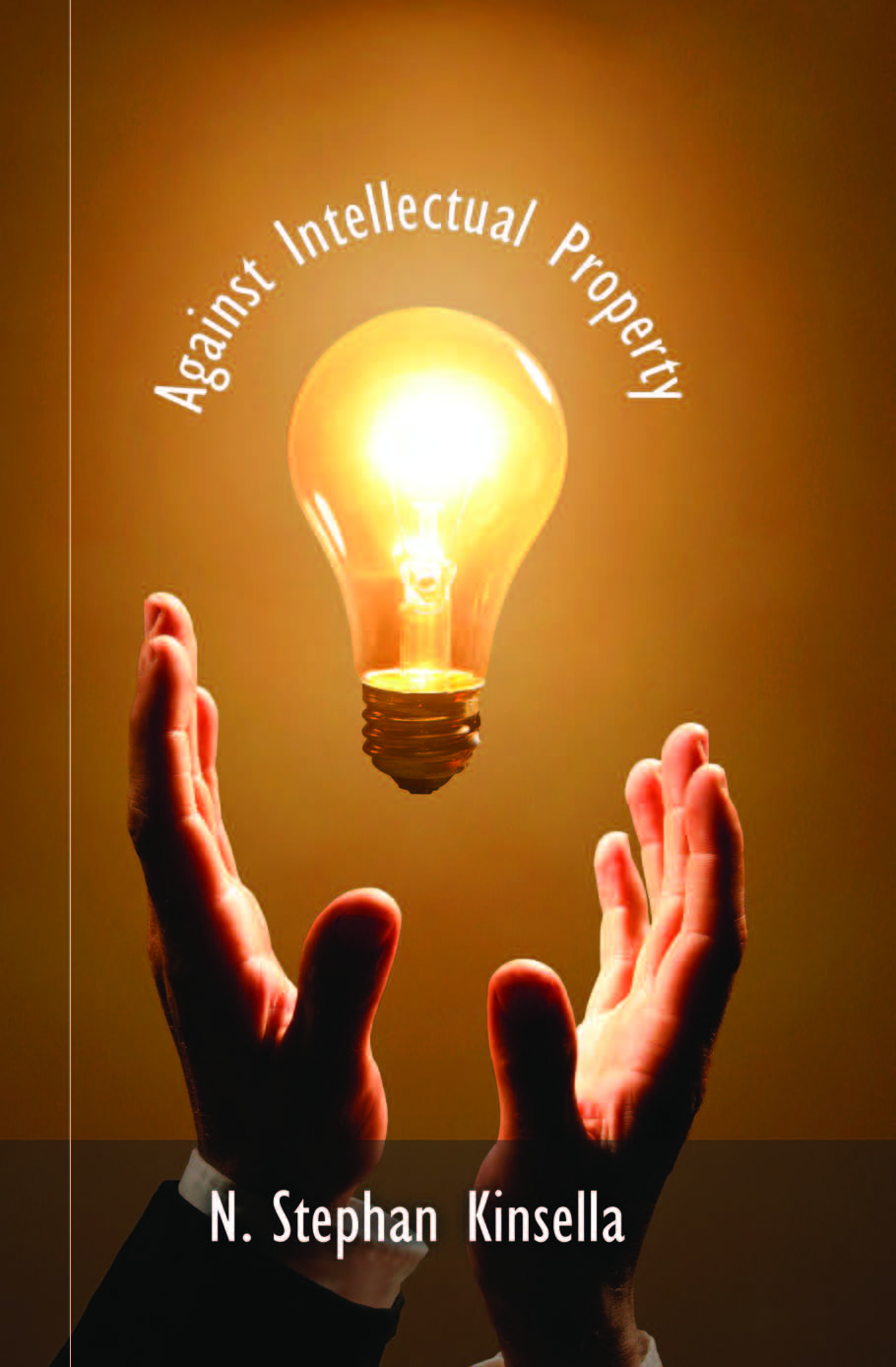
This led me to prepare a more systematic paper, “The Legitimacy of Intellectual Property,” which I presented at the Law and Economics panel at the Austrian Scholars Conference in Auburn, March 25, 2000. I remember George Reisman, a pro-IP Objectivist, in attendance, and asking at the end if I really meant that all IP law should be abolished; when I answered yes, he seemed a bit stunned and said no more. I published a condensed version of this argument, “In Defense of Napster and Against the Second Homesteading Rule,” later that year in LewRockwell.com44 and a longer article, “Against Intellectual Property” [AIP], in the Spring 2001 issue of the JLS.45 It was long enough to be republished by the Mises Institute as a monograph in 2008.

To my surprise, for my 2001 JLS article AIP I received MI’s first awarded O.P. Alford III Prize for scholarly article published during 2001–2002 that best advances libertarian scholarship, at the Mises Institute’s Eighth Austrian Scholars Conference, March 16, 2002. When I showed up for the 2002 ASC, I had no idea this was in the works. I remember Karen De Coster and I walked in and encountered David Gordon, who muttered something like “Oh, I see you are getting a prize!” Karen and I exchanged glances as we didn’t know what he was talking about; sensing he had possibly let the cat out of the bag, he changed the subject and scurried off. Hans, as editor of the JLS, selected the winner. Years later, when the JLS had mostly disappeared and I published and edited Libertarian Papers in its stead, from 2009 to 2018, initially under MI’s auspices, I was tasked with choosing the Alford Prize winner for the best article in that journal.46

Over the next few years the article attracted lots of controversy and attention but I believe it began to change minds. It is my impression that today most Rothbardians, Austro-libertarians, and anarchist libertarians of all types are overwhelmingly anti-IP, not that I take sole credit for that. I was not the first and never claimed to be.47 But a good deal of it, for sure. I just happened to be the right guy at the right time—when the emergence of the Internet and digital copying began to make more than a sleepy issue that could be ignored. I was the right guy because I happened to be interested in libertarian theory, young enough to be energetic and ambitious and stubborn, and confident I could figure it out; who also understood principled libertarianism, law, and IP law very well, and Misesian Austrian economics, and who was steeped in Mises, Rothbard, and Hoppe.48 There is a reason, in fact, why Hoppe back in 1988—before the Internet age, before any of the more recent, systematic libertarian criticisms of IP by Tom Palmer, Roderick Long, myself, Butler Shaffer, and others49 —already saw the fundamental problem with ownership of patterns of information—with IP law.50 Well before I did, and even before the emergence of the Internet and digital copying made it a more pressing issue. Hoppe already had the essentials: Misesian praxeology, Rothbardian radical politics, and … Hoppeanism. (I don’t know. Is Hoppe a Hoppean? Was Jesus a Christian?)

Incidentally, let me pause to mention that none of this explanation is meant to boast; it is to explain how, from my perspective, I was obviously closely integrated into the intellectual fold at Mises. I was writing for them, speaking, working with and studying under their chief intellectual. I had been given a major award, I was soon to start the successor journal for the JLS and to be a major part of their Mises Academy program (more on this below).

Kinsella Mises U 2009 IP and Libertarianism

Honors, Invitations, and Senior Fellowship

In any case, I was soon to be pulled even closer into the MI inner circles. In 2008, I was invited to deliver the Rothbard Memorial Lecture for the Austrian Scholars Conference 2008, entitled “The Intellectual Property Quagmire, or, The Perils of Libertarian Creationism.”51 Lew Rockwell also invited me to appear on The Lew Rockwell Show to discuss IP.52

The next year, I was invited to present a paper for the 2009 Mises University, “Intellectual Property and Libertarianism.”53 And yet again in 2011, I was invited to lecture again on IP at Mises University.54

So it was quite obvious to me that my work on IP was appreciated at MI. I had every reason to think that not only Tucker, and French, and Hoppe, and other scholars at MI did too. I had received the Alford Award for IP paper, I had been invited two years in a row to speak on this topic. Mises was adopting an open publishing, policy, clearly influenced by my IP ideas (more on this below). Countless people, including senior scholars at MI, made it clear to me they agreed with my IP views and thought it was important.

This includes Lew Rockwell himself. When I appeared on his podcast in 2008, he said:

He’s [Kinsella is] the author of many legal books published in this country and abroad in his area of specialization. Today I want to talk to him about intellectual property, about the whole concept of government patents and government copyrights. He’s really enacted a revolution in this area among libertarians.55

And in fact, the day after my July 30, 2009 talk on IP at Mises U, I had the following email exchange with Lew:

Subject: brilliant
From: Llewellyn Rockwell
Date: Thu, Jul 30, 2009 at 10:03 PM
To: Stephan Kinsella

Your talk tonight (I am listening to the MP3) is brilliant. I am just sorry I missed the actual presentation, but when I got to the room, not only were all seats taken, but so was my reserved and marked one (by a lady), so I had to content myself with the recorded version, which I will send out as a podcast.

From: Stephan Kinsella
Date: Fri, Jul 31, 2009 at 12:10 PM
To: Llewellyn Rockwell

Thanks so much Lew. The Mises U is just amazing. I think it’s one of the most wonderful things I’ve ever seen.
SK

From: Llewellyn Rockwell
Date: Fri, Jul 31, 2009 at 12:16 PM
To: Stephan Kinsella

You are an important and creative libertarian intellectual, so stay close to the Institute. It is an increasingly fruitful relationship.

From: Stephan Kinsella
Date: Jul 31, 2009, 12:19 PM
To: Llewellyn Rockwell

Thanks. Of course I will.

I thought it was very nice. But then I returned to my day job. To normal life.

A couple months later, Joe Salerno invited me to be a Senior Fellow. This was again unexpected.

Subject: invitation
From: Joseph T. Salerno
Date: Fri, Sep 11, 2009 at 3:22 PM
To: Stephan Kinsella

Hi Stephan:

I would like to redress a long standing oversight or, to use Hans’s favored term,”scandal” in not having you listed among the Senior Faculty of the Mises Institute.  So, In view of your long record of outstanding contributions to Misesian and Rothbardian political and economic thought, I am very pleased to invite you to join other distinguished scholars on the Senior Faculty of the Ludwig von Mises Institute.  I look forward to hearing from you and hope that you will accept this invitation.

Here is a link to the list of current senior faculty:  http://mises.org/faculty.aspx [archive]

Best regards,
Joe

From: Stephan Kinsella
Date: Fri, Sep 11, 2009 at 3:53 PM
To: Joseph T. Salerno

Joe, what an honor. I am not worthy of this, but gladly accept. I’ll prepare a little bio if you want. Thanks, SK

So I became a Senior Fellow (archived page from 2011), which I thought would be for life, or for a long time, but which lasted a mere four years, till 2013. More on this below.

Tucker, IP, and Open Publishing

Returning to the impact of the anti-IP ideas on Jeff Tucker: at first he thought my IP views were the typical abstruse, academic, impractical nonsense of pie in the sky theorists and that the attention it was receiving was somewhat ridiculous.56 But finally he became convinced. As he wrote in January 2009, reviewing Boldrin and Levine’s Against Intellectual Monopoly (2008):

[Kinsella’s anti-IP] argument initially struck me as crazy on its face. As I considered it further, my own view gradually changed: it’s not crazy, I thought, but it is still pie-in-the-sky theorizing that has nothing to do with reality. Kinsella’s article appeared just before the explosive public interest in this subject. The patent regime has in the meantime gone completely wild, with nearly 200,000 patents issued every year in the United States, and half a million more in other countries — with 6.1 million patents in effect worldwide — and large firms collecting stockpiles of them.

And the copyright issue has led to a massive struggle between generations: young people live by “pirating” music, movies, software, whereas the old consider this practice to presage the end of the capitalist system as we know it. The music industry has spent billions trying to contain the problem and only ended up engendering consumer embitterment and terrible public relations.

Kinsella’s article continued to haunt me personally. It took about six years or so, but I finally worked through all the theoretical problems and came to embrace his view, so you might say that I was predisposed to hear what these authors have to say. What I hadn’t realized until encountering the Boldrin/Levine book was just how far-reaching and radical the implications of a detailed look at IP really is.57

But eventually he re-read it, and was eventually persuaded, becoming a convert, the John the Baptist to my Jesus, the Boswell to my Johnson, the Engels to my Marx (his colorful words). Something like this.

The Mises Institute Goes Open Source

For years we would both write on IP on the Mises Blog and elsewhere, and repeatedly discuss these issues. We collaborated on what we both regard as an important piece, “Goods, Scarce and Nonscarce,” which I included in my 2023 book LFFS.

More than that: he began to adopt an anti-copyright and open-publishing model, putting MI works online for free and with a non-restrictive CC-BY license on each book and on the site’s footer: see this archived page.

mises.org archive, June 2011, showing CC-BY footer

Archive of Mises.org, June 2011, showing CC-BY footer

As Tucker explained in a MI speech in April 2009:

I want to talk a little bit about what we’re doing today that makes such a difference. You know you can’t even compare the intellectual environment of then with today. The prominence of the Austrian explanation and of free market generally today is astonishing by comparison.

The number of books that are coming out, you know we’re putting out, as I say, sometimes several books a week. And these are selling, the distribution is wide.

And of course digital media has made a huge difference. Mises.org remains I believe the largest, most well-trafficked economics website in the world. And I didn’t bring any data with me, it changes every day and it’s impossible to keep up with, but it’s massive. And it’s true that Mises.org gets more traffic than the Fed or the UN or anybody else. So this is great.

And we have of course now thousands of books online and tens of thousands of articles. And I don’t know how many hours of media we have recorded now. And I know many of you listen to the podcasts constantly and watch the videos constantly. I mean I think you could probably live a full-time Mises.org life if you wanted to. You know, just wake up in the morning and just live in Mises.org until you go to bed. And this could last for years.

So one of the problems we faced recently is that our traffic has just really gotten larger than we can handle and we wanted to create space for uploading ever more books. For example, Doug French mentioned that we’re putting 50 years of The Freeman online. Very exciting stuff. We want to have the freedom to do that. There’s lots more out there we want to work on. Many more — you look at the bookshelves of the Mises Institute, all this stuff needs to get out and nobody else is doing it. Somebody’s got to do it so we’re going to do it.

But we had to create the space. We have to have the server space. You bump again up against the limits of physical reality at some point. So our Web Master David Vexler had this idea that in light of all the recent studies we’ve been doing on intellectual property and the virtues of going open source. Now that phrase is not going to mean a lot to everybody in the room. What it really means is being as open as you possibly can with your copyright permissions. We put the whole of Mises.org on Creative Commons so that anybody can take anything without permission.

Part of the driving force is we get so many requests for reprint rights we don’t even have the staff to handle it. So we just said oh to heck with it, take whatever you want and print it. Leonard Read had the same view as far as FEE was concerned.58

And as he noted in a more recent interview (with me):

I am very pleased today to have with me Stephan Kinsella, an attorney who is the author of a 2001 article called “Against Intellectual Property” and more recently, a large treatise called “The Legal Foundations of a Free Society.” He is one of the most important thinkers of our time, and I think he has had a huge influence on me.

At some point in the mid-2010s, because his article came out, I thought it was probably not correct. I thought it was wrong; at least I thought it was a distraction. Essentially, what the article says is that intellectual property is an illegitimate concept, that ideas cannot be commodified and turned into property, and that the attempt to do so is destructive of market forces, information flows, and society in particular. This pertains to copyrights, patents, and yes, even trademarks.

The thesis is shocking, and probably as you listen to this, you are thinking that cannot be true. Then nobody would have the incentive to create, and so on. These are the usual comebacks. But I promise you, if you think about it long enough, as I did for years, you eventually come to be persuaded. Because of that, I shifted in my own career to only publishing within the commons. There was, at some point in this period, an innovation of the copyright status that made available to publishers what is called Creative Commons, with a number of different licenses and terms of use.

So, in my own work, I embraced the Creative Commons license with only one provision of attribution. That has been, I think, a real key to the success of many of my own personal projects. Also, as a publisher, Brownstone only publishes in the commons. As far as I know, we are the only ones. There may be other nonprofits that do it, but I am not familiar with them. It is a completely different model.59

French Joins; Mises Global; Mises.org as Hub of Austro-Libertarian Thought

When Doug French joined shortly after Tucker’s 2009 speech, he joined this mission. As noted in Doug’s talk at the Mises Institute’s 2011 Supporters’ Summit in Vienna, the MI’s publishing program that they embarked on took formerly hard to find and expensive books and digitized them, put them up free online and in multiple formats: PDF, HTML, Kindle, EPUB, audio, and physical editions.60 In one anecdote, (3:53 first video; 4:49 of the second), Doug recounts how hard it was to obtain Austrian books and articles before the internet:

And the books—you couldn’t find them. I mean, you absolutely couldn’t find the books. And you know, they gathered dust in libraries—if the libraries had them at all.

In fact, I studied under Murray Rothbard and I read one of his books in the UNLV Library. It was called The Mystery of Banking. And I read it while working in the banking industry. This was the clearest explanation of fractional reserve banking I’d ever read. I mean, I couldn’t believe it. So I had to have a copy of this book. But I couldn’t get it. Nobody had it. It was out of print. So one Saturday I went to the UNLV Library. I bought a couple rolls of dimes and I plugged the dimes into the copier, put a page down, turned the page, and so on. It took what seemed like hours to create my own copy of The Mystery of Banking.

I loved hearing this as it mirrored a similar experience of mine. As I noted in a previous post,

In grad school in London, 1991–92, I found a copy of Rothbard’s Ethics of Liberty in the University of London library. It was then out of print and hard to find. So I paid something like 10p a page to photocopy it by hand, vellum bound it, and for years that was my main marked-up copy of that classic text, until the 1998 edition was released by the Mises Institute with an amazing introduction by Hans-Hermann Hoppe.61

In any case, it is my view, and that of Doug and Jeff, that for a key period of time, the Mises Institute became the hub of Austro-libertarian information partly because of this open publishing program. People still talk about it. I was literally at a Ron Paul Institute event recently62 and several people told me that they vividly remember how useful Mises.org was in those days as a marvelous font of free information on liberty and sound economics—the natural successor to the role played in the previous two or three decades by Laissez-Faire Books. This was before there were as many other similar centers around world, and when the other foundations and think tanks and centers still largely relied on stingy paywalls and copyright. MI would grant permission to anyone who asked for rights to republish or translate; and when other Mises Institutes started cropping up and gingerly asking “permission” to use the Mises Institute name, he told them go ahead; he even showcased them on the right side of the website. Who does that? People interested in spreading the ideas of liberty, that’s who. It was even called “Mises Global” for a while; listed under “Mises Global” on the now-inoperable Mises Wiki; there was a Facebook page; a short-lived and now-defunct website, misesglobal.org (archive), started, I believe, by Jeff Tucker after he left MI.

See these screenshots from 2011 from archive.org:

mises.org archive 2011 Mises Global

Mises.org archive, 2011, showing Mises Global links displayed on right sidebar

Mises.org archive, 2011, showing Mises Global links displayed on right sidebar (closeup)

As Helio Beltrão said in his Ludwig von Mises Memorial Lecture delivered on March 10, 2011 at the Austrian Scholar’s Conference 11:

And if we are talking about people that would like to start an Austrolibertarian cell, you don’t need more than to put up a site, and start translating and publishing material. Just do it. It’s simple, and virtually costless. We’ve done it in Brazil, Gabriel Calzada has done it in Spain, the Joachims have done it in Sweden, Vlad in Romania, and likewise in PolandJapanRussiaBelgium, and other places. To build a great team, of course, is more of a challenge, but they are sprouting, because we have the example of Lew and the LvMI team.63

And see Joakim Kampe, “Helio Beltrão and Mises Global,” Mises Daily (June 14, 2011), regarding Ludwig von Mises Institute in Sweden:

One thing that needs to be mentioned before moving on is that none of this would have been possible if it hadn’t been for the totally open and generous policy of the Mises Institute, which allows anyone, anywhere, to use whatever material they publish.

Before starting up we had many conversations with Mr. Jeffrey Tucker about this, and we were amazed by his open attitude and extreme generosity. He truly understood not just the power of ideas, but also the importance of spreading them in a completely decentralized way. Of course, without this attitude we would not be where we are today, and on a global scale you can see that this attitude is really having an impact. When we started the Swedish Mises Institute, there were maybe 5 other Mises Institutes around the world, and today, one and a half years later, there are almost 20! The Austrolibertarian starfish is truly here to stay.64

Nowadays the repository of information at Mises.org is of perhaps less importance than it was in those days because there are more liberty-minded groups and sites with this and other content. But from the early 2000s for a good 10-15 years, the role of Mises.org was crucial. We could all feel it. Tucker even surmises that this all perhaps played some non-trivial role in the world we see now: when the Tea Party sputtered out and the 2008–2009 financial crises and Ron Paul’s 2008 presidential run expanded the number of libertarians,65 Mises.org, with its anti-IP-inspired policy and mission were there to help add some intellectual ammunition to the remnants of the Tea Party that Trump tapped into to win in 2016. Who knows. But a fun theory.
Libertarian Legal Theory with Stephan Kinsella

Mises Academy and the High-Water Mark

Meanwhile, Tucker and French spearheaded the formation of the Mises Academy, taking advantage of (live) remote courses delivered over the Internet. I conducted several from 2010 to 2011. These included multi-course lectures, “Rethinking Intellectual Property: History, Theory, and Economics” (twice); “Libertarian Legal Theory: Property, Conflict, and Society,” “Libertarian Controversies,” and “The Social Theory of Hoppe,” and one webinar, “Obama’s Patent Reform: Improvement or Continuing Calamity?”66 Students loved it; one said, of the first IP lecture series,

thank you so very much for all the excellent work—very few classes have really changed my life dramatically, actually only 3 have, and all 3 were classes I took at the Mises Academy, starting with PP350… Keep up the good work.

I recall being paid perhaps over $100k for my role; I had assumed MI must have made at least this much from their cut. (Doug French tells me now that in the early days of Mises Academy they perhaps goofed and the split with the speakers was too generous: it was more like 50/50, paid to early instructors like me, Bob Murphy, and Tom Woods. I was unaware of this until Doug just told me this at the time of writing this article.)

So in my view, in addition to forfeited speaking fees and reimbursements, various volunteer activities, their Mises Academy profits, my own significant financial donations, and so on, I have been a major contributor. Not that I was recognized as such; in recent years, when attending events I was told by MI fundraiser Kristy Holmes that to attend VIP receptions I would need to contribute $10k. I doubt this was asked of other VIPs or significant donors. But by then I was used to this shabby treatment. But I am skipping ahead.

In any case, I thought things were going well with my relationship with MI. So it was quite surprising and upsetting when Tucker quit in November 2011; French followed in early 2012. At the time I was not sure why. Despite this, and even after Hoppe’s demotion from the JLS, I would have assumed things for me would continue as before. But soon after they quit, things started to change.

Tucker and French v. Rockwell: Behind the Scenes, 2008–2012

I ended up resigning my position as Senior Fellow in 2013, which I’ll explain below. Only later did I begin to understand why this happened. At the time I was mystified. Before I turn to 2013, let me set out some of the background events between about 2008 to 2012. Some of the following is based on conversations with Doug French, Jeff Tucker, and others.

Jeffrey Tucker and Stephan Kinsella, Auburn, Mises Institute, October 9, 2010

Jeffrey Tucker and Stephan Kinsella, Auburn, Mises Institute, October 9, 2010

I first met Jeffrey Tucker around 1995, when I started attended MI events in Auburn. He has been a friend of mine and collaborator of sorts for perhaps 25 years, since my “Against Intellectual Property” article in 2001, had been with MI since about 1985, about when Hans moved to the US to study and work with Rothbard. And as noted, he was the force behind Mises.org and opening up its content to the world. He was behind Mises Academy and supported me in helping start Libertarian Papers.

Jeffrey Tucker and Stephan Kinsella, Auburn, Mises Institute, October 89, 2010

Jeffrey Tucker and Stephan Kinsella, Auburn, Mises Institute, October 8, 2010, with iPhone

After Doug French joined as President, they worked together on this exciting mission—of providing the texts of liberty and sound economics to the world just as the Internet made this possible, while others were relying on copyright paywalls.

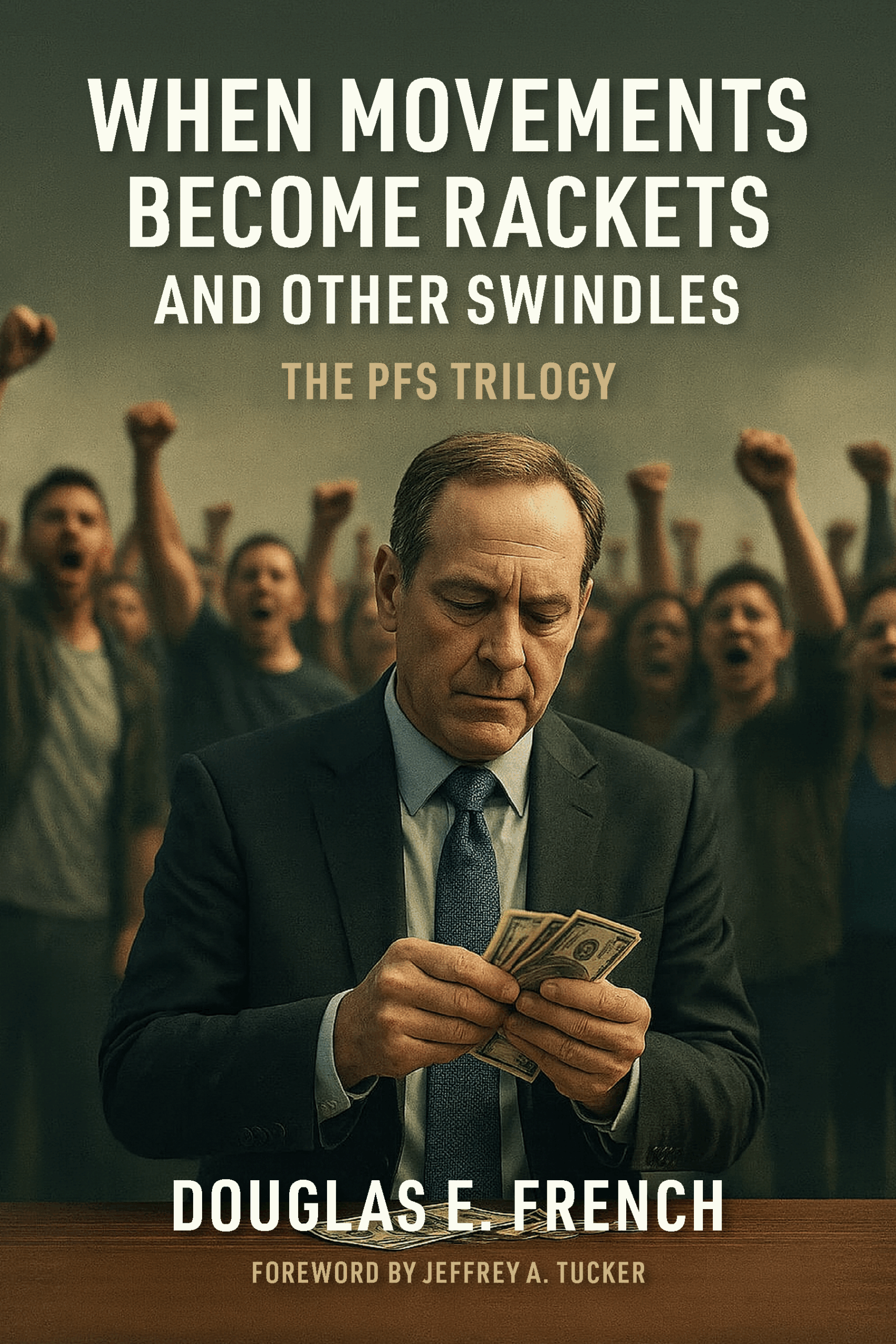
Doug had of course been Rothbard’s student at UNLV,67, and he was the recipient, in 2005, of the Center for Libertarian Studies’ Murray N. Rothbard Award and, in 2012, of the Murray N. Rothbard Medal of Freedom. He also endowed the Mises Institute’s Douglas E. French Prize. The author of several influential books, such as Early Speculative Bubbles & Increases in the Supply of Money, 4th Expanded Edition (Palmetto Publishing, 2024) and Walk Away: The Rise and Fall of the Home-Ownership Myth (Auburn, Ala.: Mises Institute, 2010), his most recent is When Movements Become Rackets and Other Swindles: The PFS Trilogy, Stephan Kinsella, ed. (Houston, Texas: Papinian Press and Property and Freedom Society, 2025), which Hans and I encouraged and supported him in publishing.

When Doug accepted the position as President, Doug and his wonderful, amazing wife Deanna Forbush, both longtime supporters of MI, uprooted their lives and moved to Auburn. Deanna, a successful attorney in Las Vegas working for a Philadelphia firm, managed to move her practice there, no easy feat. Doug was, and is, a wonderful man, and was a great first successor President to Lew’s initial reign. We have since become close friends. He and Deanna are among the finest people I know, and are both long-time supporters of MI. In fact, Deanna was part of the equation when Doug was offered the role of President. She was very important to Burt and Lew. She had purchased coins from Camino Coin and spoke to Burt and George Resch often and developed a relationship with them. With Doug as President, they envisioned her as the First lady of the Institute.

Burton S. Blumert, 1929–2009

Burton S. Blumert, 1929–2009

Under Tucker and then French, MI kept publishing books and under a CC-BY model where possible. They started the Mises Academy, and so on, as noted. Rockwell had been President but the plan was to eventually hire a President. Burt Blumert (who died in early 2009), an early key figure in setting up MI (along with John Denson and others), pushed for this. Blumert was then Chairman and offered Doug the job of President. He moved to Auburn in 2009, with plans to buy a house. His wife Deanna worked to relocate her Las Vegas practice, with a Philadelphia law firm, to Auburn. They sold their house in Vegas. Lew was supposed to turn over his office to Doug and step down. But when Doug showed up, Lew was not happy and not ready to step down; he never did give up his office, then, or under Deist’s or DiLorenzo’s tenure. Grudgingly, he allowed Doug to assume some temporary title of Executive Vice President. Not an auspicious start. But eventually, after a few months, he was officially named President, and Doug and Deanna bought a beautiful house there befitting a new President and his Mises Institute First Lady intending to make Auburn his long-term home. I visited him there after an after-conference gathering shortly after he moved in, and it was on its way to becoming a hub for activity and visits related to the Institute conferences and events. Doug told me, “People asked me what I did at the Mises Institute and I would say ‘All’s I do is make sure Jeff Tucker comes to work.'”

Doug French home, Auburn, 2011

Doug French home, Auburn, 2011; Hoppe, Jeff Barr, French, Lee Iglody, Yuri Maltsev

Doug French home, Auburn, 2011

Doug French, Jeff Tucker, and the MI Website team, Atlanta, 2011

Doug French home, Auburn, 2011

Doug French home, Auburn, 2011. Michael McKay, Andy Duncan, David Howden

Doug tried to expand Mises U, as did Jeff Deist under his later tenure, since there was room and MI had plenty of money. (Most recent filings indicate it has over $80M in assets, as of the end of 2025.)68 Plus Mises U was used to solicit funds from donors, who were happy to contribute to the mission of educating new minds. According to Doug, previously Mises U would take about 80-100 students, and was turning kids away. Doug asked Pat Barnett and others and learned that there was capacity to take more, perhaps up to 140 or so, so he attempted to expand the number of students accepted so that not as many would need to be turned away. This angered Lew. He told Doug that the purpose of Mises U is for MI to raise money. Money was raised from donors to support 140 students but numbers were cut off at 100 so MI would make money. The goal was not to try to break even, but to make as much profit as possible. Doug made the mistake of thinking like a donor, of thinking about the MI’s stated mission.

Mises Institute Supporters Summit 2009 and Awarding of Schlarbaum Prize for Lifetime Achievement in Liberty, Salamanca, Spain (October 21–24, 2009)Now in addition to the ASC and Mises U, MI would hold other conferences throughout the year, sometimes in Auburn, sometimes in other locations, such as Mises Circle events. For example there was an annual Supporters Summit, often held at a resort in some other city, such as the MI Supporters Summit 2009 held in Salamanca, Spain in October 2009, in conjunction with the Instituto Juan de Mariana,69 at which the Schlarbaum Prize was awarded to Jesús Huerta de Soto. (In other years, the prize was given to Hans-Hermann Hoppe, Ron Paul, Ralph Raico, and other Austro-libertarian luminaries. And incidentally, just the next year, I worked with Huerta de Soto, Steve Baker, Toby Baxendale, and others affiliated with MI and the Cobden Centre to try to propose a bill to eliminate fractional reserve banking in the UK.)70

Mises Institute Supporters Summit 2011, Vienna, Austria (Sept. 19-23, 2011)

Mises Institute Supporters Summit 2011, Vienna, Austria (Sept. 19-23, 2011)

Given the success of this event, French’s joining as President soon after Salamanca, the increasing popularity of Mises.org due to Tucker and French’s efforts with open publishing, Mises Academy, and so on, and the need to have an annual Supporters Summit, and the special connection of Austrian economics—sometimes called the Vienna School or Viennese economics—to Vienna, the home of Carl Menger, Eugen von Böhm-Bawerk, Mises, Hayek, Wieser, and so on—and the fact years earlier  there had previously been a MI conference in Vienna —given all this, French and Tucker organized a Supporters Summit in Vienna in 2011.71

Needless to say, it was a very popular and successful event; people still talk about it to this day. I wanted to go but with my career and a young child at home, I was unable to attend. Lew Rockwell was scheduled to speak but canceled. When French got back, Rockwell was not pleased, and he read Doug the riot act. Lew acted like he didn’t know anything about it and had not approved it, even though he had, and had even been scheduled to speak.

In Doug’s speech in Vienna, “Freedom Through Technology,” he had promoted the website and basically talked about how the Mises Institute was going to change the world via mises.org and all the open publishing and initiatives around it. Doug had said that for a lot of people around the world, the Mises Institute begins and ends at Mises.org. The speech incensed Lew. Lew said the speech was terrible and that what donors want is not the website but a building in Auburn.

Of course, the supporters, speakers, and attendees loved the conference, and it was more expensive than most but it still broke even. But most MI donors are locals and Americans, so Lew did not think it made any sense to hold such a conference in Austria, instead of a local one that he thought would be more likely to be attended by local donors.

And then he started fussing at Tucker and French about the book publishing. He wanted them to stop. He told Tucker he had to shut down the book publishing program and run all editorial content by Joe Salerno. He said MI is not Walmart or Amazon.com and was not in the book publishing business. Tucker noted that when LewRockwell.com linked to books available at the Mises Bookstore, Lew would link to the Amazon version with his referral code in the link so that he would get a cut of book sales instead of MI getting a cut via its online bookstore.

Two days later, Tucker gave his notice to take a new position at Laissez Faire Books. As he told me, “It was clear to me that my work there was done.”

It is not quite clear to me why Lew had this volte-face. Perhaps it is because he or MI had purportedly had inherited Rothbard’s copyrights and he started having second thoughts about the open publishing model. Tucker told me Lew said to him one time “this is not the Kinsella Institute.” Perhaps Lew started to regret Tucker’s hype about open publishing and the anti-copyright message I and others had adopted, even though he had previously said of me, in 2008, “He’s really enacted a revolution in this area among libertarians.” Even though he had broached the topic of becoming President with me years earlier. Even though he/MI had praised me, and invited me to lecture many times, given me an award and Senior Fellow status. Maybe he was parroting Tucker’s pro-Kinsella/anti-IP line, and never really believed it, and was starting to regret it. Maybe he is just fickle. I have been told that because he agrees to something and then later criticized staff for then doing it—as when French moved to Auburn to become President and Lew resisted this, after extending an offer to him—staff got in the habit of making him sign something as proof that he wanted something done, so that this could be produced later if he changed his mind and denied having agreed to it (see the Vienna example above). I don’t know. I was unaware of all this at the time.

It also could be—and this is just a guess—that David Gordon had some role in this. When Rothbard took Hans under his wing in 1985 and started promoting Hans and his argumentation ethics, he was the only voice in the Liberty symposium commenting on it to wholeheartedly endorse it.72 Most others were critical. David Gordon also had a comment;73 it is not critical, but says very little. It is basically noncommittal. I noticed this when it came out but no one else seemed to. I noticed over the years Gordon has studiously avoided saying one way or the other. I developed the view, which I still hold, that Gordon does not agree with the argument nor with Rothbard’s ringing endorsement. But he did not want to dissent in public from Rothbard’s praise, so he simply said something vanilla, noncommittal. It could be that he was not happy about Hoppe moving to the US in 1985 and working closely with Rothbard for his final ten years, but could do nothing about it. The same could be true, to some extent, of Lew. I don’t know.

When my IP ideas caught on and had influence at MI, it also involved my criticism of Rothbard’s mistakes on IP.74 (I have also pointed out some missteps in his revolutionary and pioneering title-transfer theory of contract. If I may be allowed to use the verboten term “revolutionary.” Ahem.)75

Maybe Gordon didn’t like this. Maybe Lew didn’t. For some reason he began to try to promote Butler Shaffer’s far inferior and later, unsystematic work on IP.76 Maybe he was acting as Lew’s attack dog, or maybe he sensed this would please Lew, given the growing tension between Tucker and Rockwell in Tucker’s final years at MI, and given Lew’s snide comments to Tucker that MI is “not the Kinsella Institute.”

In any case, when he was ordered to put the brakes on the publishing project, Tucker quit, as noted, in November 2011. Rockwell hired Danny Sanchez to replace him. All publishing decisions were run through Sanchez, going around Doug. Doug was nominally President but kept finding out things second hand. One day Lew said things aren’t working out. Doug agreed, and so he quit.

Kinsella Out

Now as previously noted, I was not aware of much of this. I stayed friends with Jeff Tucker even though he was increasingly bad-mouthed by those still associated with the Institute. Hoppe did as well, and in fact invited Tucker to attend PFS in 2012.77 And I stayed an increasingly close friend with Doug French, who was also a regular and founding member, with me, of the PFS. Hans and I were both independent paid no heed to subtle pressure to break with our old friend just because some people at MI were badmouthing him.

Little did I know that resentment among some at MI had been building against me for some of the reasons mentioned above. Perhaps because Tucker had promoted my anti-IP work too excessively in his attempts to justify his open publishing programme; perhaps because I refused to join in the blacklist of him; perhaps because I had had the temerity to point out Rothbard’s mistakes on IP.

oral history david gordon part 1 2023-10-04But it became apparent that I was no longer one of their inner circle, that my ideas were not, in fact, embraced by the major figures at the MI, when, in an October 4, 2013 interview of David Gordon by Joe Salerno and Lew Rockwell, Gordon went after my IP and other views.78 This was in the aftermath of Jeff Tucker’s and Doug French’s departure from MI in 2011 and 2012, and was in the first 7 or so minutes of Part 2 of a two-part, two-hour entry in their “Oral History Project”—the entry focusing on Rothbard.79

Gordon basically said Tucker had promoted the idea of the Kinsella IP revolution but that it was not, it was just my building on some previous critiques of IP. As he said:

Salerno: David, what’s your general position on IP? Or can you give us a criticism of sort of the anti-IP position?

Gordon: Oh, yes. Well, I agree, as in so many things, with what Murray Rothbard’s view, and as he said in Man, Economy, and State, his view was that patents and copyrights both are acceptable only to the extent that people could arrive at the protections they provide by contractual arrangements on the market.

And patents generally would be very difficult to get under that. But copyright, you thought you could get some but not all the protection of copyright by just having agreements to say, if you sold a book, the person got it, couldn’t reproduce it, and then that person would have to incorporate the same proviso into any sale that he made of it.

And at the time Murray was writing in 1962, there was quite a good deal of discussion of patents in the economics literature. I think Fritz Machlup discussed it, other people. And the argument Murray had on patents was you couldn’t really show that patents were necessary for economic progress. This seemed to be kind of a consensus position. At least a lot of people thought that it was very difficult. People might think, you know, when they first hear about patents, “don’t you have to have patents so inventors will have some incentive to invest?” But it doesn’t turn out to be that way.

But when Murray wrote about this, although that was certainly his view, he didn’t attach overwhelming importance to that. It’s just a couple pages in Man, Economy, and State. It wasn’t one of the bases of a free society that we don’t have standard patents and copyright.

But after Murray wrote, there were several libertarian writers, including Sam Konkin and Wendy McElroy, also Tom Palmer, who wrote general criticisms of intellectual property just as part of a libertarian political philosophy. But in recent years, there’s been a great deal of emphasis in certain quarters on being against intellectual property. Jeff Tucker, who is one who has had a number of articles—he’s promoted what he calls the Kinsella Revolution. And what this involves is that Stephan Kinsella published an article on patents and copyrights. And this was, I think, originally in the Journal of Libertarian Studies, and then it had been reprinted as a small book. It had been translated into Italian, maybe other languages.

But he summarized a lot of the standard anti-IP arguments, most of them taken from Tom Palmer. He had, in my view—some of the arguments weren’t all that good. In any event, that article, that was pushed by Jeff Tucker, attracted a great deal of attention. They have the view, which I don’t see any basis for, that abolishing IP, particularly ending copyrights, would promote some sort of tremendous growth in the economy. That there’d be avenues of information would suddenly become available to people. And as far as I can see that’s just claims; I don’t see any basis for it. There is a book that came out by Boldrin and Levine that I reviewed with critical patents and copyrights and I thought they had some reasonable arguments. They suggested, maybe if copyrights were abolished we shouldn’t think that people would stop writing, there are other ways writers can earn money other than by having copyrights on their books—but they didn’t claim there’d be some kind of enormous benefits just by ending copyright.

So in my view, the whole issue of IP has been blown totally out of proportion. It’s one issue, but it’s not one of the central issues of libertarianism like opposition to war or sound money. It’s just a minor point that’s been blown up.

And also, there isn’t, in my view, a Kinsella Revolution.

Salerno: Just to add on to that, Mises in Human Action pointed out that patents were a monopoly, and whether or not society should have them is a matter of efficiency. And Hayek later on said that regarding copyrights, that it’s a state intervention that creates a class of people that live on books, and he didn’t know whether that was a good thing or not.

But to follow up, I understand with the Rothbardian proviso, what if someone were to say, someone who is anti-IP, well, you really can’t have this because that would be already presupposing the right, that you have the right to prevent anyone from copying. How would you respond to that argument?

Gordon: Actually, that’s an argument Kinsella uses in his article. But in my view, it isn’t a very good argument because, see, what he says is you’re begging the question in favor of IP. If, say, you took it that the author doesn’t have the right to control who copies it—suppose you start with what Kinsella would want—everybody has the right to copy whatever they want—you would still have a contract: someone would give up that right on condition that the person selling him the book. As a condition the person selling him the book. So I think Kinsella is wrong there in saying that the copyright arrangements who contract are begging the question in favor of IP that that argument just doesn’t work.

Salerno: Yeah, it seems very weak.

Gordon: I will say, going on a limb, you’ll find, if you look at many of Kinsella’s arguments on political philosophy, there’s something wrong with the argument. In my view, he will take certain figures, he’ll say, oh, Mises, like he said, for example, he said Mises’ view on creation of money was that it was just a historical point that money had originated from a commodity, but Mises didn’t think that it had to originate that way. And that Mises did think that, and he gets things wrong on what Locke said, and other people, so generally when he takes an interpretation of somebody, it’s very often wrong.80

I guess I was not too surprised by Gordon, at this point, who seems to be sort of a snake or two-faced, and given my suspicions about his noncommittal review in Liberty, in 1988, of Hoppe’s argumentation ethics. I mean it is still odd to do so in the first 7 minutes of part 2 of a 2 hour oral history of … Rothbard … and to aim it at an existing MI Senior Fellow.

But I was more surprised by Lew and Joe. I was sure they both agreed with my IP views, even the previous history I have recounted above. Lew had previously said that I had “really enacted a revolution in this area among libertarians.” Now, to be clear, have never made such a weird claim; but Lew did. And here he is on a podcast about Rothbard, with Salerno, who is also anti-IP—you know, the one who invited me to be a Senior Fellow, after they invited me at least three times to come lecture on IP at MI—chortling along, or at least not disagreeing, when Gordon mocks the idea?

Yet when Gordon said:

So in my view, the whole issue of IP has been blown totally out of proportion. It’s one issue, but it’s not one of the central issues of libertarianism like opposition to war or sound money. It’s just a minor point that’s been blown up. … there isn’t, in my view, a Kinsella Revolution,

… Lew said nothing. WTF.

The same for Salerno; he even seemed to join in, agreeing at one point that, of David’s critique of my criticism of Rothbard’s proposed contractual-common-law-copyright/patent-IP scheme,81, “Yeah, it seems very weak.”

Again, WTF. Are they now pro-IP? The new restrictive copyright policy sure would seem to indicate this (see the section Open Publishing Abandoned below). Shades of Tom Palmer, an early anti-IP pioneer who also seemed to have crawfished later on on IP!82

So against this backdrop, I was flabbergasted and surprised by these comments. Now I hasten to add that think Gordon is confused about and wrong here, but that is really irrelevant. Everyone thinks of David Gordon as some rare genius, but he is basically just an odd character with an above-average memory, but in any case, he is deeply confused and simply wrong on the IP issue—if he is even sincere in what he was saying.83 The point is they went after me like this.

Perhaps Lew had another agenda, and wanted to erase the history of Tucker at MI, and I was connected to that. I don’t know. As for Salerno, I had thought of him as a friend. I have often referred to him as one of the few High Praxeologists—along with Hans Hoppe, Guido Hülsmann, Jeff Herbener—those who “swim in the plasma of praxeology”—i.e., those who actually use and apply praxeology and integrate it into their work, rather than occasionally sprinkling the term into their comments. (( See Kinsella, “Mises, Rothbard, Hoppe: An Indispensable Framework,” n.54 (quoting Kinsella, “Afterword,” p. 571):

Many scholars influenced by Mises and Austrian economics give praxeology—Mises’s apriori logic of action—lip service. But more so than any other living thinker, Hoppe actually applies praxeology, one of the most powerful modes of scientific analysis yet discovered. It permeates his writing. His reasoning is rooted in it. Hoppe swims in the plasma of praxeology. ))

Hoppe also, like me, respects Salerno’s scholarship. He praised Salerno’s “genuinely excellent” book Money: Sound and Unsound,84 and wrote “I had considered Salerno and still consider him the foremost contemporary monetary theorist in the Austrian tradition.”85 Yet I had heard about him being two-faced. For example, according to Tucker, he and Salerno were sitting in the room organizing an upcoming Mises U, and they were discussing inviting me to do a series on law. Salerno enthusiastically agreed. A few minutes later, Lew walked in and pulled up a chair, and Tucker mentioned that they were planning a law track taught by Kinsella. Joe interrupted and said Kinsella is not an economist and should not be speaking at Mises U. He instantly flipped his position. So I guess it is not that surprising that he also seemed to follow Gordon’s lead and join in the attack, even though he had previously agreed with me.

A few days after the podcast came out (Oct. 4, 2013), when I became aware of it, I mentioned it in a Facebook post (Oct. 8, 2013) (see screenshot below). I described what had been said.

Kinsella facbook post 2013 gordon criticism

Kinsella October 8, 2013 Facebook Post

By the way, here are some of the comments on that post:

Just to let you know, you converted me from my IP-loving ways a few years back. And now I can’t imagine why anyone would support IP laws. It seems logically inconsistent for libertarians to support IP. (Ash Smith)

Salerno and Gordon are no surprise, but Lew? (Michael Barnett)

I’m surprised by all of it. They aren’t convinced. We need the full Kinsella argument in a full length treatise. (Collin Sleuth Knight)

I’m actually most surprised by Gordon. (Matt Gilliland)

there totally IS a Kinsella revolution! (Anna Christa)

Kinsella played a key role in getting me to let go of IP. Today we published a paper in Nature Biotech describing a method to navigate 1000s of gene patents.

Sadly the article is behind a paywall but I felt this topic was best broadcasted in the arena of the IP believers…lest I waste time preaching to the choir
… I am hopeful someone will Aaron Swartz it.86

If Gordon thinks its ‘no grand insight’ to view IP in this light who cares? He did zero to convince me of the fallacy of IP. Kinsella is making an impact on others by building a sound and rational argument against IP to the point where its motivating others to change their actions on it. My post above is proof of that. If Gordon knew this all along he was less effective at convincing others of it and its really irrelevant ego driven criticism centered on ‘who had the idea first’ type of criticism. A priority date argument is circular logic in any discussion about the fallacy of IP.

I finally listened to Gordon’s 7 minutes and I think he lacks information in regards to the negative impact of IP. I wrote a blurb at the daily Paul [McKernan: “The EpiGenome and the freedom to read your own genes” (2013)] which highlights how IP hinders ones ability to read your own genome and how this is a very big deal considering we now have the tools to read everyones and personalize medicine. The ability to read ones own genome is as important as bitcoin in that it enables freedom from the medical grid and it is the lockean equivalent of owning yourself. It’s not as obvious today but will become so over time as people recognize how life extending this technology will become. For him to state the anti-IP position is overblown is simply to not understand the hindrances it causes.
(Kevin McKernan)

tldr; Gordon proves that he’s not much of a thinker. (Michael Mogren)

Now at this time, Peter Klein, whom I also thought of as a friend, was the temporary acting Executive Director (see archived Faculty and Staff page), bridging the gap between French’s departure in 2012 and late 2013, when Jeff Deist joined as President to succeed French. I remember discussing with Klein his decision to take on this temporary role. He was not interested in a permanent position; he was able to take a two-year sabbatical from his teaching position. Probably he did not want to give up a secure job as a professor to a permanent job as President of MI, given how French’s job had only lasted a couple years under the fickle Lew Rockwell.

In any case, after my Facebook post pointing out that MI had posted a podcast attacking me, Peter messaged me to ask me if I thought it was appropriate for a Senior Fellow of the Mises Institute to be criticizing other senior members of the MI. I was thinking, umm, what’s actually inappropriate is for them to be attacking me, their Senior Fellow. What they should have done was apologize, cut out the inexplicable attack on me, and re-post the podcast and focus on Rothbard. But I said you know, Peter, you’re right—remove me. Purge away, boys. I did not want to be associated with these snakes. I had had enough. I had bought and paid for my independence; now I was going to spend it. So I was no longer a Mises Institute Senior Fellow. My decision to stay independent, and to be my own benefactor, paid off yet again.

After an earlier post about this incident last month,87, I was sent this note:

I listened to the 7 minutes of David Gordon bashing you on IP. It’s important to understand this was not about ideas or arguments, but rather about excommunicating you. A decision had been made for whatever reason; the IP discussion was just a convenient way to declare to the world: “Kinsella Bad.” If you were in their good graces David would have praised you for developing Rothbard’s nascent ideas on IP.

So I feel like now I am in good company. At least I was removed by a communication with the acting Executive Director, a fellow scholar, not a couple of non-academic temporary staffers, as Hoppe was.

Aftermath

I was not really bitter about it; I didn’t need these people, really, after all. I stayed close with Hoppe and PFS and French and Tucker, and did my thing. I figured fool me once, shame on you; fool me twice… In other words, I merely adjusted and realized, …. okay, that’s who you really are. Good to know.

The ASC, which began in about 1992, was terminated after Tucker left. It was split, for no clear or stated reason, into the terribly-named Austrian Economics Scholars Conference (AERC) and the at first sporadic and occasional Libertarian Scholars Conference (LSC), which appeared to be a revival of an older LSC put on by Rothbard’s and Blumert’s Center for Libertarian Studies.

For a while I entertained the half-paranoid suspicion the reason MI split the ASC into the AERC and LSC was to keep me away. The ASC was interdisciplinary, so legal and libertarian scholars like me were welcome along with economists and others. I had been a regular fixture at ASC so, I thought, maybe the thinking is I won’t attend the AERC, which is economics-focused, and the new LSC will be only sporadic and occasional anyway. But this is a bit too narcissistic and conspiratorial. Tucker thinks the reason such changes were made—changing the ASC; changing the name of the Mises Daily which he had pioneered (and which I had named); changing the blog format and comments policy and copyright/open publishing policy—was all to erase and memory hole his influence there. (As I surmised in Mises Institute Oral History Project: The Lost Rothbard History (2013), “After Tucker and French left—the main purpose of the Oral History Project and other changes was, perhaps, to rewrite the MI history minus their central roles.”) Who knows.

But in the end, I even half-made up with MI later (see below), more or less, and even spoke at and sponsored some of their events; but it was now with eyes open, and I was never really an insider anymore, as I had been for several years.

One brief aside. After this happened, other than complaining to Hoppe and Tucker, I was mostly quiet about it. Hoppe was incensed, but there was not much he could do. I had already nuked the relationship. I was talking to Walter Block one day much later and he said something about me being a fellow Senior Fellow. I corrected him and explained that this was no longer the case. I told him what happened. As I recall, he was fairly silent, and just changed the subject and moved on. When Walter was himself recently ousted from MI and condemned by Hans because of Walter’s pro-Israel views,88 in an email where he was complaining about this, I reminded him of this: that when I had basically been driven out, he didn’t seem to care. He did not reply.

Dipping One Toe Back In

Hoppe, Kinsella, and Michael Malice’s toy helicopter, Mises 35th, Baccarat Hotel, New York, October 7, 2017

After I righteously rage-quit in 2013, I steered clear of MI and went my own way. I continued to write, speak, attend PFS and other libertarian events, as usual. But four years later, in 2017, MI was holding its 35th Anniversary Gala in New York City (Oct. 6–7, 2017), in honor of Rothbard. Like Doug French, I’ll do anything to promote and celebrate the memory and ideas of Rothbard. Hoppe was giving the keynote dinner speech, “Coming of Age with Murray,” and it promised to be an elegant affair, and in one of my wife’s and my favorite cities. Because of my wife’s busy career and different interests she could rarely attend any of my libertarian events. She only met a few of my MI-associated friends on the occasions when they passed through Houston and stayed at my house. So in this way she had met Tom Woods, Jeff Tucker, Guido Hülsmann, Doug French, and so on, but never yet Hans.

Doug French, Joe Becker, Lee Iglody, Jeff Barr, James Yohe, “Murray in Las Vegas” panel, "Conversations About Murray" Sessions (Oct. 7, 2017), Mises Institute 35th Anniversary Gala in New York City

Doug French, Joe Becker, Lee Iglody, Jeff Barr, James Yohe, “Murray in Las Vegas” panel, “Conversations About Murray” Sessions (Oct. 7, 2017), Mises Institute 35th Anniversary Gala in New York City

Kinsella's wife meets Ron Paul, Mises 35th, Baccarat Hotel, New York, October 7, 2017

Kinsella’s wife meets Ron Paul, Mises 35th, Baccarat Hotel, New York, October 7, 2017

So I wanted to go. But I had self-deported from MI in 2013, so to speak. I was whining about this to my wife and she said well aren’t you buddies with Hoppe, and isn’t he a big-shot at Mises and tight with Rockwell? Yes, I conceded. Well, ask him to feel it out for you. So I called Hans; he called Lew, said Kinsella wants to come, is it okay? Lew said sure. So I went, and my wife did too, and we had a grand time. We had a nice dinner with Hans and Guido and their wives at Il Gattopardo one night.

Dinner, Il Gattopardo, Hülsmanns, Kinsellas, Hoppes Oct. 6, 2007

I then started attending Mises Events again, on occasion. A couple times, as noted above, I was informed by Kristy Holmes I could sponsor a speaker or event, or that if I wanted to attend VIP receptions I would need to contribute some large sum, like $10k. For example, at the MI’s 40th Anniversary Supporters Summit (2022):

The cost (exclusive of room and incidentals) is $495 for Mises Institute Members and $595 for nonmembers. Registration includes: a reception and dinner Thursday evening, all meals Friday (including a black-tie optional dinner), and all sessions and lectures. Society and Gold Club Members also attend two VIP receptions.

I did this. Also for the Supporters Summit 2021. For others I was invited to sponsor a speaker, as when I was invited to speak on a panel at Austrian Economics Research Conference 2019 on “The Significance of Hans-Hermann Hoppe” (more on this below), several others and I donated $500 each.89 For the 2024 Human Action Conference, styled “75 years of Human Action,” I was invited to sponsor Hoppe’s Keynote Lecture, “My Discovery of Human Action and Mises as a Philosopher.” I split this $15k donation with Greg and Joy Morin.90 Hans never received these funds or even plane fare; he paid his own way. At the dinner we sponsored, I and Lew were sat next to Hans but Greg and Joy were relegated to the far end of the table, which was odd. When Greg raised the issue with Kristy later, he was blown off, even though he was on the (fake, outsider) Board and a major donor. It became clear that it was always about money. Even if I was a sort of VIP or attraction myself and had help MI in innumerable ways—with the JLS, Mises Academy, and so on—if there was a chance to soak someone who could pay, soak ’em.

As I noted above, by then I was used to this kind of treatment. I only spoke one more time there, in 2019, when I was invited to appear on a panel on The Significance of Hans-Hermann Hoppe, on the occasion of Professor Hoppe’s 70th birth year.91 Just as Doug (and I) will participate in anything that promotes Rothbard, I will also participate in anything honoring Hans Hoppe. I agreed to attend (on my own dime, of course) and also to sponsor the panel when asked.

Mises Institute, 2019 Austrian Economics Research Conference (AERC), Mises Institute, Auburn, Alabama (March 22–23, 2019), Panel: The Significance of Hans-Hermann Hoppe, on the occasion of Professor Hoppe's 70th birth year

Kinsella, Panel: The Significance of Hans-Hermann Hoppe, Mises Institute, 2019 Austrian Economics Research Conference (AERC) (March 22–23, 2019)

Kinsella, Panel: The Significance of Hans-Hermann Hoppe, Mises Institute, 2019 Austrian Economics Research Conference (AERC) (March 22–23, 2019),

Kinsella, Panel: The Significance of Hans-Hermann Hoppe, Mises Institute, 2019 Austrian Economics Research Conference (AERC) (March 22–23, 2019)

Also at one of these events, as I mentioned earlier, Judy Thommesen and Timothy Terrell approached me and said that MI was ready to resume regular publication the JLS, whereupon I and editor Matt McCaffrey decided to cease publication of Libertarian Papers, in 2018, after ten years of publication, and turned over the pending articles and our referee contacts to Terrell.92 Ever since then I have served—and still serve, to this day—as a volunteer outside referee for submissions to the JLS. For me, it is the libertarian enterprise and the ideas of liberty, justice, and sound economics that matters. I am always in favor of doing what we can to promote, spread, and develop libertarian theory and our ideas.

The Post-Tucker Era

As I hinted at above, under Tucker’s initiative with Mises.org and with French after he joined in 2009, and until 2012 after both Tucker and French had resigned, instead of continually improving, as it did from 1982 to the mid-1990s and especially from the late 1990s to 2011, MI has declined in several ways.

Losing Presidents

First, after losing both Tucker and French, MI lost two excellent Presidents: Jeff Deist, who served from late 2013 to 2023, and Tom DiLorenzo, who served from 2023 until he was terminated only a year and a half later in 2025. All three were excellent and did what they could to keep improving MI, but due to various tensions and conflicts in goals and values, board structure issues, and other problems as discussed in Hoppe’s Quo Vadis article, all three were lost. All three were substantial figures in the Austro-libertarian movement, and all three uprooted their lives to move to Auburn, in high hopes of being part of its mission and helping it move forward and grow. Frankly, to me, the way they were treated is an outrage. All three deserve apologies.

Canceling Programs

Under Deist’s 10-year tenure, he supported programs such as the E4B, or Economics for Business program that was being developed by longtime MI supporter Hunter Hastings,93 as well as the attempt to start an accredited graduate school offering a M.A. in economics, spearheaded by longtime MI supporter Joe Becker.94 This was all ultimately opposed by Rockwell et al., as a waste of money, one of the reasons that contributed to Deist quitting, as noted in Hoppe, “Mises Institute: Quo Vadis?” This led to the termination of the graduate school and of Becker (both Deist and Becker now work at Monetary Metals).

The loss of the graduate program was especially tragic. It actually had been a longtime dream of Ludwig von Mises to establish such a program, potentially at University of Chicago. In fact I recall years ago, probably around 2000, when a group of us had several meetings and did research on the viability of setting up an accredited graduate program in Austrian economics. I recall going a good deal of research myself on the arcane and difficult accreditation process. As I recall, a number of us were involved in this early effort: Guido Hülsmann, Hans Hoppe, Joe Salerno, me, and a couple others. But it looked to be almost impossible, so we shelved the idea.

So I was delighted when Deist and Becker revived the idea 20 or so years later. I still thought it was an uphill battle, but with resources—and the MI, of course, has plenty—and a full-time person (Becker) working on it, it was worth attempting. Salerno and Mark Thornton hated the grad school project from day one; it meant actual work for them. For example, adjuncts had to be hired to actually teach each class, the applicants, who were first thoroughly scrubbed and recommended by Joe Becker, still needed to be reviewed and assessed, which would require work from Salerno and Thornton who, after all, were on staff and paid by MI. Rockwell and Pat Barnett expressed enthusiasm for the program at first, but the Kristy Holmes didn’t think it helped fundraising, so what was the point? Some students actually made it through the full 2 years (complete with graduation ceremony to thrill donors) before it was immediately abandoned on Deist’s departure in 2023.

Pointless Name Changes, Website Changes, and Journal Confusion

In addition, as noted, various changes were made for no clear reason, such as changing the name of Mises Daily to Mises Wire, getting rid of comments on the blog and on articles, and also deleting all the massive troves of interesting and insightful comments on past blog posts and articles. The link structure to many books and articles was changed, but without redirects, so that users often encounter 404s. It is difficult to find material now. The JLS, for example, is separated into two parts now: older, and newer, articles. The Library—>Periodicals link (https://mises.org/library/periodicals) at the menu bar at the top links to older issues of the JLS (https://mises.org/library/periodical/journal-libertarian-studies) while a link at the bottom footer goes to newer JLS issues (https://jls.mises.org/) apparently hosted by Scholastica. The older issues are no longer sorted by issue or volume, so it is almost impossible to find some articles. And nothing on the home page explains why there are two different links to these two archives of JLS articles. The QJAE is also bifurcated for no reason.

Open Publishing Abandoned

Under Tucker’s tenure, a CC-BY notice was displayed on the site, implying that all content was CC-BY. CC-BY, meaning “attribution only” (you have to say who the work is “by”), is the least restrictive Creative Commons license; I sometimes use CC0 but its legal enforceability may not be clear and I think CC-BY is a perfectly reasonable choice if one’s goal is to spread one’s ideas, and to make it easy for others to republish and translate your material. Otherwise, with a normal copyright, or a more restrictive CC license, permission would be required to re-use the material.

After Tucker and French left, the previous CC-BY notice was quietly deleted and is only now used sporadically. As of this writing, MI uses a patchwork of creative commons license, sometimes CC-BY but sometimes more restrictive licenses. The JLS site (well, one of the two) asserts:

Open Access Licensing and Copyright
Since volume 23 (2019), papers have been published under a Creative Commons CC: BY 4.0 license. The full text of all content is available for free and open access without delay.

The QJAE policy is similar.

However, recent books, such as Ralph Raico’s The Struggle for Liberty: A Libertarian History of Political Thought (Auburn, Ala.: Mises Institute, 2025), are published under a Creative Commons Attribution-NonCommercial 4.0 International License, or CC-BY-NC. NC—noncommercial! It’s a bit ironic—or one might say, confused—for a pro-capitalist, pro-free market Institute to adopt a policy discriminating against activity done for (monetary) profit. What’s wrong with someone making a profit, for Heaven’s sake? Why is it okay for someone to copy my work attempting to spread the ideas of liberty but only if they don’t make a profit off of this? Not to mention the incoherence of the distinction, for Austrians at least, between usage done “for profit” and “not for profit.” After all, all action is aimed at psychic profit. Even action aimed at monetary profit has psychic aspects. The distinction between “commercial” (or for-profit) and “noncommercial” use makes about as much sense as the distinction between private and public goods, another distinction Hoppean-Misesians reject!95

The Mises Wire‘s copyright license policy is even worse; the Reprints, Permissions, and Copyright for Mises Wire Articles page specifies that “Mises Wire articles are published under the Creative Commons Attribution-NonCommercial-NoDerivs 4.0 International License,” or CC BY-NC-ND.

The Three Mises CC Licenses: One Good One and Two Evil Ones

The problem here is that because of the NC copyright license limitation used for Mises Wire and in recent books, this material cannot be used for profit or commercial use—meaning any website that has ads, or any publisher that is for profit, does not qualify. And the -ND limitation in the CC-BY-NC-ND license used for Mises Wire articles means no derivative works, such as translations, can be made. So in practice, the CC-BY-NC and CC-BY-NC-ND licenses are almost the same as a standard, restrictive copyright, but unlike a normal copyright usage, which does not pretend to be open, givefs the false impression that open publishing is being used, when it really is not. Most users and readers are not familiar with the arcana of copyright and CC licenses so obviously do not realize the implications and significance of this change. Which is why they get away with changing it with only me shouting in the wind.

In fact, I was recently talking to Manuel Ogando, who runs Mises.pt. I noticed a CC-BY-NC-ND license on one of its articles (see archived snapshot). Even more confusingly, the CC-BY-NC-ND image actually linked to the CC-BY license at Creativecommons.org. Knowing he is Kinsellian on copyright, I asked him why he was using the evil, illiberal CC-BY-NC-ND license image. He told me he had simply copied what was on Mises.org, assuming this was the old open-publishing model. After I corrected him, he modified mises.pt display the correct CC-BY image. But this is what happens when you reverse course and betray your principles—people who admire you will follow your lead.

The status of other works at Mises.org is uncertain since there is no footer or notice applying a particular licensing policy to the whole site so presumably some material at mises.org is still under normal copyright protection.

These changes have led to confusion and backtracking. For example my 2005 Mises Daily article “There’s No Such Thing As a Free Patent,” Mises Daily (March 7, 2005) has no notice at all and does not appear to be covered by the Mises Wire policy. As there is no overall copyright page on the site setting a default policy or CC-BY footer covering the whole site anymore, the reader has no way of knowing. This means that anyone wishing to re-use material on the site has to assume it is covered by copyright and that permission is needed. In other words, there is no clear CC-BY policy at Mises.org except for JLS and QJAE articles.

I did talk to Judy Thommesen and Timothy Terrell in 2018 or so when I agreed to close down Libertarian Papers as the JLS was resuming regular publication, and explained to them that after Tucker left in 2011, the MI website had seemed to crawfish on its formerly open publishing and CC-BY policy. Perhaps this is why the JLS and QJAE still employ CC-BY, while the rest of the site is either in limbo or uses more restrictive policies. Or perhaps one reason the name Mises Daily was changed to Mises Wire was so that new articles could be covered under the CC-BY-NC-ND license. Or maybe they are in disarray and the left hand does not know what the right hand is doing. Who knows. But after several complaints by me which were ignored, and knowing I am somewhat of a specialist in IP, it is obvious that they do not care if they have an open or even coherent copyright policy.

I should note that once material is published under a permissive CC-BY license the publisher technically has no right to reverse this; but as I have noted, this is one problem of CC licenses in general; there is no bargained and signed license agreement so users have no easy way of proving they did have a license.96

Because copyright law is arcane and unnatural, everyone gets it wrong. Copyright notices tend to be inaccurate all across the publishing industry, especially nonprofits and think tanks. And in fact, some of my own material published at Mises.org and in their journals have incorrect copyright notices. If an author does not assign copyright in writing to a site or journal he retains copyright. So it is simply factually incorrect, and legally ineffective, to state “Copyright Mises Institute” on, say, a work I wrote. MI would only have a license to publish it, but I retain copyright. This is one reason that I posted my own PDF of the MI’s version of my AIP which strikes out the MI copyright notice and includes a CC0 license.97

One final note here: it is actually potentially criminal, under 17 U.S.C. § 506(c), to put a “Fraudulent Copyright Notice” on a work. So if I were publishing others’ work, I would not falsely put a copyright notice on it stating that I held the copyright instead of the author; nor would I change a previously granted CC-BY copyright notice to a more restrictive one, giving the false impression that the user is not free to copy under the initial CC-BY license. But that’s just me. On the other hand, I would never want to try to make a copyright license narrow on purpose in the first place.

Moving Forward

The problems highlighted in Hoppe’s article concerning the MI structure are probably one source of this decline. In one way, this a natural result of what has been called “Founder’s Syndrome.” After over 40 years, and with the founder in poor health, and after losing three solid Presidents in a row, it is time for a change.

In addition, the current structure of a “real” or insider board of “subscriber members” who can terminate the “outside” or non-subscriber members, and where the real/insider board is populated by Rockwell, relatives and close associates, seems to have contributed to the problem.

Another is the nature of non-profit organizations in general. They operate without clear profit and loss signals and constraints and if successful at fundraising it is almost inevitable that the mission becomes preserving the funds and fundraising and having comfortable jobs for oneself, one’s family and cronies. In addition, to qualify as a non-profit and maintain public charity status, and avoid being classified as a private foundation, the organization must meet the “public support test.” This requires the organization to receive at least one-third of its total support from the general public, measured over a rolling 5-year period.98 This rule effectively forces many public charities to engage in ongoing fundraising, even if they have substantial savings or endowments. If the organization fails to meet the test it is automatically reclassified as a private foundation. This results in excise taxes, a requirement to distribute roughly 5% of non-charitable-use assets each year, more complex filings and compliance costs, and limitations on self-dealing and less flexibility compared with public charities.

In any case, if MI is to have a President, he has to have authority to implement his decisions and vision, and support and guidance from the board, and one where his subordinates (such as Salerno) are not also on the board. The President also needs to have the authority to fire and replace employees if necessary.99 I am no expert in such matters, but it seems to me it is time for something to change so that a quality President can be hired who knows he has not only the responsibility and opportunity to try to make a difference, but the authority needed to do so. To get a quality candidate, he needs to be reassured the same fate that happened to French, Deist, and DiLorenzo will not befall him, and do to this, it seems obvious that the concerns expressed in Hoppe and Hülsmann’s 2025 memo100 should be addressed.

Board Structure and Composition

This would mean, most importantly, changing the board structure to a real board, not one bifurcated into “subscriber” or inside members and outside board members who can simply be terminated by the inside board members. The current MI Board and Finance page confusingly refers to “Independent Voting Members” and “Affiliated Voting Members,” a nonsensical distinction. In reality, as noted in Hoppe, “Mises Institute: Quo Vadis?”:

the real board consists of an “inner” board of five permanent or “Subscriber” members; these are the board members exercising true control of the organization. Next to Lew, the “inner” board includes, most problematically, Joe Salerno (a paid employee); Peter Klein, Professor at Baylor University, but also on the MI payroll as so-called Senior Academic Advisor and Salerno’s sidekick; and then there is Lew’s sister and his sister-in-law (whose son and daughter-in law are Institute employees).

The other board members appear to have no real power and are mostly window dressing, since the inner board members can exercise an ultimate veto in that they can remove any other non-subscriber board member (as we saw with Judge Napolitano); the outside board members include Ron Paul, age 90, John Denson, age 90, Don Printz, age 85, and three low-profile donor-businessmen, Steve Torello, Mark Murrah and Yousif Almoayyed.

It is a joke to claim that this inner Board could or would exercise any serious control of the inner workings of the Institute’s new executive directors given that over half of that group are paid employees of the organization or have close ties to such employees. Even if there is no self-dealing the very structure invites that temptation while appearing suspicious to any outside observer. That this structure is obfuscated by a surrounding layer of “outer” board members is telling.

In my view, the current board structure should be changed (which would of course require support of the current five inside board members, which is unlikely) to a normal, flat board structure. This board would have no employees, family members, and so on, but would consist of significant donors with some business savvy, and other suitable members such as significant intellectuals who share the Institute’s values and mission (such as: Hans-Hermann Hoppe and other relevant significant, trusted Austro-libertarian Misesian-Rothbardian scholars), those with relevant expertise in finance, fundraising, marketing, management, strategy, and legal affairs, and so on. In this case, given the MI’s embattled history and its loss of three past Presidents who all faced and witnessed problems at MI, I would suggest the new Board include also all three of these former Presidents: namely Doug French, Jeff Deist (also, helpfully a lawyer), and Tom DiLorenzo.

Employees and Board Composition

No employees would sit on the Board; the President or other Executive Director or CEO would serve as a non-voting ex officio member. No Board members would receive compensation, including the Chairman (Lew Rockwell currently receives a salary of $215,614, according to the most recent ProPublica Report, Mises Institute, which appears to be very non-standard in the nonprofit world).

Foundation vs. Public Charity

If all this were done, the Board ought to bring in sufficient advisors to determine whether to operate as a public charity, or as a foundation.

President

As noted above, the President should have both the obligation and responsibility to manage the MI, as well as the authority to implement his decisions and vision, with support and guidance from the board. This would include the authority to fire and replace employees if necessary. None of his subordinates should sit on the Board, as is already implied in the criteria laid out above for the Board structure and composition.

Mises.org; Copyright and Open Publishing/Information

The CC-BY policy previously used should be adopted again, and the website overhauled so that old comments are restored, broken links fixed, and the JLS and QJAE unified in one place each, with all back issues and volume easily findable. Its most useful programs, in particular the Mises U, could be expanded to invite as many  students as possible, even if it is more costly. Surely the donors who have provided funds would be in favor of such expenditures. All these are easy fixes if there is a President who understands this and has the support and resources to get this done.

Expand Mises University, Reconsider Graduate School

As above remarks indicate, Mises U should be revamped, as necessary, and  expanded to a larger number of students, if feasible. The Graduate School initiative, started by Deist and Becker, and long a dream of Mises himself, should be reconsidered.

Conclusion: A Hope and a Forecast

And then perhaps, after righting the ship and getting back on track, MI can remedy the grievous error of ousting Hoppe, apologizing, and humbly asking him to return (possibly as a board member, as suggested above).

But what are the odds of this? Not high, I would say. Regarding democracy Hoppe wrote this:

What should one hope for and advocate as the relatively correct immigration policy, however, as long as the democratic central state is still in place and successfully arrogates the power to determine a uniform national immigration policy? The best one may hope for, even if it goes against the “nature” of a democracy and thus is not very likely to happen, is that the democratic rulers act as if they were the personal owners of the country and as if they had to decide who to include and who to exclude from their own personal property (into their very own houses). This means following a policy of utmost discrimination: of strict discrimination in favor of the human qualities of skill, character, and cultural compatibility.”101

MI is the way it is because of the nature of non-profit organizations in a society with high taxation and where the non-profit distinction even makes sense, and because of the self-interest of those in control.102 My guess is nothing significant will change: the board structure will not be changed, and because of that, there will be no new President who is actually in charge. As Hoppe wrote in Mises Institute: Quo Vadis?”,

I am not under the illusion that any of this will have any noticeable effect on the MI and its operations. The MI sits on an endowment of more than $70M. Nonprofits almost never implode, and with this endowment the Institute can limp along for decades, almost regardless of what it does or doesn’t do. There is always a clueless generation of older donors leaving some big estate gifts behind, and there is always another generation of new donors coming along, attracted by a good show and some freebies.

In all likelihood, it will in fact continue to “limp along for decades,” benefitting its staff, no doubt, and providing some type of benefit to students and others, but less than it might. I hope that “even if it goes against the ‘nature’ of a [non-profit] and thus is not very likely to happen,” that I am proven wrong.

Selected Bibliography103

  1. Hans-Hermann Hoppe, “Mises Institute: Quo Vadis?”, Property and Freedom Journal (March 25, 2026). []
  2. See Kinsella, Hoppe Removed as Mises Institute Senior Distinguished Fellow (April 1, 2026); Hoppe, “Mises Institute: Quo Vadis?: Postscript,” Property and Freedom Journal (April 17, 2026). []
  3. Due to my long personal relationship with many people mentioned here, to avoid tedium and needless formality, I will sometimes refer to them somewhat casually and informally by first name, e.g. Hans (Hoppe), Doug (French), Lew (Rockwell), and so on. I will often refer to the Mises Institute as MI, also to avoid repetitive tedium. I also sprinkle in a few pictures. Because, why not. It’s against the rules, but we are anarchists, baby. []
  4. All by me: Hoppe Removed as Mises Institute Senior Distinguished Fellow; Mises Institute Oral History Project: The Lost Rothbard History (2013) (April 17, 2026); Kinsella, KOL486 | Mark Edge Show: Kinsella, Hoppe, Mises Institute (April 17, 2026); How I Became A Libertarian, LewRockwell.com (Dec. 18, 2002) (also in Legal Foundations of a Free Society (Houston: Papinian Press, 2023) [LFFS], and published as “Being a Libertarian,” in I Chose Liberty: Autobiographies of Contemporary Libertarians, Walter Block, ed. (Auburn, Ala.: Mises Institute 2010) ]; KOL028 | The Liberty Movement, Past And Present: Recollections With A Friend From The Beginning (Jack Criss); Memories of Meeting Rothbard in 1994 (Sept. 11, 2024); Meeting Rothbard and Hoppe: John Randolph Club, 1994 (Oct. 16, 2023); Libertarian Projects in 1995 (Sept. 11, 2024); KOL302 | Human Action Podcast with Jeff Deist: Hoppe’s Democracy (Oct. 23, 2020); The Genesis of Estoppel: My Libertarian Rights Theory (Mar. 22, 2016); My Failed Libertarian Speaking Hiatus; Memories of Mises Institute and Other Events, 1988–20192026 (Feb. 29, 2016); Disinvited From Cato (Aug. 7, 2016); “Stephan Kinsella on the Logic of Libertarianism and Why Intellectual Property Doesn’t Exist,” in LFFS; “Faculty Spotlight Interview: Stephan Kinsella,” Mises.org (Feb. 11, 2011). See also Alan D. Bergman, Adopting Liberty: The Stephan Kinsella Story (2025), p. 62 et pass. []
  5. Doug Casey, On Phyles (2011); my comment in KOL231 | Let’s Talk Ethereum—Libertarianism, Anarcho-Capitalism & Blockchains. []
  6. See links in my post on Jeffrey A. Tucker, “The Magic of Open-Source Publishing,” The Epoch Times (July 7, 2025), including Tucker, “A Theory of Open” (archived comments) (Jan. 7, ; Tucker, Dissident Publishing: Then and Now (YouTube; April 10, 2009 [recorded Saturday, 4 April 2009]), presented at the Mises Institute’s “The Great Depression: What We Can Learn From It Today,” Mises Circle in Colorado (go to 27:44 or so); Kinsella, “KOL485 | The Brownstone Show, with Jeffrey Tucker: Defamation and Intellectual Property,” Kinsella on Liberty Podcast (April 12, 2026), at 00:39; Tucker, Mises.org in the Context of Publishing History, Mises Institute Supporters Summit 2009, Salamanca, Spain (October 21–24, 2009) Mises Daily (Oct. 26, 2009); Douglas E. French, “Freedom Through Technology,” Mises Institute Supporters Summit 2011, Vienna, Austria (Sept. 21, 2011; audio; video); similar, earlier talk that year in French, “Freedom Through Technology,” Mises Circle in Chicago: “Strategies for Changing Minds Toward Liberty,” on April 9, 2011 (YouTube; audio; Apr. 19, 2011 [April 9, 2011]); B.K. Marcus, Mises.org on iTunes U (Jan. 12, 2010); Doug French, The Intellectual Revolution Is in Process (archived blog comments) (Dec. 12, 2009); Kinsella, “Teaching an Online Mises Academy Course” (Jan. 10, 2011); Kinsella, “Fifteen Minutes that Changed Libertarian Publishing“ (Jan. 12, 2010); Gary North, “A Free Week-Long Economics Seminar” (July 24, 2010); Kinsella, On Leading by Example and the Power of Attraction (Open Source Publishing, Creative Commons, Public Domain Publishing) (April 12, 2025); “Faculty Spotlight Interview: Stephan Kinsella.”  []
  7. Hoppe, “Coming of Age with Murray,” in Stephan Kinsella and Hans-Hermann Hoppe, eds., Rothbard at 100: A Tribute and Assessment (Papinian Press and The Saif House, 2026), based on Hans-Hermann Hoppe, “Coming of Age with Murray” (Mises Institute 2017),” Keynote speech, Mises Institute 35th Anniversary Gala (Oct. 7, 2017), and the related article based on the transcript, “Coming of Age with Murray,” Mises.org (Oct. 16, 2017), which was also published in idemGetting Libertarianism Right (Auburn, Ala.: Mises Institute, 2018) and idemThe Great Fiction: Property, Economy, Society, and the Politics of Decline, 2nd ed (Auburn, Ala.: Mises Institute, 2021). []
  8. See also this comment from Hoppe’s 2009 Festschrift:

    My first full exposure to the brilliance of Hans-Hermann Hoppe came at an early Mises University in which he gave the main lecture on methodology. Here he offered a new take on Mises’s Kantian method. Hoppe explained Kant’s typology of propositions, and showed how Mises had appropriated them but with a new twist.

    …  This same Hoppean effect—that sense of having been profoundly enlightened by a completely new way of understanding something—has happened many times over the years. He has made contributions to ethics, to international political economy, to the theory of the origin of the state, to comparative systems, to culture and its economic relation, to anthropology and the theory and practice of war. Even on a subject that everyone thinks about but no one really seems to understand—the system of democracy—he clarified matters in a way that helps you see the functioning of the world in a completely new light.

    There aren’t that many thinkers who have this kind of effect. Mises was one. Rothbard was another. Hoppe certainly fits in that line. He is the kind of thinker who reminds you that ideas are real things that shape how we understand the world around us. I dare say that no one can read works like Democracy—The God that FailedA Theory of Socialism and Capitalism, and The Economics and Ethics of Private Property and come away unchanged.

    Often times when you first hear a point he makes, you resist it. I recall when he spoke at a conference we held on American history, and gave a paper on the U.S. Constitution. You might not think that a German economist could add anything to our knowledge on this topic. He argued that it represented a vast increase in government power and that this was its true purpose. It created a powerful central government, with the cover of liberty as an excuse. He used it as a case in point, and went further to argue that all constitutions are of the same type. In the name of limiting government—which they purportedly do—they invariably appear in periods of history when the elites are regrouping to emerge from what they consider to be near anarchy. The Constitution, then, represents the assertion of power.

    When he finished, you could hear a pin drop. I’m not sure that anyone was instantly persuaded. He had challenged everything we thought we knew about ourselves. The applause was polite, but not enthusiastic. Yet his points stuck. Over time, I think all of us there travelled some intellectual distance.

    Llewellyn H. Rockwell, Jr., “A Life of Ideas,” in Property, Freedom, and Society: Essays in Honor of Hans-Hermann Hoppe, Jörg Guido Hülsmann and Stephan Kinsella, eds. (Auburn, Ala.: Mises Institute, 2009). []

  9. Hoppe, Considerations and Reflections of a Veteran Reactionary Libertarian (AERC 2025) (March 23, 2025 [March 21, 2025]); PFP290 | Hoppe: Considerations and Reflections of a Veteran Reactionary Libertarian (AERC 2025) (March 23, 2025 [March 21, 2025]). []
  10. Bretigne Shaffer, “This Breaks My Heart: Is the Mises Institute built on a shaky foundation?“, On the Banks (Mar 26, 2026), commenting on Hoppe’s Mises Institute: Quo Vadis?” (see also her related tweet). She writes:

    When I was very young, I believed that the world must be filled with wonderful and exciting people. People who cared about the same things I cared about … But I was in for a rude shock. Yes, there are wonderful people out there—and many are wonderful in ways that I’d never expected. But what I found was that even among these people, very few were “my people”—people who shared my most fundamental values, and among whom I felt at home. … I had friends, but what I craved more than anything else was community. I was starved for a community of like-minded people, among whom I felt “at home.”

    In 1999, while I was working for The Asian Wall Street Journal in Hong Kong, I decided to attend the Mises Institute’s week-long “Mises University.” I had heard about it before, but had never had the free time nor the burning desire to attend. What I found was something magnificent.

    It was intellectually stimulating and intense, which I had expected. What I hadn’t anticipated was what it would be like to have in-depth conversations with people who already understood that the state was the problem, and were ready to discuss what comes after that recognition. I wasn’t ready for how positive and good humored everyone would be, how I would laugh until my stomach hurt with the guys from Detroit at lunch time, how I would spend hours in conversations that felt like minutes. I hadn’t anticipated what it would feel like to be “home.”

    The space that Lew created when he founded the Mises Institute is more than just a physical place, and much more than just a “think tank.” He created a framework within which a culture based on shared values could emerge organically. And it has.

    It is a place where you don’t need to self censor before speaking; if anyone takes issue with what you have to say, they will likely say so in a civilized manner, and a thoughtful discussion will ensue. It is a place where you can leave your laptop on a desk in the library and know—not believe, but know—that it will still be there when you come back. It is a place where God comes up in conversation and nobody snickers or sneers.

    It is also a home for many intellectuals who might otherwise have found themselves homeless.

    … That is all thanks to Lew. He quite literally changed my father’s life, and I will be forever in his debt for that.

    Incidentally, Butler was heroically opposed to IP. See Butler Shaffer, A Libertarian Critique of Intellectual Property (Auburn, Ala.: Mises Institute, 2013); KOL238 | Libertopia 2012 IP Panel with Charles Johnson and Butler Shaffer (Feb. 14, 2018). Good, but weaker than David Gordon claims. See David Gordon on IP (Jan. 8, 2025); my tweet (Jan. 7, 2025); also Kinsella, Mises Institute Oral History Project: The Lost Rothbard History (2013); Kinsella, KOL486 | Mark Edge Show: Kinsella, Hoppe, Mises Institute. More on this below. []

  11. Kinsella, “How I Became A Libertarian,” LewRockwell.com (Dec. 18, 2002); emphasis added. This was my entry in the LewRockwell.com autobiography series initiated by Walter Block, later published as “Being a Libertarian” in I Chose Liberty: Autobiographies of Contemporary Libertarians, Walter E. Block, ed. (Auburn, Ala.: Mises Institute, 2010). An updated and revised version is included as chap. 1 of  LFFS. See other biographical pieces, including Bergman, Adopting Liberty: The Stephan Kinsella Story. []
  12. See Kinsella, “When Did the Trouble Start?“, LewRockwell.com (Sept. 5, 2003). []
  13. See Jerome Tuccille, It Usually Begins with Ayn Rand (Stein and Day, 1971). []
  14. My Failed Libertarian Speaking Hiatus; Memories of Mises Institute and Other Events, 1988–20192026; Kinsella, “Stephan Kinsella on the Logic of Libertarianism and Why Intellectual Property Doesn’t Exist,” in LFFS, p. 649; A Tour Through Walter Block’s Oeuvre, section “Objectivist Criticisms“; KOL268 | Bob Murphy Show: Law Without the State, and the Illegitimacy of IP (June 10, 2019), transcript at 6:31. []
  15. For more on abortion, see KOL443 | Abortion: A Radically Decentralist Approach (PFS 2024) (Sept. 22, 2024). []
  16. Bergman, Adopting Liberty, ch. 2, pp. 22–23. []
  17. See Kinsella, C.P. Snow’s “The Two Cultures” and Misesian Dualism (Aug. 26, 2009). []
  18. Where I’ve Changed My Mind (Oct. 3, 2024); “What It Means To Be an Anarcho-Capitalist,” in LFFS; Then and Now: From Randian Minarchist to Austro-Anarcho-Libertarian (Feb. 6, 2010). []
  19. Murray N. Rothbard, For a New Liberty, 2nd ed. (Auburn, Ala.: Mises Institute, 2006 [1973]); Morris and Linda Tannehill, The Market for Liberty (Auburn, Ala.: Mises Institute, 2007 [1970]); Kinsella, The Greatest Libertarian Books (Aug. 7, 2006). []
  20. Hoppe, “The Ultimate Justification of the Private Property Ethic,” Liberty (Sept. 1988): 20–22;  “Argumentation Ethics and Liberty: A Concise Guide” (2011) and Supplemental Resources (Jan. 1, 2015); My Failed Libertarian Speaking Hiatus; Memories of Mises Institute and Other Events, 1988–20192026. []
  21. Kinsella, Mises, Rothbard, Hoppe: An Indispensable Framework”; idem, Hoppe: A Précis,” StephanKinsella.com (June 23, 2017); Jörg Guido Hülsmann and Stephan Kinsella, “Preface,” in A Life in Liberty: Liber Amicorum in Honor of Hans-Hermann Hoppe, Jörg Guido Hülsmann and Stephan Kinsella, eds. (Houston, Texas: Papinian Press, 2024); idem, “Introduction,” in Property, Freedom, and Society; Kinsella, “Foreword,” in Hoppe, A Theory of Socialism and Capitalism (Laissez Faire Books, 2013 [1989]); idem, “Afterword,” in Hoppe, The Great Fiction; and my six-lecture 2011 Mises Academy course, “The Social Theory of Hoppe,” see Kinsella, KOL153 | “The Social Theory of Hoppe: Lecture 1: Property Foundations” (Mises Academy, 2011), Kinsella on Liberty Podcast (Oct. 16, 2014 [July 11, 2011]). []
  22. The Genesis of Estoppel: My Libertarian Rights Theory (March 22, 2016). []
  23. Kinsella, “Estoppel: A New Justification for Individual Rights,” Reason Papers No. 17 (Fall 1992): 61–74. []
  24. Hoppe, The Economics and Ethics of Private Property: Studies in Political Economy and Philosophy (Auburn, Ala.: Mises Institute, 2006 [1993]). []
  25. Kinsella, “The Undeniable Morality of Capitalism” [review essay of Hans-Hermann Hoppe, The Economics and Ethics of Private Property (1993)], St. Mary’s L. J. 25, no. 4 (1994): 1419–47 (pdftext version), later published as “The Undeniable Morality of Capitalism,” in LFFS. []
  26. Kinsella, Book Review of Hans-Hermann Hoppe, The Economics and Ethics of Private Property (1993), The Freeman (Nov. 1994): 640–642. []
  27. Letter, Hoppe to Kinsella (Aug. 2, 1994; pdf); Memories of Meeting Rothbard in 1994. []
  28. Meeting Rothbard and Hoppe: John Randolph Club, 1994 (Oct. 16, 2023); the program. []
  29. The Three Fusionisms: Old, New, and Cautious (Jan. 16, 2022). []
  30. Kinsella, Lew Rockwell, King of Libertarianism (2009) (Sept. 15, 2009). []
  31. Kinsella, “Literature Review,” Journal of Libertarian Studies 12:2 (Fall 1996): 367–387; “Libertarian Literature Review,” Journal of Libertarian Studies 13:1 (Summer 1997): 121–133. []
  32. Kinsella, Saúl Litvinoff, R.I.P. (Jan. 6, 2010); idemThe Genesis of Estoppel: My Libertarian Rights Theory; Kinsella Not LSU Law Distinguished Alumnus (March 29, 2026); Libertarian Projects in 1995, n.6. []
  33. Kinsella, “New Rationalist Directions in Libertarian Rights Theory,” J. Libertarian Stud. 12, no. 2 (Fall 1996): 313–26, a revised version later published as “Dialogical Arguments for Libertarian Rights,” in LFFS. []
  34. Followed up later by.International Investment, Political Risk, and Dispute Resolution: A Practitioner’s Guide, 2nd ed. (Oxford University Press, 2020). []
  35. Such as: An International Framework for the Protection of Investment, Philadelphia Lawyer, p. 20 (Fall 1997); Lithuania’s Proposed Foreign Investment Laws: A Free-Market Critique (text file), Russian Oil & Gas Guide p. 60 (Vol. 3, No. 2, April 1994); “Political Risk and Petroleum Investment in Russia,” Currents, International Trade Law Journal, Summer 1993, p. 48; Reducing Political Risk in Developing Countries: Bilateral Investment Treaties, Stabilization Clauses, and MIGA & OPIC Investment Insurance (original version), 15 New York Law School Journal of International and Comparative Law 1 (1994); and others. []
  36. See Francis Ford Coppola, copyfighter (Jan. 29, 2011), about being one’s own benefactor. See also Kinsella, Make Money to Buy Your Freedom (May 30, 2025); Disinvited From CatoWhy I Libertarian (March 10, 2026). []
  37. On being one’s own benefactor, see Kinsella, Why I Libertarian; Make Money to Buy Your Freedom; Career Advice by North (Aug. 12, 2009); Francis Ford Coppola, copyfighter; also Activism, Achieving a Free Society, and Writing for the Remnant (March 16, 2025); Why I’m a Libertarian–or, Why Libertarianism is Beautiful (Jan. 13, 2010); Bergman, Adopting Liberty. []
  38. New Publisher, Co-Editor for my Legal Treatise, and how I got started with legal publishing, KinsellaLaw.com (Sep. 27, 2011); The Start of my Legal Career: Past, Present and Future: Survival Stories of Lawyers (Dec. 6, 2010); KOL455 | Haman Nature Hn 109: Philosophy, Rights, Libertarian and Legal Careers (March 24, 2025); KOL139 | Power and Market Report with Albert Lu: Law, Careers, Scholarship (July 29, 2014). []
  39. PFS 2006 Program, Speakers and Presentations; “Bodrum Days and Nights: The Fifth Annual Meeting of the Property and Freedom Society: A Partial Report” (June 16, 2010); other PFS Press. []
  40. See Kinsella, “Pictures from Hoppe Festschrift Presentation Ceremony” (Aug. 1, 2009). []
  41. I touch on some of this in various writing; see e.g. Kinsella, Mises, Rothbard, Hoppe: An Indispensable Framework.” []
  42. Where I’ve Changed My Mind; My IP Odyssey (May 30, 2013). []
  43. Roderick Long Finally Realizes IP is Unjustified (May 25, 2010); Letter on Intellectual Property RightsIOS Journal 5, no. 2 (June 1995), pp. 12-13; “Is Intellectual Property Legitimate?“, PBA IP [Pennsylvania Bar Association Intellectual Property] Law Newsletter 1 (Winter 1998): 3; republished in the Federalist Society’s Intellectual Property Practice Group Newsletter, vol. 3, Issue 3 (Winter 2000). []
  44. Kinsella, “In Defense of Napster and Against the Second Homesteading Rule,” LewRockwell.com (Sept. 4, 2000). []
  45. Kinsella, “Against Intellectual Property,” J. Libertarian Stud. 15, no. 2 (Spring 2001): 1–53. []
  46. See, e.g., Kinsella, “Alford Prize Awarded for Best Libertarian Article in 2009,” Libertarian Papers News (March 15, 2010). []
  47. The Death Throes of Pro-IP Libertarianism,” Mises Daily (July 28, 2010); “The Four Historical Phases of IP Abolitionism” (April 13, 2011); “The Origins of Libertarian IP Abolitionism” (April 1, 2011). []
  48. Again, see my “Mises, Rothbard, Hoppe: An Indispensable Framework.” []
  49. Sam Konkin and Wendy McElroy were critical of IP before this time, but did not have comprehensive, systematic critiques; Benjamin Tucker back in the late 1800s did as well but his critique had some gaps and was more proto-libertarian. See “The Four Historical Phases of IP Abolitionism”; “The Origins of Libertarian IP Abolitionism”; Benjamin Tucker and the Great Nineteenth Century IP Debates in Liberty Magazine (July 11, 2022). []
  50. See Hoppe on Intellectual Property (Dec. 27, 2010). []
  51. Kinsella, “The Intellectual Property Quagmire, or, The Perils of Libertarian Creationism” (original title: “Rethinking IP Completely”), Rothbard Memorial Lecture, Austrian Scholars Conference 2008, Ludwig von Mises Institute, Auburn AL (March 13, 2008), available at KOL012 | “The Intellectual Property Quagmire, or, The Perils of Libertarian Creationism,” Austrian Scholars Conference 2008). []
  52. Llewellyn H. Rockwell, Jr., “Intellectual ‘Property’” (interviewing Stephan Kinsella), The Lew Rockwell Show (Sept. 24, 2008). []
  53. Kinsella, KOL013 | “Intellectual Property and Libertarianism,” Mises University 2009 (Feb. 7, 2013 [July 30, 2009]), Mises University 2009 (July 30, 2009; audiovideo); podcast on The Lew Rockwell Show, #131, as The Intellectual Property Racket (Aug. 19, 2009); see also: “Intellectual Property and Libertarianism,” Mises Daily (Nov. 17, 2009). []
  54. Kinsella, KOL126 | Intellectual Property and Economic Development (Mises University 2011) (May 15, 2014 [July 27, 2011]). []
  55. Rockwell, Jr., “Intellectual ‘Property.’ []
  56. Kinsella, “KOL485 | The Brownstone Show, with Jeffrey Tucker: Defamation and Intellectual Property.” []
  57. Jeffrey A. Tucker, “A Book that Changes Everything,” Mises Daily (Jan. 16, 2009), reviewing Michele Boldrin and David K. Levine, Against Intellectual Monopoly (Cambridge University Press, 2008). See also Jeffrey A. Tucker, “Ideas, Free and Unfree: A Book Commentary,” Mises Daily (March 18, 2011) (commentaries on Boldrin and Levine’s Against Intellectual Monopoly), also included in Tucker, It’s a Jetsons World (Auburn, Ala.: Mises Institute, 2011); Kinsella, Jeffrey A. Tucker on Intellectual Property (April 13, 2025). []
  58. Tucker, Dissident Publishing: Then and Now; go to 26:34 or so; see also Kinsella, Leonard Read on Copyright and the Role of Ideas (Sept. 12, 2011). []
  59. Kinsella, “KOL485 | The Brownstone Show, with Jeffrey Tucker: Defamation and Intellectual Property,” at 00:20. See also Tucker, “A Book that Changes Everything.”  []
  60. Douglas E. French, “Freedom Through Technology” (Sept. 21, 2011); idem, “Freedom Through Technology” (April 9, 2011). []
  61. Disinvited From Cato. []
  62. Ron Paul Institute, “War is Back on the Menu,” dinner at Ron Paul’s house, Friday, April 24, 2026. []
  63. Helio Beltrão, “Austrolibertarianism as a Starfish,” Mises Daily (March 18, 2011), based on the 2011 Ludwig von Mises Memorial Lecture, given on March 10, 2011 at the Austrian Scholar’s Conference 11, “Austro-Libertarianism as a Starfish“; YouTube: Austro-Libertarianism as a Starfish | Helio Beltrão. []
  64. See also Douglas E. French et al., “Mises Around the World: A Panel of Global Mises Institutes,” Mises Institute Supporters Summit 2011, Vienna, Austria (audio; Sept. 21, 2011) and Alejandro Antonio Chafuen, “Ludwig von Mises: Inspiring Think Tanks Across The Globe,” Forbes (Aug 20, 2014). []
  65. See Kinsella, “On Libertarian Legal Theory, Self-Ownership and Drug Laws,” in LFFS, p. 625; A Tour Through Walter Block’s Oeuvre, section “Objectivist Criticisms.” []
  66. KOL018 | “Libertarian Legal Theory: Property, Conflict, and Society, Lecture 1: Libertarian Basics: Rights and Law” (Mises Academy, 2011) (Feb. 20, 2013 [Jan. 31, 2011]); KOL045 | “Libertarian Controversies Lecture 1” (Mises Academy, 2011) (May 2, 2013 [Sept. 19, 2011]); KOL153 | “The Social Theory of HoppeKOL164 | Obama’s Patent Reform: Improvement or Continuing Calamity?: Mises Academy (2011) (Dec. 9, 2014 [Sept. 23, 2011]); KOL172 | “Rethinking Intellectual Property: History, Theory, and Economics: Lecture 1: History and Law” (Mises Academy, 2011) (Feb. 14, 2015 [March 22, 2011]). []
  67. See Douglas E. French, “Remembering Murray Rothbard: Teacher, Friend, and Inspiration,” in Rothbard at 100; see other information in this regard in the author footnote there. []
  68. Mises Institute, 2025 Mises Institute Annual Report (pdf); idem, Financial Statements December 31, 2024 and 2023; ProPublica Report, Mises Institute. []
  69. See Mises Institute, “The Birthplace of Economic Theory: A Trip to Salamanca, Spain,” Mises Institute Supporters Summit 2009 and Awarding of Schlarbaum Prize for Lifetime Achievement in Liberty, Salamanca, Spain (October 21–24, 2009). See, e.g., Jeffrey A. Tucker, “The Hams of Spain (a footnote to the live blog from Salamanca),” Mises Wire (October 24, 2009); Tucker, “Rothbard’s Dream in Salamanca,” Mises Institute Supporters Summit 2009, Salamanca, Spain (October 21–24, 2009), Mises Daily (Oct. 21, 2009); Tucker, Mises.org in the Context of Publishing History; Tucker, “A Live Blog From Salamanca,” Mises Daily (Oct. 30, 2009); Llewellyn H. Rockwell, Jr., “The Economic World of the Late Scholastics,” Mises Institute Supporters Summit 2009, Salamanca, Spain (October 21–24, 2009) (YouTube, Oct. 24, 2009); Rockwell, Jr., “The World of Salamanca,” Mises Institute Supporters Summit 2009, Salamanca, Spain (October 21–24, 2009), Mises Daily (April 2, 2021 [Oct. 24, 2009]), also published in “The World of Salamanca,” Catholic Culture. See also Steve Baker, “The Birthplace of Economic Theory: A Trip to Salamanca, Spain,” Cobden Centre (October 22, 2009) and Kampe, “Helio Beltrão and Mises Global.”  []
  70. See Kinsella, UK Proposal for Banking Reform: Fractional-Reserve Banking versus Deposits and Loans (Sept. 14, 2010); see also idemThe Great Fractional Reserve/Freebanking Debate (Jan. 29, 2016). []
  71. Mises Institute, Supporters Summit 2011 in Vienna (Sept. 19–23, 2011). See also French, “Freedom Through Technology,” Mises Institute Supporters Summit 2011, Vienna, Austria (Sept. 21, 2011; audio; video); see also similar, earlier, talk in French, “Freedom Through Technology,” April 9, 2011; Eugen-Maria Schulak and Herbert Unterköfler, “The Vienna of Ludwig von Mises,” based on a speech given at the Mises Institute Supporters Summit 2011, Vienna, Austria, Mises Daily (Nov. 11, 2011); French et al., “Mises Around the World: A Panel of Global Mises Institutes“; see also Chafuen, “Ludwig von Mises: Inspiring Think Tanks Across The Globe“; Beltrão, “Austrolibertarianism as a Starfish.” []
  72. See Hoppe, “The Ultimate Justification of the Private Property Ethic”; Symposium, “Breakthrough or Buncombe?” Liberty (Nov. 1988), including Murray N. Rothbard, “Beyond Is And Ought,” Liberty (Nov. 1988): 44–45; further discussed in Kinsella, “Mises, Rothbard, Hoppe: An Indispensable Framework” (March 2, 2026). []
  73. David Gordon, “Radical & Quasi-Kantian,” Liberty (Nov. 1988): 46–47 in Liberty Magazine, Symposium, “Breakthrough or Buncombe?” []
  74. See Kinsella, “Rothbard on Intellectual Property” (April 21, 2026); idem, IP as Contract (April 20, 2025); idem, David Gordon on IP; idem, “Law and Intellectual Property in a Stateless Society,” Part III.C, in LFFSidem, “The Problem with Intellectual Property,” Part III.C.2, in Handbook of the Philosophical Foundations of Business Ethics, 2nd ed., Christoph Lütge & Marianne Thejls Ziegler, eds. (Springer, forthcoming 2026; Robert McGee, section ed.). But see/see also idem, Milton Friedman (and Rothbard) on the Distorting and Skewing Effect of Patents (Sept. 29, 2010); idem, Locke, Smith, Marx; the Labor Theory of Property and the Labor Theory of Value; and Rothbard, Gordon, and Intellectual Property (June 23, 2010); idemLocke on IP; Mises, Rothbard, and Rand on Creation, Production, and “Rearranging” (Sept. 29, 2010); idem, “Rand on IP, Owning “Values”, and ‘Rearrangement Rights’” (Nov. 16, 2009). []
  75. Kinsella, “The Title-Transfer Theory of Contract,” in David Howden, ed., Palgrave Handbook of Misesian Austrian Economics (Palgrave, forthcoming 2026), part of the Palgrave Studies in Austrian Economics Book series. []
  76. Shaffer, A Libertarian Critique of Intellectual Property; Kinsella, David Gordon on IP; Kinsella, Mises Institute Oral History Project: The Lost Rothbard History (2013). []
  77. Jeffrey Tucker, PFP100 | Jeffrey Tucker, One Million Tiny Miseries. Government Policy in Our Time (PFS 2012) (April 11, 2022 [Sept. 28–30, 2012]). []
  78. I discussed this recently in Kinsella, Hoppe Removed as Mises Institute Senior Distinguished Fellow; idem, KOL486 | Mark Edge Show: Kinsella, Hoppe, Mises Institute; idem, Mises Institute Oral History Project: The Lost Rothbard History (2013). []
  79. See Kinsella, Mises Institute Oral History Project: The Lost Rothbard History (2013); archived MI page, which linked to “Oral History Project >> An Interview with David Gordon (Part 2)” (Oct. 04, 2013) and “Oral History Project >> An Interview with David Gordon (Part 1)” (Oct. 04, 2013); those posts and podcasts were disappeared. They were found recently on the Internet Archive after my recent post: see MP3 file for Part 1MP3 file for Part 2. A clip is on YouTube here; see also Kinsella, David Gordon on IP. The video has now been uploaded. []
  80. Quoted in Kinsella, David Gordon on IP. []
  81. What I call “Rothbardian ‘common law’ copyright,” “Rothbardian contractual copyright,” or “Rothbardian contractual IP rights.” See Kinsella, “Rothbard on Intellectual Property.” []
  82. Kinsella, Palmer on Patents, Palmer Periscope (Oct. 23, 2005); idem, Palmer on Patents (Oct. 27, 2005); Cato on Drug Reimportation; Cato Tugs Stray Back Onto the Reservation; and Other Posts (Dec. 23, 2009); idem, Intellectual Property and Think Tank Corruption (Oct. 17, 2006), n.1. On Palmer’s role in the libertarian IP debates, see Kinsella, “The Four Historical Phases of IP Abolitionism”; “The Origins of Libertarian IP Abolitionism.” To crawfish is my Louisiana slang for “to backtrack” or “backslide.” []
  83. For more on some of my disagreements and why it is Gordon who is deeply confused and wrong, see Kinsella, David Gordon on IP. See also idem, IP as Contract; idem, “Rothbard on Intellectual Property“; idemThe Patent Holocaust (Oct. 8, 2025); idem, Locke, Smith, Marx; the Labor Theory of Property and the Labor Theory of Value; and Rothbard, Gordon, and Intellectual Property; idem, “The Non-Aggression Principle as a Limit on Action, Not on Property Rights” (Jan. 22, 2010); idem, “IP and Aggression as Limits on Property Rights: How They Differ” (Jan. 22, 2010). []
  84. Joseph T. Salerno, Money: Sound and Unsound (Auburn, Ala.: Mises Institute, 2010). []
  85.  Hoppe, “Mises Institute: Quo Vadis?: Postscript.” []
  86. See Kinsella, The tepid mainstream “defenses” of Aaron Swartz (Jan. 29, 2013); idemFederal copyright persecution leads RSS co-author and anti-SOPA activist Aaron Swartz to kill himself (Jan. 12, 2013). []
  87. Kinsella, Mises Institute Oral History Project: The Lost Rothbard History (2013). []
  88. Kinsella, Van De Haar and Besada on Hayek, Mises, Rothbard on Zionism (March 8, 2026). []
  89. See Revised Final Schedule, p.5, for Austrian Economics Research Conference 2019. []
  90. Event Schedule, p.2, for MI 2024 Human Action Conference. []
  91. See Mises Institute, Austrian Economics Research Conference 2019 (AERC), Mises Institute, Auburn, Alabama (March 22–23, 2019), Panel: The Significance of Hans-Hermann Hoppe, on the occasion of Professor Hoppe’s 70th birth year; Hoppe, Hans-Hermann, et al., The Significance of Hans-Hermann Hoppe (2019) (March 26, 2026 [March 23, 2019]); Kinsella, KOL263 | Hoppe on Property Rights, “Panel: The Significance of Hans-Hermann Hoppe” ([March 23, 2019]). []
  92. Stephan Kinsella, “Ten Years of Libertarian Scholarship,” Libertarian Papers 10 (2) (2019): 427–428; Matthew McCaffrey, “Reflections on Ten Years of Libertarian Papers,” Libertarian Papers 10 (2) (2019): 429–432. []
  93. See Mises Institute, Austrian Economics In Contemporary Business Applications; Hunter Hastings’s The Economics for Business Podcast; Jeff Deist and Hunter Hastings, “Are Capital Markets Corrupt?,” The Human Action Podcast (Dec. 09, 2022); Economics for Business website (archived), previously a platform of MI, now defunct. []
  94. Mises Institute, Mises Graduate School Catalog FALL 2022—SUMMER 2024. []
  95. See Hoppe, “Fallacies of the Public Goods Theory and the Production of Security,” in The Economics and Ethics of Private Property; Kinsella, “Goods, Scarce and Nonscarce,” text at n.36 and “The Undeniable Morality of Capitalism,” Part IV.A. This is yet another example of a nonsensical, arbitrary, statist classification that emerges from the existence of legislation and statism. See Kinsella, “Legislation and the Discovery of Law in a Free Society, in LFFSidemClassificationism, Legislation, Copyright (Oct. 25, 2011).   []
  96. Kinsella, “Copyright is very sticky!” (Jan. 14, 2009); idem, Are Creative Commons Licenses Even Enforceable? (Feb. 12, 2012); idem, Let’s Make Copyright Opt-OUT (April 12, 2012); idem, Leonard Read on Copyright and the Role of Ideas. []
  97.  See the resources page for AIP; also Kinsella, Copyright is not a Verb; A Work is not “Copyrighted” (Jan. 28, 2026) and Stephan Kinsella, “I am Stephan Kinsella, a patent attorney and Austrian economics and anarchist libertarian writer who thinks patent and copyright should be abolished. AMA,” reddit (Jan. 22, 2013).

    Of course, this does not stop dishonest, opinionated morons from getting it wrong. E.g., one IP socialist ‘nym tried to criticize me because my “Against Intellectual Property” “is copyrighted.” As he writes:

    In this article, I will argue that, as usual, Murray Rothbard gets it right. Then I will address Kinsella’s arguments, based on his treatise “Against Intellectual Property,” Copyright 2008 Mises Institute . That’s right, Kinsella’s book is copyrighted.

    Ed Ucation, “Intellectual Property: As usual, Rothbard gets it right,” The Daily Paul (April 4, 2013). See also Kinsella, Copyright is not a Verb; A Work is not “Copyrighted”.

    Yes, genius, my book “is copyrighted”… because it’s automatic, you fool. And it’s owned by me, not Mises Institute. And it would not be “hypocritical” to apply for a copyright, even if it was not automatic. And whether I “am hypocritical” or not is irrelevant to the issue of the legitimacy of IP law. But this is the level of discourse you get when you argue with socialists, including IP socialists. They are all dishonest misanthropes. See Kinsella, Are anti-IP patent attorneys hypocrites? (April 22, 2011); idem, “Oh yeah? How would like it if I copy and publish your book under my name?!”: On IP Hypocrisy and Calling the Smartasses’ Bluffs” (Jan. 3, 2013). []

  98. See IRS, Exempt organizations annual reporting requirements – Form 990, Schedules A and B: Public charity support test; Wikipedia page on Private foundation (United States). []
  99. A similar issue is pending in the US courts right now, concerning the authority of the President to fire executive branch personnel. After all, as the head of the Executive Branch, he is responsible for faithfully executing the laws, so he must have the authority to remove agency heads who refuse to carry out his policy directives, even if Congress has attempted to insulate those officials with “for-cause” protections that effectively prevent the President from supervising and controlling the people working under him. See Trump v. Wilcox (24A966 / 145 S. Ct. 1415 (2025), Trump v. Wilcox (SCOTUSblog), Supreme Court docket, Cornell LII; Trump v. Slaughter (25-332), Trump v. Slaughter (SCOTUSblog), Supreme Court docket, Cornell LII; and Trump v. Cook (25A312), Trump v. Cook (SCOTUSblog), Supreme Court docket, Cornell LII. []
  100. Hans-Hermann Hoppe and Jörg Guido Hülsmann, “Memo to Mises Institute Board” (Aug. 20, 2025), in Hoppe, “Mises Institute: Quo Vadis? []
  101. Hans-Hermann Hoppe, Democracy: The God That Failed (Transaction, 2001), p. 148. []
  102. Just as the “noncommercial” versus commercial classification is nonobjective and a product of artificial, statist legislation, and just as there is no objective distinction between public and private goods, or even an inherent, fixed, and binary difference between capital and consumer goods, the “for-profit” vs. “not-for-profit” distinction is also ultimately arbitrary and nonobjective. See Kinsella, “Legislation and the Discovery of Law in a Free SocietyidemClassificationism, Legislation, Copyright. []
  103.  Note: In this article and bibliography, I have been influenced by the citation policy of the second incarnation of the legal journal The Greenbag: “Citations should be accurate, complete, and unobtrusive. Familiar sources need no citation. Authors may use whatever citation form they prefer; we will make changes only to keep footnotes from looking like goulash.” See Preface, in LFFS; Cool Footnote Policy (June 14, 2002). This Bibliography contains most, but not all, of the substantive references in the text, but to avoid tedium omits some of the basic hyperlinks common/well-known sources. []
{ 0 comments… add one }

Leave a Comment

Creative Commons License
Except where otherwise noted, the content on this site is licensed under a Creative Commons Attribution 4.0 International License.