Javier Milei’s Austrian Scam By the Numbers
Saifedean Ammous
May 18, 2026
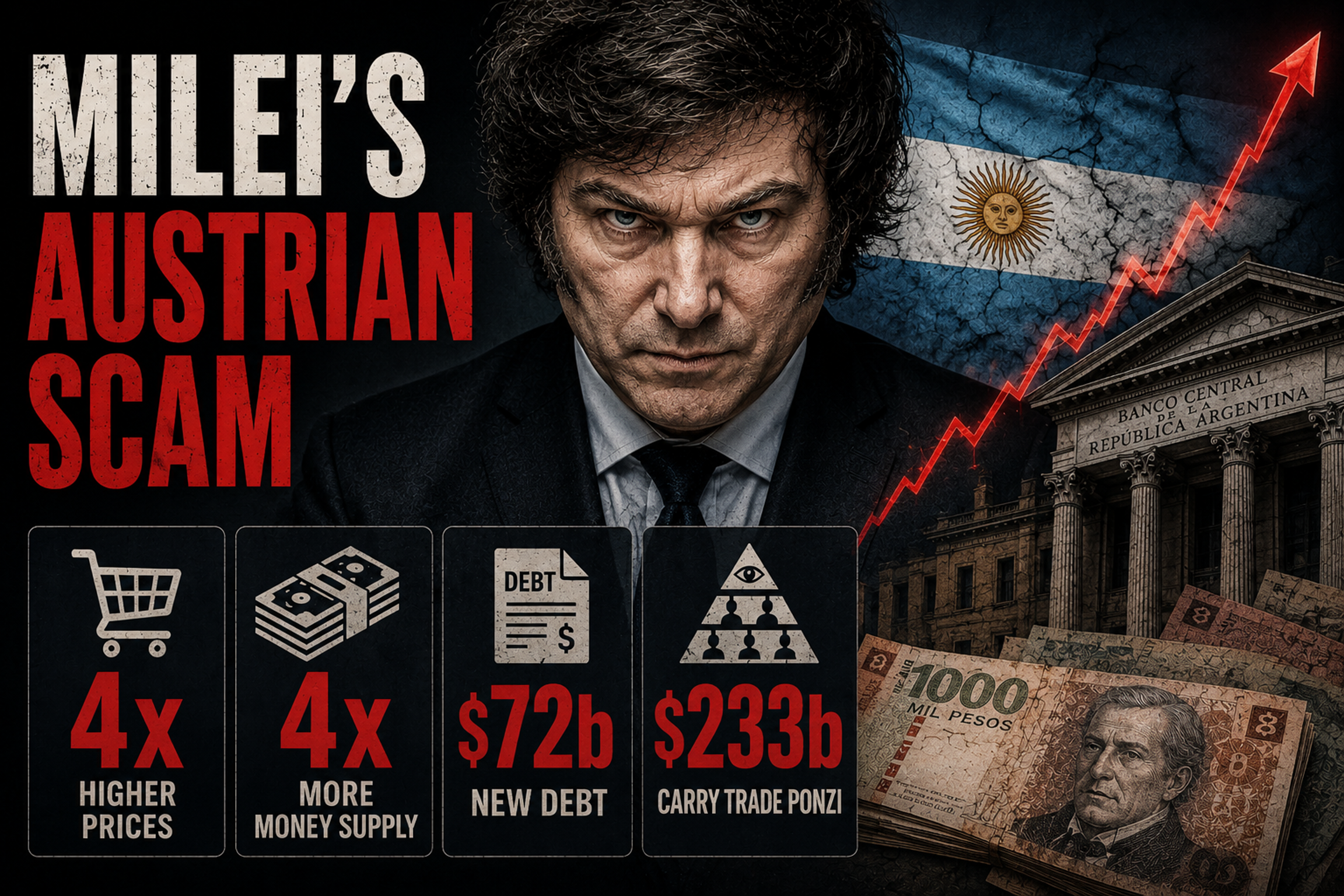
As a libertarian anarchist and Austrian school economist, I was interested in following the election of the first president in the world who professed to share my ideas. He said a lot of the right things on TV, and his radical policies seemed similar to what I would want implemented. After 30 months of close observation, I can confidently say Javier Milei’s policies bear no resemblance to what an Austrian economist would do, and he has used Austrian economics as a cover to run one of the most inflationary presidencies in Argentina’s highly inflationary history. Predictably, and in light of the most recent inflation and growth data, it is now safe to call Milei’s presidency a failure on all the important questions. Ignoring inconsequential rhetoric, Milei has been just another Latin American inflationist demagogue, selling his citizens pipe-dreams financed through inflation and debt that will burden and impoverish them for generations. In the 30th month of his presidency, when the seed of economic recovery planted early in the term should be bearing fruit, prices continue to rise, economic activity is declining, and the unsustainable government debt ponzi is larger than ever, suggesting much more pain to come.
The Neverending Inflation
The biggest promise broken by Milei was the promise of closing the central bank, which he claimed was non-negotiable during his election campaign, and is the Austrian position. He had a clear mandate from his voters to do this, but he chose not to and shifted to silly Chicago-Keynesian nonsense about managing the money supply and reviving the peso.
Milei had promised to dollarize the economy, which would have been a great move for Argentina, because as bad as the dollar is, it is superior to any currency issued by an Argentine central bank. The promise of dollarization was also broken in favor of what Milei termed free competition in currency, a ridiculous idea when the central bank still maintains a monopoly on banking licenses and mandates that banks use the peso and hold government bonds. By keeping the central bank and maintaining its monopoly over currency issuance and banking licensing, Milei guaranteed a continuation of peso inflation, forcibly impoverishing Argentina.
The proof is in the pudding: March’s consumer price index rose 3.4% in one month, an annualized rate of 49%, and that’s using the government’s obsolete basket. This was the tenth consecutive month in which the rate of price inflation has risen, and it makes Argentina the country with the fourth-highest price inflation rate in the world, behind only Venezuela, South Sudan, and Iran.
After 2.5 years in office, this is Milei’s inflation, and it is hollow to blame it on his predecessors. Prices are not a perpetual motion machine that cannot be stopped once unleashed; price rises are the consequence of the increase in the money supply, and if the central bank stops increasing the money supply rapidly, sustained price rises become impossible. After Ecuador and El Salvador dollarized in 2000 and 2001, respectively, high consumer price inflation practically ended as a problem: consumer price inflation is now in the same range as America’s, in the single digits—far from ideal, but far further from the usual Latin American rates which Argentina continues to suffer.
Had Milei gone through with dollarization or liberalization of the central bank, inflation would already be part of Argentina’s history. By keeping the central bank monopoly and not dollarizing, Milei has ensured it is in Argentina’s future. The excuse that the currency and banking system were in bad shape and that dollarization would have been too painful rings especially hollow after two and a half years of continued inflation and economic deterioration that shows no signs of abating. While El Salvador’s inflation was low before it dollarized and its transition was smooth, Ecuador’s dollarization followed a currency and banking collapse, so it is more relevant to Argentina. After Ecuador’s calamitous currency and banking collapses, and after a period of adjustment to dollarization and price controls, high price inflation was eliminated after two and a half years. Without a national currency, the Ecuadorian central bank could not create hyperinflation even if it wanted to. In all likelihood, whatever pains dollarization would have entailed for Argentina would have been over by now, and the benefits of eliminating inflation would be evident. But the path Milei chose has been delivering pain for two and a half years, and it promises to deliver a lot more. Ominously, when April’s monthly CPI number came out at 2.6% (31% annualized), Milei tweeted triumphantly that it is a “return to normal”. Given that a year ago, he was celebrating the rate dropping below 2%, he seems to be conditioning people to view prices rising permanently by around 20% a year as the new normal. Given what he has been doing to the money supply, 20% seems like a widely optimistic mark.
Quadrupling The Money Supply
Price inflation is merely the manifestation of inflation that the economically ignorant can see. Those who understand economics know inflation is made in the central bank, not in the supermarket. Milei’s money creation has been evident from Milei’s first few months in office, which saw a money supply growth that is too large to be believable, even by Argentina’s own lofty standards. After 30 months in office, here are the total increases in money supply aggregates, along with their compound monthly growth rate, as well as the change in the consumer price index.
| Dec 2023-May 2026 | M0 | M1 | M2 | M3 | CPI |
| Percent increase | 369.70 | 266.67 | 256.64 | 311.49 | 303.00 |
| Compound Monthly Growth Rate | 5.48 | 4.58 | 4.48 | 5.00 | 5.10 |
| Compound Annual Growth Rate | 89.67 | 71.20 | 69.24 | 79.56 | 81.65 |
Money supply aggregates have quadrupled or tripled in a mere 29 months, at a compound monthly growth rate of around 5%, an astonishing achievement for any inflationist, let alone one pretending to be a Rothbardian. Consumer prices have also tripled over the same period, also increasing at a monthly compound rate of 5%.
Whether looking at money supply metrics or price increases, the Milei presidency has so far been outstanding in its inflationism even by Argentine standards. Milei has so far delivered a higher annual growth rate in the monetary base than his four predecessors, and a higher annual growth rate in the consumer price index than three of the four predecessors.

The $71 Billion New Debt
Milei had promised to fight Argentina’s chronic indebtedness, but he has instead increased it, and in the process made Argentina the IMF’s primary borrower, accounting for around 35% of its total lending portfolio, and grew the local debt ponzi to unprecedented levels. When he took over, Argentina had a massive debt burden of US$423b, and that number has increased by $71b to US$494b by the end of last month. After 29 months, Milei has increased the total Argentine debt burden by 17%, even though the currency has been devalued by around 70% since he took over. In other words, by merely devaluing the currency, Milei reduced the dollar value of the peso debt he inherited by 70%, from ~US$159b to ~US$47b, and yet, by continuing to issue more high-interest peso debt, the total dollar value of peso debt has reached US$233b, meaning Milei has presided over ~US$185b of increase in high-interest peso debt in just two and a half years. This is the fuel for the Argentine carry trade, the cancer killing Argentina.
| Billion USD | Nov 30 2023 | Apr 30 2026 |
| US Dollar debt | 264 | 261 |
| Peso debt | 158.6 | 233.14 |
| Total Debt | 422.6 | 494.14 |
The biggest victory Milei’s supporters continue to claim is that he has balanced the government’s budget, but that seems to be the result of creative accounting, as the national debt continues to increase. The most obvious way this paradox is resolved is by realizing that the exorbitant interest the government pays on the LECAP bonds is not counted as part of the government’s expenditures. By ignoring the interest burden and the rollover risk of the peso-debt complex, the fiscal surplus means little.
Further, a free-market approach to government spending is not just about balancing the budget for its own sake; it is also about freeing the economy from the shackles of government monopolies and freeing critical institutions from the stranglehold of state control, which prevents them from operating productively and profitably to serve people. Milei’s regime continues to enforce statist monopolies in education, healthcare, and infrastructure, but is now depriving them of financing, causing the destruction of essential institutions and the continuous degradation of the country. The correct libertarian and Austrian choice would be to liberalize these institutions and allow them to fend for themselves without government protection. The productive parts of these institutions would be rewarded on the market, whereas the unproductive parts would disappear. By cutting spending on critical infrastructure that cannot prove itself in the free competitive market, while continuing to pay tens of billions of dollars every year as interest to the bankers and hedge funds playing the Argentine carry trade, Milei is teaching a generation of people worldwide that libertarianism is about degrading the critical infrastructure and institutions on which the vast majority of society depends, in favor of enriching the richest who can afford to play the government’s ponzi.
The Quarter Trillion Dollar Carry Trade Ponzi
As I explained in a previous piece, the carry trade is not merely an inconvenience or a minor problem enriching a few Argentines at the expense of the majority. This monetary Russian roulette has practically become the main industry in Argentina, and its continued survival hoovers up ever more Argentine capital away from productive activities.
In a country whose total stock market capitalization is ~US$90b, the carry trade constitutes around US$233b of investment, all placed into buying government ponzi bonds at exorbitant interest rates, which the government can only pay back through printing obscene amounts of pesos. In less than two and a half years in office, Milei has added more than two entire Argentine stock markets’ worth of capital into the government’s bonds ponzi scheme, which, if it survives a few more months—admittedly a big if—should hit the quarter-trillion-dollar milestone. This carry trade will, of course, end in a painful collapse for many latecomers and long-term bondholders, but just because it will generate a bad long-term outcome does not mean there is any short-term upside. In the short-term, the carry trade has hollowed out the Argentine economy of productive capital, causing an overwhelming number of businesses to shut down and jobs to be destroyed, while the Argentine stock market is one of the worst-performing in the region and the world. Why invest in actual productive businesses when you can just gamble on the carry trade and make ~2-3% return per month?
In 2 years, industrial production in Argentina is down 7.9%, and the industrial sector is running at 53.6% of capacity, which makes sense when you consider that very few industries can compete with the returns of investing in the carry trade bond ponzi. In February alone, the Argentine economy shrank an incredible 2.6%. Unemployment is up to 7.5%, a 1.1% increase on when Milei took office. Had he implemented real reforms, the short term pain would have subsided by now, inflation would be over, and growth would be booming. Instead, it seems there is no end to the pain as the carry trade eats everything.
The longer this goes on, the more Argentina loses its productive businesses, de-developing from a modern, industrialized economy into an impoverished, primitive economy where only connected financial speculators can live well, while everyone else struggles for scraps. The sooner the carry trade collapses, the better. If the problem with socialism is that, eventually, it runs out of other people’s money, the problem with Mileism is that it doesn’t, as it always finds more lenders to indulge and magnify it.
The carry trade has been bolstered by dozens of billions of dollars so far from the IMF, IDB, WB, and, most recently, the US Treasury, which straight up bought pesos to prop up the exchange rate, and “rescue” Argentines from breaking out of the carry trade debt slavery costing them tens of billions of dollars a year. By keeping the peso artificially high, the bailouts ensure the continuation of the carry trade, directing more capital to the government, depriving the productive private sector of capital, and destroying jobs. It will also necessitate more money creation to pay the bonds, inevitably leading to more price inflation. The bailout did save the parasite hedge funds making absurd returns from Argentine debt slavery.
When justifying Milei’s unhinged support for Israel and its mass murder and theft of the goyim it rules and views as subhuman, some of Milei’s fans concede the criminality but invoke necessity: by currying favor with the Zionist genocidal regime and its American puppets, Milei can get favorable deals from the US and international financial institutions to help Argentina’s recovery. This is a catastrophe as bad financially as it is morally. As long as foreigners bail out Milei’s ponzi, Argentine capital will continue to flow to government bonds, and actual physical, human, and intellectual capital will leave or be destroyed, as the country is deindustrialized and de-capitalized.
The 1000x Libra
Milei also ran on a platform of fighting the corrupt ruling caste in Argentina and ending their corruption and pilfering of funds. Instead, he has presided over a long series of scandals implicating him, his sister, and their close associates and allies in a wide variety of corruption schemes, most notably the Libra scamcoin case, which serves as a perfect microcosm of the scam that is Milei’s presidency.
Milei promoted Libra on Twitter, saying it would support the growth of the Argentine economy and entrepreneurs and small businesses. As Milei’s fans bought it up, the scammers behind Libra created a massive number of them, dumped them on the market, destroying the currency’s value, rugging the suckers who bought it, making off with tens of millions of dollars, and allegedly paying Milei a hefty commission.
Similarly, Milei promoted his presidency as a way to grow Argentina and save it from inflation and socialism. As Milei fans bought into his scheme, the scammers behind the peso created a massive number of them, dumped them on the market to fund their carry trade scam, destroying the Argentine economy, rugging the Argentine people, and making off with tens of billions of dollars. It remains to be seen whether Milei will get a hefty commission or if he’s just doing all this for the love of being called president.
Austrian economics and libertarianism are to the peso what ‘decentralization’ and ‘small businesses’ are to Libra: the marketing used to lure unsuspecting rubes into the affinity scam. The peso scam is around 1,000x larger than the Libra scam, and its victims are the poorest ~95% of Argentines, not just random memecoin trader degens. As the peso continues to be destroyed to keep the bankrupt government afloat, the entire Argentine economy is being destroyed. If international bailouts allow this larceny to continue for a few more years, government bonds and foreign aid will be the only two surviving industries in Argentina.
The Austrian Scam
Milei’s presidency will leave Argentines with a catastrophic legacy of inflation and a massive debt burden to bear for generations. It will leave us, Austrian school economists and libertarians, with a devastating reputational debt for generations to come. What makes matters worse is how many of the leading names in Austrian economics circles have completely suspended their critical faculties, ignored the blatant economic reality, believed in the demagogic mania, and cheered it on. The Mises Institute has ended its association with Professor Hans-Hermann Hoppe, the greatest living Austrian economist and the intellectual heir of Murray Rothbard, in what seems to be related to his outspoken criticisms of the Milei scam. Meanwhile, the Mises Institute has published a continuous stream of pro-Milei propaganda, ignoring the critical questions of inflation and debt, and lauding speeches and rhetoric as if they were actual accomplishments. Tying their mast to the ship of Milei will destroy the great institute’s otherwise stellar anti-war and anti-state record, turning it into just another center-right think tank using freedom buzzwords to elect neocons to fight more wars for Israel—a slightly less stupid Fox News.
Instead of writing more tributes to Milei and attending yet another tear-jerking award ceremony, I would humbly suggest that the Mises Institute and the Austrian Mileists provide the rigorous Austrian assessment of the case for, and impacts of, quadrupling the money supply, borrowing US$70b, and running a quarter-trillion-dollar carry trade in two and a half years. Might these factors be related to the persistently high price rises and low growth in Argentina? Is the government saddling its citizens with more debt justified because supporting the Zionist genocidal regime can mean slightly less extortionate interest rates from the IMF?
Austrians must realize now that the fame and recognition Milei’s rise brings to Austrian economics is part of a Faustian bargain whose cost is the destruction of the school’s reputation when his presidency’s failure can no longer be denied. Austrian economics and libertarianism will be seen as the ideology of inflation, mass indebtedness to bankers, and destroying essential institutions and infrastructure in goyim countries, while bolstering the Zionist genocidal regime’s institutions for race-based mass murder and land theft.















 Alessandro Fusillo
 Andreas Tögel
 David Dürr
 Doug French
 Fernando Chiocca
 Greg Morin
 Hans-Hermann Hoppe
 Jay Baykal
 Jayant Bhandari
 Jeff Deist
 Jeffrey Barr
 Juan Fernando Carpio
 Ken Yamarashi
 León Isidoro
 Martin Cabrera
 Nick Hoppe
 Oscar Grau
 Peter Wong
 PFS
PFS scholarium
 Saifedean Ammous
 Sean Gabb
 Sean Ring
 Stephan Kinsella
 Stéphane Geyres
 Thomas Jacob
 Tom DiLorenzo
Follow Us!