In Hans Hoppe’s “Mises Institute: Quo Vadis?: Postscript,” he notes:
Moreover, as for low productivity, almost two years ago by now, the MI held a special Human Action Conference, organized by then president Tom DiLorenzo. Funds were raised and special sponsors for each conference speaker solicited. The result of the conference, promised to the donors, sponsors and conference attendees was a book. To this day there has been no book, and even if it should appear in the near future, two years to produce a book with the assistance of plenty of helping hands does not impress.
The piece he is referring to is his “My Discovery of Human Action and of Mises as a Philosopher,” presented at the Human Action Conference, Ludwig von Mises Institute, Auburn, AL, May 16, 2024.
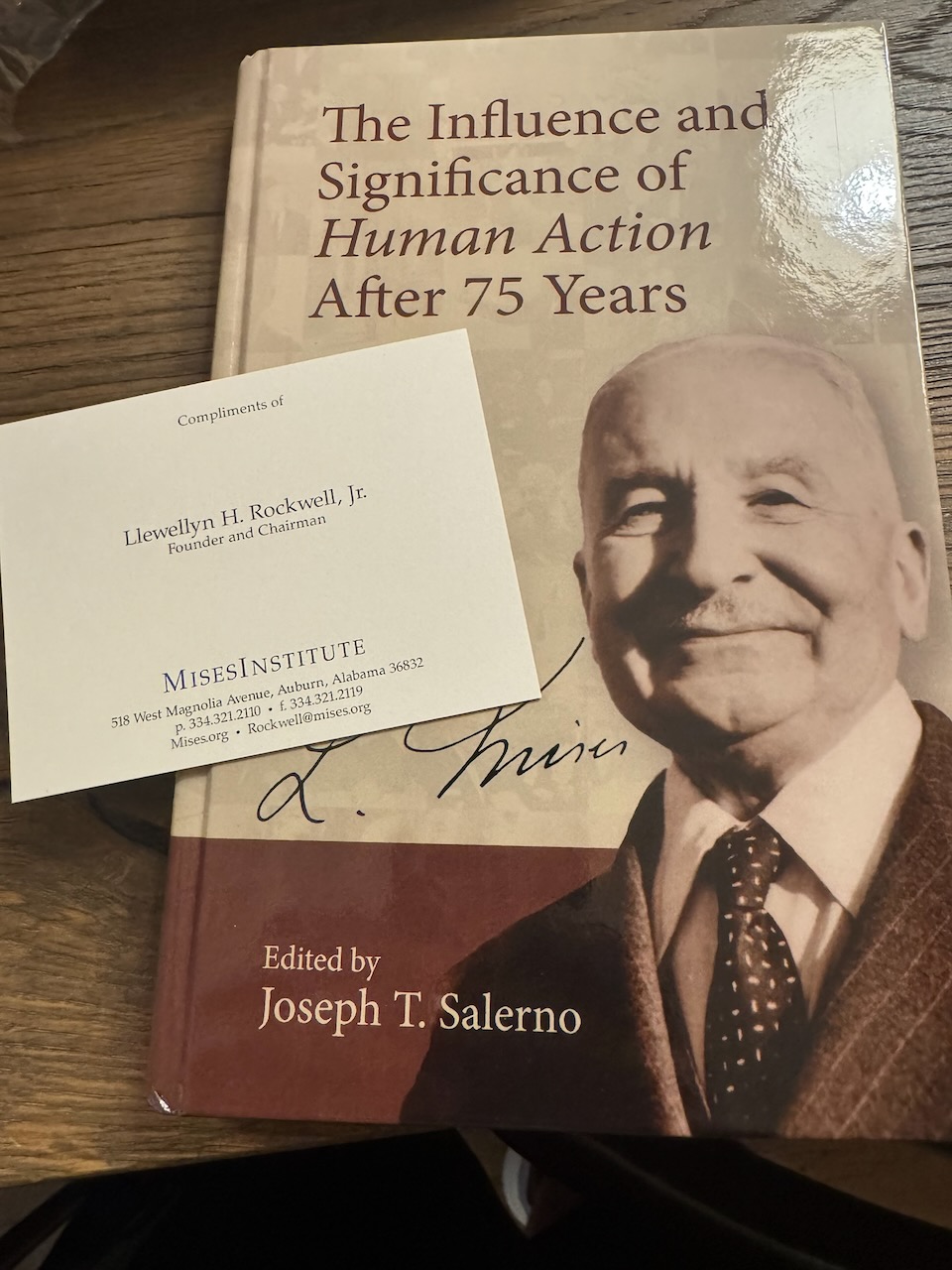
The book Hans referred to is now out; I received a physical copy yesterday. It is The Influence and Significance of Human Action After 75 Years, Joseph T. Salerno, ed. (Auburn, Ala.: Mises Institute, 2026). It does not appear to be on https://mises.org/ or the Mises.com store or, if it’s there, it cannot be found with a normal search, like much other content at the site as I bemoaned in my own recent piece, “My Years with the Mises Institute.”
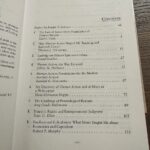
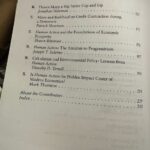

It took them two years to produce this despite all their resources. But even so, as I mentioned in a recent tweet, it appears to be somewhat of a rush job since the back cover quotes from the “Foreword,” but the book contains a Preface not a Foreword.1
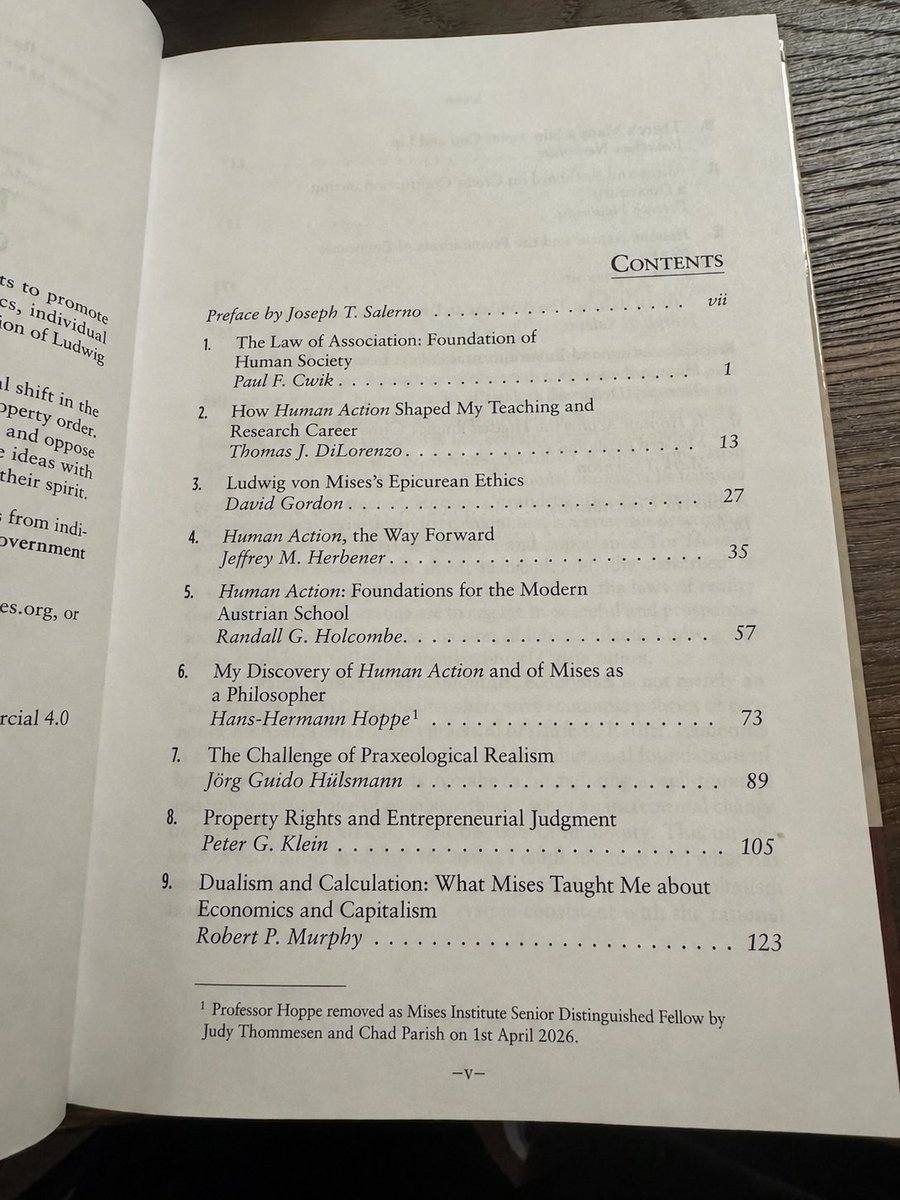 In addition, as noted in this tweet, in later printings the Table of Contents has had a footnote added (it does not appear in the copy I received):
1. Professor Hoppe removed as Mises Institute Senior Distinguished Fellow by Judy Thommesen and Chad Parish on 1st April 2026.
As a friend wrote, this is truly bizarre:
Whoever heard of a scholarly book that denigrates one of the scholar/authors of the book on the first page?! Donors who receive this will be saying, “Who the hell is Judy Thomessen“—whom Hans rightly referred to as a “subaltern employee”—to “remove” their only Distinguished Senior Fellow?2 Or a footnote on the … table of contents? This will probably lead some to find the articles by Hans and Stephan online. If they contact Judy Thomassen and ask her about this, what will she say? “See Hans’s article on the PFS Web site”?
Also, unfortunately the copyright claims that the book is published under a CC-Creative Commons Attribution-NonCommercial 4.0 International License, or CC-BY-NC. This is a shame as I point out in “My Years with the Mises Institute.”
Now when I ran Libertarian Papers, I had authors sign a Publication Agreement explicitly consenting to our CC-BY licensing policy (since authors retain copyright unless they assign their copyright in writing, and the publisher needs the author’s permission (“license”) to publish it in the first place),3 and the Libertarian Papers submissions page also clearly indicated this so that authors were on notice and also implicitly consented to allow the journal to publish their papers under a CC-BY license:
Copyright: Articles will be published under the Creative Commons Attribution 4.0 License, where possible. By submitting a manuscript to us, you grant a Creative Commons Attribution 4.0 License to the public, unless agreed otherwise in writing. We will also ask authors to sign a (simple and straightforward) Publication Agreement agreeing to publication on these terms.
But I doubt any of the authors in The Influence and Significance of Human Action After 75 Years consented to the publisher using the CC-BY-NC designation. The policy is nowhere in mises.org, as I noted in “My Years with the Mises Institute.”
For example Hoppe’s chapter, “My Discovery of Human Action and of Mises as a Philosopher,” is published CC-BY by Hoppe on his own site (see footer of Hoppe’s site). So it is simply legally incorrect to mislead readers into thinking they may not reproduce Hoppe’s chapter if it is for a “commercial purpose” (whatever that even means; why a pro-capitalist group would be opposed to actions for monetary profit is a mystery).4 This is yet another drawback of switching from the CC-BY policy previously established under Jeff Tucker and Doug French to to the current, more restrictive, policy.
One more note. In Mises Institute: Quo Vadis?: Postscript, Hans also notes:
Quite similarly, one year ago Tom DiLorenzo had organized a conference on Revisionist War History that was to likewise culminate in a following book publication. I had turned in my contribution to this project in December of last year. Until today, almost 6 months later, I still have not even received the proofs of my article. Low productivity again.
Hans is here referring to “On War, Democratic Peace, and Reeducation: The “German Experience” in Reactionary Perspective,” from the Mises Institute’s Revisionist History of War Conference (May 15, 2025—May 17, 2025). Will we see this book? Time will tell.
Related
- The Influence and Significance of Human Action After 75 Years, Joseph T. Salerno, ed. (Auburn, Ala.: Mises Institute, 2026)
- Hans-Hermann Hoppe, “Mises Institute: Quo Vadis?: Postscript,” Property and Freedom Journal (April 17, 2026)
- Hans-Hermann Hoppe, “Mises Institute: Quo Vadis?”, Property and Freedom Journal (March 25, 2026)
- Stephan Kinsella, “My Years with the Mises Institute,” Property and Freedom Journal (May 2, 2026)
- Kinsella, Mises Institute Oral History Project: The Lost Rothbard History (2013) (April 17, 2026)
- Kinsella, Hoppe Removed as Mises Institute Senior Distinguished Fellow (April 1, 2026)
- For those confused about the difference, see Parts of a Book: An Essential Guide for Authors; Preface vs Foreword vs Introduction: What’s The Difference?; Prologue, Introduction, Preface, or Foreword: Which Is Right for You?; Distinguishing between a Foreword, a Preface, and an Introduction. [↩]
- Hans-Hermann Hoppe, “Mises Institute: Quo Vadis?”, Property and Freedom Journal (March 25, 2026). [↩]
- See 7 U.S. Code § 201 – Ownership of copyright; 17 U.S. Code § 204 – Execution of transfers of copyright ownership; Copyright & Fair Use: Protect Your Rights As An Author; Copyright office, “What is Copyright?” [↩]
- See the subsection Open Publishing Abandoned in “My Years with the Mises Institute.” [↩]
Discover more from The Property and Freedom Society
Subscribe to get the latest posts sent to your email.












 Alessandro Fusillo
 Doug French
 Fernando Chiocca
 Greg Morin
 Hans-Hermann Hoppe
 Jay Baykal
 Juan Fernando Carpio
 León Isidoro
 Martin Cabrera
 Oscar Grau
 PFS
PFS Sean Ring
 Stephan Kinsella
 Stéphane Geyres
 Tom DiLorenzo
Footnote is really weird. If they wanted to somehow note his “former” status somewhere, that would make at least a little sense, since they’re putting it out after they let him go. Putting it in a footnote draws undue attention. Saying who fired him is bizarre.
Perhaps it had to do with this comment in Salerno’s Preface:
“As the reader will soon discover, all the essays in this book are profoundly inspired by Mises’s vision of economics. It is not coincidental that their authors are closely associated with the Mises Institute, whose mission since its founding by Lew Rockwell in 1982 has been to promote research and education in Misesian economics. It is a testament to the resounding success of the Mises Institute in pursuing its mission that the scholars who contributed to this volume—who were both teachers and students at its educational events—span four academic generations.”