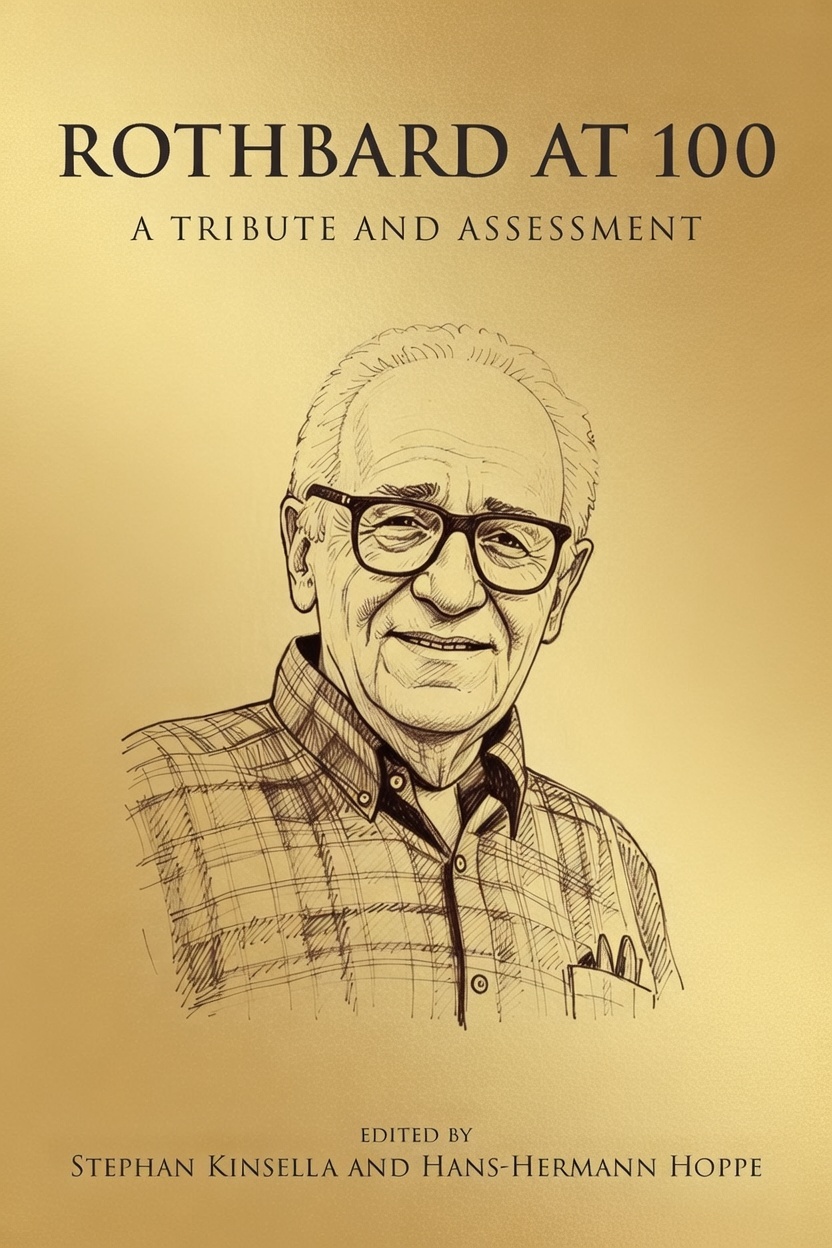
— From Rothbard at 100: A Tribute and Assessment, Stephan Kinsella and Hans-Hermann Hoppe, eds. (Houston: Papinian Press and Property and Freedom Society, 2026) —
Introduction
When Gülçin and I, in May of 2006, opened the Karia Princess for the first meeting of the Property and Freedom Society (PFS), many questions, organizational as well as substantive, had been still unresolved in our minds. It took years of experimenting and learning: of defining, refining and fine-tuning the very product that now is the PFS and its annual salon.2
Throughout all changes occurring during the last 20 years of its existence, however, the PFS has remained steadfast in its commitment to what is now widely known as “Austro-Libertarianism,” the social philosophy developed and represented in the 20th century most prominently by Murray N. Rothbard. In the following chapter I have given an account of my personal association with Rothbard during the last decade of his life, from 1985 to 1995, in New York City and Las Vegas. Here it suffices to say that I learned first-hand from Rothbard’s personal example what was then to become the ethos and trademark of the PFS: uncompromising and interdisciplinary intellectual radicalism—the fearless pursuit of truth, justice and beauty.
Today, on March 2, 2026, Rothbard would have celebrated his 100th birthday. Given his status as one of the patron saints of the PFS, we deemed it appropriate, indeed obligatory, to pay tribute to this great man and his work with a small book in his honor, published by former students, colleagues and members of the PFS intimately familiar with his work.
In the following chapter I have referred to Rothbard as the greatest of all social theorists, certainly of the 20th century. In our age of instant fame and fifteen-minute celebrities, this claim might require some explanation. But that can be easily supplied. As an economist, his bread and butter profession, Rothbard ranks below only his own teacher Ludwig von Mises, probably the greatest economist of all time. But Rothbard is not an economist-economist. In distinct contrast to some contemporary contenders and upstarts now claiming his mantle, Rothbard’s voluminous work ranges over the entire field of the social sciences. He ranks among the 20th century’s most outstanding political philosophers, venturing out there even into the field of epistemology. Qua sociologist, he has greatly contributed to the study and analysis of power elites in the tradition of Gaetano Mosca, Vilfredo Pareto and Robert Michels. As a historian, Rothbard is one of the foremost experts on Colonial America, as well as on US economic and financial history. Last but not least, with his last, unfortunately uncompleted work, his two volumes on the history of economic thought,3 Rothbard not only has established himself as a master historian of thought—of Ideengeschichte—but also, more generally, as a major contributor to the intellectual genre of universal history. Finally, to top it off, Rothbard was able to integrate and systematize all this: his wide-ranging interdisciplinary research program within a grand narrative of human history as an eternal and continuous struggle between power and market, spoliation and production, aggression and coercion versus freedom and liberty.
Naturally, a man who has somewhere commented on almost everything imaginable is also an easy target for the all-too-familiar type of the “intellectual nitpicker”: the type who gets obsessed or even enraged about one particular statement or comment made by someone and consequently roundly rejects and condemns anything and everything said or done by this very person. Rothbard had his fair share of such smartass critics, who dismissed him without having even the faintest idea of and familiarity with his massive intellectual oeuvre—and most likely also not the intellectual ability to actually comprehend it, even if they tried.
Fortunately, however, Rothbard has also a growing world-wide community of fans and friends: of readers, students and scholars from a great variety of intellectual fields and backgrounds following in his footsteps, trying to preserve, to re-present, popularize, polish, improve and enlarge the Austro-Libertarian edifice handed down to us by him. The present book presents only a tiny sample of such individuals.
Of course, there have been serious critics and criticisms of Rothbard and his work as well, also from among the contributors to this little book. Mises, for instance, his own revered teacher, defended the classical liberal “minimal” State model against Rothbard’s anarchism. Rothbard’s (and Mises’s) pure, time-preference theory of interest has come under scrutiny, and as have some aspects of his contract theory and his views on intellectual property and copyrights. As well, the issues of abortion and of children’s rights have remained contentious matters. Some critics deemed his treatment of Adam Smith as overly negative. I have criticized Rothbard for his unduly unfavorable treatment of the feudal Middle Ages and his comparatively mild criticism of democracy.4 But these criticisms, including Mises’s, have been essentially friendly. None was meant to distract from Rothbard’s greatness or tried to diminish his outstanding intellectual stature and standing.
Still: to this day Rothbard has never achieved the public recognition owed to one of the great geniuses of the 20th century. I must speculate a bit, but it is not too difficult to come up with some plausible or even obvious explanations and reasons for this phenomenon.
Rothbard is an anarchist—and not a confused leftist: socialist or syndicalist anarchist à la Noam Chomsky, who dreams of collective property and a social order without hierarchies. Rather, Rothbard is a hard-nosed rightist anarchist: a proponent of anarcho-capitalism, respectively a private law society, based squarely on the institution of private property and its acquisition by means of original appropriation (homesteading) or voluntary contract, and a society characterized by the division of labor and natural social hierarchies.5
Obviously, from the very outset this puts him in complete opposition to the near-universally shared secular religion of the present age: of Statism (Etatismus), i.e., the belief in the necessity and beneficial function of the institution of a State qua territorial monopolist of violence. More specifically, without the State there exists no public, tax-funded education system: no public schools and no public universities. Where, without this, would the present hordes of so-called intellectuals, especially in fields such as education, journalism, the social sciences and the humanities, find secure employment? Most couldn’t and wouldn’t and hence, most intellectuals will likely be strictly opposed to any such idea. As Upton Sinclair noted, “It is difficult to get a man to understand something, when his salary depends on his not understanding it.”
Further, without a State, there would also be no central banks with the monopoly of issuing fiat currencies. Yet central banks, and institutions such as the International Monetary Fund, the World Bank and the Bank for International Settlements are the largest employers of economists in today’s world. Naturally, then, in particular also economists are overwhelmingly hostile to Rothbardian ideas. As well, without a tax-funded State and a central bank there may exist armed militias, but there will be no standing army and there will be no military-industrial complex that promotes international conflict and war. Hence, mighty industries, as well as all chauvinists, war-mongers and imperialists are lined up against the idea of anarchy and a private law society as envisioned by Rothbard.
And it is above all here, then: in connection with Rothbard’s strict and unwavering opposition to war, to the military-industrial complex, to the warfare State and the interventionist US foreign policy, where the ultimate—and yet least talked about—reason for his public disregard and lack of academic recognition can be found.
Jews make up no more than 2 to 3 percent of the US population, but as everyone there knows and yet is advised not to say so, US academia and mainstream media (and much more as we shall see) is dominated by (mostly secular) Jews. Rothbard too was a secular Jew. As such, regardless of his views: his anarchism, his “racism” (he favorably reviewed The Bell Curve by Richard Herrnstein and Charles Murray and Race, Evolution, and Behavior by Philippe Rushton)6 or whatever—a man of his talents could and should have still risen to the highest ranks of academia, owing to the enormous influence and extraordinary (but also un-mentionable) intra-group solidarity of his co-religionists. That this did not happen in his case and he instead became a persona non grata in much of “polite” society has two intimately related reasons: Rothbard’s views on Judaism and on Israel.
While an agnostic, Rothbard was profoundly interested in the history and sociology of religion, and he considered Judaism, in particular the rabbinic Judaism as laid out in the Talmud, as a primitive tribal religion. In distinct contrast to modern Jewish apologists and apologetics and very much in agreement instead with Israel Shahak’s revisionist Jewish History, Jewish Religion: The Weight of Three Thousand Years,7 Rothbard viewed Judaism as a particularistic, ethnocentric and supremacist doctrine, according to which Jewish life was held to be inherently superior and more valuable than that of gentiles or goys. Tellingly, in the Talmud, Jesus has been described in exclusively negative terms: as an illegitimate bastard born to an adulteress, a sorcerer, and a criminal heretic to be sentenced to boiling in his own excrement.
Accordingly, for Rothbard, then, to ramble on, again and again, almost ritually nowadays, of Judeo-Christianity as the intellectual foundation of the West and of so-called Western values, is plain nonsense, a fundamental distortion of history, and a sign of ignorance. As a matter of fact, in contrast to the open hostility to Christianity expressed in the Talmud, it is actually the much maligned Koran that shows itself as rather friendly toward Jesus and the Virgin Mary. (Incidentally, asked what religion Rothbard would adopt if forced to do so his answer was: Catholicism, as a decidedly universalistic religion.)
As for Israel, Rothbard’s views likewise went against conventional wisdom or rather: public indoctrination. Not merely is Israel a State, and a socialist State without any private ownership in land on top (all land is held by the Israel Land Authority or the Jewish National Fund). Rather, unlike the typical case in this day and age, Israel is a State that did not grow up endogenously, from within some indigenous population, but Israel is instead the result of violent foreign conquest: the expropriation, expulsion and murder of an indigenous population by some alien invaders and occupiers. Enabled by Great Britain and the US, Jews from all over the world, especially of Zionist persuasion, were to move to Palestine, displace the indigenous, mostly Arab population by terrorist means and, in 1948, establish a Jewish State.
Moreover, Israel, qua Jewish State, and very much in accordance with the just mentioned Judaic superiority claim, practiced from the outset and still practices a strict apartheid regime, where every non-Jew is and can never be more than a second-class citizen, and it pursued and still pursues an aggressive, expansionist foreign policy at the expense of its supposedly inferior neighbors so as to re-establish modern Israel in its fancied ancient glory and territorial largess. The excuse given for all this—the earlier persecution of Jews in Germany and Eastern Europe—Rothbard considered phony. For one, because by no means all Jews assembled in Israel had been victims, and in any case, the indigenous population of Palestine that then and now had to suffer the Jewish invasion and occupation had nothing whatsoever to do with any prior crimes elsewhere committed against Jews. They were innocent as far as all that was concerned and accordingly did not owe any restitution to them.
Considered in isolation, these two claims may not exactly align with the officially approved mainstream view of the matter, but they are hardly scandalous. What turned Rothbard into a persona non grata in establishment circles and made for a scandal was to combine both claims and then to point out that the US foreign policy had been coming increasingly under the influence of the so-called neoconservatives or “neocons,” such as Irving Kristol and Norman Podhoretz and their followers. Mostly of Jewish extraction, and often former leftists (in particular of the Trotskyist variety) who had turned “conservative” in reaction to the violent outgrowths of the so-called “Civil Rights” movement and legislation of the 1960s, the neocons represented the very opposite of the old, traditional American Right. The Old Right, that had been Rothbard’s intellectual home, stood for de-centralization at home, advocated a strictly non-interventionist foreign policy and warned against any foreign entanglements and alliances. In sharp contrast, the neocons, who would increasingly take over and come to dominate the foreign policy establishment in the US, whether under Republican or Democratic administrations, supported not only a powerful, centralized welfare State at home, but in particular also an interventionist foreign policy based and built on US military strength and motivated by imperial ambitions. To make the world safe for liberal democracy, the US, qua exceptional nation, was supposed to be established and installed as the world’s dominant power, by all means necessary, whether military, financial or economic. And it was Israel of all places that was to play a central role in these neocon plans. Neocon essentially meant Zionist and Zionism. Israel was considered their most highly valued strategic and moral ally: the only bastion of Western civilization in the Near- and Middle-East, surrounded by a sea of hostile, backward and primitive Arab and Moslem neighbors.
Accordingly, whatever Israel did or does, it deserved the unconditional support of the almighty US. It received and still receives billions of US military aid, year after year, and it enjoys the closest possible cooperation and assistance of US intelligence agencies and services. Whether Egypt, Jordan, Lebanon, Syria, Iraq, Libya, Iran or Yemen, whoever stood or stands in the way of Israel’s expansionist and supremacist ambitions and was or is considered Israel’s enemy is at the time also an enemy of the US and thus requires, to this day, the US’s constant involvement and interference in Near- and Middle-Eastern affairs.
Rothbard was a vehement critic of the neocons and US interventionist foreign policy in general. It was immoral, economic waste, and a constant source of inter-national conflict and tension (instead of peace). But he was especially critical and outspoken about the Zionist and “Israel first” policy promoted by the neocons. Because what the neocons ultimately wanted, and have largely achieved as of today, was for US interests to become subordinate to the interests of Israel. That is, that for any and all foreign policy decision, the US should consult and ask Israel for approval. Rothbard considered this state of affairs “monstrous,” to use one of his favorite words used in this connection. Given the origin and location of the State of Israel and its nature as an explicitly and exclusive Jewish State, Rothbard predicted, the Near- and Middle-East would be turned into a powder keg: a permanent danger zone marked and marred by unending conflict and war, and the once exceptional US in particular would progressively (or rather regressively) grow into the world’s biggest war machine and threat to world peace. Rothbard turned out right with this prediction, of course, as is even more apparent now than it was 20 years ago at the time of his death.
For the most powerful of all lobbies in the US, however, the Jewish lobby, represented prominently for instance by the American Israel Public Affairs Committee (AIPAC), the American Jewish Committee (AJC) or the Anti-Defamation League (ADL), Rothbard’s criticism and his call for the withdrawal and disengagement of the US from Israel constituted the ultimate treachery and sin of “anti-Semitism.” If the man could not be silenced entirely, he should be ignored or belittled. And that is what they did; and it is above all they, then, the neocons and the Jewish lobby, who denied Rothbard the intellectual stardom that he deserved.
❧
Newsflash: Recently, since Javier Milei’s election as President of Argentina, in 2023, Rothbard’s name has come to be frequently mentioned also in some mainstream media. The reason: because Milei professed to be—“philosophically”—an anarcho-capitalist and cited Rothbard repeatedly as his main source of inspiration. Many self-professed libertarians, especially in the Spanish-speaking world, have celebrated this as a great breakthrough of and for “our” ideas. This necessitates a brief critical comment, because Rothbard’s “resurrection” via Milei represents at best a rather mixed blessing and is actually more likely to do serious damage to the libertarian movement in the long run, and in any case involves a severe mis-representation and “falsification” of the real Rothbard.8
To be sure, Milei has read some Rothbard, but his knowledge of Rothbard’s work is rather limited and superficial.9 He has also introduced some economic “free market” reforms in Argentina that have been inspired by “Austrians.” But he has done nothing truly radical, deserving the praise of any anarcho-capitalist. He has not closed the central bank, as originally promised, and there are no signs that this will happen any time soon. He has brought consumer price inflation down from 300% to some 30% (wow!), but the money supply (of all monetary aggregates) has continued to grow rapidly (even more so than under several of his predecessors). He has centralized rather than decentralized government power and is on record as being fundamentally opposed to secession. In addition to assuming (rather than repudiating, as Rothbard would have recommended)10 the existing government debt owed to the IMF of some 40 billion USD, he burdened the Argentinian people with another 42 billion USD of debt, solicited from the IMF, the World Bank and the Inter-American Development Bank, and in order to avoid insolvency right before the Argentinian mid-term election, in October 2025, he further required a rescue package of some 20 billion USD from “his dear friend” Donald Trump.
And with Donald Trump entering the picture, then, an entirely new and different Milei comes to light, typically ignored or made light of by his adoring libertarian fans.
Trump, by sheer accident, may have heard the name of Rothbard, but he certainly never read a word of his. Indeed, it is doubtful whether Trump ever read a serious book in his entire life, and as far as economics in particular is concerned he must be essentially considered illiterate.11 Government spending (especially on the military and on so-called national security measures) and government debt have increased under his direction. He is a dedicated protectionist, as demonstrated by his erratic and punitive tariff policies, and in general he pursues an economic agenda that has more in common with the interventionist policies conducted under fascism or national socialism than with anything resembling a free-market economy.
More importantly still in the current context, of all previous US presidents, Trump is the most ardent Zionist and “Israel-Firster” ever (all the while claiming the mantle of an “America-Firster”). Never before has Israel received more military and financial aid and support, even while committing unspeakable atrocities in the Gaza strip as well as the West Bank, than under Trump. Benjamin Netanyahu, Israel’s prime minister, a war criminal of the first degree, a man with no compunction to admit to his own genocidal intentions vis-à-vis the Palestinian population (which he compares to the to be vanquished and eradicated Amalekites of the Old Testament and the Torah), is Trump’s “best friend” and always welcome guest at the White House or Mar-a-Lago. On behalf of Israel, and at the advice (or on the orders?) of Netanyahu, Trump even directly engages in war against Iran and Yemen, which both pose no threat to the US whatsoever.
And as if that is not enough of foreign entanglement, and as an unmistakable sign of Trump’s own megalomania, he continuously trumpets threats, bully-like, against everyone and anyone deemed disobedient, most prominently against Russia and China as the two main remaining obstacles on the way to US global dominance. While posing as a peace-maker, he still continues to support Volodymyr Zelenskyy, the Jewish strongman of the Ukraine and fellow Zionist, in his losing war against Russia, initially provoked and designed by the US to weaken and bring Russia to its knees. He sends weaponry to Taiwan to provoke mainland China, he kidnaps Venezuelan president Nicolas Maduro so as to take control of the country’s massive oil reserves, and he engages in open piracy by confiscating or sinking foreign ships or tankers in international waters and ordering its captains and crews to be killed.
Milei, the self-proclaimed anarcho-capitalist, then, is best friends with this man Trump. Again and again, he has hailed Trump as a champion of liberty and of so-called Western civilization and values. Trump’s America, according to Milei, represents the epitome of free-market capitalism. And he is not just friends with Trump and his name and that of Trump are regularly mentioned in one breath as closely associated, Milei is also best friends with Trump’s best friend Netanyahu. In his view, too, Israel can do no wrong, and whatever may appear to the outside observer as outright atrocities, mass-murder and wanton destruction is in reality nothing but justified defense according to him. For this outspoken solidarity and praise of Israel as a bastion of freedom and civilization, Milei was awarded the Genesis prize by Netanyahu, also referred to as the “Jewish Nobel Prize,” coming with a prize money of one million USD, that Milei then committed to be used for celebrating Israel and combatting “anti-Semitism” all over Argentina and elsewhere in Latin America. And it is not only Trump’s and Netanyahu’s names that are closely associated with that of Milei, but Milei is also on hugging and kissing terms with Zelenskyy.
Three interconnected questions then arise: How to explain this Milei-Trump-Netanyahu-Zelenskyy love affair? What consequences does this have for the name of libertarianism, i.e. its reputation and public recognition? And how does Rothbard fit into all this?
The first question is answered easily. What all four have in common is their Zionism and “Israel First” stand as propounded and advocated by the neocons. Nominally, Milei is not a Jew, but he has toyed with the idea of converting to Judaism, several Jewish oligarchs such as the Werthein family have greatly helped his career, and he is constantly accompanied and advised by a personal rabbi. Trump too is not nominally Jewish (yet several of his family members are), but he has also enjoyed the largess of numerous Jewish oligarchs such as Sheldon and Miriam Adelson, and he has repeatedly claimed to be the most pro-Israel president in US history and the best friend that Israel ever had. Zelenskyy is Jewish and owes his entire career to various Ukrainian Jewish oligarchs such as Ihor Kolomoyskyi, and Netanyahu, of course, is the very super-Jew and Zionist. (Another commonality: all four of them have been noted for their talents as clowns and the vulgarity and profanity of their public speeches.)
There is also a quick answer to the second question. The core of libertarianism is the recognition of private property and the non-aggression principle. How, then, can anyone seriously believe that libertarianism’s public image will be helped and improved by someone like Milei, who is intimately associated and engaged in closest cooperation with a bunch of welfare-warfare Statists, supremacists, imperialists, warmongers and murderous criminals?!
And finally, as for the third question concerning Rothbard: How can anyone seriously believe that Rothbard would be delighted to see his name, via Milei, connected and associated with those of Trump, Netanyahu and Zelenskyy?! “Monstrous!”—that would be Rothbard’s reaction!
Hans-Hermann Hoppe
Istanbul, February 2026
- Hans-Hermann Hoppe, the founder, along with his wife, Gülçin Imre Hoppe, of the PFS, is Professor Emeritus of Economics at UNLV, former Distinguished Senior Fellow (~2000–2026) with the Ludwig von Mises Institute, Founder and President of The Property and Freedom Society, and former Editor of the Journal of Libertarian Studies. He has received multiple awards, including the Gary G. Schlarbaum Award for lifetime defense of liberty (2006), the Murray N. Rothbard Medal of Freedom (2015), and the Caminos de la Libertad “A Life for Freedom” Award (2024). [↩]
- More information about the origin of the PFS may be found at Property and Freedom Society, “History and Principles” (propertyandfreedom.org/about) and Property and Freedom Society, “Press & Offsite Material (propertyandfreedom.org/press), including Hans-Hermann Hoppe, “My Life on the Right,” The Great Fiction: Property, Economy, Society, and the Politics of Decline, 2nd ed (Auburn, Ala.: Mises Institute, 2021) (based on “The Property And Freedom Society—Reflections After Five Years,” Property and Freedom Society 2010 Annual Meeting, Bodrum, Turkey (June 4, 2010) ); idem, “This Crazy World,” in The Great Fiction (based on “The Role of the Property and Freedom Society in a Crazy World,” Property and Freedom Society 2009 Annual Meeting, Bodrum, Turkey (May 22, 2009) ); Hans-Hermann Hoppe and Gulcin Imre Hoppe, “2006–2015: PFS, Now and Then,” Property and Freedom Society 2015 Annual Meeting, Bodrum, Turkey (Sept. 11, 2015), available at Stephan Kinsella, “PFP133 | Hans-Hermann Hoppe & Gülcin Imre Hoppe, “2006–2015: PFS, Now and Then” (PFS 2015),” Property and Freedom Podcast (May 26, 2022); and Tom Woods, “Interview with Hans Hoppe,” Tom Woods Elite Letter, Issue #18 (Summer 2025). [↩]
- Murray N. Rothbard, An Austrian Perspective on the History of Economic Thought (Auburn, Ala.: Mises Institute, 2006). See also Stephan Kinsella, “Volume 3 of Rothbard’s History of Economic Thought,” StephanKinsella.com (Sept. 1, 2009). [↩]
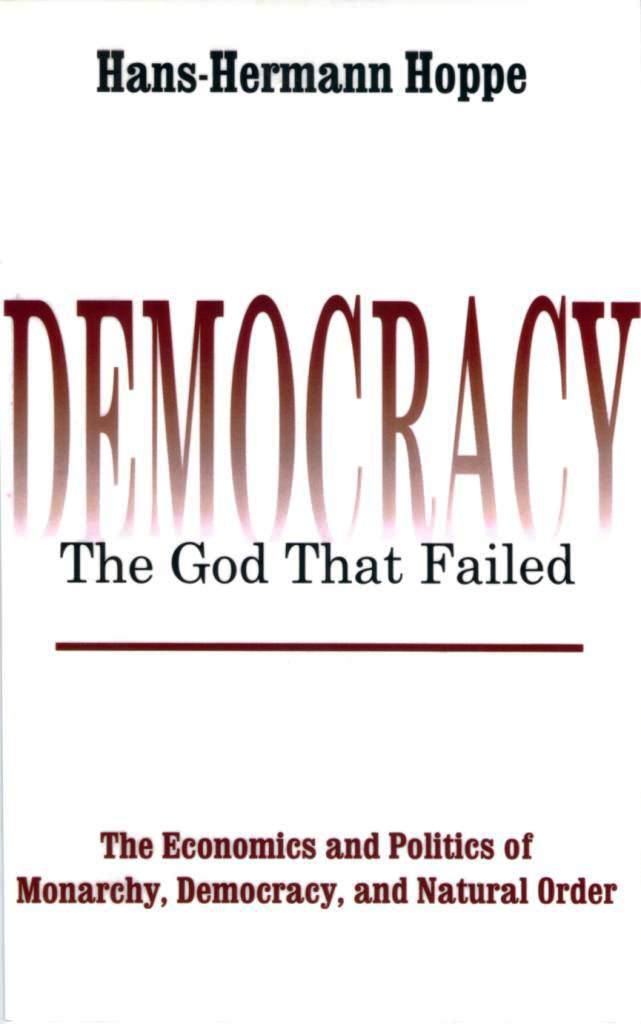
- See, e.g., Hoppe, “Introduction,” in Democracy: God that Failed (New Brunswick and London: Transaction Publishers, 2001) (“although aware of the economic and ethical deficiencies of democracy, both Mises and Rothbard had a soft spot for democracy and tended to view the transition from monarchy to democracy as progress”); idem, “The Libertarian Quest for a Grand Historical Narrative,” in The Great Fiction; Robert A. Nisbet, The Quest for Community: A Study in the Ethics of Order and Freedom (Wilmington, Del.: ISI Books, 2010 [1953]). [↩]
- See Hoppe, “A Realistic Libertarianism,” LewRockwell.com (Sept. 30, 2013). For a possible explanation of the rather different treatment of Chomsky vs. Rothbard, see Jose Alberto Nino, “How Noam Chomsky Became the Establishment’s Favorite Radical,” The Unz Review (Feb. 7, 2026). Likewise, for my discussion of why “Nozick’s libertarianism” and his “methodologically non-committal” “razzle-dazzle” “was deemed respectable by the academic masses,” compared to the academy’s shameful treatment of Rothbard, see my “Murray N. Rothbard and the Ethics of Liberty,” in Murray N. Rothbard, The Ethics of Liberty (New York: New York University Press, 1998). [↩]
- Murray N. Rothbard, “Race! That Murray Book (December 1994),” The Irrepressible Rothbard: The Rothbard-Rockwell Report Essays of Murray N. Rothbard (Center for Libertarian Studies, 2000). [↩]
- Israel Shahak, Jewish History, Jewish Religion: The Weight of Three Thousand Years, New Edition (Pluto Press, 2008 [1994]; pdf; pdf2). [↩]
- See Hans-Hermann Hoppe, “PFP280 | Special: Hans-Hermann Hoppe, “Javier Milei” (PFS 2024),” Property and Freedom Podcast (Dec. 23, 2024); idem, “Resignation from the Scientific Advisory Board of the Ludwig von Mises Institute Germany,” HansHoppe.com (Aug. 18, 2025); idem, “PFP290 | Hoppe: Considerations and Reflections of a Veteran Reactionary Libertarian (AERC 2025),” Property and Freedom Podcast (March 23, 2025); idem, “A ‘Great Thinker’ at Work,” Power & Market (June 19, 2025); Kristoffer Mousten Hansen, “PFP306 | Kristoffer Mousten Hansen: Mileinomics (PFS 2025),” (Jan. 12, 2026). [↩]
- See, e.g., Javier Milei, Capitalismo, Socialismo y la Trampa Neoclásica: De la Teoría Económica a la Acción Política (Planeta, 2024); idem, “Capitalism, Socialism, and the Neoclassical Trap,” in The Emergence of a Tradition: Essays in Honor of Jesús Huerta de Soto, Volume II: Philosophy and Political Economy, David Howden and Philipp Bagus, eds. (Palgrave Macmillan, 2023) (a book which also includes my essay “The Ultra-Reactionary as a Radical Libertarian: Carl Ludwig von Haller (1768–1854) on the Private Law Society“). See also, concerning Milei and the (non-)closure of Argentina’s central bank, idem, “A ‘Great Thinker’ at Work,” and the recent interchange between Philipp Bagus and Jörg Guido Hülsmann, beginning with Philipp Bagus, “Credit Money, Pesos, Dollars and Argentina,” Power & Market (Oct. 20, 2025), first published, in German, as Philipp Bagus, “Kreditgeld, Pesos, Dollars und Argentinien,” Ludwig von Mises Institut Deutschland (Oct. 20, 2025). The Power & Market article contains links to others in the interchange. [↩]
- See, e.g., Man, Economy, and State, with Power and Market, Scholar’s ed., 2nd ed. (Auburn, Ala.: Mises Institute, 2009), p. 1028 (“Social utility can therefore not be enhanced by debt-reduction, except by the method of repudiation—the one way that the public debt can be lowered without a concomitant increase in fiscal coercion. Repudiation would also have the further merit (from the standpoint of the free market) of casting a pall on all future government credit, so that the government could no longer so easily divert savings to government use.”); idem, “Frank Chodorov: R.I.P.,” Left and Right: A Journal of Libertarian Thought (Winter 1967): 3–8, p. 5 (Chodorov “was the only one of the host of ostensible believers in the free market economy in this country to call for the outright repudiation of the public debt, and to see that such repudiation is infinitely more libertarian and infinitely less criminal than looting taxpayers to redeem that debt.”); idem, “Repudiating the National Debt”, Chronicles (June 1992; Mises Daily version): 49–52. [↩]
- For my negative appraisal of Trump, see Woods, “Interview with Hans Hoppe.” [↩]













 Alessandro Fusillo
 Doug French
 Fernando Chiocca
 Greg Morin
 Hans-Hermann Hoppe
 Jay Baykal
 Juan Fernando Carpio
 Martin Cabrera
 Oscar Grau
 PFS
PFS Stephan Kinsella
 Tom DiLorenzo