In 2024, the Property and Freedom Society published A Life in Liberty: Liber Amicorum in Honor of Hans-Hermann Hoppe, Jörg Guido Hülsmann and Stephan Kinsella, eds. (Houston, Texas: Papinian Press, 2024), on the occasion of Professor Hoppe’s 75th birthday on Sept. 2, 2024.
Most of the the pieces were not published in HTML text form as separate articles; we will be posting them in this Bookstream. The Preface was republished in the inaugural post in this Bookstream: A Life in Liberty Bookstream: Preface — Hülsmann and Kinsella. Links to the remaining chapters may be found at the book’s landing page here. We have been posting these entries three times a week, MWF, but are now switching to twice a week: Mondays and Thursdays. Here’s the next entry—
Uhhh …. yeah. I mean… there’s libertarian macho flash1 and then there’s libertarian macho flash. WTF? Tell that to the poor French right now. Even if they sort of asked for it. Doesn’t mean we ought to cheer it on. [continue reading…]
Superb article by @FeserEdward on the “scientific” delusion– “the mechanization of the world picture”– that still hobbles our understanding of the distinct and separate nature of things in the world. We refuse to accept both that separateness and the idea of an inherent nature in anything.
The “basic conceit is human beings, in theory and practice, can and ought to transcend the limitations of their nature.”
This is how you get transhumanism. This is how you get murderous governments. This is how you get an addled & miserable population in the midst of incredible material comfort.
My feed is filled with people reproducing this post. It is nonsense. You won’t find anybody more opposed to monetary debasement than I am. But you are asking me to believe that in 1971, half of America had an income equivalent to that of nearly a millionaire today.
No society anywhere has ever been that prosperous. And the 1970s sure don’t give off the vibe of everybody living in luxury.
Of course Nixon shouldn’t have closed the gold window. No argument there. But the statement below is unsupportable, and it’s contradicted by common sense.
ADDENDUM: I’ll add: literally nobody, no economist of any school, thinks real wages have fallen 88% since 1971. That is absolutely and demonstrably false. I don’t get how people can find this plausible. If real wages had fallen 88% since 1971, TRUST ME, YOU WOULD KNOW. I will devote an issue of my newsletter to this, since I’m aghast that some people on my side seem to think this is the case. I assure you, there has been no such collapse.
Want to have your mind blown?
In 1971, the median household income was $9,030, or 220 ounces of gold.
In 2025, it was $87,460, or just 25 ounces of gold.
Your paycheck went up 10x.
Measured in gold, it fell 88%.
To earn what the median household earned in 1971, you’d need about $890,000 per year today.
During a recent trip to Madrid, Javier Milei, Argentina’s self-proclaimed anarcho-capitalist president, was featured as keynote speaker at the 10th Annual Madrid Conference on Austrian Economics, organized by Jesús Huerta de Soto, and took the opportunity to publicly denounce Pedro Sánchez, the present socialist president of Spain, and express his support for Sánchez’s “rightist” opponents in the current Spanish election campaign.
Milei openly called out Sánchez as a “dictator” and as a “thief” deeply involved in corruption.1
All correct from an anarcho-capitalist viewpoint: Sánchez, as head of state, indeed dictates law without (or even against) the explicit consent of everyone affected by it. (In fact, that’s what politics is all about: one person ruling over and above another one!) As well, taxes and fiat money inflation are indeed theft, and Sánchez and his regime live off of taxes and money “creation.” Hence, to call him a thief is also true. And Sánchez and his wife are indeed implicated in some corruption affairs. Also true. [continue reading…]
Was thinking of some of these when talking to some libertarian friends recently. Some fascinating and insightful passages from those I sometimes refer to as the “High Austrians”—those that, as I say, “swim[] in the plasma of praxeology”:1 For those looking for something to sink their mental teeth into this glorious weekend. [continue reading…]
Summary: Louis Rossmann explores the emergence of open-source alternatives to Adobe software built using artificial intelligence. The discussion examines the legal landscape of reverse engineering, current DMCA regulations, and the potential for future corporate lobbying efforts to restrict software interoperability and control digital ownership.
The day has come. AI can finally thwart the most toxic and socially devastating career dreams ever sold to young women: influencer, TikTok star, OnlyFans.
The French girl in this clip does not exist. Her song is an earworm with a superb narrative in lyrics and film, better than most human pop slop, which is far more generic. Anyone with a browser and a subscription can now produce her, and that is good news above all for real young women. The attention market paid them to sell their youth, their privacy and in the end their bodies to strangers, and since it paid narcissism best, it bred narcissism in a whole generation.
Unfortunately, we are now entering an awkward interim phase. The market-financed toxic careers for female narcissists are disappearing, but the state is not bankrupt yet. So the talent moves to where the taxpayer still pays: NGO director, salaried antifa activist, trauma counsellor for France’s looters. There is too little market demand for any of these, so they will only go away with the state’s bankruptcy.
France is working on it. https://t.co/0pFbdoc03W
— Rahim Taghizadegan (scholarium.at) (@scholarium_at) October 21, 2026
My appearance on Bitcoin Infinity #225, With Knut Svanholm.
Shownotes:
Stephan Kinsella joins the Bitcoin Infinity Show to talk about why you can’t legally own Bitcoin, what the difference between ownership and possession means for self-custody, and whether the July 2026 Coldcard hack was really theft. Knut and Stephan dig into Austrian economics, libertarian contract theory, why fractional reserve banking is harder on a Bitcoin standard, and how Bitcoin could limit the state’s ability to borrow and tax. They also look back at the Property and Freedom Society’s 20th anniversary in Bodrum, Murray Rothbard’s centennial, Hans-Hermann Hoppe’s split with the Mises Institute, and their Austrian economics panel at BTC HEL in Helsinki.
From PFSer Martin Martín Cabrera1, re Jörg Guido Hülsmann, “Garrisonian Macroeconomics,” Q. J. Austrian Econ. 4, no. 3 (Fall 2001): 33–41:
Great insight by Jörg Guido Hülsmann on the distinction between microeconomics and macroeconomics:
“Modern macroeconomics began with Böhm-Bawerk’s seminal Capital and Interest. The epithet “modern” is shorthand for “post-Ricardian” and refers most notably to the application of methodological individualism in explanations of phenomena such as the production structure, capital, and money interest. Böhm-Bawerk showed that and how these phenomena, which affect more or less all members of society (“the economy as a whole”), result from individual human action and interaction. Menger had pioneered this method. He had shown how prices on individual markets spring from the acting person’s evaluation of marginal quantities of economic goods. Böhm-Bawerk did nothing but extend the application of this method to explain how the various markets interrelate, what costs are, and how and why interest comes into existence. Later, Mises applied the very same method to explain the impact of money on the economy, and to analyze the business cycle. With Mises’s 1912 treatise on money, Austrian economics had come full circle, giving a coherent and encompassing explanation of all economic phenomena (see Mises 1980).
It is therefore of little surprise that the early Austrian economists did not distinguish between microeconomics and macroeconomics. There was in their eyes only one type of economic analysis, which was based on certain invariable facts of human action—such as “only individual persons act,” “acting involves choosing,” “choice refers to marginal units of economic goods”— and which was able to give a satisfactory explanation of all economic phenomena. From this point of view, one might call certain phenomena “macroeconomic” because they are virtually immune from the choices of any given person, but result from the combined effect of the choices of great masses of people; and one might call other phenomena “microeconomic” because here the impact of individuals is perceptible and important. But this distinction is entirely nominal—it is an artificial convention without foundation in real differences. The fact is that all economic phenomena result from individual choices; hence, Menger’s method can be applied universally; and ultimately there can be only one unified economic science, just as there is only one real world that this science describes.”
In 2024, the Property and Freedom Society published A Life in Liberty: Liber Amicorum in Honor of Hans-Hermann Hoppe, Jörg Guido Hülsmann and Stephan Kinsella, eds. (Houston, Texas: Papinian Press, 2024), on the occasion of Professor Hoppe’s 75th birthday on Sept. 2, 2024.
Most of the the pieces were not published in HTML text form as separate articles; we will be posting them in this Bookstream. The Preface was republished in the inaugural post in this Bookstream: A Life in Liberty Bookstream: Preface — Hülsmann and Kinsella. Links to the remaining chapters may be found at the book’s landing page here. Here’s the next entry—
PFS Members have long been able to sign up to the PFS-Announce Google Group for PFS general announcements (see Contact and Membership to sign up).
PFS Members and others in the general public interested in following PFS content at our website may subscribe to our newly redesigned PFS Newsletter, designed by Pedro Figueiredo of our IT team at neurons.pt (we are also working with Pedro on a PFS website refresh later this year). We have updated the old PFS email newsletter to make it easier to keep up with new articles, blog posts, announcements and podcasts. You can now choose how often you hear from us:
Daily: one email with new publications from the last 24 hours.
Weekly: one email with new publications from the past week.
Each recap brings the new material together, with links to read or listen on the PFS website. If there is nothing new, no recap is sent. You can change delivery or unsubscribe at any time.
Enter your email address, choose Daily or Weekly, and follow the confirmation link sent to your inbox.
If you already receive PFS recaps, you can change your delivery choice or unsubscribe at any time. Follow the preferences link in any recap, or visit the newsletter page and select Manage my subscription. We will email you a secure link; no password is needed.
Please share this with like-minded libertarian friends who would enjoy following PFS. Send them the newsletter page so they can choose their own subscription:
On another housekeeping note: we are working with our volunteer IT assistant Pedro Figueiredo to make some technical changes to the site, including the email newsletter subscription feature. Stay tuned—
As The Donald is wont to say, Thank you for your attention to this matter!
In 2024, the Property and Freedom Society published A Life in Liberty: Liber Amicorum in Honor of Hans-Hermann Hoppe, Jörg Guido Hülsmann and Stephan Kinsella, eds. (Houston, Texas: Papinian Press, 2024), on the occasion of Professor Hoppe’s 75th birthday on Sept. 2, 2024.
Most of the the pieces were not published in HTML text form as separate articles; we will be posting them in this Bookstream. The Preface was republished in the inaugural post in this Bookstream: A Life in Liberty Bookstream: Preface — Hülsmann and Kinsella. Links to the remaining chapters may be found at the book’s landing page here. Here’s the next entry—. See also:
Every so often the @ClaremontInst Review of Books has an essay or two hinting at deviation from its Straussian/Jaffaite roots. So does its American Mind sister site. Call it an occasional softening toward Old Right/Paleo traditions, and a slight but detectable distancing from Con. Inc. This is also evident in the numerous Claremont alums active in the Trump administration– a fact not escaping the ire of National Review types. In short, Claremont has at least attempted to update its operating system in light of an entirely new landscape.
But then… a new edition of CRB arrives at my doorstep full of relapses into the worst Boomer constitutionalism and silly hagiography to some founding Father. Throw in another dose of Lincoln idolatry and anti-Southern animus, or another tired ode to Churchill, and the issue is a complete bust. Not even a reflection on Fowler’s Modern English Usage at 100 can save it.
I credit Christopher Caldwell mightily for attacking the most sacred cow in his Age of Entitlement book, and there are some very good voices in the CRB bullpen (Michael Anton, @ToryAnarchist). But the inertia may be too strong. It’s hard to ally with people who want to write about China or Ben Franklin at this very late stage of what they themselves contend is a propositional American experiment.
The Right needs serious, erudite publications for lay audiences, and Claremont Review is the closest thing. But we need populist, pragmatic, anti-interventionist organs of the same magnitude, perhaps expanding on @ChroniclesMag. This requires actually paying writers real sums of money for serious articles, something almost totally lost in the digital age.
Every so often the @ClaremontInst Review of Books has an essay or two hinting at deviation from its Straussian/Jaffaite roots. So does its American Mind sister site. Call it an occasional softening toward Old Right/Paleo traditions, and a slight but detectable distancing from Con. Inc. This is also evident in the numerous Claremont alums active in the Trump administration– a fact not escaping the ire of National Review types. In short, Claremont has at least attempted to update its operating system in light of an entirely new landscape.
But then… a new edition of CRB arrives at my doorstep full of relapses into the worst Boomer constitutionalism and silly hagiography to some founding Father. Throw in another dose of Lincoln idolatry and anti-Southern animus, or another tired ode to Churchill, and the issue is a complete bust. Not even a reflection on Fowler’s Modern English Usage at 100 can save it. [continue reading…]
Vous allez probablement gouverner en 2027. Alors je vous parle franchement, de l’extérieur : je suis économiste de l’école autrichienne et je vous écris de Suisse.
Hier soir, à Limoges, une mairie de 1883 a brûlé et son clocher est tombé. Elle avait été payée par une France qui produisait encore. Elle a été brûlée par une France qui ne fait plus que distribuer. Les formes survivent longtemps à leur raison d’être. Puis elles brûlent.
Rien de ce que l’État pleure aujourd’hui n’a été bâti par lui. Les banques, les lettres de change, la comptabilité, les bourses : les villes les ont faites, entre marchands qui se devaient des comptes. La couronne les a encaissées et a appelé le produit « la France ». Le comité a hérité du tout. Les fruits de la liberté se récoltent dans des phases de non-liberté croissante, et c’est pourquoi l’on prend si facilement le centralisme pour la cause de la prospérité.
Je le dis comme je le pense : la Révolution française fut une erreur, et le centralisme qui la suivit en fut une autre. La théorie étatique de la monnaie n’a fait en 1789 que changer d’habit, de l’hermine au comité. Le comité est devenu ministère, le ministère déficit.
Écoutez la rue : elle veut plus d’État. Un des plus gros déficits de la zone euro, et une foule qui le veut plus gros. Une religion de salut dont le dieu est en faillite ne perd pas de fidèles ; elle hausse la voix et, hélas, ses briquets.
Il n’y a pas de complot, ni à gauche ni à droite. L’Occident s’est relâché après une surtension excessive et névrotique, et dans le vide s’est avancée la religion de substitution de l’étatisme : le salut par l’État, la rédemption dans le nous collectif. La plus grande part de la faute, aussi paradoxal que cela paraisse, revient aux prétendus conservateurs. Un appareil se nourrissait en parasite des institutions et consommait leur capital, et les conservateurs appelaient cela préserver. Ils ont donné bonne conscience au déclin.
Et l’immigration ? Vous pouvez la régler demain matin, vous n’aurez soigné que la fièvre. L’immigration de masse subventionnée vers l’État-providence, menée sous le mensonge du réfugié, est le dernier symptôme : le point culminant d’une naïveté hors du réel, d’un formalisme aveugle et de la consommation de statut et de revenu dans l’État thérapeutique. Qui y voit la cause confond la poussée de fièvre avec la maladie.
Et ne comptez pas sur le patriotisme pour vous sauver de l’étatisme : il en est la forme d’origine. La nation est née en 1789 avec le comité, la conscription et l’impôt pour tous, et la droite « patriote » vit aujourd’hui du même jeu à somme nulle que la gauche : servir les nôtres contre les autres avec l’argent d’une machine qui ne produit rien. Sans la machine, elle n’aurait rien à promettre. L’électoralisme est le cœur du système, pas une faiblesse de vos candidats : il sélectionne une classe qui distribue et une foule qui attend la distribution. Il est trop tard pour le patriotisme ; il faisait partie du problème.
Ne cherchez pas non plus le moment où revenir. Ce moment n’existe pas : tout moment que l’on voudrait ramener est une récolte, et les récoltes ne se répètent pas, mais bien les semailles. Ce qui demeure de la nostalgie, c’est le costume, et le costume pris au sérieux devient un jeu de rôle qui ne veut plus que célébrer sa certitude de salut.
On ne renoue pas avec un moment. On renoue avec un momentum : l’autonomie des villes, la décentralisation, la confiance entre étrangers, l’ambition culturelle, l’esprit d’entreprise, l’invention, l’individu qui ose quelque chose et en répond. La France en avait plus que quiconque, dans ses villes, ses foires, ses salons et ses ateliers.
Il n’y faut pas de programme ; les programmes sont la figure sous laquelle un moment se défend contre le temps. Il y faut des hommes qui fondent, découvrent, inventent, tiennent une maison sur des générations et contredisent une autorité lorsqu’ils savent mieux qu’elle. Et des institutions qui leur donnent durée, dignité et liberté, au lieu de les traiter en suspects.
On ne ramène pas 1883. On peut ramener ce qui l’a bâti.
— Rahim Taghizadegan (scholarium.at) (@scholarium_at) October 18, 2026
A town hall from 1883, paid for by a France that still produced, burned tonight by a France that only distributes. Forms outlive their purpose for a long time. Then they burn. https://t.co/vaMI6KzkMt
— Rahim Taghizadegan (scholarium.at) (@scholarium_at) October 17, 2026
Translation of first Tweet and related article by Rahim below.
Translation of Tweet
By Rahim Taghizadegan (scholarium.at)
Originally posted on X, 18 October 2026.
Message to the French right.
You will probably govern in 2027. So I speak to you frankly, from the outside: I am an Austrian School economist and I write to you from Switzerland.
Last night in Limoges, a town hall from 1883 burned and its bell tower fell. It had been paid for by a France that still produced. It was burned by a France that does nothing but distribute. Forms long outlive their reason for being. Then they burn. [continue reading…]
Murray N. Rothbard delivers a sweeping analysis of world affairs at the 1989 Texas State Libertarian Conference, recorded at the Embassy Suites in Austin, Texas (most likely Saturday, June 17, 1989). Speaking just days after the Tiananmen Square massacre, the death of Ayatollah Khomeini, and Poland’s landmark elections, Rothbard surveys the accelerating collapse of communism in Eastern Europe, the crisis of the welfare-warfare state in the West, hyperinflation in Argentina, the S&L bailout scandal, and the internal politics of the Libertarian Party — including the upcoming Philadelphia national convention. The lecture is followed by a Q&A session..
He covers, inter alia: the Current State of World Affairs, Texas State Libertarian Conference (Austin, 1989): Collapse of Socialism and Communism, Technology Undermines Totalitarianism, Destatization Problem, End of the Cold War, War on Drugs as New Statism, Libertarian Opportunities Under Bush, LP Leadership Failures, and More. For example, he covers:
Collapse of Socialism / Communism (core theme from the opening through Eastern Europe and the Soviet bloc)
Technology vs. Totalitarianism (copy centers, personal computers, typewriters ending sealed totalitarian systems)
Destatization / “How Do You Destatize?” (his pointed complaint about the lack of serious work on privatizing after communism)
End of the Cold War (and the resulting pressure on the military-industrial / foreign-policy complex)
Libertarian Party Failures (or opportunities under Bush) — the practical, insider critique that closes the main lecture
In 2024, the Property and Freedom Society published A Life in Liberty: Liber Amicorum in Honor of Hans-Hermann Hoppe, Jörg Guido Hülsmann and Stephan Kinsella, eds. (Houston, Texas: Papinian Press, 2024), on the occasion of Professor Hoppe’s 75th birthday on Sept. 2, 2024.
Most of the the pieces were not published in HTML text form as separate articles; we will be posting them in this Bookstream. The Preface was republished in the inaugural post in this Bookstream: A Life in Liberty Bookstream: Preface — Hülsmann and Kinsella. Links to the remaining chapters may be found at the book’s landing page here. Here’s the next entry—
The Conservative Ideological Divide: The article opens by examining a modern split among conservatives (using Texas politics as an example) between “Heritage Republicans”—who believe nations are historically rooted communities tied to time and place—and “Creedal Republicans,” who believe a nation is defined by abstract shared ideas and civil rights consensus. [continue reading…]
In 2024, the Property and Freedom Society published A Life in Liberty: Liber Amicorum in Honor of Hans-Hermann Hoppe, Jörg Guido Hülsmann and Stephan Kinsella, eds. (Houston, Texas: Papinian Press, 2024), on the occasion of Professor Hoppe’s 75th birthday on Sept. 2, 2024.
Most of the the pieces were not published in HTML text form as separate articles; we will be posting them in this Bookstream. The Preface was republished in the inaugural post in this Bookstream: A Life in Liberty Bookstream: Preface — Hülsmann and Kinsella. Links to the remaining chapters may be found at the book’s landing page here. Here’s the next entry—
As noted here, the 2026 Twentieth Annual Meeting of the Property and Freedom Society was recently held from Thursday, September 17, 2026 to Tuesday, September 22, 2026. Information on the 2027 meeting will be released in early 2027.
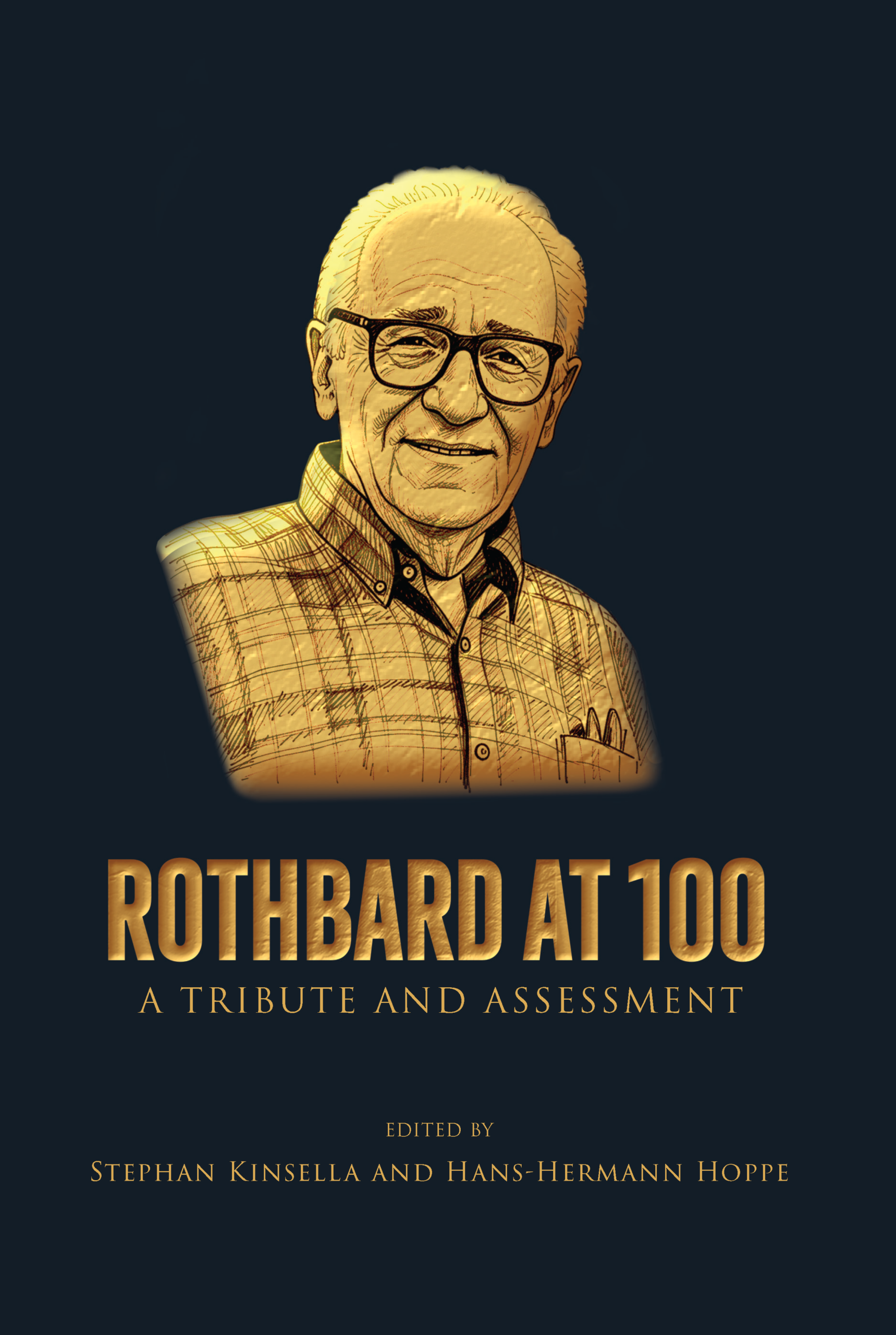
Rothbard at 100 is in production! As you can see, the books are printed in premium hardcover with gold foil stamping, and then they will be covered with a dust jacket. Also available as an audiobook and eBook. Preorder your copy now: https://t.co/iaEh0bk5G0pic.twitter.com/bapPGmhFHb
To donate with BITCOIN please use the address below. If you would like us to credit your payment (for dues, conference fees, etc.) please email Stephan Kinsella ([email protected]) when you make the bitcoin payment.
17M9V6m5X5Da4vNM5wWLjzcHz9qF36FPk6
“Property does not exist because there are laws, but laws exist because there is property.” — FrédéricBastiat
“Because the concept of property, for instance, is so basic that everyone seems to have some immediate understanding of it, most people never think about it carefully and can, as a consequence, produce at best a very vague definition. But starting from imprecisely stated or assumed definitions and building a complex network of thought upon them can lead only to intellectual disaster. For the original imprecisions and loopholes will then pervade and distort everything derived from them. To avoid this, the concept of property must first be clarified.” —Hans-Hermann Hoppe, TSC, ch. 2
The Property and Freedom Society (PFS; Facebook) stands for an uncompromising intellectual radicalism: for justly acquired private property, freedom of contract, freedom of association—which logically implies the right to not associate with, or to discriminate against—anyone in one's personal and business relations—and unconditional free trade. It condemns imperialism and militarism and their fomenters, and champions peace. It rejects positivism, relativism, and egalitarianism in any form, whether of "outcome" or "opportunity," and it has an outspoken distaste for politics and politicians. As such it seeks to avoid any association with the policies and proponents of interventionism, which Ludwig von Mises identified in 1946 as the fatal flaw in the plan of the many earlier and contemporary attempts by intellectuals alarmed by the rising tide of socialism and totalitarianism to found an anti-socialist ideological movement. Mises wrote: "What these frightened intellectuals did not comprehend was that all those measures of government interference with business which they advocated are abortive. ... There is no middle way. Either the consumers are supreme or the government."
(A more complete statement of our Principles can be found here.)
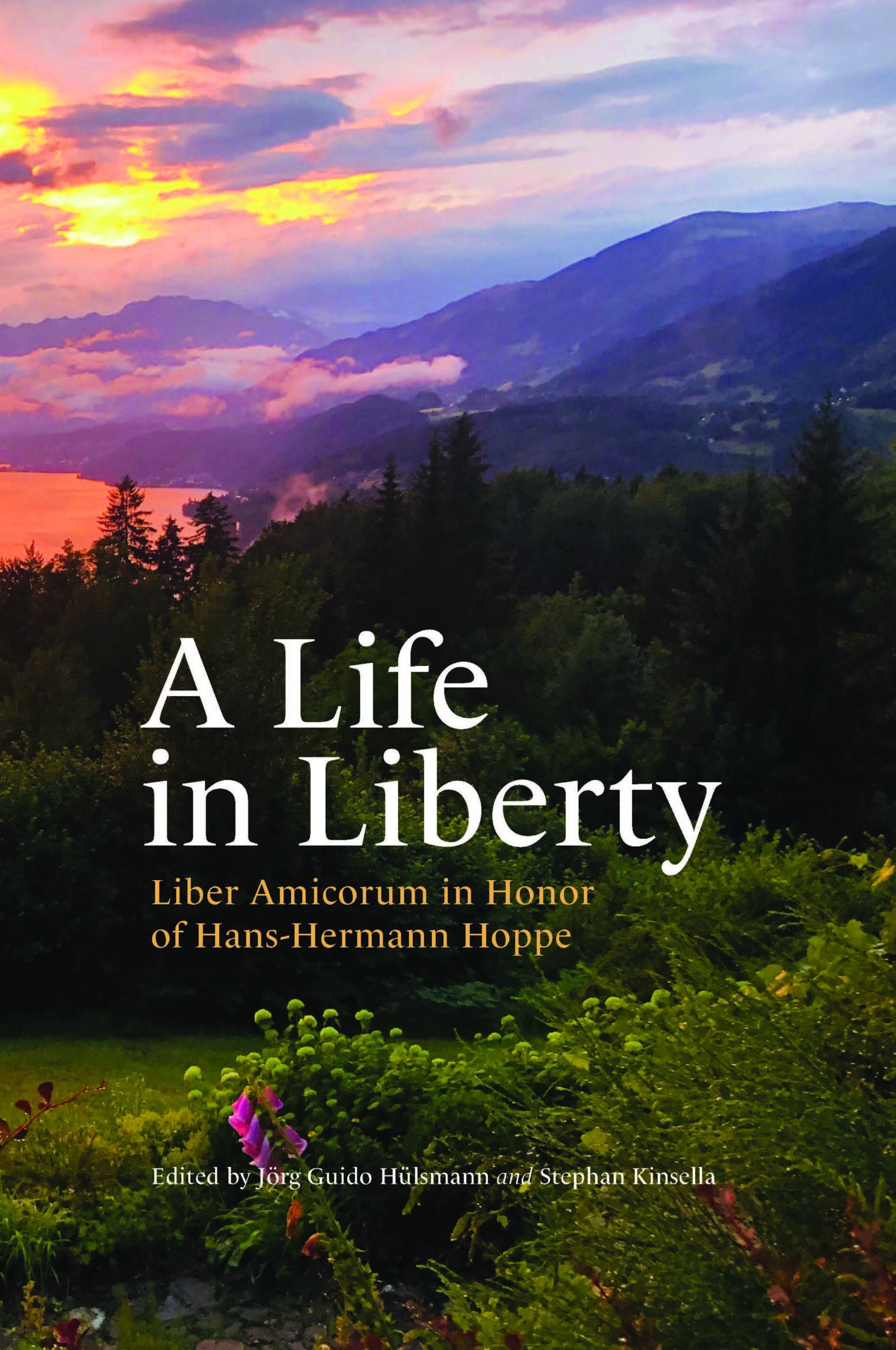 In 2024, the Property and Freedom Society published A Life in Liberty: Liber Amicorum in Honor of Hans-Hermann Hoppe, Jörg Guido Hülsmann and Stephan Kinsella, eds. (Houston, Texas: Papinian Press, 2024), on the occasion of Professor Hoppe’s 75th birthday on Sept. 2, 2024.

 Wanjiru Njoya, “











 Alessandro Fusillo
 Andreas Tögel
 David Dürr
 Doug French
 Fernando Chiocca
 Greg Morin
 Hans-Hermann Hoppe
 Jay Baykal
 Jayant Bhandari
 Jeff Deist
 Jeffrey Barr
 Juan Fernando Carpio
 Ken Yamarashi
 León Isidoro
 Martin Cabrera
 Nick Hoppe
 Oscar Grau
 Peter Wong
 PFS
PFS scholarium
 Saifedean Ammous
 Sean Gabb
 Sean Ring
 Stephan Kinsella
 Stéphane Geyres
 Thomas Jacob
 Tom DiLorenzo
Follow Us!