Escalating from Suez to Waterloo: Trump’s Three-Card-Monte Takes on the Chess Grandmasters
Saifedean Ammous
March 29, 2026
[Previously posted at Twitter]
 When Israel and the US launched their war on Iran, they claimed it would last a few days. A few days later, they said it would last 3 to 4 weeks. As the fourth week ends, it is a good time to take stock of what has happened and the war’s scoreboard, and the political and economic implications. Military matters are unpredictable, and everything can change quickly in battlefields, so this analysis is tentative, but there are clear changes in the facts on the ground so far that indicate the US has suffered a significant setback with important ramifications, and if the US chooses to double down, it may exacerbate it, with momentous political, economic, and military implications for the Middle East, the US, and the world at large.
A massive global economic crisis might unfold, the presence of the US in the Middle East is in serious danger, the US Empire may be in its death throes, the fiscal fate of the US hangs in the balance, and the world may finally be free of dollar slavery. Militarily and technologically, this might go down in history as a decisive turning point in which a twentieth-century superpower was defeated by a twenty-first-century medium power, which used newer technology at ~1% of the cost. Drones and hypersonic missiles that defeat aircraft carriers, jet fighters, tanks, and other twentieth-century relics remind us of small gun-wielding armies defeating larger armies carrying swords.
What is remarkable about this war is the disconnect between the real-world battlefield outcomes and the public understanding of what is happening. Over the past few decades, American military dominance has been so complete, and its opponents so mismatched, that Americans seem no longer capable of even conceiving of defeat, and cannot recognize it even as it stares them down. In America’s other recent conflicts, the range of outcomes was almost entirely determined by inter-American politics, with the opponent a passive subject. ‘Defeat’ simply referred to the other country failing to fully adopt the form of government and social customs that America sought to impose; it did not mean the failure to achieve military and strategic objectives, as American soldiers conquered Kabul and Baghdad in a matter of weeks. But in Iran, we have so far had a remarkable American failure to achieve strategic objectives, and the option of escalating to achieve these objectives threatens dire consequences.
To assess the war so far, we look at the objectives set by each party and how they have fared. At the initiation of the American Zionist regime’s attack on Iran, these appear to be its declared goals:
US goals:
- Unconditional surrender❌
- Regime change❌
- End of Iran’s nuclear program❓
- Destroy Iranian industrial, military, air force, and navy capacity (partial✅)
- End of Iran’s missile program❌
US achievements so far: 1 or 2 out of 5 achieved
The US has likely not achieved any of the essential goals in the fourth week of what was initially sold as a quick operation that would take a few days, then later revised to 3-4 weeks.
- Surrender seems out of the question in a country that has been preparing for this very war for decades, and in which millions are seemingly happy to die. ❌
- The Israel-US forces have succeeded in assassinating many individual leaders, which is the Israeli regime’s signature move, and something that its American puppet has recently adopted in contravention of centuries of civilized Western norms of war. The regime has survived so far, Iranians seem to have rallied around it, and it seems unlikely that it will fall, even after countless senior assassinations. The country is large enough, and the regime established enough, that individuals do not seem to matter so much, and the institutions continue to operate. The extent of domestic opposition to the regime was likely overstated by Israeli intelligence to sell this war to America’s easily impressionable president. Opposition to the government is one thing, but support for a foreign war is something entirely different. As Professor Robert Pape has argued, aerial bombardment alone has never produced regime change. Instead, it usually causes people to rally around the flag, and that seems to have happened in Iran. This has likely been intensified by Zionist regimes targeting more Iranian civilians, schools, and hospitals. Trump has already conceded defeat on this as he’s desperately trying to assure markets that he is negotiating with the regime he promised to destroy, while the regime denies talking to him or his intermediaries. ❌
- We do not know what happened to the Iranian nuclear materials, but we do know that the regime now has a far stronger incentive to acquire a nuclear bomb. ❓
- The US has likely succeeded in destroying much of Iran’s industrial capacity, and the longer the war goes on, the more of it will be destroyed. This terrorism will cost the people of Iran dearly in the many years to come, whatever the outcome of the war. The US has also massively degraded Iran’s conventional military forces, but this is a pyrrhic victory. Conventional military equipment constitutes very little threat to Israel and the US, and is not very useful for Iran in this war, which is why they control Hormuz even if their navy is gone. Iran does not need tanks, helicopters, boats, airplanes, or other twentieth-century technologies to achieve its objectives in this war. It has high-precision hypersonic missiles and cheap, accurate drones, which are allowing it to achieve its objectives. When Trump brags about destroying conventional military assets, he may as well be bragging about murdering Iranian horses and cavalry divisions. Zionist regimes’ forces have also succeeded in bombing many civilian targets, most notably the Minab girls’ school, demonstrating that schools, hospitals, and civilian structures are among potential targets, terrorizing the civilian population, which is another signature Israeli move. Both the assassinations and the targeting of civilians are unlikely to make a difference to the outcome of the war, but Israel observers will not be surprised to find Israel persists with them, because Israel’s real objective is to turn Iran into a failed state, as discussed below.✅
- The biggest and most consequential failure so far is the failure to eliminate the threat of Iranian missiles and drones, which continue to rain on US bases in the region and on Israel, and show no signs of abating. As I write this in Amman, Jordan, on the 26th day of the war, in the pathway of Iranian missiles to Israel, we may be witnessing the day with the most missile sirens since the war started, a clear indication that Iran’s missile capabilities are still strong. Further, Iran’s missiles and drones remain intact enough for Iran to credibly threaten energy infrastructure in the region and deter attacks on Iranian energy infrastructure. If the Iranians destroy energy infrastructure in the Gulf, the impact on the US and world economies will be devastating for many years.Iranian drones cost around $7,000 to make, as cheap as the average social media influencer Israel buys. They weigh 200 pounds and are easy to hide. They are easy to manufacture from cheap parts, earning the nickname “flying lawnmower”. There is an enormous productive capacity of these drones in Iran, and it is extremely unrealistic to imagine that aerial bombardment can destroy all its production capabilities.Iranian missiles have improved significantly in accuracy in this war compared to the previous war. Many of these missiles and drones can be fired from trucks, which means it is not simple to just pinpoint their bases and destroy them. The bases are hidden underground, and the trucks can fire from a different location every time.The continued sustained pace of Iranian rocket and drone attacks suggests that there will likely be serious shortages in the Zionist alliance’s defensive capabilities, and that explains why Air defense systems have been moved from Korea to the Middle East, and WaPo reports more defense systems may be moved from Europe. On March 19, Rheinmetall’s CEO said the war lasting another month would deplete air defense stockpiles. Given that Iranian drones and missiles are very cheap and fast to produce, whereas American interceptors are expensive and slow to produce, the longer the war lasts, the more vulnerable regional defenses are, and the more likely interceptors are to become insufficient. Rather than the US destroying Iran’s military capabilities, Iran is depleting American weapons stocks, leaving American allies exposed worldwide, and exposing how limited the American military really is in this new military technology world. If America is faring like this against a medium-sized, relatively poor country under sanctions, imagine how it would fare against China. ❌
Iran’s goals:
- Maintain regime in power ✅
- End US-Israel attacks ❌
- Receive reparations for attacks ❌
- Maintain nuclear program ❓
- Maintain missile program ✅
- Establish control over Hormuz traffic ✅
- Expel the US from the Middle East ✅
- Remove sanctions (Partial ✅)
Iranian achievements so far: 5 or 6 out of 8 goals achieved
- Control over Hormuz ✅
Thanks to its drones and missiles, Iran has established de facto control over the Strait of Hormuz. It only took a few drone attacks in the first few days to completely freeze traffic in the Hormuz Strait, and now only Iranian-approved boats dare to traverse it. Iran has said that it will impose a toll on the Strait of Hormuz and has asked vessels to pass through a particular route between two Iranian islands to ensure safe passage, allowing them to be under close Iranian watch and easy inspection. Several ships have traveled that path in the last few days, suggesting the tollbooth is operational. It seems Iran is charging around $1 per barrel of oil for passage, and that is a very small price to pay for the world’s energy consumers compared to the alternative of hoping Trump’s war can bring this to an end.
Control over Hormuz gives the Iranian regime enormous leverage over global energy markets and the entire Gulf region. All the Gulf states looking to export oil must get their tankers through the Persian toll booth, and their governments need to stay on Iran’s good side.
There is no obvious military strategy for quickly ending Iranian control of Hormuz. Iran has thousands of square miles of mountainous territories overlooking the narrow Hormuz like a stadium overlooking a pitch, allowing easy targeting of giant tankers like fish in a barrel. Iran has a considerable arsenal of cheap drones and missiles hidden all over this landscape, and they can be launched from mobile launchers in different locations, making them difficult to detect. Trump and his cabinet of TV bimbos seem to have had no idea that Iran closing the Strait was a possibility, thanks to their Israeli bosses trying to sell them on this misguided war by ignoring all the possible downsides.
Trump and his regime have gone from claiming the Strait is open, to saying that the US did not care if it was open, to demanding China, Europe, and other countries send their navies to deal with it, a ridiculous demand which all nations rejected, except for the Chinese, who did not even dignify it with any kind of response. When it finally dawned on Orange Caligula that Israeli intelligence had duped him into plunging the US and world economies into a massive crisis, he lost his marbles and issued a 48-hour ultimatum to Iran to clear the strait or face the annihilation of its power infrastructure, an astonishingly brazen admission of intent to commit a war crime. But as the deadline approached, US government bond yields spiked, and Trump backed down from his threat, extending it by five days, claiming that a breakthrough had happened in negotiations, although Iranian authorities repeatedly insisted no such negotiations were taking place. And as the five days came to an end, and bond yields began to rise again, Trump chickened out again and extended his ultimatum another ten days. There can be no more blatant illustration of bumbling amateurism and strategic impotence than this humiliating capitulation, while Iran ignored him and repeatedly denied that negotiations were taking place, continuing to fire its trusted drones and missiles.
- Expelling the US from the Middle East✅
Perhaps the most important and remarkable geopolitical development in the war is the de facto severe degradation, and possibly even elimination, of the US presence in the Middle East. The exact extent of damage to US bases in the region is not clear, but after 26 days of Iranian bombing, it is likely significant enough to have rendered them unusable, as the NY Times reported, with the majority of US soldiers having been moved to European bases or staying in civilian areas.
Not only has Iran destroyed American bases, but it has also succeeded in clearing US vessels from the Persian Gulf. The two aircraft carriers sent by the Trump regime to the Gulf have stayed more than 1,000 kilometers away, with the USS Lincoln hiding on the wrong side of Oman in the Arabian Sea, while the USS Ford is in the Mediterranean undergoing repairs for a long list of suspicious problems. All possible explanations for these problems are devastating to the idea that the US is a superpower, and the idea that they suffered damage from Iranian missiles is the least bad. A worse possibility is that the boat is the victim of sabotage from admirable soldiers who have decided their lives may be worthy of more lofty goals than helping Zionists steal more land. But the worst explanation is the most likely: the culprit is the incompetent engineering of the US military-industrial complex, whose only technological innovation in the past three decades has been to increase costs by reducing reliability.
Iran’s entire military budget is less than the cost of one of these carriers. What exactly is the point of spending billions of dollars on a giant boat that carries many aircraft that need to have expensive living pilots trained to fly them over enemy territory to launch airstrikes? The most convincing answer seems to be that this is a great way to enrich the military industrial complex, but if the actual goal is to achieve military and strategic objectives, then swarms of cheap and unmanned drones and precision hypersonic missiles seem far more effective, safe, and efficient. China’s hypersonic missiles could hit any target on Earth, more than what a US pilot, aircraft, and aircraft carrier can hit, at a fraction of the cost, and a tiny fraction of the time and risk, since it doesn’t require soldiers outside of China’s borders. The US is behind China, Russia, and Iran in these critical technologies because the latter did not spend $10 trillion and a quarter century optimizing their militaries for fighting militias and bombing civilian structures for Israel to steal goy land, and instead developed the technology that can take on a superpower.
Hypersonic missiles may turn out to be as superior to aircraft carriers as guns are to swords, since hypersonic missiles and guns allow you to neutralize your opponent from afar, whereas the sword and aircraft carrier require you to get close. Will aircraft carriers become as obsolete as swords in modern combat?
Iran has also focused much of its attacks on American radars, refueling tankers, and AWACS (Airborne Warning and Control Systems), which undermines air defenses and the ability to carry out military attacks on Iran. The full extent of damage and its implications are unclear so far. But the very precise targeting of high-tech essential equipment suggests a deliberate, methodic, and cunning Iranian effort to blind and paralyze US operations in the region. As the war goes on, this may come to be significant.
The remarkable implication of the damage to US bases and retreat of US aircraft carriers is that the US no longer has a functional military presence in the Middle East from which it can project power. Destroying and removing US bases from the region is a concrete and important objective of Iran’s war, and reversing it will likely require an enormous US military effort with a large number of casualties. Iranian attacks have rendered American and host nation plans and hopes for these bases irrelevant. Whether they want to keep them or not, there is no way to rebuild them without eliminating Iran’s drones and missiles, or obtaining the blessing of Iran, both of which are unlikely.
Barring a quick turnaround in favor of the US-Israeli war effort, the hosts of these bases may want to begin planning for life without them. If the current status quo persists, with Iran maintaining its missile capacity, its deterrence capacity, control of Hormuz, and with US bases dysfunctional, we are entering a ‘New Middle East’ very different from what bloodthirsty Neocons have been fantasizing about for thirty years.
- Removal of sanctions (partial ✅)
The most astonishing development of the war has been that the US has resorted to lifting some sanctions against Iran while the war is ongoing, probably the first time a country has removed sanctions against an opponent it is fighting. Iran’s closure of Hormuz made oil and gas prices rise worldwide, and that is politically unpopular in the US, as Americans do not want to pay higher prices for energy, and the knock-on effects of an energy shock will be devastating to the US economy. While everyone with a brain could have foreseen the closure of Hormuz, the US regime clearly doesn’t fit the bill, as they seem to have made no preparations for the very obvious and publicly proclaimed strategy of Iranian deterrence. In an astonishing display of incompetence and negligence, Trump was so taken by surprise at the Iranian response that his only methods for dealing with it was to tweet angrily demanding others send their navies, and then to lift some sanctions against Russia and Iran itself, to allow them to sell more oil onto the market and bring the prices down, averting, or at least delaying, economic catastrophe.
With the spike in oil prices and the easing of sanctions, the Zionist war on Iran has gifted Iran a windfall of tens of billions of dollars in oil revenue at the exact time the Iranian regime needs them the most. And if the situation at Hormuz remains, then Iran will also be able to tax the entire planet’s oil, gas, fertilizer, and more.
Israel’s goals:
- End of Iran’s nuclear program❓
- End of Iran’s missile program❌
- State destruction ❌
Israel’s achievements: 0 or 1 goal from 3 achieved
Israel, from its inception, is a project of land theft, and its actions are only understood through that lens. Zionism built an ethnostate on a land in which the state’s ethnicity owned no more than 5.67% of the land in 1945, which necessitated the mass murder and expulsion of Palestinians, which, contrary to Zionist propaganda, started and was well underway, long before any Arab armies had attempted to intervene to stop it. Around a quarter of a million Palestinians had already been murdered or expelled before any Arab soldier had entered Palestine. With global support for the original sin that was Israel’s birth through mass murder and theft, Israel has continued to get greedier about capturing more and more territory over time.
Israel’s eternal problem is that it is a state operating by barbaric pre-civilized norms of behavior and morality, where everything is allowed for the in-group, and nothing is beyond being done to the out group; but at the same time, it is a parasite entirely dependent on the civilized world subsidizing it, but the civilized world has long moved past Israel’s barbarism.
This is Israel’s duality that explains why it can be so polarizing. If you judge Israel by its actions in the real world, you are shocked to realize this is a country that legally allows murder, rape, theft, starvation, pogroms, and torture of goyim, including children, purely for being goyim. None of these are exceptions or individual cases; these crimes are fully sanctioned by the state because it does not prosecute the perpetrators, no matter the abundance of evidence. It’s a state that stole the vast majority of the land it controls from its rightful owners and prevents them from ever going back to their land or even purchasing it, just because they were born to the wrong race. It continues to expel peaceful people from their homes every day for no crime except being goyim.
But if you judge Israel based on the astonishingly good propaganda it uses to trick civilized westerners into subsidizing it, you will cry like an idiot at the thought of anyone not worshipping it.
This dichotomy is what explains Israeli policies: Israel would like to expel and murder millions of goyim to take their land, but they realize that the support of the civilized world, including global Jewry, would be endangered by such barbarism. So they need to be slower and more gradual in their approach, relying on repressing their victims to elicit a violent reaction, which then allows the Israelis to carry out their mass murder and expulsion under the cover of self-defense. With a dose of added atrocity propaganda, Israel can get Western nations to abandon foundational laws and values to support it. The US, Europe, and all the hosts on which the Zionist parasite relies have laws that ban their countries from offering aid, military cooperation, or even trade with governments that target civilians and engage in torture, but these are brushed aside because of propaganda, political manipulation, and blackmail.
Israel is the only country in the world that does not define its borders because its theft of land is still a work in progress, nowhere near done. If Israel defines its borders to include all the territories it occupies, it becomes a Jewish state where the majority of the citizens are non-Jewish. If it doesn’t give its subjects citizenship, it becomes a more blatant apartheid model and makes it impossible for it to pretend to be interested in peace for Westerners. So it keeps its borders vague so it can keep expanding them, and to work on slowly and surely murdering and expelling the goyim who live there.
Israel’s immediate plans are to murder and expel as many Palestinians as possible from the West Bank and Gaza, in order to steal their land and make it formally part of Israel. The majority of the West Bank has already been cleansed of its goyim, who have been gathered into ever-smaller concentration camps, where they are left defenseless for Israeli land thieves and soldiers to murder, rob, and torture them with impunity.
The next step is to begin settlement in parts of Lebanon and Syria that Israel is occupying now. Remember that the Zionist claim for Palestine, after all, is based on ancient scripture that says that the land of Israel extends from the Euphrates to the Nile, as America’s traitor ambassador to Israel recently clarified. If messianic fundamentalists’ interpretation of ancient scripture overrules the millennia-long property rights of goyim in Jaffa and Ramallah, the goyim of Cairo, Baghdad, Damascus, and Beirut don’t have to wait till settlers from Brooklyn show up to steal their homes to begin worrying. The full extent of Biblical Greater Israel, as seen on the uniforms of Israeli soldiers, currently houses more than 200 million goyim in Egypt, Palestine, Jordan, Syria, Lebanon, Saudi Arabia, Iraq, and Turkey. Many Israeli extremists also aim to destroy Islam’s third-holiest site to build the third Temple, and extremists even want to make sure to destroy all Christian churches for idolatry.
The irreconcilable difference at the heart of the Middle East is that the region’s goyim do not share Israel’s view of them as an inferior species who have no property rights, so they are not keen on making way for this Messianic project that would destroy their lives. Israel can’t just fight them all, especially as such blatant aggression would alienate the Westerners who subsidize Israel’s entire parasitic existence.
Israel thus has to adopt a gradual approach to its expansionist plans, undermining all regional opponents individually by siccing their American golem on them, and conquering more and more land. Israel’s agenda for Iran was laid out by the Project for the New American Century three decades ago, and the Yinon Plan four decades ago. This is the plan that Israel’s puppets in the Bush administration told Wesley Clark in November 2001, that they would topple seven countries: Iraq, Syria, Lebanon, Libya, Somalia, Sudan, and Iran. Six of these countries have been successfully turned into failed states, and now it is Iran’s turn to enjoy Zionist liberation through mass murder, state failure, and fragmentation. The ultimate goal is to turn all the goy nations of the Middle East into small warring tribes fighting each other with light weapons that cannot threaten Israel. The goal is far more ambitious than mere regime change, because regime change in an intact and armed country could still constitute a threat.
This makes the goals of Israel in this war more ambitious than America’s, but unachievable without US military might. Israel cannot just get Americans to fight an all-out war with the purpose of destroying Iran and turning it into Syria, but Israel can gradually boil the frog by getting the US to commit to modest goals, after whose failure, Israel can push for more US involvement until the American golem is fully consumed in the quagmire of destroying Iran. As Narco Rubio made clear thanks to his astounding stupidity, Israel told the US it would attack Iran, and the US decided to join because they assumed Iran must retaliate against American bases in the region, and the American traitors are incapable of even contemplating the possibility of using the billions of dollars in money and weapons Israel robs from Americans every year as leverage to persuade Israel tnot to attack or to consider disavowing the attack and informing Israel and Iran that it would not intervene and they are on their own. Iran would have been more than glad to keep the US out of the war and point its entire missile and drone fleet at Israel, whose air force would be unable to make significant strikes without US aircraft carriers and regional bases. The mere prospect would have deterred Israel from starting the war, and America and the world would be in a far better place today. Israel has used American soldiers and military bases, and the countries hosting them, as a human and military shield to protect Israel from the consequences of its attack. Those of us who thought the US could not possibly be more servile to Israel continue to be proven wrong.
The start of the war makes the power dynamic between the two countries clear. Thanks to bribes, blackmail, propaganda, and possibly more, the American government is entirely captured by the Israelis and has no institutional capacity to deny Bibi’s carefully calibrated requests. Israel gave Trump delusional intelligence that a decapitation strike would cause Iranians to rise up and remove the regime, with the war over in a few days. Nobody in the US government will hold them accountable for their lies. This was the foot in the door Israel needed, and now the war takes on a life of its own. Israel will hope the same easily manipulable idiocy of this administration will keep pushing the US to continue escalation. This likely explains why they assassinated Larijani, as he would have been more likely to negotiate a deal with Trump. This explains why they escalated dangerously by targeting the Pars gas field, which Trump had to disavow in fear of Iranian retaliation. It also explains why they hit a desalination plant in Iran. They are not done, and it would not be wise to bet against them getting the escalation they want.
Even though Israel has not achieved its objectives so far, it is important to remember that Rome was not destroyed in a day, and they are diligently working on it.
Iranian deterrence
In summation, after one month, Iran has achieved most of its objectives. The US and Israel have not achieved their substantive goals and have suffered serious setbacks compared to the pre-war situation, with the degradation of the US presence in the Middle East and Iranian control over Hormuz. Iran’s achievements are relatively sustainable. As long as it can keep firing its cheap, plentiful, and well-hidden drones and missiles into US bases and unapproved Hormuz traffic, it can maintain most of its gains so far. On the other hand, there is no easy way for the Ziopedo regime to snatch this victory from Iran. If the US wants to reverse this status quo, it needs to eliminate Iranian drone and missile threats. The Epstein coalition likely already targeted all of its important and consequential targets in the first few days, and if these didn’t achieve the intended objective, then the continued bombing of less important targets is unlikely to achieve much, especially since the conventional military targets are unlikely to materially degrade the well-hidden missiles and drones on which Iran’s strategy relies. Bombing civilian targets will only strengthen the regime and further undermine the legitimacy of any opposition.
Iran has also successfully established a degree of deterrence, at least for now, as it still has several layers of escalation it can unleash. When it threatened to target regional energy infrastructure, it got the US to commit to not target its energy infrastructure. Iran could also get their Houthi allies to close Bab Al-Mandeb in Yemen, which would be a huge disaster for the global economy, exacerbating the Gulf energy crisis by limiting exports from the east of the Arabian peninsula.
The longer the war goes on, the greater the disruption to the global energy and food industries, and the more devastating the economic consequences worldwide. Not only does ~20% of the world’s oil and gas pass through Hormuz, but also a sizable percentage of the world’s fertilizers and essential industrial chemicals. As I discuss in detail in my Principles of Economics, hydrocarbon fuels are essential to our modern life, and a Hormuz supply disruption would cause massive economic devastation, especially to the world’s poor. The disruption to fertilizer supplies would make this much worse, potentially resulting in famines. And the shortages in industrial chemicals will also wreak havoc with global markets and industry.
I suspect Iranians think that time is on their side. Iran knows Trump can’t handle high oil prices, and they know he can’t handle high Treasury yields. They know that he and his base care about this war about as much as they care about his mean tweets mocking Democrat nobodies. IRGC knows that practically no American is willing to sacrifice anything for fighting Iran, and they know the only Americans who support this war are the morons who think it will cost them nothing, and the Israeli agents scamming them into thinking that. Iranians know that as soon as the costs of the war start showing up for the average American, the war, Trump, and Israel will become unspeakably unpopular. They have also tried negotiations and realized that this Israel-owned regime operates by pre-civilized war standards, where negotiations are used as cover for murdering the negotiators. They may very strongly believe there is no point in negotiating and will keep pushing. Israel’s non-stop assassination of top leadership seems designed to ensure this outcome and further entrap the US.
Trump’s inept strategizing has left him with few carrots and sticks with which to try to bring about his favored outcomes. He has already removed some of the sanctions he placed on Iran, and showed Iran that 3 weeks of war are more effective for sanctions relief than four decades of negotiations. And as he’s adopted Israeli diplomatic etiquette by bombing the Iranian leadership during negotiations, the new leadership is highly unlikely to trust him. He’s already exhausted his most important aerial bombardment targets, and his aircraft carriers are too petrified to come near the Persian Gulf, limiting their effectiveness.
Perhaps even more significant than the impact on energy markets is the impact on the US government deficit. The longer the war drags on, the more it costs, the more likely the US is to experience insolvency, and the more likely the dollar is to be devalued and destroyed. The oil crisis exacerbates this.
Since the war on Iran began, the 10Y yield has risen from ~0.46% to ~4.42%. The rise in yields translates into tens of billions of dollars in higher debt-service payments for the US government and much more for the entire world economy, which uses Treasury interest rates as the risk-free base rate. When you add the hundreds of billions, or trillions, likely to be spent on the war & the impact of an energy shock, the US fiscal situation looks even more precarious. The higher these rates rise, the more likely defaults and bankruptcies will be across the US and global economies, creating unemployment and recessions, and requiring more government handouts and inflation.
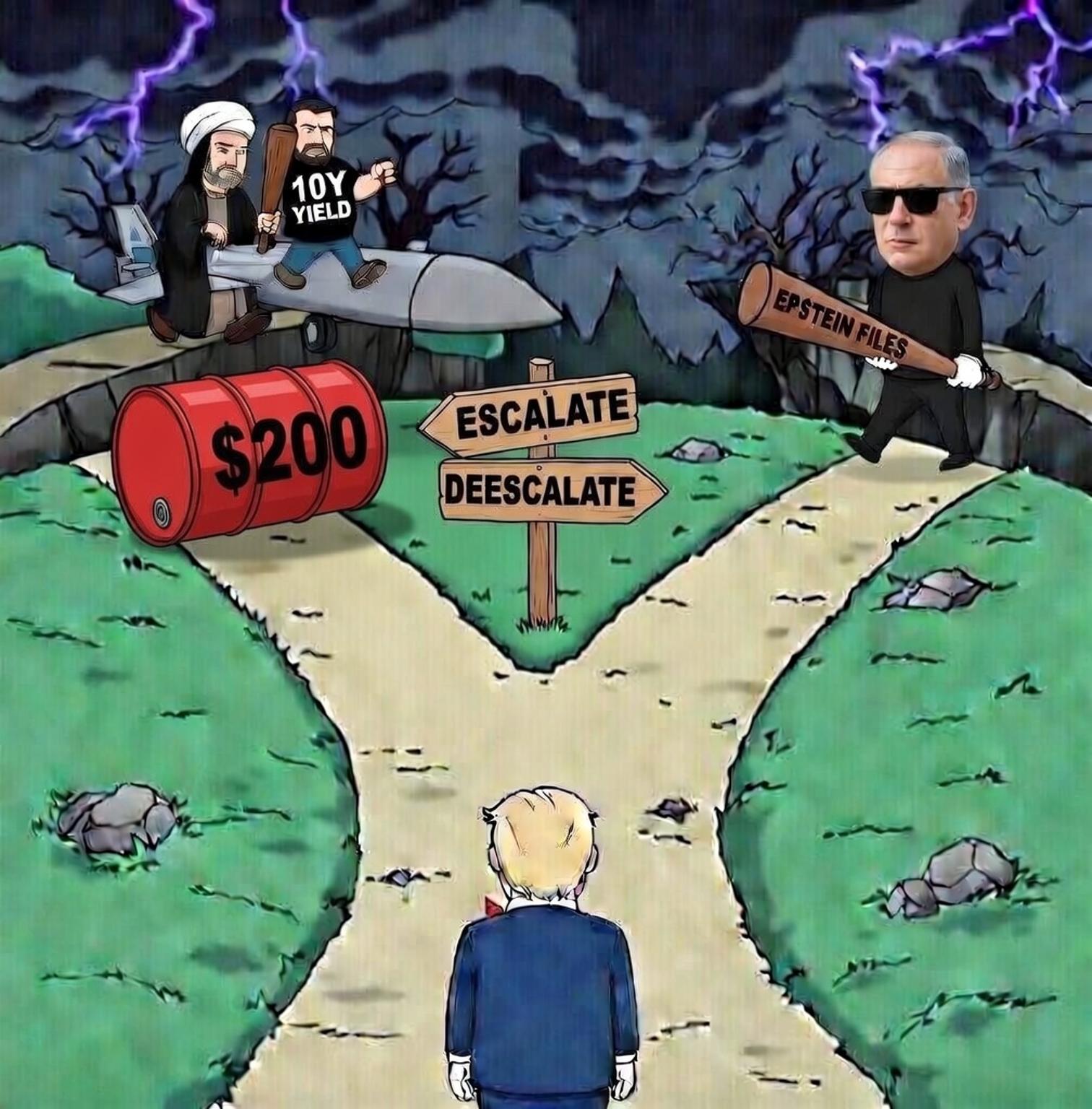
In his last erratic hubristic catastrophe, Trump backed out of his tariff tantrum when the 10Y yield hit 4.5%. I predicted he might chicken out of this war as he did with tariffs when the 10Y yield hits 4.5%, and indeed, at around 4.44%, he chickened out of his threat to destroy Iranian power plants if they don’t open Hormuz, claiming to have made good progress on negotiations with Iran, and giving them an extra five days to negotiate. Six days later, Iran continues to deny that any such negotiations have taken place, and there is nothing concrete on the ground to suggest they have, as Iranian missiles continue unabated. The 10-year yield declined slightly, but the fake-negotiations ruse soon wore off. On March 26, the yield rose back to 4.4%, and, like clockwork, within a couple of hours, Trump announced that he was extending his deadline for Iran by another 10 days. At the close of the week, 10Y crept up again to 4.42%.
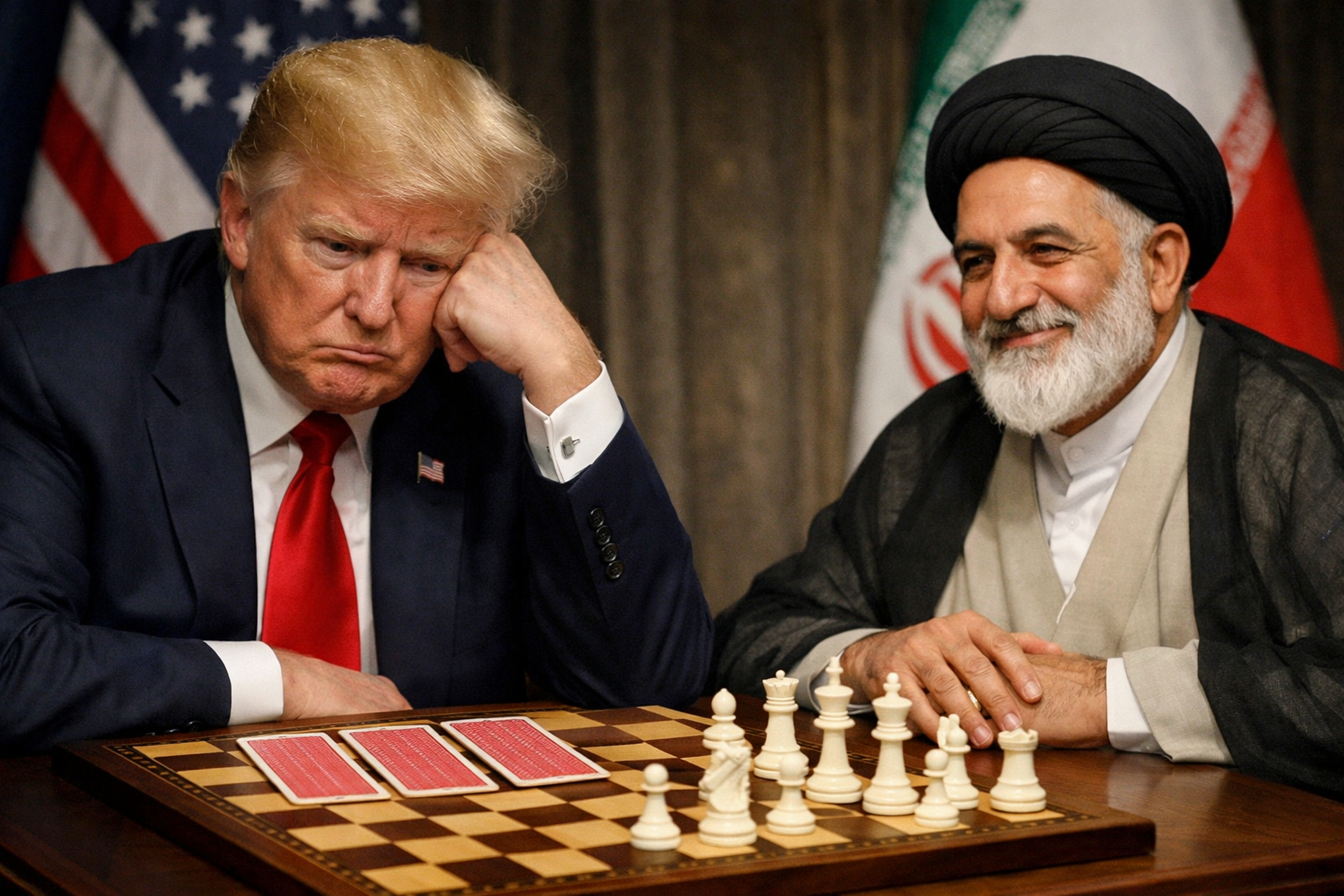
This pathetic backtracking on empty threats shows a man out of his depth, in a world he doesn’t understand, flailing cluelessly, bluffing, blustering, vastly overestimating his strength, and utterly ignorant of his enemy’s weapons and strategy. Persians have a national average IQ of 105, by some measures, one of the highest in the world, and the highest outside East Asia. Persians invented chess, but Trump’s strategic thinking and relentless bullshiting and blustering suggest the three-card monte is the most sophisticated and honest game he’s ever played.
In the face of these enormously unfavorable realities, Trump is changing his objectives. He is no longer talking about regime change or unconditional surrender; he is instead seeking to negotiate with the regime and even boasting about making good progress, even as they deny any contact. He has gone from wanting to eliminate Iran’s missile program to being more tolerant of it. The new and more modest goals of the US are:
Revised US goals:
- Open Hormuz
- End the nuclear program
The US strategy now focuses on opening Hormuz, which was the status quo before the war started in February 2026. If, after a month of the war you started, you are fighting to recreate the conditions you had before the war started, then you lost.
Perhaps the most tragicomic and telling aspect of this war is how, in all of the US administration’s tantrums about Hormuz, blaming and dumping the problem on everyone, none of them once suggested that Israel get involved in trying to open the Strait, when it was the country that started the entire war.
Trump lost his first Iran war and is now faced with the choice of accepting defeat and cutting losses or fighting a new war with new objectives, where he is in a far less favorable position because he has no more Middle Eastern bases, lower domestic support, and more fragile and nervous markets. The first option could give America its Suez moment, the second, its Waterloo.
De-escalation and Suez
America ending the war now would be the smartest thing for Trump to do, as it would end the energy crisis, reduce the fiscal burden on the US government, and prevent Treasury yields from continuing to rise. This isn’t so politically difficult since Trump isn’t running for reelection, and his core supporters are cultists who will venerate whatever he does and call it genius.
But accepting defeat cements the status quo. It cedes Hormuz to Iran, which will impose a tax on the world’s oil consumers, and the legacy of this war will be that it made the whole world subsidize the regime Trump sought to overthrow. American regional bases will never be rebuilt. Both developments will cement Iran’s status as the regional superpower, and Gulf oil producers will have to win Iran’s good graces to sell their oil. Iran will likely never again enter into the Non-Proliferation Treaty and will likely develop a nuclear bomb. Iran may not get reparations or sanctions relief in this scenario, but the new oil income and regional dominance will make up for that.
Such an outcome would likely constitute America’s Suez moment, in reference to the 1956 Suez crisis, which effectively ended the British Empire and concluded the process of British decline that began with World War I. Even though this sounds bad, it would be a blessing to the American people, who get nothing from their government’s foreign adventures but inflation, taxes, poverty, and enemies. The US would lose all influence in the Middle East and beyond. If China chose to invade or impose a blockade on Taiwan, it would be very difficult to see the US being able to help. If all of the US military assets in the Gulf have failed to defeat Iran, what hope do they have against Russia or China? Russia, China, and other smaller rivals will be emboldened to take on the US or its regional allies. The EU might even begin to assert itself after the incredible abuse it has sustained at the hands of the US regime, from destroying Nordstream, to Trump’s tariffs shakedowns, to threatening the takeover of Greenland.
But a US capitulation is too dangerous for Israel, as it leaves Iran in control of Hormuz, with the ability to build better and stronger missiles and drones, and forces Gulf regimes to realign with Iran if they want to export their oil. Israel’s vice grip on American politics makes it very difficult to see Trump capitulating and leaving Israel to fend for itself in a sea of people who are not fond of their messianic land theft, with Iran as a regional superpower, eager for revenge.
(Incidentally, Israelis and Americans may want to familiarize themselves with what Iran did over four decades to avenge Iraq’s invasion of Iran in the 1980s to get an idea of the horrors that await them from kicking this hornet’s nest.)
The same forces that got Trump into an idiotic war that doesn’t benefit America in any way whatsoever can also get him to foolishly escalate it at devastating cost. Observing America’s Israeli media agents recently makes it clear that escalation is Israel’s agenda, and they are adopting the usual incremental warmongering strategy: they begin by promising a quick, decisive victory, but when that doesn’t materialize, the failure is used as proof that a more aggressive campaign is needed. Most Americans are no longer stupid enough to fall for these predictable tricks, but their government is.
The next bait Israel has laid for Trump seems to be to conquer islands or coastal areas near the Strait of Hormuz. That would almost certainly achieve none of the war’s objectives, but it would turn American soldiers into fish in a barrel, with drones and missiles raining from mountains enveloping 270 degrees around them. One of Israel’s most loyal servants in the Senate, Lindsay Graham, in his attempt to sell this idea to the American people, likened it to Iwo Jima, which killed 26,000 US soldiers. This helps explain why none of the war cheerleaders is suggesting sending precious Israeli troops to open Hormuz, as such dangerous jobs are only for goyslave soldiers. The potential for casualties in this case exceeds anything the US has experienced since Vietnam. If this attack happens and a large number of Americans are murdered or captured by Iran, then Israel’s agents in the US will capitalize on American anger to escalate further. We have already seen Israeli mouthpiece rag WSJ make this argument, eventually escalating all the way to a ground invasion or a nuclear attack.
Escalation and Waterloo
If Trump refuses to accept the Suez ending of this war, he opens himself up for something far more devastating: Waterloo. An aggressive military push to defeat Iran could fail and bring with it the economic, military, and political destruction of the US Empire.
The only powerful lever of escalation left to secure Hormuz and achieve regime change is an overwhelming ground invasion to secure the Iranian coastline and/or overthrow the regime. A ground invasion would not succeed if limited; it would need to control and completely comb the entire coastal area of Iran, and likely invade Tehran, a city of ten million people. Such an undertaking may require the greatest US military effort since WWII. The cost in money and lives will be enormous, and the outcome far from certain. Iran is an enormous country the size of Western Europe, with rugged and impenetrable mountain terrain, and a population of 93 million, larger than Iraq and Afghanistan combined. Iran is also far more militarily advanced than Iraq and Afghanistan, and there is no way of dealing with Iran’s drones and missiles without sustaining significant damage. Iranians have been preparing for this war against America since 1953, and the war so far shows that they are better prepared than the American buffoon who started the war because his Israeli owners lied to him and told him it would be as easy as Venezuela, and when that failed he had to scramble and sent soldiers and air defenses to the region to face the ferocious Iranian response.
But beyond the deaths of soldiers, the impact of escalation is likely to be devastating to the US and world economies, to US global military dominance, and to the US dollar. Escalation will send Treasury yields higher and increase the fiscal pressure on the US. Debt/GDP is already approaching banana republic levels, and debt servicing is already the largest part of the US budget. Escalation of this sort is unlikely to leave Iranian and Gulf energy infrastructure intact, destroying large percentages of the world’s energy supply, causing an energy and poverty crisis. The escalation will also likely disrupt Hormuz traffic for a long period of time, resulting in devastating damage to the US and world economies. This could unleash a recessionary inflation worse than the 1970s, whose energy shock was actually tiny and mostly a cover-up for inflation, as I explain in The Fiat Standard. With high inflation to fund the war, supply disruptions that cripple economic activity, rising interest rates destroying businesses, a collapsing bond market destroying savings, growing unemployment, increased pressure for inflationary and welfare policies to counter the damage, and rising cost of debt servicing, a US default is not an outlandish possibility in this world, it may even be probable, and it would be devastating to the US government, the US dollar, and the countless suckers who believed that US bonds are a good saving instrument. If the Treasury market loses its status as the ultimate safe haven, the dollar will likely lose its status as the global reserve currency, and America’s exorbitant inflationary privilege will disappear.
Further, if Trump escalates against Iran, his military will be stretched to the point where it would be very difficult for it to engage elsewhere, opening it up for significant geopolitical setbacks. It is already bordering on delusional to hear Americans talk about China being an enemy, because if America were to start a war in China’s surroundings, Chinese hypersonic missiles could quickly and decisively end the war, as a leaked Pentagon report explains. Without hypersonic missiles, the US is at a severe disadvantage. With an expensive and protracted quagmire in Iran, the US would be even more vulnerable.
The US has no reason to be involved in this war at all, and the only sane course of action for it is to evacuate all its troops from the Middle East, stop giving military or economic aid to any government in the region, and establish normal diplomatic relations with them and no alliances. But Israel is in control of America, and Israel needs the US to prosecute this war until it can destroy Iran as a society and a country, and turn it into a post-apocalyptic wasteland. Iran, on the other hand, needs to make the cost of the war unbearable for the US before the US can destroy Iran.
Given that Trump isn’t running for reelection and isn’t a die-hard Republican who cares about the party after him, it won’t be political pressure that moves him. And given that his family is likely making incredible gains from his manipulation of the market, selling pardons, and being Miriam Adelson’s perfect little puppet, he’s unlikely to be moved by moderate inflation and growing deficits. Iran will have to impose an enormous military and economic cost before the US retreats, which means very high inflation, a devastating depression, and/or a fiscal crisis.
In conclusion, the choice facing Trump today is very difficult, and it is between bad options. De-escalation is a humiliating defeat unacceptable to his Israeli bosses, even though it would be much better for America and the world. Escalation risks economic catastrophe at home and worldwide, the destruction of the US empire, a fiscal crisis, high inflation, and maybe even hyperinflation. Israel’s control of the US means there is likely no endpoint to this conflict except through the destruction of Iran and its plunging into civil war, or the destruction of the US economy with tragic consequences for billions of people. We could also end up with both.

















 Doug French
 Fernando Chiocca
 Hans-Hermann Hoppe
 Jay Baykal
 Juan Fernando Carpio
 PFS
PFS Stephan Kinsella
 Tom DiLorenzo
Follow Us!