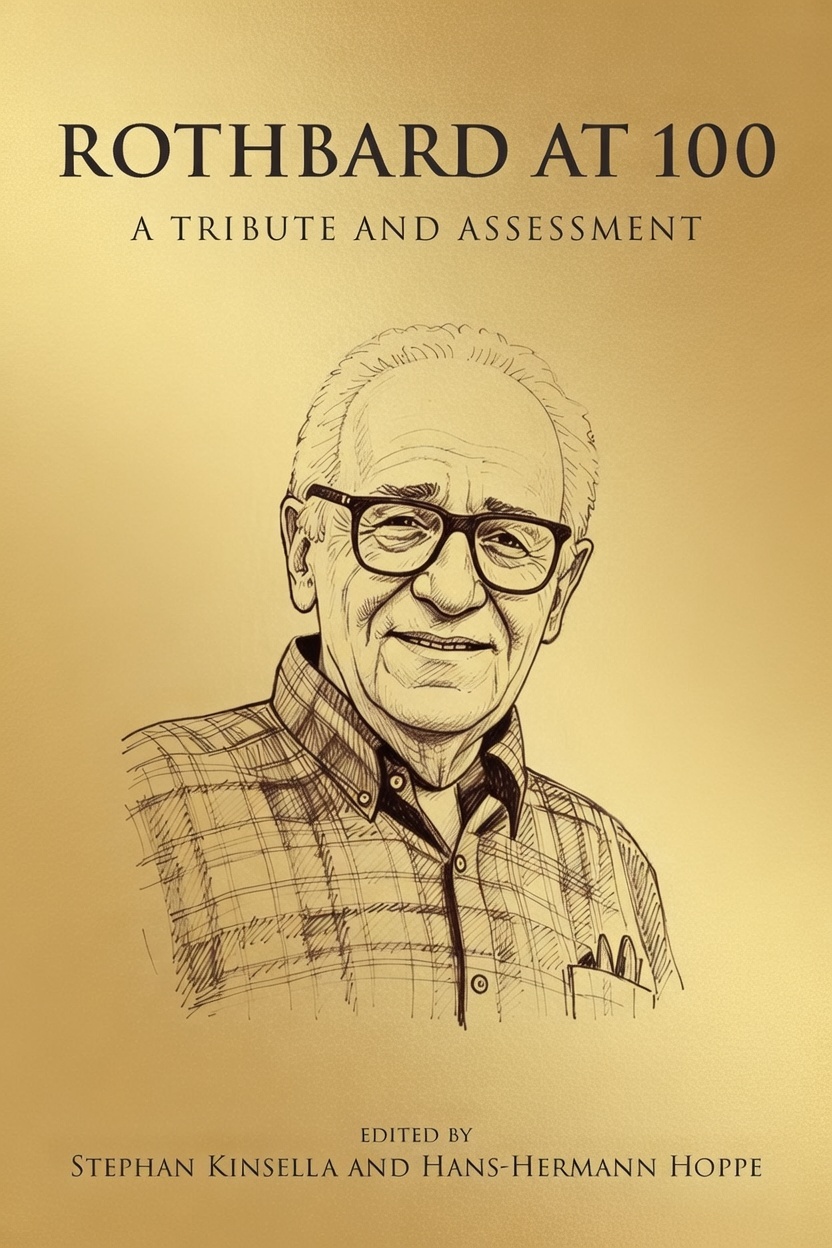
— From Rothbard at 100: A Tribute and Assessment, Stephan Kinsella and Hans-Hermann Hoppe, eds. (Houston: Papinian Press and Property and Freedom Society, 2026) —
19
Life in a World Without the Rothbardian One Big Liberty Master Button
I was never fortunate enough to meet Murray Rothbard in person, but this intellectual giant nevertheless changed my life immeasurably. He helped me reach the heart of the argument for a free society and showed me how vital it is, when studying economics, to stand firmly on the foundations laid by the great scholars of the Austrian School. He also showed me how to connect economic theory with the teaching of political philosophy, legal theory, and ethics. Only through this broad-spectrum approach can we discover the rules of human coexistence in a free social order.
My journey of discovery into the Rothbardian tradition took place in the early 1990s, before the advent of the internet, and was therefore slow. However, it had Rothbardian traces from the very beginning. It began with a meeting with Leonard Liggio at a European summer school.2 This was followed by my trip across the ocean to the Foundation for Economic Education, where I met Hans Sennholz and Israel Kirzner. During our discussions, they mentioned Murray Rothbard as a leading figure of the Austrian tradition who could currently be interacted with at the Mises Institute in Auburn, Alabama. The following year, I therefore took another trip across the ocean, this time to the Mises Institute. Unfortunately, it was too late. I visited the Institute only to meet JoAnn lecturing students about her late husband, Murray. I was just a few months away from meeting Murray Rothbard in person. What a pity.
At least I brought back a few of Murray Rothbard’s books from the Mises Institute, read them, and decided to gradually translate them and start using them in my university teaching. Thousands of students in the Czech Republic were thus exposed to Rothbard’s influence—Power and Market as a textbook on the economics of government intervention, What Has Government Done to Our Money as a textbook on “monetary policy.”3 The magic of Rothbard’s argument, as anyone who has been exposed to his texts knows, lies in the fact that it is perfectly understandable, and even those who disagree are led to think deeply about why their views differ—and that is an ideal feature of a book suited to the needs of critical thinking in university education.
Rothbard’s world is unique. While it can sometimes be “black and white,” it also offers “many shades of gray.” This black-and-white nature of his worldview stems naturally from the fundamental conflict between voluntarism and coercion, the market and the state, and economic and political means. The strength of Rothbard’s arguments, for example in his book Power and Market—as its title suggests—lies precisely in such a profound systematic discussion of the implications of this dichotomy in hundreds of examples of state interventionism. If one is looking for a map to guide one’s journey towards the ideal of harmonious human coexistence, the path to a free society and a market economy necessarily lies in abandoning all policies of state coercion—the sooner, the better. Every advocate of freedom should be guided by this key conclusion. Every advocate of freedom should be an abolitionist. As Rothbard writes in his The Ethics of Liberty: “The libertarian, then, should be a person who would push a button, if it existed, for the instantaneous abolition of all invasions of liberty.”4
Everything seems clear. Press the “Rothbard-Read” button to see how a harmonious anarchic society, which guarantees the inviolability of private property and generates unprecedented prosperity, replaces state tyranny.
The catch, of course, is that there is no such thing as a “liberty button.” However, this thought experiment is crucially relevant as it helps us to understand the ultimate goal of advocates of a free society: the existence of a fundamentally functional, yet still utopian, social reality of a free society. The highest political goal. Anyone who could “put their finger on it and push” would pass the test of a principled opponent of statism. This is what a “Rothbardian” looks like: a clear, principled, non-utilitarian stance toward attempts to justify the state. However, this is only the beginning of the story; it is a necessary stance that indicates a person’s political orientation. From this initial stance, further steps can then unfold.
At this point, we enter the realm of “many shades of gray” in Murray Rothbard’s teachings. This is when we move from defining goals to addressing the problem of achieving them in a world without the liberty button. As Rothbard writes:
It is essential to make a clear-cut distinction between the ultimate goal itself and the strategic estimate of how to reach that goal; in short, the goal must be formulated before questions of strategy or “realism” enter the scene. [Ibid.]
Rothbard himself tried a number of approaches—he wrote, explained, reviewed; taught at universities; built think tanks; became politically involved; and formed strategic alliances and coalitions. His strategic moves were sometimes widely appreciated, while at other times he remained misunderstood. However, he left an indelible mark on all these paths, and that is why we find people all over the world who proudly claim his intellectual legacy.
We can engage in endless debates about which of these paths was, is, or may be most effective in the future—within or outside the system, through politics or outside it, through academic work or activism—but rather than speculating about which strategy is “best,” it is important to realize that passionate Rothbardians can be found in all these areas and all over the world. Within and outside the system, in politics, at universities, in think tanks, among entrepreneurs and journalists.
Rothbard knew that the road to freedom “may well be a long and rocky road” (Ibid., p. 258). While it is probably impossible to find One Big Liberty Master Button for establishing freedom on this road, it is possible to find some sort of “virtual” small buttons—reform opportunities—for partial deregulation and reduction of state power in various parts of the world. Murray Rothbard and his mentor, Ludwig von Mises, are often responsible for this, as they are the intellectual impetus behind political reforms such as deregulation, privatization, tax cuts, and the like.
An interesting question, however, is how Murray Rothbard views libertarian decision-making in a world of such—figuratively speaking—small liberty buttons, where there is room for partial deregulation in a given political constellation, but it is realistically impossible to change other policies at the same time.
Sometimes the situation seems simple. When Leonard Read formulated the example of a magic button that he would boldly press to establish freedom, he spoke of the “simple” removal of wage-and-price controls.5 There does not seem to be much else to add here. An incoming socialist will introduce rent controls under the impression that this is an easy solution to the problem of high housing prices. After some time, the well-known effects of this policy will become apparent, and with a little bit of luck, after the next election, another politician knowledgeable about the basics of economics will remove these controls.
However, even this seemingly simple example can be complicated by adding another government intervention to the story, such as monetary expansion. Suddenly, we find ourselves in the “real world” of a larger number of government regulations acting simultaneously, often in opposite directions, so that their effects and market distortions can sometimes be partially reinforced, but sometimes also weakened or canceled out. While in our example, monetary expansion would normally lead to an unsustainable boom in the construction sector and excessive construction of new apartments, as a result of the second existing regulation, i.e., rent control, fewer apartments will be built. One government regulation mitigates the negative effects of the other.
While there can be no doubt about the justification for removing isolated government intervention (Rothbard’s Austrian economics and analysis from Power and Market serve us well here), removing just one of the regulations in a world of many other government regulations brings (or at least can bring) a new empirical dimension into consideration. Market distortions may increase due to the only partial removal of some state interventions (while maintaining other state interventions). The results may sometimes be an impetus to continue deregulation efforts, but at other times they may be disastrous. They may spell the end for a reformist government and may even greatly damage the standard of living of the population.
A “black and white” reading of Murray Rothbard would suggest that empirical reasoning has no place in his analysis, as it smacks of utilitarianism. However, practical considerations about establishing freedom in the real world are not a matter of theory, but of finding a functional practical path to the goal, finding “the most efficacious means, i.e. those means which will most speedily and thoroughly arrive at the goal.” (Ibid.)
Reinforcing the destructive influence of a single policy by recklessly pressing a single tiny liberty button may not necessarily be the fastest route to freedom. It is clear that Murray Rothbard came to a similar conclusion when, in his later works, influenced by the writings of Hans-Hermann Hoppe, he revised his original position and opposed the idea of liberalizing migration to the US, even though political control over border crossings—i.e. state migration policy—has no place in a utopian ideal of a free society based on private property.6 The “forced integration” aspects of living in a world of multiple state interventions and their empirical impacts came into play here and affected Rothbard’s policy stance. (Note that the “forced overconstruction” example mentioned above did not have enough empirical power to change Rothbard’s argument for the abolition of rent control.)
In a world full of state regulations, when trying to determine the most effective and realistic strategy, timing and sequence of reform steps, we must consider much more than just whether to press each available small liberty button at a given moment. The art of approaching the ideal of freedom through the denationalization and depoliticization of social and economic activities is not a matter of pure theory, but rather that “rocky road” where defenders of freedom in political office must not only navigate safely the nearest bend, but must also get as close as possible to the final destination. This is not gradualism, but rather a search for the fastest route to the final destination, because reality does not offer any better shortcuts or faster routes to freedom.
In this spirit, Murray Rothbard used both criteria in his assessment of real politics—he evaluated the ultimate goal and then the content and depth of the reforms actually implemented by reform politicians. He was thus able to sometimes praise some reformers (“Prime Minister Václav Klaus [of the Czech Republic] was able to drive through rapid change to a genuine free market”)7 and passionately criticize others (“The presidency of Ronald Wilson Reagan has been a disaster for libertarianism in the United States, and might yet prove to be catastrophic for the human race.”).8
I believe that defenders of freedom—including the author of this text—can easily aspire to be proud Rothbardians by sharing his core political beliefs and appreciating his work, even if they sometimes differ9 in their assessment of the conclusions, reforms and policies he derived from his empirical analyses, through which he sought to translate his fascinating social theory into reality. Disagreements over the practical implications of the teachings of Murray Rothbard, who was born 100 years ago, may provide a fertile ground on which new generations of scholars inspired by this great man can further develop the theoretical, empirical and practical aspects of his system.
- Josef Šíma ([email protected]) is Professor of Economics at the Metropolitan University Prague, Czech Republic. [↩]
- Leonardo Liggio, Rothbard’s friend since the mid-1950s, from the days of Mises’ seminars at NYU, and co-founder of Circle Bastiat, subsequently offered to finance the translation of Rothbard’s book Man, Economy, and State into Czech. He made this offer after finding out that I was translating Rothbard’s works, including Power and Market—the intended final part of Man, Economy, and State, which originally appeared as a separate volume. Without Liggio’s support, Man, Economy, and State would probably never have been published. The combined publication is now Murray N. Rothbard, Man, Economy, and State, with Power and Market, Scholar’s ed., second ed. (Auburn, Ala.: Mises Institute, 2009). See also Jeffrey Tucker’s discussion of his urging Rothbard to allow the reprinting of Man, Economy, and State in his entry in this volume. [↩]
- Murray N. Rothbard, What Has Government Done to Our Money?, 6th ed. (Auburn, Ala.: Mises Institute, 2024). After the book was published, we sent a copy with a personal letter to all members of the Czech National Bank’s Board. Not all of them responded and thanked us, but some did. [↩]
- Murray N. Rothbard, The Ethics of Liberty (New York: New York University Press, 1998 [1982]), p. 259. [↩]
- Leonard Read, I’d Push the Button (New York: Joseph D. McGuire, 1946). See also Murray N. Rothbard, For a New Liberty, 2d ed. (Auburn, Ala.: Mises Institute, 2006), p. 379; idem, “Why be libertarian?”, Left and Right 2, no. 3 (1966): 5–10. For some cautionary views, see Stephan Kinsella, “On the Non Liquet in Libertarian Theory and Armchair Theorizing,” StephanKinsella.com (July 20, 2025 ); idem, “Roman Law and Hypothetical Cases,” StephanKinsella.com (Dec. 19, 2022); idem, “On Pushing the Button—the problem with magic,” StephanKinsella.com (Nov. 3, 2009 ). [↩]
- Murray N. Rothbard, “Nations by Consent: Deconstructing the Nation-State,” J. Libertarian Stud. 11, no. 1 (Fall 1994; pdf version): 1–10. Three years after Rothbard’s death, the Journal of Libertarian Studies, now under Hoppe’s editorship, featured a symposium issue (Vol. 13 no. 2, Summer 1998) on the immigration issue featuring the following, only one of whom (Walter Block) opposed all immigration restrictions: Ralph Raico, “Introduction,” pp. 135–136; Julian Simon, “Are There Grounds for Limiting Immigration?“, pp. 137–152; John Hospers, “A Libertarian Argument Against Opening Borders,” pp. 153–165; Walter Block, “A Libertarian Case for Free Immigration,” pp. 167–186; Jesús Huerta de Soto, “A Libertarian Theory of Free Immigration,” pp. 187–197; Tibor R. Machan, “Immigration Into A Free Society,” pp. 199–204; Gary North, “The Sanctuary Society and its Enemies,” pp. 205–219; Hans-Hermann Hoppe, “The Case for Free Trade and Restricted Immigration,” pp. 221–233 (also in The Great Fiction: Property, Economy, Society, and the Politics of Decline, Second Expanded Edition (Auburn, Ala.: Mises Institute, 2021) ) and published as “On Free Trade and Restricted Immigration” in idem, Democracy: The God That Failed (Transaction, 2001) ). See also idem, “On Free Immigration and Forced Integration,” LewRockwell.com (June 1, 1999) (also published in Chronicles (July 1, 1995) and in idem, Democracy: The God That Failed) ); and idem, “Natural Order, the State, and the Immigration Problem,” J. Libertarian Stud. 16, no. 1 (Winter 2002): 75-97 (also in The Great Fiction) ). [↩]
- Murray N. Rothbard, Making Economic Sense (Auburn, Ala: Mises Institute, 1996), p. 396. [↩]
- Murray N. Rothbard, “The Reagan Phenomenon,” Mises Daily (Jan. 29, 2011), originally published in Free Life: The Journal of the Libertarian Alliance 4, no. 1 (1984). For other Rothbard essays critical of Reagan, see Part 8: Reaganomics, in The Free Market Reader: Essays in the Economics of Liberty, Llewellyn H. Rockwell, Jr., ed. (Auburn, Ala.: Mises Institute, 1988), including Rothbard, “Is There Life After Reaganomics?” and “Ronald Reagan: Protectionist” and Sheldon L. Richman, “Ronald Reagan: Protectionist”; Rothbard, “The Reagan Fraud,” Reason (June 1981): 84; idem, “The State of the Movement: The Implosion” and “Why the Apotheosis of Ronnie?”, both in The Libertarian Forum 18, nos. 8–12 (Sept.–Dec. 1984), in The Complete Libertarian Forum, Murray N. Rothbard, ed. (Auburn, Ala.: Mises Institute, 2012). See also Matt Welch, “Rothbard on Reagan in Reason,” Reason (Sept. 9, 2011). [↩]
- Josef Šíma and Dan Šťastný, “A Laissez Faire Fable of the Czech Republic,” J. Libertarian Stud. 14, no. 2 (Summer 2000): 155–78. [↩]










Follow Us!