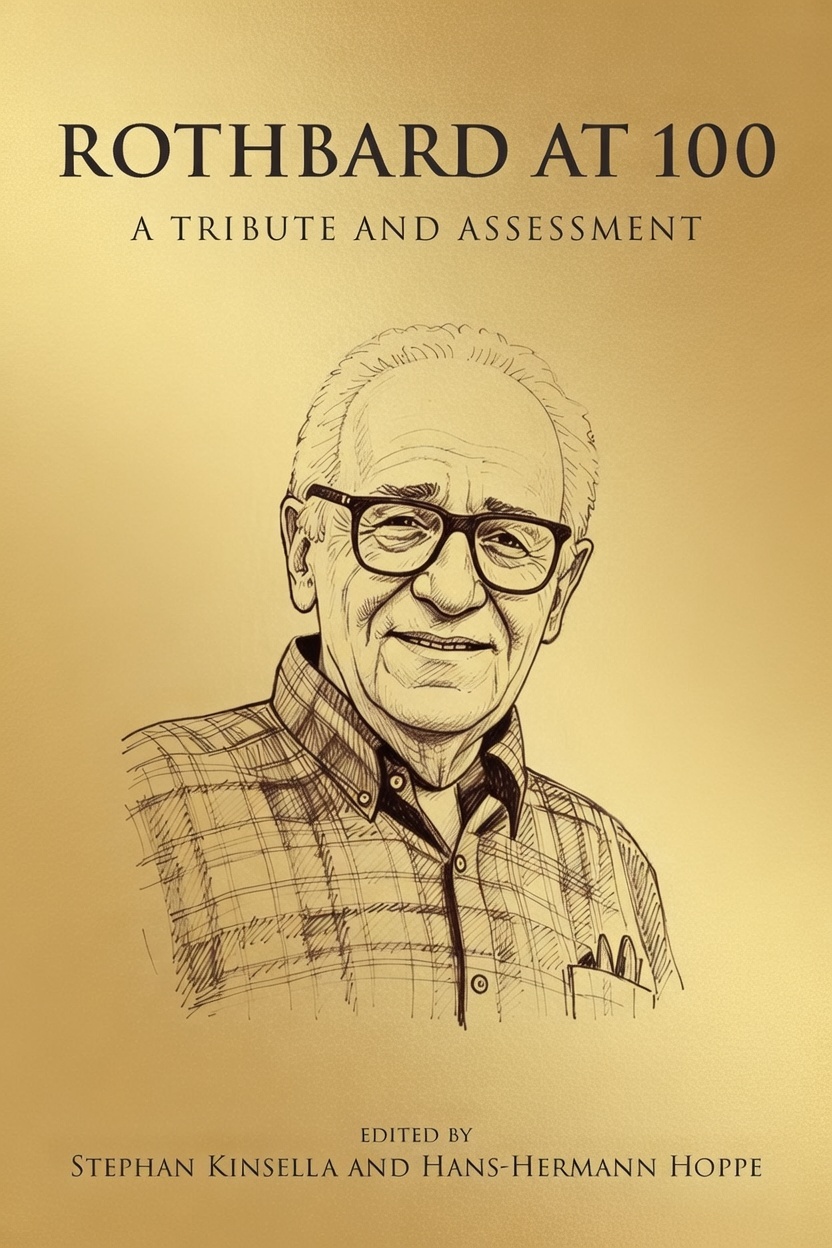
— From Rothbard at 100: A Tribute and Assessment, Stephan Kinsella and Hans-Hermann Hoppe, eds. (Houston: Papinian Press and Property and Freedom Society, 2026) —
Preface
The Property and Freedom Society was founded in 2006 by Hans Hoppe, eleven years after Murray Rothbard’s death. As Hoppe was Rothbard’s most intimate associate, partner, friend, and student for the last decade of his life, the PFS is naturally home to admirers of Rothbard and his brand of Austrian economics and anarcho-libertarianism. Many of its founding members knew Rothbard personally and all were admirers. Most of its other members are also heavily influenced by, and indebted to, Rothbard’s powerful body of ideas. The PFS, and all its members, are in an important sense Rothbard’s children.
The PFS is thus, in a sense, a sort of Rothbard Institute under a different name. In fact, some critics (and even admirers) of the Ludwig von Mises Institute have also suggested that it, too, should instead be named the Rothbard Institute, as its members and supporters are so obviously influenced by Rothbardianism. There is some merit to this charge, though this is not the insult the critics imagine it to be. Rothbard was Mises’s most important student and expositor and the primary intellectual force behind the institute from its founding in 1982 until his death in 1995, as is also the case with the PFS. Those drawn to Misesian Austrian economics also tend to have an affinity for Mises’s quite radical classical liberal political views and even more so for Rothbard’s even more radical and better developed anarcho-capitalism. This is a natural progression, not a surprise at all, and no cause for criticism.
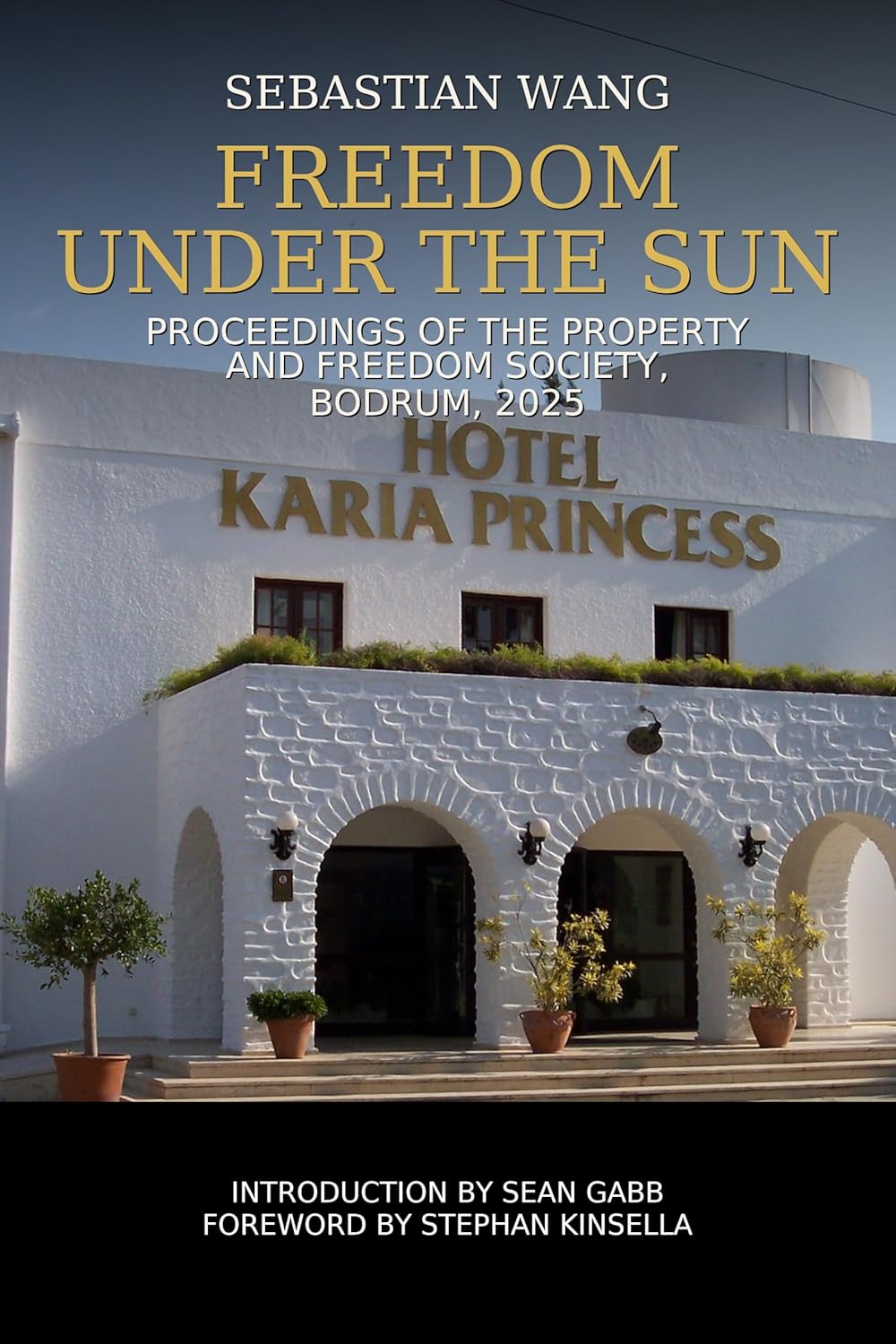
It is only fitting, then, that an international array of PFS scholars commemorate his 100th birthday with this collection of tributes and reflections. This collection, released online at the Property and Freedom Society website on his 100th birthday, March 2, 2026, will be published in book form in upcoming months and presented and discussed at the 20th annual meeting of the PFS in Bodrum, Turkey, in September 2026.
The contributions are all by longtime PFS members or supporters and friends, many of them founding members since its inaugural meeting in 2006 and most of them scholars and Rothbardians of one type or another. Many of them knew Rothbard personally, some intimately—such as Hans Hoppe; Rothbard’s students, Doug French, Lee Iglody, and Jeff Barr; and colleagues such as Tom DiLorenzo and Jeffrey Tucker. The contributors, in fact, include all three past Presidents of the Mises Institute, as well as Mr. Tucker who, in his key role at the Mises Institute, associated closely with Rothbard in the last decade of his life (the same period as Hoppe’s close association with Murray). We have arranged the essays into two parts: Part 1, by those who actually knew or met Rothbard in person, and Part 2, others who never met him but who have been deeply influenced by his work.
As the essays in this volume attest, Rothbard was, in our eyes, the most important social theorist of the twentieth century. Rothbard built on the soundest and most rigorous and developed school of economics—the praxeological branch best developed and formalized by Mises,2 and combined it with an individualist libertarian political philosophy even more consistent, radical, and uncompromising than Mises’s already-admirable classical liberalism. Mises systematized, formalized, improved on, and advanced the Austrian economics first initiated by Carl Menger and further developed by others such as Eugen von Böhm-Bawerk. Rothbard built on and extended Misesian economics and incorporated it into his radical anarchist libertarian views.
Rothbard was the first modern libertarian with a complete, comprehensive, radical, and Misesian-Austrian informed political philosophy. To paraphrase Isaac Newton, writing in 1675,3, if Rothbard has seen further than others, it is by standing on the shoulders of giants”—in particular on the shoulders of Mises, whom many of us regard as the most brilliant economic thinker not only of the last century but of all time. There is a reason Guido Hülsmann entitled his biography of Mises The Last Knight of Liberalism4 and it is also fitting that Fernando Chiocca entitled his tribute to Rothbard in this volume “The First Knight of Libertarianism.” And it is why I refer to him, along with Hoppe and Mises, in my chapter, as the indispensable framework for Austro-libertarianism.
A Festschrift (or liber amicorum) is a collection of scholarly and personal reflections in honor of an important thinker on some important occasion such as retirement and so on. It is rare for a scholar’s œuvre to be significant and influential enough to merit this; even rarer is the scholar who warrants two. Mises himself had two.5 The first was published on the occasion of the fiftieth anniversary of his doctorate at the University of Vienna in 1906.6 The second was published on the occasion of his 90th birthday, about which Mises wrote to his wife: “The only good thing about being a nonagenarian is that you are able to read your obituaries while you are still alive.”7
Rothbard’s only Festschrift was published when he was 62 and based on papers produced from a conference discussing Rothbard’s work in the year of his 60th birthday.8 There can be little doubt that had he lived past the age of 68, another Festschrift in his honor would have been produced by now, as was the case for his teacher, Mises—as well as for his most important (informal) student and colleague, Professor Hoppe, who also received two such accolades, on the occasions of his 60th and 75th birthdays.9 We, his intellectual children and students at the PFS, could not let his 100th birthday pass without giving recognition and tribute to this great and good man, to whom we are so grateful. We hope this volume serves as a fitting Gedenkschrift, a posthumous Festschrift in his honor.
We are now in Rothbard’s world—a world that is better, and changed, for his having been in it. Happy birthday, Murray—we love you.
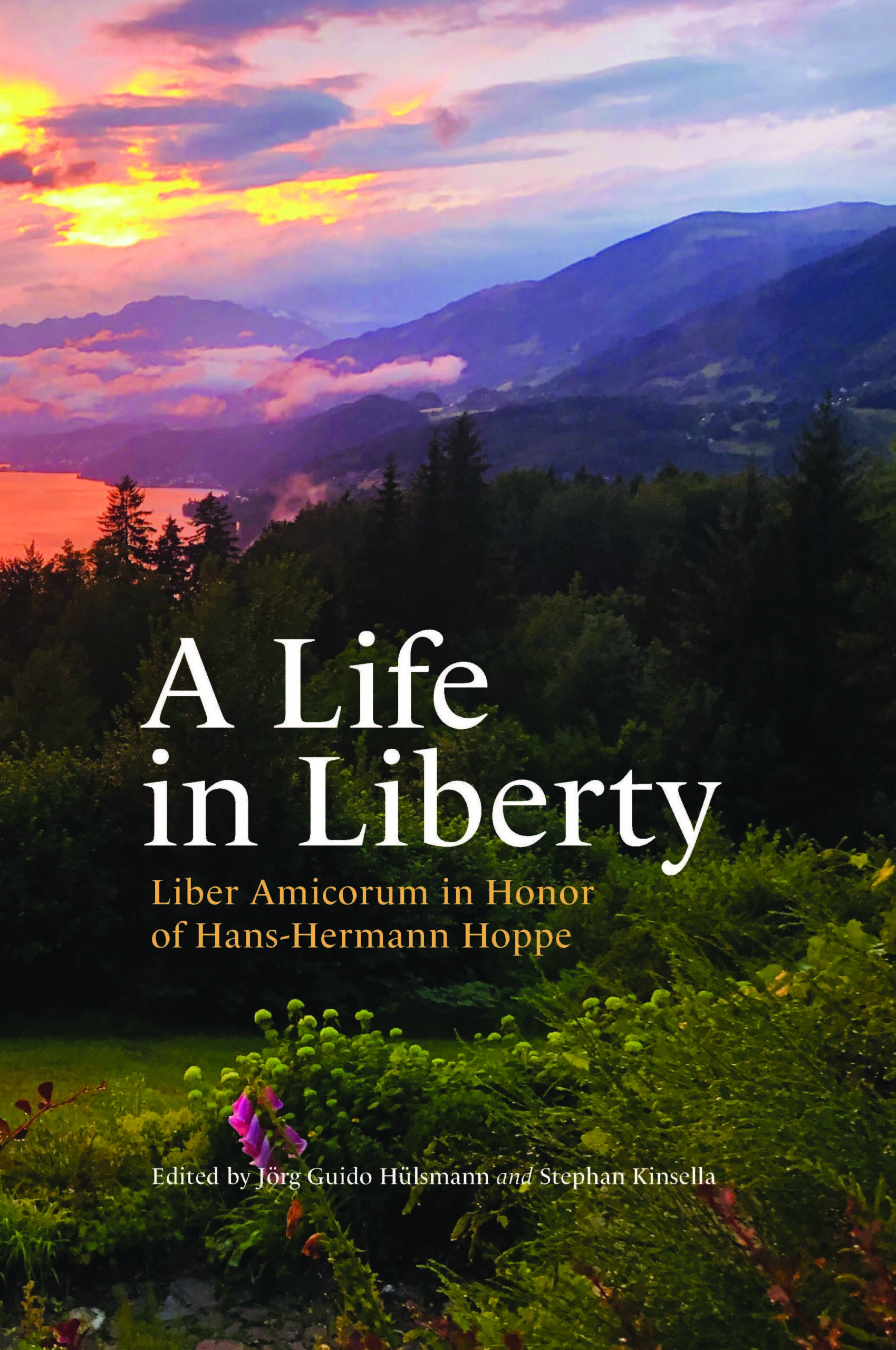
- Stephan Kinsella, a founding member of the PFS, is a libertarian writer and retired attorney in Houston. His publications include Legal Foundations of a Free Society (Houston, Texas: Papinian Press, 2023) (LFFS), Against Intellectual Property (Auburn, Ala.: Mises Institute, 2008); A Life in Liberty: Liber Amicorum in Honor of Hans-Hermann Hoppe (co-editor, with Jörg Guido Hülsmann; Houston, Texas: Papinian Press, 2024); and International Investment, Political Risk, and Dispute Resolution: A Practitioner’s Guide, 2nd ed. (Oxford, 2020).
Most of my own publications cited here, and in this book, may be found at www.stephankinsella.com or www.c4sif.org/aip. I hereby grant a CC0, no rights reserved, license in this Preface. [↩]
- I almost wish Hoppe had not discovered Mises until later in his own path to discovering economic science, to see how his own version of praxeology might have developed. As I wrote previously,
Professor Hoppe’s real education was autodidactic. First, as a mainstream leftwinger, his eyes were opened by the Austrian economist Eugen von Böhm-Bawerk’s critique of Marxism. Later, after encountering and then rejecting the logical positivism of Milton Friedman and the Chicago school, he discovered Mises and his unique approach. As he wrote in an interview in the Austrian Economics Newsletter:
Independently, I had concluded that economic laws were a priori and discoverable through deduction. Then I stumbled on Mises’s Human Action. That was the first time I found someone who had the same view; not only that, he had already worked out the entire system. From that point on, I was a Misesian.
Stephan Kinsella, “Afterword,” in Hans-Hermann Hoppe, The Great Fiction: Property, Economy, Society, and the Politics of Decline, 2nd ed. (Auburn, Ala.: Mises Institute, 2021), quoting Hans-Hermann Hoppe, “The Private Property Order: An Interview with Hans-Hermann Hoppe,” Austrian Economics Newsletter 18, no. 1 (Spring 1998). [↩]
- “Standing on the shoulders of giants” (Wikipedia). [↩]
- Jörg Guido Hülsmann, Mises: The Last Knight of Liberalism (Auburn, Ala.: Mises Institute, 2007). [↩]
- Mary Sennholz, ed., On Freedom and Free Enterprise: Essays in Honor of Ludwig von Mises (Auburn, Ala.: Mises Institute, 2008 [1956]); F.A. Hayek, et al., eds., Toward Liberty: Essays in Honor of Ludwig von Mises on the Occasion of his 90th Birthday, September 29, 1971 (two volumes; Menlo Park, Cal.: Institute for Human Studies, 1971). [↩]
- See Hülsmann, Mises: The Last Knight of Liberalism, pp. 932–35; Bettina Bien Greaves, “A Festschrift for Doctor Mises,” The Freeman (April 1, 1956). [↩]
- Hülsmann, Mises: The Last Knight of Liberalism, p. 1037. [↩]
- Walter Block & Llewellyn H. Rockwell, eds., Man, Economy, and Liberty: Essays in Honor of Murray N. Rothbard (Auburn, Ala.: Mises Institute, 1988). See The Free Market (June 1986), p. 2, listing papers in “Man, Economy, and Liberty: A Conference in Honor of Murray N. Rothbard.” See also: Jeffrey A. Tucker and Llewellyn H. Rockwell, Jr., “Man, Economy, and Liberty” (Nov. 17, 2009) (Tucker interviews Rockwell about Rothbard’s Festschrift, published in 1986 in honor of Rothbard’s sixtieth birthday); Murray N. Rothbard, Man, Economy, and Liberty (March 1, 1986) (Rothbard comments and responds to the speakers and papers presented at the “Man, Economy and Liberty” colloquium hosted by the Mises Institute; backup YouTube); Hoppe, “Book Review of Walter Block and Llewellyn H. Rockwell, Jr., eds., Man, Economy, and Liberty: Essays in Honor of Murray N. Rothbard,” Rev. Austrian Econ. 4, no. 1 (1989): 249–263. See also Timothy Virkkala, “Bestschrift,” Liberty (September 1989), p. 63. [↩]
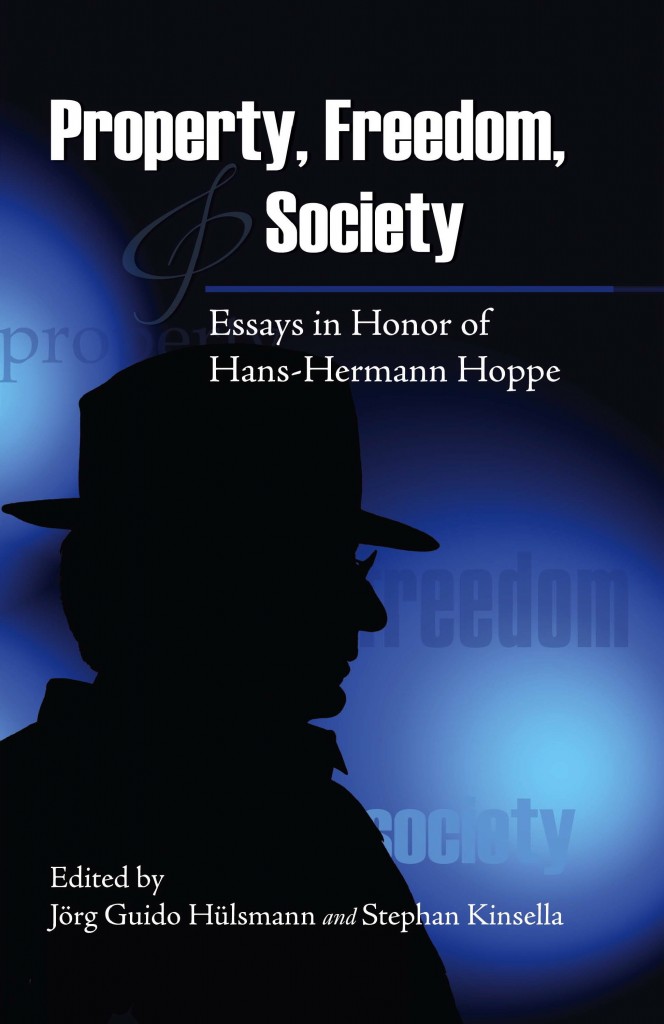
- Jörg Guido Hülsmann & Stephan Kinsella, eds., Property, Freedom, and Society: Essays in Honor of Hans-Hermann Hoppe (Auburn, Ala.: Mises Institute, 2009); idem, A Life in Liberty: Liber Amicorum in Honor of Hans-Hermann Hoppe (Houston, Texas: Papinian Press, 2024). [↩]









Follow Us!