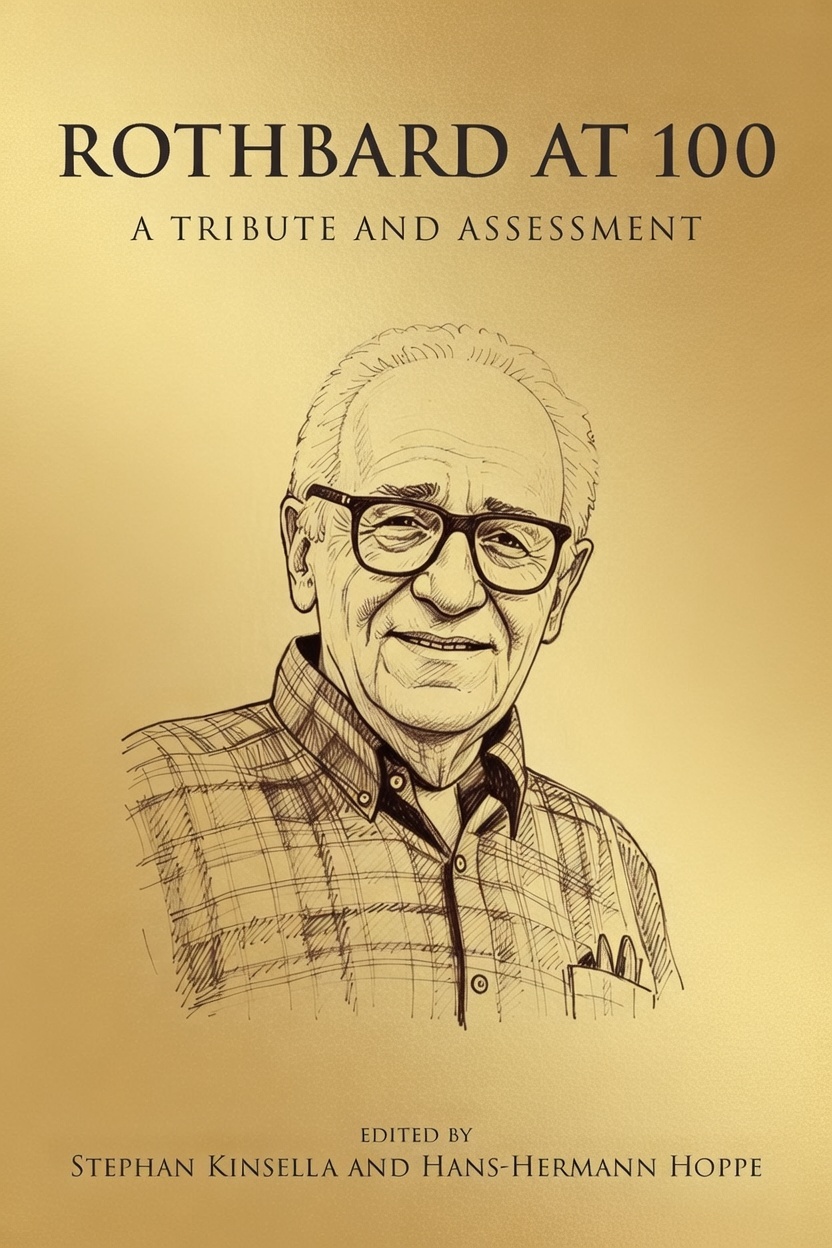
— From Rothbard at 100: A Tribute and Assessment, Stephan Kinsella and Hans-Hermann Hoppe, eds. (Houston: Papinian Press and Property and Freedom Society, 2026) —
6
The Man Across the Hall: My Time with Professor Rothbard
Murray N. Rothbard was a rare kind of teacher and thinker: a genuine polymath whose intellectual range was matched only by his willingness to sit patiently with a young student and help him build his own framework from the ground up. For those of us fortunate enough to study under him in Las Vegas,2 he was not merely an economist or a libertarian theorist, but a guide through a labyrinth of ideas, and one whose infectious laughter, generosity, and methodological rigor permanently altered the course of our lives.
Professor Murray N. Rothbard entered my life twice, both times by accident. First, at the end of a finger in a hallway in Brooklyn, and then on a spine on a dusty shelf in Greenwich Village. Without those two seemingly trivial moments, I might have gone on to live an entirely respectable, entirely conventional life. Instead, I found the man who introduced me to a civilization of ideas and gave me the guardrails to navigate it.
The first time I “met” Murray, I did not speak to him at all. I was a teenage mechanical engineering major at Polytechnic University (or Brooklyn Poly, as we called it), taking a fascinating elective on the history of technology. Professor Sviedrys liked my work well enough to invite me into his office, where one project led to another until I found myself writing a lengthy paper tracing how the medieval waterwheel reshaped civilization. For the first time, I glimpsed what it meant to think seriously about incentives and institutions, rather than just machines and formulas.
At the end of that semester, Professor Sviedrys did something I will never forget. We were sitting in his office, having a wide-ranging discussion about some aspect of the history of technology, with the door open. He paused, looked past me, and literally pointed across the corridor. “That man,” he said, “that man is the man you need to speak to.”
I turned and saw Murray Rothbard. He was sitting in his office with the door open, surrounded by books: books on the floor, books on his desk, books stretching the shelves to their limit; you could almost hear them groaning under the strain. I had no idea I was looking at one of the most original minds in twentieth-century economics and political philosophy. I didn’t act on the suggestion. Soon thereafter, Murray accepted a position at the University of Nevada, Las Vegas (UNLV), and he was gone. I had been shown the door, but I wasn’t yet ready to walk through it.
The second accident happened shortly later, in a used bookstore in Greenwich Village. I was wandering the aisles without any particular plan when I saw a name I recognized: Murray Rothbard. I remembered the finger in the hallway, the words “That man is the man you need to speak to,” and I felt a jolt. I bought the book and took it home. I did not realize I had just stepped over a threshold into a new world. I devoured For a New Liberty in one sitting.3
From that book, and the many that followed, I learned that economics could be something very different from the dry, mathematical science I had imagined. In Rothbard’s hands, economics became a branch of moral philosophy—a rigorous analysis of human action grounded in respect for the individual and a deep suspicion of power. More than that, each book was a map pointing outward to Mises, Böhm-Bawerk, Hayek, the scholastics, the natural law theorists, and radical critics of the state.
I determined that I had to study under Professor Rothbard. I worked hard, saved my money, and moved to Las Vegas to attend UNLV. I left New York (and my really sweet rent-controlled apartment in midtown) behind and have never regretted it. Okay, yes: whenever I’m back in New York City, I still walk past my old building and indulge the memories. Murray, of course, played the New York apartment game at a higher level. He didn’t give up his rent-controlled apartment on the Upper West Side. He kept it until the end. Another example of his brilliance.
Anyone who knew Murray only from his formidable early treatises might have expected a towering, terrifying intellectual. I certainly did. What I found instead was a jolly man with a huge smile who seemed to find humor in absolutely everything. His characteristic cackle could fill a room and put even the most nervous graduate student at ease. He was patient with me and other students when we showed a willingness to grapple with and master the material. His dedication to the discovery and dissemination of truth and knowledge inspires me to this day.
Murray and Hans-Hermann Hoppe sat at the center of a small, intense circle of students and colleagues at UNLV.4 There was an unspoken hierarchy: an inner ring of those who had already proven themselves, a wider ring of admirers, and newcomers like me at the periphery. Coming from a world in which hierarchy and earned merit were ingrained, I did not rush in. I stood back and listened. I waited months before daring to ask my first question, convinced I had to earn the right to impose on the time of a man whose books were already reshaping how I saw everything.
Over time, I stepped closer. The classroom sessions were rich, laced with cutting historical examples. His laughter would fill the room as he ranged effortlessly from economic theory to medieval history to contemporary political absurdities to whatever else came to mind. The science of human action came to life. His classes were Ludwig von Mises’s theory of history in action: thymology at its finest.5 It felt, in those hours, like sitting at the feet of the masters: Plato with Aristotle, Aristotle with Alexander, Mises with his seminar circle.
For me, however, the real education took place outside of class, in his office, his home, the hallway, in the moments when I could lay my scattered thoughts before him. I would come with mismatched pieces: the habits of mind of a mechanical engineer who thought in terms of systems and constraints; moral intuitions inherited from family and faith; fragments of economic theory from Mises and others; questions about history, power, and war. Murray would let me talk, listening patiently with that twinkle in his eye. Then, with a mix of gentleness and mischief, he would point out the missing premise, the contradiction I had carefully stepped around, or the historical case that blew my assumption apart, and then send me home with books. I would read, reconsider, and return with new questions. The cycle repeated, and it was the most intellectually stimulating period of my life. He never humiliated; he educated. He made it possible to be wrong without being broken. Though he could be devastating in his critiques of others, he was careful not to crush earnest students who were genuinely trying to understand.
More importantly, he taught me how to read them: how to test arguments against first principles, how to distinguish genuine insight from fashionable sophistry, and how to avoid being dazzled by technical jargon that hides reality. Within those guardrails, I was able to crystallize a moral and intellectual framework that has served me in every area of my life. It is a framework in which self-ownership and property rights are not mere abstractions but living constraints on what we may rightly do to each other. It is a framework in which voluntary exchange and contract are not just economic mechanisms but moral practices, and in which war, inflation, and bureaucratic regulation are seen for what they are: mechanisms by which the few extract wealth, obedience, and blood from the many. Once that framework took shape, I could not look at law, business, or politics the same way again.
He did not merely hand me his conclusions. He gave me a method of approaching ideas. Economics, history, ethics, and political philosophy were not separate academic silos but interconnected pieces of a single architecture aimed at understanding human action, power, and justice. Through his work and his example, I came to see that the great questions of economics could not be separated from questions of right and wrong, and that the story of history could not be told honestly without facing the reality of exploitation.
As I absorbed his teaching, I came to see a recurring pattern in history: again and again, institutions evolve that allow the few to live at the expense of the many. Sometimes, by grace or accident, a natural elite arises that genuinely tries to serve the many, but most of the time the pattern is the same. That is not a slogan; it is a structural fact running through empires, states, cartels, and bureaucracies. Murray helped me see this not as vague resentment but as principle grounded in careful economic and historical analysis. Once you see the world that way, you cannot unsee it.
Nowhere was this clearer than in his treatment of war and the state. For Rothbard, the state was “the organization of robbery on a grand scale,” and war was its most vicious expression. He showed, in patient detail, how monetary manipulation, conscription, and propaganda knit together into machinery that turns the lives and property of ordinary people into fuel for elite ambitions. This analysis resonated with something deeply personal: my father’s deathbed plea that I do not join the military, which I was seriously considering at the time. My father, who had spent years in combat, begged me not to let my life be consumed by other people’s wars. Under Murray’s tutelage, that plea found its intellectual home. My visceral opposition to war became a principled stance, rooted in a coherent view of economics, history, and ethics.
I was elated when Murray chose me to lead what turned out to be his last study group in Las Vegas. Unlike the unstructured, freewheeling, and often animated exchanges we enjoyed each week with Hans at a local pub, the evening sessions with Murray were by invitation only (one of my sacred duties as study group leader was to keep the riffraff out) and tightly structured, taking place in a quiet corner of a local diner. He would assign us a book; we would wrestle through a chapter on our own. Then, on Monday nights, we would gather and sit with him for hours. Or, to be soberly accurate, he would talk for hours while we did our best to keep up.
The sessions stretched late, but they never dragged. Often the nominal subject was a single chapter of Man, Economy, and State or some other book or essay, but within minutes he would be ranging from praxeology to monetary history to contemporary politics to modern cinema in a single, tightly reasoned arc. Watching him do this was like watching a master engineer walk you through the workings of an intricate, perfectly designed machine. His intellect was, in the best sense, addictive; once you had tasted that experience, you couldn’t get enough. I certainly couldn’t. I am proud to call myself a Rothbard-Hoppe groupie, a member of the Vegas Circle.
Murray and I even sketched a plan for my future that reflected his sense of strategy and his humor. After reviewing and praising my lengthy paper on the history of cost accounting and its perversion during the Progressive Era, he hatched an idea for my academic future. With his help and the help of a professor friend, I was to enter a PhD program in accounting, complete my graduate work, and then enter the academy as a professor of accounting and accounting history. On the surface, it was the most innocuous, technical path imaginable. But the underlying goal was quietly subversive: to smuggle the logic of capitalism and the ethics of liberty into modern academia under the polite heading of “accounting history.” It was a classically Rothbardian plan to work within the given structures, but use every inch of autonomy to advance truth.
Life rarely follows the neat outlines we draw in youth. Murray passed away unexpectedly, in January 1995. I was crushed. I quit school, left Las Vegas, and took a job with a large accounting firm in Florida. Eventually, my path led into the law, and I became a commercial trial attorney. At first glance, that might look like a complete departure from the life Murray and I had imagined. But the framework he gave me has proven as relevant in courtrooms, conference rooms, and boardrooms as it would have been in lecture halls.
In cannabis law, for example, I have worked at the messy edge of a regime that at last decriminalized peaceful behavior while creating lucrative niches for those able to navigate its rules. In charter school law, I have seen firsthand the tension between local initiative and bureaucratic centralization, and I have defended spaces where families and educators can experiment outside the grip of central planners. In corporate and fiduciary litigation and other complex commercial disputes, I deal every day with contracts, promises, breaches of duty, and the subtle ways legal forms can either honor voluntary arrangements or dress up exploitation as compliance. During the Covid madness, I fought tirelessly for the rights of individuals to assert their bodily autonomy, at great personal cost; during the real estate crisis, I fought tirelessly to save people’s homes and assets.6 As Mises would say, Tu ne cede malis, sed contra audentior ito.
In all of these arenas, I have tried to act as a kind of Rothbardian guardian rebel within the system. I cannot remake the legal order single-handedly; the machinery of the few exploiting the many is too entrenched for that. But within the cases I take, the arguments I frame, and the compromises I refuse, I can push in the direction of voluntary order and against arbitrary power. I often hear echoes of Murray’s voice. The question is always there: Does this serve genuine consent and accountability, or does it help entrench coercion behind legal jargon?7 A portrait of Murray hangs in my office and in my home. It inspires me to fight the good fight and to remember to laugh.
I sometimes feel a pang of regret that Murray did not live just a little longer. I can still see my alternative life: the professor of accounting and accounting history, standing before a lecture hall, weaving discussions of double-entry bookkeeping and the language of business into a deeper exploration of property, capital, and the moral logic of markets. That path would have been deeply satisfying, not least because it would have been a direct continuation of the plan we once sketched together. I would be spreading the gospel of capitalism, “professing” the Austrian Method and the profound, timeless insights of Mises, Rothbard, Hoppe, Hülsmann, and other Austrian masters. As I grow older, I have come to understand that the true measure of a teacher’s influence is not whether the student ends up with the exact title or position imagined. It is whether the student carries the principles into whatever station he actually occupies. In that sense, I am still and always will be Murray Rothbard’s student.
I found him by accident, twice. Nothing about what he did for me was accidental. He introduced me to a civilization’s worth of ideas, gave me the guardrails to navigate some of the greatest thinkers in human history, and helped me crystallize a moral and intellectual framework that has guided my choices in every major area of my life. If, in my work as an attorney and in my role as a father and citizen, I have managed to oppose, even in small ways, the enduring pattern of the few exploiting the many; if I have defended spaces of voluntary cooperation against the encroachments of power; if I have remained viscerally anti-war and suspicious of empire; then I have done at least something to honor the debt I owe him.
I feel a deep ambivalence when I look back. On one side, I am profoundly honored that I was able to spend so much time in the presence of a giant. On the other, I carry a lingering sadness for him. A mind of his caliber should have been enthroned at one of the finest universities in the country, surrounded by the most gifted young men and women of our generation. Instead, he labored at a very average school, surrounded by ordinary students who were made extraordinary by proximity to him, fighting institutional battles that never should have been necessary. That mismatch between his stature and his circumstances remains, in my mind, one of the quiet scandals of twentieth‑century academia.
And yet, that very misallocation of talent was, for us, an undeserved blessing. Because he was not locked away behind the gatekeeping machinery of a prestige institution, we could reach him. We could sit with him for hours, ask our halting questions, and absorb what we could of his relentless, joyful mind.
For the years I spent in his presence, for the laughter and the rigor and the challenge he offered, for the mind he helped me build, I remain his eternally grateful student.
Tu ne cede malis, Murray.
- Lee I. Iglody ([email protected]), a founding member of the PFS, is an attorney in Las Vegas. He completed his Bachelor of Arts in Economics under the guidance of Professors Murray N. Rothbard and Hans-Hermann Hoppe at the University of Nevada, Las Vegas. See also his previous reminiscences of Rothbard in Douglas E. French et al., “Memories: Murray N. Rothbard (1926–1995) as Mentor and Teacher,” Property and Freedom Society Annual Meeting 2015, Bodrum, Turkey (Sep. 11, 2015), available at Stephan Kinsella, “PFP129 | Memories: Murray N. Rothbard (1926–1995) as Mentor and Teacher, Hoppe, DiLorenzo, French, Iglody (PFS 2015),” Property and Freedom Podcast (May 20, 2022). See also Lee’s chapter “The Vegas Circle,” in Property, Freedom, and Society: Essays in Honor of Hans-Hermann Hoppe, Jörg Guido Hülsmann and Stephan Kinsella, eds. (Auburn, Ala.: Mises Institute, 2009), touching on Hoppe but also on Rothbard, and Doug French’s chapter in this volume, “Remembering Murray Rothbard: Teacher, Friend, and Inspiration,” Jeff Barr’s “The Last Lecture,” and Hans Hoppe’s “Coming of Age with Murray.” [↩]
- See also Doug French’s chapter in this volume, “Remembering Murray Rothbard: Teacher, Friend, and Inspiration.” [↩]
- Murray N. Rothbard, For a New Liberty, 2nd ed. (Auburn, Ala.: Mises Institute, 2006). [↩]
- For my previous tributes to Hoppe, see my contributions in his two festschrifts: “The Vegas Circle,” in Property, Freedom, and Society: Essays in Honor of Hans-Hermann Hoppe, Jörg Guido Hülsmann and Stephan Kinsella, eds. (Auburn, Ala.: Mises Institute, 2009), and “A Beacon of Light,” in A Life in Liberty: Liber Amicorum in Honor of Hans-Hermann Hoppe, Jörg Guido Hülsmann and Stephan Kinsella, eds. (Houston, Texas: Papinian Press, 2024). [↩]
- On this concept, see Ludwig von Mises, Theory and History: An Interpretation of Social and Economic Evolution (Auburn, Ala.: Mises Institute, 2007). [↩]
- I also discuss this issue in Lee I. Iglody, “Foreword,” in Douglas E. French, Walk Away: The Rise and Fall of the Home-Ownership Myth, 2nd ed. (Baltimore, Maryland: Laissez Faire Books, 2012), p. vii. [↩]
- On distinguishing state activities which are not inherently aggressive, and which should privatized, from state activities that are inherently aggressive (e.g., running concentration camps) which should not, see Murray N. Rothbard, “Property and the Public Sector,” pp. 440–442 et pass. and “Aurophobia: Or, Free Banking on What Standard?”, p. 889, both in Economic Controversies (Auburn, Ala.: Mises Institute, 2011); see also Hans-Hermann Hoppe, “Of Common, Public, and Private Property and the Rationale for Total Privatization,” Part III, in The Great Fiction: Property, Economy, Society, and the Politics of Decline, 2nd ed (Auburn, Ala.: Mises Institute, 2021). [↩]










Follow Us!