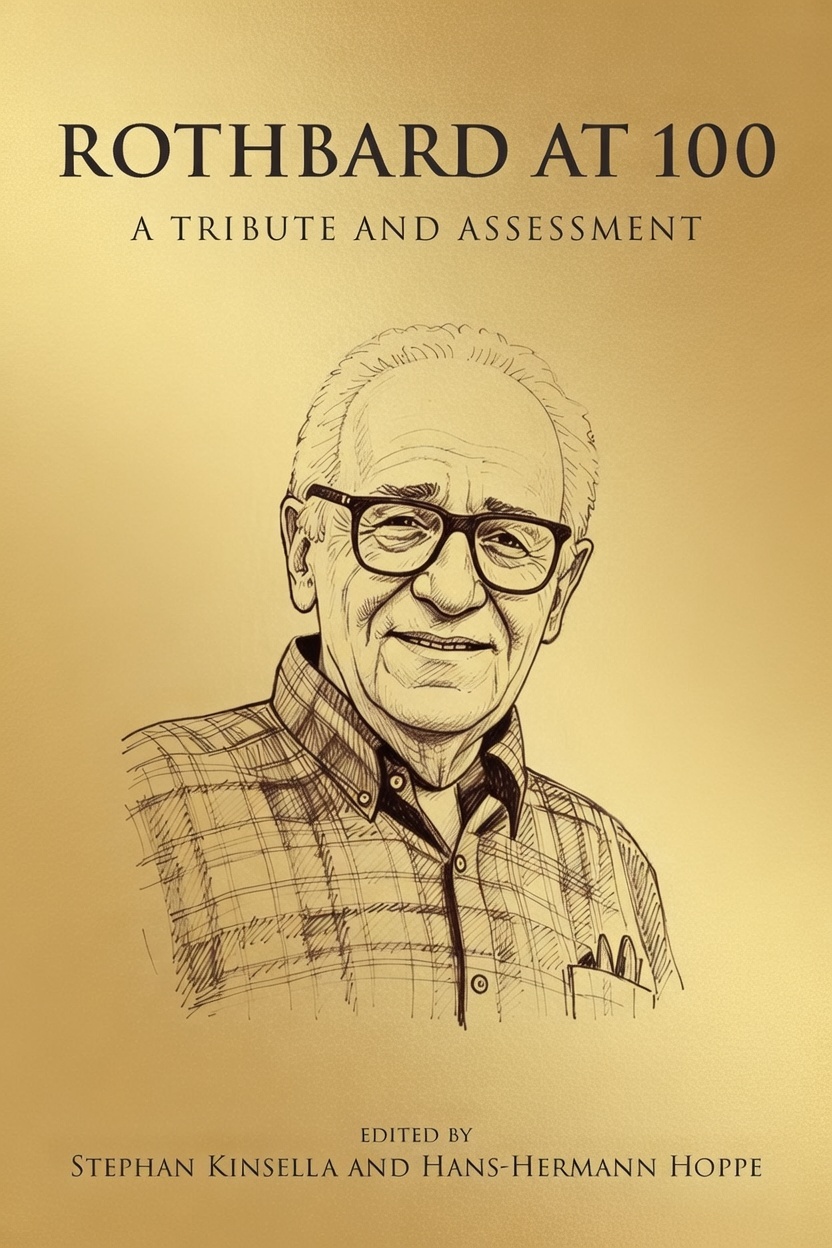
— From Rothbard at 100: A Tribute and Assessment, Stephan Kinsella and Hans-Hermann Hoppe, eds. (Houston: Papinian Press and Property and Freedom Society, 2026) —
16
Rothbard: An Appreciation from England
I: The Man Without the Anecdote
Unlike many of the other contributors to this volume, I never met Murray Rothbard. I never corresponded with him. This is my loss, to be sure. It is also, I suggest, my gain. When I read someone I know—let us take Hans-Hermann Hoppe as an example—I am not purely considering what he says on the page. I open Hoppe, and I see Hoppe. I see his sudden pauses to collect his train of thought. I see the chilly though faintly self-satisfied smile he gives whenever he says something designed to produce the maximum outrage from his many enemies. I hear his soft German accent. Of course, I read him, and I appreciate him. But I never experience him in the way that I experience Hume or Gibbon or Macaulay, or any of the other leading influences on my own thought.
When I read Rothbard, there is no cross-contamination that inevitably comes from being a friend of the writer. It means that I can take a more distant, and therefore a less biased, view of him. Where Rothbard is concerned, I do suggest again, this is an advantage.
When I first came out as a libertarian in the late 1970s, I found myself in what even then seemed a limited intellectual world. The other self-identified libertarians I met did not say what I was thinking. I will aggregate these men under the name Russell Chambers. He was middle-aged. He was very middle class. He hated the trade unions, and blamed them for everything that had gone wrong with the country. He was scared of the Soviets, and warmed to Margaret Thatcher’s promise of a harder line in fighting the Cold War. Yes, he wanted lower income tax—but this was plainly because he wanted to keep more of his soft professional salary and more of his dividends. Yes, if pushed, he would agree that drugs should be legal. Yes, if pushed again, he would agree that all interactions between consenting adults should be legal—though he would always add something slighting about the groups whose preferred interactions were not wholly legal. In general, his view was that there was nothing much wrong with the world that would not be fixed by five or ten years of Margaret Thatcher.
This was not libertarianism as I felt it. It was a strongly anti-union, mildly fiscally conservative, mildly permissive add-on to an otherwise conventional conservatism. It was a plea for a tidier and cheaper state, not for a different civilisation.
When I met Chris Tame in 1979, my libertarian horizons immediately broadened.2 I had found a mentor who viewed libertarianism as a radical challenge to the whole established order—the established order as it was, as it had been, and as we both increasingly believed it was becoming. His own early and continuing inspirations were Ayn Rand and Murray Rothbard. I never could warm to Rand. She always struck me as a silly hysterical woman, insisting that a bundle of loosely connected claims about the world—some sensible, some not—all followed from her own dubious premises as surely as the laws of geometry. Rothbard, on the other hand—he was another matter.
I read For a New Liberty soon after I met Chris. I regret that my first reaction was to spend more time disagreeing with his premises than with his conclusions. Undoubtedly, though, I was impressed, and I was influenced more than I realised at the time. I read more by him. Again, I agreed sometimes with him, sometimes not. But I read him, and his influence deepened.
Now, if I were writing a whole book about Rothbard, rather than one chapter in a book about him, I would at this point make a list, and then begin a discussion of his vast intellectual achievement under each heading, which would swell naturally each into a chapter of its own. But I am only writing a chapter, and so I will be selective. I think where I have been most inspired by Rothbard is his denunciations of war and of big business. I will discuss these. Before then, however, let me go back to my own first personal experience of libertarianism. Russell Chambers was an aggregation not only of English, but also of American libertarians before Rothbard took charge. That libertarianism is nowadays much else beside is largely due to Rothbard.
It is fashionable to say that movements grow organically, that ideas simply ripen when the time is right. This is romantic nonsense. Movements are built by men who write, organise, quarrel, recruit, and refuse to be silenced. If there is a modern libertarian movement rather than a scattering of eccentric anti-tax clubs, this is in no small part because Rothbard willed it into existence.
II. The Architect of a Movement
Murray N. Rothbard did not invent anti-statism. He did not invent Austrian economics. He did not invent natural rights theory. What he did was to fuse them into a single system, to propagate that system with tireless energy, and to build institutions that could carry it beyond his own lifetime.
The account given in Justin Raimondo’s biography, An Enemy of the State , makes plain that Rothbard’s importance was not confined to writing books. He was an intellectual entrepreneur in the strict sense: a man who understood that ideas without networks remain inert.
From the late 1940s onwards, he absorbed the isolationist and anti-New Deal tradition of the Old Right. He attended Ludwig von Mises’s seminar in New York. He devoured Human Action. He saw that Austrian economics, with its insistence on methodological individualism and its critique of intervention, could be given a political corollary that was more radical than Mises himself was willing to embrace.
In Left, Right, and The Prospects for Liberty,3 Rothbard argued that classical liberalism had once been a revolutionary doctrine against the Old Order of throne and altar, but that in the twentieth century the lines had blurred. The state had become the universal predator, whether draped in conservative bunting or socialist rhetoric. The task was not to choose between left and right, but to resurrect liberty against both.
This was not the language of Russell Chambers. It was not a plea for marginal tax cuts within an otherwise intact warfare-welfare state. It was a call for what Rothbard in For a New Liberty named plainly: the abolition of the state as an institution of aggression.
He founded journals. He helped found the Libertarian Party. He collaborated in the creation of the Cato Institute. He later helped found the Mises Institute. The institutional history is complex and not always edifying. There were quarrels, splits, expulsions, and reconciliations. But the cumulative effect was unmistakable. There now existed a body of doctrine, a network of scholars, a set of platforms, from which libertarianism could speak in its own voice.
Stephan Kinsella observes that some critics have suggested that the Mises Institute might as well be called the Rothbard Institute.4 The criticism, he notes, is no insult. Rothbard was Mises’s most important student and expositor, and the primary intellectual force behind the Institute in its formative years. The Property and Freedom Society, founded by Hoppe, along with its members, is described as “in an important sense Rothbard’s children.” The language is affectionate, but it is not sentimental. It records a fact.
A thinker who warrants a festschrift is rare. A thinker who warrants two is rarer still. Rothbard’s fusion of praxeology and anarcho-capitalism created what Kinsella calls an “indispensable framework for Austro-libertarianism.” The neologisms of lesser men evaporate. The categories of Mises and Rothbard endure.
You can dissent from elements of his natural rights theory. I do, and I hope I shall not be thought hostile to his legacy if I say that I do. You can question whether every function of government can be replaced by private contract. You can, as I have done, recoil from certain tactical alliances. But you cannot deny that without Rothbard there would be no modern libertarian movement in the sense in which we now use the term.
And it is to two aspects of that movement that I now turn: his denunciations of war, and his demolition of the myth of big business as victim.
III: War—The Health of the State
Rothbard’s opposition to war was not an appendage to his system. It was not a sentimental afterthought. It was the logical and moral centre of his politics. If the state is, as he argued, an organisation that claims a territorial monopoly of ultimate decision-making and the power to tax, then war is its highest and most terrible expression.
Randolph Bourne’s dictum—“War is the health of the state”—was taken by Rothbard not as a slogan, but as an axiom. In “War, Peace, and the State,” he wrote with a clarity that has never been improved upon:
The libertarian’s basic attitude toward war must then be: it is legitimate to use violence against criminals in defense of one’s rights of person and property; it is completely impermissible to violate the rights of other innocent people.5
There is no wriggle room here. Violence is justifiable only against aggressors. Modern war, which by its nature engulfs entire populations, cannot meet this test.
In Left, Right, and The Prospects for Liberty, Rothbard traced the way in which war collectivism in the First World War became the template for peacetime statism. Central planning, industrial cartels, propaganda ministries, price controls, compulsory labour discipline—these were not aberrations. They were innovations born of war and retained in peace. He described the New Deal as in significant measure a continuation of wartime centralisation. The state discovered in 1917 that it could regiment industry and opinion. It discovered that businessmen would collaborate if promised security and advantage. It discovered that the public, once frightened and flattered in equal measure, would accept controls that would have provoked revolt in calmer times.
This analysis is not just historical revisionism. It is a structural insight. War requires unity. Unity requires suppression of dissent. Suppression of dissent requires legal and administrative machinery. That machinery does not vanish when the guns fall silent. It becomes normal.
Rothbard’s isolationism was therefore not a romantic retreat from the world. It was the foreign policy corollary of libertarian ethics. A state at war expands. A state that expands does not contract voluntarily. A people that learns to obey in war does not immediately rediscover the habits of resistance in peace.
He rejected the standard justifications of American foreign policy in the twentieth century. The Cold War, he argued, was less a simple defensive posture against Soviet expansion than a permanent rationale for militarisation. In An Enemy of the State, Raimondo tells of Rothbard’s willingness to align with the New Left in opposition to the Vietnam War.6 This was not because he shared their domestic programme. It was because he saw in the war an unjust aggression and a lever for further state expansion at home.
You can question his interpretation of specific conflicts. I may be less indulgent than he was toward the Confederacy, whose defence of self-determination sat uneasily with its defence of slavery. But the general principle remains sound. Modern war is waged by states against populations. It involves conscription, taxation, propaganda, and often mass slaughter of civilians. A libertarian who makes his peace with such a system has ceased to be a libertarian.7
Rothbard’s critique extended to the moral language of war. He despised the inflation of rhetoric that accompanied every mobilisation. Enemies were demons. Leaders were saviours. Dissenters were traitors. The smear that he was soft on Communism because he opposed the Korean War was not an aberration. It was the standard technique of a wartime mentality extended into general policy.
There is a passage in Left, Right, and The Prospects for Liberty in which he describes how conservatives, despairing of domestic victory, embraced foreign crusades as a substitute. If the welfare state could not be rolled back at home, perhaps it could be redeemed by confrontation abroad. As he writes:
The conservative has long been marked, whether he knows it or not, by long-run pessimism: by the belief that the long-run trend, and therefore Time itself, is against him, and hence the inevitable trend runs toward left-wing statism at home and Communism abroad. It is this long-run despair that accounts for the Conservative’s rather bizarre short-run optimism; for since the long run is given up as hopeless, the Conservative feels that his only hope of success rests in the current moment. In foreign affairs, this point of view leads the Conservative to call for desperate showdowns with Communism ….8.
This was a false consolation. A government that acquires emergency powers in war rarely relinquishes them in peace. It acquires new habits and new constituencies.
In our own time, the pattern has been grotesquely confirmed. Anti-terror legislation becomes the template for general surveillance. Financial controls introduced to choke off funding to enemies become tools for regulating ordinary transactions. The language of emergency becomes permanent.
The libertarian opposition to war is therefore not a luxury position. It is a recognition that war is the most efficient engine of domestic tyranny ever devised. It creates debt, bureaucracy, censorship, and a political class habituated to command. It trains the public to accept sacrifice without scrutiny.
Rothbard’s denunciation of war was uncompromising because he saw the link between foreign aggression and domestic despotism. A state that can bomb a village abroad can imprison a dissenter at home. The moral barrier has already been breached.
IV: Big Business—The Myth of the Persecuted Giant
If war is the health of the state, big business, in Rothbard’s analysis, is often its willing accomplice. This was the second great liberation he offered to those of us raised on a diet of Russell Chambers-style libertarianism.
The conservative mythology of the late twentieth century cast big business as the victim of regulation. Corporations were besieged by meddling bureaucrats and socialist politicians. The task of the libertarian was to defend enterprise against interference.
Rothbard did not deny that regulation could be oppressive. He denied that it was primarily designed to curb the strong. In Left, Right, and The Prospects for Liberty, drawing in part on the work of Gabriel Kolko, he argued that much Progressive Era regulation was instigated by big business itself.9 When competition proved inconvenient, when cartels were unstable under market pressure, the state could be invited to stabilise them. The Interstate Commerce Commission did not so much shackle railroads as regularise their pricing. The Federal Reserve System did not so much discipline bankers as cartelise them.
In this light, regulation becomes less a check on power than a means of consolidating it. Small firms struggle to comply. Large firms absorb the cost and enjoy the reduced competition. The state becomes the arbiter and guarantor of market share.
Rothbard’s critique of “state monopoly capitalism” was therefore a double-edged sword. He attacked the state for granting privileges. He attacked big business for seeking them. The alliance between the two was not an aberration. It was a pattern.
In America’s Great Depression, Rothbard demolished the image of Herbert Hoover as a laissez-faire apostle. Hoover was, in his telling, a corporatist who sought to maintain wage rates artificially and use government to prop up failing firms. The Depression was not the product of unregulated capitalism. It was the product of credit expansion and intervention.
This analysis resonated with me far more than the Thatcherite catechism that “the market” was worship of the big banks, and that “the good old days” were worth bringing back, and could be brought back by strong leadership. Even as this was preached, the police state grew, and the printing presses rolled on. If interest rates are manipulated, if credit is expanded by central banks, if deficits are monetised, the resulting boom and bust cannot be reasoned away as the result of a few incidental defects of policy. Artificially low rates create malinvestment. Artificially high rates destroy otherwise viable enterprise. In either case, the culprit is intervention. And intervention is equally bad whether it is made by a government that calls itself of the “left” or of the “right.”
I have criticised Mrs Thatcher at length elsewhere for imposing high interest rates while maintaining large deficits, thereby crushing industry. That analysis owes more than I once admitted to Rothbard and the Austrian tradition. A market distorted by monetary policy is not a market. A capitalism dependent on state privilege is not capitalism.
Rothbard rejected Ayn Rand’s description of big business as “America’s most persecuted minority.” He saw instead a symbiosis. Corporations benefit from limited liability, from access to central bank credit, from government contracts, from regulatory barriers to entry. They lobby for subsidies, for tariffs, for bailouts. When crisis comes, they are too big to fail.
This is not an argument against enterprise. It is an argument against privilege. A genuinely free market would allow firms to rise and fall. It would not socialise losses while privatising gains. It would not create an oligarchy of corporations shielded from competition by statute.
The insight that big business often loves big government was, for me, liberating. It freed libertarianism from the suspicion that it was just a defence of boardroom interests. It allowed me to criticise corporate welfare with the same ferocity as we criticised welfare for individuals. It restored the radical edge.
Rothbard even went so far, in certain contexts, as to suggest that firms heavily dependent on state privilege might properly be “nationalised” in the sense of being stripped of that privilege and their assets redistributed to those with homestead claims.10 You can purse your lips at the rhetoric. The underlying point is that property rights acquired through coercion are not sacrosanct.
Here, as elsewhere, you can disagree on details. But the broad thrust is undeniable. A libertarian who cannot distinguish between market exchange and state-backed corporatism is defending a caricature.
Rothbard’s denunciations of war and big business were not separate themes. They converged in the military-industrial complex. War contracts enrich corporations. Corporations lobby for intervention. Debt finances both. The public pays.
A society that wages perpetual war and sustains corporate privilege is not a free society. It is an oligarchy in which political and economic elites intertwine.
For those of us who began as English conservatives with libertarian sympathies, this was a bracing education. The enemy was not merely high taxes. It was the system of power that united bureaucrats and boardrooms in mutual advantage.
V: Recovery, Realism, and the Libertarian Alliance
It may be objected that Rothbard’s denunciations of war and big business were too sweeping, too absolute, too unwilling to accommodate the compromises of political life. There is force in this objection. He was not a gradualist. He did not temper his conclusions for fear of alienating donors or journalists. He had, as Raimondo’s biography makes clear , little patience with those who sought respectability at the cost of clarity.
And yet it is precisely this refusal to dilute principle that gave his thought its enduring power. In an age when so many who called themselves libertarians were content to trim the sails of the Leviathan, he insisted on charting a different course.
My own position has never been identical to his. I am not an anarchist in the strict sense. I regard the non-aggression principle less as a theorem of geometry than as a moral aspiration constrained by circumstance. I do value continuity, custom, and the historic liberties of England as much as I value abstract theory. I am suspicious of schemes that promise paradise once the state has been abolished. I am conscious of the fragility of order.
But it was Rothbard who taught me that you can combine realism about society with radicalism about power. His historical work, from America’s Great Depression to his revisionist essays on American foreign policy, was not the work of a dreamer. It was forensic. It examined who benefited, who lobbied, who financed, who administered. It asked not what governments claimed, but what they did.
In Left and Right, he described how nineteenth-century liberalism had once been revolutionary against monarchy and mercantilism, only to be supplanted by new forms of state privilege in the twentieth century. The labels changed. The substance endured. That insight has lost none of its force. The managerial state, draped alternately in conservative or progressive rhetoric, remains a machinery of extraction.
His critique of the New Deal as an extension of wartime collectivism is echoed, in a different register, in our own criticisms of the British state’s expansion under cover of emergency. Whether the emergency is economic collapse, pandemic, climate change, or foreign war, the pattern repeats. Powers are claimed. Institutions are entrenched. Dissent is marginalised.
You need only glance at the proliferation of regulatory agencies, the intertwining of finance and government, the use of war rhetoric to justify domestic controls, to see that Rothbard’s warnings were not the product of American idiosyncrasy. They apply to every advanced state.
It is true that he formed alliances that made some of his friends uneasy. His temporary cooperation with elements of the New Left in opposition to Vietnam startled those who saw only ideological enemies. His later paleolibertarian turn, seeking common ground with paleoconservatives, was equally controversial. You can judge some of these tactical decisions harshly. I have done so myself on occasion.
But there is a difference between misjudging allies and misjudging the enemy. On the latter, Rothbard was almost always right. The enemy was not merely socialism in its explicit form. It was statism in all its guises. It was the assumption that society must be directed from above, that wealth must be channelled through political favour, that war is a legitimate instrument of policy, that corporations may safely entangle themselves with power without corrupting both.
For a recovering English conservative, this was a hard lesson. The old Toryism in which I was steeped believed in limited government, in private property, in continuity. It did not always perceive how thoroughly those ideals had been hollowed out by the twentieth century. It did not always see that the empire, the wars, the central bank, and the regulatory apparatus were not protective shells around liberty, but constraints upon it.
Rothbard forced the issue. He stripped away the comforting myths. He asked whether a state that wages total war, that taxes and inflates at will, that privileges corporations, that polices opinion, can plausibly be described as limited. He answered in the negative.
This does not mean that every practical question admits of a Rothbardian solution. I have argued, for example, that in a world already deformed by state privilege, some countervailing regulations may be justified to offset structural coercion . I have defended the use of passports and border controls in a world of welfare states and demographic upheaval. These are accommodations to circumstance, not repudiations of principle.
The end remains what Rothbard declared without hesitation: a social order based on voluntary exchange, private property, and the strict limitation of violence to defence against aggression. The path toward that end is not always obvious. It is entangled with history, culture, and human frailty. But the end must not be forgotten.
It is here that the significance of Rothbard’s institutional legacy becomes most apparent. The Mises Institute, the Property and Freedom Society, the various journals and conferences that bear his imprint, are not mere memorials. They are training grounds. They keep alive a body of thought that refuses to sanctify war or to genuflect before corporate power.
Kinsella’s remark that the Mises Institute might as well be called the Rothbard Institute is less an exaggeration than a recognition. The intellectual framework within which Austro-libertarianism now operates is largely his. Even those who dissent from his anarchism work within categories he clarified.
The Libertarian Alliance, in its own modest way, stands in these footprints. From its early days under Chris Tame, through my own long tenure, to its present leadership, it has tried to propagate a libertarianism that is neither a defence of boardroom capitalism nor a parody of conservatism. It has opposed war, whether waged in the name of anti-Communism or humanitarian intervention. It has criticised corporate welfare as vigorously as it has criticised welfare statism. It has insisted on freedom of speech even when that freedom is used to denounce us.
We have not always agreed with Rothbard. We have sometimes tempered his conclusions with English caution. But the radical challenge to the whole established order that first attracted me in 1979 was, in large measure, his gift.
To appreciate Rothbard is not to canonise him. It is to recognise that he restored to libertarianism its edge. He made it once more a doctrine capable of confronting power in all its forms. He reminded us that war is not glory but coercion writ large, that big business is not always the victim but often the beneficiary of state privilege, and that liberty, if it is to mean anything, must be defended without apology.
For a recovering English conservative, that was, and remains, a necessary tonic. And for the Libertarian Alliance, it is a heritage we are bound to honour—not with incense, but with argument.
Murray Rothbard did not merely write against the state. He helped to create a movement that continues to do so. In that sense, whatever our disagreements, we walk in his shadow—and, if we have any courage, in his footsteps.
- Sean Gabb, an English libertarian and conservative, is a novelist and Director of the Centre for Ancient Studies, an academy that teaches Greek and Latin. [↩]
- See, e.g., Sean Gabb, “Chris Tame: Ten Years on 17 Votes Chris R. Tame: Ten Years After,” Libertarian Alliance (UK) (March 20, 2016). [↩]
- Murray N. Rothbard, Left, Right, and the Prospects for Liberty (Auburn, Ala.: Mises Institute, 2010), originally published in Left and Right (Spring 1965): 4–22. [↩]
- See Stephan Kinsella’s preface, in this volume. [↩]
- Murray N. Rothbard, “War, Peace, and the State,” The Standard (April 1963): 2-5, 15-16, republished in Egalitarianism as a Revolt Against Nature and Other Essays, R.A. Childs, Jr., ed., 2d. ed. (Auburn, Ala.: Mises Institute, 2000). [↩]
- But see Llewellyn H. Rockwell, Jr., “Introduction,” in Murray N. Rothbard, The Irrepressible Rothbard: The Rothbard-Rockwell Report Essays of Murray N. Rothbard (Center for Libertarian Studies, 2000), p. xv (explaining that attempts to divide Rothbard into several periods are “highly misleading”). [↩]
- On the Confederacy, see Murray N. Rothbard, “America’s Two Just Wars: 1775 and 1861,” in John V. Denson, ed., The Costs of War: America’s Pyrrhic Victories, 2d expanded ed. (New Brunswick: Transaction Publishers, 1999). But see Rothbard, “War, Peace, and the State,” pp. 123–124, arguing that, with modern weapons and modern war, “State wars are always to be condemned.” See also Tom DiLorenzo’s discussion of this issue in his chapter in the present volume. [↩]
- Rothbard, Left, Right, and The Prospects for Liberty, p. 5. [↩]
- See, e.g, Murray N. Rothbard, “Confessions of a Right-Wing Liberal,” Ramparts VI, 4 (June 15, 1968), republished in Mises Daily (March 2, 2022), criticizing Ayn Rand’s view that Big Business is “America’s most persecuted minority” and echoing Gabriel Kolko’s observations about how Big Business has long benefited from and supported various types of welfare statism and federal regulation. See also Murray N. Rothbard, “Origins of the Welfare State in America,” in The Progressive Era (Auburn, Ala.: Mises Institute, 2017), originally published as “Origins of the Welfare State in America,” J. Libertarian Studies 2, no. 2 (Fall 1996): 193–232; idem, For a New Liberty, 2d ed. (Auburn, Ala.: Mises Institute, 2006), p. 388 et pass.; idem, The Betrayal of the American Right, Thomas E. Woods, ed. (Auburn, Ala.: Mises Institute, 2007), pp. 185–86, and quoting Albert Jay Nock, at p. 22 (“The simple truth is that our businessmen do not want a government that will let business alone. They want a government they can use. Offer them one made on Spencer’s model, and they would see the country blow up before they would accept it.”).
See also Timothy P. Carney, The Big Ripoff: How Big Business and Big Government Steal Your Money (Hoboken, NJ: John Wiley & Sons, 2006) and Llewellyn H. Rockwell, Jr., “The Economics Of Discrimination,” in Speaking of Liberty (Auburn, Ala.: Mises Institute, 2003), p. 99 (“One way the ADA [Americans with Disabilities Act] is enforced is through the use of government and private ‘testers.’ These actors, who will want to find all the ‘discrimination’ they can, terrify small businesses. The smaller the business, the more ADA hurts. That’s partly why big business supported it. How nice to have the government clobber your up-and-coming competition.”) But see Robert L. Bradley, Jr. and Roger S. Donway, “Reconsidering Gabriel Kolko: A Half-Century Perspective,” The Independent Review (Spring 2013). [↩]
- But see Stephan Kinsella, “Rothbard on the ‘Original Sin’ in Land Titles: 1969 vs. 1974,” StephanKinsella.com (Nov. 5, 2014). [↩]











Follow Us!