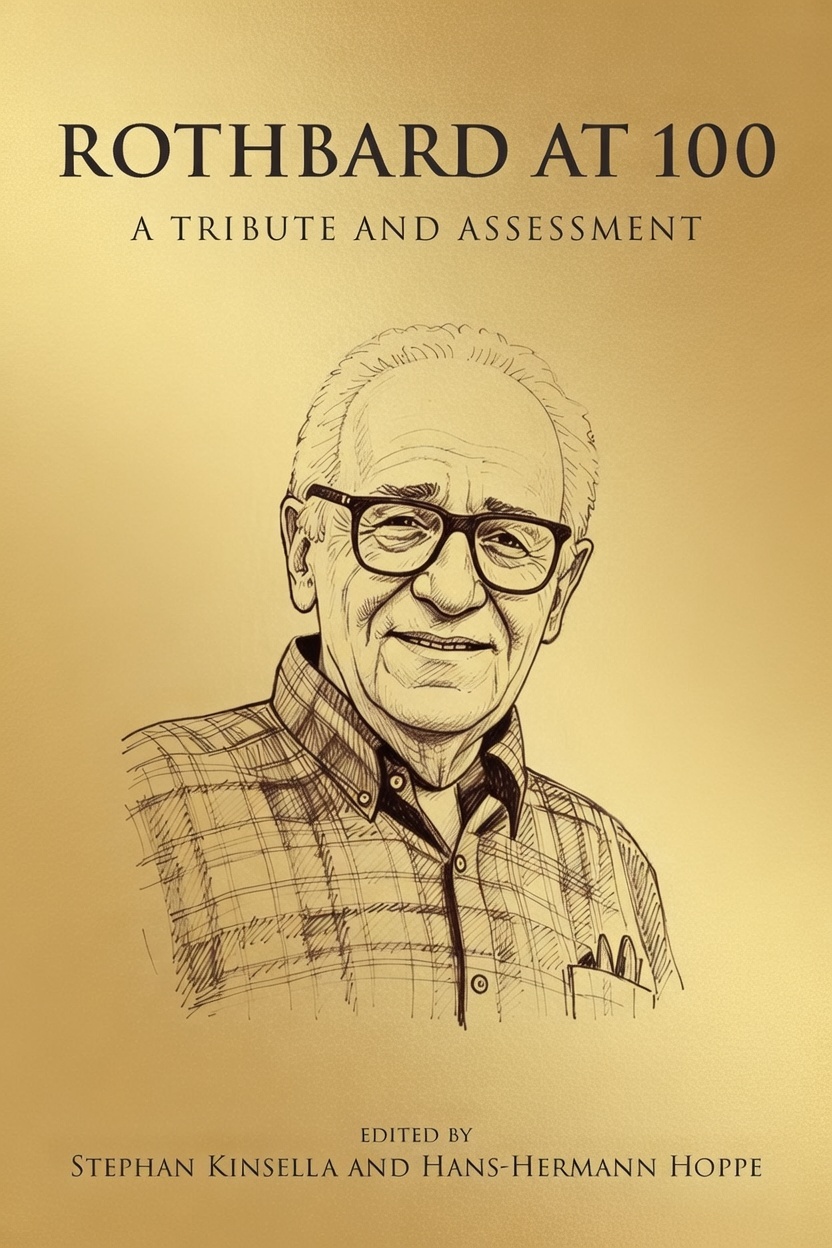
— From Rothbard at 100: A Tribute and Assessment, Stephan Kinsella and Hans-Hermann Hoppe, eds. (Houston: Papinian Press and Property and Freedom Society, 2026) —
4
Remembering Murray Rothbard: Teacher, Friend, and Inspiration
Once a student of Murray Rothbard’s, always a student of Murray Rothbard’s. I have carried his influence all of these years since taking EC742 History of Economic Thought under Rothbard at UNLV in the fall of 1990. Rothbard’s Economic Thought class was different each semester and his emphasis that semester on financial history with its booms and busts would lead to me writing my thesis Early Speculative Bubbles and Increases in the Supply of Money (now in its 4th edition) under him with Hans Hoppe on my committee.2
Little did I know I would participate in a historic real estate bubble and crash in Las Vegas in the mid-to-late 2000s. Working as a real estate lender—“the efficient banker,” as Murray came to call me—I hadn’t forgotten Rothbard’s lessons and frequently wrote articles for LewRockwell.com skeptical of the boom.3 My fellow bankers weren’t amused and after the bank failed, bank regulators and attorneys wondered why I didn’t singlehandedly stop the episode I surely must have known was coming.4
From the 2008 Great Financial Crash, the short book Walk Away: The Rise and Fall of the Home-Ownership Myth was born while I worked at The Mises Institute and from that a talk at the 2011 Property and Freedom Society (PFS) salon, “Going Broke: The Ethics of Default.”5 The term structural default became common. Borrowers who could afford to make house payments chose not to because their homes were worth much less than their mortgage balance. Financial commentators argued that borrowers had obligated themselves for 30 years no matter what their home values had fallen to. Also, they claimed, walking away would cause neighboring properties to fall in value. While big banks were being bailed out, homeowners were supposed to spend their last dollar paying their mortgage. I wondered, what would Murray think?
Concerning the issue of denigrating a neighbor’s property value by walking away I leaned on Rothbard’s work on libel and slander (defamation) from For a New Liberty. “What the law of libel and slander does, in short, is to argue a ‘property right’ of someone in his own reputation.”6 But a homeowner has a property right in his property—in its physical integrity—not in the value derived from the subjective feelings and attitudes held by others.7
With most mortgages being sold to Government Sponsored Entities (GSE) Fannie Mae and Freddie Mac, underwater borrowers were struggling to essentially pay the government. Rothbard wrote, “Relations with the State, then, become purely prudential and pragmatic considerations for the particular individuals involved, who must treat the State as an enemy with currently prevailing power.”8 The funding of Fannie and Freddie debt by taxpayers was done in Rothbard’s words through “coercion and aggression,” which can “never be licit from a libertarian point of view” (p. 184).
The audience in Bodrum was not convinced.9
Murray Rothbard passed away in 1995 and twenty years later at the 2015 PFS a panel was gathered entitled Memories: Rothbard as Mentor and Teacher.10 I told a story to illustrate both that I didn’t know who Murray was when I enrolled in EC742 and how humble he was. Rothbard gave a mid-term test, a final, and required a ten-page paper on any topic we wanted, but he had to approve the topic.
I went in to see him at his Beam Hall office at the east end of the fifth floor and told him I wanted to do a paper on the Great Depression. “Oh, that’s great Douglas!” he said joyfully. He then went on to recommend that I look at The Great Depression by Lionel Robbins, Banking and the Business Cycle by C.A. Phillips, T.F. McManus, and R.W. Nelson, and Benjamin M. Anderson’s Economics and the Public Welfare.
Then, as I was getting up to leave, seemingly as an afterthought, he said, “Oh, and I wrote something about the depression.” Of course he had; I felt stupid for not knowing that he had written America’s Great Depression. A book historian Paul Johnson called an intellectual tour de force:
I know of few books which bring the world of economic history so vividly to life, and which contain so many cogent lessons, still valid in our own day. It is also a rich mine of arcane knowledge, and I urge readers to read the footnotes, which contain many delicious quotations from the great and the foolish of those days, three-quarters of a century ago.11
In the foreword to the book’s first edition, Rothbard, in a footnote of course, comments on John K. Galbraith’s The Great Crash, 1929. He calls the book a “slick, superficial narrative of the pre-crash stock market” (p. xliii). In 2025, financial journalist Andrew Ross Sorkin wrote a bestseller, 1929: Inside the Greatest Crash in Wall Street History—and How It Shattered a Nation. He gushed that Galbraith’s book was a “seminal work” and described it as “lucid.” America’s Great Depression was not among Sorkin’s sources despite Rothbard’s work focusing on the 1929–1933 period as Sorkin’s did.
I spent as much time as I could speaking to Murray during his office hours, often while a line formed in the hallway outside his office. He urged me to read Ayn Rand’s Atlas Shrugged and The Fountainhead. He directed me to Laissez-Faire Books and Liberty Fund to buy books. He told me to read H.L. Mencken to learn how to write. His lectures referencing the gold standard and bimetalism spurred my interest in precious metals. He told me to sign up to receive The Freeman from FEE. I signed up to receive journals from the CATO Institute at his suggestion. And of course he urged me to contact the Mises Institute to receive The Free Market.
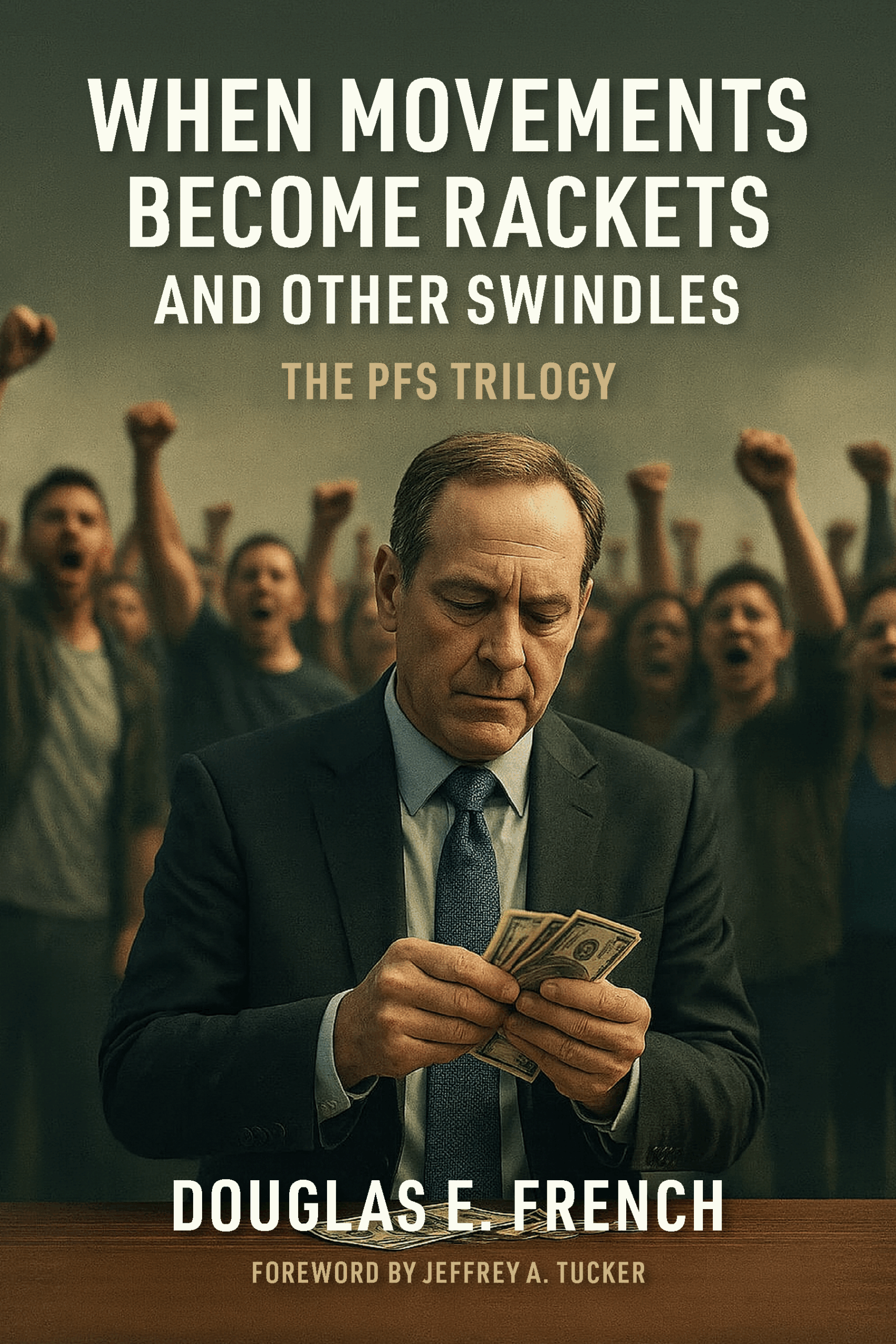
Strictly Confidential is a lightly read collection of Rothbard memos written while he was at the Volker Fund and starts with a July, 1961 confidential memo to F.A. Harper, and George Resch.12 This memo was the inspiration for my 2022 PFS talk “How Movements are Turned into Rackets” and would be part of a book of similar title, published by Stephan Kinsella and the PFS at the suggestion of Hans Hoppe.13 In the memo Rothbard calls on libertarian scholars to be hardcore and that they should have organizations which foster that point of view. Not to “abandon the true principles in the name of gradual advance.”
In this way, the hardcore man, the “militant” libertarian, works to advance not only the total system, but all steps toward that system. In this way, we achieve “unity of theory and practice” we spurn the pitfalls of base opportunism, while making ourselves much more effective than our brothers, the sectarians.
He emphasized that hardcore libertarian scholars or the “cadre” must be nourished and their work would then be spread by libertarian publicists to the masses. He believed there must be a sharp break from the conservative movement which he believed was a threat to liberty.
Rothbard goes on to give a brief post-WWII history of the libertarian movement. What caught my eye was a brief section subtitled, “The Decline of FEE,” and especially its last paragraph:
Another danger which the history of FEE and other right-wing organizations tells us: the tendency for the fellow who can obtain money to be in control of policy, and the corollary tendency to begin to trim the output of the organization to what will attract the money, When the latter happens, the gathering of money begins to become the end, not the means, and the organization begins to take on the dimension of a “racket.”
The last time I saw Murray was mid-December of 1994 before final exams. I had just moved back to Las Vegas from Reno. We talked and laughed about many things. I asked if any progress had been made on what he called the “jail break,” moving the economics department out of the School of Business and into Liberal Arts and beginning a PhD program.14 There hadn’t. I expressed my frustration with the many rejections I had received from mainstream economics journals of my Tulipmania article, carved out from my thesis. Murray said he would happily publish it in the Review of Austrian Economics.15
I also told Murray about attending a Liberty Magazine conference in Tacoma, Washington in 1994 where R.W. Bradford held a session called “Why Libertarians Hate” which was primarily about him and Ayn Rand.16 He laughed and laughed. I told him I had purchased the cassette tape of the session and that we would get together and listen to it when he came back to Las Vegas after Christmas break.
Murray passed away a month later in New York.17 Clarence Ray, a colleague of Rothbard’s but not a fellow traveler said at Rothbard’s Las Vegas memorial that Murray was first and foremost a nice man. Hans Hoppe told Tom Woods recently, “I’ve met bright people in my life, but the only person I’ve met whom I would consider to be a genius was Rothbard.”18
Yes, Murray was a genius, but what I remember most about him was that he was a nice man. A brilliant man who changed my life.
- Douglas E. French, a founding member of the PFS, is President Emeritus (2009–2011) of the Ludwig von Mises Institute and author of numerous publications, including When Movements Become Rackets and Other Swindles: The PFS Trilogy, Stephan Kinsella, ed. (Houston, Texas: Papinian Press and Property and Freedom Society, 2025), Early Speculative Bubbles & Increases in the Supply of Money, 4th Expanded Edition (Palmetto Publishing, 2024), and Walk Away: The Rise and Fall of the Home-Ownership Myth (Auburn, Ala.: Mises Institute, 2010). He was the recipient, in 2005, of the Center for Libertarian Studies’ Murray N. Rothbard Award and, in 2012, of the Murray N. Rothbard Medal of Freedom, and also endowed the Mises Institute’s Douglas E. French Prize.
Doug’s previous tributes and reminiscences of Rothbard include Douglas E. French, “Rothbard as Teacher,” Liberty (May 1995), p. 14; Douglas E. French et al., “Memories: Murray N. Rothbard (1926–1995) as Mentor and Teacher,” Property and Freedom Society Annual Meeting 2015, Bodrum, Turkey (Sep. 11, 2015), available at Stephan Kinsella, “PFP129 | Memories: Murray N. Rothbard (1926–1995) as Mentor and Teacher, Hoppe, DiLorenzo, French, Iglody (PFS 2015),” Property and Freedom Podcast (May 20, 2022); Douglas E. French et al., “Murray Rothbard as a Teacher: The UNLV Years—A Panel with Rothbard’s Former Students,” Austrian Economics Research Conference 2023, Auburn, Alabama, Mises Institute (Oct. 7, 2017), available at Stephan Kinsella, “PFP252 | Bonus: Murray Rothbard as a Teacher: The UNLV Years—A Panel with Rothbard’s Former Students (AERC2023),” Property and Freedom Podcast (Oct. 2, 2023); French, “Reminiscences of Murray,” LewRockwell.com (April 8, 2005), republished as “Studying Under Murray,” in I Chose Liberty: Autobiographies of Contemporary Libertarians, Walter Block, ed. (Auburn, Ala.: Mises Institute 2010) (based on a talk was delivered on the occasion of receiving the Center for Libertarian Studies’ Murray N. Rothbard Award in recognition of his dedication to the ideals of liberty in the Rothbardian tradition); idem, “Learning From the Master,” LewRockwell.com (Dec. 24, 2002). See also Lee Iglody’s chapter in this volume, “The Man Across the Hall: My Time with Professor Rothbard,” Jeff Barr’s “The Last Lecture,” and Hans Hoppe’s “Coming of Age with Murray.” [↩]
- Douglas E. French, Early Speculative Bubbles & Increases in the Supply of Money, 4th Expanded Edition (Palmetto Publishing, 2024). [↩]
- See, e.g., the following LewRockwell.com articles: “The Land-Price Bubble” (June 10, 2003); “Las Vegas Housing Boom Over?” (Oct. 22, 2004); “City of the Bubble” (June 22, 2005); “Condo-mania” (July 11, 2005); “High Rises and High Time Preferences” (Dec. 6, 2005); “Risky Vegas” (March 6, 2006); “Boom Madness” (Oct. 3, 2006); “Bubblicious” (March 12, 2007); “The Unbloody Streets of Vegas” (July 21, 2007). [↩]
- My thesis, “Early Speculative Bubbles and Increases in the Supply of Money,” was the first exhibit to my nine hour deposition with the FDIC lawyer. The LewRockwell.com articles were also exhibits. [↩]
- Douglas E. French, Walk Away: The Rise and Fall of the Home-Ownership Myth (Mises Institute, 2010); idem, “Going Broke: The Ethics of Default,” Property and Freedom Society, Bodrum, Turkey (May 27, 2011), available at Stephan Kinsella, “PFP072 | Doug French, Going Broke: The Ethics of Default (PFS 2011),” Property and Freedom Podcast (March 3, 2022). [↩]
- Murray N. Rothbard, For a New Liberty, 2d ed. (Auburn, Ala.: Mises Institute, 2006), pp. 116–117. See also idem, “Knowledge, True and False” in The Ethics of Liberty (New York: New York University Press, 1998); and Stephan Kinsella, “Defamation as a Type of Intellectual Property,” in A Life in Liberty: Liber Amicorum in Honor of Hans-Hermann Hoppe, Jörg Guido Hülsmann and Stephan Kinsella, eds. (Houston, Texas: Papinian Press, 2024). [↩]
- On this crucially important issue, see Hans-Hermann Hoppe, “The Justice of Economic Efficiency,” in The Economics and Ethics of Private Property: Studies in Political Economy and Philosophy (Auburn, Ala.: Mises Institute, 2006), pp. 337–338; idem, A Theory of Socialism and Capitalism: Economics, Politics, and Ethics (Auburn, Ala.: Mises Institute, 2010), pp. 23 n.11, 165–168 & n.128; Hans-Hermann & Walter Block, “On Property and Exploitation,” Int’l J. Value-Based Mgt 15, no. 3 (2002): 225–36; Murray N. Rothbard, “Law, Property Rights, and Air Pollution,” in Economic Controversies (Auburn, Ala.: Mises Institute, 2011), p. 375; idem, Man, Economy, and State, with Power and Market, Scholar’s ed., 2nd ed. (Auburn, Ala.: Mises Institute, 2009), chap. 2, § 12, p. 183; and Stephan Kinsella, Legal Foundations of a Free Society (Houston, Texas: Papinian Press, 2023), ch. 5, at n.16; ch. 8, at n.17; ch. 23, at n.27; ch. 25, at n.36. [↩]
- Murray N. Rothbard, “The Moral Status of Relations to the State,” in The Ethics of Liberty, p. 184. [↩]
- Douglas E. French, et al., “French, Hoppe, DiLorenzo, Machaj, Bagus, Gertchev, Discussion, Q&A,” Property and Freedom Society, Bodrum, Turkey (May 27, 2011), available at Stephan Kinsella, “PFP075 | French, Hoppe, DiLorenzo, Machaj, Bagus, Gertchev, Discussion, Q&A (PFS 2011),” Property and Freedom Podcast (March 7, 2022), at time markers 9:06, 31:27, 41:54. [↩]
- French et al., “Memories: Murray N. Rothbard (1926-1995) as Mentor and Teacher.” [↩]
- Paul E. Johnson, “Introduction,” in Murray N. Rothbard, America’s Great Depression, 5th ed. (Auburn, Ala.: Mises Institute, 2000), p. xxvii. [↩]
- Murray N. Rothbard, Strictly Confidential: The Private Volker Fund Memos of Murray N. Rothbard, David Gordon, ed. (Auburn, Ala.: Mises Institute, 2010). [↩]
- Douglas E. French, “How Movements Turn Into Rackets,” Property and Freedom Society, Bodrum, Turkey (Sep. 16, 2022), available at Stephan Kinsella, “PFP236 | Doug French, How Movements are Turned into Rackets (PFS 2022),” Property and Freedom Podcast (June 19, 2023); idem, “How Movements are Turned into Rackets,” The Rude Awakening (Sept. 16, 2022); idem, “How Movements Turn Into Rackets,” in When Movements Become Rackets and Other Swindles: The PFS Trilogy, Stephan Kinsella, ed. (Houston, Texas: Papinian Press and Property and Freedom Society, 2025). [↩]
- “It is important to have programs established in the liberal arts departments rather than in schools of business, which are looked down upon by the intellectual world anyway and often with good reason.” Rothbard, Strictly Confidential, p. 22. [↩]
- After Rothbard’s death, I submitted the article to the Review of Austrian Economics and was rejected. It was finally published in the Quarterly Journal of Austrian Economics. Douglas E. French, “The Dutch Monetary Environment During Tulipmania,” Q.J. Austrian Econ. 9, no. 1 (Spring 2006): 3–14. [↩]
- See Douglas E. French, “Rothbard as Teacher,” Liberty (May 1995), p. 14 & 69, at p. 69; Liberty (March, 1995), p. 13 (offering for sale video and audiotape of “Why Libertarians Hate,” by R.W. Bradford, from the Liberty Editors’ Conference in Tacoma, Washington, 1994). [↩]
- See French, “Rothbard as Teacher,” and other memorials at Murray N. Rothbard: In Memoriam (Auburn, Ala.: Mises Institute, 1995) (various authors) and “Rothbard Remembered,” Liberty (March, 1995): 20–26 (various authors). [↩]
- See Tom Woods, “Interview with Hans Hoppe,” Tom Woods Elite Letter, Issue #18 (Summer 2025). [↩]











Follow Us!