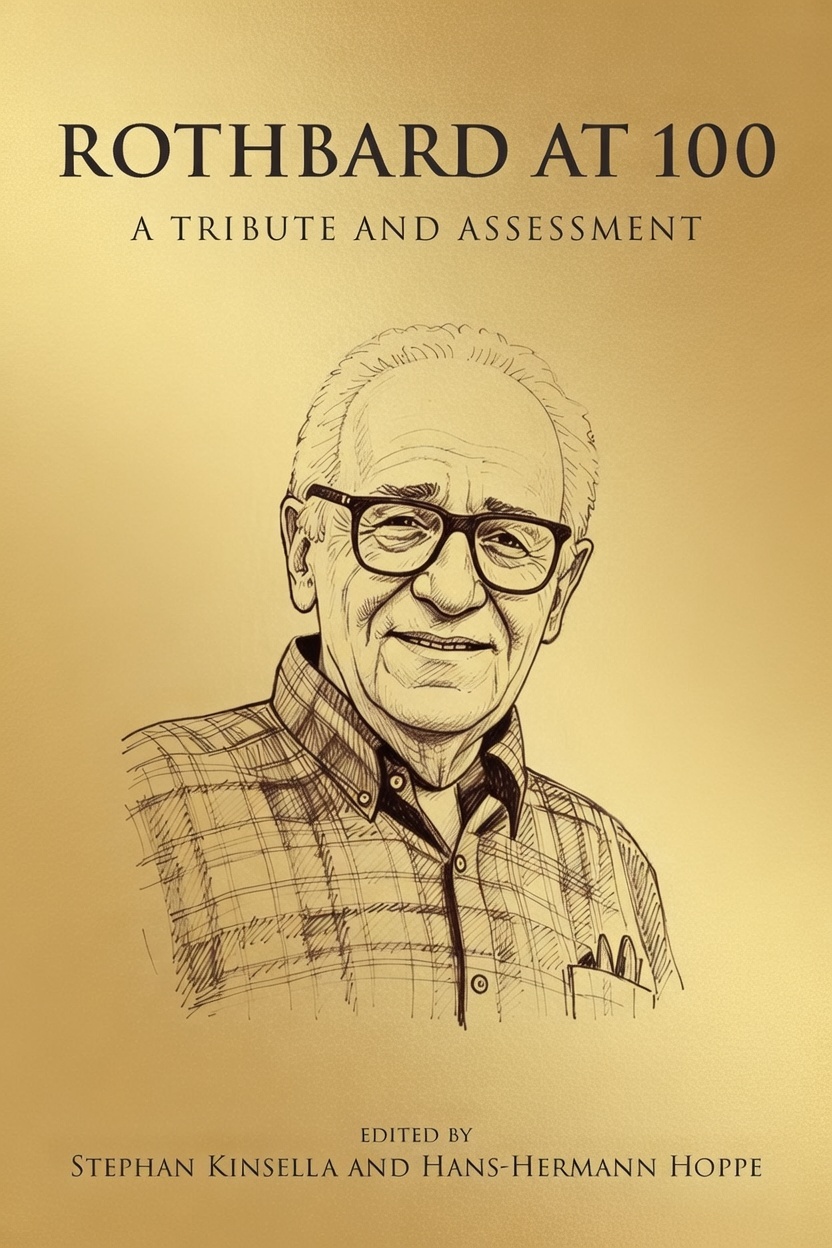
— From Rothbard at 100: A Tribute and Assessment, Stephan Kinsella and Hans-Hermann Hoppe, eds. (Houston: Papinian Press and Property and Freedom Society, 2026) —
12
The First Knight of Libertarianism
This year we celebrate the 100th anniversary of the arrival on this planet of a powerful mind that indelibly transformed the world of ideas. The 100-year period is used to subdivide history into centuries and organize our understanding of events over time. Also this year, I turn 50 years old. Murray Newton Rothbard was born on March 2, 1926, in New York. I was born on February 3, 1976, in São Paulo. Life really goes by fast. As I turn half a century, I feel that a century is no longer the enormous amount of years it seemed to me when I was younger, and this increases the feeling of closeness to the past. If a century is a short time, only 20 periods like this separate us from the Jesus’ fullness of time and 10 from the time when the Ottonian dynasty ruled the Holy Roman Empire; it’s practically like yesterday.
The mark that Rothbard left in the history of thought should place him as the greatest political philosopher not only of the twentieth century, but of all time. Before Rothbard, there simply was no coherent moral political position. There were the anarchists, who, faced with the immorality of the state, rejected it, but instead proposed nothing coherent, and added their own immoralities. All other options acquiesced in the immorality of the state—as a necessary evil or a cherished good—and none could provide a coherent justification for this depravity. The most popular foundation among statist theorists is also the most incoherent: the absurd theory of the Social Contract which, ironically, boils down to the non-existence of any contract.2 No parties involved, no agreement of wills, no objective, no pacta sunt servanda. And even if there had ever been some madman somewhere who had signed, without any termination clause, a contract that established a provider with the ability to decide when, how, and what services he would provide and how much others would have to pay, this contract could never be bound to third parties who did not sign it and to their descendants. No sane mind is capable of accepting such absurdity and moving on,3 yet it is on this kind of loose basis that statists have built their theories.
Among the statist positions, the main ones were socialism, conservatism, and classical liberalism,4 and before Rothbard, those who rejected the abysmal anarchist proposal would end up choosing one of these. Socialism was the most popular option among young people. If an apparatus of compulsion and coercion is inevitable, let it be used for good, helping the poorest and neediest, says the naïve youthful heart. But those who have more than two brain cells soon realize that the welfare state ends up encouraging idleness and discouraging work, increasing general poverty. If he is not a scoundrel of the parasitic class who benefits from the socialist exploitation scheme, our juvenile would end up recognizing his mistake and becoming a classical liberal.
Conservatism does not have a precise definition, however, it can be said that its essence is the valorization of institutions and customs that have existed for a long time just because they have existed for a long time, and this is evidently absurd.5 If the Conquistadors were conservative, when faced with the human sacrifices practiced for centuries by the Aztecs, Mayans and Incas, they would choose to maintain this custom in the Americas, instead of—as they did—ending it immediately because they considered it objectively wrong, contrary to the laws of God. In the same way, the conservative will defend the maintenance of any evil, such as the Central Bank, the War on Drugs or the state itself, as long as this evil has been established for some time—and it does not have to be a very long time.
The classical liberals, on the other hand, had the merit of recognizing the state as an evil, but, illogically, they considered it necessary. The idea of necessary evil has never made sense: if it is an evil, it is not necessary, because no one needs an evil. If it is necessary, it is a good, not an evil. In fact, the state is really an evil, and what is necessary is to get rid of it, altogether. The fatal mistake of the classical liberals was to concede to an institution inherently violating private property the function of protecting it: they literally placed the fox guarding the henhouse.
This was the quagmire that political philosophy found itself in. A coherent and moral person had nowhere to go. Then Rothbard stepped in and gave us the only sound position: libertarianism. For the first time in history, it was no longer necessary to pervert one’s mind in order to have a political position. Like the anarchists, Rothbard rejected the unnecessary evil of the state, but proposed in its place the order based on private property, with the necessary services of justice and security, nowadays provided by the state, being provided by totally free markets. Twenty years ago, when I first came across libertarianism, I was a classical liberal, and Rothbard’s ideas simply annihilated all my justifications for the existence of the state. Having my contradiction exposed and my arguments defeated, I was left to become an anarcho-capitalist: “If you can’t beat them, join them.”
Like every classical liberal, I was a walking contradiction, and I got rid of this deplorable state of mind only thanks to the revolutionary Rothbardian innovation. Libertarianism is so disruptive that the history of political philosophy should be divided into BR and AR, Before Rothbard and After Rothbard. Before Rothbard, it was permissible to defend meaningless and immoral political positions because there was simply no other option—after Rothbard, not being a libertarian became a matter of ignorance, stupidity or malice. Rothbard’s main mentor, Ludwig von Mises, was introduced to anarcho-capitalism when he read Rothbard’s economic treatise, Man, Economy, and the State, in 1962, but he did not become a libertarian. In his glowing review of the work, he commented:
Less successful than his investigations in the fields of general praxeology and economics are the author’s occasional observations concerning the philosophy of law and some problems of the penal code. But disagreement with his opinions concerning these matters cannot prevent me from qualifying Rothbard’s work as an epochal contribution to the general science of human action…6
However, Rothbard not only destroyed liberalism as far as the philosophy of right was concerned—he also demolished it through economics. Mises knew perfectly well that economic theory tells us that goods and services provided monopolistically tend to be worse and more expensive than those provided by the free market, but contradictorily, he argued that police and justice services must be monopolies. Mises was over 80 years old in 1962, and would live for another 11 years, until his death in 1973, as a paradoxical classical liberal. And he was not just any classical liberal, but the greatest classical liberal in history, dedicating much of his monumental intellectual work to the elucidation and defense of classical liberalism. However, Mises did not have access to Rothbard’s stubborn ethical defense of libertarianism in 1982 in The Ethics of Liberty, where, in addition to dismantling Mises’s utilitarianism, he presents libertarianism as a theory of justice.
Rothbardian libertarianism is not just an economic theory that tells us how consumer demands can be met more efficiently—it is much more than that. Rothbard outlines the answer to everything we can and cannot do, i.e., what we have the right to do, and if we do not have the right to do something, violence can be used against us. He tells us what is just and what is unjust. Only then did Rothbard expound his integral philosophy of law, which had been criticized by Mises in 1962. That is why we have to consider Mises as a thinker of the BR era, and not as the dumb, ignorant or jerk classical liberals of the AR era. In fact, as well defined in the title of Jörg Guido Hülsmann’s biography of Mises, he was the last knight of liberalism.7 And Rothbard is the first knight of libertarianism, the enlightened thinker who freed political philosophy from darkness.
- Fernando Fiori Chiocca ([email protected]) is the founder and editor of the Instituto Rothbard in Brazil, dedicated to spreading the Austrian School of economics and libertarianism. [↩]
- On the social contract, see Jean-Jacques Rousseau, The Social Contract and Discourses, G.D.H. Cole, trans. (New York: E. P. Dutton, 1950); John Rawls, A Theory of Justice (Cambridge, MA: The Belknap Press of Harvard University Press, 1971); James M. Buchanan and Gordon Tullock, The Calculus of Consent (Ann Arbor: University of Michigan Press, 1962); and, on the idea of a “constitutional contract,” James M. Buchanan, The Limits of Liberty (Chicago: University of Chicago Press, 1975). For criticism of social contract theory, see Murray N. Rothbard, “Buchanan and Tullock’s Calculus of Consent,” in Economic Controversies (Auburn, Ala: Mises Institute, 2011); idem, The Ethics of Liberty (New York: New York University Press, 1998 [1982]), pass.; idem, “The State,” in For a New Liberty, 2d ed. (Auburn, Ala.: Mises Institute, 2006); Williamson M. Evers, “Social Contract: A Critique,” J. Libertarian Stud. 1 (Summer 1977): 187–88; Hans-Hermann Hoppe, “Rothbardian Ethics,” in The Economics and Ethics of Private Property: Studies in Political Economy and Philosophy (Auburn, Ala.: Mises Institute, 2006), pass.; idem, “On Democracy, Redistribution, and the Destruction of Property,” “On the Errors of Classical Liberalism and the Future of Liberty” and “On Government and the Private Production of Defense,” in Democracy: The God That Failed (Transaction, 2001); idem, “Capitalist Production and the Problem of Public Goods,” in A Theory of Socialism and Capitalism (Laissez Faire Books, 2013); idem, “Foreword,” in Stephan Kinsella, Legal Foundations of a Free Society (Houston, Texas: Papinian Press, 2023); Anthony de Jasay, “Inventing The State: The Social Contract,” in The State (Indianapolis: Liberty Fund, 1998); idem, Against Politics: On Government, Anarchy, and Order (London and New York: Routledge, 1997), Introduction, ch. 1, et pass.; idem, Social Contract, Free Ride: A Study of the Public Goods Problem (Oxford: Clarendon Press, 1989), Introduction, ch. 4, et pass.; Stephan Kinsella, “Review of Anthony de Jasay, Against Politics: On Government, Anarchy, and Order,” in Legal Foundations of a Free Society, p. 539. [↩]
- See Sheldon Richman, “The Absurdity of Alienable Rights,” Liberty (January 1989): 50–52). [↩]
- See Hoppe’s analysis of different types of socialism in A Theory of Socialism and Capitalism (Laissez Faire Books, 2013), chs. 3–6. [↩]
- But see Hans-Hermann Hoppe, “A Realistic Libertarianism,” LewRockwell.com (Sept. 30, 2013) (characterizing the left as essentially egalitarian and the right as essentially realist). [↩]
- Ludwig von Mises, “A New Treatise on Economics,” New Individualist Review (Autumn 1962): 21–23; reprinted in New Individualist Review (omnibus volume) (Liberty Fund, 1982), p. 323 and in idem, Economic Freedom and Interventionism (Liberty Fund, 2006). [↩]
- Jörg Guido Hülsmann, Mises: The Last Knight of Liberalism (Auburn, Ala.: Mises Institute, 2007). [↩]















Follow Us!