— From Rothbard at 100: A Tribute and Assessment, Stephan Kinsella and Hans-Hermann Hoppe, eds. (Houston: Papinian Press and Property and Freedom Society, 2026) —
10
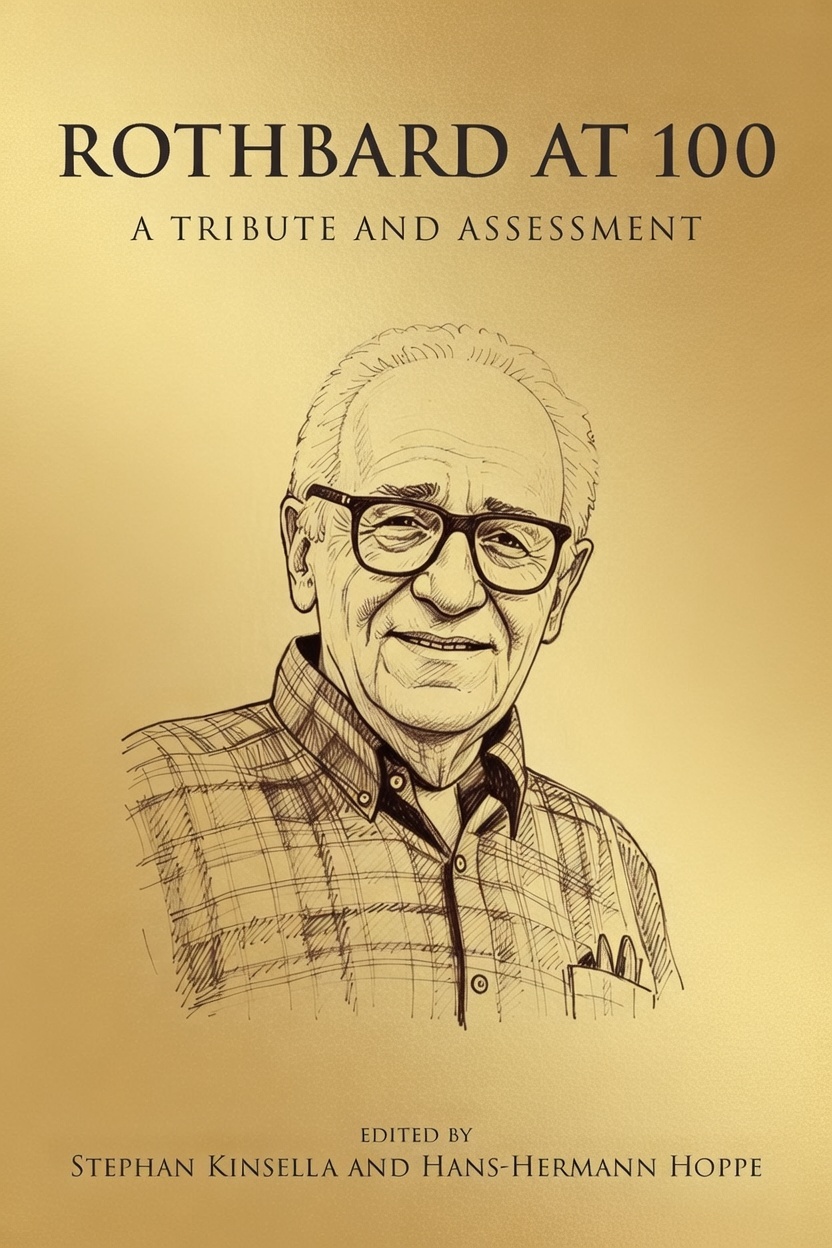
Murray Rothbard: An Ode to an Intellectual Hero
Looking back at my intellectual development over my forty-five years of life, there stands a major landmark and inflection point around October 2008, when, for the first time, I read Murray Rothbard. I vividly recall being astonished by the clarity and depth of his ideas, so much so that I concluded I learned more from reading a page by him than from reading an entire book from the many drab texts I was assigned in my graduate studies. Looking back eighteen years later, I can confidently say the clarity and breadth of Rothbard’s work have been the guiding star and intellectual inspiration for my own work. I only made sense of the world after reading him. I only became an economist after understanding him. I only became a writer after being inspired by his unwavering courage, searing clarity, and ruthless honesty. To this great man I never met, I owe my entire intellectual output.
In October 2008, I was entering the last year of my graduate studies at Columbia University in New York City, where I was studying for a PhD in Sustainable Development, a program based heavily on the dominant mainstream economics of the fiat era. Until 2007, the extent of my familiarity with Austrian economists consisted mainly of hearing of them lumped in with Chicago and neoliberal economists as free-market fundamentalists personally responsible for the vast majority of the problems of the human race from the 1970s onwards through their nefarious influence on Reagan, Thatcher, and Pinochet. I had read Friedrich Hayek’s The Use of Knowledge in Society2 when I was doing my Master’s degree at the London School of Economics, and I remember finding it mildly interesting, though it failed to make much of an impact on my way of thinking at the time.
My Sustainable Development program was a perfect example of what Hayek would call scientism, the fatal conceit that human affairs can be managed coercively through the enlightened methods of science.3 Using the tools and methods of modern economics, my background in engineering, and armed with some vintage twentieth-century social science propaganda, I was expected to produce a multidisciplinary study that provides actionable policy insights for policymakers on the topic of alternative energy.
In 2007, as I was supposed to get into writing in earnest, I was beginning to come to terms with the absurdity of this quest for central planning. My models were supposed to include the actions of billions of consumers and producers of fuels around the world, and decide for them what was best for them. There was no recognition of the dynamic importance of prices and how individual economic calculation drives human action. As I began to grapple with the methodological problems involved, I found some helpful insight from reading Karl Popper, which led me to Friedrich Hayek and his work on scientism and the limitations of central planning. Reading Hayek would soon guide me to the Ludwig von Mises Institute website, Mises.org, and its endless free PDFs of the works of the great Austrian economists.4 And down the rabbit hole I fell. I would soon find Rothbard’s PDFs among them, and they would become my indispensable guide and framework for navigating the world.
I spent months devouring these PDFs in my tiny Morningside Heights apartment, at the expense of writing my PhD dissertation. I felt a personal connection with Rothbard, who, like me, had also gotten his PhD from Columbia, and had grown up and lived a few blocks down Broadway from where I was living. In his last year in Columbia, Rothbard heard of Ludwig von Mises’s New York University seminar and began to attend it. Similarly, I discovered in my last year that the Mises seminar was still taking place in New York University under Professor Mario Rizzo, as it continues to this day. I emailed Professor Rizzo, and he graciously accepted my request to attend. Attending the seminar, over the next few months, I had the pleasure of meeting, learning from, and interacting with Professors Joseph Salerno, Ralph Raico, and Israel Kirzner, among many old and young Austrian scholars. I vividly remember the distinct feeling of relief I experienced when surrounded by serious academics who shared some of my heretic views. It was a relief for my sanity.
Meanwhile, a few blocks further down Broadway, the epicenter of global finance was imploding, providing me with a very useful learning aid on my journey into Austrian economics, and more incentive to dig into Rothbard’s endless PDFs. As one bank after another went bankrupt, the US Treasury and Federal Reserve bailed out the financial industry with trillions of dollars, arguably the first time the term “trillion” came into popular usage, a testament to the ease with which fiat currencies are created. As my Columbia University professors were hauled before TV cameras to explain to people why it is in their interest to continue destroying the value of the dollar to save the richest banks in the world, their rationales raised more questions than they answered. Then, in October 2008, I read Murray Rothbard for the first time, and I began to make sense of the world around me. Whereas the mainstream of economics distorted reality to justify the actions of those in power, Rothbard clarified reality, plainly indicting them. People’s natural instinctive suspicions about the dangers of an increase in the money supply and moral hazard are actually correct, and in no way can the mathematical sophistry of regime economists overrule them.
Most startling to me was how plainly Rothbard employed a logical approach to analyzing economics, grounded in the realistic understanding that human beings’ actions and valuations shape economic reality. Here was a man who just looked at the actions of human beings to understand reality, and it made a lot more sense than my standard intellectual diet of ascribing cognizance to aggregates and abstract nouns, and appealing to authority and sophistry. Rothbard’s genius was to expose that what passes for policy debate is mostly incantations of propaganda and spell-casting by a priesthood loyal to power. He taught me how to translate the heart-warming incantations of “stabilization,” “liquidity shortage,” “systemic risk,” and “public interest” into their plain English translation and accounting terms: “destabilization,” “bankruptcy,” “politically favored,” and “politically favored private interests” respectively. He taught me to ignore the incantations and just look at who is paying whom. Once you apply that translation, the 2008 crisis stops being a mysterious accident and becomes the predictable outcome of a monetary and political structure rigged to favor a monopoly that privatizes its profits and socializes its losses. Contra propaganda, central banking is as essential to a society as tapeworms are to an individual.
It is difficult to enumerate or summarize the important economic ideas I learned from Rothbard in such a short space, but I will highlight a few of the most important points. Perhaps the most influential piece of Rothbard’s writing for me was his brief chapter, “The Austrian Theory of Money.”5 I remember reading this in 2008 and being completely blown away by his distillation of the essence of Austrian monetary theory, and the most important lessons of Mises’s monumental works, Human Action and Theory of Money and Credit, into a mere 24 pages.6 The most mind-blowing lesson for me from that paper was Mises’s contention that money is a good acquired for its purchasing power, which can increase without the supply increasing. Any quantity of money, provided it is divisible enough, is thus sufficient to secure the service of money. The entire rationale for increasing the money supply disappeared. Rothbard further went on to contend:
A world of constant money supply would be one similar to that of much of the eighteenth and nineteenth centuries, marked by the successful flowering of the Industrial Revolution with increased capital investment increasing the supply of goods and with falling prices for those goods as well as falling costs of production.7
I will never forget the moment I read that sentence in my apartment in New York in late 2008. Around the same time, on the internet, Satoshi Nakamoto was putting the final touches on the software for Bitcoin, the first, and still only, example of a money with a credible claim for having a constant supply.
It was this point, more than any other, that made me understand the value of bitcoin. When I first heard of it, I thought it would make a neat idea because it would fit Rothbard’s hypothetical fixed supply money, but I was dismissive of the possibility that it would work, blissfully and pathetically confident, in a way which only a PhD can bestow, that my ignorance of its technical details could not possibly bear on the question of its success or failure. After a few years of bitcoin’s stubborn refusal to go away, and its supply remaining fixed according to schedule, I began to study bitcoin, and finally understood how its decentralized, censorship-resistant nature could ensure its supply remains fixed, producing the Rothbardian monetary Holy Grail.
On January 3, 2009, Satoshi Nakamoto launched bitcoin and I was in San Francisco for the annual meeting of the American Economic Association, the largest meeting of economists in the United States, which hosts the job interviews for prospective university professors. I remember spending the day outside of my interviews walking up to various celebrity fiat economists and asking them why they think the money supply should increase at all. I remember not getting a single coherent answer to that question, and plenty of flustered and confused looks.
Rothbard’s work on money, banking, and economic history were indispensable in developing my own ideas on bitcoin, which culminated with the publication of The Bitcoin Standard in 2018. The Bitcoin Standard was my attempt to do with Bitcoin what Rothbard did with money: strip away the cant, understand the reality, and deduce its implications. In The Fiat Standard (2021) I applied what I learned from him about inflation to trace the long-term impact of monetary debasement and credit expansion on economics and society broadly, including family, culture, politics, time preference, and civilization itself. My Principles of Economics (2023) was heavily based on Rothbard’s Man, Economy, and State,8 and can be described as my attempt to distill its most important lessons into a shorter and more accessible alternative.
The breadth of Rothbard’s writings is arguably unmatched. He covered all the important topics and fields of economics comprehensively and was the best guide to understanding these topics, as well as the debates around them and their historical evolution. From economic theory—money and banking, the business cycle, capital and interest, monopoly and antitrust—to policy controversies—taxation, regulation, welfare, education, immigration, war, and civil liberties—to economic history, and the history of economic ideas, Rothbard wrote about it all, and made you think every single time.
It is difficult to pick a favorite among Rothbard’s economic books, but after much consideration, I would choose America’s Great Depression as my favorite, as it was Rothbard at the absolute pinnacle of his craft.9 He begins by explaining the Austrian theory of the business cycle in a very simple and intuitive way, which might actually be his best statement of the theory. He then completely dismantled the official story of The Great Depression, leaving nothing defensible. He summoned a mountain of historical evidence and research to combine with his Austrian economic framework and brilliantly illustrate the ugly truth.
But what makes this work so singularly important are the many profound implications of understanding the true history of the Great Depression: how its roots go back to the destruction of the gold standard and the first world war; how British manipulation of American policy makers exported Britain’s inflation to the US and fueled the unsustainable credit boom of the 1920s, which in turn led to the infamous market crash which mainstream economists treat as inexplicable; how Hoover’s interventionist policies turned the market crash into a depression, and how FDR exacerbated the policies of Hoover, dooming the gold standard. His account of how wage-and-price maintenance and cartelization policies prevented recovery, and turned a stock market crash into a depression, was the first time I saw the period explained with logical cause and effect rather than Keynesian folk mythology. Here was a fully detailed exposition of the civilization-shattering consequences of monetary fraud and inflation, exploding the official history as little more than the propaganda of the beneficiaries of inflation. Austrian theory makes for the best approach to understanding the Great Depression; and the Great Depression makes for the best object lesson in Austrian economics.
Rothbard’s contributions were not confined to economics. He also wrote extensively in history and political philosophy, as well as US politics, foreign policy, international politics, and beyond. If Rothbard’s work in history and political philosophy were published by two different authors, these two would have arguably been the most important and original contributions to these fields in the twentieth century. I do not think this is an exaggeration, because in both fields, as in economics, Rothbard’s uncompromising refusal to toe the fiat cartel line and serve as a court intellectual allows him to communicate much more powerful ideas with a clarity no court intellectual could ever muster. Whereas American historiography centers on the glorious success and legitimacy of the American government, Rothbard shows the ugly, real face of America’s leviathan in Conceived in Liberty, a book so encyclopedic you will not believe Rothbard had the time to write it, let alone research it.10
Whereas political philosophers are constantly bickering over their absurd attempts at legitimizing government aggression and violence, only Rothbard stands apart, like the child calling the emperor naked, consistently applying to the state the same moral and legal principles that apply to any other entity, and thus, convincingly, clearly, and coherently explaining the true nature of the state, and the damage it brings to society. The vast majority of political philosophers other than Rothbard will provide you with sophistry whose only purpose is to enhance your loyalty to the bank and government cartel that pays their salary. With this searing honesty, Rothbard’s works of political philosophy exit the realm of academic bloviation and government propaganda and enter the realm of essential practical life skills. Only by understanding the true nature of the state can you begin to understand how to liberate yourself from its yoke and extricate your life from its powerful claws.
International politics, US foreign policy, and the warfare state are yet another group of topics on which Rothbard offered a substantial outcome with which any serious scholar must grapple. The modern American university has served as a faithful stenographer for US foreign policy, furnishing an ever-growing list of pseudo-intellectual, criminal, and idiotic justifications for the conveyor belt of death and destruction that is US foreign policy. For decades, Rothbard has provided a comprehensive refutation of all these justifications, small and large, and has given his readers the searing truth about the realities of the conflicts whose flames DC was fanning.
My particular favorite piece here is Rothbard’s discussion of the Palestinian-Israeli conflict. As a Palestinian who has spent my entire life living and learning about the tragedy that is Zionism, I could not find a better, more precise piece to understand the conflict. With his peerless clarity and sharp pen, Rothbard pinpointed the exact crux of the so-called conflict: the Zionist war of aggression and theft against the legitimate owners of the land of Palestine. He effortlessly cleared the large clouds of clichés, emotional blackmail, and confusion surrounding this topic, replacing them with the very simple and inarguable concrete reality: by denying the property rights of the rightful owners of the land based on their race, Israeli aggression inevitably generates conflict and requires endless subsidies from emotionally, violently, and sexually blackmailed Western nations to survive.
Underpinning all of Rothbard’s ethics and economics is the solid, even, and consistent intellectual foundation of property rights, whicfh allowed him to build magnificent works arriving at solid conclusions published fearlessly. There was no special exception for any government or favored group that would destroy the consistency of Rothbard’s work and force him to write incoherent drivel to justify it. Once one adopts this lens to understand the world, everything becomes much clearer.
Yet my intellectual debt to Rothbard does not end with his scholarship; it extends to his writing style, and the courage of his convictions. Although I had always enjoyed writing, I struggled to write in my graduate studies as I could never muster the conviction to mimic the timid style of academia, and the complex ways in which academics twist words in order to impressively communicate nothing of substance. Rothbard was the first economist I encountered that wrote clearly, decisively, precisely, and unapologetically. For the first time, I found someone who wrote with the supreme purpose of being understood, not to obfuscate, prevaricate, impress, or flatter. Seeing that example convinced me to write clearly and honestly, and that was pivotal in my decision to pursue writing The Bitcoin Standard and my subsequent books.
I found value in Hayek, but found Rothbard and Mises on firmer and more consistent ground. I enjoyed and benefited from reading Mises, but Rothbard’s writing style was far more engaging and relatable to me. Rothbard, after all, wrote in his native English language, and most of his work was more recent than Mises, whose work was translated from German or written in the author’s third language, when it seemed like he thought in German and translated to English.
Along with this clarity of thought came the clarity of conviction, and the courage to communicate it plainly and honestly, regardless of the impact it might have on the delicate sensibilities of readers used to gentler and more flattering propaganda. Prevaricating, massaging reality, and flattering the reader’s prejudices may land you fancy job titles at modern universities, but they will ensure that you’re rarely ever read outside of mandatory curricula. More than three decades after his untimely passing, Rothbard remains one of the most widely read economists of the twentieth century. A cursory look at his books on Amazon shows a very large number of positive reviews, surpassing almost all the heavily-promoted regime economists, past and present. This feat is even more impressive when one remembers that his books are available for free download from mises.org, and have been downloaded by countless people from around the world. Toeing the line of the Federal Reserve cartel and the academic cartel it finances would have likely secured him a better job than the one he had, but it would have ensured his name is as obscure as the many thousands of his contemporaries who are never read or mentioned in today’s world.
Recently, a friend shared with me a critical obituary of Rothbard written by an opportunist CIA agent and fiat regime propagandist named William F. Buckley, Jr., who spent decades drumming up support for US and Israeli wars of aggression among conservatives by writing flowery slop.11 Buckley’s bitter obituary brings to mind the difference in the lives and legacies of the two men born in New York a century ago. Rothbard toiled in obscurity in an unprestigious university, frozen out of all major media outlets, writing to the libertarian and intellectual fringe, and constantly attacked by regime mouthpieces like Buckley as a simpleton and traitor. Buckley, on the other hand, marched from his CIA job to one important media appointment after another, regularly featured on major TV, newspapers, and radio stations. Thirty-one years after Rothbard’s death, and 18 years after Buckley’s, it is now possible to assess their legacies. Rothbard’s books have around five times as many reviews as Buckley’s inconsequential and ephemeral drivel. Rothbard’s work has only become more important as inflation continues to accelerate societal decline. Countless people from all over the world download Rothbard’s books for free from Mises.org, but I know absolutely nobody who has any good reason to read Buckley today, and I can never recall hearing anyone reference an important idea of his relevant to today’s world. To the extent anyone ever mentions him, it is usually just sentimental boomer slop longing for the better-written propaganda of the past.
For all of the media and promotion, regime agents like Buckley are forgotten, because there’s always a new and improved Buckley tailor-made to make war and despotism agree with the latest fads among conservative midwits. Rothbard was fully aware that actors like Buckley got the limelight during their lifetime, but he persistently continued on his path, churning out millions of words for posterity to read. Whereas Rothbard wrote with incredible breadth and depth, Buckley was essentially a slightly less dumb Sean Hannity, using flowery language to impress his readers with exhibitionist literacy. Buckley’s regime has delivered war and inflation and untold destruction, and an increasingly larger number of Americans are waking up to the fiat regime scam Buckley promoted, as their children struggle to afford homes while Netanyahu commandeers America’s people and their resources like they were his private farm.
Finding out how the world’s monetary and political system actually works by reading Rothbard can be unnerving. It is tempting to just ignore the Austrians, get back to the fiat plantation, make the right fiat noises, seek a safe career, and pay your bills until you die. But comparing Rothbard’s legacy to that of regime propagandists made that impossible for me. There is, and always will be, a massive conveyor belt producing imminently forgettable and interchangeable Buckley-like automatons. There will only ever be one Murray Rothbard. Regime propaganda will fade into obscurity, but clear, principled writing will age well. The Buckleys can enjoy the fleeting adulation of idiots, but to Rothbard goes posterity. Life is too short, and posterity too long, to mince words.
- Saifedean Ammous is a prominent economist and bestselling author of The Bitcoin Standard (Wiley, 2018) and numerous other books. [↩]
- F.A. Hayek, “The Use of Knowledge in Society,” American Economic Review 35, no. 4 (1945): 519–530 (pdf). For critical views of Hayek’s approach to this issue, see Murray N. Rothbard, “The End of Socialism and the Calculation Debate Revisited,” in Economic Controversies (Auburn, Ala: Mises Institute, 2011), p. 846 (“the entire Hayekian emphasis on ‘knowledge’ is misplaced and misconceived”); Stephan Kinsella, “Knowledge vs. Calculation,” Mises Economics Blog (July 11, 2006); and related references in Alessandro Fusillo’s chapter. [↩]
- On scientism, see Murray N. Rothbard, “The Mantle of Science” and other chapters in Section One: Method, in Economic Controversies; Hans-Hermann Hoppe, “On Certainty and Uncertainty, Or: How Rational Can Our Expectations Be?“, and “In Defense of Extreme Rationalism,” in The Great Fiction: Property, Economy, Society, and the Politics of Decline, Second Expanded Edition (Auburn, Ala.: Mises Institute, 2021), and other references in Thorsten Polleit’s entry in this volume. [↩]
- See references in Stephan Kinsella, “The Academic Publishing Paywall Copyright Subsidized Racket,” C4SIF Blog (Nov. 9, 2025) and idem, “Tucker, The Magic of Open-Source Publishing,” C4SIF Blog (July 15, 2025). [↩]
- Murray N. Rothbard, “The Austrian Theory of Money,” in Economic Controversies, reprinted from The Foundations of Modern Austrian Economics, Edwin Dolan, ed. (Kansas City: Sheed Andrews and McMeel, 1976; pdf). [↩]
- Ludwig von Mises, Human Action: A Treatise on Economics, Scholar’s ed. (Auburn, Ala: Mises Institute, 1998); idem, The Theory of Money and Credit (Auburn, Ala.: Mises Institute, 2009 [1953]). [↩]
- Rothbard, “The Austrian Theory of Money,” p. 699. [↩]
- Murray N. Rothbard, Man, Economy, and State, with Power and Market, Scholar’s ed., 2nd ed. (Auburn, Ala.: Mises Institute, 2009). [↩]
- Murray N. Rothbard, America’s Great Depression, 5th ed. (Auburn, Ala.: Mises Institute, 2000). [↩]
- Murray N. Rothbard, Conceived in Liberty, single-volume ed. (Auburn, Ala.: Mises Institute, 2011). [↩]
- William F. Buckley, Jr., “Murray Rothbard, RIP,” National Review (Feb. 6, 1995); see also Stephan Kinsella, “Disparaging Rothbard,” StephanKinsella.com (Jan. 14, 2026). [↩]














Follow Us!