
Podcast: Play in new window | Download (51.7MB)
Property and Freedom Podcast, Episode 299.
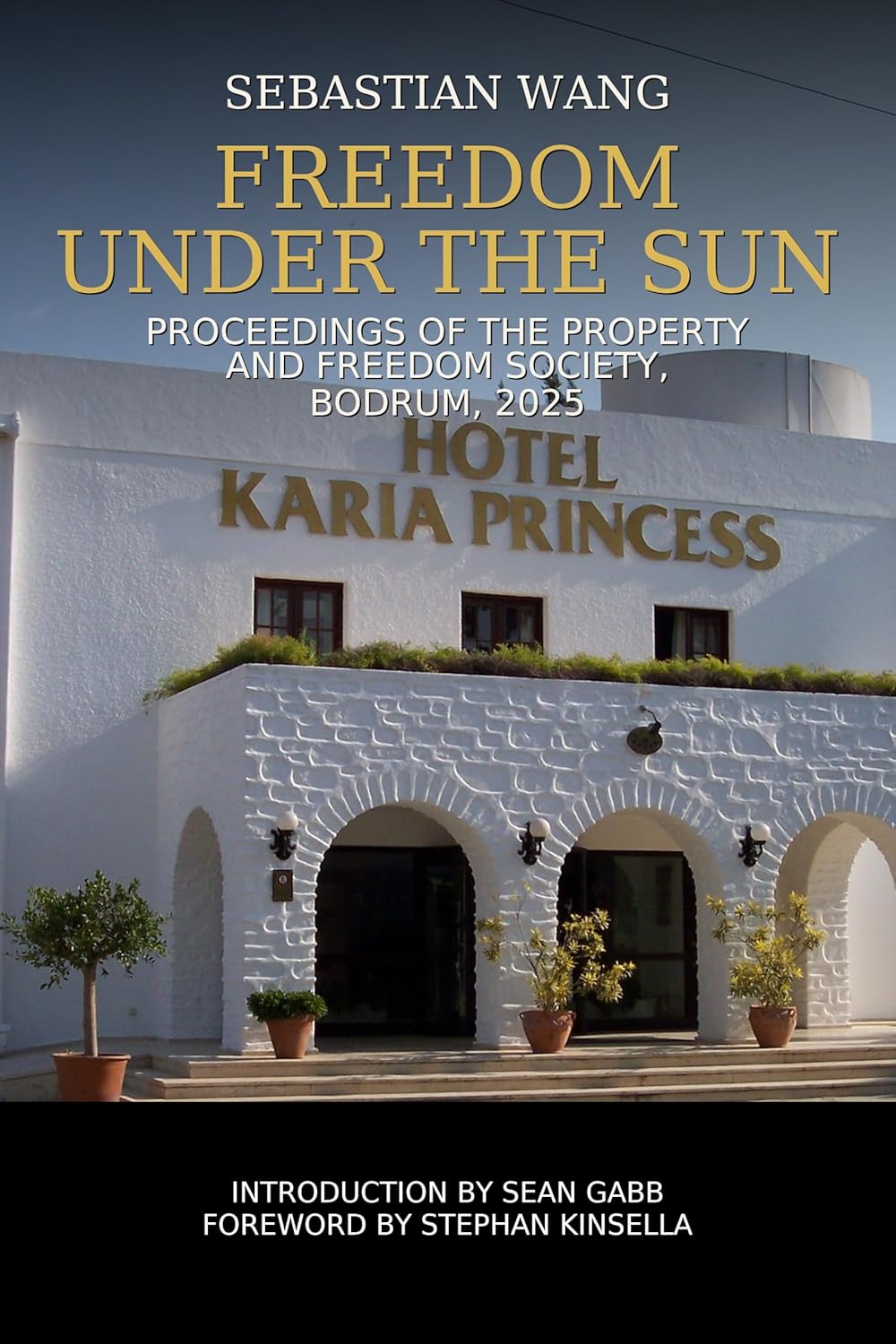
This talk is from the recently-concluded 19th annual PFS 2025 Annual Meeting (Sep. 18–23, 2025, Bodrum, Turkey).
Alessandro Fusillo (Italy): The Pirates of the Caribbean as Forebears of the Libertarians and of the American Revolution [Sebastian Wang, “Pirates, Liberty, and Revolution: Alessandro Fusillo in Bodrum,” Libertarian Alliance [UK] Blog (Sep. 19, 2025)] Shownotes and transcript below.
Other talks appear on the Property and Freedom Podcast. Other videos may also be found at the PFS 2025 Youtube Playlist.
Grok shownotes
PFS Conference Talk: “Pirates of the Caribbean – A Libertarian Perspective”
Hans Gillshin opens with humor about his non-piratical attire and thanks the audience at the Property and Freedom Society (PFS) conference. He frames the talk with St. Augustine’s famous quote (via Cicero) equating kingdoms without justice to large-scale robbery, as recounted in the story of Alexander the Great and a captured pirate.
Historical Context (17th Century)
- The 1648 Treaty of Westphalia births the modern state, ending medieval liberties.
- The Thirty Years’ War introduces mass destruction, secret services, and centralized legislation.
- England’s 1640s Civil War (often overshadowed by later revolutions) features Levellers, religious freedom advocates, and figures like John Lilburne (“Freeborn John”).
- The 1688 Glorious Revolution establishes the Bank of England—model for all future central banks—enabling unlimited war financing via fiat money.
- Enclosure Acts expropriate medieval common lands, creating a rural proletariat, urban migration, and forced impressment into the Royal Navy.
- Displaced English, Scottish, and Irish peasants become the first chattel slaves in the West Indies (7-year terms), predating African slavery.
The Golden Age of Piracy (ca. 1713–1726)
- Post-War of Spanish Succession, mutinies on brutal navy and merchant ships spawn pirate crews.
- Pirates fly the Jolly Roger; merchant crews often force captains to surrender and voluntarily join.
- Pirate justice: captains tried by crew; tyrants executed, fair ones (e.g., Captain Snellgrave) spared.
- Non-pirates set adrift with provisions; violence targeted oppressors, not random cruelty.
- Pirates attack slave ships to free captives—leading to significant Black crew members and even captains.
- British pardon laws and mock “forced enlistment” defenses briefly reduce piracy, but by 1726 most pirates are hanged.
Pirate Governance & Libertalia
- Primary source: A General History of the Pyrates (Captain Charles Johnson, likely Daniel Defoe).
- Notable pirates: Henry Every (romantic treasure legend) and Blackbeard (terror via flaming beard).
- Highlight: French pirate Olivier Misson (possibly fictional) and ex-priest Caraccioli found Libertalia in Madagascar—a libertarian anarchist society based on John Locke’s principles.
- Universal pirate practice: every ship had a signed charter—egalitarian shares (captain 1.5–2×), revocable leadership, and a quartermaster as crew tribune.
- Many crews issued formal declarations of war against all states.
Conclusion
Pirates were not mere criminals but rebels against tyranny, slavery, and state power—early fighters for individual liberty. Gillshin closes to applause, suggesting the talk may reframe popular views of piracy.
Grok/Youtube transcript
Introduction and Thanks
[0:01]
Hans Gillshin, as usual I will start with thanking you for the invitation here at the PFS conference. It’s a great pleasure to be here year after year and a great honor to be invited as a speaker. Hans previously drew my attention to the fact that my attire today is not in line with my topic. I should have sported at least an eye patch or a peg leg or hired a local parrot to have him on my shoulder. But okay, we will do without.
Topic Announcement: Pirates of the Caribbean
[0:37]
Today’s topics are the Pirates of the Caribbean and piracy in general.
St. Augustine’s Quote on Piracy and Empire
[0:45]
I will start with a quote from St. Augustine, a very famous quote that he got from Cicero. It’s a story of Alexander the Great’s fleet navigating through the Mediterranean. They caught a pirate ship and as he was about to execute the pirate as a criminal, the pirate said to Alexander, “What have you in mind? What do you think, trying to rob all people and to seize the other ships? This is completely illegal.” And the pirate answered, “What thou meanest by seizing the whole earth, but because I do it with a petty ship, I am called a robber, whilst thou dost it with a great fleet, art styled an emperor.”
The legend goes—maybe it’s not so much a legend—that Alexander the Great had two possible finales for this story. The first one, the nicer one, is that Alexander the Great was so pleased by the answer that he spared the pirate’s life. The other one is that he executed him nonetheless after having a good laugh at his response. In fact, this story was reminded by the late Pope Benedict XVI to the German Parliament a few years ago because the conclusion of St. Augustine is: justice being taken away, then what are kingdoms but great robberies. And I think this is a very good conclusion, a very libertarian conclusion from one of the fathers of the church.
Shift to Classical Piracy and the Golden Age
[2:38]
But today we won’t speak about ancient piracy but of the, let’s say, the classical piracy—sometimes you hear about the golden age of piracy. And it is the piracy especially of the Caribbean, but not only the Caribbean: the Bahamas Islands, the Caribbean Islands and the whole East African coast, and especially the island of Madagascar, which was one of the base points of the pirates.
Historical Context: The Birth of Modern States
[3:11]
But before we go on to the pirates, I would like to put the story in a general context. And so we go back on land and we go back to the 17th century. The 17th century is, in my opinion, a crucial time of modern history because during the 17th century modern states were born. In fact, the birth date and birth place of the modern states is the Westphalian Treaty of 1648, which ended the Thirty Years’ War and which established a new actor in history, which is the modern state.
Modern states are what we know, and at that time they were just in their infancy, in their beginnings, but still they had already in place things which we will learn to understand during the next centuries: like legislation, like secret services—secret services began in the Thirty Years’ War—like extensive wars. I think the Thirty Years’ War was the first mass war with mass destructions and so on. And it was the end of medieval liberties.
The English Revolution and Loss of Liberties
[4:37]
The country where this loss of medieval liberties was felt the most is for sure Great Britain—England at that time—where in the same years started the great English Revolution of 1644. It is somehow maybe a forgotten revolution because we always speak about the three great revolutions: the American Revolution, the French Revolution and of course the Russian Revolution. But in fact, especially the American Founding Fathers in some way were the heirs to the English Revolution.
Where we have certain themes which will later on—in fact the pirates, as I will tell you, and the American Founding Fathers—I’m speaking especially about the Levellers, about the rebels, about religious freedom. And you have these mythical figures like John Lilburne, Freeborn John, and lots of rebels who for the first time asserted the same ideals of liberty which are our ideals of liberty in a way lots of time before but still this is what they were telling the world. Of course they lost to the beginning of the global financial elites which were born in England during that time.
The Glorious Revolution and the Central Bank
[6:19]
In the roughly 60 years after the first English Revolution you have the second revolution, the so-called Glorious Revolution. I’m not so sure about the glorious but still it brought about a new dynasty and a new ruling elite in England and it brought about something fundamental from our libertarian point of view, namely the institution of the Central Bank of England. The Central Bank of England is the model of all later central banks and it exerted—and maybe it still exerts—a crucial influence on the world, especially by means of war.
Because the big problem of all previous kings and medieval rulers was how to pay for the wars. There’s only a certain point up to which you can rob your citizens; at a certain point they stop, they don’t pay the taxes, you can count on rebellions. And this is the great invention of the central banks: to print fiat money and with this fiat money, with paper, they can just finance any war they want.
Enclosures and the Destruction of Common Lands
[7:34]
The same financial elites who brought about this big change in English power around the world—which set up the British dominance of the world—were the same ones who made a profound change in English agriculture. Sadly enough, this is a field of study which is almost entirely occupied by Marxist scholars and it is the story of the enclosures. But I think this is very important from a libertarian point of view.
Enclosures are the encirclement of big agricultural properties, especially for the raising of cattle, especially sheep for the wool industry, and what this happened through was the eviction of the common lands. Common lands were a medieval model of property which is very far away from the individual property that we consider more or less the only model of property. Because typically a British village of the 16th and 17th century would have small plots of land with maybe a small cottage for one family. The family had maybe a cow, maybe some sheep, chickens and so on. They sold their products and they could use, together with all the other villagers, these common lands which could be used for grazing, which could be used for taking wood, water and so on.
And this was private property, wrongly styled as common property as it is now with state property. It was not state property. It was the property of an individual village, of an individual group of people, regulated by certain rules about the use of these lands. Well, these lands were expropriated—sometimes legally just by buying them, sometimes illegally occupying them, and sometimes with the power of the state behind the occupiers which through the British Parliament made these enclosure acts which basically expropriated the farmers.
Consequences of Enclosures: Proletariat and Impressment
[10:14]
This brought about two changes. First—and this was intended because the idea was to better agriculture, to have more efficient agriculture—and this brought about first a rural proletariat which was used to work now not as independent owners and farmers but to work for the owners of the big lands. Most of these people couldn’t be used and so they both migrated to the big cities, especially to London, where they could be used for the manufacturers which were the forebears of the Industrial Revolution.
And lots of especially young men were impressed by the impressment gangs because the British Empire needed manpower to be on the ships, on the warships, to establish the international dominance in the whole world. And these people were the same ones who had participated in the English Revolution and who had been, let’s say, infected by certain ideals of liberty and who had basically and most of the time no choice than accepting this fate.
The First Chattel Slaves: White Europeans
[11:37]
There were even worse fates because it is common knowledge but not very often disclosed that the first chattel slaves were white people. They were not black people. The first slaves were Scottish people, Irish people and English people because all these people they had no use for. So why not take them as slaves? Sometimes it was time slavery—so 7 years was the usual term—and they were shipped to the so-called West Indies, to Jamaica, to Barbados, to other colonies of the British Empire to work there as slaves.
Later on the British discovered that it was cheaper and easier to buy black slaves, especially from West Africa. But the first slaves were natives of Ireland, Scotland and Britain.
Life Aboard Royal Navy Ships and the Birth of Piracy
[12:36]
These people brought with them the ideas of liberty, especially on the boats, the ships of the British kings where life was horrible and miserable. The captain was a ruler like a god and he could easily decide to inflict death penalty, torture by flogging, by keelhauling—a brutal torture—to the sailors who were less than 100% obedient.
This facilitated the fact that the first pirate ships were born. At a certain point the sailors on the ships understood that they were maybe 100 people, maybe 150 of the crew and they had to overwhelm just a few officers—the captain, the lieutenant, the doctor, maybe the boatswain. And so they had the physical power on their side. And this happened time and again both in military vessels and in commercial vessels. And this is how piracy was born.
The Golden Age of Piracy (1713–1726)
[13:52]
And especially the highlight of the so-called golden age of piracy was in the years after the end of the War of Spanish Succession until 1726 when the British crushed piracy and hanged almost all pirates. But during these years, during roughly 20 years of piracy, the pirates achieved incredible successes—if from their point of view, of course; from the point of view of the British kings and merchants, not so much—because they brought the international commerce of Great Britain almost to a stop. It was close to impossible to sail a vessel from the Caribbean to Europe and vice versa.
Pirate Tactics and the Jolly Roger
[14:52]
And it was very easy for the pirates to overwhelm the ships for a very easy reason. Pirate ships usually flew the black flag, the Jolly Roger, the black flag with a skull on it. And when the other ships saw the pirate ship with the skull, what the sailors usually did is they forced their captains to surrender. They said, “We won’t fight the pirates.” And normally a big chunk of the sailors of the conquered vessels just voluntarily enlisted with the pirates.
Pirate Justice: Trials of Captains
[15:30]
Contrary to a common narrative that describes the pirates as criminals, as robbers, as torturers, this wasn’t in most cases like that. They just took over the ships because the sailors of those ships were on their side. What they did is very interesting because usually their violence came into play when they made trials against the captains.
They examined the sailors of the conquered ships as witnesses and they asked them how they were treated. If they found that the captain was a tyrant—as in many cases—he was executed because he oppressed his own sailors. If he was a good captain—as sometimes happened—there’s a famous case of a Captain Snellgrave who was spared by the pirates because he was a good captain. And usually the ones who didn’t want to enlist with the pirates were left free. They gave them maybe a rowboat, they gave them provisions in water and food, and they left them where they could reach land easily and they could go back to their countries. So it’s a narrative very different from the one that we have of the savage and violent pirates. They were quite humane. Of course, not in all cases.
Freeing Slaves and Multicultural Crews
[17:06]
Another thing that the pirates did regularly on a regular basis was attacking slave ships. Not as you might imagine because they wanted to get the slaves and sell them on the market. No, because they wanted to free the slaves. The first ones who freed the slaves were the pirates.
And this is the reason why there are statistics about this fact. The reason why there is a big percentage of black sailors and even black captains on pirate ships—because most of these people decided to remain with the pirates because the alternative would have been maybe to be captured again and sold in some plantation slave market in Jamaica or somewhere. Of course, the choice to go a-pirating, like they called it, was a choice without way back. This is the reason why the Jolly Roger has a skull on it—because the pirates knew that if they were caught the only solution was to be executed and hanged.
Pardon Laws and the End of the Golden Age
[18:17]
This was a common problem that many British kings tried to solve and in fact they issued pardon laws. And these pardon laws were in part useful to fight piracy because lots of pirates decided to abandon piracy and go to the British authorities and say, “Okay, I stop being a pirate so I will take advantage of the pardon law.”
And this was good for the pirates because if they hid their treasures—you know there are lots of stories about the treasure chest which is hidden somewhere in some tropical islands—they could keep the proceeds of their piracy. And another common trick that they used was to show especially military ships that the pirates had been enlisted by force. So they made a show, a mock of this forceful enlistment. And so the British knew that the ones who were on some pirate ships did it against their will. And this was a common defense in pirate trials. They said, “No, no, I was forced to be a pirate, so I don’t deserve to be hanged.” In fact, most of the pirates were hanged and executed by 1726, which marks the end of the so-called golden age of piracy.
Primary Source: A General History of the Pyrates
[20:01]
There are not many sources about pirate history. The most famous one is A General History of the Pyrates of the mysterious Captain Charles Johnson who, according to some theories, is a pseudonym for Daniel Defoe who is or should be the true author of this book, which is a collection of biographies of famous pirates.
Famous Pirates: Henry Every and Blackbeard
[20:32]
You have the famous ones like Henry Every who supposedly robbed a big ship of the Indian Mughal and became enormously rich and the princess, the daughter of the Mughal who was going to be married in some Arab countries, fell desperately in love with Henry Every, with a pirate, and they eloped and they lived happily ever after. This is one of the nicest stories of pirates.
You have the terrible ones. Maybe the most famous one is Edward Teach, also known as Blackbeard, and he was one of the pirates who exploited in the best way the terrorizing function of the black flag and of the appearance of the pirates. He was called Blackbeard because he had a very long black beard of course. And he used to make braids in his beard and to attach little crackers on the beard and he put them on fire when he attacked the other ships. And so they saw this big man with a cutlass and the pistol and the beard on fire and so they were terrorized and they just surrendered to this appearance.
The Story of Olivier Misson and Libertalia
[21:56]
The most interesting pirate—although I will finish with his story—is a French pirate and according to most scholars about piracy his story is invented. However, Charles Johnson or Daniel Defoe says he is not invented because “I received his memoirs” and so it’s a true story. Of course, in his memoirs he doesn’t reveal his real name and so we don’t know his name, but it’s a very interesting story.
In short, this pirate Olivier Misson was the second son of a wealthy family of lower nobility in France. He didn’t inherit his father’s estate and so he chose a military career on the ships of the French Navy. And during his service on these ships he gets to know an Italian priest, a guy who is called Caraccioli. He knows him in Naples at the port of Naples. And together they go to Rome to visit the seat of Christianity. And Caraccioli is his philosophical mentor, let’s say. And he explains to him: this is all religion is just a way to dominate people and it’s just an instrument of government. The true significance is individual freedom.
This is one of the reasons why Misson’s story is considered to be fake, to be invented—because it’s too good to be true. And they decide to enlist. So Caraccioli throws off his priestly robe and enlists in the French Navy. And after a certain amount of adventures, during a battle with a British ship, all the officers of the French ship are killed by the cannons of the British. Misson takes over command of the ship and they win. The British ship explodes and all the British sailors except one are killed in the explosion of the ammunition on the ship.
And at that point, Misson and Caraccioli ask their sailors, “What do you want to do? We could go back and we will be decorated because we won a big battle, because we sunk a British ship and maybe I will be promoted as a captain or whatever. Or we can decide to choose liberty and become pirates.” And they enthusiastically accept his proposal to become pirates.
Founding Libertalia
[25:02]
And they decide to fly a different flag, not the black flag of the pirates, but a white flag which has “Liberty” written on it. And they are enormously successful pirates. They take Spanish ships and they manage to escape the Caribbean and they land in Madagascar. And in Madagascar they found the dream of us libertarians. They managed to found an actual gulch, a libertarian anarchist city which is governed by principles which are taken from John Locke’s books and which are founded on individual liberty and on respect for private property.
Pirate Constitutions and Democratic Governance
[25:58]
In fact, this is the most interesting thing about all pirate ships. So maybe the story of Misson is a legend, but this is a true and historically proven fact. Any pirate ship had a constitution, a charter which all the sailors decided upon and signed. And usually these charters were quite libertarian because there was absolute respect for private property.
The officers of the ship weren’t that much elevated above the common sailors. Usually the captain took twice a share or 1.5 share in comparison to the sailors. Any captain could be revoked from his office by his sailors easily. And they had a very interesting institution which was the quartermaster. The quartermaster was a pirate institution which resembles the Roman tribunes of the plebs. They were the representatives of the sailors. If the captain was too abusive, he was the representative of the sailors.
And there are lots of stories which are told by Charles Johnson about captains who were deposed by the quartermasters or by the assembly of the sailors. Another very interesting thing which the pirates did on many ships—this happened—they signed a declaration of war against the world, against all states of the world. And Misson did the same and there are lots of documented examples of these declarations of war. They said states are against our liberty. They are destroying our lives and so we declare war against the rest of the world.
And at that time it was possible because if you had a man-of-war with 40 or 50 cannons, you had really power in your hands.
Conclusion: Pirates as Fighters for Freedom
[28:01]
And of course the end of the pirates is a tragical end. They were all hanged. And even Misson, he was defeated and the remains of this mythical anarchist city which was called by the way Libertalia are lost and we don’t know where it is.
And so I think maybe I changed your mind about pirates. They were not criminals but they were fighters for the freedom. Thank you for your attention.
[28:31]
[Music]
[28:32]
[Applause]
Discover more from The Property and Freedom Society
Subscribe to get the latest posts sent to your email.












 Alessandro Fusillo
 Doug French
 Fernando Chiocca
 Greg Morin
 Hans-Hermann Hoppe
 Jay Baykal
 Juan Fernando Carpio
 Martin Cabrera
 Oscar Grau
 PFS
PFS Stephan Kinsella
 Tom DiLorenzo