Unfortunately, there are Austrian-School economists—most of them—and there are pseudo Austrian ones—enough to spoil the whole. It seems that many of that kind can be observed, lately. In France, where I do my best to promote Murray Rothbard’s legacy, we have our share of pseudos. Quite a share, actually. I like to call them “economyths”. Consider.
A few weeks ago, François Facchini published a book with the following title: “Quelle fiscalité pour demain ?”—“What taxation for tomorrow?”1 The tone is already set, isn’t it? As I am sure you had guessed, this book is not meant to explain that “Taxation is Theft”, but rather that taxation is a necessary evil that we can at least try to keep below 100%.
Please realize that Facchini is not a mere blogger like myself. He is an established senior professor at Panthéon Sorbonne–Université Paris I—where his official profile makes explicit reference to the Austrian School. He was also the author, some years ago, of a “L’Ecole autrichienne de A à Z”—“The Austrian School, from A to Z”.2 Thus, he did not bump into the Austrians only lately by accident.
In his defense, some people might object that France is a bit apart from the rest of the world: Indeed, full of leftists, the academic world here doesn’t like Austrians very much; it is almost impossible to climb the hierarchy ladder unless you bend before the Thomas Pikettys and Esther Duflos of this inferno. Mostly true, but reality is not so dark. We have several examples who prove that a bit of courage is not incompatible with a successful career – Guido Hülsmann, Renaud Fillieule3 and Serge Schweitzer4 come to mind.
Before this masterpiece on taxation, our economyth had made even better. In a recent piece,5 I discussed his contribution to the “BARS Curve”, which is a thesis that there would be an optimum point on the curve of the “size of the state”. In a way, this is quite similar in message and spirit to the book mentioned above—no need to underline further its distance from a Rothbardian editing line. The paper I am referring to has this title: “Optimal government size and economic growth in France (1871-2008): An explanation by the State and market failures.”6
At this point, many “moderates” might argue that is a rather thin argument to make a case against our economyth. Be patient, the best is yet to come. Because to articulate his thesis, Facchini explains what method he adopted—here I have two extracts from the papers’ abstracts—my translations, originals below:
1: “To contribute to such broad topics, I have gathered numerous data sets for France over the period from 1870 to 2020 while leveraging two pillars of the neo-institutionalist literature: the Austrian School of Economics and the Public Choice theory”.7
2: “The State’s advantages and costs suggest an optimum size for balance. This optimum size is studied by analyzing the link between public spending and actual GDP in France over the period from 1896 to 2008. Results show a nonlinear cointegration relationship.8
Our timed data on France make up one of the longest period under study ever published. Our empirical conclusions suggest that the State’s optimal size, measured in terms of public spending, was reached when the latter made up some 30% of GDP. Conclusions underline each country’s specifics, suggesting thereby that the State’s optimal size is proper to each country.”
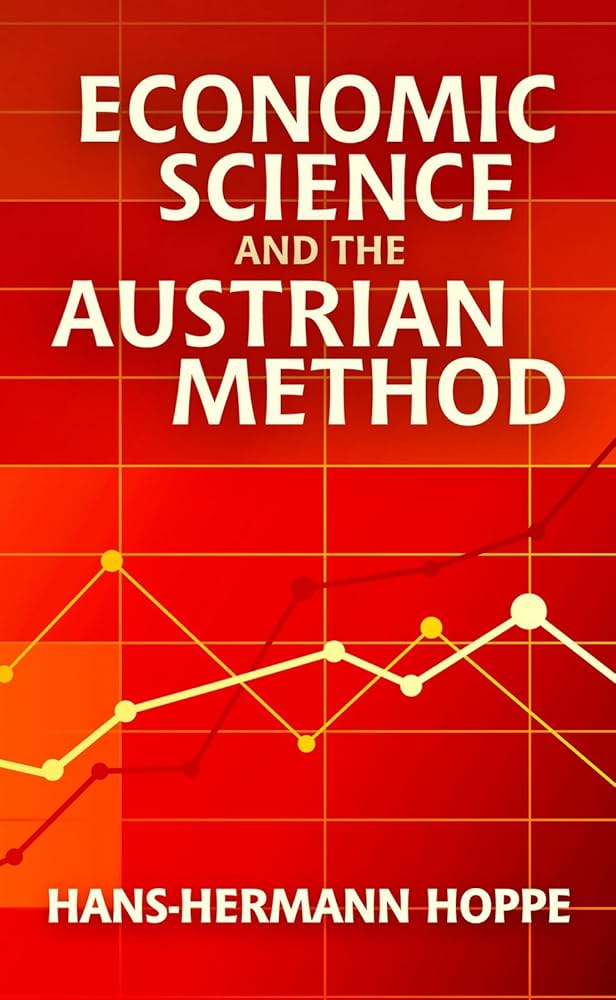
In other words, it is after a painful empirical study over more than a century that Facchini could establish that the optimum size for the State in France is at 30% of GDP. Yet, one of the first lessons I was taught by Mises (Human Action & Theory and History), Rothbard (Man, Economy and State), and Hoppe (Economic Science and Austrian Method) is that economics is a field where only praxeology’s apriorism can lead to sound, scientific results. Another one, from the same sources, was that economics is a field where nothing can be measured and quantified, including the mysterious “GDP.”9 And even before, that the State can only spend what it had previously stolen, making any “optimum” an optimum in crime.
How can anyone serious claim at the same time to be an Austrian and to publish two such mutually contradictory texts? It is a bit like claiming to be a magical mathematician.
I am sure that I will be reminded that his approach is indeed quite smart, in this empiricist world. Because in doing so, Facchini used the Enemy’s arsenal to demonstrate that our government cannot anymore safely claim that increasing public spending is the right thing to do; because he pushes our politicians to come back to 30% only.
But in doing so, he builds on the “Javier Milei Usurpation Movement”: He contributes to associating in uninformed minds the Austrian School to “optimal taxation” and to “taxation is not always theft”, away from Rothbard’s legacy. This certainly does not help the libertarian movement, nor does it help the Austrian School.
In conclusion, I would like to clarify that my objective is not specifically to point at François Facchini. I am rather pointing at all the Facchinis of this world, calling them for some integrity and courage: If they are serious enough about the scientific grounds and consistency of Austrian economics, can they take just as consistent public positions, please? And stop tarnishing economic science…
- Amazon.fr – Quelle fiscalité pour demain?: Décrypter les enjeux des futures réformes – Facchini, François – Livres. [↩]
- L’Ecole Autrichienne de A à Z by F. Facchini et A. Gentier Editeurs | Blurb Books. [↩]
- Renaud Fillieule – Université de Lille. [↩]
- Serge Schweitzer : biographie, travaux et citations cv_schweitzer_complet.pdf. [↩]
- Un coup de BARS et ça repart ? – by Stéphane Geyres. [↩]
- Optimal government size and economic growth in France (1871-2008): An explanation by the State and market failures. [↩]
- « Pour contribuer à ces vastes sujets, j’ai constitué de nombreuses séries pour la France sur la période 1870-2020 et mobilisé deux piliers de la littérature néo-institutionnaliste : l’école autrichienne d’économie et l’école des choix publics. » [↩]
- «Les avantages et les coûts de l’État en suggèrent une taille optimale. Nous étudions cette taille optimale en analysant la relation entre les dépenses publiques et le PIB réel en France pour la période 1896-2008. Les résultats montrent une relation de cointégration non linéaire. Nos données chronologiques sur la France représentent l’une des plus longues périodes étudiées dans la littérature. Nos conclusions empiriques suggèrent que la taille optimale de l’État, mesurée en termes de dépenses publiques, a été atteinte lorsque celles-ci représentaient environ 30 % du PIB. Les conclusions soulignent les particularités de chaque pays, qui suggèrent que la taille optimale de l’État est spécifique à chaque pays.».
Note: A “nonlinear cointegration relationship” qualifies an equilibrium between two quantities on the long term, even if it does not always display as such in the short term. [↩]
- See this Grok summary of Austrian-related/adjacent alternatives to GDP, e.g. Murray Rothbard’s Private Product Remaining (PPR)/Gross Private Product (GPP); Mark Skousen’s Gross Output (GO)/Gross Domestic Output (GDO), Robert Higgs’s Gross Domestic Private Product (GDPP); George Reisman’s Gross National Revenue (GNR). [↩]
Discover more from The Property and Freedom Society
Subscribe to get the latest posts sent to your email.













 Alessandro Fusillo
 Doug French
 Fernando Chiocca
 Greg Morin
 Hans-Hermann Hoppe
 Jay Baykal
 Juan Fernando Carpio
 Martin Cabrera
 Oscar Grau
 PFS
PFS Stephan Kinsella
 Stéphane Geyres
 Tom DiLorenzo