Fernando Chiocca, “How to win the economic debate,” Instituto Rothbard (Jan. 29, 2013), regarding PFS 2012 (PFS 2012 Youtube Playlist; PFS 2012 Annual Meeting—Speakers and Presentations). I was just made aware of this so have added it to our Press & Offsite Material page. The automatic English translation is below.
How to win the economic debate
Put Fernando Chiocca-29/01/2013
 “We won!”
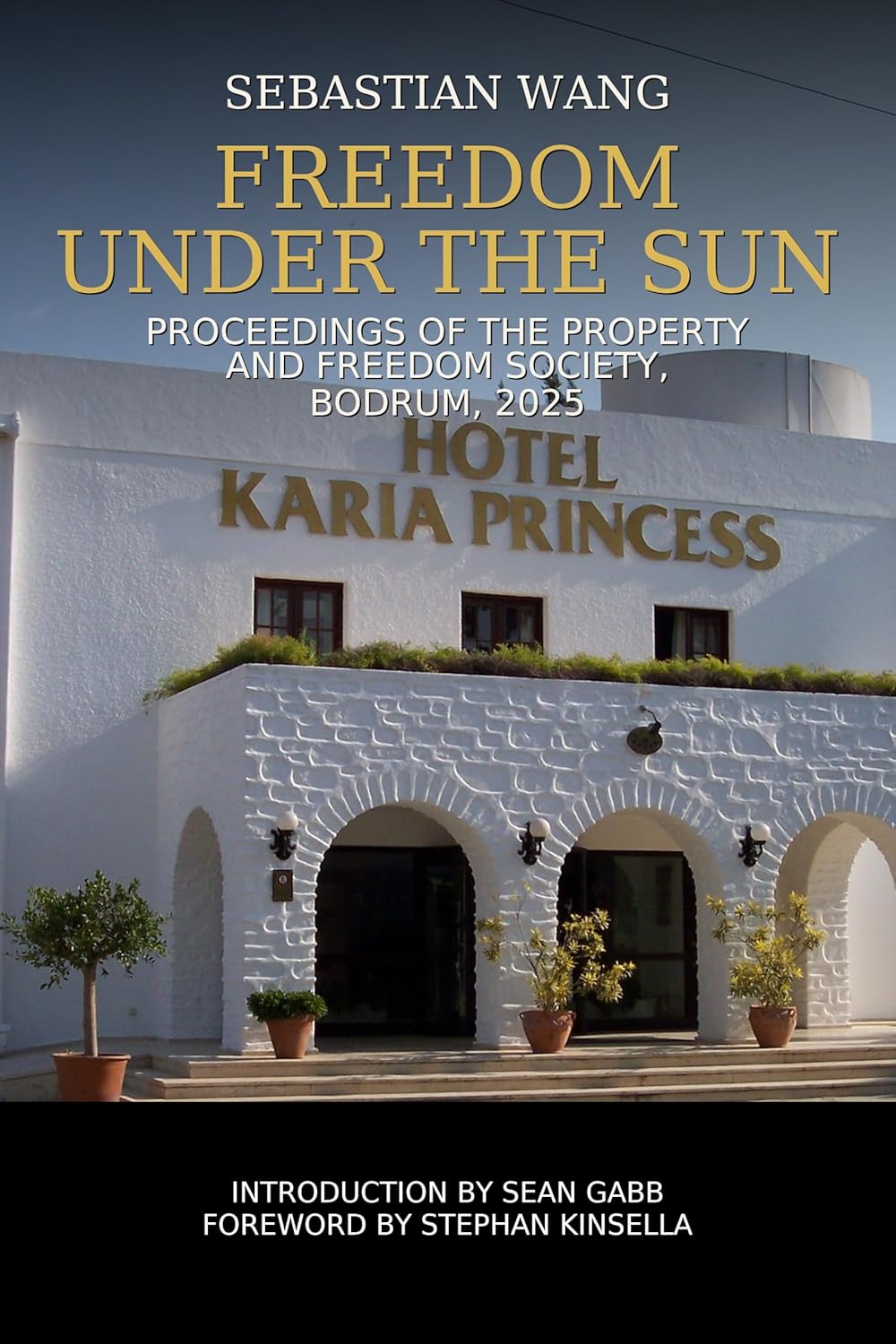
This is how writer and economist Andy Duncan began the opening lecture at the annual meeting of the Property & Freedom Society (PFS), held in September 2012 in Bodrum, Turkey.
In 1912, Ludwig von Mises published his book A Theory of Money and Credit, and in the hundred years that followed, an ideological battle was fought and won by Mises and his followers. Refuting all criticisms made against his methodology while simultaneously making scathing and definitive criticisms against other schools of economic thought, and demonstrating the irrefutable nature of its epistemology, the Austrian School established itself as the only true economic science. However, after witnessing this victory, Duncan mentioned a small problem: with the exception of a few islands of sanity, such as the Mises Institutes scattered around the world, the rest of the world’s population (99.99%) suffers from a massive Stockholm Syndrome, supporting large and terrifying state interventions in the economy and private life, believing devoutly in what is propagated by fallacious economic theories.
Duncan proposed a strategy for how the teachings of the Austrian School and the ideas of liberty could reach a larger audience than the current 0.01%: the use of literature. His friend Jack England wrote what he called the first Rothbardian novel, Sword of Marathon, with the potential to become a Hollywood film. The strategy is to insert the ideas of Mises, Rothbard, Hoppe, etc., into fictional stories, thus reaching an audience that would never read the academic books of these authors. This would only be one means. And to reach a relevant percentage, a percentage that makes effective changes a reality—and I would say that 20 to 30% would be enough—we have to use all possible and imaginable means.
The annual PFS meeting is an exclusive, invitation-only event—and invitations, it is said, are more sought after than the golden ticket to Willy Wonka’s Chocolate Factory—bringing together the greatest minds in the freedom movement worldwide. In addition to speakers like Guido Hülsmann, Jeffrey Tucker, Anthony Daniels, and Thorsten Polleit, the audience, numbering no more than 90 people, also included figures of the caliber of Michael McKay, Detlev Schlichter, and Mark Crovelli. The interaction with the other guests ends up being as valuable as the lectures themselves. Furthermore, at the end of each day, a panel discussion was held where all the day’s speakers answered questions from the audience. The host, Hans-Hermann Hoppe—the leading figure of the Austrian School in our time and founder and president of the PFS—graced us with his presence on two of these panels. Each time he spoke, he made precise and insightful comments, confirming that human genius is reflected in simplicity. And, in answering a question from the audience, together with Professor Salerno, he presented us with another type of strategy: how we should respond to the insanities that dominate all academic and media circles.
The question was originally posed to Salerno, and it mentioned the economist Paul Krugman and the tricks he uses to skillfully exploit the common man’s ignorance of economic theory. The question was how it would be possible to win the economic debate given that Krugman and other conventional economists spread nonsensical economic ideas with easy popular appeal. It is very difficult to correct this lack of sense in the eyes of the general public using rational economic arguments. After all, lies, obfuscation, and simplicity have easy appeal; refuting lies using reason and intelligence is a more laborious approach and very difficult to captivate the general public (minute 34:10).
Salerno referred to Henry Hazlitt’s strategy, which used extremely clear and direct language, illustrating the nonsensical ideas of conventional pro-government economists with everyday examples, thus exposing them as the frauds they were. He concluded by saying that this is what is attempted at the Mises Institute, the PFS, and other pro-free market organizations. That is, to translate and present the ideas of these charlatans in a simple way, because in this way it is easy to see how foolish they are—such as, for example, the idea that pieces of paper can stimulate the economy. For Salerno, what is lacking is more people realizing and doing this. It is essential to spread economic education. And, at this point, it is a matter of quantity, not quality.
Professor Hoppe then took the floor and, with his usual brilliance, added the following:
It is very important that, in these responses to people like Krugman, we do not get bogged down in technical details and, instead, ask questions as if we were practically children:
“Explain to me how increasing the number of pieces of paper can make a society richer.”
“If this can generate more wealth, explain to me how poverty still exists in the world.”
“Aren’t all the central banks in the world capable of printing as much paper as they want?”
“If they do that, do you think society and the world would become richer?”
I’m sure the person can’t answer that kind of question. Nobody can answer that kind of question.
But, again, people often get stuck responding to the technical details of these arguments instead of constantly repeating this simple and direct question: “Please explain to me how a piece of paper can make a society richer.”
In fact, as I reported in the article “Resurrect Orson Welles!“, the insanity of these people has reached the point where their most respected and renowned representative, Paul Krugman—Nobel Prize winner in economics and columnist for The New York Times—stated on national television, with the most brazen face in the world, that if governments allocated all of society’s resources to combat a non-existent alien invasion, the economic crisis would be solved. This is blatant nonsense. Anyone who has read a single essay by Bastiat knows more about economics than the greatest exponent of the mainstream. Or rather, anyone with common sense is already capable of perceiving the insanity of these people. What was lacking after such a statement—and they are made by the hundreds, every day, in every newspaper, magazine, radio and TV program—was people responding to these absurd statements with questions of the type mentioned above: “Explain to me how directing all existing efforts and scarce resources to building a gigantic weapon against non-existent aliens can enrich society.”
We truly live in a Dark Age regarding economic science. Insanity dominates academia and the media, and the harmful consequences are felt by everyone, with the government intervening more and more, generating more and more poverty—or increasingly hindering the creation of new wealth. Every day, tons of nonsensical ideas are dumped not only on radio and television audiences, but also, and especially, on newspaper readers and viewers. Every day, economics students are bombarded with economic insanities, thrown at them by professors who also had these same ideas thrown at them when they were students, and accepted them without question. I believe that most economics professors and commentators are simply repeating the insanities they heard in the past, but it is undeniable that there are those who do so because ideas that empower the state serve their own particular interests. But regardless of the reasons, these ideas can no longer be passively accepted. The type of logical, questioning reaction described above should be followed whenever someone with common sense hears things that make absolutely no sense. If you can’t respond in person, send emails to the media outlet where the nonsense was exposed, call, or send a letter.
During a dinner last week, a young libertarian friend and Austrian School student, Paulo Kogos, heard the following phrase: “Without the BNDES, Brazil wouldn’t grow.” Obviously, he almost choked on this absurd idea, but his reaction didn’t stop there; he also had the “Hoppean reaction” described above. First, he told the person who said this that they didn’t even have basic knowledge of economics, because what they had said made no sense. But the person replied saying that they were an economics professor with a master’s degree from FGV. My friend then asked for more explanations: “You mean that from 1500 until the BNDES emerged during Vargas’ second term, Brazil was a giant jungle with a few caravels and some sugar mills… and then, from there, we evolved from brazilwood and bartering to the current prosperity in a span of a few decades thanks to the BNDES. Is that it?”
The professor’s response was precisely to insert technical details within incomprehensible economic jargon, talking about macroeconomic indicators and sustainable job creation, etc. Kogos insisted on the basic questions: “Tell me more about how you mathematically analyzed the actions of millions of human minds to conclude that credit obtained through theft and fraud and granted centrally is more effective than credit originating from one’s own savings granted according to market forces.”
The professor appealed to an argument from authority, saying that once he had a master’s degree, he would understand. As Hoppe predicted, he couldn’t answer these questions. No one can answer that kind of question.
And as Professor Salerno emphasized, we need more people doing exactly that.












 Alessandro Fusillo
 Doug French
 Fernando Chiocca
 Hans-Hermann Hoppe
 Jay Baykal
 Juan Fernando Carpio
 Martin Cabrera
 Oscar Grau
 PFS
PFS Stephan Kinsella
 Tom DiLorenzo