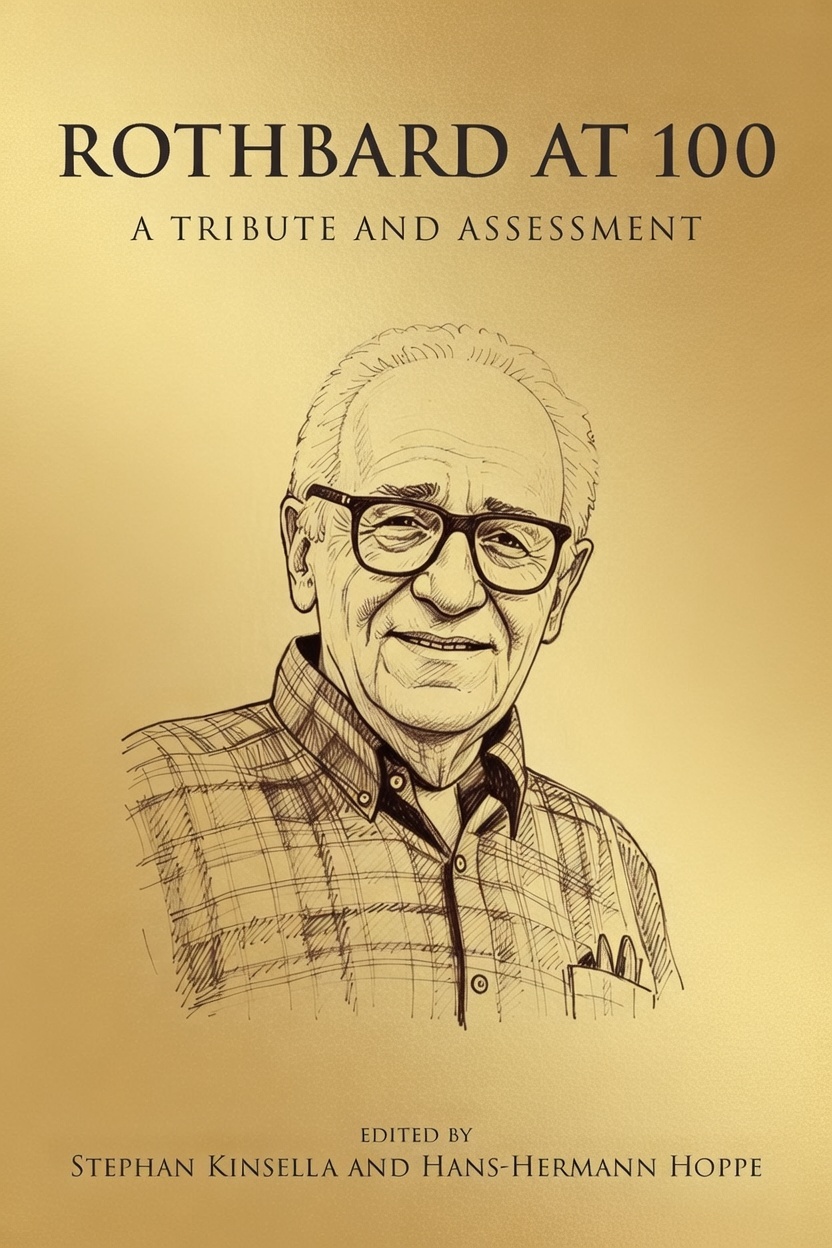
Jeffrey A. Tucker, “Murray N. Rothbard at 100,” Epoch Times (3/2/2026).
(See also Tucker’s “The Murray Rothbard I Knew,” Rothbard at 100: A Tribute and Assessment, Stephan Kinsella and Hans-Hermann Hoppe, eds. (Papinian Press and The Saif House, 2026), also published today).
Reprinted with permission of author.
Murray N. Rothbard at 100

Commentary
My friend Murray N. Rothbard, easily ranked as the leading and most productive libertarian scholar of the second half of the 20th century, would have been 100 years old on March 2. It is said he died too soon and surely those who knew him feel that often. That said, he produced more writing and scholarship in his life than hundreds of other great scholars combined. His library, which will likely never come out in collected works, amounts to a lifetime of reading.
Part of me regrets having to tag him as a “libertarian” scholar because that pregames the experience you will have with reading him. He was a major historian of ideas and events, with a focus on America, and there is no one who cannot learn from him. We are overly acquainted with libertarians who specialize only in shouting bromides, and I can assure you that this was not him. He was a true scholar of the old world but with a twist: his passion for human freedom was his overriding concern. He saw all things through that lens.
To get to know his writing, you can start anywhere. But one way to get a super-fast start is the book “Rothbard from A to Z.” Putting such a collection together is a seemingly impossible job, in part because everything he wrote was quotable. He has this gift for writing because he had a passion to communicate. That means he wrote as clearly as he could, eschewing all the usual academic blather of his generation.
A short list of his important works include “Man, Economy, and State” (1962), “The Panic of 1819: Reactions and Policies” (1962), “America’s Great Depression” (1963), “What Has Government Done to Our Money?” (1963), “Economic Depressions: Their Cause and Cure” (1969), “An Austrian Perspective on the History of Economic Thought” (1995), “The Case Against the Fed” (1994), “Conceived in Liberty” (1975–1979, 2019), “The Betrayal of the American Right” (one version 2007), “For a New Liberty: The Libertarian Manifesto” (1973), “The Ethics of Liberty” (1982) “Anatomy of the State” (1974), “Egalitarianism as a Revolt Against Nature and Other Essays” (1974), “Economic Controversies” (2011, posthumous), “The Irrepressible Rothbard” (2000), “Strictly Confidential: Memos to the Volker Fund” (2011), “The Progressive Era” (2017), plus many thousands of essays. He was also editor of many periodicals and journals.
It’s actually astonishing how much he wrote, all of it with explosive creativity and fire. Too often with such thinkers—people like John Locke or Lord Acton come to mind—there is a tendency to sum up their thoughts in slogans and conclusions. This is deeply unfair because such enormously important intellects need to be understood through biography. This is especially true for Rothbard. He had a passion to both learn from and engage the events of his time, and that led to an evolving position in many areas. Indeed, if all you know is his earliest work in which he mapped out theoretical binaries and taxonomies, you will wholly miss the way these mutated in the course of his studies and writings.
I only encountered him because a professor had one of his books on his bookshelf, I asked about it and he warned me against reading him. “He is an anarchist,” he snarled, a comment which sent me to the library quickly to find his earliest and large treatise on economic principles. It’s a solid book, a worthy successor to J.B. Say’s “Principles” from the 19th century. The main burden of the book was to crush the conventional economics of the time, rooted in the hallucinations of John Maynard Keynes, and replace them with a classical framework heavily informed by the works of Ludwig von Mises whom he admired. Having finished that work, I gained an impression of Rothbard as a towering figure, a forbidding theorist, a dogged and determined pronouncer of truths.
Upon graduation I had the chance to spend time with him. I was stunned to meet a jolly man of short stature with an infectious laugh and infinite curiosity in the ideas of others. Indeed, he was voracious for ideas of all sorts from all disciplines. It was due to circumstances of time and place that we became fast friends. In fact, I starred in the public performance of one of his plays on the occasion of his 60th birthday. We spoke several times a week by phone, and delighted in attending orchestral concerts together in Manhattan.
His death in 1995 was a shock, like my world was suddenly missing a power source, a font of insight and wisdom. My personal sadness was matched by my sudden realization that he was utterly irreplaceable. His students could go on as interpreters and expositors but his dynamism, his radicalism (getting to the root of things), and his astonishing passion for life were gone forever. Those of us who knew him were forever touched nearly with an indelible mark so his spirit survives even now. But the man himself died too young.
In the old days, it sometimes fell to me to be a driver for him at events, making sure he got where he needed to be. This was a challenge because Murray was a persistent night owl. His favorite thing was hanging out until all hours at diners talking with colleagues and students. These meetings would last until 4 a.m. and later and plenty of people gladly gave up their sleep to spend time with him. They were not worshipers; what they wanted was to partake in the energy and adventure of his personality and way of thinking.
I recall many times when he would enter a room, never with a sense of having arrived, but rather with an intense curiosity backed by a wild sense of humor. It was always the case that after not even an hour, he would find himself on a sofa surrounded on all sides, talking up a storm. It’s not that he dominated the conversation with sharp elbows; it was that he possessed an intellectual magnetism that just drew people around him.
He loved challenging people with hard questions. For some reason, I can recall one very late night when I was walking home with him across a long grassy park and he was talking about drunk driving laws. He said they were truly wrong because they criminalize contents of blood rather than actual evidence of bad driving. If someone is endangering others, that should be the crime but not blood alcohol level as such. I was tremendously shocked and, I recall, a bit mortified, and I hoped he would not share this opinion widely. Actually, as it turns out, he had a point. It was always this way with him: his views were alarming at first but common sense once you think about them.
Once, and only once, did I feel his frustration and even anger toward me. I had completed a graduate course in voting systems and was explaining to him that there are no circumstances in which the people can rise up against an entrenched bureaucracy backed by industrial elites who benefit from it. He grimaced and explained that this was nonsense, that ideas rule the world and no power on earth can stop an idea whose time had come. There is always a case for hope and never a case for despair. All these years later, I’ve come around fully to agree.
I tell these personal stories because I’m worried for his legacy. The popular view of him as an opinionated anarchist and libertarian preacher is just a caricature. He never sought to be the author of a dogmatic canon of truth much less an infallible expositor. His was a life of adventure and far-reaching curiosity without limits. That’s the spirit he conveyed in life, even if his writings present a different impression of who he was. I worry that others will make the mistake I made as a 20-year-old and think of him as some kind of totemic oracle that he never sought to be.
Those who knew him wonder constantly what Rothbard would think about this or that event, this or that politician, this or that trend in public life. This is a hopeless undertaking. There will only be one Murray Rothbard and he was his own best interpreter. All the others are merely basking in his achievements. Plus, if you knew Murray, he was very willing to change his mind, such that past opinions were never necessarily predictive of future ones.
What can we say about such giants who lived among us? We should honor them by reading their works, considering their points of view, and learning from them. It was my great fortune to know the man very well and I absorb so much of his desire to chronicle and interpret the world around us as it unfolds, hopefully recreating that fascinating combination of determined principle, intense curiosity, unfailing good humor, and powerful hope in the future of mankind.