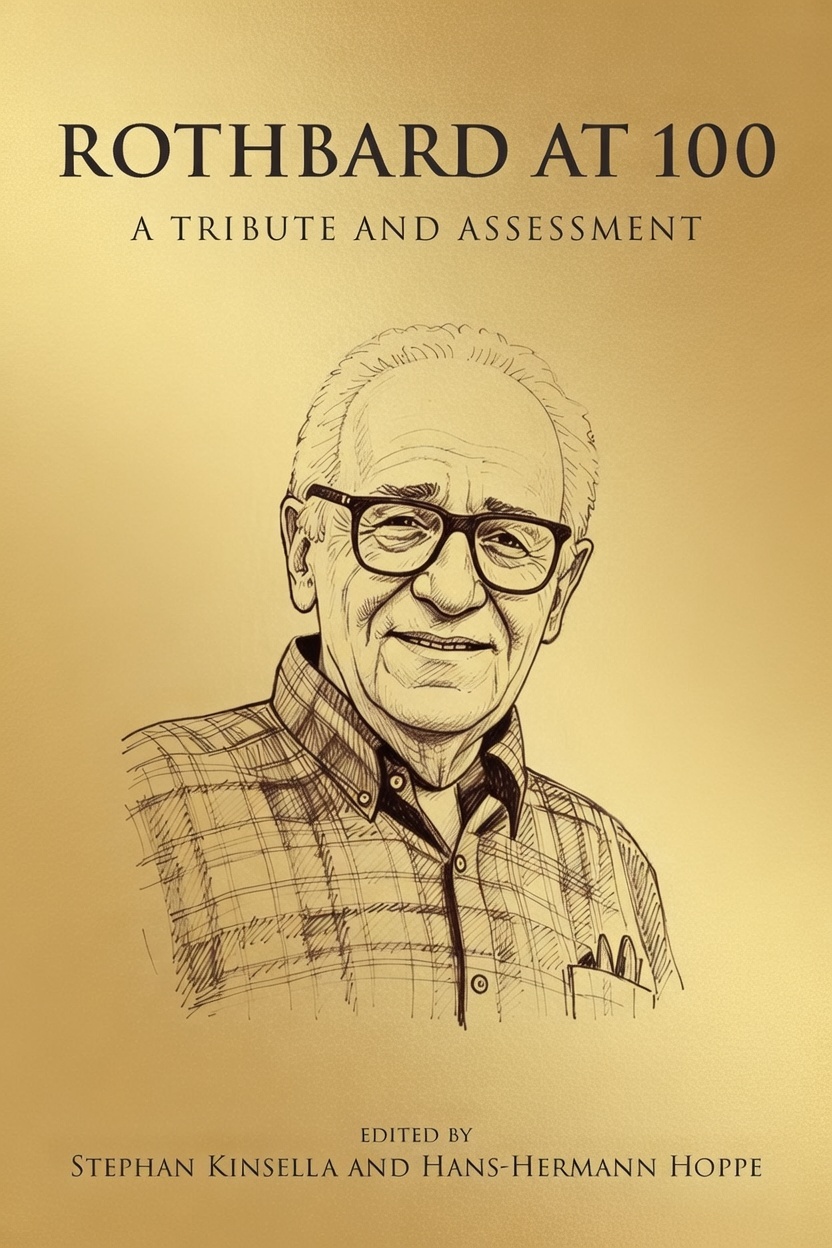
Thorsten Polleit, “Ohne Murray N. Rothbard kein Libertarismus” [“Without Murray N. Rothbard, There Would Be No Libertarianism”], Ludwig von Mises Institut Deutschland [Mises Institute Germany] (March 4, 2026) has published an appreciation of Rothbard and mentioning Rothbard at 100: A Tribute and Assessment (Papinian Press and The Saif House, 2026). Auto-translate below:

Without Murray N. Rothbard, there would be no libertarianism.
March 4, 2026 — by Thorsten Polleit
March 2, 2026, marked the 100th birthday of Murray N. Rothbard. He was born in New York City to Jewish immigrants from Eastern Europe. By his own account, he grew up in a left-leaning, intellectual Jewish environment, but showed an early aversion to socialism and collectivism—influenced in part by his father. Rothbard studied mathematics and economics at Columbia University, earning his bachelor’s degree in 1945 and his doctorate in 1956 with his dissertation, “The Panic of 1819: Reactions and Policies.” However, the decisive factor in Rothbard’s intellectual development was undoubtedly his encounter with Ludwig von Mises (1881—1973) beginning in 1949. Rothbard regularly attended Mises’s seminar at New York University and became Mises’s most important American student. Rothbard’s intellectual successor, Hans Hermann Hoppe, described his teacher as a genius. Rightly so, if one considers Rothbard’s extremely extensive and wide-ranging work—which encompasses economic theory and history, political philosophy, social philosophy, ethics and political history.
Rothbard stands in direct lineage to Ludwig von Mises primarily because he not only followed Mises’s scientific method, namely the logic of human action (praxeology), but also applied it unwaveringly and fearlessly, with all its epistemological (extreme) consequences, to the fields of knowledge he studied. The linchpin of action-logical thinking is the proposition “Man acts.” It cannot be denied without contradiction; it is true, it holds a priori. And starting from this irrefutable insight, Rothbard, like Mises before him, built his entire scientific work. And he did so courageously and undauntedly, against all resistance and adversity.
Like Mises before him, Rothbard boldly opposed the prevailing (and still prevailing) dogma in mainstream economics: the historical method of science, which is positivist-empiricist (oriented towards falsifiability) and which Rothbard rejected as unsuitable for the social and economic sciences. And this is certainly one of the decisive reasons why Rothbard was unable to achieve a truly great career within academia, why the reception of his work remained comparatively limited during his lifetime, and why he did not receive the appreciation and academic recognition that he undoubtedly deserved.
Rothbard, an exceptional intellectual figure, dedicated himself to many different fields of knowledge, making numerous new contributions to understanding. Below is a brief (and certainly not exhaustive) overview:
Economic theory
With “Man, Economy, and State” (1962), Rothbard not only presented a textbook on Mises’ Human Action (1949), but also a comprehensive, more detailed presentation of the theoretical framework of economics, consistently based on considerations of the logic of action.
As early as 1956, Rothbard developed a rigorous reconstruction of welfare economics in “Toward a Reconstruction of Utility and Welfare Economics.” He demonstrated that interpersonal utility comparisons are impossible and that government interventions can never be “welfare-enhancing.” Furthermore, Rothbard integrated Frank A. Fetter’s (1863—1949) rent theory into Austrian capital theory, refuted the idea of monopoly prices in free markets, and presented a detailed analysis of entrepreneurship, emphasizing the entrepreneur’s role as a carrier of uncertainty, a “capital allocator,” and a mediator of knowledge (beyond prices, complementing Hayek’s work).
In “What Has Government Done To Our Money?” (1963), Rothbard demonstrates why and how governments have replaced commodity money with their own fiat currency. And in “The Mystery of Banking” (1983), he exposes the entire fraudulent structure of today’s fiat money system. Consequently, Rothbard calls for the abolition of the central bank, elaborated upon in his book “The Case Against the Fed” (1994), coupled with instructions for pegging the US dollar back to gold.
Political Philosophy
Mises accepted a minimal state for police, courts, and defense (e.g., in Liberalism (1927) and Economics (1940)). Rothbard, on the other hand, rejected any state, viewing it as an aggressive bandit that violates the principle of non-aggression. In For a New Liberty (1973) and The Ethics of Liberty (1982), Rothbard argued that all state functions (security, justice, defense) could and should be provided privately and through the market—for example, by insurance companies, private arbitration tribunals, and security firms. This was the crucial radicalization: Mises criticized interventionism, Rothbard the state itself. And not to be forgotten: Rothbard presented a sharp critique of democracy in “Power and Market: Government and the Economy” (1970) (which Hans Hermann Hoppe then completed and finalized in “Democracy. The God That Failed” (2001)).
Ethics of Freedom
Mises’ liberalism was utilitarian and value-free—he rationalized freedom as useful for prosperity, but without considering ethical or moral factors. Rothbard developed an objective, natural law ethic based on self-ownership and the original appropriation of resources not yet claimed by others. In “The Ethics of Liberty” (1982), he derives from this a complete libertarian legal system—including children’s rights, freedom of contract, and the rejection of compulsory levies as theft.
History
Rothbard extensively engaged with the interpretation of historical episodes, adopting a revisionist perspective that stemmed from his considerations of the logic of action. He even wrote monumental revisionist works, such as “Conceived in Liberty” (1979, four volumes), a libertarian view of the American colonial period and revolution, portrayed as a struggle against centralism. Another example is “A History of Money and Banking in the United States: The Colonial Era to World War II,” an interpretation of the development of the monetary system in the USA, government interventions, and the resulting crises. Particularly noteworthy is Rothbard’s “An Austrian Perspective on the History of Economic Thought” (two volumes, published posthumously in 1995): a comprehensive critique and reinterpretation of economic history from an Austrian perspective (for example, a sharp rejection of Adam Smith as a plagiarist and a relapse into labor theory thinking; or the (re)discovery of the Spanish Scholastics as “proto-“Austrians”).
Rothbard was not merely a theorist in an ivory tower; he was also a man of action, politically active, building think tanks, forging coalitions, publishing newsletters, and supporting political candidates. His activity was always radically anti-statist, yet simultaneously pragmatic and strategic. Rothbard wanted not only to intellectually penetrate libertarianism down to the last detail and teach it, but also to implement it socially—often through unconventional alliances. And so Rothbard built the modern libertarian movement in America. He was, for example, a co-founder of the Libertarian Party (1971).
In light of current world events, Rothbard’s libertarian reflections on war should also be mentioned: Rothbard did not see war as a necessary evil, but rather as the ultimate means for the state to destroy individual freedom and strengthen itself. He made a strict distinction between genuine defense (legitimate) and wars of aggression (always criminal). He judged almost every modern war (especially interventionist wars waged by the United States) as illegitimate and aggressive, as a tool for the oppression of citizens.
Rothbard taught for many years at Brooklyn Polytechnic Institute (from the 1960s to the 1980s) in New York and, from 1986, as Distinguished Professor of Economics at the University of Nevada, Las Vegas (UNLV). At the Ludwig von Mises Institute in Auburn, Alabama (USA), founded in 1982 by Llewellyn H. Rockwell Jr., Rothbard served as Vice President for Academic Affairs and was its central intellectual figure. Rothbard was and remained the intellectual driving force and public face of the Institute until his death in 1995.
One can speculate here: Without Mises, there would probably have been no Rothbard, and without Rothbard, there would be no libertarianism today—that is, the rigorous, action-logically derived and justified doctrine of freedom. In any case, Rothbard bequeathed an invaluable legacy to posterity: Thanks to Rothbard, we know (and with apodictic certainty, we know it a priori) how a world, how a community of people, must organize itself so that it can flourish peacefully and productively, both nationally and internationally. Rothbard’s works are not academic pipe dreams. Rather, the insights they contain are a concrete guide and encouragement for all who want to bring peace and prosperity to humanity.
On the 100th anniversary of Rothbard’s birth, Hans Hermann Hoppe and Stephan Kinsella published a highly readable collection of essays in which the authors share their personal memories of Rothbard, but also engage with the content of Rothbard’s works. Anyone looking for a quick, firsthand introduction to Rothbard’s life and work will find it here.
The libertarian philosopher and senior fellow at the Ludwig von Mises Institute, David Gordon, once told me that Rothbard, his intellectual mentor, “knew everything about everything.” And in the same breath, David quoted from Shakespeare’s Hamlet: “I shall not look upon his like again.” Anyone who has gained even a basic understanding of Rothbard’s work will already have a sense of how apt both of David Gordon’s statements are.

Professor Dr. Thorsten Polleit worked as an economist for 15 years in international investment banking and subsequently for 12 years in the international precious metals trading business. Since 2014, he has also been an honorary professor of economics at the University of Bayreuth. Thorsten Polleit is an Adjunct Scholar at the Mises Institute, Auburn, Alabama, a member of the research network “ROME,” and President of the Ludwig von Mises Institute Germany. In 2012, he received the OP Alford III Prize in Political Economy. Thorsten Polleit is the author of numerous articles in peer-reviewed journals, magazines, and newspapers. His latest books are: “The Devil’s Money: The Faustian Fiat Money Pact—How We Can Terminate It and Return to Good Money” (October 2023), “The Global Currency Plot: How the Deep State Will Betray Your Freedom, and How to Prevent It” (2023), “Ludwig von Mises: The Uncompromising Liberal” (2022), and “The Path to Truth: A Critique of Economic Reason” (2022). Since April 2024, he has been publishing Dr. Polleit’s BOOM & BUST REPORT. Follow Thorsten Polleit on Twitter here.