AI-assisted audio narration of the main chapters of is available at this PFS
Various members of the Libertarian Party of Switzerland and others held a Live Stream in honor of Rothbard on his birthday, March 20, 2026, including Martin Hartmann (Libertarian Party of Switzerland), Thomas Jacob (Witness at Mises University, Switzerland), Matthias Hummels (Board Member, Libertarian Party of Germany), and Andreas Tank (Translator of some of Rothbard’s works). This was held on Tank’s channel, Der rosarote Panzer, which, according to one of the commenters, is is one of the top libertarian channels in the German-speaking world.
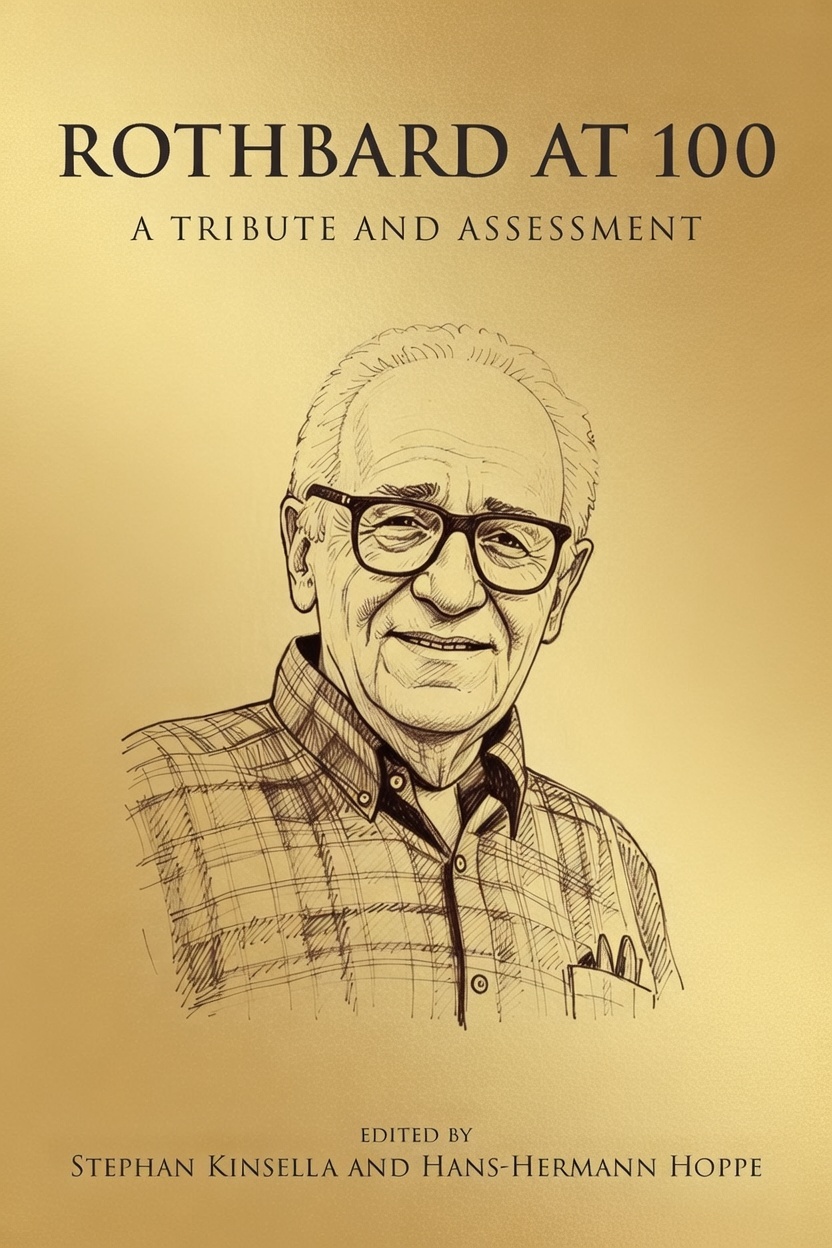
The live stream included a reading, by Tank, of Hans-Hermann Hoppe’s “Introduction” to Rothbard at 100: A Tribute and Assessment (Papinian Press and The Saif House, 2026) (from about 21:00 – 1:07:27). Tank’s German translation of Hoppe Introduction is available at Einleitung: German translation of “Introduction” to Rothbard at 100.
Tank’s shownotes:
Streamed live on March 2, 2026. A live stream in honor of Murray Rothbard’s 100th birthday.
Schedule:
8:00 PM Welcome by Martin Hartmann (Libertarian Party of Switzerland)
8:05 PM Thomas Jacob (Witness at Mises University, Switzerland)
8:25 PM Matthias Hummels (Board Member, Libertarian Party of Germany)
8:45 PM Andreas Tank (Translator of some of Rothbard’s works)
9:05 PM Q&A Approximately
9:30 PM End
The transcript (translated into English) and detailed shownotes are provided below.
Concise Shownotes (Grok)
Shownotes / Concise Summary
This 1-hour-37-minute live stream (March 2, 2026) celebrates Murray Rothbard’s 100th birthday with talks from Andreas Tank (host, rosaroter Panzer), Martin Hartmann (Libertarian Party of Switzerland), and Thomas Jacob (longtime Swiss libertarian and Mises University attendee). Thomas Jacob provides a detailed biographical and intellectual portrait of Rothbard—his radical anarcho-capitalism versus minarchist contemporaries, conversion story, optimism, humor, prolific output, institution-building role (Mises Institute, LP), and key recommendations (Man, Economy, and State, Power and Market, Hoppe’s Theory of Socialism and Capitalism). Andreas Tank shares his own graphical simplifications of Rothbardian ideas (non-aggression principle, state-as-mafia, stateless “Outbox Planet” thought experiment), plays Rothbard’s 1949 anarchism-conversion clip, and reads Hans-Hermann Hoppe’s tribute essay (original English text inserted), which praises Rothbard’s genius while critiquing his marginalization, anti-war stance, views on Israel/neocons, and incompatibility with Milei’s Trump/Netanyahu associations.
The stream closes with brief Q&A on money/denationalization/private security, Mises Institute internal developments, and optimistic remarks on libertarian networking today versus pre-internet isolation, urging viewers to read Rothbard, attend events, and “become ungovernable.”
Detailed Shownotes (Grok)
Shownotes: Live Stream in Honor of Murray Rothbard’s 100th Birthday
YouTube Link: https://www.youtube.com/live/nCjuktyDYak
Streamed live: March 2, 2026
Duration: ≈1 hour 37 minutes
Hosts/Participants: Andreas Tank (rosaroter Panzer – main host), Martin Hartmann (Libertarian Party of Switzerland), Thomas Jacob (contemporary witness, Mises University attendee), Matthias Hummels (pre-recorded message from Libertarian Party of Germany)
0:00 – 1:34
Opening & Welcome – Going Live
Andreas Tank welcomes viewers, introduces the stream as a celebration of Murray Rothbard’s 100th birthday, greets the panel (Martin Hartmann, Thomas Jacob), and hands over to Martin Hartmann for the formal introduction.
1:34 – 4:31
Welcoming Remarks & Event Schedule
Martin Hartmann thanks the organizers and participants, explains the joint Swiss-German libertarian collaboration, introduces Andreas Tank and Thomas Jacob, notes Matthias Hummels’ absence, outlines the schedule (Thomas Jacob’s talk followed by Andreas Tank), and praises Andreas’ memes and translation work.
4:31 – 31:00
Thomas Jacob’s Main Presentation: Rothbard’s Life, Thought, and Place in History
Thomas Jacob thanks Martin, jokes about his age, expresses gratitude to viewers and organizers.
He places Rothbard in 20th-century libertarian thought (comparing Mises, Hayek, Rand, Friedman), highlights Rothbard’s radical anarchism vs. others’ minarchism, shares the 1982 Zurich keynote discovery, and outlines the Austrian School lineage (Menger → Mises → Hayek/Rothbard/Hoppe).
Biographical overview: born 1926 in Bronx, Jewish immigrant family, father’s pro-American values, prodigy at Columbia, conversion via Mises’ Human Action, academic marginalization until age 40, institution-building (Cato, IHS, Mises Institute, LP), personal traits (night owl, optimist, humorous, urban, anti-nature), wife’s anecdotes, daily calls with Lew Rockwell.
Literature recommendations: Mises’ Human Action, Rothbard’s Man, Economy, and State + Power and Market, Hoppe’s A Theory of Socialism and Capitalism.
Personal path: from Objectivism (1980) to Rothbardianism after 1990 Mises University meeting Rothbard & Hoppe; emphasizes friendships and networks built through libertarian events.
31:00 – 33:50
Transition & Appreciation of Thomas Jacob
Andreas thanks Thomas, clarifies Rothbard’s anarchism via the 1949 logical-inconsistency anecdote, recommends Power and Market, praises pre-internet libertarians, confirms Thomas is attending the Nepal conference, and plays Matthias Hummels’ pre-recorded message.
33:50 – 35:00
Pre-recorded Message from Matthias Hummels
Short clip from Matthias Hummels (Libertarian Party of Germany): libertarianism is not mere contemplation but a call to action to abolish the leviathan state worldwide through voluntary cooperation and markets.
35:00 – 1:07:27
Andreas Tank’s Segment & Reading of Hoppe/Kinsella Tribute
Andreas praises Rothbard’s clarity, humor, optimism; quotes famous lines (state as criminal band/legalized mafia); presents his meme-style simplifications (ZEP, Outbox Planet stateless society thought experiment); plays Rothbard’s 2-minute 1949 conversion clip and comments on its logic.
Announces new book Rothbard at 100 (cover features Thomas Jacob’s photo with Rothbard).
Reads full German translation of Hans-Hermann Hoppe’s introduction (“Rothbard at 100: A Tribute and Assessment” by Stephan Kinsella & Hans-Hermann Hoppe).
The content covers:
- Rothbard’s interdisciplinary genius (economics, philosophy, sociology, history, universal history)
- Marginalization due to uncompromising anarchism and anti-war stance
- Contrast with Mises/minarchism
- Rejection of neoconservatism, interventionism, U.S.–Israel policy
- Views on Judaism, Talmud, Israel as socialist/apartheid state
- Critique of Milei’s association with Trump/Netanyahu/Zelenskyy as incompatible with Rothbardianism
(Original English text used here for fidelity; Andreas narrated his German translation of this exact essay.)
1:07:27 – 1:37:34
Q&A, Discussion of Recent Developments & Closing Remarks
Thomas Jacob responds to Milei critique: not deeply informed, prefers no strong opinion outside expertise; reaffirms Rothbard’s anti-interventionism.
Andreas discusses libertarian consistency, private security (recommends Molinari, Janich, David Friedman’s Machinery of Freedom), Mises Institute changes (DiLorenzo departure, Milei influence, resignations by Hülsmann/Puster/Hoppe from German institute).
Chat questions answered:
- Banking quote refuted as Chartalist/state theory of money nonsense (contrast Menger)
- Rothbard on denationalization of money (agreed with Hayek’s core idea, critiqued some details)
- Private security approaches already in Power and Market
Andreas praises Hoppe’s rigor, warns against excusing statism via “lesser evil” logic.
Closing: Andreas thanks everyone; Thomas reflects on pre-internet isolation vs. today’s networked optimism, urges positivity in Rothbard’s spirit.
Andreas final call: attend libertarian events (“vacation for the brain”), read Rothbard, become ungovernable.
End of Stream
Key Themes: Rothbard’s radical anarcho-capitalism, life/optimism, Austrian School context, anti-war/anti-interventionism, critique of modern libertarian-adjacent figures (Milei/Trump), importance of intellectual consistency, hope for libertarian revival.
Transcript in English (Youtube/Grok)
Full English-Translated Transcript
Live Stream in Honor of Murray Rothbard’s 100th Birthday
Original Source: https://www.youtube.com/live/nCjuktyDYak
Streamed live: March 2, 2026
(Note: All spoken content is translated from the original German audio. For the long section where Andreas Tank reads his German translation of Hans-Hermann Hoppe’s introduction, the original English text from the source book—available at https://propertyandfreedom.org/books/rothbard-100/hoppe-introduction/—is inserted verbatim below, as it represents the precise content Tank was narrating in translation. The rest of the transcript remains a direct, complete English rendering of the spoken German without summarization or omission.)
0:00 – 0:50
Opening – Going Live
Speaker: Andreas Tank (rosaroter Panzer – Host)
And we are live and thus a warm welcome to the stream in honor of Murray Rothbard’s 100th birthday.
And we have with us today Martin Hartmann from the Libertarian Party of Switzerland. We have Thomas Jacob, a contemporary witness who personally met Mises at the Mises University, and I am the rosarote Panzer. You all know me, this is my channel, and thus a wonderful good evening. Moin to the round. Taxes are theft, stay ungovernable. Good evening and greetings to Switzerland.
0:50 – 1:34
Handover to Martin Hartmann
Speaker: Andreas Tank
And with that I would like to let Martin Hartmann do the introduction right away, so that he can briefly present what will confront us this evening and say a few words about Murray Rothbard. He wanted to speak for about 5 minutes and after that we come to the presentation by Thomas Jacob.
And with that, Martin, the stage is yours.
1:34 – 3:30
Welcoming Remarks & Schedule
Speaker: Martin Hartmann (President, Libertarian Party of Switzerland)
Thank you. I will even try to do it in only 2 minutes. Um, many thanks for the opportunity that we can do this event together here. As said, my name is Martin Hartmann. I am President of the Libertarian Party in Switzerland and we have managed to set up this joint event here with the Libertarians also in Germany. Uh and many thanks also to you Andreas and to you Thomas, that you are also here.
Um the whole thing was actually even planned with Matthias Hummels from the Libertarians in Germany. Unfortunately he cannot be here today. The schedule is as follows. Uh first Thomas Jacob will say something about Rothbard and after that we go over to Andreas Tank, the rosarote Panzer. And yes, what can one say about the people? Andreas I actually don’t need to introduce any longer, one knows him anyway. Meme Lord covers the entire libertarian thinking in the form of funny memes that stimulate thinking. Very valuable contribution and of course also all the books that you have already translated, where I have already bought a few or even received some for free. Very good. Thank you very much for this commitment. And there I would like to continue directly to Thomas.
3:30 – 4:31
Praise for Thomas Jacob & Introduction to His Talk
Speaker: Martin Hartmann
Thomas Jacob, I like to call him one of the first libertarians in Switzerland. Thomas Jacob was already libertarian in the 70s and dealt with it. He also had the opportunity to meet Murray Rothbard personally. He will surely highlight that and he is also a personal friend of Hans-Hermann Hoppe and is involved with the Property and Freedom Society in Bodrum. Also an event that is very recommendable. Uh one sees uh various threads come together here. It is very nice that uh the Austrian economists, the Austrian School, that they are experiencing a revival, that we uh also uh due to uh uh political developments, that people are again a bit knowing what libertarian is or at least more people are interested again in what libertarian is. And therefore we want to remember Murray Rothbard today. Murray Rothbard was born 100 years ago today. He is one of the great and formative minds in uh in the Austrian School. I myself also hold him in high regard. Unfortunately have not yet read all his books, but the more Andreas translates, the more I will also read from him.
4:31 – 5:00
Handover to Thomas Jacob
Speaker: Martin Hartmann
And with that I actually do not want to continue any further and not become any longer. I would like to hand over the floor to you. Thomas uh you have as said already met Murray Rothbard and we are excited about your remarks.
5:00 – 8:05
Thomas Jacob Begins – Personal Thanks & Introduction
Speaker: Thomas Jacob
Thank you dear Martin. Now we can do a quiz, guess my age or [laughter] I don’t know how you do it, Martin organize such an event on short notice. Job family felt 100 comments on WhatsApp per day plus other things. So chapeau and heartfelt thanks and thanks also to all today’s and future viewers, as it is so nicely called, the guests make the celebration and I was already allowed to present Rothbard at the Liberty Summer School of the Liberal Institute and it is every time with the preparation the same. So I deal with him, there I immerse myself in the endless fascination of the biography, the theory and in the end I have mild stress, that I will never do justice to the abundance of the preciousness. In the end I simply hope that my enthusiasm for the for the for the topic can infect you and stimulate to deepened study.
8:05 – 31:00
Main Presentation: Placing Rothbard in Economic Thought, Biography, Personal Traits & Recommendations
Speaker: Thomas Jacob
First I would now like to place Rothbard very roughly in the world and the history of ideas of economics. for those who don’t know him at all. And uh yes, that is of course also a personal uh assessment of it and with that we would jump directly to the first slide. Let’s see that I get the whole thing technically Oh, here in the grip. Exactly. Here five great libertarian thinkers of the 20th century clearly Mises Friedrich August von Hayek ein Rand Murray Rothbard Milton Friedman, four men one woman, four Jews and Friedrich von Hayek the Catholic three immigrants, two Americans, two Nobel Prize winners and three outsiders. The most cultural isolation they reaped. That would of course be Rand, Rothbard and Mises. And another exciting detail. Mises Hayek Friedman all became over 90 and with the most radical Rand Rothbard died clearly earlier. Rothbard not even with 70. Moment, there I have now already not even with 70. It starts, so one could think, radicalism has its price. Mises Hayek and Friedman were classical liberal state-skeptical, but not state-hostile. Rand went further and wanted a minimal state and Rothbard was the only anarchist and demanded not the taming, but the abolition of the state and uh uncompromising to the end.
And in this context I made an exciting discovery yesterday and namely this uh and namely uh I would like to show something uh from a YouTube video. the keynote speech of Rothbard 1982 to the first conference of the libertarian international of the Liberty International, so world conference of the international libertarians and since this was recorded precisely in Zurich and that is a that is a late plaster for me. I was already libertarian in 1982, but back then a Rand follower without contacts, without organization and without internet one had almost no possibility to learn about it, but of course it interests me today still. And it is by the way one of the rare moments in which Rothbard made long journeys at all. Uh he traveled reluctantly, had fear of means of transport from subway to airplane. He moved relatively little anyway, always went to the nearest restaurant in Las Vegas to eat and that is probably with a possible reason for his rather early demise, but the video is really a great pleasure has many clever thoughts on the organization of libertarian movements and above all on the role and priorities of libertarian parties.
Uh now Rothbard is uncompromising in the rejection of the state, in political practice however astonishingly differentiated. He explains that here in this video. More I don’t want to say and keep the tension high. And quite new this organization Libertarian International, that still exists today and the next world conference beginning of August in Nepal you may gladly accompany me, if you want now Rothbard’s place within economics I like to present very very simplified so. We have a first milestone, surely Adam Smith and then relatively early the Marxists, who used economics for the state, so for state justification or controlled economy and the classics, who were relatively long until into the 20s, 30s uh more an uh explanatory science than a political science, that only changed really with Keynes and with uh with the monetarists and then the Austrian School also receded into the background for a while.
So the Austrian School surely for very little state and Rothbard would then still right over the edge, namely no state interventions at all and here the five giants of the Austrian School, so surely the founder Carl Menger 1871, then the greatest probably Ludwig von Mises and uh a bit in the background Hayek then Rothbard and Hoppe in the tradition of Menger Mises Menger and Mises and Hayek in the background that there is sometimes also discussions is he an Austrian, he was after all until into the 30s in the wake of Ludwig von Mises has also researched and published in the same school in the same way and then also received the Nobel Prize for his works in the spirit of Ludwig von Mises and but had there it gave then later had drifted more into sociology, into history and political philosophy so to speak, that he today also in social-democratic circles partially more acceptable is than Murray Rothbard and therefore there are also these two institutes Mises Institute then the Hayekians e.g. in the Mercatus Center or also the Hayek Clubs and the Mises Clubs now in the German-speaking world is there uh I sense little animosity, but it is then of course also an exciting topic. That simply very very roughly for the classification of these uh great uh liberal libertarians.
Um, then we can go back. I don’t need the presentation at the moment. Yes. Exactly. A few biographical data. Murray Rothbard, as said, born 100 years ago in New York in the Bronx in a milieu of Eastern European Jewish immigrants. That was strongly communist project. Rothbard himself said, he grew up in a communist culture. The big question among his relatives was, whether they want to register with the communists and commit their lives to communism or whether they just selfishly only sympathizers and followers want to remain. And the only exception was the father David, who consciously committed himself to American values. Minimal state free markets, private property advancement from own achievement as Rothbard grew up essentially in the spirit of his father. was a highly gifted student, skipped classes, began at 16 at Columbia University and had with 20 years precisely a mathematics master’s already then went into economics and decisive impulses were given there by lectures of George Stigler at New York University and then there via Friedman he finally came to Ludwig von Mises, Ludwig von Mises 1949 41 with Human Action, that the Bible, the Austrian Bible quasi, that the Bible of Austrian school economics was for Rothbard a revelation. He became regular guest at Mises’ legendary seminar in New York University and arrived there to convince that anarcho-capitalism was the logical consequence of economic thinking there I come back later with a small pearl on how and when that exactly happened now academically Rothbard remained excluded for a long time is with 40 receives the first permanent professorship nevertheless wrote tirelessly books articles reviews with enormous discipline and in the 70s and 80s Rothbard was decisively involved in the building of libertarian institutions among others Cato Institute for Human Studies and finally the Ludwig von Mises Institute and of course the Libertarian Party of America, so at the latest from the 70s one can say, there was no greater influence on the libertarian movement than Murray Rothbard.
And now the biographical personal remarks there from his wife, that is really, what I 100% can confirm. She has said as far as I could judge at all, after one week. She said, her husband was a happy person, a cheerful and serene personality been, a night owl. He has managed 40 years long his livelihood to earn without having to get up in the morning. That was important to him and Rothbard began every day with a telephone conversation with his colleague Lew Rockwell, whereby quote: “fits of laughter shook the house or the apartment, when they called each other for Murray was this best way the day to begin.” And Rothbard firmly believed in the reason of man, was therefore an unshakable optimist. confirm also those people with really incredible incredible predictions and hopes from Rothbard more or less seriously each then given to the best and he liked good food and vodka martinis and was an expressed night person as said technically remained consciously old-fashioned computer rejected but worked with typewriter telephone fax and copier and if we hold that before eyes, then the quantity and the quality of his works become much more incredible still.
And uh another detail uh Rothbard was a through and through urban person born and grown up in New York. Nature meant for him danger as recreation. He understood himself as culture person. His motto was: “Where nature is, civilization should be.” He was extremely fast, possessed enormous knowledge and showed real interest in almost all topics. And to that came his humor and his comedic talent. Uh, if I once again back to the Mises Rothbard Hoppe um the trio um the trio gang come perhaps also with that so I don’t forget, literature tips not the as said the the Bible is Human Action by Ludwig von Mises, he has there the and and Human Action was after a review by Rothbard that that it demands a lifelong study. So it is it is a book about everything, how how he once expressed it, so philosophy history and economics and Rothbard then extracted the economic part in his magnum opus, that is the book Man Economy and State 1962 already also 1000 pages an extract, but he has the economics really on a uh in really on the detail broken down the logic of action the the the free market in the first thousand pages exhaustively described. So, if you want to do an economics study in one book, then I can recommend that. Is absolutely accessible to read and very very recommendable. And the that is the the free market description is the most. Then there was still the logic of interventions, Power and Market. That was a book, that comes a third part, that came a bit later out. Uh there with that you are really top equipped, theoretically for a foundation. And if that is too much for you, then I would recommend the third in the alliance the book Theory of Socialism and Capitalism, the first popular book by Hans-Hermann Hoppe also exists in German. and he then makes a synthesis and uh and shows shows logically concise uh why any state intervention not only to impoverishment, but also to moral degeneration of every society must lead. Uh no matter with what fig leaf in what form the interventions come. And he presents there also his logical uh arguments for freedom to the argumentation of freedom, the so-called argumentation ethics. So those are the three my three literature recommendations.
Now perhaps still to the personal personal significance of Rothbard for me. So my path to libertarianism began 1980, so not yet in the 70s years. So so bad is it then yet not. 1980 with Ayn Rand, I was a so-called Objectivist, as they call themselves and intellectually of course quite isolated. I say often exaggerated in the 80s years I knew in Switzerland exactly two libertarians not from me what we, that we today have a libertarian party, that I would never have dreamed back then. Now 1990 led me a series of coincidences to the Mises University after Stanford and there I met not only the most important professors of the Austrian School, s above all also Murray Rothbard. There I have my claim to fame the photo with Rothbard exactly. And Hans-Hermann Hoppe left with as said with Hans-Hermann Hoppe I am since then friends disclaimer. At the end of this week I was convinced Rothbardian and very happy. because especially Hoppe and Rothbard have answered me the most important open questions, that remained and plagued me in the study and plagued have.
Now besides Hoppe arose a second significant friendship for me from this single from a single week a a long-year friendship and there I would like simply to illustrate for you perhaps interesting once to think about, because libertarian organizations clubs, party and events are often more than intellectual networks because finally meet there people with same values like freedom and self-responsibility and common values are the best basis. is for sustainable friendships and therefore I am also all people thankful, who selflessly for such internal such organizations Mises Institute, liberal Institute and also the libertarian party engage.
31:00 – 33:50
Transition & Short Pre-recorded Message
Speakers: Andreas Tank & Martin Hartmann (brief comments)
Andreas: Thank you, dear Thomas. I found that a really great, very exciting contribution.
I just want to clarify for people who may not have fully followed what you explained in the two-minute clip from Rothbard… Leftists sat down with Murray Rothbard and said: “We get together and establish a judiciary, a legal system, and police – and you think that’s somehow right.” Then they said to him: “But why can’t people get together and establish a state electricity company or a junkyard or whatever – if the majority agrees?” And Rothbard realized: “Oh, that’s completely correct logic.” Because the state forbids and excludes others from doing the same.
That’s exactly Power and Market – the third volume of Man, Economy, and State. If you don’t want the full economics but want to jump straight in to how intervention works, just read Power and Market. Worth it.
It’s always great to have real old hands here who’ve been at this for decades – long before the internet – and to meet people like you at events. You mentioned the Libertarian World Conference in Nepal – are you going this year?
Thomas: Yes, yes. [laughter] Okay, lots of tradition with these visits.
Andreas: So we’ll come back together later with Martin to answer questions. For now I’ll say goodbye to you, Thomas, and push myself into the spotlight a bit. [laughter] Thank you for your contribution.
There was a bit of internal back-and-forth about Matthias Hummels, but that wasn’t really his fault – just a scheduling conflict that went badly. So now I’ll play a short one-minute clip sent by the Libertarians in Germany, and after that I’ll give you a little personal bit.
33:50 – 35:00
Pre-recorded Greeting from Matthias Hummels
Speaker: Matthias Hummels (Board Member, Libertarian Party of Germany – video clip)
Because for us libertarians, libertarianism is not the intellectual contemplation of a wonderful true and just political philosophy. It is not just the aesthetic contemplation of a beautiful ideal – the ideal of a world without organized aggression, a world of harmony, of freedom, of prosperity, of mutual cooperation through voluntary activities and markets.
It is of course all of that. We become libertarians in the first place because we fall in love, so to speak, with the goodness, truth, and beauty of libertarianism. But we libertarians are not content with contemplating justice, contemplating truth, goodness, and beauty. We are not playing intellectual games. We mean to change the world. We want to put this thing into reality. We are setting out on the noblest task of abolishing the leviathan state in each of our countries and ultimately throughout the world. And in order to do that, in order to put liberty into practice…
35:00 – 1:07:27
Andreas Tank’s Segment & Reading of Hoppe’s Introduction
Speaker: Andreas Tank (rosaroter Panzer)
Yes, I find those inspiring words from Murray Rothbard and I intend to hold myself to them.
Murray Rothbard is certainly one of the most dazzling, inspiring personalities the libertarian scene has ever seen. He died in 1995. I was born in 1988 – so I was 7 years old when Rothbard passed away. Naturally I know him only through his works, books, and here and there the poorly filmed clips with his very strong New Yorker accent. That’s why I sometimes struggle to understand him acoustically, and his writing style is actually quite difficult to translate.
Quick answer to the question: Human Action or better start with Rothbard or with Hoppe?
I see it somewhat as: Do you want to become an expert in economics or do you want to go far beyond economics?
In principle I would say Man, Economy, and State (three volumes – “Man, Economy, and State” in German) is basically everything you need. After that you are an expert in a great many areas – if you read, learn, and study it actively. I did that. I had already read Human Action in English before. I find Rothbard partly easier to understand than Mises. Mises jumps a bit back in time and deals little with social philosophy, sociology, or political science. That is Rothbard’s territory. Mises is a rather pure economist.
That makes it more accessible; it makes it easier for Hayek Clubs in many respects to propagate the ideas, because Mises is not so controversial that he rejects the entire concept of the state.
But many people are already libertarian anarchists by gut feeling anyway – as Thomas already said – and therefore, if you are already an anarchist by head and gut, then start with Rothbard. You don’t need to begin with Mises first, because Human Action – if you read it in German – is very voluminous. You will need a very long time.
Today at noon Hans-Hermann Hoppe sent me an email. On hanshoppe.com, stephankinsella.com, and propertyandfreedom.org, Hans-Hermann Hoppe and Stephan Kinsella – in cooperation with many other confidants (some of whom I have already spoken with, e.g. Alessandro Fusillo, but also other well-known figures such as Saif) – published a special book for Rothbard’s 100th birthday.
The nice or funny thing is that the photo of Thomas with Murray Rothbard that you saw earlier was used as the cover image. I think it is the sharpest picture of Murray Rothbard I have ever seen, because in 1995 cameras were not yet that good.
The introduction to the book by Hoppe about Rothbard I will now read aloud. I translated it this afternoon and spontaneously thought: instead of boring you with my own thoughts, I’ll give you Hoppe’s words – who surely knows best how to put it. After all, Hoppe was Rothbard’s closest and most personal friend and companion for over ten years – first in New York and later at the university in Las Vegas.
Anyone interested in the more personal story and anecdotes can listen to “Growing Up with Murray” as chapter five in Libertarianism Properly Understood as an audiobook on my channel. It’s the fifth and final chapter in the Hörbücher playlist.
[Andreas Tank reads his German translation of the following original English text by Hans-Hermann Hoppe:]
When Gülşen and I opened the gates of the Princess Hotel for the first Property and Freedom Society conference in May 2006, many organizational and substantive questions were still unresolved in our minds. It took years of experimentation and learning, of defining, refining, and optimizing the product that today is the Property and Freedom Society and its annual salon. Despite all the changes that have taken place during the last twenty years of its existence, however, the PFS has remained true to its commitment to what is still known today as Austro-Libertarianism. That social philosophy that in the twentieth century was developed and represented above all by Murray Rothbard. In the following chapter I have described my personal relationship to Rothbard during the last decade of his life from 1985 to 1995 in New York City and Las Vegas. Here it suffices to say that from Rothbard’s personal example I learned first-hand what was later to become the ethos and trademark of the PFS: uncompromising and interdisciplinary intellectual radicalism. The fearless pursuit of truth, justice, and beauty.
Today, on March 2, 2026, Rothbard would have celebrated his 100th birthday. Given his status as one of the patron saints of the PFS we considered it appropriate, indeed our duty, to honor this great man and his work with a small book published by former students, colleagues, and members of the PFS who are intimately familiar with his work. In the following chapter I have described Rothbard as the greatest of all social theorists, certainly of the twentieth century. In our age of instant fame and fifteen minutes of celebrity this claim may perhaps require some explanation, but it can be easily supplied. As an economist by trade Rothbard ranks only behind his own teacher Ludwig von Mises, arguably the greatest economist of all times. But Rothbard is no mere economist. In stark contrast to some contemporary competitors and upstarts who now claim his mantle, Rothbard’s voluminous work spans the entire field of the social sciences. He ranks among the most prominent political philosophers of the twentieth century and even ventures into the field of epistemology. As a sociologist he has made a major contribution in the tradition of Gaetano Mosca, Vilfredo Pareto, and Robert Michels to the exploration and analysis of power elites. As a historian Rothbard is one of the leading experts on colonial America as well as on U.S. economic and financial history. Not least, with his last, unfortunately unfinished work, his two volumes on the history of economic thought, Rothbard has established himself not only as a master of intellectual history but also more generally as an important representative of the intellectual genre of universal history.
Finally, Rothbard succeeded in integrating and systematizing all of this. His broad, interdisciplinary research program within one grand narrative of human history as an eternal and continuous struggle between power and market, exploitation and production, aggression and coercion versus freedom and independence. Naturally a man who had something to say about almost everything is also an easy target for the all-too-familiar type of intellectual nitpicker. The type who becomes obsessed or even angry about one particular statement or remark of a person and consequently rejects and condemns everything that person has said or done. Rothbard had his fair share of such know-it-all critics who dismiss him without having the slightest idea of his voluminous intellectual work or being familiar with it. And most likely also without the intellectual ability to actually understand it even if they had tried. Fortunately, however, Rothbard also has a growing worldwide community of fans and friends, readers, students, and scholars from a variety of intellectual fields and with different backgrounds who follow in his footsteps and try to preserve, re-present, popularize, refine, improve, and expand the Austro-Libertarian edifice he bequeathed to us. The present book presents only a small selection of such persons.
Of course there have also been serious critics and criticisms of Rothbard and his work, even among the contributors to this little book. Mises, for instance, his own revered teacher, defended the classical liberal model of the minimal state against Rothbard’s anarchism. Rothbard’s and Mises’ pure time preference theory of interest has been critically questioned as have some aspects of his contract theory and his views on intellectual property and copyrights. Also the topics of abortion and children’s rights have remained controversial. Some critics have held his treatment of Adam Smith to be overly negative. I have criticized Rothbard for his overly unfavorable treatment of the feudal Middle Ages and his comparatively mild criticism of democracy. But these criticisms, including those of Mises, were essentially friendly meant. None of them should detract from Rothbard’s greatness or diminish his outstanding intellectual stature and standing.
Yet to this day Rothbard has never received the public recognition due to one of the great geniuses of the twentieth century. I must speculate a bit, but it is not too difficult to find plausible or even obvious explanations and reasons for this phenomenon. Rothbard is an anarchist and no muddled leftist, no socialist or syndicalist anarchist à la Noam Chomsky who dreams of collective ownership and a social order without hierarchies. Rather, Rothbard is a hard-core right anarchist, an advocate of anarcho-capitalism, i.e., of a private-law society that is based directly on the institution of private property and its acquisition through original appropriation (homesteading) and cultivation or voluntary contracts and a society characterized by division of labor and natural social hierarchies.
Obviously, from the outset he stands in complete opposition to the almost universally shared secular religion of our time, statism. That is, the belief in the necessity and the beneficial function of the institution of a state as territorial monopoly of force. More precisely, without a state there is no public tax-financed education system, no public schools and no public universities. Where would today’s hordes of so-called intellectuals, especially in the fields of education, journalism, social sciences, and humanities find secure employment? Most could and would not and therefore most intellectuals would probably strictly oppose such an idea. As Upton Sinclair noted, it is difficult to get a man to understand something when his salary depends on his not understanding it. Moreover, without a state there would also be no central banks with the monopoly of issuing fiat currencies. Yet central banks and institutions such as the International Monetary Fund, the World Bank, and the Bank for International Settlements are the largest employers of economists in today’s world. It is therefore only natural that in particular economists are mostly hostile to Rothbard’s ideas. Without a tax-financed state and a central bank there may be armed militias, but no standing army and no military-industrial complex promoting international conflicts and wars. Therefore powerful industries as well as all chauvinists, warmongers, and imperialists are opposed to the idea of anarchy and a private-law society as envisioned by Rothbard.
And here lies the ultimate and yet least discussed reason for his public disregard and lack of academic recognition: Rothbard’s strict and unwavering rejection of war, of the military-industrial complex, of the warfare state, and of U.S. interventionist foreign policy. Jews make up no more than 2 to 3 percent of the U.S. population. But as everyone there knows and should not say, U.S. academia and mainstream media and much more, as we shall see, are dominated by mostly secular Jews. Rothbard too was a secular Jew. As a German, a man of his caliber, regardless of his views, his anarchism, his racism—he reviewed The Bell Curve by Richard Herrnstein and Charles Murray as well as Race, Evolution and Behavior by J. Philippe Rushton positively or whatever—owing to the enormous influence and the exceptional but also unspeakable solidarity within his faith community would nevertheless have risen to the highest ranks of the academic world. That this did not happen in his case and he was instead persona non grata in large parts of polite society had two closely related reasons: Rothbard’s views on Judaism and on Israel.
Although Rothbard was an agnostic, he was very interested in the history and sociology of religion and regarded Judaism, especially rabbinic Judaism as laid down in the Talmud, as a primitive tribal religion. In stark contrast to modern Jewish apologists and in strong agreement with Israel Shahak’s revisionist Jewish History, Jewish Religion: The Weight of Three Thousand Years, Rothbard regarded Judaism as a particularistic, ethnocentric, and oppressive doctrine according to which Jewish life was considered by nature superior and more valuable than that of non-Jews or goyim. Notably, Jesus is described in the Talmud exclusively negatively as an illegitimate bastard of an adulteress, as a sorcerer and criminal heretic who was sentenced to be boiled in his own excrement. Accordingly, it is simply nonsense, a fundamental distortion of history and a sign of ignorance when one ritually speaks nowadays of Judaism–Christianity as the intellectual foundation of the West and of so-called Western values. In fact, in contrast to the open hostility toward Christianity expressed in the Talmud, the much-maligned Koran is rather friendly toward Jesus and the Virgin Mary.
When Rothbard was asked which religion he would adopt if forced to do so, he answered Catholicism as the most decidedly universalistic religion. As for Israel, Rothbard’s views likewise contradicted common opinion or better public indoctrination. Israel is not only a state but a socialist state without any private property in land. All land is owned by the Israel Land Authority or the Jewish National Fund. Rather, Israel, unlike what is usual nowadays, is a state that did not arise endogenously from a native population but is the result of a violent foreign conquest, expropriation, expulsion, and murder of a native population by foreign invaders and occupiers. With the support of Great Britain and the U.S., Jews from all over the world, especially those of Zionist conviction, were to move to Palestine, expel the native mostly Arab population by terrorist means, and establish a Jewish state in 1948.
Moreover, Israel as a Jewish state has practiced from the beginning and to this day a strict apartheid regime in accordance with the aforementioned Jewish superiority claim, in which every non-Jew can only be a second-class citizen and is persecuted and continues to pursue an aggressive expansionist foreign policy at the expense of its allegedly inferior neighbors in order to restore modern Israel to its dreamed-of ancient glory and territorial generosity. The justification offered for this, the early persecution of Jews in Germany and Eastern Europe, Rothbard considered phony. On the one hand, because by no means all Jews assembled in Israel had been victims, and on the other hand, because the native Palestinian population that suffered then as now under Jewish invasion and occupation had nothing to do with earlier crimes against Jews elsewhere. They were innocent in this respect and therefore owed them no reparations.
Taken by themselves these two claims may not quite fit the officially recognized mainstream opinion on this subject, but they are hardly scandalous. What made Rothbard persona non grata in establishment circles and caused a scandal was the combination of both claims and the hint that U.S. foreign policy has increasingly come under the influence of the so-called neoconservatives or neocons such as Irving Kristol and Norman Podhoretz and their followers. The neocons, mostly of Jewish origin and often former leftists, especially of the Trotskyist variety, who had turned conservative in reaction to the violent excesses of the so-called civil rights movement and the legislation of the 1960s, represented the exact opposite of the old traditional American Right. The old Right, Rothbard’s intellectual home, stood for decentralization at home, advocated strict non-interventionist foreign policy, and warned against any entanglements and alliances with foreign countries. In stark contrast, the neoconservatives, who increasingly dominated U.S. foreign policy under Republican as well as Democratic administrations, supported not only a powerful centralized welfare state at home but in particular also an interventionist foreign policy based on U.S. military strength and motivated by imperial ambitions. In order to make the world safe for liberal democracy, the U.S. as an exceptional nation should be established and installed as the dominant world power with all necessary means, be they military, financial, or economic.
And Israel in particular was to play a central role in these plans of the neocons. Neocon meant in Western parlance Zionist and Zionism. Israel was considered their most valuable strategic and moral ally. The only bastion of Western civilization in the Near and Middle East, surrounded by mostly hostile, backward, and primitive Arab and Muslim neighbors. Accordingly, Israel deserved, whatever it did or does, the unconditional support of the all-powerful U.S. It received and continues to receive billions in U.S. military aid year after year and enjoys the closest possible cooperation and support from U.S. intelligence agencies and authorities. Whether Egypt, Jordan, Lebanon, Syria, Iraq, Libya, Iran, or Yemen, whoever stood or stands in the way of Israel’s expansionist and oppressive ambitions and was or is considered an enemy of Israel is at the same time also an enemy of the U.S. and therefore requires to this day the constant interference and intervention of the U.S. in the affairs of the Near and Middle East.
Rothbard was a vehement critic of the neoconservative and interventionist U.S. foreign policy in general. It was immoral, an economic waste, and a constant source of international conflicts and tensions instead of peace. But he was particularly critical and outspoken about the Zionist and Israel First policy promoted by the neoconservatives. For what the neocons ultimately wanted and have largely achieved to this day was that the interests of the U.S. be subordinated to the interests of Israel. That is, that the U.S. should consult Israel and ask for its approval in all foreign policy decisions. Rothbard considered this state of affairs monstrous, one of his favorite words in this context. Given the origin and situation of the state of Israel and its character as an explicitly and exclusively Jewish state, so Rothbard predicted, the Near and Middle East would become a powder keg, a permanent danger zone marked and destroyed by endless conflicts and wars, and in particular the U.S. would increasingly become the greatest war machine in the world and the greatest threat to world peace.
With this prediction Rothbard was of course correct and what is even clearer today than twenty years ago at the time of his death. For the most powerful of all lobbies in the U.S., the Jewish lobby, prominently represented for example by the American Israel Public Affairs Committee (AIPAC), the American Jewish Committee (AJC), or the Anti-Defamation League (ADL), Rothbard’s criticism and his demands for a withdrawal and disengagement of the U.S. from Israel constituted the ultimate betrayal and the sin of anti-Semitism. If one could not completely silence the man, one should ignore him or talk him down. And that is exactly what they did. And it was above all they, the neoconservatives and the Jewish lobby, who denied Rothbard the intellectual fame he deserved.
Newsflash. Since the election of Javier Milei as President of Argentina in 2023, Rothbard’s name has also been frequently mentioned in some mainstream media. The reason: Milei philosophically professed anarcho-capitalism and repeatedly cited Rothbard as his most important source of inspiration. Many self-proclaimed libertarians, especially in the Spanish-speaking world, celebrated this as a great breakthrough for our ideas. This requires a brief critical comment, because Rothbard’s resurrection through Milei is at best a double-edged sword and will likely cause serious damage to the libertarian movement in the long run. In any case, it is a gross misrepresentation and distortion of the true Rothbard.
Certainly Milei has read some of Rothbard, but his knowledge of Rothbard’s works is rather limited and superficial. He has also introduced some economic, market-oriented reforms in Argentina inspired by the Austrians, but he has done nothing truly radical that would deserve the praise of an anarcho-capitalist. He has not closed the central bank as originally promised, and there is no indication that this will happen in the near future. He has reduced consumer price inflation from 300% to about 30%. Wow. But the money supply of all monetary aggregates continues to grow rapidly, even more strongly than under some of his predecessors. He has centralized rather than decentralized government power and is notoriously a principled opponent of secession. In addition to taking over rather than rejecting, as Rothbard would have recommended, the existing state debts to the IMF of about 40 billion U.S. dollars, he burdened the Argentine people with another 42 billion U.S. dollars in debt that he took on from the IMF, the World Bank, and the Inter-American Development Bank. To avoid insolvency shortly before the Argentine midterm elections in October 2025, he demanded another bailout package of around 20 billion U.S. dollars from his dear friend Donald Trump.
With the appearance of Donald Trump, a completely new and different Milei now emerges, who is usually ignored or ridiculed by his libertarian fans who adore him. Trump may have heard the name Rothbard by chance, but he has certainly never read a word of his. In fact, it is doubtful whether Trump has ever read a serious book in his life and as regards economics in particular he must rather be regarded as basically uneducated. Government spending, especially for the military and so-called national security measures, and government debt have risen under his leadership. He is a convinced protectionist, as his erratic and punitive tariff policy shows, and in general pursues an economic policy that has more in common with the interventionist policy as practiced under fascism or National Socialism than with anything resembling a free market economy.
More importantly in the present context is that Trump is the most passionate Zionist and Israel Firster of all previous U.S. presidents while at the same time claiming the mantle of America Firster for himself. Never before has Israel received more military and financial aid and support than under Trump. even while they were committing unspeakable atrocities in the Gaza Strip and the West Bank. Benjamin Netanyahu, Israel’s Prime Minister, a war criminal first class, a man who has no scruples about admitting his own genocidal intentions toward the Palestinian population, comparing them to the Amalekites to be defeated and exterminated in the Old Testament and the Torah, is Trump’s best friend and always welcome guest in the White House or in Mar-a-Lago. In the name of Israel and on the advice or order of Netanyahu, Trump even wages direct war against Iran and Yemen, both of which pose no threat whatsoever to the U.S. And as if that were not enough as regards entanglement in foreign affairs and as an unmistakable sign of Trump’s own megalomania, he constantly threatens like a tyrant everyone and everything he considers disobedient, above all Russia and China, the last two obstacles on the way to global U.S. dominance. While posing as a peacemaker, he continues to support Volodymyr Zelenskyy, the Jewish ruler of Ukraine and a neo-Zionist, in his lost war against Russia, originally provoked and staged by the U.S. to weaken Russia and bring it to its knees. He sends weapons to Taiwan to provoke mainland China. He kidnaps Venezuelan President Nicolás Maduro to gain control of the country’s huge oil reserves. and he engages in open piracy by seizing or sinking foreign ships or tankers in international waters and ordering the killing of their captains and crews.
Milei, the self-proclaimed anarcho-capitalist, is thus the best friend of this man, Trump. Again and again he has praised Trump as a champion of freedom and so-called Western civilization and values. Trump’s America, according to Milei, represents the epitome of free market capitalism and he is not only friends with Trump and his name and that of Trump are regularly mentioned in the same breath. Milei is also the best friend of Trump’s best friend Netanyahu. In his opinion too Israel can do no wrong. And what appears to outsiders as outright atrocities, mass murder, and wanton destruction is in his opinion actually nothing other than justified defense. For this unabashed solidarity and praise of Israel as a bastion of freedom and civilization, Milei was awarded the Genesis Prize by Netanyahu, also known as the Jewish Nobel Prize and endowed with a prize money of one million U.S. dollars, which Milei then wanted to use to celebrate Israel and fight anti-Semitism throughout Argentina and other parts of Latin America.
And it is not only the names of Trump and Netanyahu that are closely linked to the name Milei, but also between Milei and Zelenskyy fits seamlessly. From this arise three interrelated questions. How can this love relationship between Milei, Trump, and Netanyahu and Zelenskyy be explained? What consequences does this have for the name of libertarianism, that is, for its reputation and public recognition? And how does Rothbard fit into all this?
The first question can be easily answered. What all four have in common is their Zionism and their Israel First stance as advocated and supported by the neoconservatives. Nominally Milei is not a Jew, but he has toyed with the idea of converting to Judaism. Several Jewish oligarchs such as the Werthein family have significantly promoted his career and he is constantly accompanied and advised by a personal rabbi. Trump too is nominally not a Jew, although several members of his family are Jews. But he too has benefited from the generosity of numerous Jewish oligarchs such as Sheldon and Miriam Adelson and has repeatedly claimed to be the most pro-Israel president in the history of the U.S. and the best friend Israel has ever had. Zelenskyy is a Jew and owes his entire career to various Ukrainian-Jewish oligarchs such as Ihor Kolomoisky, and Netanyahu is of course the super-Jew and Zionist par excellence.
Another commonality: All four are known for their talent as clowns and the vulgarity and obscenity of their public speeches. There is also a quick answer to the second question. The core of libertarianism is the recognition of private property and the non-aggression principle. How then can one seriously believe that the public image of libertarianism is improved by someone like Milei who is closely associated with and collaborates with a group of social warmongers, oppressors, imperialists, warmongers, and murderous criminals?
And finally, as regards the third question concerning Rothbard: How can anyone seriously believe that Rothbard would be pleased if his name were associated and linked with those of Milei, Trump, Netanyahu, and Zelenskyy? Monstrous. That would be Rothbard’s reaction. Hans-Hermann Hoppe, Istanbul February 2026.
Yes, those were clear words. Do you see it the same way, Thomas?
1:07:27 – 1:37:34
Q&A, Closing Discussion & Final Remarks
Speakers: Thomas Jacob, Andreas Tank
Thomas Jacob: Uh, are you muted? No. So uh but gladly take it off me. I have now somehow talked stiff for 25 minutes and of course could not pay attention to the chat or any reactions. Uh, you may now gladly take over, then I can rest drink and then I would suggest, we still come to answering some questions, if any arise.
Uh, now we don’t hear you. Must the again Thomas now. You are not muted with me, Thomas. We don’t hear you. Yes, now 1 Z D, because before was my now okay, good. Yes, [laughter] but not much clever to say to that. I of course know the positions they are known to me. That is also an ongoing uh debate there especially with Milei. Uh and uh yes, that my that is absolutely comprehensible the considerations, obviously. Must must I want to say quite honestly, I am there also too I am too little informed and specialist and also quite honestly too little interested now in this topic. It is not my not my specialty, that one may so cowardly push me out push out. It is quite clear, the the whole Rothbard was quite quite clearly against state interventions. The old question is uh how one optimizes it in a in today’s world and there that is there I am of course agreed, that the the today’s politics of the Americans surely far from the achievable optimum are away. In Argentina I simply cannot say, what would be possible. For example the abolition of the central bank, that uh I simply do not understand. I uh think, it is not the worst attitude, when one with certain topics simply does not occupy intensively, to say, I have no detailed opinion to it. That is definitely something, what I then by far more welcome, than what every person on Twitter does, namely to say, I know absolutely everything about every topic and accordingly I find that absolutely forgivable. If you say, it interests me not and I want to have nothing to do with it, then you simply have no opinion. It is better, to have no opinion and to be silent on something, than to know everything better, but to be zero informed. And that quite paraphrased was about economics once an almost literal quote, that Rothbard once brought.
Andreas Tank: Exactly. There were a few questions from the chat side. Would anyone else like any Also, the text that I just read aloud, you can download as PDF on my Telegram in my Telegram channel. Otherwise uh you find it on propertyandfreedom.org. Uh and uh on uh I mean uh hoppe.com you should also find it. There of course always so no, moment, that is hoppieren or hoppe.org is definitely wrong. Uh it is Hanshoppe is possible. Yes, hanshoppe.com I think is right. I just landed on a completely wrong page. Hoppe. Oh, you can forget again. hanshoppe.com, that is updated by uh, I mean Stephan Kinsella uh. There you find the entire book. Uh, I could perhaps still briefly give information from the sewing box. That Hoppe namely also additionally told me. Uh, yes, I actually actually want apropos hop.com. Yes. Hm. Aha, exactly. There I would still have a tip as entry for the for the reading of from Kinsella from Hoppe. There I have made a reader test from Hoppe. You can download that for free there. The hoppeanplagt. You can download that via hoppe.com or hoppeanplagt.com. There are also further uh literature recommendations in it. So there yes also as hint for new for newcomers. I think experience shows it comes relatively well received. Is relatively digestible as entry into the world of thought of Hoppe and thus of course also of Rothbard.
Uh yes, I find literature recommendations always very uh very important. For me it is uh I publish yes lib- so lib-liib.org. Everything I have translated so far, you can find there and linked with all links, where you can download or buy or listen to it, depending on what I have done. I have not read everything aloud. Uh from Rothbard e.g. America’s Great Depression. That has far too many tables, as that would be interesting as audiobook in any way. There it sometimes goes too much about theoretical uh back and forth and the uh different kinds of uh partially 100 year old uh American and hardly known in Germany uh financial constructions like these old bill transactions are simply difficult to understand today. One can read them in translation, but uh that as audiobook to voice would be very very strenuous and strange.
Uh, what I still uh wanted to inform about, is yes uh the the point, why uh Hoppe also uh so so sharply against uh against many people shoots, because uh it is so, that uh many people, so with Rothbard I now already expect so a bit, that the people come out of the economics line, but always when the politics filter bubble so a bit becomes aware of the libertarian thought pattern. Then uh we had that just mentioned, Thomas already said it in his talk and we also had that from Rothbard shown with one must actually only realize what the state actually is and then the becoming anarchist comes quite by itself. If we think the other way around, well, but the state is self-evident and will always remain, then we come out then then we are in a circle from which we never come out. And that is then what tempts people to excuse Milei behavior. And that is what induces people to excuse the behavior of Zelenskyy or Netanyahu or Trump, because they say, well, the alternative would be even much someone much worse. That is not the concept how a Rothbard or a Hoppe thinks. And we can still occupy ourselves with the one millionth and the 100 thousandth time with it, but you are all theorists, that is no argument and will never be. It does not work front and back. And accordingly I just want to point out, think about from what mental area these people come and how self-evident these thoughts appear good. And then you also come sometime to the realization, okay, it simply does not work that way and there are at least alternatives to the thought patterns gone until then. And uh the reason why Hoppe partially criticizes his own comrades here and there, I would perhaps also on the occasion of Murray Rothbard’s 100th birthday once again briefly chat from the sewing box, because it is no real secret. Who has seen the videos from the Property and Freedom Society from 2025, he has perhaps also seen and a bit deeper in the topic is, he knows that Thomas DiLorenzo the previous head of the American the president of the American Mises Institute was and he was pushed out of this circle. He is no longer the president of the American Mises Institute and DiLorenzo was still an old confidant of Rothbard. And the current uh organizers of the Mises Institute are Joe Salerno and Joseph Klein. About their contributions of them at uh the uh at other Mises conferences I do not want to lose a word now. I do not consider them bad in content, but uh the Milei supporters also increase in the Mises Institute, where the German Mises Institute in my opinion has been lost for longer. The Andreas Titke wanted to award Milei a prize there.
Thereupon Jörg Guido Hülsmann, Rolf Puster and Hans-Hermann Hoppe resigned from the board of the Ludwig von Mises Institute Germany and said, we do not want to associate ourselves with that and uh one may criticize this this decision as one wants. The only one who somehow completely withdraws there is Thorsten Polleit. he is still invited to the Property and Freedom Society by Hoppe. The two seem to still get along. I have the impression, Thorsten Polleit is then a bit so so holds himself completely neutral. Uh uh and uh in the American Mises Institute it was now on the occasion of Murray Rothbard’s 100th birthday probably also so. That has Thomas DiLorenzo published on lurwill.com and L. Rockwell himself has severe Parkinson’s and is no longer able to appear in public or give a speech or such. And uh accordingly there is so Hoppe calls it a palace revolution. Uh there is at the moment so a bit the point that they uh the Milei supporters in the Mises Institute push stronger, because they know, that brings them more attention, that brings them more donors, as Hoppe just called it. That is so a bit this the everyone gets his 5 10 minutes of fame. Instead of long-term doing the right thing, one does what is promising for short-term success. And that is something Hoppe has criticized very very strongly. That Rothbard has always criticized and that is what Hoppe does not like and that is what he criticizes and I find that very very understandable. I would also rather be known in 100 years postmortem as the one who told the right things than that I now for uh four election periods in a democracy somehow get elected, but then ride the country into the shit, as that probably happens under Milei. And uh that is uh so roughly, so the the American Mises Institute uh is doing very very dubious things at the moment and they have apparently uh asked Hoppe for money to distribute this little book to commemorate Murray Rothbard uh, instead of the other way around, because they are actually quite well off, they have very very rich donors partially. uh instead of contributing something themselves to bring it out and then promote it. The text that I just read aloud, there Hoppe and his comrades apparently had to fight, so that the Mises Institute propagates it at all in any way. That I wanted to get rid of here in this stream also still. As a bit chat from the sewing box. There you have something from the from what you perhaps otherwise not uh so directly experience in public, because you get even these partially even confidential information from some institutions gladly without preamble and uh on direct level with me. Otherwise one often has to be very very close to these things. I know, not everyone is directly interested in that, but there will be the one or the other who still uh sees this stream afterwards and for whom that is perhaps relevant.
Do we have questions? Yes, one question was given. The fourth-last comment. What are your thoughts on the following quote? If all the bank loans were paid, no one could have a bank deposit and there would not be a dollar of currency or coin in circulation. M, that sounds pretty much like the state theory of money. That is actually a very very easily refutable theory. That is the theory that only the state can issue money, because only the state by decree determines what money is. And uh he has uh with the institution, the central bank the disposal over all money reserves and that is then the theory. Here on the one side are only debts, here on the other side are only revenues. If all people service their debts, then there are logically also no revenues. Then the money supply would shrink to zero. And that is absolute complete nonsense, because the point is, every every good and every service, there is money opposite, but that is not necessarily paper money. In that we can also illustrate it with a very very simple example. In a prison there is no money, no paper notes, yes, no fiat money. There is no central bank, no no issued money. And what happens? The people automatically find alternative means to pay for goods and services. In prison e.g. cigarettes. In every hyperinflationary currency, there is the opposite. So we have Zimbabwe and Venezuela and actually Argentina already with or Weimar Republic so incredibly much money, that the people do not care about money at all. What happens? They find a substitute means for banknotes. So uh this quote is coined by uh one thinks only the state can issue money at all. That is nonsense. Every Bitcoin knows that and uh that corresponds to the state theory of money by Georg Friedrich Knapp. And uh who is more deeply interested in that, should deal uh with Carl Menger and about the origins of money. There the whole becomes clearer.
Yes, one knows these quotes from Hayek, who says, we will only have good money when one can withdraw the power of the state uh over money this power. Uh has Rothbard also already positioned himself in this direction or even for the denationalization of money or something. one rather knows from Hayek or what was that one? Yes, even very concretely. Uh so first uh uh both Hayek as well as Rothbard refer back to Menger. Uh Menger has this theory of money uh first led namely, I mean eighth chapter of Principles of Economics from 1871. Mises has that again strongly refined with uh a theory of money and means of circulation. And uh also both rely on that. And uh on the denationalization of money there is a reply article by Rothbard to that. Only I cannot now reproduce in detail from memory. I would have to google that myself and research again what exactly Rothbard said to it. He has criticized Hayek at certain points. He has not criticized Hayek for bringing up the point that of course almost all Bitcoiners know. The quote you just brought. That is the the idea. We must take money out of the state’s hand, that it has the monopoly over it. uh and find something better. But uh Hayek made a few mistakes in his denationalization of money, uh that still go in this direction, uh this token money and uh and that is what Rothbard quoted. I once went into that in a video where someone asked me about the Bit Credit System by Hubertus Hofkirchner and I then later also had a conversation with him about it. Who is interested in that, uh who who will probably also find on my channel somehow still uh Hofkirchner or something and uh that is not a badly clicked video of mine, there I go directly into that.
Yes, do we have another question? Yes, uh another question from me. Uh also uh regarding one likes to speak then of the privatization of the legal system and the executive power the police and so on. Uh there are then these scenarios, that that could be an uh insurance that one concludes, that then cares for one and for the security, if there are no state structures anymore that guarantee such. Uh does one see such approaches already with Rothbard? Have I already mentioned. Is uh in uh that is directly one of the first chapters in Power and Market. Uh can very very recommend. Uh is also really good uh translated and easy to read. Uh alternatively literature, who perhaps wants to read something shorter uh can also read by Oliver Janich surely without state. I also find very recommendable. Uh another book I find not quite so good, but also describes the basic concept by Stefan Molyneux anarchy in practice. I also find not a bad book, but uh as said, all these concepts with a private insurance, that then uh still still once Thomas said it at the beginning, we must only realize what the state is. It is, so if we think about it, the state is a mafia, then everything that etatists say, we beg, that everything is a as fair mafia as possible. And the the thought is absurd, if if we realize that. Yes, we beg all the time, that the PTE, who puts a horse head in bed for other people, uh that he please is as nice as possible. That that that is what we do in etatism and uh how absurd that is, that we do not say, we want to exit exactly from this system. This whole intellectual basis, that one should realize. And Murray Rothbard obviously cost one evening with two leftists to become anarchist. You can also do that. It is not so hard. It is mentally really the easier way than to remain etatist. Very nice. Very nice.
Yes. Yes, exactly. Hans, so I actually have nothing more to add. Would like to hand the floor to Thomas. Excuse me. Yes. Yes, exactly. Hans says yes always uh the the difference between a uh minarchist and an anarchist is his half hour disciplined thinking. Uh and uh I uh and what I there may I really may I two videos of mine, that I have uploaded my attempt is yes the whole thing really to make accessible for teenagers on comic style level and there may I the two YouTubes, that I newly uploaded on the channel Outbox Planet, so Outbox Planet one word may I recommend, so it is about security from st the most difficult question on the Outbox Planet and then no alternative a thought experiment. So that is, I claim, is a gentle introduction to anarcho-capitalism and the the security video very very strongly based on Oliver Janich and on Hans-Hermann Hoppe the private production of security. Those are actually most ideas are simply really popularized uh presented from it. That I have spoken.
Uh for that I cannot now put my hand in the fire. There is still uh from uh and he is no uh no no Austrian, but Chicago School by David Friedman. Uh uh the Machinery of Freedom. Yes, that also exists in German the machinery of freedom, but I have not read it. I cannot say anything about it, I cannot recommend it. I do not know it. My day also has only 24 hours can Mhm. is absolutely excellent as entry. That is yes is yes on the empirical side, so it needs no it needs no no courage to read that. It reads very very uh very fluently. absolutely recommendable as entry into anarcho-capitalism.
Uh from Stefan Böckner has the quote, that I just so so so lightly paraphrased, uh still posted in the chat in pure form. It is no crime to be economically uneducated. All in all it is a specialized subject and one that most people see as dismal science. Incidentally I know what he refers to. It is called dismal science in English, so D I S M A L. That is a word that is not really translatable. It means gloomy science. It means something like hidden, unknown, occult, not taught science and also simultaneously somehow disdained and pushed aside dismal science, what people understand as black science. But it is completely irresponsible to have a loud noisy opinion on economic questions while one is in this state of ignorance. Thank you Stefan. Uh, then uh I wanted still briefly uh Qu incomprehensible spelled name Mises Institute makes Rothbard University for the first time this year. So bad is that hardly. From Rothbard University I actually know nothing now, but the uh annually repeating AERC uh now I must think American Economic uh I am not quite sure now. In any case the point is, they have invited Hta de Soto from Madrid, the uh the co-leader of Philip Bagus and he is a Milei-ist and I think that is what Hoppe criticized again. Uh, that with Lew Rockwell uh that you did not know that Lew Rockwell has severe Parkinson’s. Uh, I believe already 2 years ago uh Lew Rockwell was once again on stage at the Mises University. I mean, that was at that time when Ron Paul was also invited again. Ron Paul has exceeded 90. Lew Rockwell is also similarly old. So uh it is that it is Lew Rockwell is, so I wish the man that he becomes old and happy, but he is over 90, that it ends with him sometime is unfortunately also simply so. And uh Reiner Honkler has still a very very interesting question. How did Rothbard stand on monarchy? Especially in contrast to Hoppe? The question I unfortunately cannot answer in detail so detailed as I would perhaps like, but I can tease something nice and namely uh in the text that I just read aloud, Hoppe has uh mentioned that uh Rothbard was not quite so uh uh sociable, let’s say, with the feudal Middle Ages and and the democracy not so strongly criticized as Hoppe did, what uh uh what what uh Hoppe Hoppe’s Democracy The God That Failed came out 2003. That was so 8 years after Rothbard’s death. Rothbard could now not comment on that anymore. Uh, I assume that that he that uh um I I can assume nothing at all. Uh, the point is, Rothbard wrote gigantic works uh at the end of his life about about history and uh they are really really thick and I know that they are currently in the translation process and namely from uh from uh Bokat Swart, who most recently also translated Röpke and before all-powerful state by Ludwig von Mises. In other words, we may look forward in the coming years to also getting these final works and gigantic thick works by Rothbard available in German. I assume, in these extensive works by Rothbard there will probably be uh quite a bit on the history of the Middle Ages and the monarchy and hereditary monarchy and then we all know more.
Super, we have no further questions. With that we are just about at one and a half hours. What do you think? Yes, I thank you very much that you were there. Originally it was planned the other way around, that I I was actually invited by you. Now we have somehow moved the whole thing to me and three times back and forth, but whatever, it was wonderful fun. I enjoyed it very much. I was glad with uh yes, so Martin Hartmann is I think first time on my channel, right? We have uh live not spoken at all yet. So we have uh met personally already times, but we were I think not yet in conversation. And uh Thomas uh we did not know each other before at all. I am always fully enthusiastic uh to meet old hands who have been at it for a long time. Uh I have asked you the question already under four or six eyes and not publicly. And uh perhaps you could with a short answer uh as statement once again wait. uh as you the last 20 years and partially in the time before the internet uh spent as, how did you say, as as one of two uh libertarians in Switzerland uh besides Robert Neff and you. Uh was it not lonely and is it not better now and is it not nicer that we are now better networked and that we can find each other uh and that we now have the internet and so on and so forth?
Thomas Jacob: Yes, that was there was. So it is unimaginable one can no longer imagine how how unimaginable the whole was. So I mean also, so that is also still a point that I always like to bring further, uh that we may have hope also, that history has already uh incredibly surprised us and I mean in the 80s years I say salop in the cold war, there the divided world was a matter of course and I say each time, if someone had made a bet with me, I would rather have bet that I learn flying cows than that I experience that there is no wall anymore. And that happened overnight and uh and therefore uh there the history still has many surprises in store for us and uh there I am optimistic that the surprises are positive, because the negative surprises we have yes, I mean, that there is a surprising communist revolution, a big one is rather rather unlikely, so but a libertarian, that the people suddenly one morning get up and and look into parliament and say, from those I let myself prescribe how I have to live my life. That is yes conceivable, that is relatively easy conceivable and that is uh uh you tell me how unthinkable was it? So, it is today it is it is incredible it is an incredibly great time today. Incredible and we had it yes also so my objectivist also we never had it better than today also. There we as libertarians must also endeavor in the spirit of Rothbard, perhaps the closing word really in the spirit of Rothbard optimism and joy of life. uh also the whole idea with with fun and with uh uh namely not with doubt the cheerful hours only uh look at the sun only uh simply also see the positive more, because there is also not it goes yes nothing more strenuous than uh than embittered libertarians and that is also not uh the there is also no reason for that. There is no reason, that I can now say from from from from from from from experience, there is no reason for pessimism.
Andreas Tank: I find that a great closing statement and uh with that I also want to call again, if you must not have read 100 works by Rothbard, you must not be deep in the topic of the Austrian School, but go to a few events, no matter where you are and and talk with other libertarians, it is vacation for the brain. It is incredibly much fun to sit together with people who live the spirit of freedom and uh that is simply much more relaxing than sitting the whole time among sullen etatists. And with that I thank you uh that you were here and Thomas and taxes are theft. Read more Rothbard and become ungovernable. [laughter] Thank you. Nice. Bye. All clear. Okay. Ts.
[End of stream]







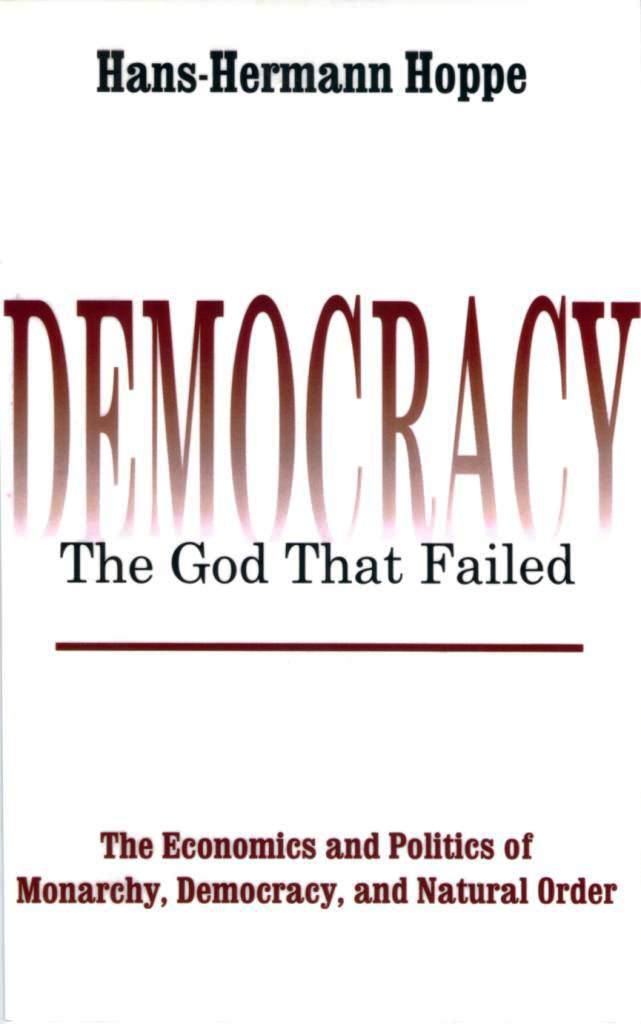




You must log in to post a comment. Log in now.